Page 183 of 324
bags, rags, floor mats -- anything you can wrap around
yourself or tuck under your clothing to keep warm.
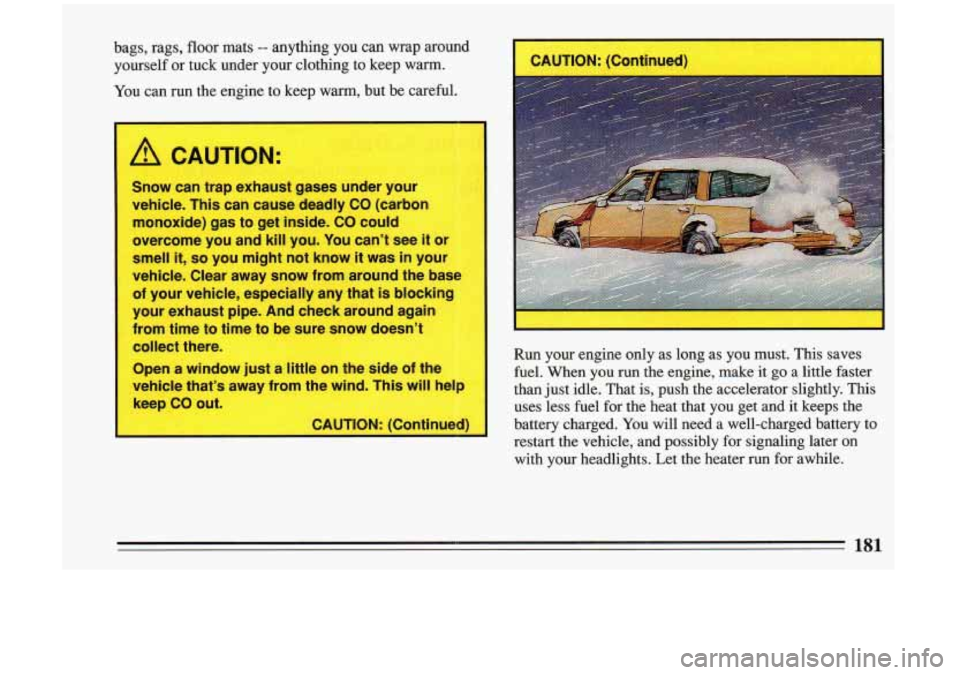
You can run the engine to keep warm, but be careful.
Snow can trap exhaust gases under your
vehicle. This can cause deadly CO (carbon
monoxide) gas to get inside. CO could
overcome you and kill you. You can’t see
it or
smell it,
so you might not know it was in your
vehicle. Clear away snow from around the ba
!
of your vehicle, especially any that is blocking
your exhaust pipe- And check ar
from time to time to be sure snow
collect there.
Open a window just a little on the side of the
vehicle that’s away from the wind. This
will heir
keep CO out.
I CAUTION: (Continued)
Run your engine only
as long as you must. This saves
fuel. When you run the engine, make
it go a little faster
than just idle. That is, push the accelerator slightly.
This
uses less fuel for the heat that you get and it keeps the
battery charged. You will need a well-charged battery to
restart the vehicle, and possibly for signaling later on
with your headlights. Let the heater run for awhile.
181
Page 186 of 324
Hazard Warning Flashers
c
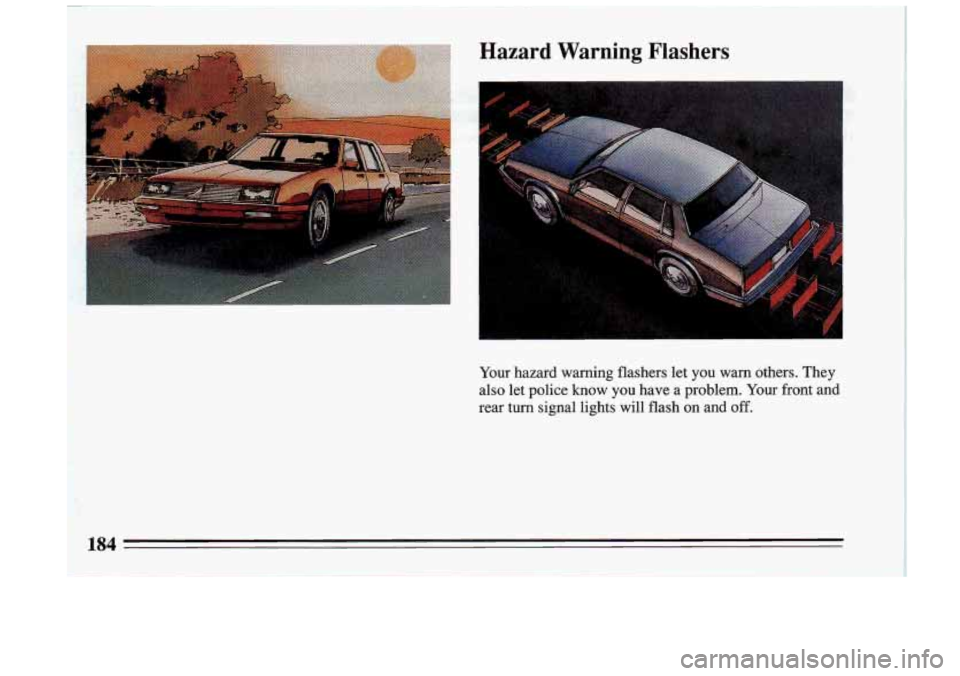
Your hazard warning flashers let you warn others. They
also let police know you have a problem. Your front and
rear turn signal lights will flash on and
off.
Page 187 of 324
I
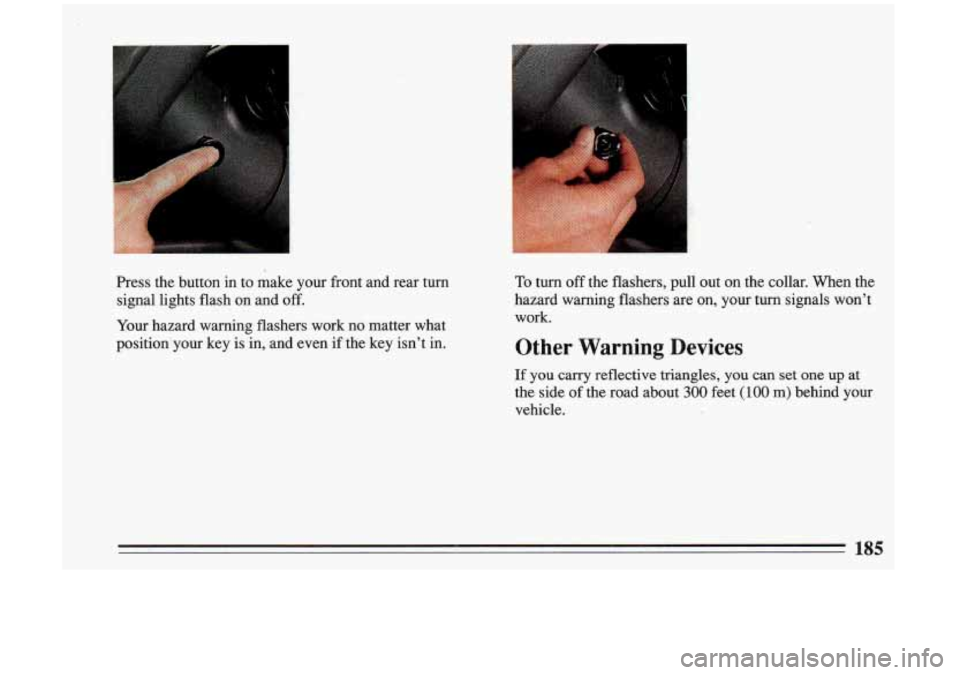
Press the button in to make your front and rear turn
signal lights flash on and
off.
Your hazard warning flashers work no matter what
position your key is in, and even
if the key isn't in.
To turn off the flashers, pull out on the collar. When the
hazard warning flashers are on, your
turn signals won't
work.
Other Warning Devices
If you carry reflective triangles, you can set one up at
the side
of the road about 300 feet (100 m) behind your
vehicle.
185
Page 189 of 324
I A CAUTION:
u could be injured if the vehicles roll. Set the
arking brake firmly on each vehicle. Put an
utomatic transaxle
in “P” (Park) or a manual
axle
in “N” (Neutral).
P
3. Turn off the ignition on both vehicles. Turn off all
lights that aren’t needed, and radios. This
will avoid
sparks and help save both batteries. And it could
save your radio!
4. Open the hoods and locate the batteries.
I A CAUTION:
An electric fan can start up even when the
engine is not running and can injure you. Keep
hands; clothing and tools away from any
underhood electric fan.
~~
Find the positive .(+) and negetive (-), terminals on
each battery.
Page 190 of 324
A CAUTION:
Using a match near a battery can cause battery
gas to explode. People have been hurt doing
this, and some have been blinded. Use a
flashlight if you need more
light.
Be sure the battery has enough water. You don’t
need to add water to the Delco Freedom@
battery installed
in every new GM vehicle. But if
a battery has filler caps, be sure the right
amount of fluid
is there. If it is low, add water to
take care of that first. If you don’t, explosive gas
could be present.
Battery fluid contains acid that can burn you.
Don’t get
it on you. If you accidentally get it in
your eyes or on your skin, flush the place with
water and get medical help immedia
y.
1 5. Check that theJumper cames don’t have loose wr
missing insulation. If they do, you could get a shock.
The vehicles could be damaged, too. Before
you connect the cables, here are some things
you should know. Positive (+) will go to positive (+)
and negative (-) will go to negative (-) or
a metal
engine part. Don’t connect
(+) to (-) or you’ll get a
short that would damage the batterv and maybe other
parts, too.
A CAUTION:
Fans or other moving engine parts can injure
you badly. Keep your hands away from moving
parts once the engines are
running.
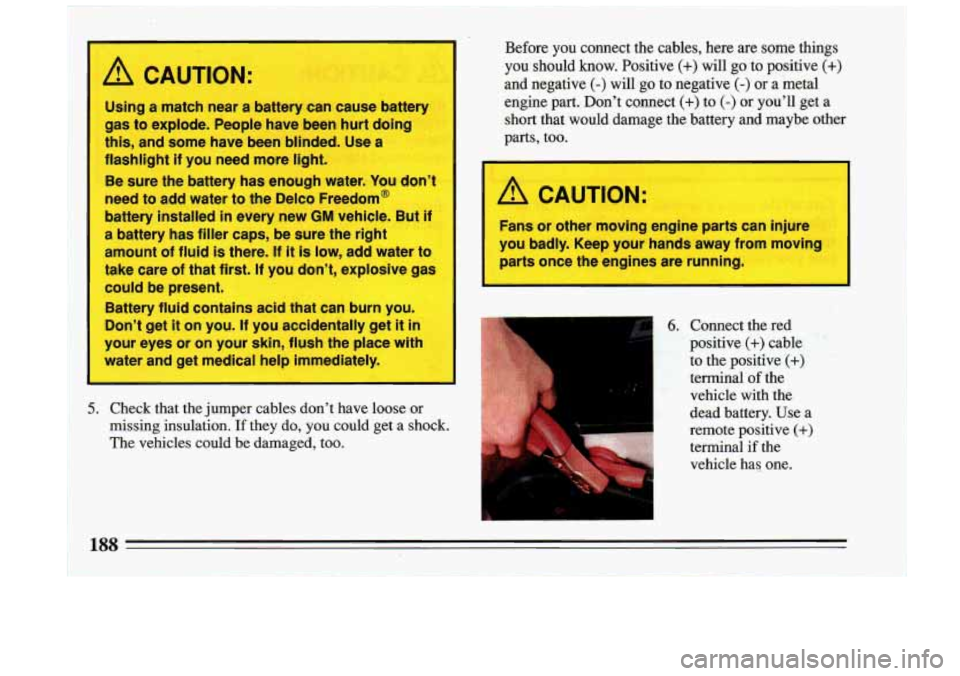
6. Connect the red
positive
(+) cable
to the positive
(+)
terminal of the
vehicle with the
dead battery. Use a
I * ;,* remote positive (+) , . ”, . , ,, ,, terminal if the &&>>;&,3; ,, , ,, ~
vehicle has one.
Page 198 of 324
Engine Overheating
You willi find a coolant temperature gage and the
warning light about a hot engine on your Buick
instrument panel.
If Steam Is Coming From Your Engine:
I
A CAUTION:
Steam from an overheated engine can burn you
badly, even if you just open the hood. Stay away
from the engine if you see or hear steam
coming from
it. Just turn it off and get everyone
away from the vehicle until
it cools down. Wait
until there is no sign of steam or coolant before
opening the hood.
If you keep driving when your engine is
overheated, the liquids in it can catch fire. You
or others could be badly burned. Stop your
engine if
it overheats, and get out of the vehicle
until the engine is cool.
If No Steam Is Coming From Your Engine:
If you get the overheat warning but see or hear no
steam, the problem may not be too serious. Sometimes
the engine can get a little too hot when you:
Climb a long hill on a hot day.
Stop after high speed driving.
Id.le for long periods in traffic.
If you get the overheat warning with no sign of steam,
try this for a minute or
so:
1. Turn off your air conditioner.
2. Turn on your heater to full hot at the highest fan
3. Try to keep your engine under load (in a drive gear
speed and open the window as necessary.
where the engine runs slower).
Page 214 of 324
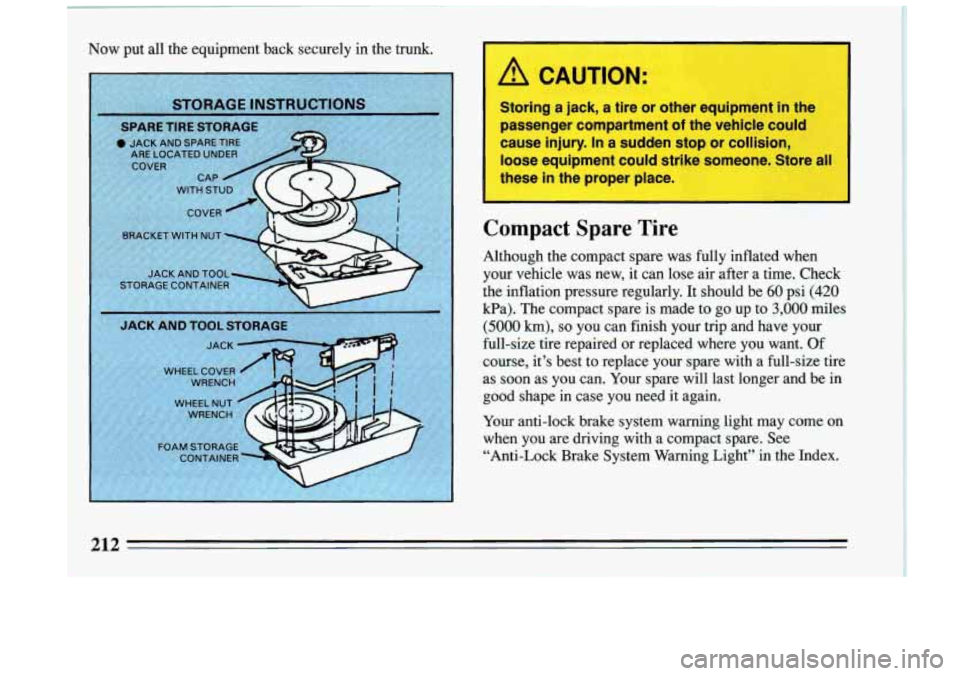
Now put all the equipment back securely in the trunk.
Compact Spare Tire
Although the compact spare was fully inflated when
your vehicle was new, it can lose air after a time. Check
the inflation pressure regularly. It should be
60 psi (420
kPa). The compact spare is made to go up to 3,000 miles
(5000 km), so you can finish your trip and have your
full-size tire repaired or replaced where you want.
Of
course, it’s best to replace your spare with a full-size ti\
re
as soon as you can. Your spare will last longer and be in
good shape in case you need it again.
Your anti-lock brake system warning light may come on
when you are driving with a compact spare. See
“Anti-Lock Brake System Warning Light” in the Index.
212
Page 233 of 324
are made especially for your automatic transaxle.
Damage caused by fluid other than
DEXRONs-IIE is
not covered by your new vehicle warranty.
After adding fluid, recheck the fluid level as
described under
“How to Check.”
When the correct fluid level is obtained, push the
dipstick back in all the way.
Engine Coolant
The following explains your cooling system and how to
add coolant when it is low. If you have a problem with
engine overheating, see “Engine Overheating” in the
Index.
The proper coolant for your Buick
will:
Give freezing protection down to -34’F (-37 ’ C) .
0 Give boiling protection up to 262 ’ F ( 128 ’ C) .
Protect against rust and corrosion.
Help keep the proper engine temperature.
0 Let the warning lights work as they should.
What to Use:
Use a mixture of one-half clean water (preferably
distilled) and one-half antifreeze that meets “GM Specification 1825-M,” which won’t damage aluminum
parts. Use GM Engine Coolant Supplement (sealer) with
any complete coolant change. You can also use a
recycled coolant conforming to “GM Specifications
1825-M” with a complete coolant flush and-refill.
If you
use these, you don’t need to add anything else.
Adding only plain water to your cooling system
can be dangerous. Plain water, or some other
liquid like alcohol, can boil before the proper
coolant mix will. Your vehicle’s coolant warnin!
system
is set for the proper coolant mix. With
plain water or the wrong mix, your engine coul
get
too hot but you wouldn’t get the overheat
warning. Your engine could catch fire and you
or others could be burned. Use a
50150 mix of
clean water and
a proper antifreeze.
231