Page 73 of 324
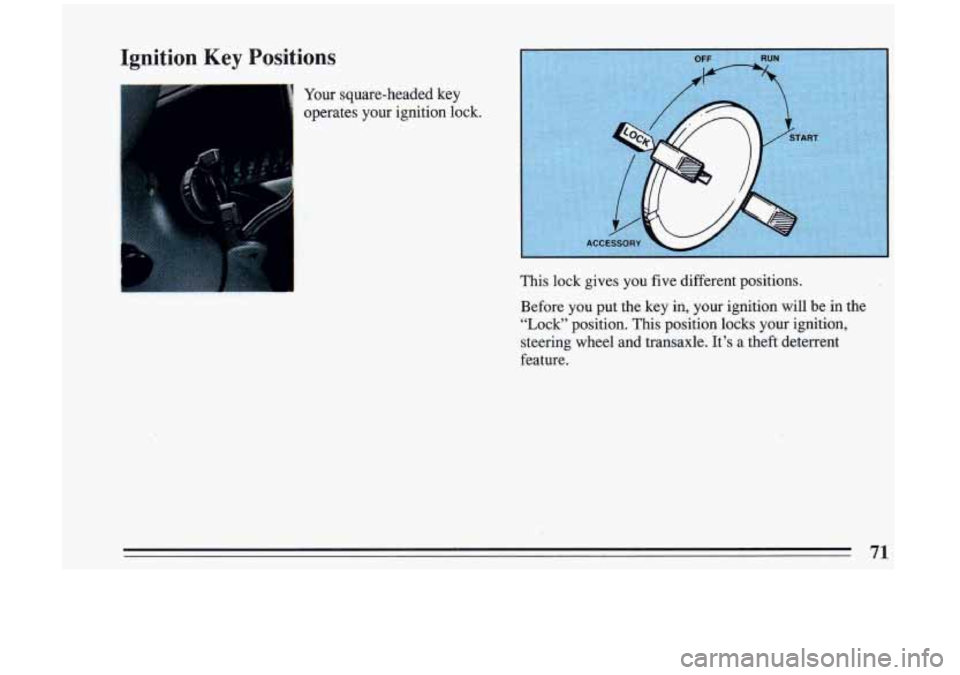
Ignition Key Positions
Your square-headed key
operates your ignition lock.
71
Page 74 of 324
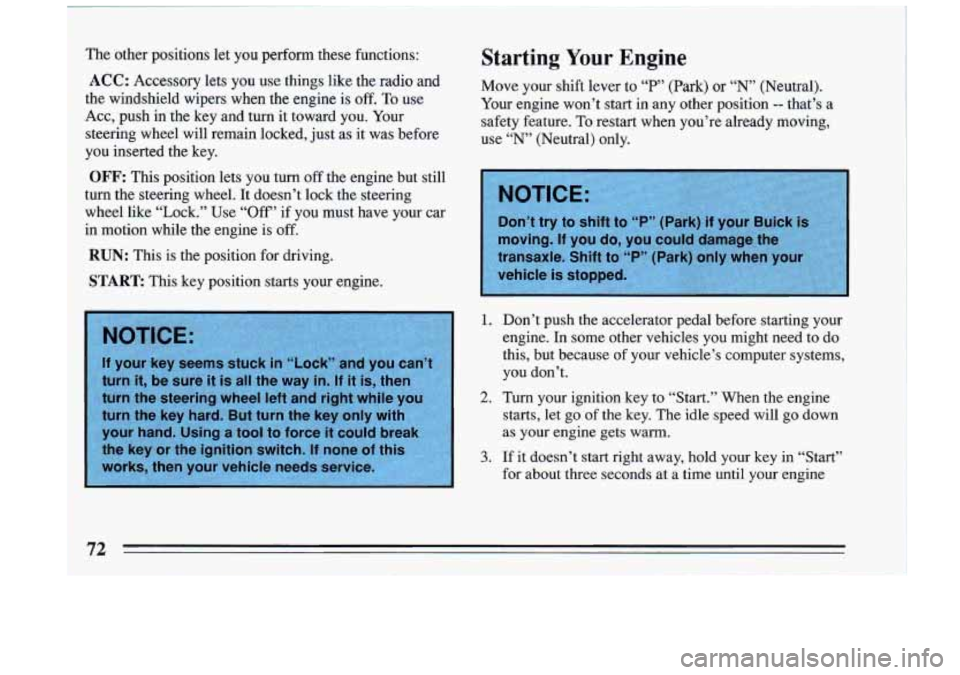
Starting Your Engine The other positions let you perform these functions:
ACC: Accessory lets you use things like the radio and
the windshield wipers when the engine is
off. To use
Acc, push
in the key and turn it toward you. Your
steering wheel will remain locked, just as it was before
you inserted the key.
OFF: This position lets you turn off the engine but still
turri the steering wheel. It doesn’t lock the steering wheel like “Lock.” Use “Off’ if you must have your car
in motion while the engine is off.
RUN: This is the position for driving.
START This key position starts your engine. Move your shift lever
to “P,’ (Park) or “N’ (Neutral).
Your engine won’t start in any other position
-- that’s a
safety feature, To restart when you’re already moving,
use
“N” (Neutral) only.
1. Don’t push the accelerator pedal before starting your
engine.
In some other vehicles you might need to do
this, but because of your vehicle’s computer systems,
you don’t.
starts, let go of the key. The idle speed will go down
as your engine gets warm.
3. If it doesn’t start right away, hold your key in “Start”
for about three seconds at a time until your engine
2. Turn your ignition key to “Start.” When the engine
72
Page 77 of 324
Automatic- Transaxle
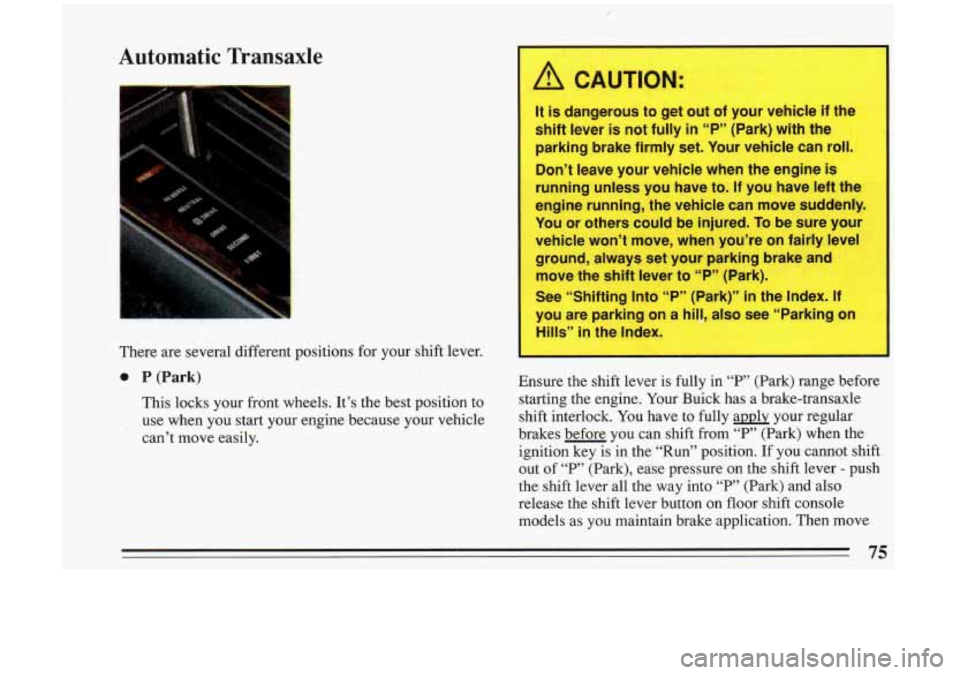
There are SL . dral different positions for your shift lever.
0 P (Park)
This locks your front wheels. It’s the best position to
use when you start your engine because your vehicle
can’t move easily.
A CAU ION:
It is dangerous to get out of your vehicle if the
shift lever
is not fully in “P” (Park) with the
parking brake firmly set. Your vehicle can roll.
Don’t leave your vehicle when the engine
is
running unless you have to. If you have left the
engine running, the vehicle can move suddenly.
You or others could be injured.
To be sure your
vehicle won’t move, when you’re on fairly level
ground, always set your parking brake and move the shift lever to “P” (Park).
See “Shifting Into “P” (Park)”
in the Index. If
you are parking on a hill, also see “Parking on
Hills” in the Index.
L
Ensure the shift lever is fully in “P’ (Park) range before
starting the engine. Your Buick has a brake-transaxle
shift interlock. You have to fully apply your regular
brake.s before you can shift from
“P’ (Park) when the
ignition key is in the “Run” position. If you cannot shift
out of
“P’ (Park), ease pressure on the shift lever - push
the shift lever all the way into “P” (Park) and also
release the shift lever button on floor shift console models as you maintain brake application. Then move
75
Page 82 of 324
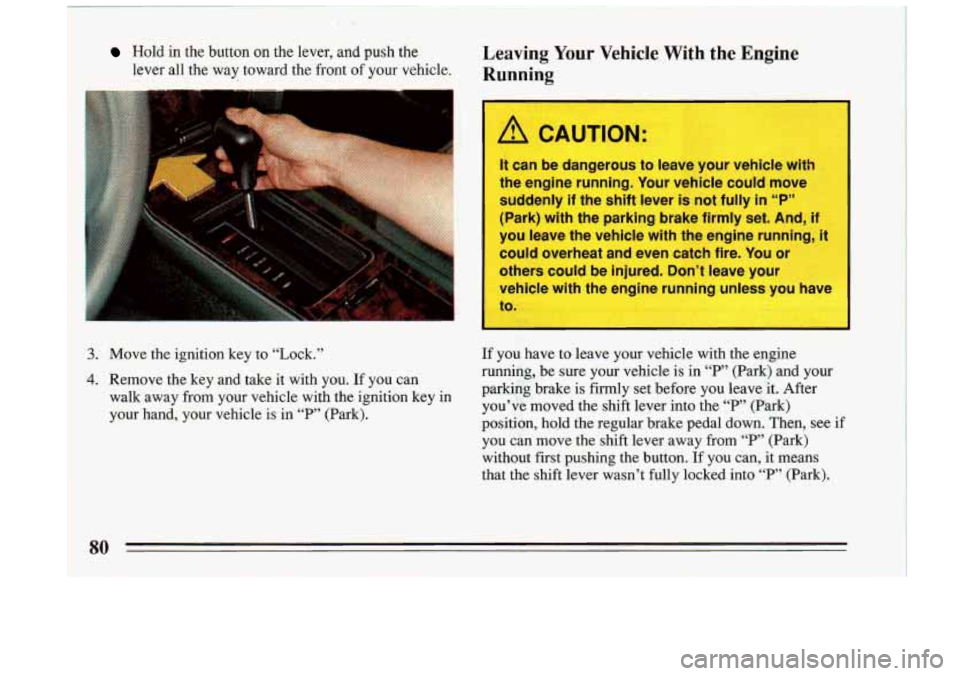
Hold in the button on the lever, and push the Leaving Your Vehicle With the Engine
I lever all the way toward the front of your vehicle. Running
3. Move the ignition key to “Lock.”
4. Remove the key and take it with you. If you can
walk away from your vehicle with the ignition key in
your hand, your vehicle is in
“P)’ (Park).
A CAUTION:
It can be dangerous to leave your vehicle with
the engine running. Your vehicle could move
suddenly
if the shift lever is not fully in “P”
(Park) with the parking brake firmly set. And,
if
you leave the vehicle with the engine running, it
could overheat and even catch fire. You or
others could be injured. Don’t leave your
vehicle with the engine running unlesr --ou have
to.
I
If you. have to leave your vehicle .with the engine
running, be sure your vehicle is in
“P” (Park) and your
parking brake is firmly set before
you leave it. After
you’ve moved the shift lever into the
“P” (Park)
position, hold the regular brake pedal down. Then, see if
you can move the shift lever away from “P,’ (Park)
without first pushing the button.
If you can, it means
that the shift lever wasn’t fully locked into
T“ (Park).
so
Page 83 of 324
Shifting Out of 66 P 99 (Park)
Your Buick has a brake-transaxle shift interlock. You
have to fully applv your regular brake before you can
shift
from “P” (Park) when the ignition is in the “Run”
position. See “Automatic Transaxle” in the Index.
If you cannot shift out of
“P” (Park), ease pressure on
the shift lever
-- push the shift lever all the way into “P”
(Park) and also release the shift lever button on floor
shift console models as you maintain brake application.
Then move the shift lever into the gear you wish. (Press
the shift lever button before moving the shift lever.)
If
you ever hold the brake pedal down but still can’t shift
out
of “P” (Park), try this:
1.
2.
3.
4.
5.
Turn the key to “Off.” Open and close the driver’s
door to turn off the Retained Accessory Power
feature.
Apply and hold the brake until the end
of Step 4.
Shift to “N” (Neutral).
Start the vehicle and then shift to the drive gear you
want.
Have the vehicle fixed as soon as you can.
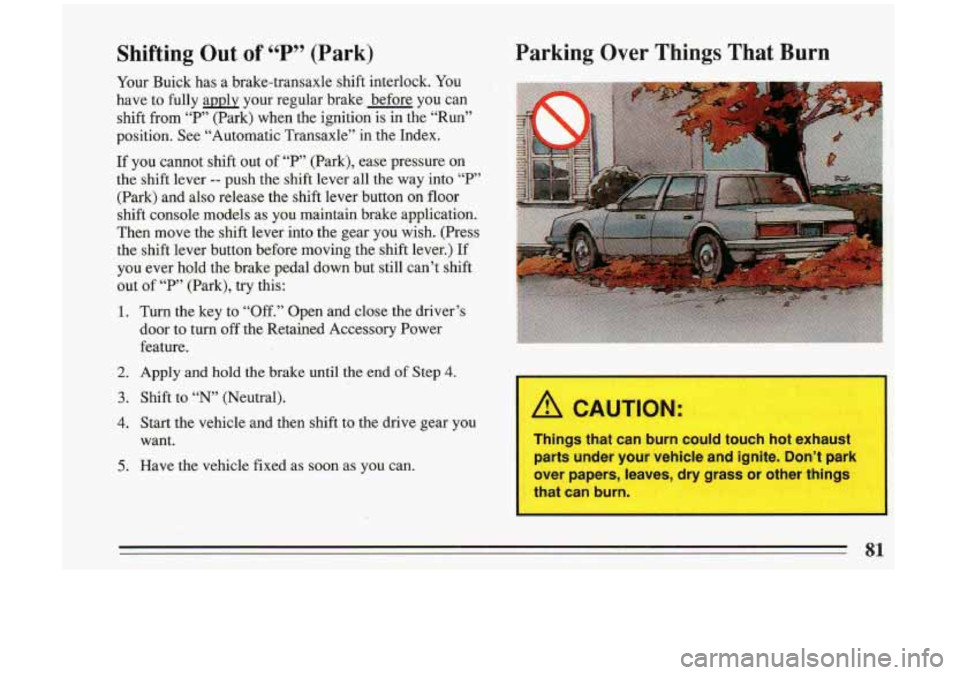
Parking Over Things That Burn
; CAUTION:
Things that can burn could touch hot exhaust
parts under your vehicle and ignite. Don’t park
over papers, leaves,
dry grass or other things
that can burn.
81
Page 109 of 324

Trip Odometer
I
Warning Lights, Gages and Indicators
A trip odometer can tell you
how many miles you have Warning lights and gages can signal t\
hat something is
driven since you last set it wrong before it becomes serious enough to cause an
back to zero.
TO reset, push expensive repair or replacement. Paying attention to
the button. your warning lights and gages could also save you or
others from injury.
Warning lights go on when there may be or
is a problem
with one
of your vehicle's functions. As you will see in
the details on the next few pages, some warning lights come on briefly when you turn the ignition key just to
let you know they're working.
If you are familiar with
this section, you should not be alarmed when this
happens.
This section describes the warning lights and gages that
are on your vehicle. The pictures will help
you locate
them. Gages can indicate when there may be or is a problem
with one
of your vehicle's functions. Often gages and
warning lights work together to let you know when
there's a problem with your vehicle.
When one of the warning lights comes on and stays on
when you are driving, or when one of the gages shows
there may be a problem, check the section that tells
you
what to do about it. Please follow the manual's advice.
Waiting to do repairs can be costly
-- and even
dangerous.
So please get to know your warning lights
and gages. They're a big help.
107
Page 112 of 324
Volts Gage and Light
c 1
Tachometer
When you turn the key to “Run,” the “LOW’ light will The tachometer tells you how fast the engine is go\
ing. It
come on briefly, to show that your alternator and battery disp\
lays engine speed
in revolutions per minute (RPM).
charging systems are working. If a light stays on, you As engine speed increases, the bars light up on the
need service, and you should take your Buick to the tachometer\
display. Each bar represents
100 RPM. Do
dealer at once. To save your battery until you get there, not operate your car’\
s engine in the red line range. If
turn
off all accessories, and set your air system to you do, you can cause severe engine damage.
“OFF.”
110
Page 114 of 324
Anti-Lock Brake System Warning Light
1
I’
i
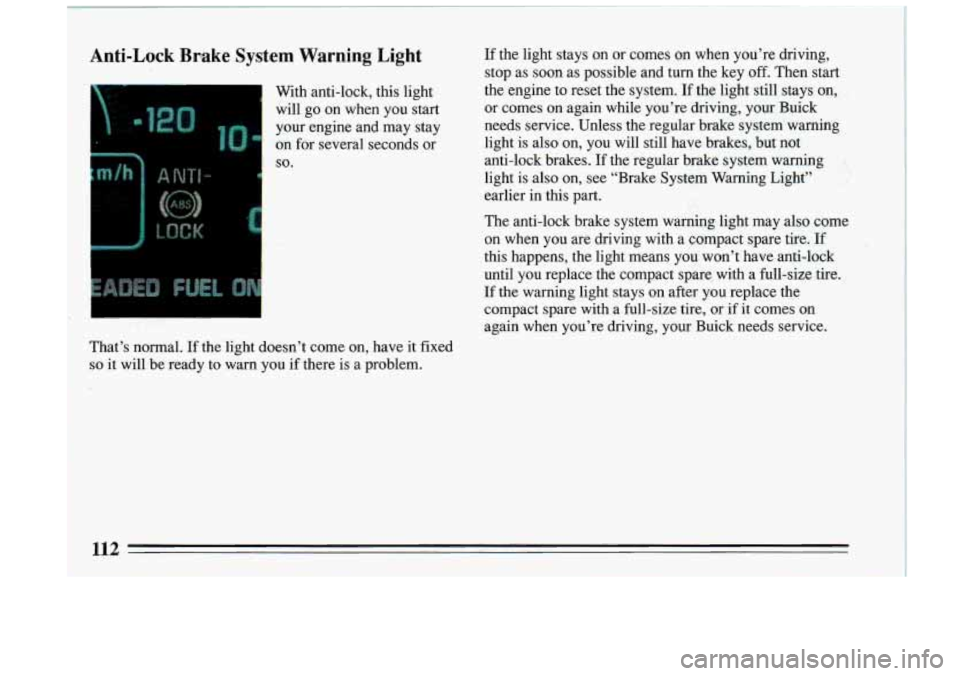
If the light stays on or comes on when you’re driving,
stop as soon as possible and turn the key off. Then start
With anti-lock, this light the engine to reset the system.
If the light still stays on,
will go on when you start or comes on again while you’re driving, your Buick
your engine and may stay needs service. Unless the regular brake system’ warning
on for several seconds or light is also on, you will still have brakes, but not
so. anti-lock brakes.
If the regular brake system warning
light
is also on, see “Brake System Warning Light”
earlier in this part.
The anti-lock brake system warning light may also come on when you are driving with
a compact spare tire. If
this happens, the light means you won’t have anti-lock
until you replace the compact spare, with a full-size tire.
If the warning light stays on after you replace the
compact spare with
a full-si.ze tire, or if it comes on
again when you’re driving, your Buick needs service.
That’s normal.
If the light doesn’t come on, have it fixed
~ so it will be ready to warn you if there is a problem.
112