1993 BUICK REGAL flat tire
[x] Cancel search: flat tirePage 11 of 308
HowtoUsethisManual ................................................................ 10
Seats and Safety Belts
. . . . . . . . . . . . . . . . . . . . . . . . . . . . . . . . . . . . . . . . . . . . . . . . . . *. . . . . *. . . . . . . . 13
FeaturesandControls
.................................... ............................... 57
Comfort Controls and Audio Systems . . . . . . . . . . . . . . . . . . . . . . . . . . . . . . . . . . . . . . . . . . . . . . . . I.. . I 109
YourDrivingandtheRoad
.............0.0..........s...................................... 127
ProblemsontheRoad
.................................................................. 177
Service and Appearance Care..
. . . . . . . . . . . . e . . . . . . . . . . . . . . . . . . . . . . . . . . . . . . . . . . . . . . . . . . 213
Maintenanceschedule
.................................................................. 265
Customer Assistance Information
. . . . . . . . . . . . . . . . . . . . . . . . . . . . . . . . . . . . . . . . . . . . . . . . . . . . . . . . 285
This part tells you how to use your manual and includes safety and vehicle damage warnings & symbols. 13
This part tells you how to use your seats and safety belts properly.
This part explains how
to start and operate your Buick.
This part tells you how to adjust the ventilation
& comfort controls and how to operate your sound system.
Here you’ll find helpful information and tips about the road and how
to drive under different conditions.
This part tells you what
to do if’ you have a problem while driving, such as a flat tire or engine overheatins.
Here the manual tells you how to keep your Buick running properly and looking good.
This part tells you when
to perf’orm vehicle maintenance and what fluids and lubricants to use.
This part tells you how to contact Buick for assistance and how
to get service publications. It also gives
you information on “Reporting Safety Defects” on page
287.
Here’s an alphabetical listing of almost every subject in this manual. You can use it to quickly find
something you want to read.
Index ........................................................................\
........ 293
9
ProCarManuals.com
Page 161 of 308
Driving a Long Distance
Although most long trips today are made on freeways,
there are still many made on regular highways.
Long-distance driving on freeways and regular
highways is the same in some ways. The trip has to be
planned and the vehicle prepared,
you drive at
higher-than-city speeds, and there are longer turns
behind the wheel. You’ll enjoy your trip more if you and
your vehicle are in good shape. Here are some tips for a
successful long trip.
Before Leaving on a Long Trip
0
0
0
0
0
0
Make sure you’re ready. Try to be well rested. If you
must start when you’re not fresh -- such as after a day’s
work
-- don’t plan to make too many miles that first part
of the journey. Wear comfortable clothing and shoes you
can easily drive
in.
Is your vehicle ready for a long trip? If you keep it
serviced and maintained, it’s ready to go.
If it needs
service, have it done before starting out. Of course,
you’ll find experienced and able service experts in
Buick dealerships all across North America. They’ll be
ready and willing to help
if you need it.
Here are some things you can check before a trip:
0
Windshield Washer Fluid: Is the reservoir full? Are
all windows clean inside and outside?
Wiper Blades: Are they in good shape?
Fuel, Eng;ine Oil, Other Fluids: Have you checked
all levels?
Lights: Are they all working? Are the lenses clean?
- Tires: They are vitally important to a safe,
trouble-free trip.
Is the tread good enough for
long-distance driving? Are the tires all inflated to the
recommended pressure?
Weather Forecasts: What’s the weather outlook
along your route? Should you delay your trip a short
time to avoid a major storm system?
Maps:
Do you have up-to-date maps?
On the Road
Unless you are the only driver, it is good to share the
driving task with others. Limit turns behind
the wheel to
about
100 miles (160 km) or two hours at a sitting.
Then, either change drivers or stop for some refreshment
like coffee, tea or soft drinks and some limbering up.
But do stop and move around. Eat lightly along the way.
Heavier meals tend
to make some people sleepy.
159
ProCarManuals.com
Page 174 of 308
curb weight of the vehicle, any cargo you may carry in Total Weight on Your Vehicle’s Tires
it, and the people who will be riding in the vehicle. And
if you will tow a trailer, you must subtract the tongue
load from your vehicle’s capacity weight because your
vehicle will be carrying that weight, too. See “Loading
Your Vehicle” in the Index for more information about
your vehicle’s maximum load capacity.
-
Be sure your vehicle’s tires are inflated to the limit for
cold tires. You’ll find these numbers on the Certification
label at the rear edge of the driver’s door (or see “Tire
Loading’’ in the Index). Then be sure you don’t go over
the GVW limit €or your vehicle.
Hitches
It’s important to have the correct hitch equipment.
Crosswinds, large trucks going by, and rough roads are a
few reasons why you’ll need the right hitch. Here are
some rules to follow:
0
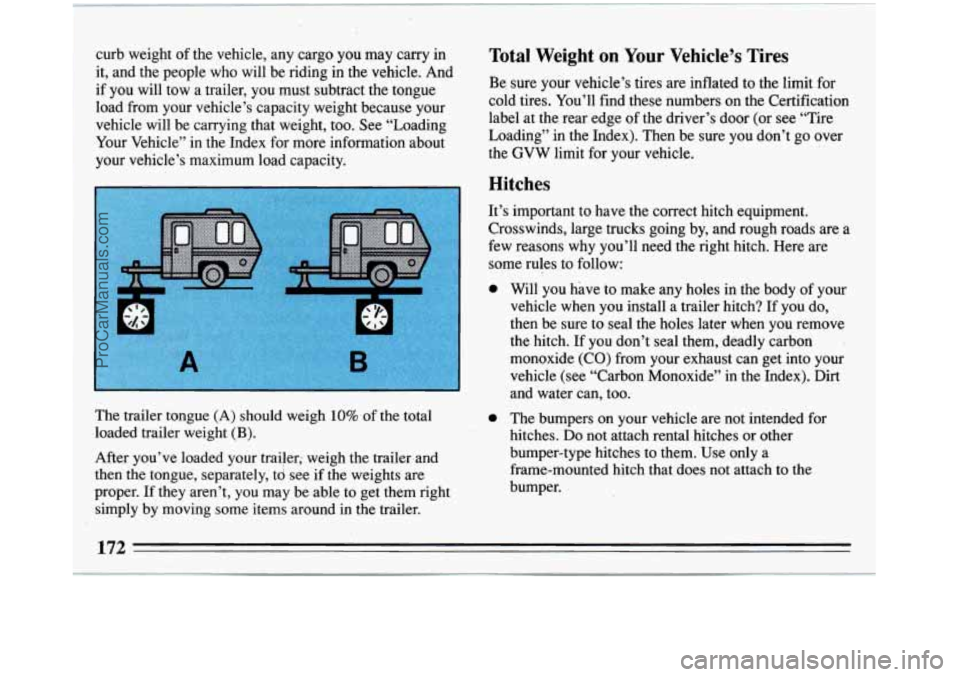
The trailer tongue (A) should weigh 10% of the total
,loaded trailer weight
(B).
After you’ve loaded your trailer; weigh the trailer,and
then the tongue, separately,
td see if the weights are
proper.
If they aren’t, you may be able to get them right
simply by moving some items around in the trailer.
0
Will you have to make any holes in the body of your
vehicle when you install a trailer hitch? If you do,
then be sure to seal the holes later when you remove
the hitch.
If you don’t seal them, deadly carbon
monoxide (CO) from your exhaust can get into your
vehicle (see “Carbon Monoxide’’ in the Index). Dirt
and ‘water can, too:
The bumpers on your vehicle are not intended for
hitches.
Do not attach rental hitches or other
bumper-type hitches to them. Use only a
frame-mounted hitch that does not attach to the
bumper.
172
ProCarManuals.com
Page 179 of 308
Part 5 Problems On The Road
Here you’ll find what to do about some problems that can occur on the road .
Part 5 includes:
Hazard Warning Flashers
........................................................
QtherWarningDevices .........................................................
“Jump”Starting ...............................................................
TowingYourBuick ............................................................
Engineoverheating ............................................................
IfaTireGoesFlat .............................................................
ChangingaFlatTire ............................................................
CompactSpareTire ............................................................
If You’re Stuck in Sand, Mud, Ice or Snow ..........................................
...
...
...
...
...
...
...
...
...
178
179
180
185
192
201
201
210
211
ProCarManuals.com
Page 203 of 308
If a Tire Goes Flat
It’s unusual for a tire to “blow out” while you’re driving,
especially if you maintain your tires properly. If air goes
out
of a tire, it’s much more likely to leak out slowly.
But if
you should ever have a “blowout,” here are a few
tips about what to expect and what
to do:
If a front tire fails, the flat tire will create a drag that
pulls the vehicle toward that side. Take your foot off
the
accelerator pedal and grip the steering wheel firmly.
Steer
to maintain lane position, then gently brake to a
stop well out
of the traffic lane.
A rear blowout, particularly on a curve, acts much like a
skid and may require the same correction you’d use in a
skid. In any rear blowout, remove your foot fromthe
accelerator pedal. Get the vehicle under control by
steering the way you want the vehicle to go. It may be
very bumpy and noisy, but you can still steer. Gently
brake to a stop, well
off the road if possible.
If your tire goes flat, the next section shows how to use
your jacking equipment to change a flat tire safely.
Changing a Flat Tire
If a tire goes flat, avoid further tire and wheel damage
by driving slowly
to a level place. Turn on your hazard
warning flashers.
A CAUTION:
Changing a tire can cause an injury. The vehicle
can slip off the jack and roll over you or other
people. You and they could be badly injured. Find
a level place to change your tire. TO help prevent
be
! licle from moving:
. the parking brake firmly.
L. Put the shift lever in “P” (Park).
3. Turn off the engine.
To be even more certain the vehicle won’t move,
you can put chocks at the front and rear of
th
tire farthest away from the one being ehangec
That would be the tire
on the other side nG the
vehicle, at the
opposit- md. ;
201
ProCarManuals.com
Page 207 of 308

m
Position the jack under
the vehicle.
Your Buick
has
a notch on the
frame near each
of the
wheels. Fit the lift head
into the notch nearest
the wheel with the flat
1 tire.
Raising your vehicle with the jack improperly
positioned will damage the vehicle
or may allow
the vehicle to fall off the jack. Be sure to
fit the
jack
lift head into the proper location before
raising your vehicle.
,etting under a vehicle when
it is jacked up is
dangerous. If the vehicle slips off the jack, you
could be badly injured or killed. Never get undel
I vehicle when is supported only bv a iack.
Raise the vehicle by rotating the wheel wrench
clockwise.
Raise the vehicle far enough off the ground
so there is enough room for the spare tire to fit.
205
ProCarManuals.com
Page 208 of 308
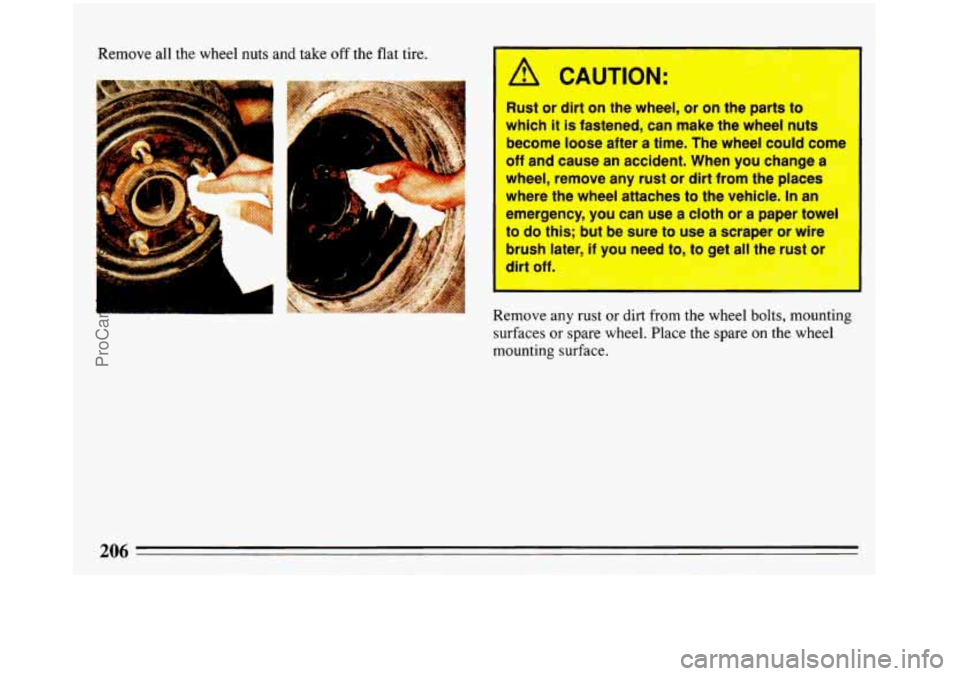
Remove all the wheel nuts and take off the flat tire.
iP
A CAUTION:
Rust or dirt on the wheel, or on rne parts to
which it is fastened, can make the wheel nuts
become loose after
a time. The wheel could come
off and cause an accident. When you change a
wheel, remove any rust or dirt from the places
where the wheel attaches to the vehicle.
In an
emergency, you can
use a cloth or a paper towel
to
do this; but be sure to use a scraper or wire
brush later,
if you need to, to get all the rust or
dirt off.
Remove any rust or dirt from the wheel bolts, mounting
surfaces
or spare wheel. Place the spare on the wheel
mounting surface.
206
ProCarManuals.com
Page 210 of 308
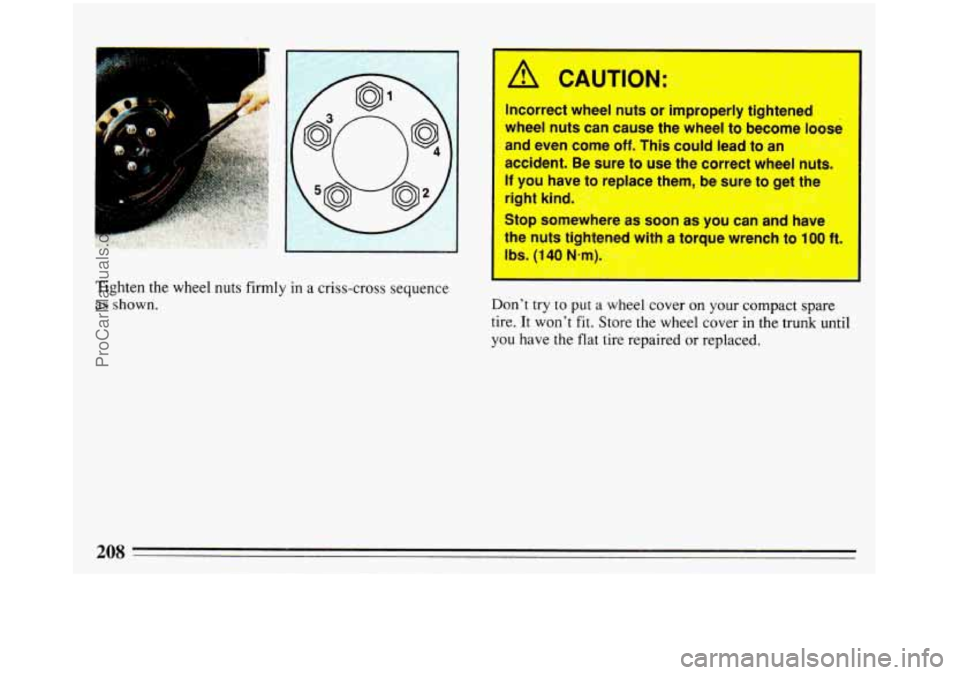
I
Tighten the wheel nuts firmly in a criss-cross sequence
as shown.
1
icorrect wheel nuts or improperly tightened
wheel
nuts can cause the wheel to become loose
and even come
off. This could lead to an @iig$
accident. Be sure to use the correct wheel'nuls
If you have to replace them, be sure to get the
right kind.
I
Stop somewhere as soon as you can and have
the nuts tighten4 with a torque wrench to
100 ftD
Ibs. (lpn N-m). -,
.. -,
Don't try to put a wheel cover on your compact spa.re
tire. It won't
fit. Store the wheel cover in the trunk until
you have the flat tire repaired or replaced.
ProCarManuals.com