1993 BUICK REGAL flat tire
[x] Cancel search: flat tirePage 212 of 308
A CAUTION:
Storing a jack, a tire or other equipment in the
passenger compartment
of the vehicle could
cause injury.
In a sudden stop or collision, loose
equipment could strike someone. Store all these
in the p-per place.
I
Compact Spare Tire
Although the compact spare was fully inflated when
your vehicle was new, it can lose air after a time. Check
the inflation pressure regularly. It should be
60 psi
(420 kPa). The compact spare is made to go up to 3,000
miles (5000 km), so you can finish your trip and have
your full-size tire repaired or replaced where you want.
Of course, it's best to replace your spare with a full-size
tire as
soon as you can. Your spare will last longer and
be in
good shape in case you need it again.
Your anti-lock brake system warning light may come
on
when you are driving with a compact spare. See
"Anti-Lock Brake System Warning Light"
in the Index.
NOTICE:
' Don't take your compact spare through an
automatic car wash with guide rails. The
compact spare can get caught
on the rails. Tha
can damage the tire and wheel, and maybe other
parts of your vehicle.
. :s:; ?<,. $3 I "' .. x. , ., . ", ,**~. I , z .. . . ... . ." . ..--;i.~""*rSl~~,~"." ~.~=:~~~~;~~~~;~,.~:,,~~~~~
Don't use your compact spare on some other vehicle.
And don't mix your compact spare or wheel with other
wheels
or tires. They won't fit. Keep your spare and its
wheel together.
Tire chains won't fit your compact spare. Using
them will damage your vehicle and destroy the
chains too. Don't use tire chains on your
g g*
compact spare. :&
s,,.-T +.?;:a: I--- b i ,, 2s: 7,' : *&".;&&;< S? ,.:~ 'p *. . yp& '?gPS ..ar.,%: __ . .,., _, < . '*Y ., .: ~ ,
ProCarManuals.com
Page 240 of 308
I
4. Pull the bulb straight out to remove it from its
socket. The new bulb must be aligned properly, then
push it in the socket. Reinstall the socket, taillight,
and rear trunk trim.
Loading Your Vehicle
OCCUPANTS VEHICLE CAP. WT.
TIRE-LOADING
INFORMATION
FRT. CTR.
RR. TOTAL LBS. KG
MAX. LOADING
& GVWR SAME AS VEHICLE
CAPACITY WEIGHT XXX COLD TIRE
TIRE SIZE SPEED PRESSURE RTG PSVKPa
FRT.
RR.
SPA. IF TIRES ARE HOT, ADD 4PSV28KPa
SEE OWNER'S MANUAL FOR ADDITIONAL
INFORMATION
ll]m' .$$;i#..:.
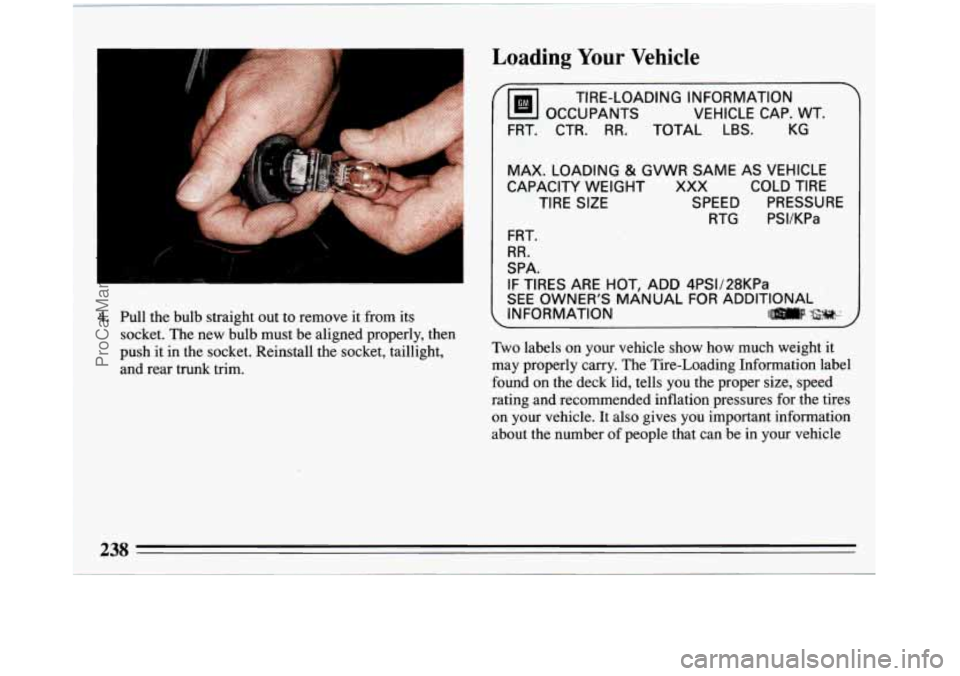
Two labels on your vehicle show how much weight it
may properly carry. The Tire-Loading Information label
found on the deck lid, tells you the proper size, speed
rating and recommended inflation pressures
for the tires
on your vehicle. It also gives you important information
about the number of people that can be in your vehicle
ProCarManuals.com
Page 243 of 308
A CAUTION:
Poorly maintained and improperly used tires are
dangerous.
0
Overloading your tires can cause
overheating as a result
of too much
friction. You could have an air-out and a
serious accident. See “Loading Your
Vehicle”
in the Index.
Underinflated tires pose the same danger
as overloaded tires. The resulting accident
could cause serious injury. Check all tires
frequently to maintain the recommended
pressure. Tire pressure should be checked
when your tires are cold.
Overinflated tires are more likely to be cut,
punctured, or broken by
a sudden impact,
such as when you
hit a pothole. Keep tires
at the recommended pressure.
Worn, old tires can cause accidents.
If your
tread
is badly worn, or if your tires have
been damaged, replace them.
Inflation - Tire Pressure
The Tire-Loading Information label which is on deck lid
shows the correct inflation pressures for your tires, when
they’re cold. “Cold” means your vehicle has been sitting
for at least three hours or driven
no more than a mile.
241
ProCarManuals.com
Page 244 of 308
When to Check: Check your tires once a month or
more.
Don’t forget your compact spare tire. It should be at
60
psi (420 kPa).
How to Check: Use a good quality pocket-type gage to
check tire pressure. Simply looking at the tires will not
tell
you the pressure, especially if you have radial tires --
which may look properly inflated even if they’re
underinflated.
If your tires have valve caps, be sure to put them back
on.
They help prevent leaks by keeping out dirt and
moisture.
Tire Inspection and Rotation
To make your tires last longer, have them inspected and
rotated at the mileages recommended
in the
Maintenance Schedule. See “Scheduled Maintenance
Services”
in the Index.
I
I‘
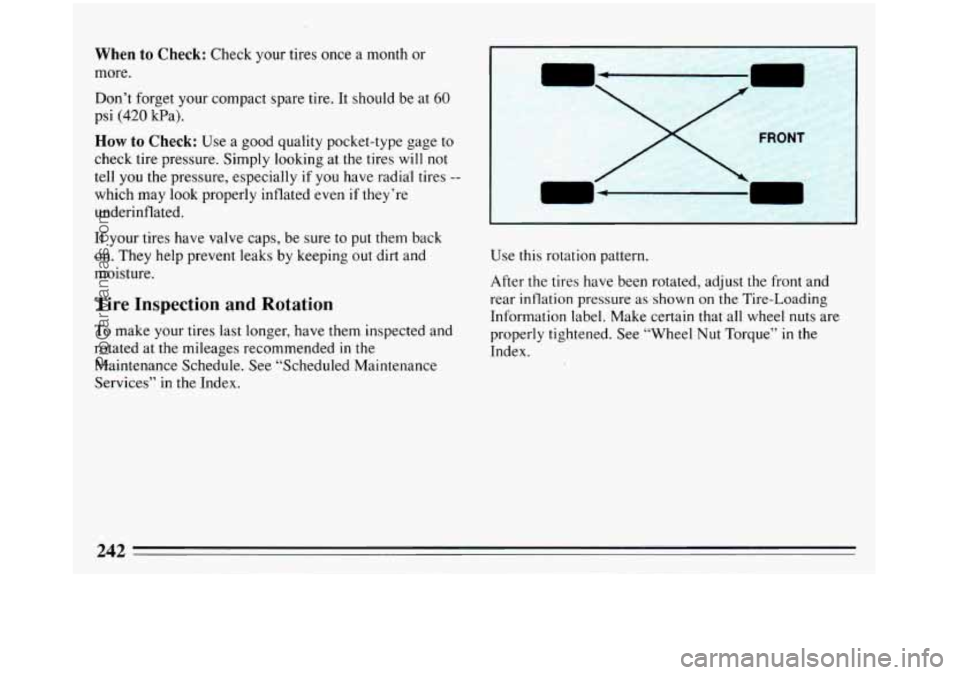
Use this rotation pattern.
After the tires have been rotated, adjust the front and
rear inflation pressure
as shown on the Tire-Loading
Information label. Make certain that all wheel nuts are
properly tightened. See “Wheel Nut Torque”
in the
Index.
242
ProCarManuals.com
Page 245 of 308
A CAW’ON
Rust or dirt on a wheel, or on the parts to which
it is fastened, can make wheel nuts become
loose after a time. The wheel could come off
a-”
cause an accident. When you change a wheel,
remove any rust or dirt from places where the
wheel attaches to the vehicle.
In an emergency,
you can use a cloth
or a paper towel to do this;
but be sure to use a scraper or wire brush later, if
you need to, to get all the rust or dirt off. (See
“nhanging a Flat
in the Index.)
I
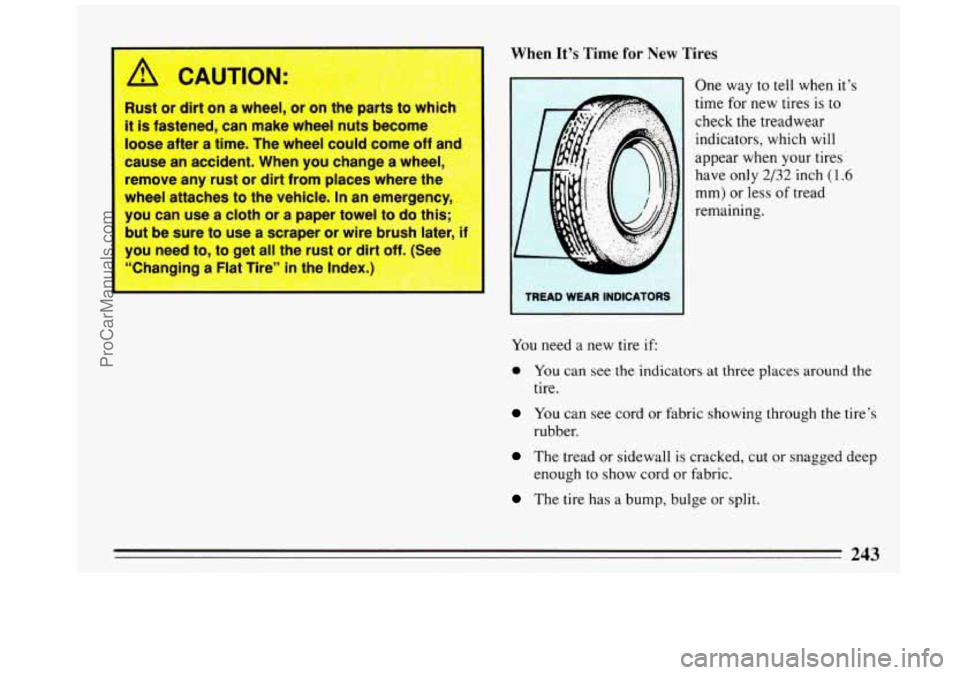
When It’s Time for New Tires
b One wav to tell when it’s r’
time for new tires is to
check
the treadwear
indicators, which will
appear when your tires
have only
2/32 inch (1.6
mm) or less of tread
remaining.
I TREAD WEAR INDICATORS I
You need a new tire if
0 You can see the indicators at three places around the
tire.
You can see cord or fabric showing through the tire‘s
rubber.
The tread or sidewall is cracked, cut or snagged deep
enough to show cord or fabric.
The tire has a bump, bulge or split.
243
ProCarManuals.com
Page 247 of 308
1/2) times as well on the government course as a tire
graded
100. The relative performance of tires depends
upon the actual conditions of their use, however, and
may depart significantly from the norm due to variations
in driving habits, service practices and differences
in
road characteristics and climate.
Traction - A, B, C
The traction grades, from highest to lowest are: A, B,
and C. They represent the tire’s ability to stop on wet
pavement as measured under controlled conditions on
specified government test surfaces of asphalt and
concrete.
A tire marked C may have poor traction
performance.
Warning: The traction grade assigned to this tire
is based
on braking (straight-ahead) traction tests and does not
include cornering (turning) traction.
Temperature - A, B, C
The temperature grades are A (the highest), B, and C,
representing the tire’s resistance to the generation of
heat and its ability to dissipate heat when tested under
controlled conditions on a specified indoor laboratory
test wheel. Sustained high temperature can cause the
material
of the tire to degenerate and reduce tire life, and
excessive temperature can lead to sudden tire failure. The
grade
C corresponds to a level of performance
which all passenger car tires must meet under the
Federal Motor Vehicle Safety Standard
No. 109. Grades
B and A represent higher levels of performance on the
laboratory test wheel than the minimum required by law.
Warning: The temperature grade for this tire
is
established for a tire that is properly inflated and not
overloaded. Excessive speed, underinflation, or
excessive loading, either separately or
in combination,
can cause heat buildup and possible tire failure.
These grades are molded
on the sidewalls of passenger
car tires.
While the tires available
as standard or optional
equipment
on General Motors vehicles may vary with
respect to these grades, all such tires meet General
Motors performance standards and have been approved
for use on General Motors vehicles. All passenger type
(P Metric) tires must conform to Federal safety
requirements
in addition to these grades.
Wheel Alignment and Tire Balance
The wheels on your vehicle were aligned and balanced
carefully at the factory to give
you the longest tire life
and best overall performance.
245
ProCarManuals.com
Page 269 of 308
Your Vehicle and the Environment
Proper vehicle maintenance not only helps to keep your
vehicle in good working condition, but also helps the
environment. All recommended maintenance procedures
are important. Improper vehicle maintenance or the
removal of important components can significantly
affect the quality of the air we breathe. Improper fluid
levels or even the wrong tire inflation can increase the
level of emissions from your vehicle. To help protect
our environment, and to help keep your vehicle in
good
condition, please maintain your vehicle properly.
How This Part is Organized
The remainder of this part is divided into five sections:
“Section
A: Scheduled Maintenance Services” shows
what to have done and how often. Some of these
services can be complex,
so unless you are technically
qualified and have the necessary equipment, you should
let your dealer’s service department or another qualified
service center do these jobs.
e dangerous. In trying to do some jobs, you ca
le seriously injured.
Do your own maintenanc
work only if you have the required know-how and
:he proper tools and equipment for the job.
If you
have any lubt, have a qualified technic’
1 do
the work.
If you are skilled enough to do some work on your
vehicle, you will probably want to get the service
information GM publishes. You
will find a list of
publications and how to get them
in this manual. See
“Service Publications”
in the Index.
“Section B: Owner Checks and Services” tells you what
should be checked whenever you stop for fuel. It also
explains what you can easily do to help keep your
vehicle in good condition.
“Section
C: Periodic Maintenance Inspections” explains
important inspections that your Buick dealer’s service
department or another qualified service center should
perform.
267
ProCarManuals.com
Page 279 of 308
At Least Once A Month
CHECK OR
SERVICE
Tire Inflation
WHAT TO DO
Check tire inflation. Make sure they
are inflated
to the pressures specified
on the Tire-Loading Information
label located on the rear edge of
the
driver’s door. See “Tires” in the
Index for further details.
c!%&lkY 1 --“-+
Starter Switch
At Least Once A Year
I CHECKOR
SERVICE
I WHAT TO DO
Key Lock
the lubricant specified in Section
D. Cylinders Lubricate the
key lock cylinders with
Body
Lubrication Lubricate all
body door hinges.
Also
lubricate all hinges and latches,
including those for the hood, glove
box door and console door. Section
D tells you what to use.
1. Before you start, be sure you have
enough room around the vehicle.
2. Firmly apply both the parking brake
(see “Parking Brake”
in the Index if
necessary) and the regular brake.
NOTE:
Do not use the accelerator
pedal, and
be ready to turn off the
engine immediately if
it starts.
3. Try to start the engine in each gear.
The starter should work only in “P”
(Park) or
“N” (Neutral). If the starter
works
in any other position, your
vehicle needs service.
277
ProCarManuals.com