Page 78 of 308
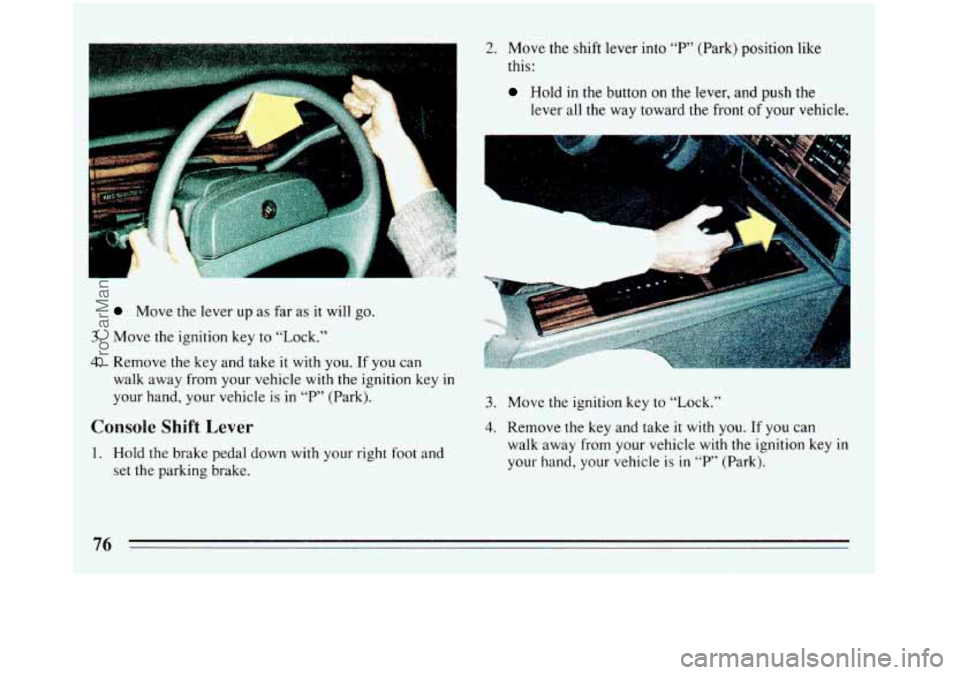
Move the lever up as far as it will go.
3. Move the ignition key to “Lock.”
4. Remove the key and take it with you. If you can
walk away from your vehicle with the ignition key in
your hand, your vehicle is in “P” (Park).
Console Shift Lever
1. Hold the brake pedal down with your right foot and
set the parking brake.
2. Move the shift lever into “P’ (Park) position like
this:
Hold in the button on the lever, and push the
lever all the way toward the front
of your vehicle.
-II
3. Move the ignition key to “Lock.”
4. Remove the key and take it with you. If you can
walk away from your vehicle with the ignition key
in
your hand, your vehicle is in “P’ (Park).
76
ProCarManuals.com
Page 81 of 308
f
-
CAUTION: (Continued)
It can be dangerous to get out of your vehicle if
the shift lever
is not fully in “P” (Park) with the
parking brake firmly set. Your vehicle can roll.
Don’t leave your vehicle when the engine is
running unless you have to. If you’ve left the
engine
running, the vehicle can move suddenly.
You or others could be injured. To be sure your
vehicle won’t move, even when you’re
on fairly
level ground, always set your parking brake and
-we the shift lever to “P” (Park)
Follow the proper steps to be sure your vehicle
won’t move. See “Shifting Into ‘P’ (Park)”
in the
Index,
If you are parking on a hill, or if you’re pulling a
iler, also see “Parking on Hills” or “Towing a
ailer”
in the Index.
Power Windows (Option)
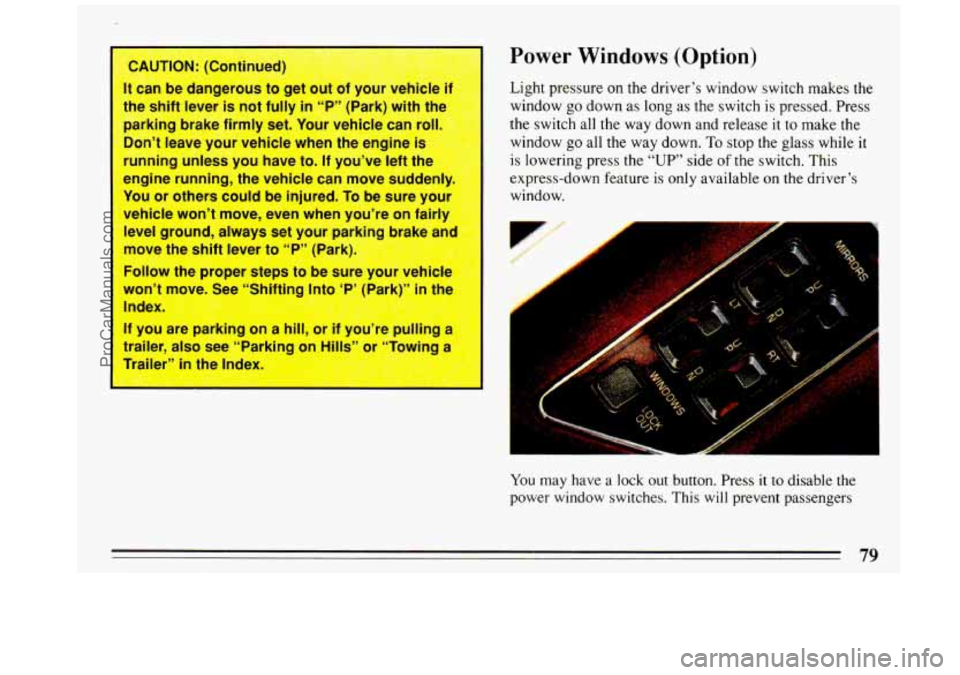
Light pressure on the driver’s window switch makes the
window go down as long as the switch is pressed. Press
the switch all the way down and release
it to make the
window go all the way down. To stop the glass while
it
is lowering press the “UP” side of the switch. This
express-down feature is only available
on the driver’s
window.
You may nave a lock out button. Press it to disable the
power window switches. This will prevent passengers
79
-
ProCarManuals.com
Page 85 of 308
Headlight High-Low Beam
rc
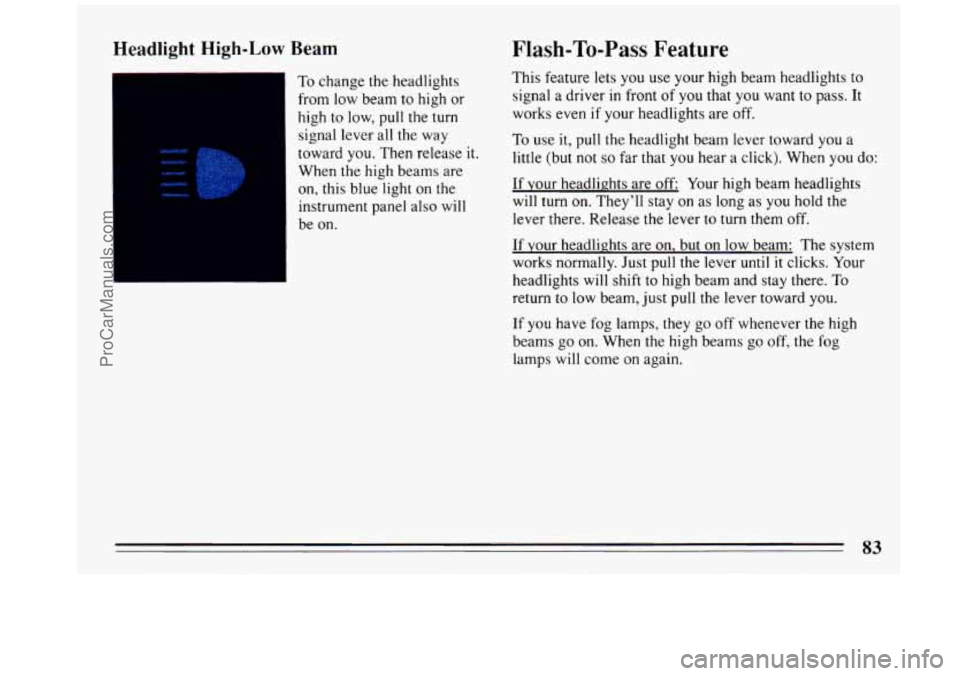
To change the headlights
from low beam to high or
high to low, pull the turn
signal lever all the way
toward you. Then release
it.
When the high beams are
on, this blue light on the
instrument panel also will
be on.
Flash-To-Pass Feature
This feature lets you use your high beam headlights to
signal a driver
in front of you that you want to pass. It
works even if your headlights are off.
To use it, pull the headlight beam lever toward you a
little (but
not so far that you hear a click). When you do:
If your headlights are off Your high beam headlights
will
turn on. They’ll stay on as long as you hold the
lever there. Release the lever
t.o turn them off.
If your headliphts are on, but on low beam: The system
works normally. Just pull the lever until
it clicks. Your
headlights will shift to high beam and stay there.
To
return to low beam, just pull the lever toward you.
If
you have fog lamps, they go off whenever the high
beams go on. When the high beams
go off, the fog
lamps will come
on again.
83
ProCarManuals.com
Page 100 of 308
Storage Armrest (Option) Rear Seat
Console and Pass-Through
(Option)
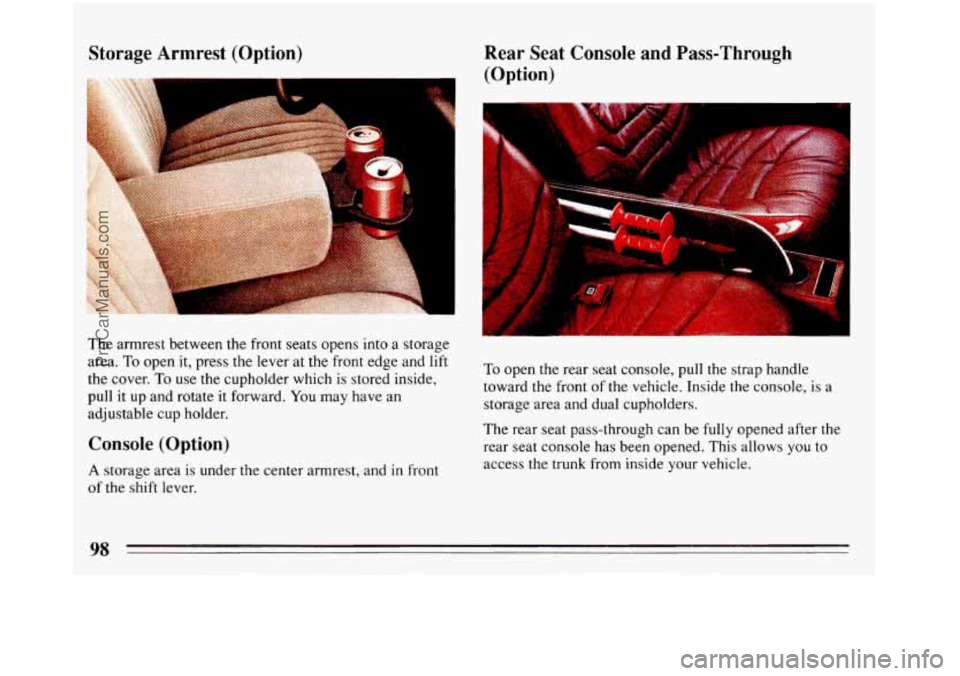
The armrest between the front seats opens into a storage
area.
To open it, press the lever at the front edge and lift
the cover.
To use the cupholder which is stored inside,
pull it up and rotate it forward.
You may have an
adjustable cup holder.
Console (Option)
A storage area is under the center armrest, and in front
of
the shift lever. To
open the rear seat console, pull the strap handle
toward the front
of the vehicle. Inside the console, is a
storage area and dual cupholders.
The rear seat pass-through can be
fully opened after the
rear seat console has been opened. This allows
you to
access the trunk from inside your vehicle.
98
ProCarManuals.com
Page 104 of 308

Brake System Warning Light
(a)(!)
BRAKE
Your Buick’s hydraulic
brake system is divided into
two parts. If one part isn’t
working, the other part can
still work and stop you. For
good braking, though, you
need both parts working well.
If the warning light goes on, there could be a brake
problem. Have your brake system inspected right away.
This light should come on as you start the vehicle.
If it
doesn’t come on then, have it fixed
so it will be ready to
warn you if there’s a problem. This
light will also come on when you set your parking
brake, and will stay on if your parking brake doesn’t
release fully. If it stays
on after your parking brake is
fully released, it means you have a brake problem. If the
light comes on while driving, pull off the road and stop
carefully. You may notice that the pedal is harder
to
push. Or, the pedal may go closer to the floor. It may
take longer to stop.
If the light is still on, have the
vehicle towed for service. (See “Towing Your Vehicle”
in the Index.)
A CAUTION:
Your brake system may not be working properly
if the brake warning light is on. Driving with the
brake warning light on can lead to an accident.
If
the light is still on after you’ve pulled off the road
and stopped carefully, have the vehicle towed fo
service.
aw,Tp 1 e- c -
102
ProCarManuals.com
Page 113 of 308
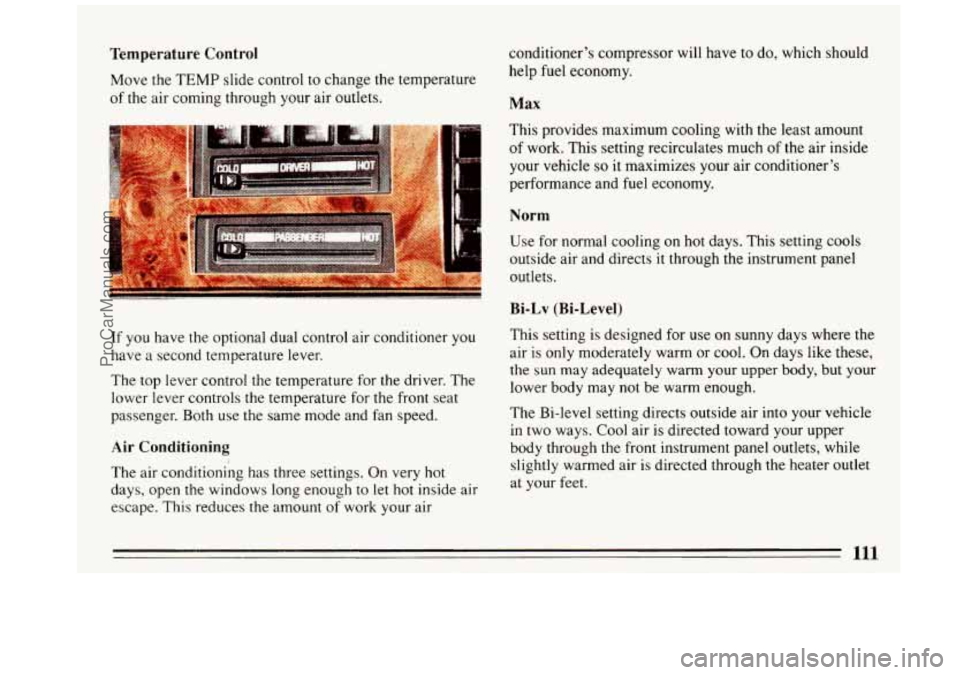
Temperature Control
Move the TEMP slide control to change the temperature
of the air coming through your air outlets. conditioner’s
compressor will have to do, which should
help fuel economy. Max
This provides maximum cooling with the least amount
of work. This setting recirculates much of the air inside
your vehicle
so it maximizes your air conditioner’s
performance and fuel economy.
Norm
Use for normal cooling on hot days. This setting cools
outside air and directs it through the instrument panel
outlets.
Bi-Lv (Bi-Level)
If you have the optional dual control air conditioner you
have a second temperature lever.
The top lever control the temperature for the driver. The
lower lever controls the temperature for the front seat
passenger. Both use
the same mode and fan speed.
Air Conditioning
The air conditioning has three settings. On very hot
days, open
the windows long enough to let hot inside air
escape.. This reduces the amount of work your air This setting
is designed for
use on sunny days where the
air is only moderately warm or cool. On days like these,
the
sun may adequately warm your upper body, but your
lower body may not be warm enough.
The Bi-level setting directs outside air into your vehicle
in two ways.
Cool air is directed toward your upper
body through the front instrument panel outlets, while
slightly warmed air is directed through the heater outlet
at your feet.
111
ProCarManuals.com
Page 114 of 308
The air conditioner compressor operates in all Air
Conditioning positions, and
the Defrost position when
the outside temperature is above 40'F (4.5 "C).
Ventilation
For mild outside temperatures, when little heating or
cooling
is needed, press the VENT button. Air will flow
through the instrument panel outlets. Use the air outlets
to turn on, adjust and turn
off the air flow. Adjust the
TEMP lever to control the temperature.
Heating
When outside temperatures are cold, press the button
marked HTR and slide the
TEMP lever toward HOT to
send heated air through the floor outlets.
Defog
When your windshield is foggy, press the DEFOG
button to direct most of the air flow toward the
windshield. When it's
50 F ( 10 C) or warmer, the
system will provide cooled air.
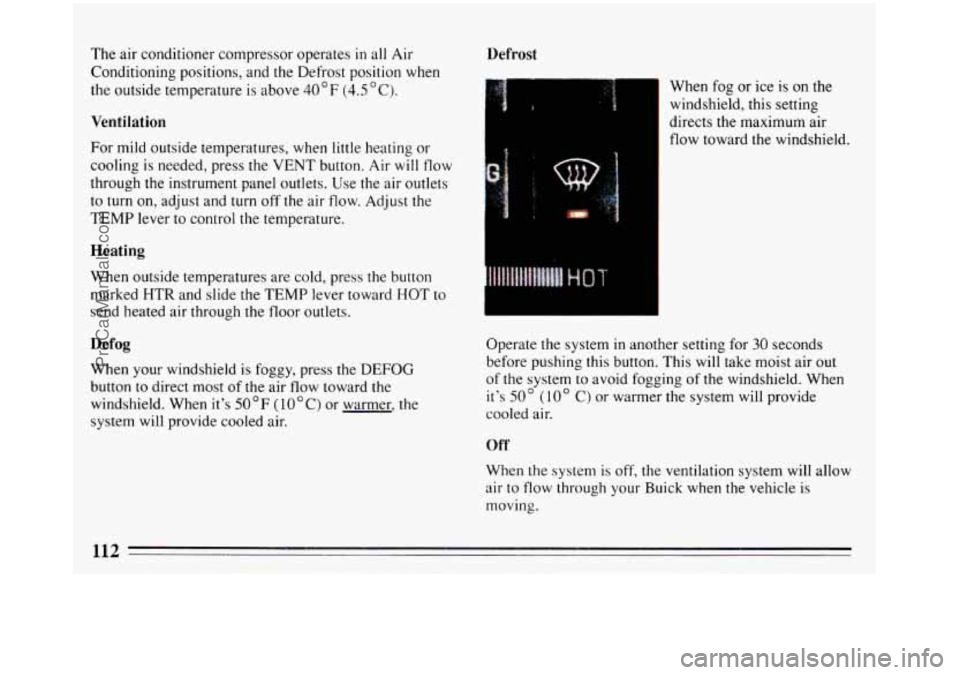
Defrost
When fog or ice is on the
windshield, this setting
directs the maximum air
flow toward the windshield.
Operate the system
in another setting for 30 seconds
before pushing this button.
This will take moist air out
of the system
to avoid fogging of the windshield. When
it's
50' (10" C) or warmer the system will provide
cooled air.
Off
When the system is off, the ventilation system will allow
air to flow through your Buick when the vehicle is
moving.
112
ProCarManuals.com
Page 129 of 308
@ Part 4 Your Driving And The Road
.
..
Here you'll find information about driving on different kinds of roads and in varying weather conditions . We've also
included many other useful tips
on driving .
Part 4 includes:
Roadsigns
....................................................................... \
DefensiveDriving .................................................................
ControlofaVehicle ................................................................
BrakingTips .................................................................
SteeringTip ..................................................................
Passing .....................................................................
LossofControl ...............................................................
DrivingatNight ....................................................................
DrivingintheRain .................................................................
Driving in Fog, Mist and Haze ........................................................
CityDriving ....................................................................... \
FreewayDriving ...................................................................
DrivingonaLongTrip ............................................................
HillandMountainRoads ..........................................................
ParkingonHills ...................................................................
WinterDriving ....................................................................
TowingaTrailer ...................................................................
DrunkenDriving ..................................................................
Steering in Emergencies ........................................................
128
134
135
138
139
144
145
147
148
149
152
154
156
157
159
161
163
166
170
ProCarManuals.com