Page 224 of 340
If you get the overheat warning with no sign of steam,
try this for a minute or
so:
1. Turn off your air conditioner.
2. Turn on your heater to full hot at the highest fan
speed and open the window as necessary.
3. If you’re in a traffic jam, shift to “N” (Neutral).
If
you no longer have the overheat warning, you can
drive. Just
to be safe, drive slower for about ten minutes.
If the warning doesn’t come back on,
you can drive
normally.
If the warning continues, pull over, stop, and park your
vehicle right away.
If there’s still no sign of steam, you can idle the engine
for two or three minutes while you’re parked, to see if
the warning stops. But then, if
you still have the
warning, TURN
OFF THE ENGINE AND GET
EVERYONE OUT
OF THE VEHICLE until it cools
down. You
may decide not to lift the hood but to get service
help right away.
e
w . ._
,
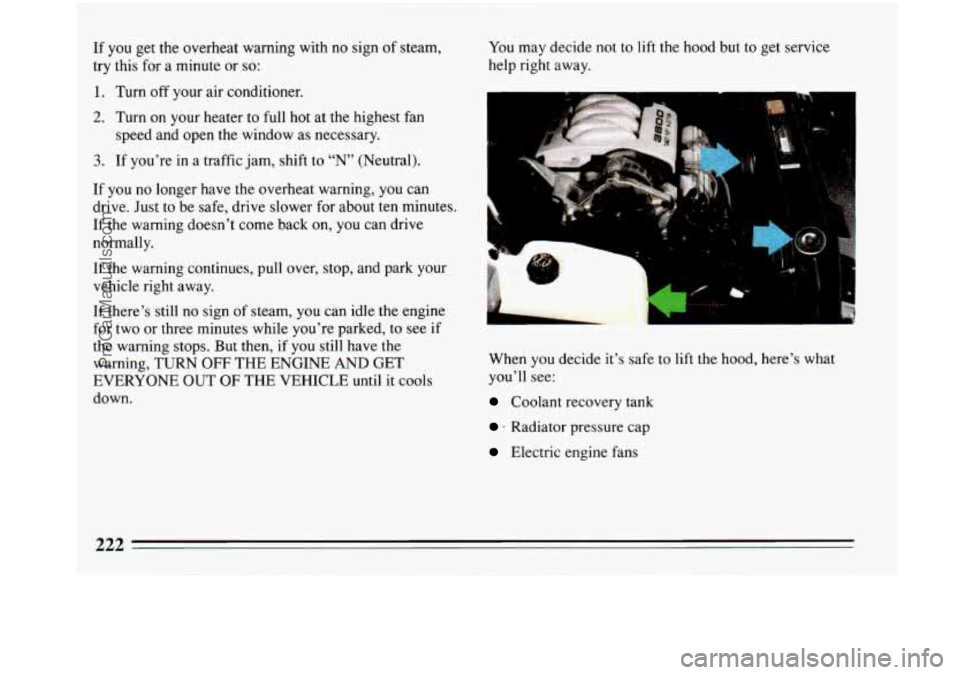
When you decide it’s safe to lift the hood, here’s what
you’ll see:
Coolant recovery tank
* Radiator pressure cap
Electric engine fans
ProCarManuals.com
Page 225 of 340
I A CAUTION:
An electric fan under the hood can start up even
when the engine
is not running and can injure
you. Keep hands, clothing and tools away from
any underhood electric fan.
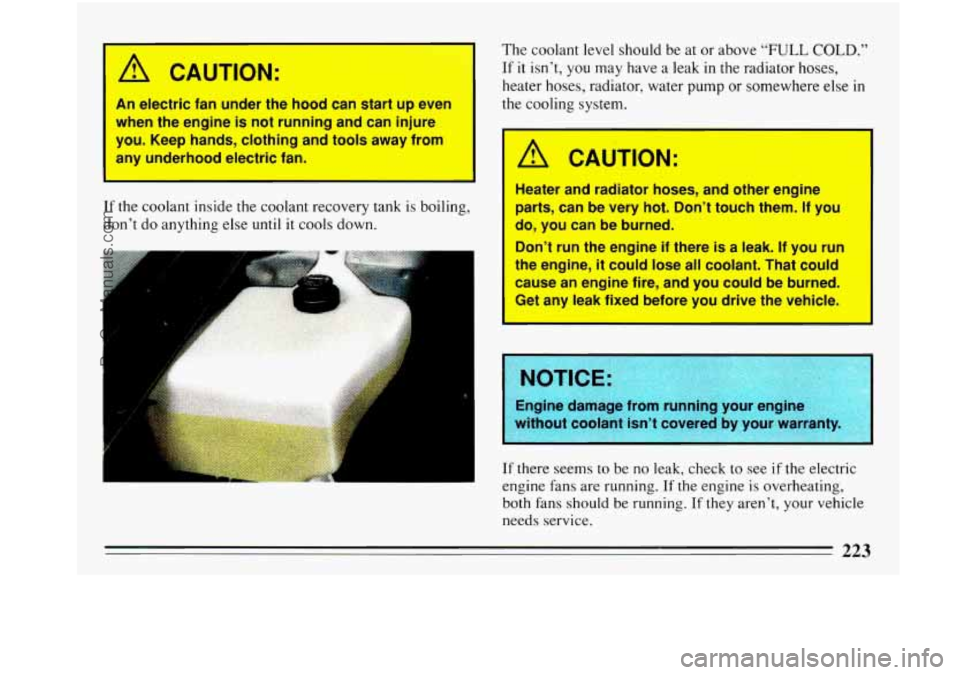
If the coolant inside the coolant recovery tank is boiling,
don’t do anything else until it cools down.
. .” P
The coolant level should be at or above “FULL COLD.”
If it isn’t, you may have a leak in the radiator hoses,
heater hoses, radiator, water pump
or somewhere else in
the cooling system.
I I
A CAUTION:
Heater and radiator hoses, and other engine
parts, can be very hot. Don’t touch them.
If you
do, you can be burned.
Don’t run the engine
if there is a leak. If you run
the engine, it could lose all coolant. That could
cause an engine fire, and you could be burned.
Get any leak fixed before you drive the vehicle.
I
Engine damage? Il’onl I mning bUrlr engine
without coolant isn’t covered by your warrbllr
If there seems to be no leak, check to see if the electric
engine fans are running. If the engine
is overheating,
both fans should be running. If they aren’t, your vehicle
needs service.
223
ProCarManuals.com
Page 226 of 340
How to Add Coolant to the Coolant
Recovery
Tank
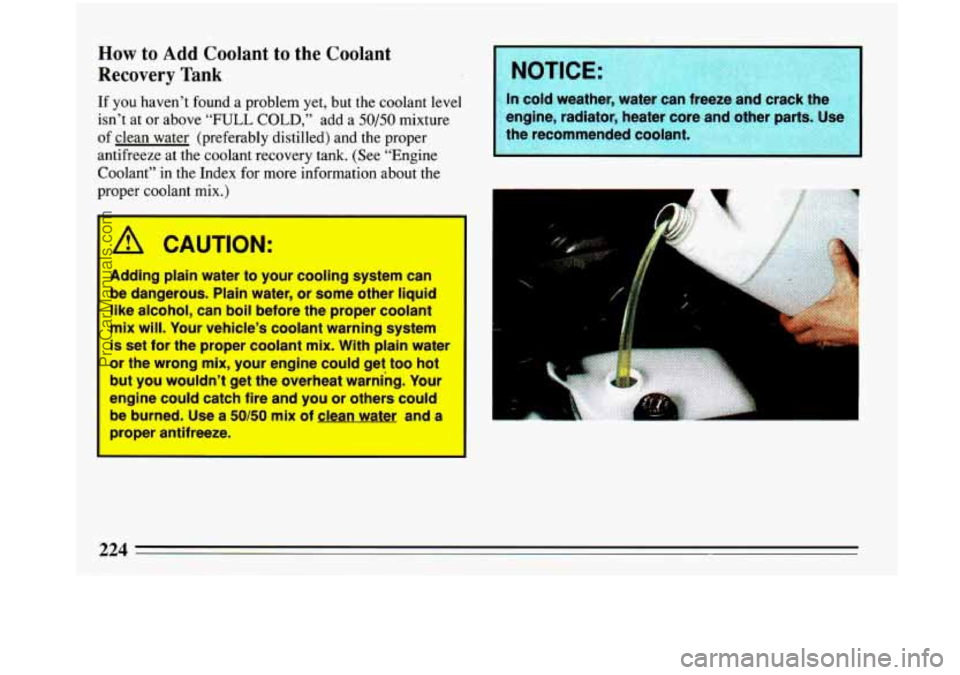
If you haven’t found a problem yet, but the coolant level In cold weather, water can free
isn’t at or above “FULL COLD,” add a 50/50 mixture
of clean water (preferably distilled) and the proper
antifreeze at the coolant recovery tank. (See “Engine
Coolant’’ in the Index for more information about the
proper coolant mix.)
I A CAUTION:
I Adding plain water to your cooling system can
be dangerous. Plain water, or some other liquid
like alcohol, can boll befare the proper coolant
mix will. Your vehicle’s coolant warning system
is set for the groper coolant mix. With plain water
.of the wrung mix, your engine could get too hot
but you wouldn’t get the overheat warning. Your
engine could catch fire and you or others could
be burned. Use a 50/50 mix of Glean water and a
proper antifreeze.
I
I
I
ProCarManuals.com
Page 227 of 340
A CAUTION: A CAUTION:
You can be burned if you spill cootant on hot
engine parts. Coolant contains ethylene glycol
and it will burn if the engine parts are hot
enough. Don’t spill coolant on a hot engine.
When the coolant in the coolant recovery tank is at or
above
“FULL COLD,” start your vehicle.
If the overheat warning continues, there’s one more
thing you can try.
You can add the proper coolant mix
directly
to the radiator, but be sure the cooling system is
cool before
you do it.
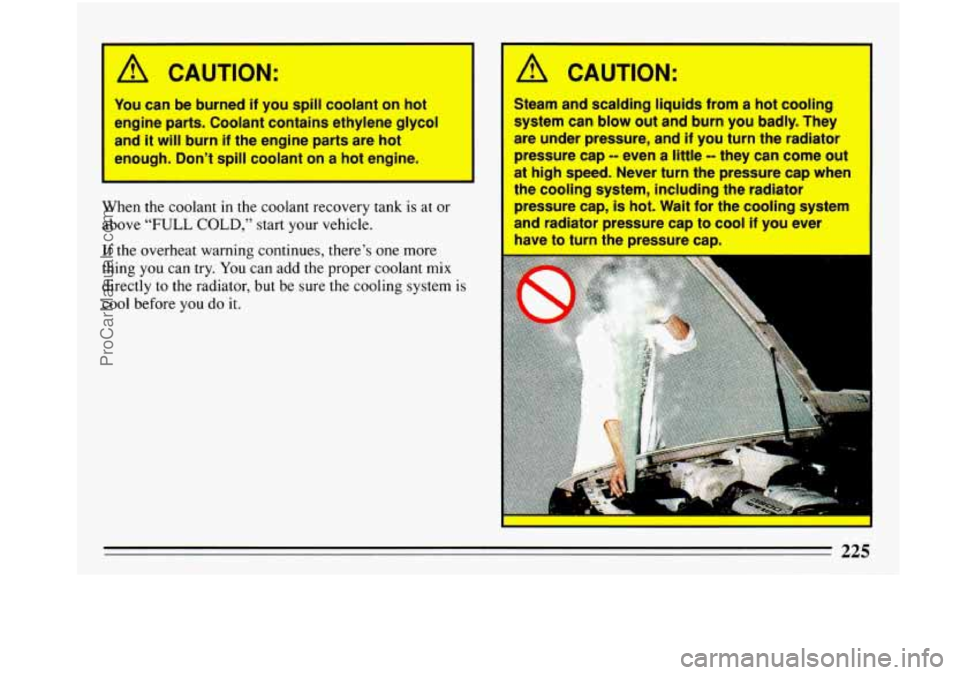
Steam and scalding liquids from a hot cooling
system can blow out and burn you badly. They
are under pressure, and if you turn the radiator
pressure cap
-- even a little -- they can come out
at high speed. Never turn the pressure cap when
e cooling system, including the radiator
pressure cap, is hot. Wait for the cooling system
and radiator pressure cap to cool
if you ever
have
to turn the pressure cap.
L
L
ProCarManuals.com
Page 229 of 340
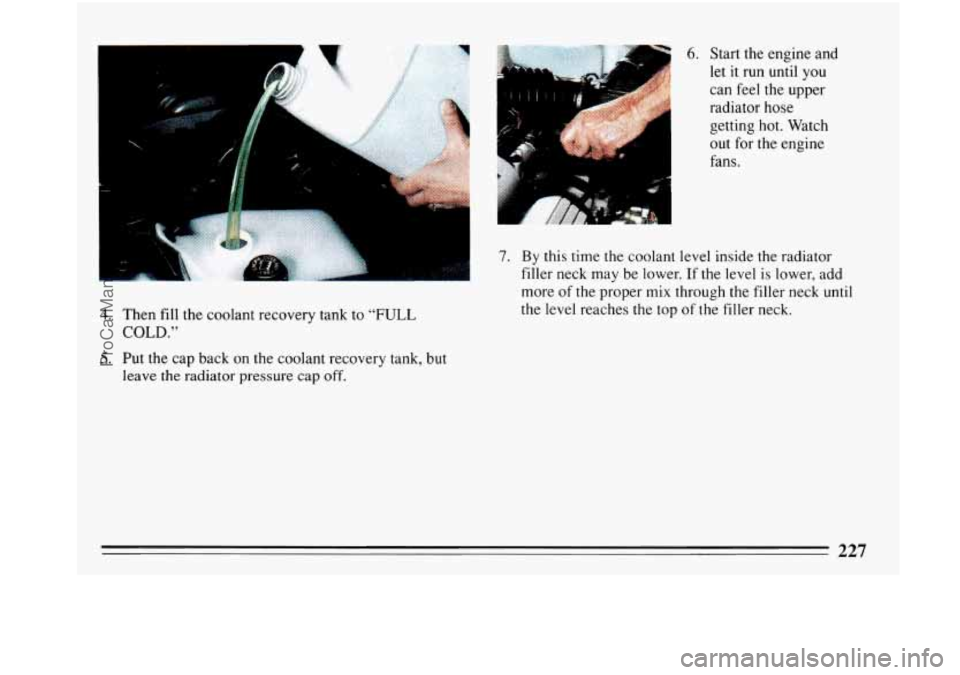
4. Then fill the coolant recovery tank to “FULL
COLD.”
6. Start the engine and
let it run until you
can feel the upper
radiator hose
getting hot. Watch
out for the engine
fans.
7. By this time the coolant level inside the radiator
filler neck may be lower. If the level
is lower, add
more of the proper
mix through the filler neck until
the level reaches the top
of the filler neck.
5. Put the cap back on the coolant recovery tank, but
leave
the radiator pressure cap off.
227
ProCarManuals.com
Page 231 of 340
Changing a Flat Tire
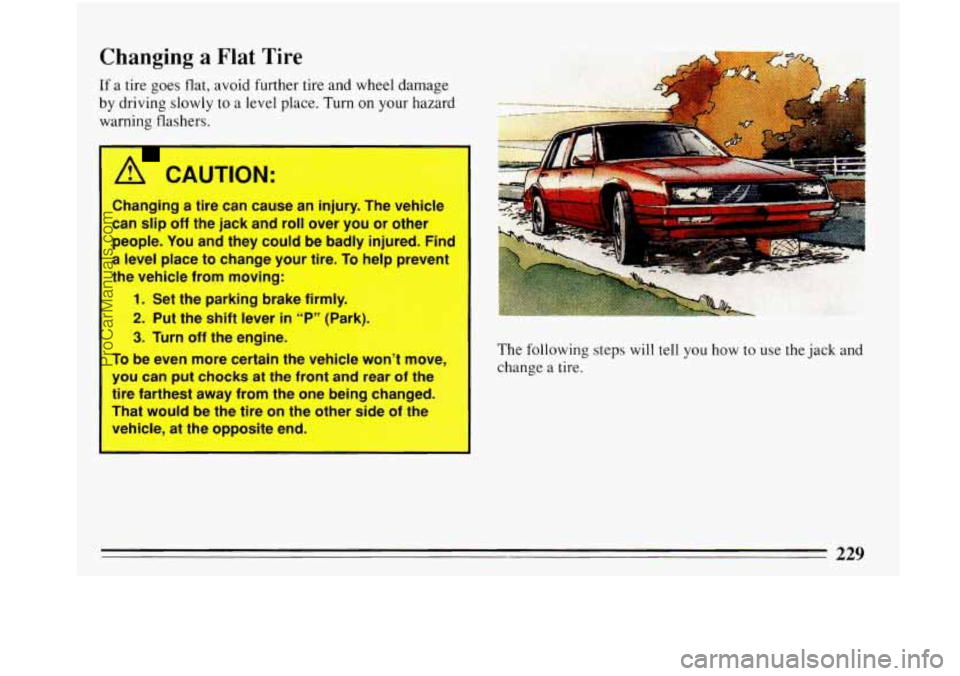
If a tire goes flat, avoid further tire and wheel damage
by driving slowly to a level place. Turn on your hazard
warning flashers.
A CAUTION:
Changing a tire can cause an injury. The vehicle
can
slip off the jack and roll over you or other
people. You and they could be badly injured. Find
a level place to change your tire. To help prevent
the vehicle from moving:
1. Set the parking brake firmly.
2. Put the shift lever in “P” (Park).
3. Turn off the engine.
I To be even more certain the vehicle won’t move,
you can
put chocks at the front and rear of the
tire farthest away from the one being changed.
That would be the tire on the other side of the
vehicle, a’ *?e opposite end.
- 2. I.
The following steps will tell you how to use the jack and
change a tire.
ProCarManuals.com
Page 241 of 340
If You’re Stuck: In Sand, Mud, Ice or
Snow
What you don’t want to do when your vehicle is stuck is
to spin your wheels. The method known as “rocking” can
help
you get out when you’re stuck, but you must use
caution.
I A CAUTION:
If you let your tires spin at high speed, they can
explode and you or others could be injured. And,
the transaxle or other parts of the vehicle can
overheat. That could cause an engine
compartment fire or other damage. When you’re
stuck, spin the wheels as little as possible. Don’t
spin the wheels above
35 mph (55 km/h) as
shown
on the speedometer.
I = I
Spinning your wheels lestroy par __ of your
vehicle as well as the tires. If you spin the whe
too fast while shifting your transaxle back
forth, you can destroy your transaxle.
Rocking your vehicle to get it out:
First, turn your steering wheel left and right. That will
clear the area around your front wheels. Then shift back
and forth between
“R” (Reverse) and a forward gear,
spinning the wheels as little as possible. Release the
accelerator pedal while you shift, and press lightly on
the accelerator pedal when the transaxle is
in gear. If
that doesn’t get
you out after a few tries, you may need
to be towed out.
If you do need to be towed out, see
“Towing Your Car”
in the Index.
ProCarManuals.com
Page 243 of 340
I
I
Here you will find information about the care of your Buick . This part begins with service and fuel information. and
then it shows how to check important fluid and lubricant levels
. There is also technical information about your
vehicle. and a section devoted to its appearance care
.
Part 6 includes:
ServiceTips
......................................................................
Engineoil ....................................................................... \
242
Fuel
........................................................................\
..... 243
Hood Release 248
251
AirFilter
........................................................................\
. 255
Automatic Transaxle Fluid
...........................................................
Enginecoolant .................................................................... 258
PowerSteeringFluid
............................................................... 261
Windshield Washer Fluid
............................................................ 262
Brakes
........................................................................\
... 263
Battery
........................................................................\
... 265
266
268
270
278
Vehicle Identification Number (VIN)
.................................................. 286
Fuses .and Circuit Breakers
........................................................... 287
Capacities and Specifications
.......................................................... 292
.....................................................................
256
BulbReplacement
.................................................................
LoadingYourVehicle ...............................................................
Tires ........................................................................\
....
Appearancecare ..................................................................
241
ProCarManuals.com