Page 253 of 340
The powertrain control module (PCM), works with a
vacuum control to regulate the increased pressure
required during specific driving conditions. When this
increased pressure or boost, is not desired such as during
idling and light throttle cruising, the excess air that the
Supercharger is pumping is routed through a bypass. All
of these controls, working together provide high
performance character and fuel efficiency in the
3800
V6 Supercharged Buick engine.
The power steering pump uses a remote reservoir
mounted on the throttle and cruise control cable bracket.
See “Maintenance Schedule’’ in the Index for when you
should check the fluid.
The supercharged
3800 engine uses two accessory drive
belts. One belt drives the generator and the power
steering pump. The second belt drives the supercharger,
coolant pump and air conditioning compressor. Each
belt has
its own tensioner and idler pulley. See
“Maintenance Schedule’’ in the Index for when you
should check the accessory drive belts and supercharger
oil level. Have your dealer check the oil level in the
supercharger.
Engine Oil
It’s a good idea to check your engine oil every time you
get fuel. In order to get an accurate reading, the oil must
be warm and the vehicle must be on level ground.
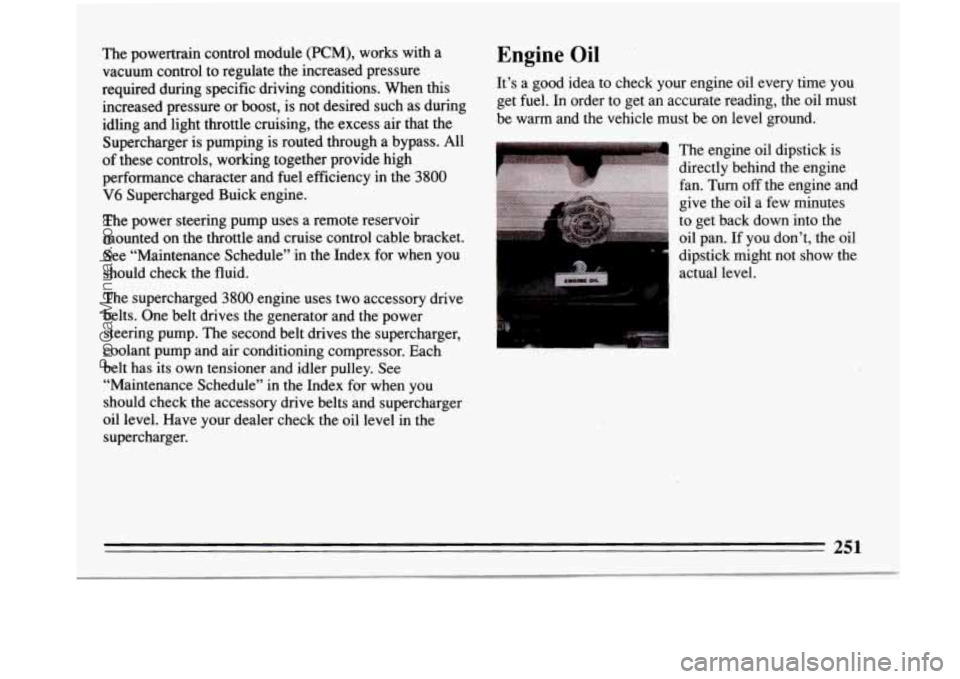
The engine oil dipstick is
directly behind the engine
fan. Turn
off the engine and
give the oil a few minutes
to get back down into the
oil pan. If you don’t, the oil
dipstick might not &ow the
actual level.
ProCarManuals.com
Page 254 of 340
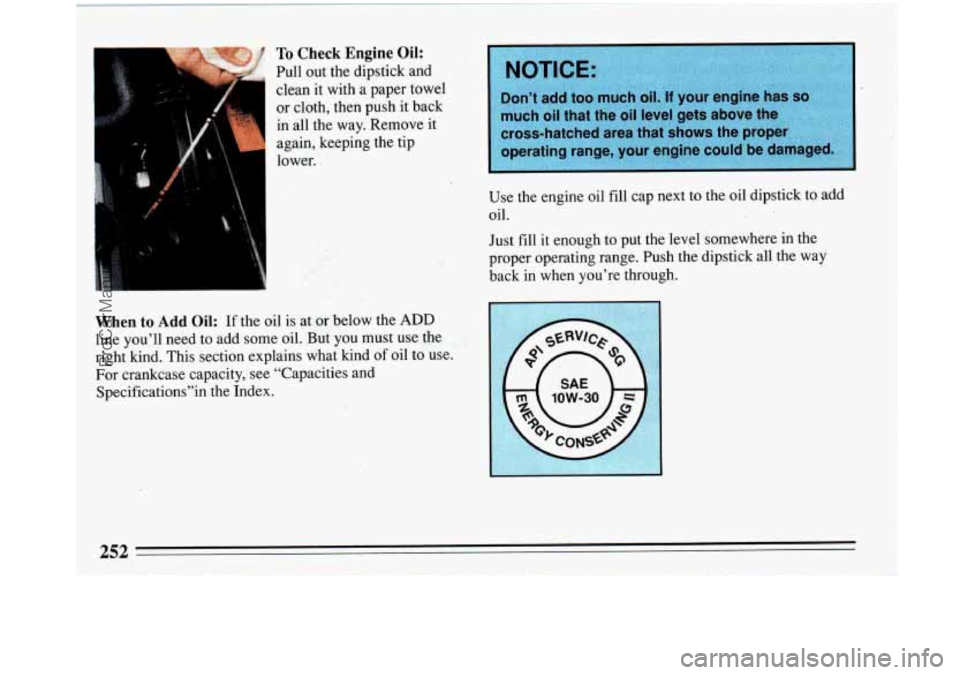
To Check Engine Oil:
Pull out the dipstick and
clean it with a paper towel
or cloth, then push it back
in all the way. Remove it
again, keeping the tip
lower.
I
i
When to Add Oil: If the oil is at or below the ADD
line you’ll need to add some oil. But you must use the
right kind. This section explains what kind of oil to use.
For crankcase capacity, see “Capacities and
Specifications”in the Index.
I NOTICE:
Don’t add too much oil. If your engine has so
much oil that the oil level gets above the
cross-hatched area that shows the proper operating range, your engine could be damaged,
Use the engine oil fill cap next to the oil dipstick to add
oil.
Just
fill it enough,to put the level somewhere in the
proper operating range. Push the-dipstick all the way
back in when you’re through.
252
ProCarManuals.com
Page 257 of 340
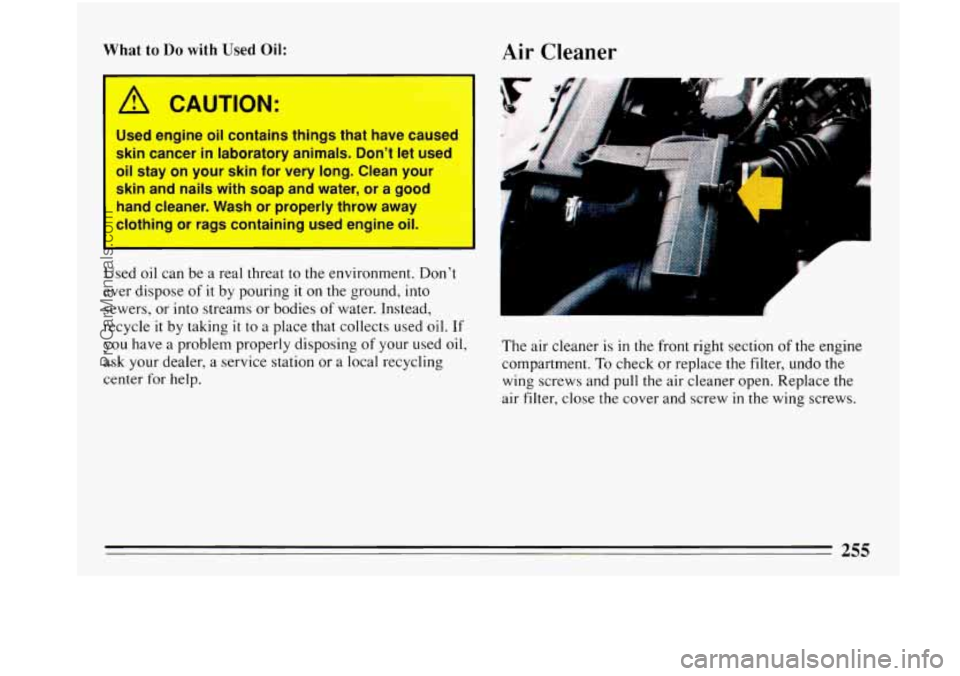
What to Do with Used Oil:
A CAUTION:
Used engine oil contains things that have cause
skin cancer in laboratory animals. Don't let used
oil stay on your skin for very long. Clean your
skin and nails with soap and water, or a good
hand cleaner. Wash or properly throw away
clothing or rags containing used engine
0"
Used oil can be a real threat to the environment. Don't
ever dispose of
it by pouring it on the ground, into
sewers,
or into streams or bodies of water. Instead,
recycle
it by taking it to a place that collects used oil. If
you have a problem properly disposing of your used oil,
ask your dealer, a service station or a local recycling
center for help.
I
Air Cleaner
The air cleaner is in the front right section of the engine
compartment. To check or replace the filter, undo the
wing screws and pull the air cleaner open. Replace the
air filter, close the cover and screw
in the wing screws.
ProCarManuals.com
Page 258 of 340
Refer to the Maintenance Schedule to determine when
to replace the air filter.
See “Scheduled Maintenance Services’’ in the Index.
A CAUTION:
Operating the engine with the air cleaner off can
cause you or others to be burned. The air cleaner
not only cleans the air, it stops flame
if the
engine backfires.
If it isn’t there, and the engine
backfires, you could be burned. Don’t drive with
it off, and be careful working on the engine with
the air cleaner off.
: NOTICE:
I If the air clean
i damaging engine fire. And, dirt can easily get
into your engine, which will damage
it. Always
’ have the air cleaner in place when you’re driving.
Automatic Transaxle Fluid
When to Check and Change:
A good time to check your automatic transaxle fluid
level is when the engine oil is changed. Refer to the
Maintenance Schedule to determine when to change
your fluid. See “Scheduled Maintenance Services” in
the Index.
How to Check:
Because this operation can be a little difficult, you may
choose to have this done at a Buick dealership Service Department.
If
you do it yourself, be sure to follow all the
instructions here, or
you could get a false reading on the
dipstick.
transaxle. Too much can mean that some of the
fluid could come out and fall on hot engine parts,
starting a fire. Be sure to get an
a
if you check your transaxle fluid.
ProCarManuals.com
Page 259 of 340
Wait at least 30 minutes before checking the transaxle
fluid level if you have been driving:
When outside temperatures are above 90°F (32 C).
At high speed for quite a while.
In heavy traffic -- especially in hot weather.
0 While pulling a trailer.
To get the right reading, the fluid should be at normal
operating temperature, which is
1 80 F to 200 F
(82OC to 93OC).
Get
the vehicle warmed up by driving about 15 miles
(24 km) when outside temperatures .are above
50 F
(10OC). If it’s colder than 50°F (lO°C), you may have
to drive longer.
To check the fluid level:
Park your vehicle on a level place.
0 Place the shift lever in “P’ (Park) with the parking
brake applied.
0 With your foot on the brake pedal, move the shift
lever through each gear range, pausing for about three seconds
in each range. Then, position the shift
lever
in “P’ (Park).
0 Let the engine run at idle for three to five minutes.
Then, without shutting off the engine, follow these
steps:
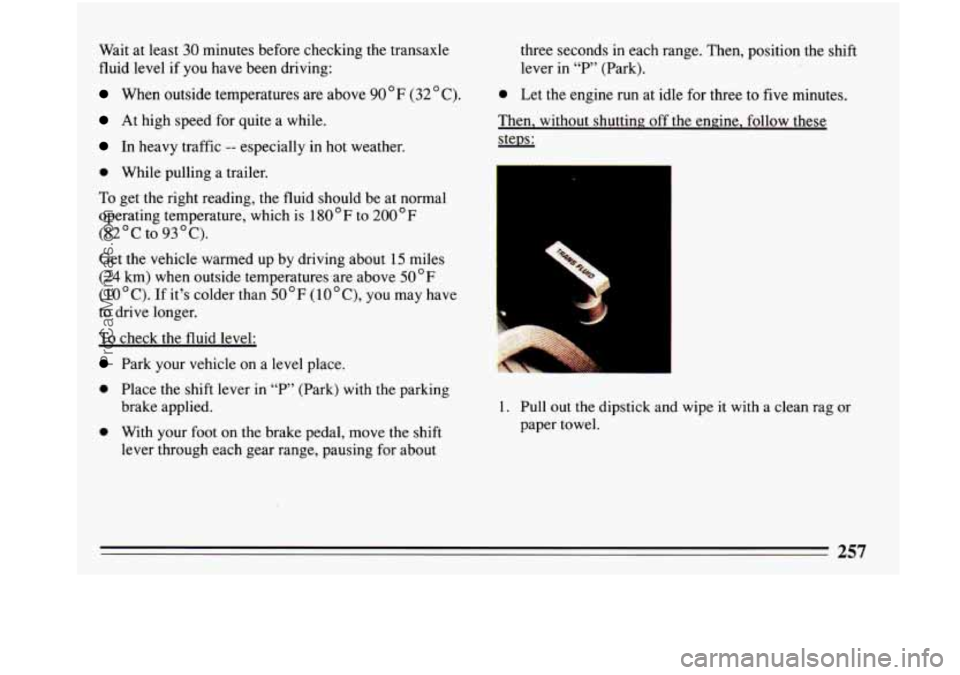
1. Pull out the dipstick and wipe it with a clean rag or
paper towel.
ProCarManuals.com
Page 260 of 340
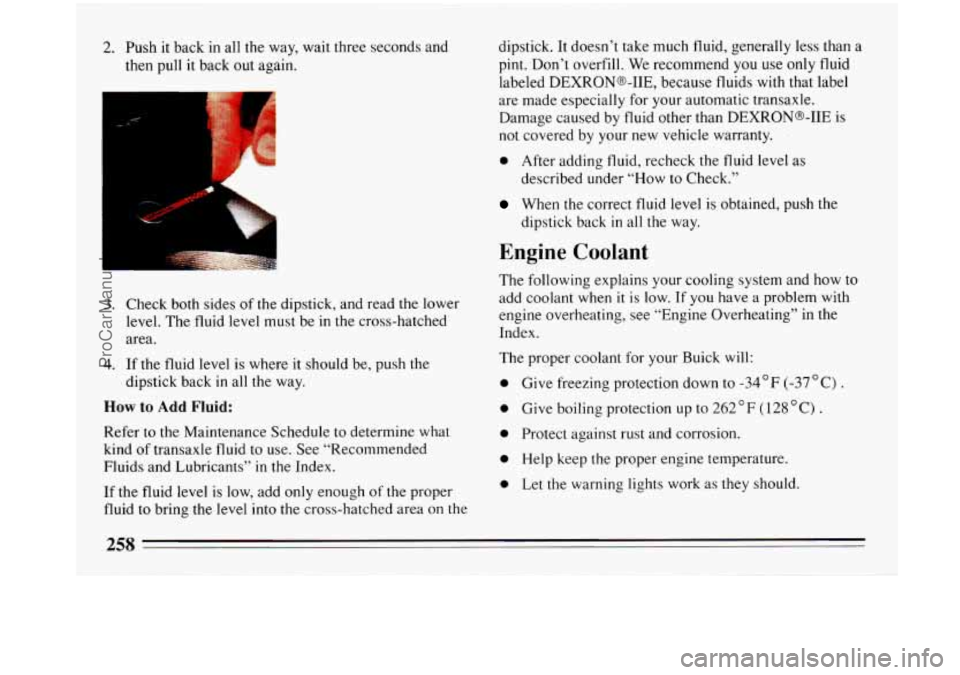
2. Push it back in all the way, wait three seconds and
then pull it back out again.
3. Check both sides of the dipstick, and read the lower
level. The fluid level must be in the cross-hatched
area.
4. If the fluid level is where it should be, push the
dipstick back
in all the way.
How to Add Fluid:
Refer to the Maintenance Schedule to determine what
kind of transaxle fluid to use. See “Recommended
Fluids and Lubricants” in the Index.
If the fluid level is low, add only enough of the proper
fluid to bring the level
into the cross-hatched area on the dipstick, It
doesn’t take much fluid, generally less than a
pint. Don’t overfill. We recommend
you use only fluid
labeled DEXRONWIE, because
fluids with that label
are made especially for your automatic transaxle.
Damage caused by fluid other than DEXRONB-IIE is
not covered by your new vehicle warranty.
0 After adding fluid, recheck the fluid level as
described under “How to Check.”
When the correct fluid level is obtained, push the
dipstick back
in all the way.
Engine Coolant
The following explains your cooling system and how to
add coolant when
it is low. If you have a problem with
engine overheating, see “Engine Overheating” in the
Index.
The proper coolant for your Buick will:
0 Give freezing protection down to -34°F (-37 “C) .
0 Give boiling protection up to 262 F ( 128 ” C) .
0 Protect against rust and corrosion.
0 Help keep the proper engine temperature.
0 Let the warning lights work as they should.
ProCarManuals.com
Page 262 of 340
To Check Coolant: When your engine is cold, the
coolant level should be at
“FULL COLD,” or a little
higher. When your engine is warm, the level should be
up to
“FULL HOT,” or a little higher.
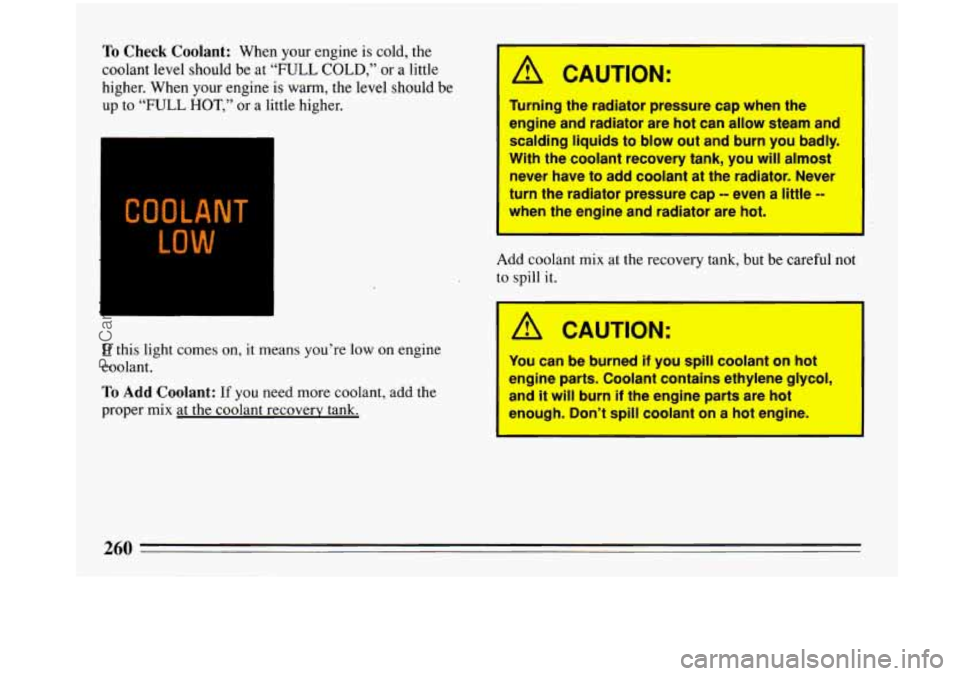
If this light comes
on, it means you’re low on engine
coolant.
To Add Coolant: If you need more coolant, add the
proper mix at the coolant recovery .tank.
‘ CAUTION:
T‘urning the radiator pressure cap when the
engine and radiator are hot can allow steam and
scalding liquids to blow out and burn you badly.
With the coolant recovery tank, you will almost
never have to add coolant at the radiator. Never
turn the radiator pressure cap -- even a little -
#hen the engine and radiator are hot.
I
Add coolant mix at the recovery tank, but be careful not
to spill it.
A CAUTION:
You can be burned if you spill coolant on hot
engine parts. Coolant contains ethylene glycol,
and it will burn
if the engine parts are hot
enough. Don’t spill coolant on a hot engine.
ProCarManuals.com
Page 263 of 340
Radiator Pressure Cap
Your radiator pressure cap is a 15 psi (105 kPa)
pressure-type cap and must be tightly install
to prevent coolant
loss and possible engine
damage from overheating. Be sure the arro
the cap line up with the
ov be on t
radiator filler neck.
Power Steering Fluid
When you replace your radiator pressure cap, an AC@
cap
is recommended.
Thermostat
Engine coolant temperature is controlled by a thermostat
in the engine coolant system. The thermostat stops the
flow
of coolant through the radiator until the coolant
reaches a preset temperature.
When
you replace your thermostat, an AC@ thermostat
is recommended.
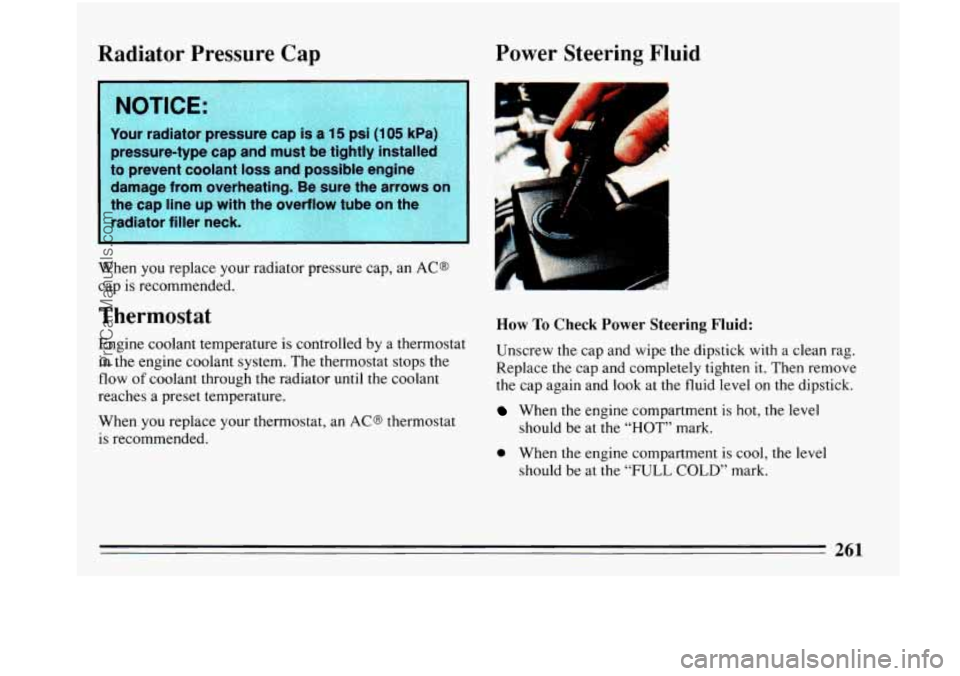
How To Check Power Steering Fluid:
Unscrew the cap and wipe the dipstick with a clean rag.
Replace
the cap and completely tighten it. Then remove
the cap again and look at the fluid level on the dipstick.
When the engine compartment is hot, the level
should be at the
“HOT” mark.
0 When the engine compartment is cool, the level
should be at the “FULL COLD” mark.
ProCarManuals.com