1993 BUICK PARK AVENUE check engine
[x] Cancel search: check enginePage 192 of 340
braking before moving onto the exit ramp.
Unfortunately, not all deceleration
lanes are long enough
-- some are too short for all the braking. Decide when to
start braking. If you must brake on the through lane, and
if there is traffic close behind
you, you can allow a little
extra time and flash your brake lights (in addition to
your turn signal) as extra warning that you are about to
slow down and exit.
The exit ramp can be curved, sometimes quite sharply.
The exit speed is usually posted. Reduce your speed
according to your speedometer, not to your sense of
motion. After driving for any distance at higher speeds,
you may tend
to think you are going slower than you
actually are. For example,
40 mph (65 km/h) might
seem like only
20 mph (30 km/h). Obviously, this could
lead to serious trouble on a ramp designed for
20 mph
(30 km/h)!
Driving a Long Distance
Although most long trips today are made on freeways,
there are still many made on regular highways.
Long-distance driving on freeways and regular
highways
is the same in some ways. The trip has to be
planned and
the vehicle prepared, you drive at
higher-than-city speeds, and there are longer turns
behind the wheel. You’ll enjoy your trip more
if you and your vehicle
are in good shape. Here are some tips for a
successful long trip.
Before Leaving on a Long Trip
Make sure you’re ready. Try to be well rested. If you
must start when you’re not fresh -- such as after a day’s
work
-- don’t plan to make too many miles that first part
of the journey. Wear comfortable clothing and shoes you
can easily drive
in.
Is your vehicle ready for a long trip? If you keep it
serviced and maintained, it’s ready to go. If it needs
service, have it done before starting out. Of course,
you’ll find experienced and able service experts in
Buick dealerships all across North America. They’ll be
ready and willing to help if
you need it.
Here are some things you can check before a trip:
Windshield Washer Fluid: Is the reservoir full? Are
all windows clean inside and outside?
0 Wiper Blades: Are they in good shape?
Fuel, Engine Oil, Other Fluids: Have you checked
Lights: Are they all working? Are the lenses clean?
Tires: They are vitally important to a safe,
all levels?
trouble-free trip. Is
the tread good enough
for
ProCarManuals.com
Page 202 of 340
A CAUTION:
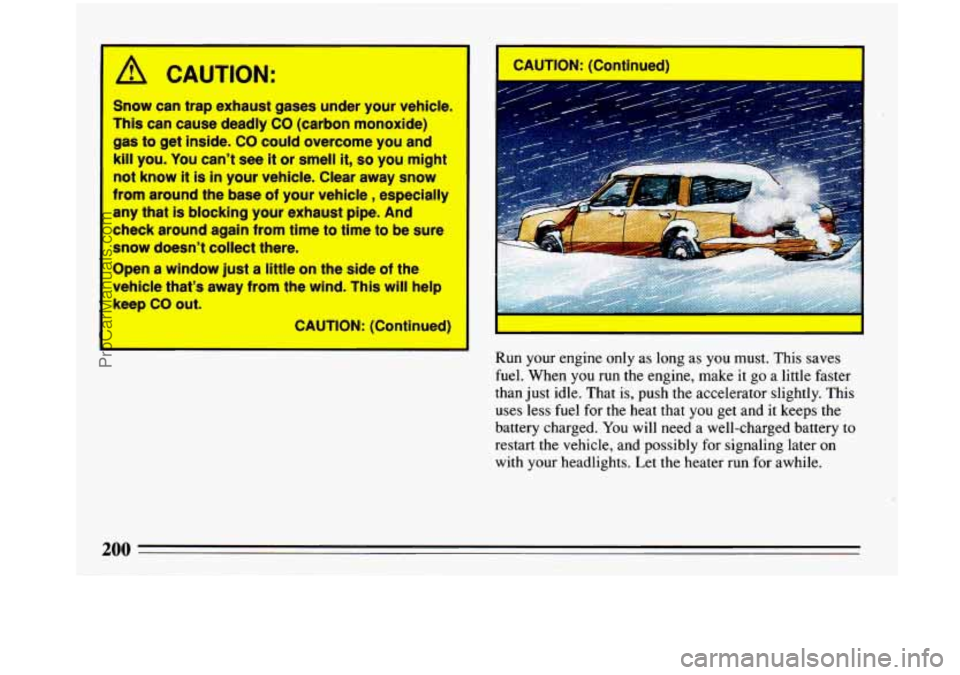
Snow can trap exhaust gases under your vehicle.
This can cause deadly
CO (carbon monoxide)
gas to get inside. CO could overcome you and
kill you. You can’t see it or smell it, so you might
not know it is in your vehicle. Clear away snow
from around the base of your vehicle, especially
any that
is blocking your exhaust pipe. And
check around again from time to time to be sure
snow doesn’t collect there.
Open
a window just a little on the side of the
vehicle that’s away from the wind. This will help
keep CO out.
CAUTION: (Continued)
LCAUTION:
Run your engine only as long as you must. This saves
fuel. When you run the engine, make it go a little faster
than just idle. That is, push the accelerator slightly. This
uses less fuel for the heat that you get and it keeps the
battery charged. You will need a well-charged battery
to
restart the vehicle, and possibly for signaling later on
with your headlights. Let the heater run for awhile.
ProCarManuals.com
Page 208 of 340
the trailer lights will also flash, telling other drivers
you’re about to turn, change lanes or stop.
When towing a trailer, the green arrows
on your
instrument panel will flash for turns even
if the bulbs on
the trailer are burned out. Thus, you may think drivers
behind you are seeing your signal when they are not. It’s
important to check occasionally to be sure the trailer
bulbs are still working.
Your vehicle has bulb warning lights. When you plug
trailer lights into your vehicle’s lighting system, its bulb warning lights may not
let you know if one of your
lights goes
out. So, when you have trailer lights plugged
in, be sure
to check your vehicle and trailer lights from
time to time to be sure they’re-all working. Once
you
disconnect the trailer lights, the bulb warning lights
again can
tell you if one of your vehicle lights is out.
Driving On Grades
Reduce speed and shift to a lower gear before you start
down a long
or steep downgrade. If you don’t shift
down, you might have to use your brakes
so much that
they would get hot and no longer work well. On
a long uphill grade, shift down to
“D or 3” (Drive)
and reduce your speed to around
45 mph (70 km/h) to
reduce the possibility of engine and transaxle
overheating.
Parking on Hills
You really should not park your vehicle, with a trailer
attached,
on a hill. If something goes wrong, your rig
could start to move. People can be injured, and both
your vehicle and the trailer can be damaged.
But
if you ever have to park your rig on a hill, here’s
how to do it:
1. Apply your regular brakes, but don’t shift into “F’”
(Park) yet.
2. Have someone place chocks under the trailer wheels.
3. When the wheel chocks are in place, release the
regular brakes until the chocks absorb the load.
4. Reapply the regular brakes. Then apply your parking
brake, and
then shift to “P’ (Park).
5. Release the regular brakes.
ProCarManuals.com
Page 209 of 340
When You Are Ready to Leave After
Parking on
a Hill
1. Apply your regular brakes and hold the pedal down
while you:
Start your engine;
0 Shift into a gear; and
0 Release the parking brake.
2. Let up on the brake pedal.
3. Drive slowly until the trailer is clear of the chocks.
4. Stop and have someone pick up and store the chocks.
Maintenance When Trailer Towing
Your vehicle will need service more often when you’re
pulling a trailer. See the Maintenance Schedule for more
on this. Things that are especially important in trailer
operation are automatic transaxle fluid (don’t overfill),
engine oil, belt, cooling system, and brake adjustment.
Each
of these is covered in this manual, and the Index
will help
you find them quickly. If you’re trailering, it’s
a good idea to review these sections before
you start
your trip.
Check periodically to see that all hitch nuts and bolts are
tight.
ProCarManuals.com
Page 216 of 340
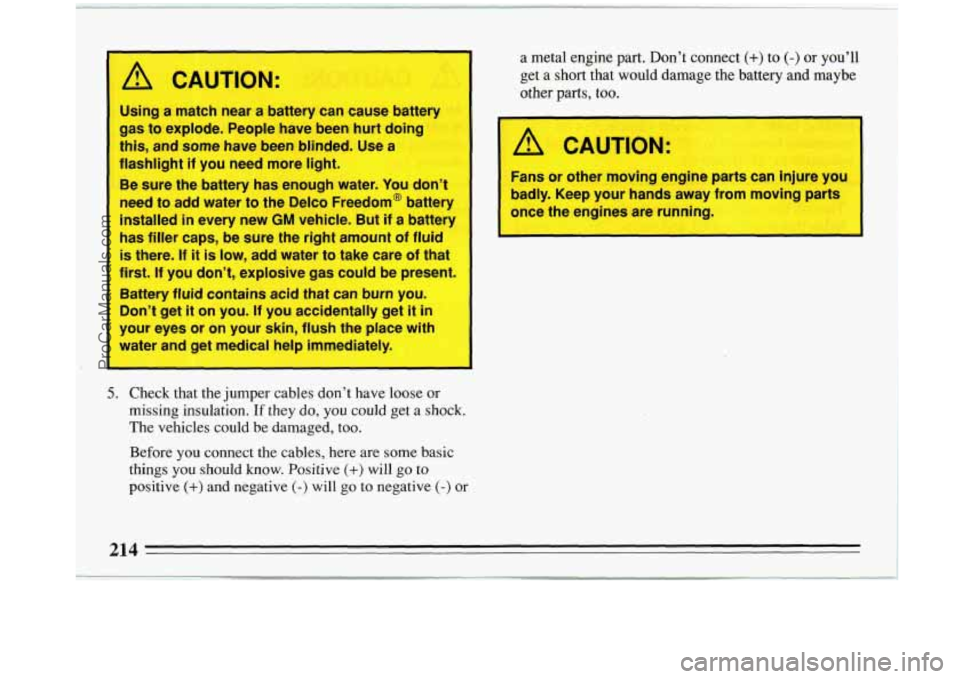
A CAUTION:
Using a match near a battery can cause battery
gas to explode. People have been hurt doing
this, and some have been blinded. Use a
flashlight if you need more light.
Be sure the battery has enoug,h water. You don’t
need to add water to the Delco Freedom@ battery
installed in’ every new GM vehicle. But if a battery
has filler caps,
be sure the right amount of fluid
is there. If it is low, add water to’ take care of that
first
If you don’tt, explosive gas could be present.
Battery fluid contains acid that can burn you.
Don’t get
it on you. If you accidentally get it in
your eyes or on your skin, flush the place with
water and
get medical help immediately.
5. Check that the jumper cables don’t have loose or
missing insulation. If they do, you could get a shock.
The vehicles could be damaged, too.
Before you connect the cables, here are some basic
th.ings
you should know. Positive (+) will go to
positive
(+) a~d mgative (-) will go to negative (-) or a
metal engine part. Don’t connect
(+) to (-) or you’ll
get a short that would damage the battery and maybe
other parts,
too.
‘
A CAUTION:
Fans or other moving engine parts can injure you
badly. Keep your hands away from moving parts
once the engines are running.
214
ProCarManuals.com
Page 225 of 340
I A CAUTION:
An electric fan under the hood can start up even
when the engine
is not running and can injure
you. Keep hands, clothing and tools away from
any underhood electric fan.
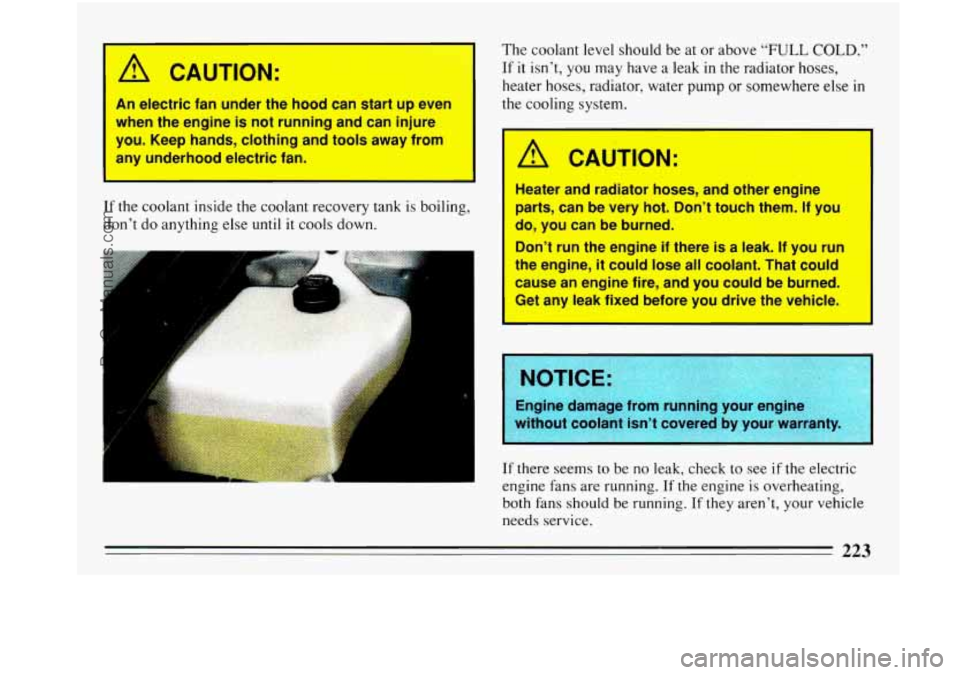
If the coolant inside the coolant recovery tank is boiling,
don’t do anything else until it cools down.
. .” P
The coolant level should be at or above “FULL COLD.”
If it isn’t, you may have a leak in the radiator hoses,
heater hoses, radiator, water pump
or somewhere else in
the cooling system.
I I
A CAUTION:
Heater and radiator hoses, and other engine
parts, can be very hot. Don’t touch them.
If you
do, you can be burned.
Don’t run the engine
if there is a leak. If you run
the engine, it could lose all coolant. That could
cause an engine fire, and you could be burned.
Get any leak fixed before you drive the vehicle.
I
Engine damage? Il’onl I mning bUrlr engine
without coolant isn’t covered by your warrbllr
If there seems to be no leak, check to see if the electric
engine fans are running. If the engine
is overheating,
both fans should be running. If they aren’t, your vehicle
needs service.
223
ProCarManuals.com
Page 243 of 340
I
I
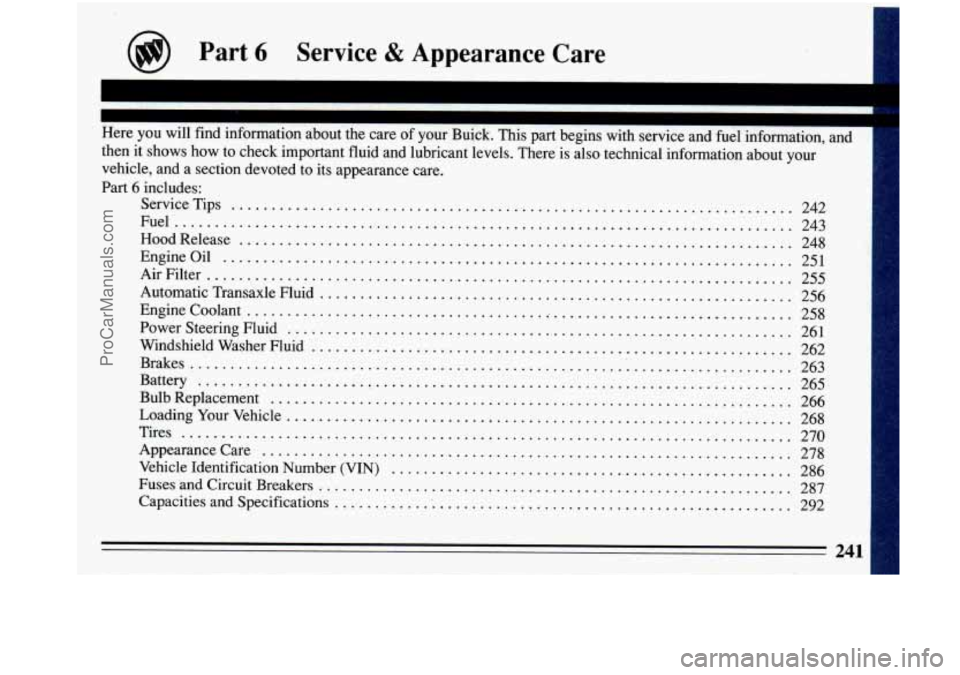
Here you will find information about the care of your Buick . This part begins with service and fuel information. and
then it shows how to check important fluid and lubricant levels
. There is also technical information about your
vehicle. and a section devoted to its appearance care
.
Part 6 includes:
ServiceTips
......................................................................
Engineoil ....................................................................... \
242
Fuel
........................................................................\
..... 243
Hood Release 248
251
AirFilter
........................................................................\
. 255
Automatic Transaxle Fluid
...........................................................
Enginecoolant .................................................................... 258
PowerSteeringFluid
............................................................... 261
Windshield Washer Fluid
............................................................ 262
Brakes
........................................................................\
... 263
Battery
........................................................................\
... 265
266
268
270
278
Vehicle Identification Number (VIN)
.................................................. 286
Fuses .and Circuit Breakers
........................................................... 287
Capacities and Specifications
.......................................................... 292
.....................................................................
256
BulbReplacement
.................................................................
LoadingYourVehicle ...............................................................
Tires ........................................................................\
....
Appearancecare ..................................................................
241
ProCarManuals.com
Page 247 of 340
Ethanol is ethyl or grain alcohol. Properly-blended fuel
that is no more than
10% ethanol is fine for your car.
Methanol is methyl or wood alcohol.
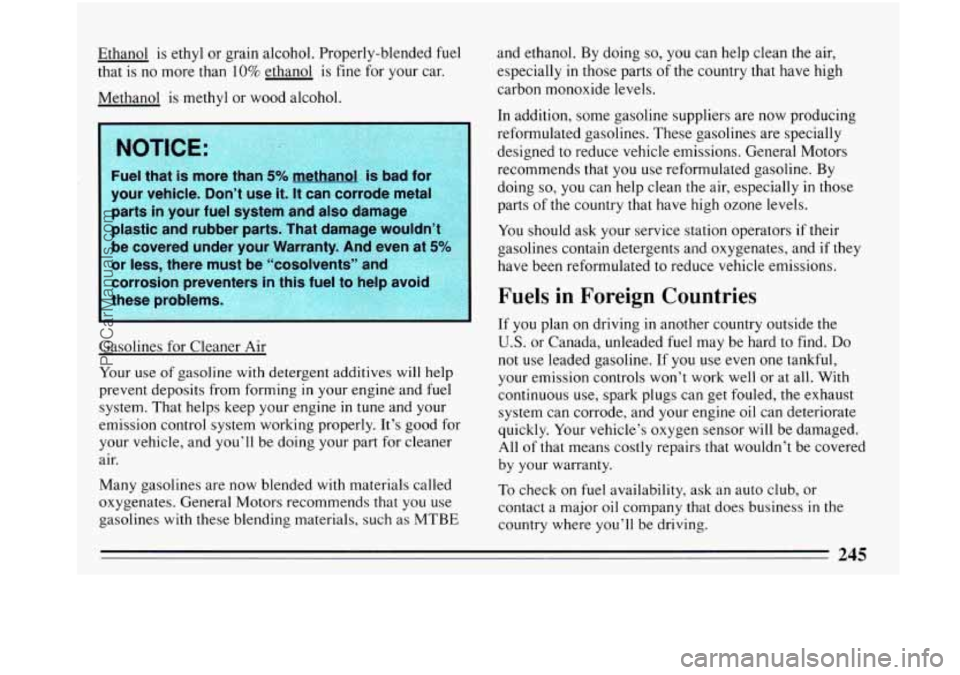
Fuel that is more than 5% methanol is bad for
your vehicle. Don’t use it.
It can corrode metal
parts in your fuel system and also damage
plastic and rubber parts. That damage wouldn’t be covered under your Warranty. And even at
5%
or less, there must be “cosolvents” and
corrosion preventers in this fuel to help avoid
Gasolines for Cleaner Air
Your use
of gasoline with detergent additives will help
prevent deposits from forming
in your engine and fuel
system. That helps keep your engine in tune and your
emission control system working properly. It’s good for
your vehicle, and you’ll be doing your part for cleaner
air.
Many gasolines are now blended with materials called
oxygenates. General Motors recommends that you use
gasolines with these blending materials, such as MTBE and ethanol.
By doing
so, you can help clean the air,
especially
in those parts of the country that have high
carbon monoxide levels.
In addition, some gasoline suppliers are now producing
reformulated gasolines. These gasolines are specially
designed to reduce vehicle emissions. General Motors
recommends that you use reformulated gasoline. By
doing
so, you can help clean the air, especially in those
parts of the country that have high ozone levels.
You should ask your service station operators if their
gasolines contain detergents and oxygenates, and if they
have been reformulated to reduce vehicle emissions.
Fuels in
Foreign Countries
If you plan on driving in another country outside the
U.S. or Canada, unleaded fuel may be hard to find. Do
not use leaded gasoline. If you use even one tankful,
your emission controls won’t work well or at all. With
continuous use, spark plugs can get fouled,
the exhaust
system can corrode, and your engine oil can deteriorate
quickly. Your vehicle’s oxygen sensor will be damaged.
All
of that means costly repairs that wouldn’t be covered
by your warranty.
To check on fuel availability, ask an auto club, or
contact a major oil company that does business
in the
country where you’ll be driving.
245
ProCarManuals.com