1993 BUICK PARK AVENUE brake light
[x] Cancel search: brake lightPage 207 of 340
Driving with a Trailer
Towing a trailer requires a certain amount of experience.
Before setting
out for the open road, you’ll want to get
to know your rig. Acquaint yourself with the feel of
handling and braking with the added weight of the
trailer. And always keep in mind that the vehicle
you are
driving is now a good deal longer and not nearly
so
responsive as your vehicle is by itself.
Before you start, check the trailer hitch and platform,
safety chains, electrical connector, lights, tires and
mirror adjustment.
If the trailer has electric brakes, start
your vehicle and trailer moving and then apply the
trailer brake controller by hand
to be sure the brakes are
working. This lets you check your electrical connection
at the same time.
Passing
During your trip, check occasionally to be sure that the
load is secure, and that the lights and any trailer brakes
are still working.
Following Distance
Stay at least twice as far behind the vehicle ahead as you
would when driving your vehicle without a trailer. This
can help you avoid situations that require heavy braking
and sudden turns. You’ll
need more passing distance up ahead when
you’re towing a trailer. And, because you’re a good deal
longer, you’ll need to go much farther beyond the
passed vehicle before you can return to your lane.
Backing Up
Hold the bottom of the steering wheel with one hand.
Then, to move the trailer
to the left, just move that hand
to the
left. To move the trailer to the right, move your
hand to the right. Always back up slowly and, if
possible, have someone guide you.
Making Turns
When you’re turning with a trailer, make wider turns
than normal. Do this
so your trailer won’t strike soft
shoulders, curbs, road signs, trees, or other objects.
Avoid jerky or sudden maneuvers. Signal well
in
advance.
lbrn Signals When Towing a Trailer
When you tow a trailer, your vehicle has to have a
different turn signal flasher and extra wiring. The green
arrows on your instrument panel will flash whenever
you signal a turn or lane change. Properly hooked up,
ProCarManuals.com
Page 208 of 340
the trailer lights will also flash, telling other drivers
you’re about to turn, change lanes or stop.
When towing a trailer, the green arrows
on your
instrument panel will flash for turns even
if the bulbs on
the trailer are burned out. Thus, you may think drivers
behind you are seeing your signal when they are not. It’s
important to check occasionally to be sure the trailer
bulbs are still working.
Your vehicle has bulb warning lights. When you plug
trailer lights into your vehicle’s lighting system, its bulb warning lights may not
let you know if one of your
lights goes
out. So, when you have trailer lights plugged
in, be sure
to check your vehicle and trailer lights from
time to time to be sure they’re-all working. Once
you
disconnect the trailer lights, the bulb warning lights
again can
tell you if one of your vehicle lights is out.
Driving On Grades
Reduce speed and shift to a lower gear before you start
down a long
or steep downgrade. If you don’t shift
down, you might have to use your brakes
so much that
they would get hot and no longer work well. On
a long uphill grade, shift down to
“D or 3” (Drive)
and reduce your speed to around
45 mph (70 km/h) to
reduce the possibility of engine and transaxle
overheating.
Parking on Hills
You really should not park your vehicle, with a trailer
attached,
on a hill. If something goes wrong, your rig
could start to move. People can be injured, and both
your vehicle and the trailer can be damaged.
But
if you ever have to park your rig on a hill, here’s
how to do it:
1. Apply your regular brakes, but don’t shift into “F’”
(Park) yet.
2. Have someone place chocks under the trailer wheels.
3. When the wheel chocks are in place, release the
regular brakes until the chocks absorb the load.
4. Reapply the regular brakes. Then apply your parking
brake, and
then shift to “P’ (Park).
5. Release the regular brakes.
ProCarManuals.com
Page 215 of 340
I
A CAUTION:
You could be injured if the vehicles roll. Set the
parking brake firmly on each vehicle. Put an
automatic transaxle
in “P” (Park) or a manual
transaxle
in “N” (Neutral).
3. Turn off the ignition on both vehicles. Turn off all
lights that aren’t needed, and radios. This will avoid
sparks and help save both batteries. And it could
save your radio!
A CAUTION:
An electric fan can start up even when the engine
is not running and can injure you. Keep hands,
clothing anA
tools away from any underhood
electric fan
1 NOTICE:
3
If you leave your ram0 or ’t could be baaly
damaged. The repairs wouldn’t be covered b)
your warranty.
Find the positive (+) and negative (-) terminals on eact
battery.
4. Open the hoods and locate the batteries.
213
ProCarManuals.com
Page 239 of 340
Don’t try to put a wheel cover on your compact spare
tire.
It won’t fit. Store the wheel cover in the trunk until
you have the
flat tire repaired or replaced.
I NOTICE:
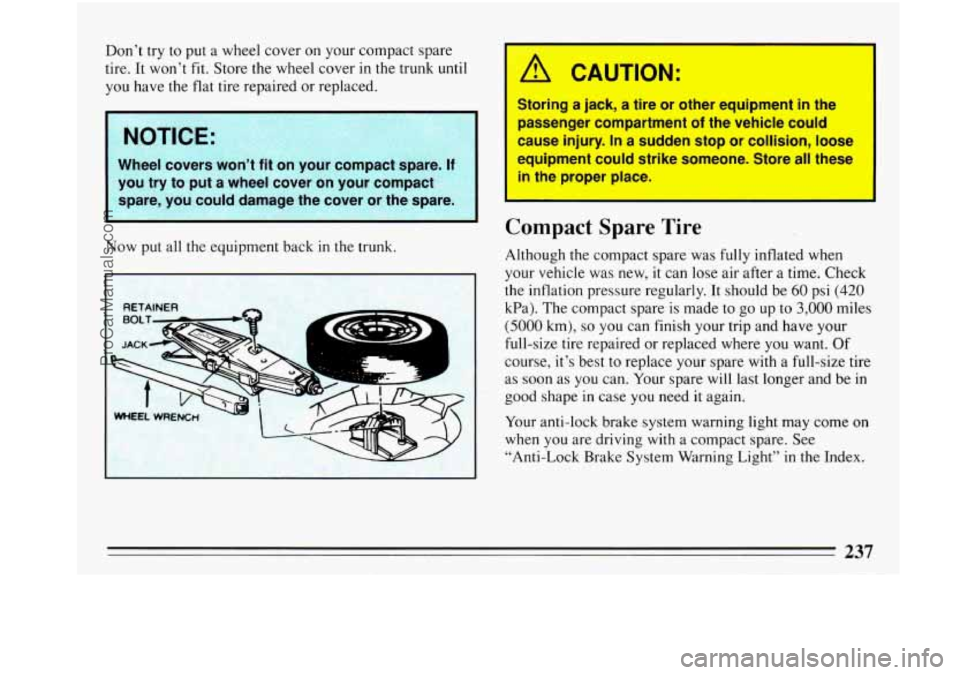
Now put all the equipment back in the trunk.
WHEEL WRENCH
A CAU I ION:
Storing a jack, a tire or other equilpment in the
passenger compartment of the vehicle could
cause injury. In a sudden stop or collision, loose
equipment cowtd strike someone. Store all these
in the proper
place.
Compact Spare Tire
Although the compact spare was fully inflated when
your vehicle was new, it can lose air after a time. Check
the inflation pressure regularly. It should be
60 psi (420
kPa). The compact spare is made to go up to 3,000 miles
(5000 km), so you can finish your trip and have your
full-size tire repaired
or replaced where you want. Of
course, it’s best to replace your spare with a full-size tire
as soon as you can. Your spare will last longer and be in
good shape
in case you need it again.
Your anti-lock brake system warning light may come on
when
you are driving with a compact spare. See
“Anti-Lock Brake System Warning Light’’ in the Index.
237
ProCarManuals.com
Page 266 of 340
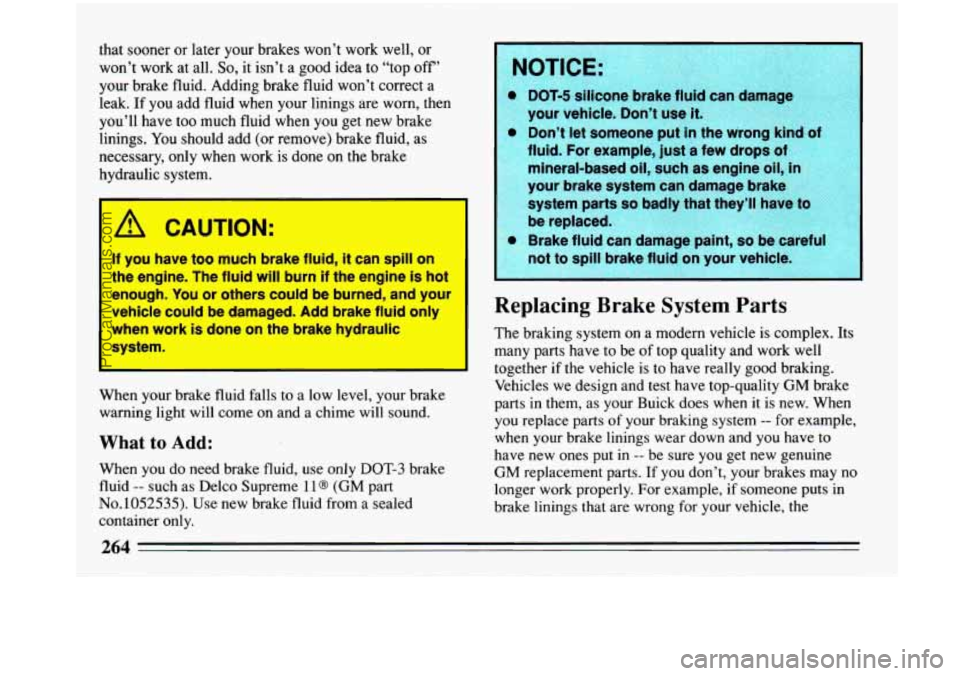
that sooner or later your brakes won’t work well, or
won’t work at all.
So, it isn’t a good idea to “top off’
your brake fluid. Adding brake fluid won’t correct
a
leak. If you add fluid when your linings are worn, then
you’ll have
too much fluid when you get new brake
linings. You should add
(or remove) brake fluid, as
necessary, only when work is done
on the brake
hydraulic system.
I-
A CAUTION:
If you have too much brake fluid, it can spill on
the engine. The fluid will burn
if the engine is hot
enough. You or others could be burned, and your
vehicle could be damaged. Add brake fluid only
when work is done on the brake hydraulic
system.
When your brake fluid falls to a low level, your brake
warning light will come on and a chime will sound.
What to Add:
When you do need brake fluid, use only DOT-3 brake
fluid
-- such as Delco Supreme 11 @ (GM part
No.1052535). Use new brake fluid from a sealed
container only.
Replacing Brake System Parts
The braking system on a modern vehicle is complex. Its
many parts have to be
of top quality and work well
together if the vehicle is to have really good braking.
Vehicles we design and test have top-quality GM brake
parts in them, as your Buick does when it is new. When
you replace parts of your braking system
-- for example,
when your brake linings wear down and you have to
have new ones put
in -- be sure you get new genuine
GM replacement parts.
If you don’t, your brakes may no
longer work properly. For example,
if someone puts in
brake linings that are wrong for your vehicle, the
ProCarManuals.com
Page 289 of 340
Fuses and Circuit Breakers
The wiring circuits in your car are protected from short
circuits by a combination of fuses and circuit breakers.
This greatly reduces the chance of fires caused by
electrical problems.
If you ever have a problem on the road and don’t have a
spare fuse, you can “borrow” one of the correct value.
Just pick some feature
of your car that you can get along
without
-- like the radio or cigarette lighter -- and use its
fuse,
if it is of the value you need. Replace it as soon as
you can.
tl R
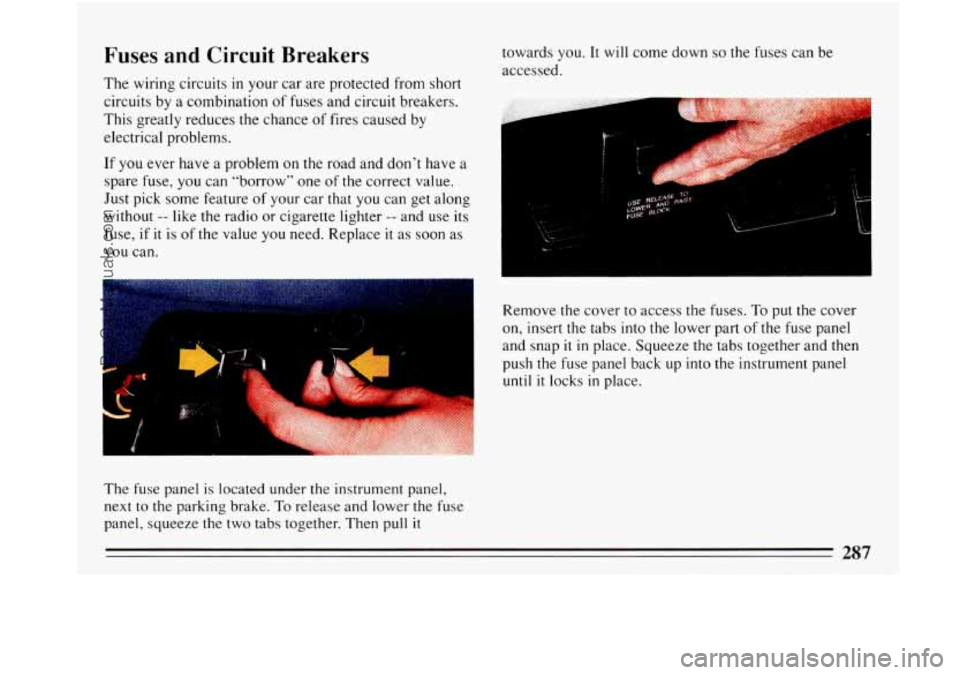
towards you. It will come down so the fuses can be
accessed.
Remove the cover to access the fuses.
To put the cover
on, insert the tabs into the lower part of the fuse panel
and snap
it in place. Squeeze the tabs together and then
push the fuse panel back up into the instrument panel
until it locks in place.
The fuse panel
is located under the instrument panel,
next to the parking brake.
To release and lower the fuse
panel, squeeze
the two tabs together. Then pull it
287
ProCarManuals.com
Page 290 of 340
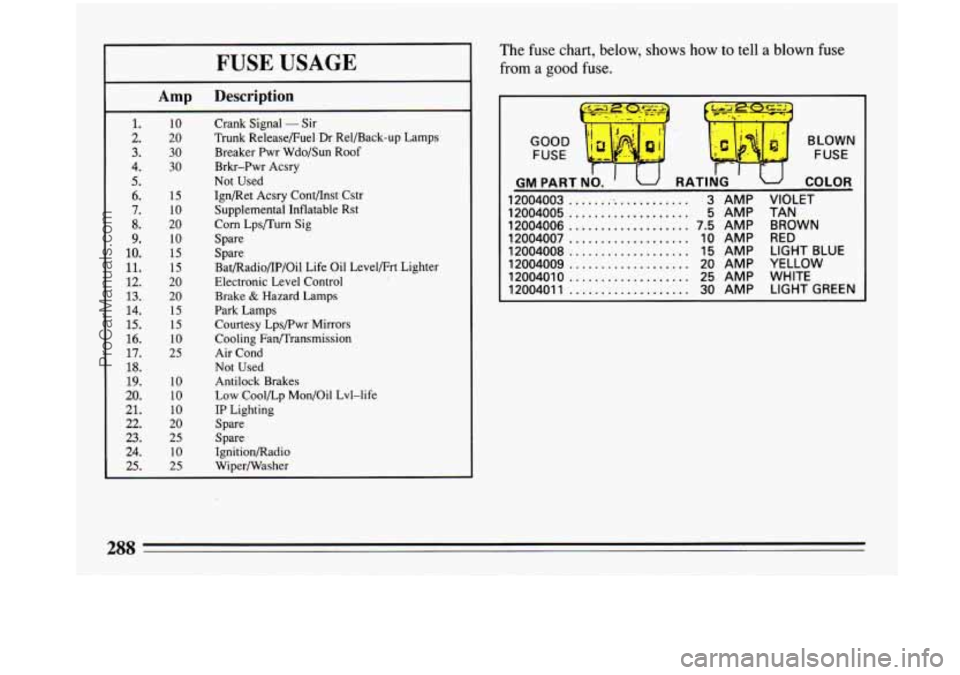
FUSE USAGE
Amp Description
1.
2.
3.
4.
5. 6.
7.
8.
9.
10.
11. 12.
13.
14.
15.
16. 17.
18.
19.
20.
21.
22.
23.
24.
25.
10
20
30
30
15
10
20
10
15
15
20
20
15
15
10
25
10
10
10
20
25
10
25
Crank Signal - Sir
Trunk Release/Fuel.Dr Rel/Back-up Lamps
Breaker Pwr Wdo/Sun Roof
Brkr-Pwr Acsry
Not Used
Ign/Ret Acsry ContDnst Cstr
Supplemental Inflatable Rst
Corn Lps/Turn Sig
Spare
Spare
Bat/Radio/IP/Oil Life Oil Level/Frt Lighter
Electronic Level Control
Brake
& Hazard Lamps
Park Lamps
Courtesy Lps/Pwr Mirrors
Cooling Fan/Transmission
Air Cond
Not Used
Antilock Brakes
Low Cool/Lp Mon/Oil Lvl-life
IP Lighting
Spare
Spare
IgnitionBadio
Wiperwasher
The fuse chart, below, shows how to tell a blown fuse
from a
good fuse.
GOOD
FUSE 1 BLOWN .r, ' \' gJ
'TI r
FUSE
GM PART NO. ' RATING ' COLOF
12004003 .................... 3 AMP VIOLET
12004005
................... 5 AMP TAN
12004006
................... 7.5 AMP BROWN
12004007
................... 10 AMP RED
12004008
................... 15 AMP LIGHT
BLUE
12004009
................... 20 AMP YELLOW
12004010
................... 25 AMP WHITE
1200401
1 ................... 30 AMP LIGHT
GREEN
ProCarManuals.com
Page 311 of 340
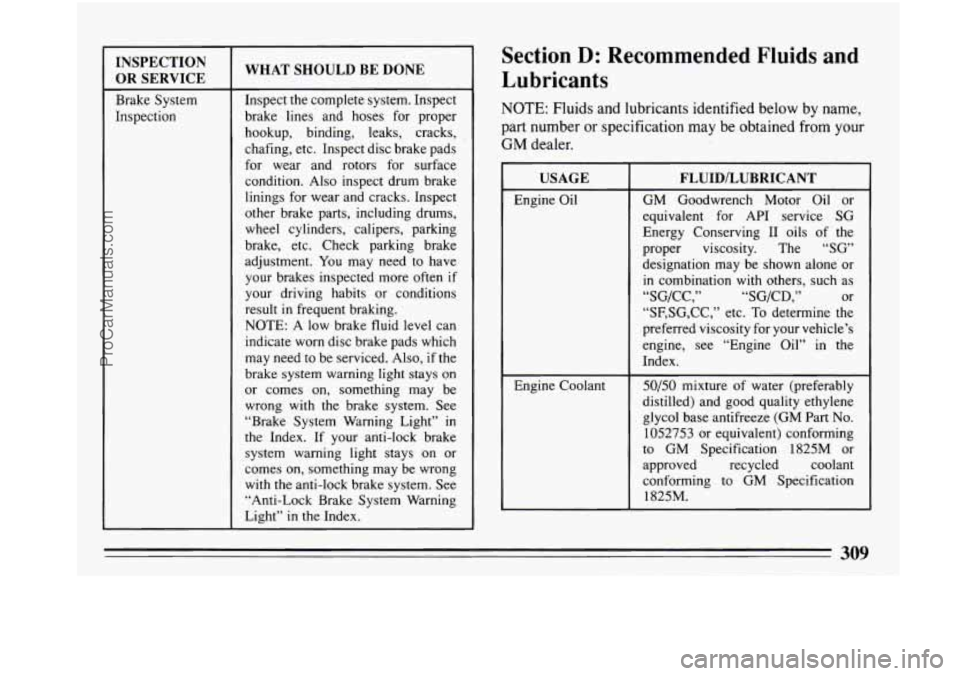
INSPECTION
OR SERVICE
Brake System
Inspection
WHAT SHOULD BE DONE
Inspect the complete system. Inspect
brake lines and hoses for proper
hookup, binding, leaks, cracks, chafing, etc. Inspect disc brake pads
for wear and rotors for surface
condition. Also inspect drum brake
linings for wear and cracks. Inspect
other brake parts, including drums,
wheel cylinders, calipers, parking
brake, etc. Check parking brake
adjustment.
You may need to have
your brakes inspected more often
if
your driving habits or conditions
result
in frequent braking.
NOTE: A low brake fluid level can
indicate worn disc brake pads which
may need
to be serviced. Also, if the
brake system warning light stays on
or comes
on, something may be
wrong with
the brake system. See
“Brake System Warning Light”
in
the Index. If your anti-lock brake
system warning light stays on or
comes on, something may be wrong
with
the anti-lock brake system. See
“Anti-Lock Brake System Warning
Light”
in the Index.
Section D: Recommended Fluids and
Lubricants
NOTE: Fluids and lubricants identified below by name,
part number or specification may be obtained from your
GM dealer.
USAGE
Engine Oil
Engine Coolant
FLUID/LUBRICANT
GM Goodwrench Motor Oil or
equivalent for API service SG
Energy Conserving I1 oils of the
proper viscosity. The
“SG”
designation may be shown alone or
in combination with others, such as
“SG/CC,” “SG/CD,”
or
“SF,SG,CC,” etc. To determine the
preferred viscosity for your vehicle’s
engine, see “Engine Oil” in the
Index.
50/50 mixture of water (preferably
distilled) and good quality ethylene
glycol base antifreeze (GM
Part No.
1052753 or equivalent) conforming
to GM Specification 1825M or
approved recycled coolant
conforming to GM Specification
1825M.
ProCarManuals.com