1993 BUICK LESABRE fuel
[x] Cancel search: fuelPage 255 of 324
Loading Your Vehicle
TIRE-LOADING INFORMATION
OCCUPANTS VEHICLE CAP. WT.
FRT. CTR. RR. TOTAL LBS. KG
MAX. LOADING
& GVWR SAME AS VEHICLE
CAPACITY WEIGHT XXX COLD TIRE
TIRE SIZE SPEED PRESSURE RTG PSVKPa
FRT.
RR.
SPA.
IF TIRES ARE HOT, ADD 4PSV28KPa
SEE OWNER’S MANUAL FOR ADDITIONAL
, INFORMATION
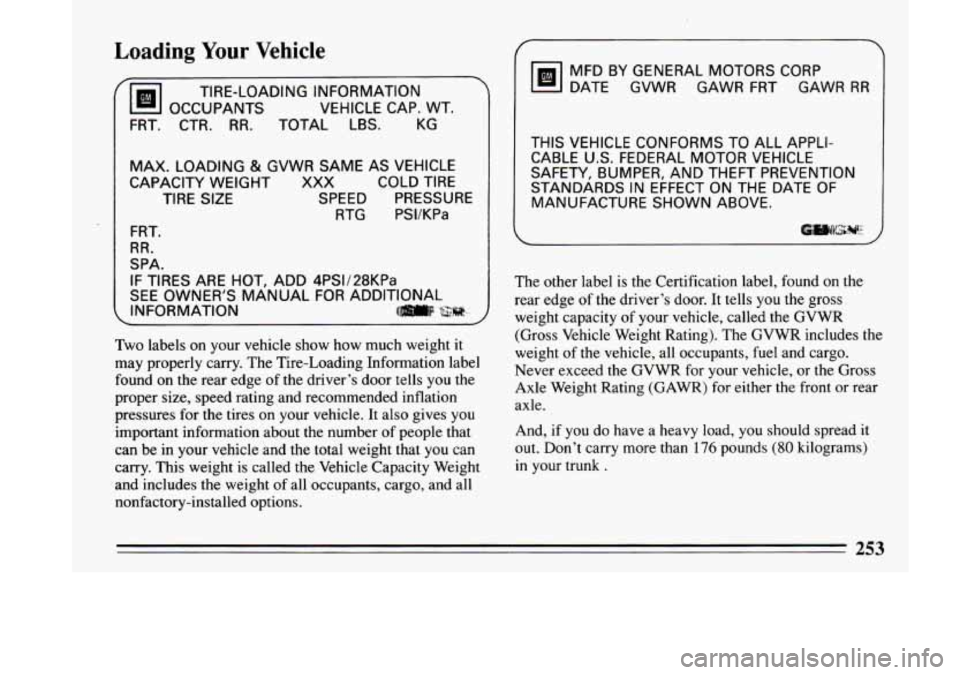
Two labels on your vehicle show how much weight it
may properly carry. The Tire-Loading Information label
found on the rear edge of the driver’s door tells you the
proper size, speed rating and recommended inflation
pressures for the tires on your vehicle. It also gives you
important information about the number of people that
can be in your vehicle and the total weight that you can
carry. This weight is called the Vehicle Capacity Weight
and includes the weight of all occupants, cargo, and all
nonfactory-installed options.
MFD BY GENERAL MOTORS CORP
DATE GVWR GAWR FRT GAWR
RR
THIS VEHICLE CONFORMS TO ALL APPLI-
CABLE U.S. FEDERAL MOTOR VEHICLE
SAFETY, BUMPER, AND THEFT PREVENTION
STANDARDS IN EFFECT ON THE DATE
OF
MANUFACTURE SHOWN ABOVE.
The other label is the Certification label, found on the
rear edge of the driver’s door. It tells you the gross
weight capacity of your vehicle, called the GVWR
(Gross Vehicle Weight Rating). The GVWR includes the
weight of the vehicle, all occupants, fuel and cargo.
Never exceed the GVWR for your vehicle, or the Gross
Axle Weight Rating (GAWR) for either the front or rear
axle.
And,
if you do have a heavy load, you should spread it
out. Don’t carry more than
176 pounds (80 kilograms)
in your trunk .
Page 269 of 324
Sheet Metal Damage
If your vehicle is damaged and requires sheet metal
repair or replacement, make sure the body repair shop
applies anti-corrosion material to the parts repaired or
replaced to restore corrosion protection.
Foreign Material
Calcium chloride and other salts, ice melting agents,
road oil and tar, tree sap, bird droppings, chemicals from
industrial chimneys, and other foreign matter can
damage your vehicle’s finish if
they remain on painted
surfaces. Use cleaners that are marked
safe for painted
surfaces for
these stains.
Finish Damage
Any stone chips, fractures or deep scratches in the finish
should be repaired right away. Bare metal will corrode
quickly and may develop
into a major repair expense.
Minor chips and Scratches can be repaired with touch-up
materials available from your dealer or other service
outlets. Larger areas of finish damage can be corrected
in your dealer’s body and paint shop.
Underbody Maintenance
Chemicals used for ice and snow removal and dust
control can collect on the underbody.
If these are not
removed, accelerated corrosion (rust) can occur on the
underbody parts such as fuel lines, frame, floor pan, and
exhaust system even though they have corrosion
protection.
At least every spring, flush these materials from the
underbody with plain water. Clean any areas where mud
and other debris can collect.
Dirt packed in closed areas of
the frame should be
loosened before being flushed. Your
dealer or an underbody vehicle washing system can do this
for
you.
Chemical Paint Spotting
Some weather and atmospheric conditions can create a
chemical fallout. Airborne pollutants can fall upon and
attack painted surfaces
on your vehicle. This damage can
take two forms: blotchy, ringlet-shaped discolorations,
and small irregular dark spots etched into the paint
surface.
Although no defect in the paint job causes this, Buick
will repair, at
no charge to the owner, the surfaces of
new vehicles damaged by this fallout condition within
12 months or 12,000 miles (20 000 km) of purchase,
whichever comes first.
Page 277 of 324
Capacities and Specifications
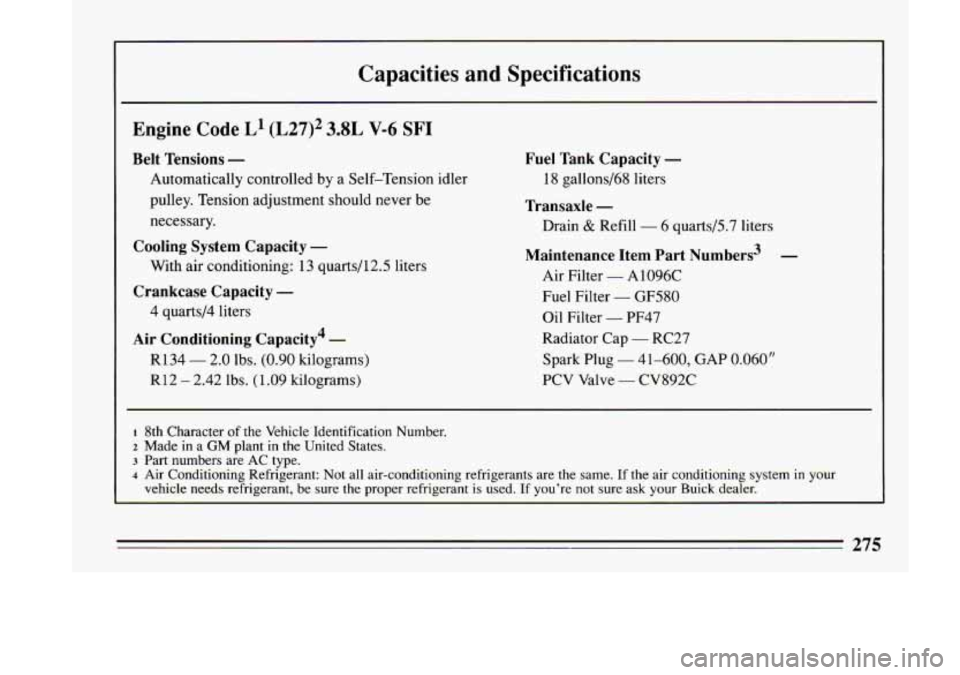
Engine Code L1 (L27)2 3.8L V-6 SF1
Belt Tensions -
Automatically controlled by a Self-Tension idler
pulley. Tension adjustment should never
be
necessary.
Cooling System Capacity -
Crankcase Capacity -
Air Conditioning Capacity4 -
With air conditioning: 13 quarts/l2.5 liters
4 quarts/4 liters
R134
- 2.0 lbs. (0.90 kilograms)
R12 - 2.42 lbs. ( 1.09 kilograms)
Fuel Tank Capacity -
18 gallons/68 liters
Transaxle -
Drain & Refill - 6 quarts/5.7 liters
Maintenance Item Part Numbers3 -
Air Filter - A1096C
Fuel Filter
- GF580
Oil Filter
- PF47
Radiator Cap - RC27
Spark Plug
- 41-600, GAP 0.060”
PCV Valve
- CV892C
1 8th Character of the Vehicle Identification Number.
2 Made in a GM plant in the United States.
3 Part numbers are AC type.
4 Air Conditioning Refrigerant: Not all air-conditioning refrigerants are the same. If the air conditioning system in your
vehicle needs refrigerant, be sure the proper refrigerant
is used. If you’re not sure ask your Buick dealer.
Page 279 of 324
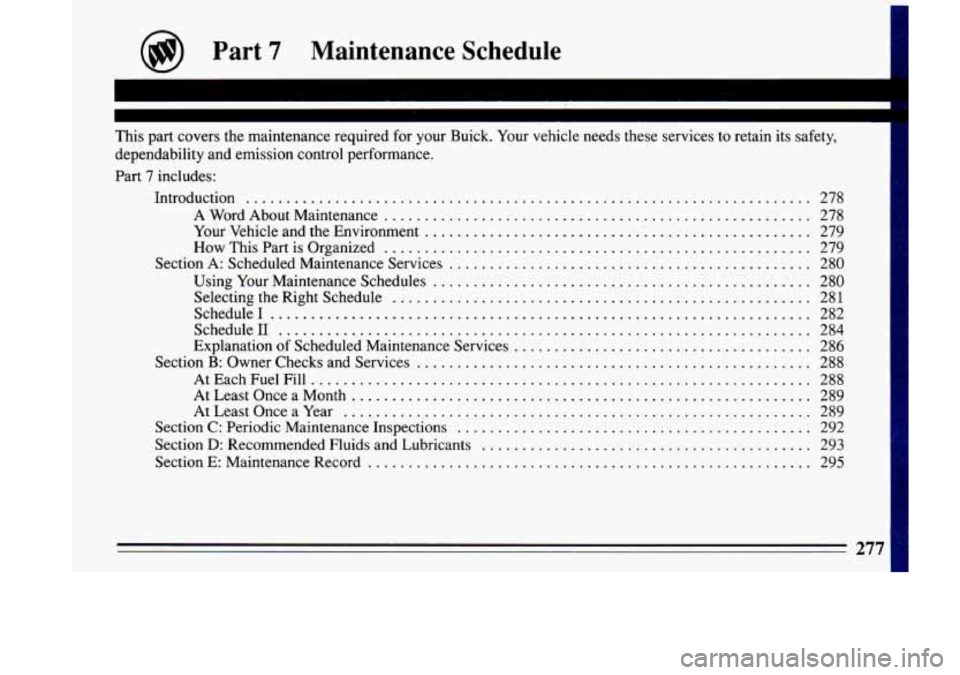
This part covers the maintenance required for your Buick . Your vehicle needs these services to retain its safety.
dependability and emission control performance
.
Part 7 includes:
Introduction
...................................................................... 278
A Word About Maintenance
..................................................... 278
Your Vehicle and the Environment
................................................. 279
Section A: Scheduled Maintenance Services
............................................. 280
Using Your Maintenance Schedules
............................................... 280
Selecting the Right Schedule
.................................................... 281
Schedule1
................................................................... 282
Schedule11
.................................................................. 284
Explanation of Scheduled Maintenance Services ..................................... 286
Section
B: Owner Checks and Services ................................................. 288
AtEachFuelFill
.............................................................. 288
AtLeastOnceaMonth
......................................................... 289
AtLeastOnceaYear
.......................................................... 289
Section
C: Periodic Maintenance Inspections ............................................ 292
Section
D: Recommended Fluids and Lubricants ......................................... 293
Section
E: Maintenance Record ....................................................... 295
How
This Part is Organized
..................................................... 279
277
Page 281 of 324
* Your Vehicle and the Environment
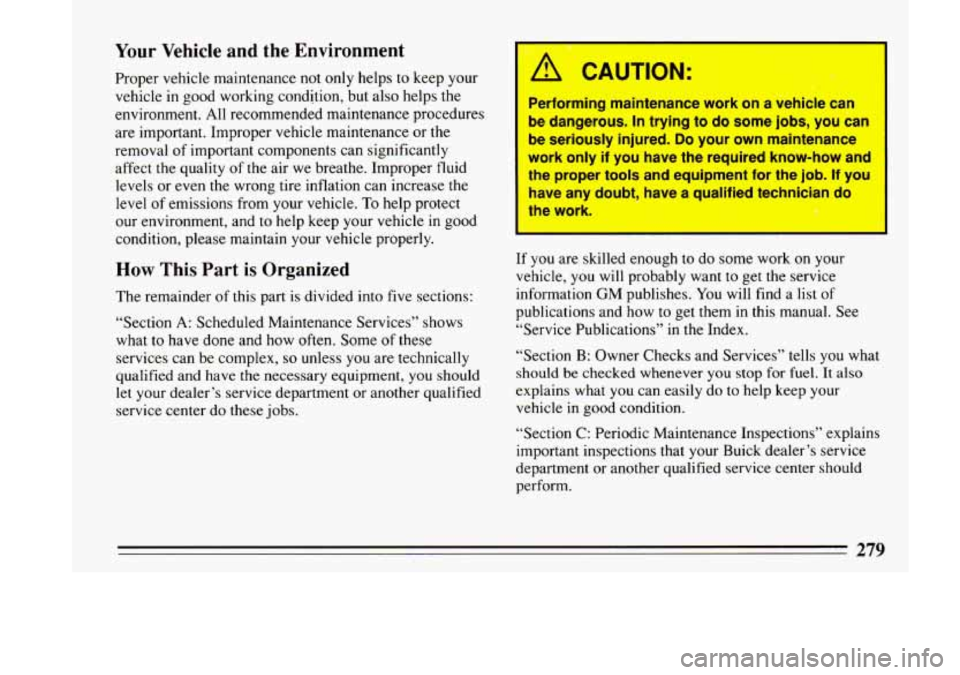
Proper vehicle maintenance not only helps to keep your
vehicle in good working condition, but also helps the
environment. All recommended maintenance procedures
are important. Improper vehicle maintenance or the
removal of important components can significantly
affect the quality
of the air we breathe. Improper fluid
levels or even the wrong tire inflation can increase the
level of emissions from your vehicle.
To help protect
our environment, and to help keep your vehicle in good
condition, please maintain your vehicle properly.
How This Part is Organized
The remainder of this part is divided into five sections:
“Section
A: Scheduled Maintenance Services” shows
what
to have done and how often. Some of these
services can be complex,
so unless you are technically
qualified and have the necessary equipment,
you should
let your dealer’s service department or another qualified
service center do these
jobs.
A CAUTION:
1. *
._ 1. c
Performing maintenance work on a vehicle can
be dangerous. In trying to do some jobs, you can
be seriously injured.
Do your own maintenance
work only if you have the required know-how and the proper tools and equipment for the
job. If you
have any doubt, have a qualified technician do
the work.
If you are skilled enough to do some work on your
vehicle, you will probably want to get the service
information
GM publishes. You will find a list of
publications and how to get them in this manual. See
“Service Publications’’ in the Index.
“Section
B: Owner Checks and Services” tells you what
should
be checked whenever you stop for fuel. It also
explains what you can easily do to help keep your
vehicle in good condition.
“Section
C: Periodic Maintenance Inspections” explains
important inspe.ctions that your Buick dealer’s service
department or another qualified service center should
perform.
279
- .. ~ .. - .
Page 282 of 324
“Section D: Recommended Fluids and Lubricants” lists
some products GM recommends to help keep your
vehicle properly maintained. These products, or their
equivalents, should be used whether you do the work
yourself or have it done.
“Section
E: Maintenance Record” provides a place for
you to record the maintenance performed on your
vehicle. Whenever any maintenance is performed, be
sure to write it down in this section. This will help
you
determine when your next maintenance should be done.
In addition, it is a good idea to keep your maintenance
receipts. They may be needed to qualify your vehicle for
warranty repairs.
Section A: Scheduled Maintenance
Services
Using Your Maintenance Schedules
This section tells you the maintenance services you
should have done and when you should schedule them.
Your Buick dealer knows your vehicle best and wants
you to be happy with it. If you go to your dealer for your
service needs, you’ll know that GM-trained and
supported service people will perform the work using
genuine
GM parts.
These schedules are for vehicles that:
0 carry passengers and cargo within recommended limits. You will find these limits on your vehicle’s
Tire-Loading Information label. See “Loading Your
Vehicle” in the Index.
0 are driven on reasonable road surfaces within legal
driving limits.
0 use the recommended unleaded fuel. See “Fuel” in
the Index.
280
Page 285 of 324
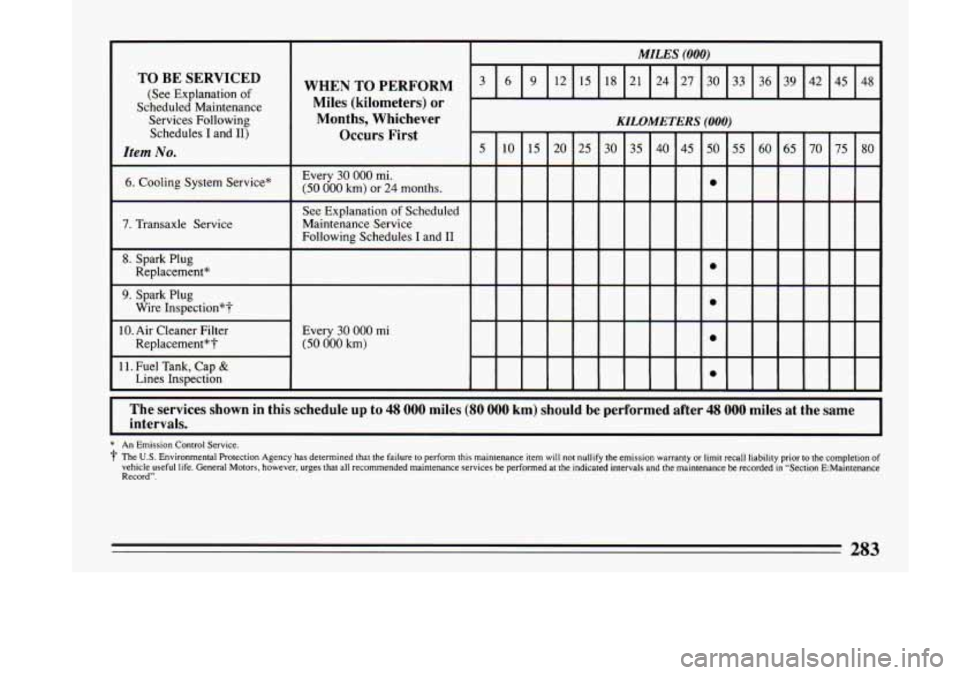
TO BE SERVICED
(See Explanation of
Scheduled Maintenance
Months, Whichever Services Following
Miles (kilometers) or
WHEN
TO PERFORM
Schedules I and
IIj
I Itern No.
Occurs First
I
7. Transaxle Service See
Explanation
of Scheduled
Maintenance Service
Following Schedules I and
I1
I 8. Spark~Plug ~
Replacement*
I 9. Wire Spark Inspection”?
10. Air Cleaner Filter
I Replacement*? I
Every 30 000 mi
(50 000 km)
11. Fuel Tank, Cap &
I Lines Inspection
MILES (000)
3
39 36 33
30 27
24 21 18 15 12 9 6
KILOMETERS (000)
50 55
0
0
0
0
0
60 65 70 75 80
The services
shown in this schedule up to 48 000 miles (80 000 km) should be performed after 48 000 miles at the same
intervals.
* An Emission Control Service.
The
U.S. Environmental Protection Agency has determined that the failure to perform this maintenance item will not nullify the emission warranty or limit recall liability prior to the completion of
vehicle useful life. General Motors, however, urges that all recommended maintenance services be performed at the indicated intervals and the maintenance be recorded in “Section EMaintenance
Record”.
283
Page 287 of 324
1 I
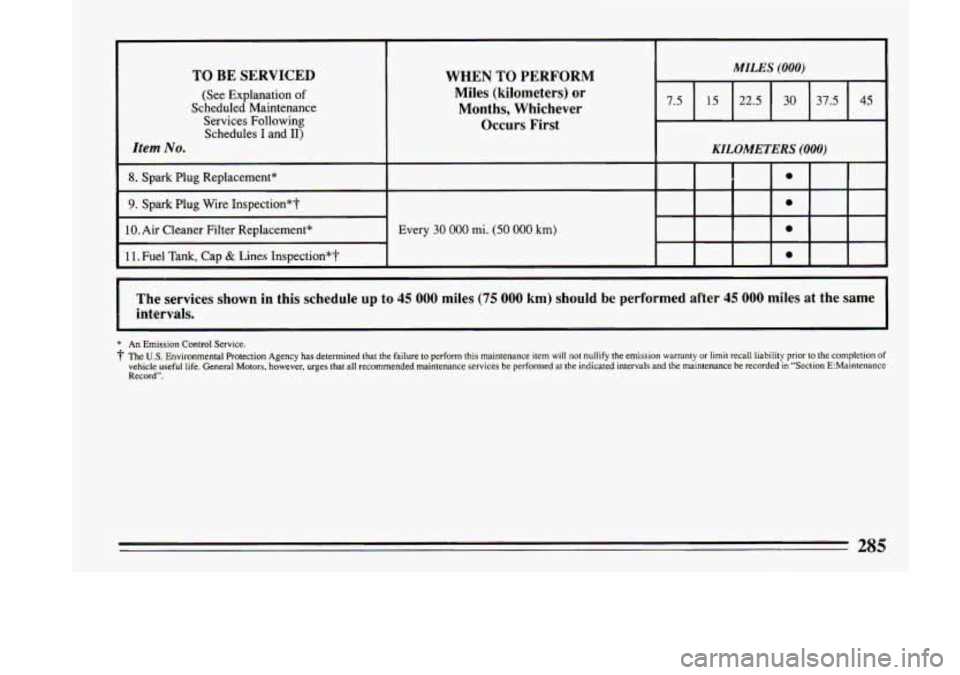
TO BE SERVICED
(See Explanation of
Scheduled Maintenance Services Following Schedules
I and II)
Item No.
WHEN TO PERFORM
Miles (kilometers) or
Months, Whichever Occurs First
MILES (000)
7.5 45 37.5 30 22.5 15
KILOMETERS (000)
8. Spark Plug Replacement*
9. Spark Plug Wire Inspection*?
0
0 1 1. Fuel Tank, Cap & Lines Inspection*?
0 Every 30 000 mi. (50 000 km) 10. Air Cleaner Filter Replacement*
0
I
The services shown in this schedule up to 45 000 miles (75 000 km) should be performed after 45 000 miles at the same
intervals.
I
* An Emission Control Service.
The
U.S. Environmental Protection Agency has determined that the failure to perform this maintenance item will not nullify the emission warranty or limit recall liability prior IO the completion of vehicle useful life. General Motors, however, urges that all recommended maintenance services be performed at the indicated intervals and the maintenance be recorded in "Section E:Maintenance
Record".