1993 BUICK LESABRE tires
[x] Cancel search: tiresPage 194 of 324
e e Will you have to make any holes in the body of your vehicle when you install a trailer hitch? If you
do,
then be sure to seal the holes later when you remove
the hitch. If you don’t seal them, deadly carbon
monoxide
(CO) from your exhaust can get into your
vehicle (see “Carbon Monoxide” in the Index). Dirt
and water can, too.
The bumpers on your vehicle are not intended for
hitches.
Do not attach rental hitches or other
bumper-type hitches to them. adequate.
Be sure to read and follow the instructions for
the trailer brakes
so you’ll be able to install, adjust and
maintain them properly. Because you have anti-lock
brakes, do not try to tap into your vehicle’s brake
system.
If you do, both brake systems won’t work well,
or at all.
Driving with a Trailer
Towing a trailer requires a certain amount of experience.
Before setting out for the open road, you’ll want to get
to know your rig. Acquaint yourself with the feel of
handling and braking with the added weight of the
trailer. And always keep in mind that the vehicle you are
driving is now a good deal longer and not nearly
so
responsive as your vehicle is by itself.
Safety Chains
You should always attach chains between your vehicle
and your trailer.
Cross the safety chains under the
tongue
of the trailer so that the tongue will not drop to
the road if it becomes separated from the hitch.
Instructions about safety chains may be provided by the
hitch manufacturer or by the trailer manufacturer.
Follow the manufacturer’s recommendation for
attaching safety chains. Always leave just enough slack
so you can turn with your rig. And, never allow safety
chains to drag
on the ground.
Trailer Brakes
If your trailer weighs more than 1,000 pounds (450 kg)
loaded, then it needs its own brakes
-- and they must be
192
~-
Before you start, check the trailer hitch and platform,
safety chains, electrical connector, lights, tires
and
mirror adjustment. If the trailer has electric brakes, start
your vehicle and trailer moving and then apply the
trailer brake controller by hand to be sure the brakes are
working. This lets you check your electrical connection
at the same time.
During your trip, check occasionally
to be sure that the
load is secure, and that the lights and any trailer brakes
are still working.
Page 205 of 324
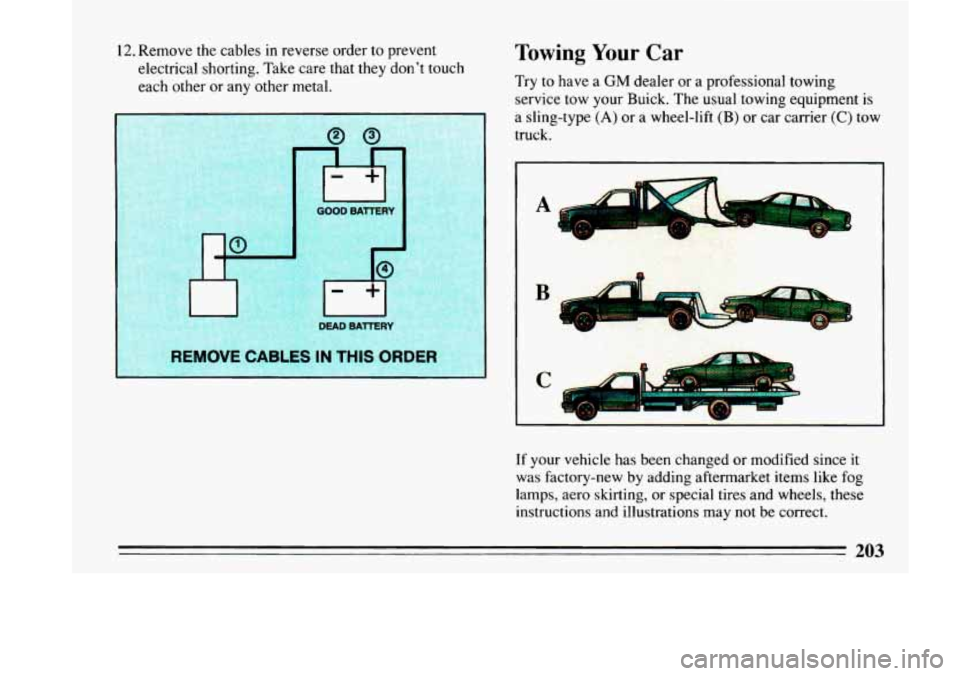
12. Remove the cables in reverse order to prevent
electrical shorting. Take care that they don't touch
each other
or any other metal.
rp+,
GOOD BATTERY
I:
Towing Your Car
Try to have a GM dealer or a professional towing
service tow your Buick. The usual towing equipment is
a sling-type
(A) or a wheel-lift (B) or car carrier (C) tow
truck.
I
If your vehicle has been changed or modified since it
was factory-new by adding aftermarket items like fog
lamps, aero skirting, or special tires and wheels, these
instructions and illustrations may not be correct.
203
Page 218 of 324
If a Tire Goes Flat
It’s unusual for a tire to “blow out” while you’re driving,
especially if you maintain your tires properly.
If air goes
out of a tire, it’s much more likely to leak out slowly.
But if you should ever have a “blowout,” here are a few
tips about what to expect and what to do:
If a front tire fails,
the flat tire will create a drag that
pulls the vehicle toward that side. Take your foot off the
accelerator pedal and grip the steering wheel firmly. Steer to maintain lane position, then gently brake to a
stop well out
of the traffic lane.
A rear blowout, particularly on a curve, acts much like a
skid and may require the same correction you’d use in a
skid. In any rear blowout, remove your foot from the
accelerator pedal. Get the vehicle under control
by
steering the way you want the vehicle to go. It may be
very bumpy and noisy, but you can still steer. Gently
brake to a stop, well
off the road if possible.
If your tire goes flat, the next section shows how to use
your jacking equipment to change a flat tire safely.
Changing a Flat Tire
If a tire goes flat, avoid further tire and wheel damage
by driving slowly to
a level place. Turn on your hazard
warning flashers.
A CAUTION:
Changing 8 tire can cause an injury. The vehicle
can
slip off the jack and roll over you or other
people. You and they could be badly injured. Find
eve1 place to change your tire. To help prevent
the vehicle from moving:
1. Set the parking brake firmly.
2. Put the shift lever In “P” (Park).
3. Turn off the engine.
lo be even more certain the vehicle won’t move,
you can put chocks at the front and rear of the tire
Farthest away from the one being changed. That
would
be the tire on the other side of the vehicle,
at the oppll le end.
216
-
Page 229 of 324
Compact Spare Tire
Although the compact spare was fully inflated when
your vehicle was new, it can lose air after a time. Check
the inflation pressure regularly. It should be
60 psi (420
Wa). The compact spare is made to go up to 3,000 miles
(5000 km), so you can finish your trip and have your
full-size tire repaired or replaced where you want. Of
course, it’s best
to replace your spare with a full-size tire
as soon as
you can. Your spare will last longer and be in
good shape in case you need it again.
Your anti-lock brake system warning light may come
on
when you are driving with a compact spare. See
“Anti-Lock Brake System Warning Light” in the Index. Don’t
use your
compact spare on some other vehicle.
And don’t mix your compact spare or wheel with other
wheels or tires. They won’t fit. Keep your spare and its
wheel together.
Tire chains wo
them will damage
y
chains too. Do
compact spar I
A CnUTION:
Storing a jack, a tire, or other equipment in the
passenger compartment of the vehicle could
cause injury. In a sudden stop or colllsian, loose
mwipment could strike someone. Store all these
.__ the proper place.
I
227
Page 230 of 324
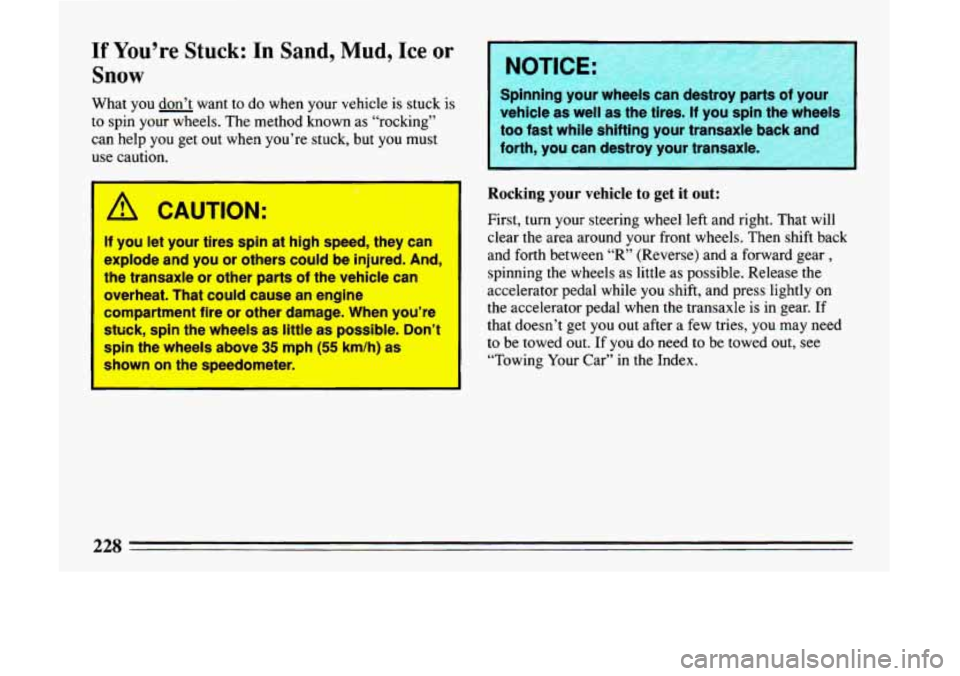
If You’re Stuck: In Sand, Mud, Ice or
Snow
What you don’t want to do when your vehicle is stuck is
to spin your wheels. The method known as “rocking”
can help you get out when you’re stuck, but you must
use caution.
1 LAUTION:
If you let your tires spin at high speed, they can
explode and you or others could be injured. And,
the transaxle or other parts of the vehicle can
overheat. That could cause an engine
compartment fire or other damage. When you’re
stuck, spin the wheels as little as possible. Don’t
spin the wheels above 35 mph (55 km/h) as
own on the speedometer.
I
I AOTICE:
Spinning your troy pal I
vehicle as well as the tires. If you spin the wheels
too fast while shifting your transaxle
forth, you can destroy your transaxle.
Rocking your vehicle to get it out:
First, turn your steering wheel left and right. That will
clear the area around your front wheels. Then shift back
and forth between
“R” (Reverse) and a forward gear ,
spinning the wheels as little as possible. Release the
accelerator pedal while you shift, and press lightly on
the accelerator pedal when the transaxle
is in gear. If
that doesn’t get
you out after a few tries, you may need
to be towed out. If you do need to be towed out, see
“Towing Your Car” in the Index.
Page 231 of 324

@ Part 6 Service & Appearance Lare
Here you will find information about the care of your Buick . This part begins with service and fuel information. and
then it shows how to check important fluid and lubricant level\
s
. There is also technical information about your
vehicle. and a section devoted to its appearance care .
Part 6 includes:
ServiceTips
......................................................................
Fuel ........................................................................\
.....
HoodRelease .....................................................................
Engineoil ....................................................................... \
AirFilter ........................................................................\
.
Automatic Transaxle Fluid ............................................................
Enginecoolant ....................................................................
Power Steering Fluid ...............................................................
Windshield Washer Fluid ............................................................
Brakes ........................................................................\
...
Battery ........................................................................\
..
BulbReplacement .................................................................
Tires ........................................................................\
.....
Appearancecare ..................................................................
Vehicle Identification Number (VIN) ..................................................
FusesandCircuitBreake ............................................................
Capacities and Specifications .........................................................
LoadingYourVehicle ...............................................................
230
231
234
236
240
241
243
246 247
248
249
250
253
255
262
269
270
275
229
Page 255 of 324
Loading Your Vehicle
TIRE-LOADING INFORMATION
OCCUPANTS VEHICLE CAP. WT.
FRT. CTR. RR. TOTAL LBS. KG
MAX. LOADING
& GVWR SAME AS VEHICLE
CAPACITY WEIGHT XXX COLD TIRE
TIRE SIZE SPEED PRESSURE RTG PSVKPa
FRT.
RR.
SPA.
IF TIRES ARE HOT, ADD 4PSV28KPa
SEE OWNER’S MANUAL FOR ADDITIONAL
, INFORMATION
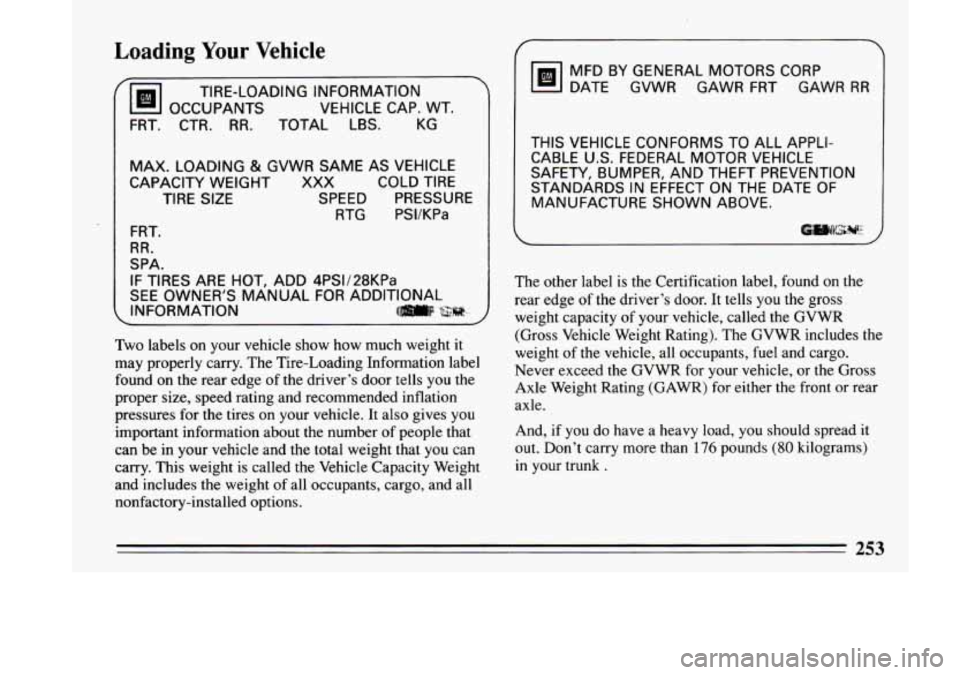
Two labels on your vehicle show how much weight it
may properly carry. The Tire-Loading Information label
found on the rear edge of the driver’s door tells you the
proper size, speed rating and recommended inflation
pressures for the tires on your vehicle. It also gives you
important information about the number of people that
can be in your vehicle and the total weight that you can
carry. This weight is called the Vehicle Capacity Weight
and includes the weight of all occupants, cargo, and all
nonfactory-installed options.
MFD BY GENERAL MOTORS CORP
DATE GVWR GAWR FRT GAWR
RR
THIS VEHICLE CONFORMS TO ALL APPLI-
CABLE U.S. FEDERAL MOTOR VEHICLE
SAFETY, BUMPER, AND THEFT PREVENTION
STANDARDS IN EFFECT ON THE DATE
OF
MANUFACTURE SHOWN ABOVE.
The other label is the Certification label, found on the
rear edge of the driver’s door. It tells you the gross
weight capacity of your vehicle, called the GVWR
(Gross Vehicle Weight Rating). The GVWR includes the
weight of the vehicle, all occupants, fuel and cargo.
Never exceed the GVWR for your vehicle, or the Gross
Axle Weight Rating (GAWR) for either the front or rear
axle.
And,
if you do have a heavy load, you should spread it
out. Don’t carry more than
176 pounds (80 kilograms)
in your trunk .
Page 257 of 324
Tires
We don’t make tires. Your new vehicle comes with high
quality tires made by
a leading tire manufacturer. These
tires are warranted by the tire manufacturers and their
warranties are delivered
with every new Buick. If your
spare tire
is a different brand than your road tires, you
will have a tire warranty folder from each of these
manufacturers.
A CAUTION:
Poorly maintained and improperly used tires are
dangerous.
Overloading your tires can cause
overheating as
a result of too much
friction. You could have an air-out and a
serious accident.
See “Loading Your
Vehicle” in the Index.
Underinflated tires pose the same danger
as overloaded tires. The resulting accident
could cause serious injury. Check
all tires
frequently to maintain the recommended
pressure. Tire pressure should
be checked
when your tires are
cold.
Over inflated tires are more likely to be cut,
punctured, or broken by
a sudden impact,
such
as when you hit a pothole. Keep tires
at the recommended pressure.
Worn,
old tires can cause accidents. If your
tread
is badly worn, or if your tires have
been damaged, replace them.
255