1993 BUICK LESABRE trailer
[x] Cancel search: trailerPage 192 of 324
trailer adds considerably to wind resistance, increasing the pulling requirements.
All
of that means changes in:
Handling
Durability
Fuel economy
If You Do Decide To Pull A Trailer
If you do, here are some important points.
There are many different laws having to do with
trailering. Make sure your rig will be legal, not only
where you live but also where you’ll be driving.
A
good source for this information can be state or
provincial police.
Consider using a sway control if your trailer will
weigh
2,000 pounds (900 kg) or less. You should
always use a sway control if your trailer will weigh
more than
2,000 pounds (900 kg).
You can ask a hitch dealer about sway controls.
Don’t tow a trailer at all during the first 500 miles
(800 km) your new vehicle is driven. Your engine,
axle or other parts could be damaged.
Then, during the first 500 miles (800 km) that you
tow a trailer, don’t drive over
50 mph (80 km/h) and
don’t make starts at full throttle. This helps your engine and other parts of your vehicle wear in at the
heavier loads.
Three important considerations have to do with weight:
Weight of the Trailer
How heavy can a trailer safely be?
It should never weigh more than
1,000 pounds (450 kg),
unless you have the optional
3,000 pound (1 350 kg)
trailer towing package. But even that can be too heavy.
It depends on how you plan to use your rig. For
example, speed, altitude, road grades, outside
temperature and how much your vehicle is used to pull a
trailer are all important. And,
it can also depend on any
special equipment that
you have on your vehicle.
You can ask your dealer for our trailering information or
advice, or you can write us at Buick Motor Division, Customer Assistance Center,
902 E. Hamilton Avenue,
Flint,
MI 48550.
In Canada, write to General Motors of Canada Limited,
Customer Assistance Center, 1908 Colonel Sam Drive,
Oshawa, Ontario
LlH 8P7.
190
Page 193 of 324
Weight of the Trailer Tongue
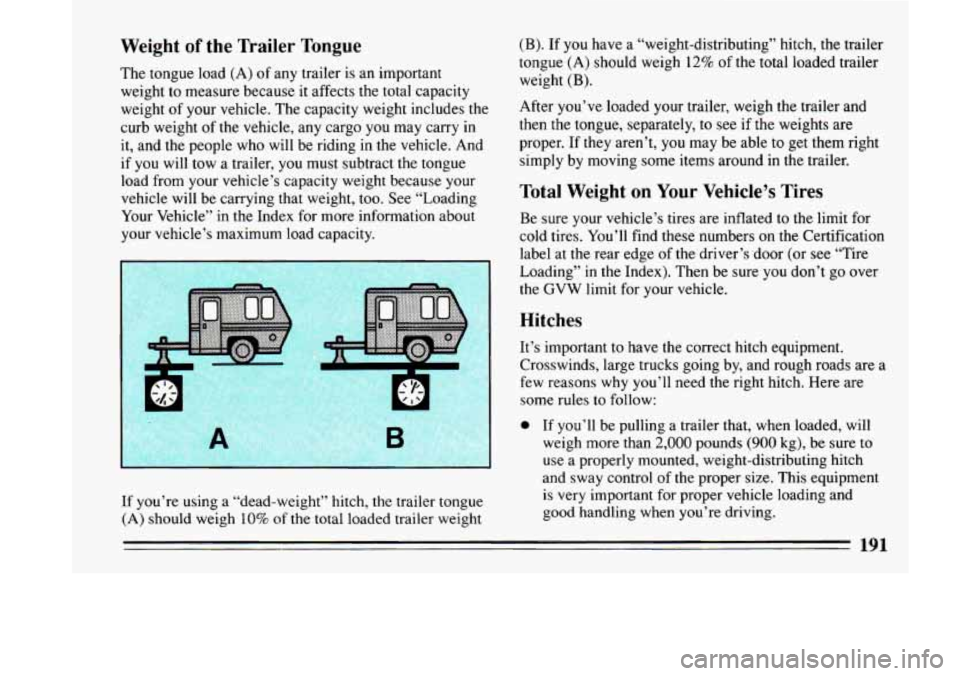
The tongue load (A) of any trailer is an important
weight
to measure because it affects the total capacity
weight
of your vehicle. The capacity weight includes the
curb weight
of the vehicle, any cargo you may carry in
it, and the people who will be riding in the vehicle. And
if
you will tow a trailer, you must subtract the tongue
load from your vehicle’s capacity weight because your
vehicle will be carrying that weight, too. See “Loading
Your Vehicle” in the Index for more information about
your vehicle’s maximum load capacity.
A
If you’re using a “dead-weight” hitch, the trailer tongue
(A) should weigh 10% of the total loaded trailer weight (B).
If you have a “weight-distributing” hitch, the trailer
tongue
(A) should weigh 12% of the total loaded trailer
weight (B).
After you’ve loaded your trailer, weigh the trailer and
then the tongue, separately, to see
if the weights are
proper. If they aren’t, you may be able to get them right
simply by moving some items around in the trailer.
Total Weight on Your Vehicle’s Tires
Be sure your vehicle’s tires are inflated to the limit for
cold tires. You’ll find these numbers on the Certification
label at the rear edge of the driver’s door (or see “Tire
Loading” in the Index). Then be sure you don’t go over
the
GVW limit for your vehicle.
Hitches
It’s important to have the correct hitch equipment.
Crosswinds, large trucks going by, and rough roads are a
few reasons why you’ll need the right hitch. Here are
some rules to follow:
0 If you’ll be pulling a trailer that, when loaded, will
weigh more than
2,000 pounds (900 kg), be sure to
use a properly mounted, weight-distributing hitch
and sway control
of the proper size. This equipment
is very important for proper vehicle loading and
good handling when you’re driving.
191
Page 194 of 324
e e Will you have to make any holes in the body of your vehicle when you install a trailer hitch? If you
do,
then be sure to seal the holes later when you remove
the hitch. If you don’t seal them, deadly carbon
monoxide
(CO) from your exhaust can get into your
vehicle (see “Carbon Monoxide” in the Index). Dirt
and water can, too.
The bumpers on your vehicle are not intended for
hitches.
Do not attach rental hitches or other
bumper-type hitches to them. adequate.
Be sure to read and follow the instructions for
the trailer brakes
so you’ll be able to install, adjust and
maintain them properly. Because you have anti-lock
brakes, do not try to tap into your vehicle’s brake
system.
If you do, both brake systems won’t work well,
or at all.
Driving with a Trailer
Towing a trailer requires a certain amount of experience.
Before setting out for the open road, you’ll want to get
to know your rig. Acquaint yourself with the feel of
handling and braking with the added weight of the
trailer. And always keep in mind that the vehicle you are
driving is now a good deal longer and not nearly
so
responsive as your vehicle is by itself.
Safety Chains
You should always attach chains between your vehicle
and your trailer.
Cross the safety chains under the
tongue
of the trailer so that the tongue will not drop to
the road if it becomes separated from the hitch.
Instructions about safety chains may be provided by the
hitch manufacturer or by the trailer manufacturer.
Follow the manufacturer’s recommendation for
attaching safety chains. Always leave just enough slack
so you can turn with your rig. And, never allow safety
chains to drag
on the ground.
Trailer Brakes
If your trailer weighs more than 1,000 pounds (450 kg)
loaded, then it needs its own brakes
-- and they must be
192
~-
Before you start, check the trailer hitch and platform,
safety chains, electrical connector, lights, tires
and
mirror adjustment. If the trailer has electric brakes, start
your vehicle and trailer moving and then apply the
trailer brake controller by hand to be sure the brakes are
working. This lets you check your electrical connection
at the same time.
During your trip, check occasionally
to be sure that the
load is secure, and that the lights and any trailer brakes
are still working.
Page 195 of 324
Following Distance
Stay at least twice as far behind the vehicle ahead as you
would when driving your vehicle without a trailer. This
can help
you avoid situations that require heavy braking
and sudden turns.
Passing
You’ll need more passing distance up ahead when
you’re towing a trailer. And, because you’re a good deal
longer, you’ll need to go much farther beyond the
passed vehicle before you can return
to your lane.
Backing Up
Hold the bottom of the steering wheel with one hand.
Then,
to move the trailer to the left, just move that hand
to the left. To move the trailer to the right, move your
hand
to the right. Always back up slowly and, if
possible, have someone guide you.
Making nrns
When you’re turning with a trailer, make wider turns
than normal. Do this
so your trailer won’t strike soft
shoulders, curbs, road signs, trees, or other objects.
Avoid jerky or sudden maneuvers. Signal well
in
advance.
Turn Signals When Towing a Trailer
When you tow a trailer, your vehicle has to have a
different turn signal flasher and extra wiring. The green
arrows
on your instrument panel will flash whenever
you signal a turn
or lane change. Properly hooked up,
the trailer lights will also flash, telling other drivers
you’re about to turn, change lanes or stop.
When towing a trailer, the green arrows on your
instrument panel will flash for turns even if the bulbs on
the trailer are burned out.
Thus, you may think drivers
behind you are seeing your signal when they are
not. It’s
important to check occasionally to be sure the trailer
bulbs are still working.
Driving On Grades
Reduce speed and shift to a lower gear before you start
down a long or steep downgrade. If you don’t shift
down,
you might have to use your brakes so much that
they would get hot and no longer work well.
On a long uphill grade, shift down to “D” (Drive) and
reduce your speed to around
45 mph (70 km/h) to
reduce the possibility of engine and transaxle
overheating.
193
Page 196 of 324

Parking on Hills
You really should not park your vehicle, with a trailer
attached, on a hill. If something goes wrong, your rig
could start to move. People can be injured, and both
your vehicle and the trailer can be damaged.
But if you
ever have to park your rig on a hill, here’s
how to do it:
1. Apply your regular brakes, but don’t shift into “P7’
(Park) yet.
2. Have someone place chocks under the trailer wheels.
3. When the wheel chocks are in place, release the
regular brakes until the chocks absorb the load.
4. Reapply the regular brakes. Then apply your parking
brake, and then shift to
“P” (Park).
5. Release the regular brakes.
When You Are Ready to Leave After
Parking
on a Hill
1. Apply your regular brakes and hold the pedal down
while you:
Start your engine;
Shift into a gear; and
0 Release the parking brake.
2. Let up on the brake pedal.
3. Drive slowly until the trailer is clear of the chocks.
4. Stop and have someone pick up and store the chocks.
Maintenance When Trailer Towing
Your vehicle will need service more often when you’re
pulling a trailer. See the Maintenance Schedule for more
on this. Things that are especially important in trailer
operation are automatic transaxle fluid (don’t overfill),
engine oil, belts, cooling system, and brake adjustment.
Each of these is covered
in this manual, and the Index
will help you find them quickly. If you’re trailering, it’s
a good idea to review these sections before you
start
your trip.
Check periodically to see that all hitch nuts and bolts are
tight.
194
Page 210 of 324
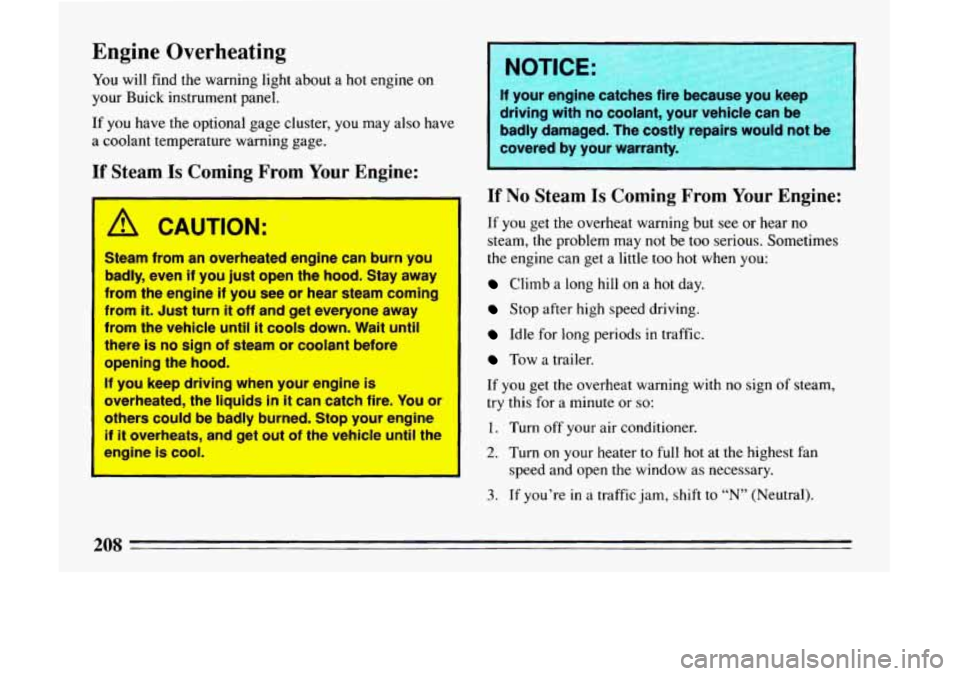
Engine Overheating
You will find the warning light about a hot engine on
your Buick instrument panel,
If you have the optional gage cluster, you may also have
a coolant temperature warning gage.
If Steam Is Coming From Your Engine:
CAUTION:
eam from an overheated engine can burn you
badly, even if you just open
the hood. Stay away
from
the engine if you see or hear steam coming
from
it. Just turn it off and get everyone away
From the vehicle until
it cools down. Wait until
there
is no sign of steam or coolant before
opening the hood.
If you keep driving when your engine is
overheated, the liquids in it can catch fire. You or
others could be badly burned. Stop your engine
if it overheats, and get out of the vehicle until the
engine is cool. badly
damaged. The costly
covered by your warranty.
If No Steam Is Coming From Your Engine:
If you get the overheat warning but see or hear no
steam, the problem may not be too serious. Sometimes
the engine can get a little too
hot when you:
Climb a long hill on a hot day.
Stop after high speed driving.
Idle for long periods in traffic.
Tow a trailer.
If you get the overheat warning with no sign of steam,
try this for a minute or so:
1. Turn off your air conditioner.
2. Turn on your heater to full hot at the highest fan
speed and open the window as necessary.
3. If you’re in a traffic jam, shift to “N” (Neutral).
208
Page 241 of 324

SAE low-30
As shown in the viscosity chart, SAE low-30 is best
for your vehicle. However, you can use SAE 5W-30
if
it’s going to be colder than 60 F ( 16 C) before
your next oil change. When it’s very cold, below
0 F (- 1 8 C), you should use SAE 5W-30.
These numbers on an oil container show its viscosity, or
thickness,
Do not use other viscosity oils such as SAE
1OW-40 or SAE 20W-50.
Energy Conserving I1
Oils with these words on the container will help
you
save fuel.
This doughnut-shaped logo (symbol) is used on most oil
containers to help
you select the correct oil.
You should look for this on the oil container, and use
only those oils that display the logo.
GM Goodwrench@
oil (in Canada, GM Engine Oil)
meets all the requirements for your vehicle.
Engine Oil Additives: Don’t add anything to your oil.
Your Buick dealer is ready to advise if you think
something should be added.
When to Change Engine Oil: See if any one of these
is true for you:
Then go
to the front of the vehicle and release the
secondary hood release. Lift the hood.
Most trips are less than 4 miles (6 km).
0 It’s below freezing outside and most trips are less
than
10 miles ( 16 km).
0 The engine is at low speed most of the time (as in
0 You tow a trailer often.
0 Most trips are through dusty places.
If any one of these is true for your vehicle, then you
need to change your oil and filter every 3,000 miles
(5 000 km) or 3 months -- whichever comes first.
(See “Change Oil Soon” in the Index.)
If none of them is true, change the oil every
7,500 miles
(12 500 km) or 12 months -- whichever comes first.
Change the filter at the first oil change and at every
other oil change after that. (See “Change Oil Soon”
in the Index.)
Engine Block Heater: An engine block heater can be a
big help if you have to park outside in very cold
weather,
0 F (- 18 C) or colder. If your vehicle has this
option,
see “Engine Block Heater” in the Index.
door-to-door delivery, or
in stop-and-go traffic).
239
Page 244 of 324

Wait at least 30 minutes before checking the transaxle
fluid level if
you have been driving:
0 When outside temperatures are above 90 " F (32 " C).
0 At high speed for quite a while.
0 In heavy traffic -- especially in hot weather.
While pulling a trailer.
To get the right reading, the fluid should be at normal
operating temperature, which is
180 F to 200 " F (82 " C
to 93 "C).
Get the vehicle warmed up by driving about 15 miles
(24 km) when outside temperatures are above 50 " F
(10' C). If it's colder than 50 " F (1 0 ' C), you may have
to drive longer.
To check the fluid level:
Park your vehicle on a level place.
Place the shift lever in 7'" (Park) with the parking
With your foot on the brake pedal, move the shift
brake
applied.
lever through each gear range, pausing for about
three seconds in each range.
Then, position the shift
lever in "P" (Park).
Let the engine run at idle for three to five minutes. Then, without
shutting off the engine, follow these
steps:
1. Pull out the dipstick and wipe it with a clean rag or
paper towel.
2. Push it back in all the way, wait three seconds and
then pull it back out again.
242