Page 212 of 324
0 -' e
A! ek-bic fan under the kod-can start up even
when' the endne is not runniiig and can Injure
yoG. Keep hands, clothing and tools away from
any underhood electric fan.
I
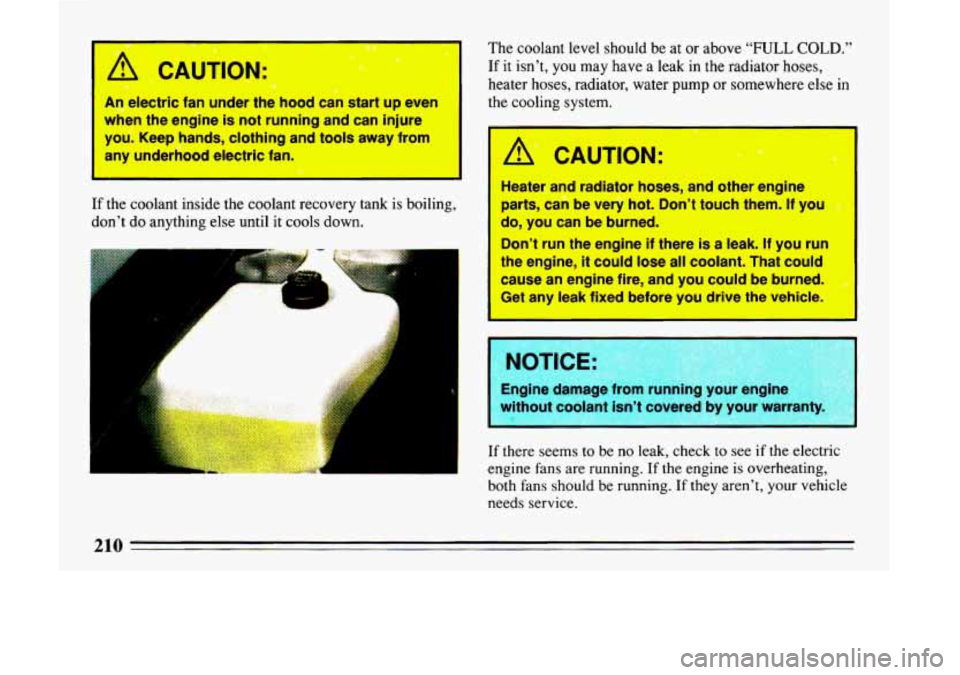
If the coolant inside the coolant recovery tank is boiling,
don't do anything else until it cools down.
I-
rs-
L
I
P
The coolant level should be at or above "FULL COLD.''
If it isn't, you may have a leak in the radiator hoses,
heater hoses, radiator, water
pump or somewhere else in
the cooling system,
I
/A CAUTION: 0
Heater and radiator hoses, and other engine
parts, can be very
hot. Don't touch them. If you p
do, you can be burned.
Don't run the engine if there is a leak.
If you run
the engine,
it could lose all coolant. That could
cause an engine fire, and you could be burned.
Get any leak fixed before you drive the vehicle.
I
Engine damage from running your engine
without coolant isn't covered by your warranty.
If there seems to be no leak, check to see if the electric
engine fans are running.
If the engine is overheating,
both fans
should be running. If they aren't, your vehicle
needs service.
Page 213 of 324
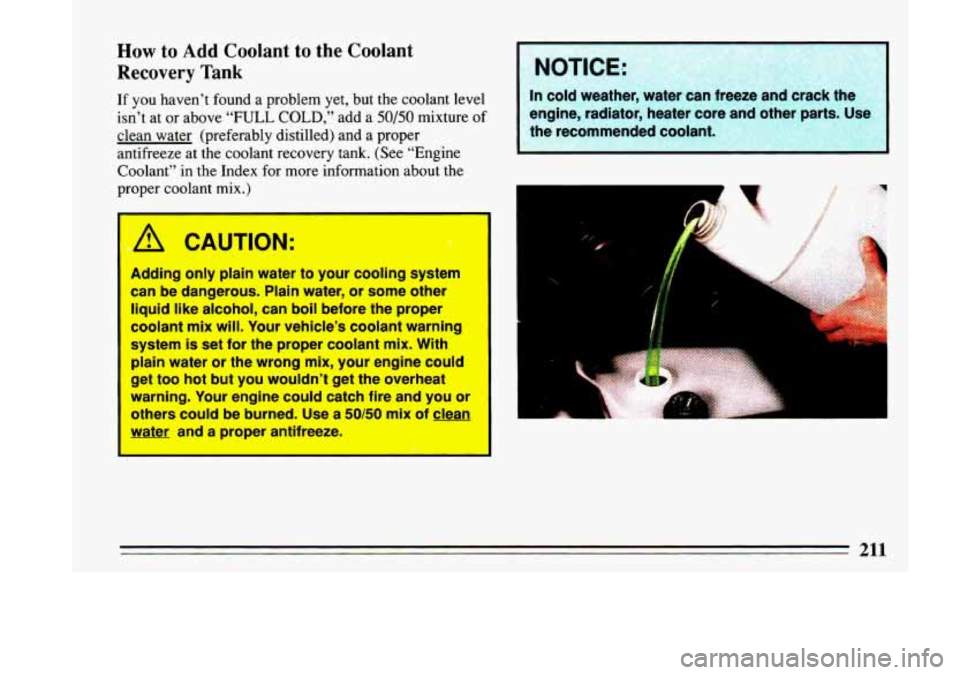
How to Add Coolant to the Coolant
Recovery Tank
If you haven’t found a problem yet, but the coolant level
isn’t at or above
“FULL COLD,” add a 50/50 mixture of
clean water (preferably distilled) and
a proper
antifreeze at the coolant recovery tank. (See “Engine
Coolant”
in the Index for more information about the
proper coolant mix.)
‘A CAUTION: Q
Adding only plain water to your cooling system
can be dangerous. Plain water,
or some other
liquid like alcohol, can boil before the proper
coolant
mix will. Your vbhicle’s coolant warning
system
is set for the properecoolant mix. With
plain water or the’wrong mix, your engine could
get too hot
but you douldn’t get the overheat
warning.
Your engine could catch fire and you or
others could be burned. Use a 50/50 mix of clean
water and
a proper antifreeze.”
I NOTICE 1
I fr ze an :rack In cold weather, water c
engine, radiator, heater core and other parts. Us€
the recommended coolant. I
211
Page 226 of 324
* A
wheel mounting surface.
..
, . ..
A?%%
-
I A CAUTION:
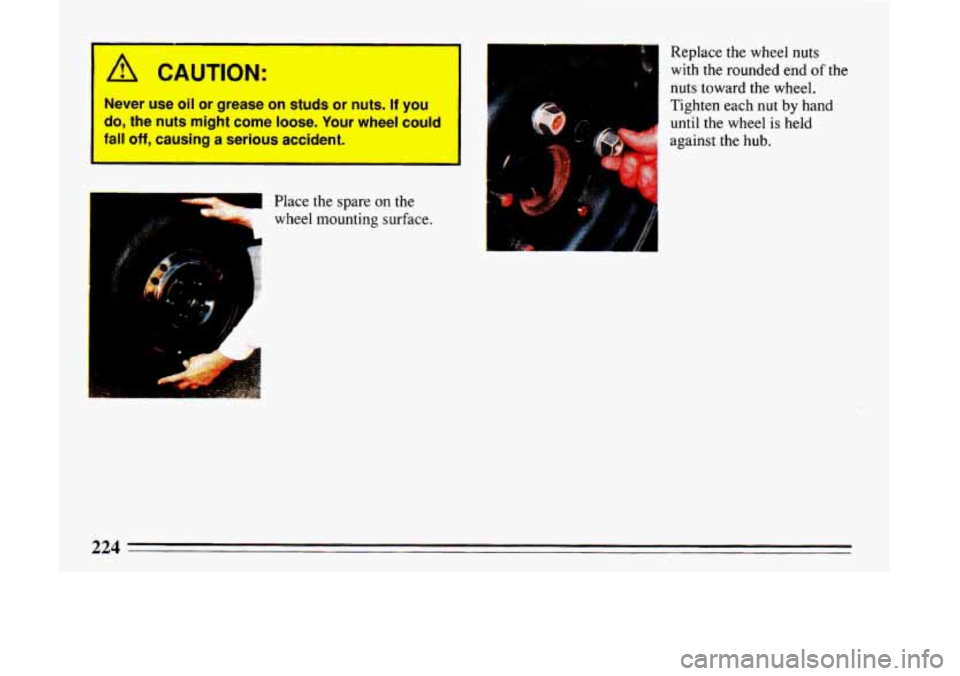
Replace the wheel nuts
with the rounded end of the
nuts toward the wheel.
Never use oil or grease on studs or nuts. If you Tighten each nut by hand
do; the nuts might come loose. Your wheel could until the wheel is held
fall off, causing a serious accident. against the hub.
Place the spare on the -- -
P
Page 231 of 324

@ Part 6 Service & Appearance Lare
Here you will find information about the care of your Buick . This part begins with service and fuel information. and
then it shows how to check important fluid and lubricant level\
s
. There is also technical information about your
vehicle. and a section devoted to its appearance care .
Part 6 includes:
ServiceTips
......................................................................
Fuel ........................................................................\
.....
HoodRelease .....................................................................
Engineoil ....................................................................... \
AirFilter ........................................................................\
.
Automatic Transaxle Fluid ............................................................
Enginecoolant ....................................................................
Power Steering Fluid ...............................................................
Windshield Washer Fluid ............................................................
Brakes ........................................................................\
...
Battery ........................................................................\
..
BulbReplacement .................................................................
Tires ........................................................................\
.....
Appearancecare ..................................................................
Vehicle Identification Number (VIN) ..................................................
FusesandCircuitBreake ............................................................
Capacities and Specifications .........................................................
LoadingYourVehicle ...............................................................
230
231
234
236
240
241
243
246 247
248
249
250
253
255
262
269
270
275
229
Page 234 of 324
gasolines with these blending materials, such as MTBE
and ethanol. By doing
so, you can help clean the air,
especially in those parts of the country that have
high
carbon monoxide levels.
In addition, some gasoline suppliers are now producing
reformulated gasolines. These gasolines are specially
designed to reduce vehicle emissions. General Motors
recommends that you use reformulated gasoline. By
doing
so, you can help clean the air, especially in those
parts of the country that have high ozone levels.
You should ask your service station operators if their
gasolines contain detergents and oxygenates, and
if they
have been reformulated to reduce vehicle emissions.
Fuels in Foreign Countries
If you plan on driving in another country outside the
U.S. or Canada, unleaded fuel may be hard to find. Do
not use leaded gasoline. If you use even one tankful, your emission controls won’t work well or at all. With
continuous use, spark plugs can get fouled, the exhaust
system can corrode, and your engine oil can deteriorate
quickly. Your vehicle’s oxygen sensor will be damaged.
All of that means costly repairs that wouldn’t
be covered
by your warranty.
To check on fuel availability, ask an auto club, or
contact
a major oil company that does business in the
country where you’ll be driving.
You can also write us at the following address for
advice. Just
tell us where you’re going and give your
Vehicle Identification Number
(VIN).
General Motors of Canada Ltd.
International Export Sales
P.O. Box 828
Oshawa, Ontario L1 H 7N1, Canada
.
323
Page 238 of 324
A CAUTION:
Things that burn can get on hot engine parts and
start a fire. These include liquids like gasoline,
oil, coolant, brake fluid, windshield washer and
other fluids, and plastic
or rubber. You or others
could
be burned. Be careful not to drop or spill
things that
will burn onto a hot engine.
I
Before closing the hood, be sure all the filler caps are on
properly.
Then just pull the hood down and close it firmly.
Engine Oil
It’s a good idea to check your engine oil every time you
get fuel. In order to get an accurate reading, the oil must
be warm and the vehicle
must be on level ground.
The engine oil dipstick is directly behind the engine fan.
Turn
off the engine and give the oil a few minutes to
drain back into the oil pan. If you don’t, the oil dipstick
might not show the actual level.
236
Page 239 of 324
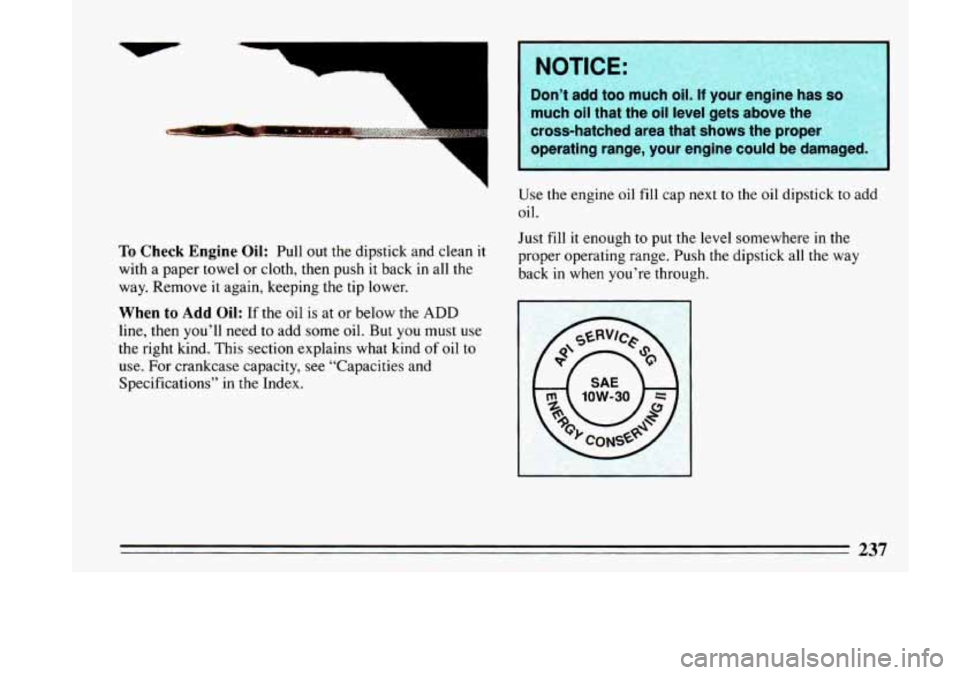
To Check Engine Oil: Pull out the dipstick and clean it
with a paper towel or cloth, then push it back in all the
way. Remove it again, keeping the tip lower.
When to Add Oil: If the oil is at or below the ADD
line, then you’ll need to add some oil. But you must use
the right kind. This section explains what kind of
oil to
use. For crankcase capacity, see “Capacities and
Specifications” in the Index.
1 NOTICE:
Don’t add too much oil. If your engine has so
much oil that the oil level gets above the
cross-hatched area that
shows the proper
operating range, your engine could be damaged.
Use the engine oil fill cap next to the oil dipstick to add
oil.
Just fill it enough to put the level somewhere in the
proper operating range. Push
the dipstick all the way
back
in when you’re through.
I
237
Page 240 of 324
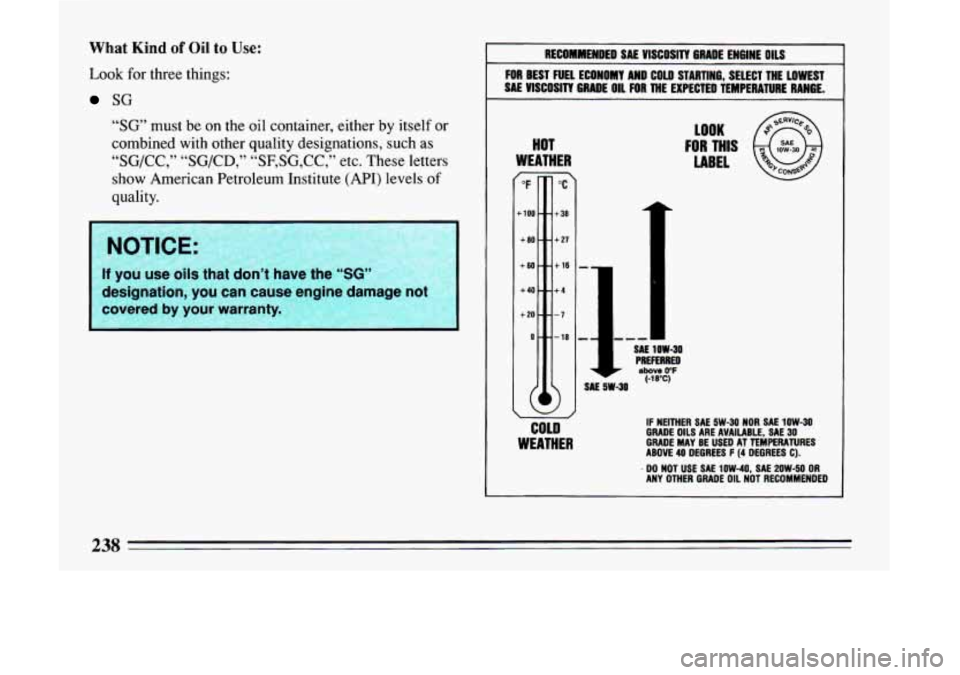
What Kind of Oil to Use:
Look for three things:
SG
“SG’ must be on the oil container, either by itself or
combined with other quality designations, such as
“SG/CC,”
“SG/CD,” “SF,SG,CC,” etc. These letters
show American Petroleum Institute (API) levels
of
quality.
NOTICE:
If you use oils that don’t have the “SG”
designation, you can cause engine damage I
covered by your warranty.
RECOMMENDED SAE VISCOSIN GRADE ENGINE OILS
FOR BEST FUEL ECONOMY AND COW STARTING, SELECT THE LOWEST
SAE VISCOSITY GRADE OIL FOR THE EXPECTED TEMPERATURE RANGE.
HOT
WEATHER
COLD
WEATHER
SAE 5W-30
LOOK
FOR THIS
LABEL
SAE 1OW-30
above 0°F (-18%)
IF NEITHER SAE 5W-30 NOR SAE 1OW-30
GRADE OILS ARE AVAILABLE, SAE 30 GRADE MAY BE USED AT TEMPERATURES
ABOVE 40 DEGREES F (4 DEGREES C).
ANY OTHER GRADE
OIL NOT RECOMMENDED . DO NOT USE SAE 1OW-40, SAE 2OW-50 OR