1993 BUICK LESABRE heating
[x] Cancel search: heatingPage 195 of 324
Following Distance
Stay at least twice as far behind the vehicle ahead as you
would when driving your vehicle without a trailer. This
can help
you avoid situations that require heavy braking
and sudden turns.
Passing
You’ll need more passing distance up ahead when
you’re towing a trailer. And, because you’re a good deal
longer, you’ll need to go much farther beyond the
passed vehicle before you can return
to your lane.
Backing Up
Hold the bottom of the steering wheel with one hand.
Then,
to move the trailer to the left, just move that hand
to the left. To move the trailer to the right, move your
hand
to the right. Always back up slowly and, if
possible, have someone guide you.
Making nrns
When you’re turning with a trailer, make wider turns
than normal. Do this
so your trailer won’t strike soft
shoulders, curbs, road signs, trees, or other objects.
Avoid jerky or sudden maneuvers. Signal well
in
advance.
Turn Signals When Towing a Trailer
When you tow a trailer, your vehicle has to have a
different turn signal flasher and extra wiring. The green
arrows
on your instrument panel will flash whenever
you signal a turn
or lane change. Properly hooked up,
the trailer lights will also flash, telling other drivers
you’re about to turn, change lanes or stop.
When towing a trailer, the green arrows on your
instrument panel will flash for turns even if the bulbs on
the trailer are burned out.
Thus, you may think drivers
behind you are seeing your signal when they are
not. It’s
important to check occasionally to be sure the trailer
bulbs are still working.
Driving On Grades
Reduce speed and shift to a lower gear before you start
down a long or steep downgrade. If you don’t shift
down,
you might have to use your brakes so much that
they would get hot and no longer work well.
On a long uphill grade, shift down to “D” (Drive) and
reduce your speed to around
45 mph (70 km/h) to
reduce the possibility of engine and transaxle
overheating.
193
Page 197 of 324

@ Part 5 Problems on the Road
Here you’ll find what to do about some problems
Part 5 includes:
Hazard Warning Flashers
..............
Other Warning Devices ...............
“Jump” Starting .....................
Engine Overheating ..................
If a Tire Goes Flat ...................
Changing a Flat Tire ..................
If You’re Stuck in Sand. Mud. Ice or Snow
Towing Your Buick
..................
Compact
Spare Tire ..................
that can occur on the road .
..............................................
..............................................
..............................................
..............................................
..............................................
..............................................
..............................................
..............................................
..............................................
196
197
198
203
208
216
216 227
228
Page 210 of 324
Engine Overheating
You will find the warning light about a hot engine on
your Buick instrument panel,
If you have the optional gage cluster, you may also have
a coolant temperature warning gage.
If Steam Is Coming From Your Engine:
CAUTION:
eam from an overheated engine can burn you
badly, even if you just open
the hood. Stay away
from
the engine if you see or hear steam coming
from
it. Just turn it off and get everyone away
From the vehicle until
it cools down. Wait until
there
is no sign of steam or coolant before
opening the hood.
If you keep driving when your engine is
overheated, the liquids in it can catch fire. You or
others could be badly burned. Stop your engine
if it overheats, and get out of the vehicle until the
engine is cool. badly
damaged. The costly
covered by your warranty.
If No Steam Is Coming From Your Engine:
If you get the overheat warning but see or hear no
steam, the problem may not be too serious. Sometimes
the engine can get a little too
hot when you:
Climb a long hill on a hot day.
Stop after high speed driving.
Idle for long periods in traffic.
Tow a trailer.
If you get the overheat warning with no sign of steam,
try this for a minute or so:
1. Turn off your air conditioner.
2. Turn on your heater to full hot at the highest fan
speed and open the window as necessary.
3. If you’re in a traffic jam, shift to “N” (Neutral).
208
Page 212 of 324
0 -' e
A! ek-bic fan under the kod-can start up even
when' the endne is not runniiig and can Injure
yoG. Keep hands, clothing and tools away from
any underhood electric fan.
I
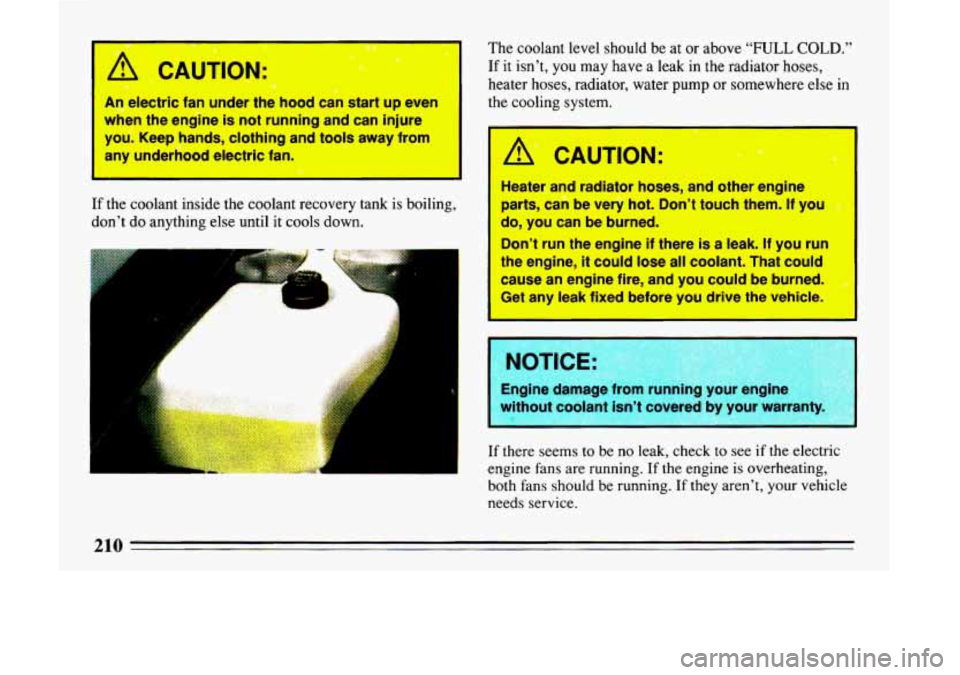
If the coolant inside the coolant recovery tank is boiling,
don't do anything else until it cools down.
I-
rs-
L
I
P
The coolant level should be at or above "FULL COLD.''
If it isn't, you may have a leak in the radiator hoses,
heater hoses, radiator, water
pump or somewhere else in
the cooling system,
I
/A CAUTION: 0
Heater and radiator hoses, and other engine
parts, can be very
hot. Don't touch them. If you p
do, you can be burned.
Don't run the engine if there is a leak.
If you run
the engine,
it could lose all coolant. That could
cause an engine fire, and you could be burned.
Get any leak fixed before you drive the vehicle.
I
Engine damage from running your engine
without coolant isn't covered by your warranty.
If there seems to be no leak, check to see if the electric
engine fans are running.
If the engine is overheating,
both fans
should be running. If they aren't, your vehicle
needs service.
Page 245 of 324
3.
4.
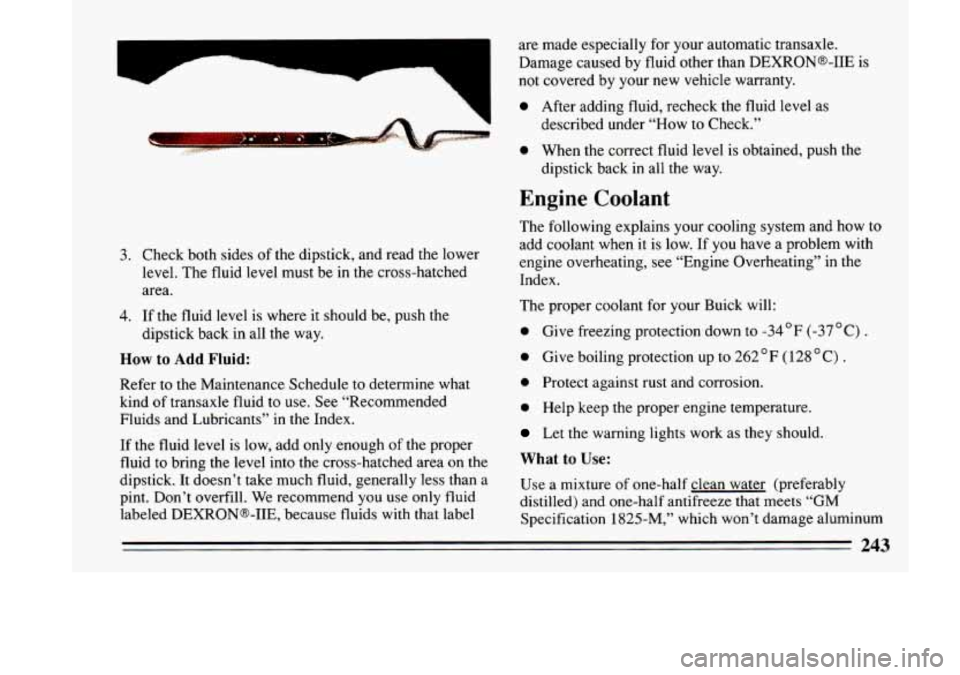
Check both sides of the dipstick, and read the lower
level. The fluid level must be in the cross-hatched
area.
If the fluid level is where it should be, push the
dipstick back in all the way.
How to Add Fluid:
Refer to the Maintenance Schedule to determine what
kind
of transaxle fluid to use. See “Recommended
Fluids and Lubricants” in the Index.
If the fluid level
is low, add only enough of the proper
fluid to bring the level into the cross-hatched area on the
dipstick. It doesn’t take much fluid, generally less than a
pint. Don’t overfill. We recommend you use only fluid
labeled DEXRONa-IIE, because fluids with that label are made especially for your automatic transaxle.
Damage caused by fluid other than DEXRONs-IIE
is
not covered by your new vehicle warranty.
0 After adding fluid, recheck the fluid level as
described under “How to Check.”
0 When the correct fluid level is obtained, push the
dipstick back in all the way.
Engine Coolant
The following explains your cooling system and how to
add coolant when it is low. If you have a problem with
engine overheating, see “Engine Overheating” in the
Index.
The proper coolant for your Buick will:
0 Give freezing protection down to -34OF (-37OC) .
0 Give boiling protection up to 262°F (128 “C) .
0 Protect against rust and corrosion.
0 Help keep the proper engine temperature.
Let the warning lights work as they should.
What to Use:
Use a mixture of one-half clean water (preferably
distilled) and one-half antifreeze that meets
“GM
Specification 1825-M,” which won’t damage aluminum
243
Page 247 of 324
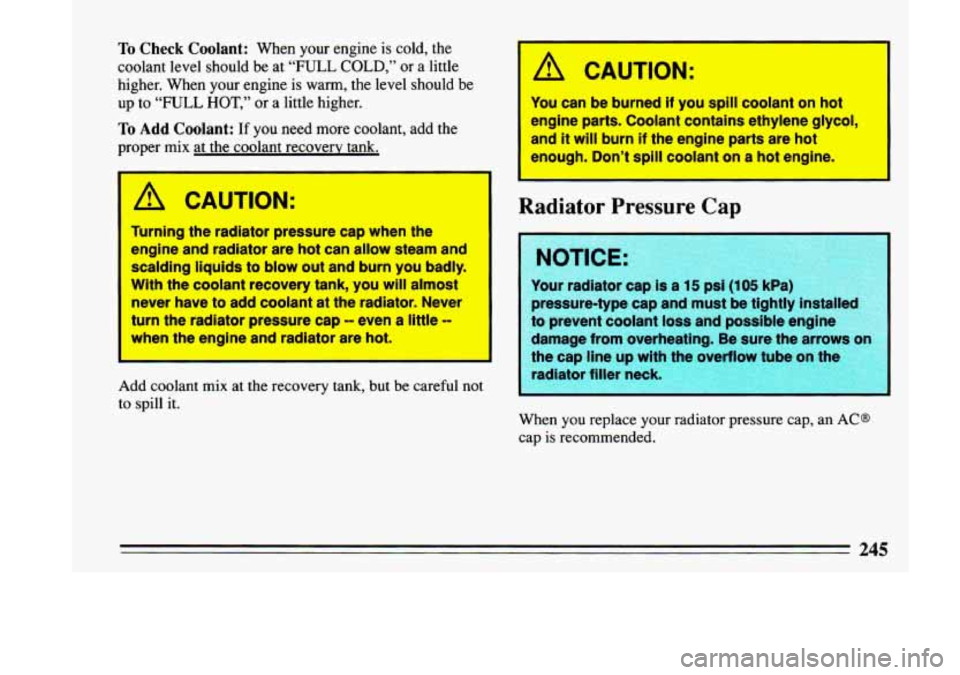
To Check Coolant: When your engine is cold, the
coolant level should
be at “FULL COLD,’’ or a little
higher. When your engine is
warm, the level should be
up to “FULL HOT,” or a little higher.
To Add Coolant: If you need more coolant, add the
proper mix at the coolant recovery tank.
I
I
A CAUTION:
Turning the radiator pressure cap when the
engine and radiator are hot can
allow steam and
scaldlng
liquids to blow out and burn you badly.
With the coolant recovery tank, you will almost
never have
to add coolant at the radiator. Never
turn the radiator pressure cap -- even a little -
when the engine and radiator are hot.
Add coolant mix at the recovery tank, but be careful not
to spill
it.
A CAUTION: I
You can be burned if you spill coolant on hot
engine parts. Coolant contains ethylene glycol,
-..d
it will burn if the engine parts are hot
enough. Don’t spill coolant on a hot engine.
Radiator Pressure Cap
I Tour rar
I I.
cap IS a 13 PSI (105 kPa1
pressure-rype cap and must be tightly Insrawe
to prevent coolant loss and possible engine
damage from overheating. Be sure the arrows
o
I
the cap line up with
radiator filler neck. I
When you replace your radiator pressure cap, an AC@
cap is recommended.
245
Page 257 of 324
Tires
We don’t make tires. Your new vehicle comes with high
quality tires made by
a leading tire manufacturer. These
tires are warranted by the tire manufacturers and their
warranties are delivered
with every new Buick. If your
spare tire
is a different brand than your road tires, you
will have a tire warranty folder from each of these
manufacturers.
A CAUTION:
Poorly maintained and improperly used tires are
dangerous.
Overloading your tires can cause
overheating as
a result of too much
friction. You could have an air-out and a
serious accident.
See “Loading Your
Vehicle” in the Index.
Underinflated tires pose the same danger
as overloaded tires. The resulting accident
could cause serious injury. Check
all tires
frequently to maintain the recommended
pressure. Tire pressure should
be checked
when your tires are
cold.
Over inflated tires are more likely to be cut,
punctured, or broken by
a sudden impact,
such
as when you hit a pothole. Keep tires
at the recommended pressure.
Worn,
old tires can cause accidents. If your
tread
is badly worn, or if your tires have
been damaged, replace them.
255
Page 310 of 324

Electric Outside Mirror Control .................... 100
Electrical Equipment. Adding
.................. 128. 269
Emergencies. Braking
............................ 163
Emergencies on the Road
.......................... 195
Emergencies. Steering in
......... ; ................ 164
Emergency Starting. Dead Battery
................... 198
Emergency Wrecker Towing
....................... 203
Engine Energy Conserving
Oil ............................ 237
Block Heater
.............................. 72. 239
Coolant
................................. 21 1. 243
Coolant Temperature Warning Light
.............. 110
Exhaust
...................................... 81
Identification
................................. 269
Oil
......................................... 236
Oil Additives
................................. 239
Oil Life Monitor
.............................. 114
Oil Pressure Warning Light
..................... 112
Oil. When to Change
...................... 239. 277
Overheating
.................................. 208
Starting
...................................... 70
Warning Light. Need for Service
................. 111
Ethanol in Gasoline
.............................. 231
Expectant Mothers. Use of Safety Belts
............... 37
Explanation of Scheduled Services
.................. 286
Expressway Driving
.............................. 176
Extender. Safety Belt
.............................. 55
Exterior Appearance ............................. 265 Fasteners.
Replacement
.......................... 230
Features and Controls
............................. 57
Fetus. Risk to
.. From Safety Belt Use ................ 37
Filling Your Fuel Tank
............................ 233
Filter. Oil
...................................... 275
Finish Care
..................................... 266
Finish Damage
.................................. 267
First Gear. When to Use
............................ 75
Flat Tire
....................................... 216
Flooded Engine. Starting a
.......................... 70
Fluid
Capacities
................................... 275
Brake
....................................... 248
Power Steering
........... ; ................... 246
Transaxle/Transmission
........................ 241
Windshield Washer
............................ 247
Fluids and Lubricants Recommended
................ 293
FM Stereo Radio Reception
........................ 127
Fog. Driving
in .................................. 173
Francais. Guide En
................................. 2
Freedom Battery
................................. 249
Freeway Driving
................................ 176
French LanguageManual
........................... 2
Front Brake Disc Wear Indicators
................... 162
Front Towing Hook-Ups
.......................... 206
Fuel
.......................................... 231
Fuel Gage
...................................... 106
Fuel Tank. Filling Your
........................... 233
Fuses and Circuit Breakers
........................ 270
Fuseusage ..................................... 271
Foreign Operation
............................... 232
308