1993 BUICK LESABRE brake light
[x] Cancel search: brake lightPage 111 of 324
The anti-lock brake system warning light may also come Traction Control System Warning Light
on when you are driving with a compact spare tire. If (Option)
this happens, the light means you won’t have anti-lock
until you replace the compact spare with a full-size tire.
If the warning light stays on after you replace the
compact spare with a full-size tire, or
if it comes on
again when you’re driving, your Buick needs service.
TRACTION
OFF
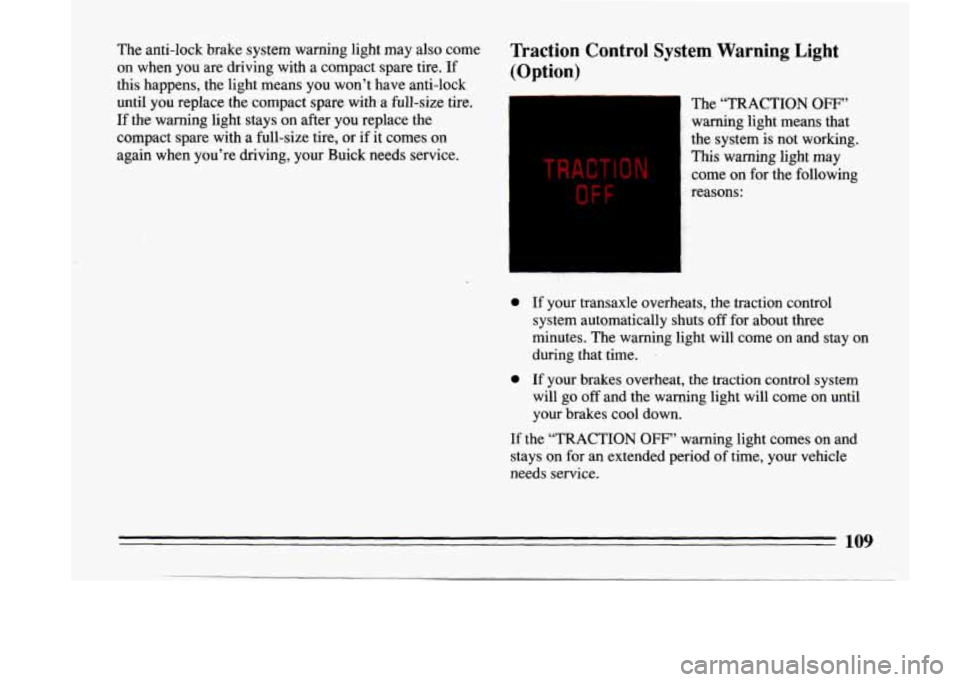
The “TRACTION OFF”
warning light means that
the system is not working.
This warning light may
come on for the following
reasons:
0 If your transaxle overheats, the traction control
system automatically shuts
off for about three
minutes. The warning light will come on and stay on
during that time.
.
0 If your brakes overheat, the traction control system
will
go off and the warning light will come on until
your brakes cool down.
If the “TRACTION
OFF” warning light comes on and
stays on for an extended period
of time, your vehicle
needs service.
109
Page 155 of 324
Pavement Markings
NO
PASSING
ZONE
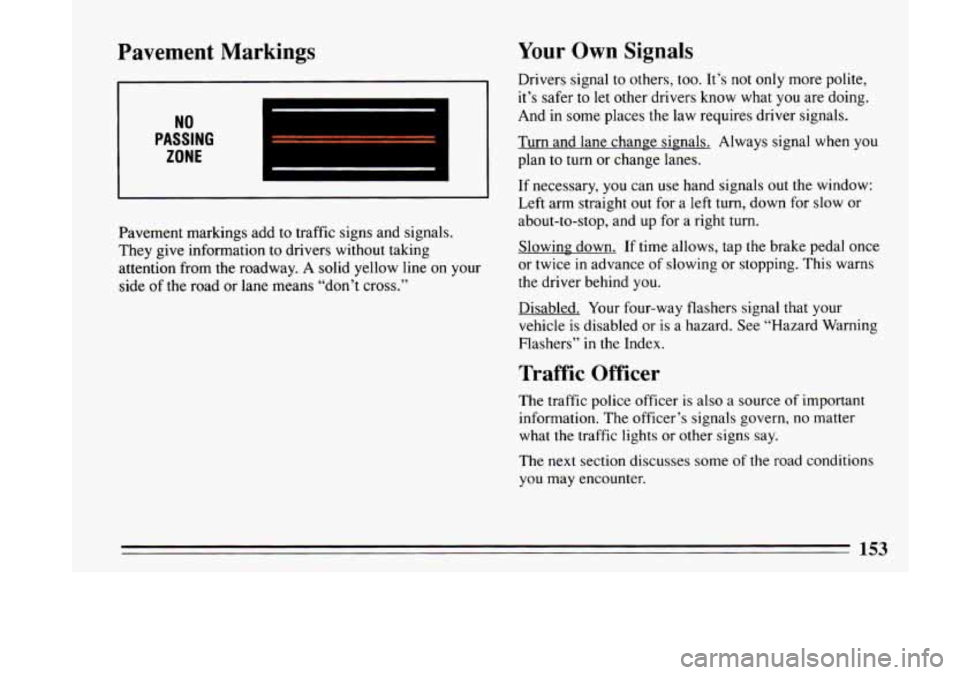
Pavement markings add to traffic signs and signals.
They give information to drivers without taking
attention from the roadway. A solid yellow line on your
side
of the road or lane means “don’t cross.’’
Your Own Signals
Drivers signal to others, too. It’s not only more polite,
it’s safer to let other drivers know what
you are doing.
And in some places the law requires driver signals.
Turn and
lane change signals. Always signal when you
plan to turn or change lanes.
If necessary, you can use hand signals
out the window:
Left arm straight out for a left turn, down for slow or
about-to-stop, and
up for a right turn.
Slowinn down. If time allows, tap the brake pedal once
or twice in advance of slowing or stopping. This warns
the driver behind
you.
Disabled. Your four-way flashers signal that your
vehicle is disabled
or is a hazard. See “Hazard Warning
Flashers” in the Index.
Traffic Officer
The traffic police officer is also a source of important
information. The officer’s signals govern, no matter
what the traffic lights or other signs say.
The next section discusses some
of the road conditions
you may encounter.
153
Page 161 of 324
0 Avoid needless heavy braking. Some people drive in
spurts
-- heavy acceleration followed by heavy
braking
-- rather than keeping pace with traffic. This
is a mistake. Your brakes may not have time to cool
between hard stops. Your brakes will wear
out much
faster
if you do a lot of heavy braking.
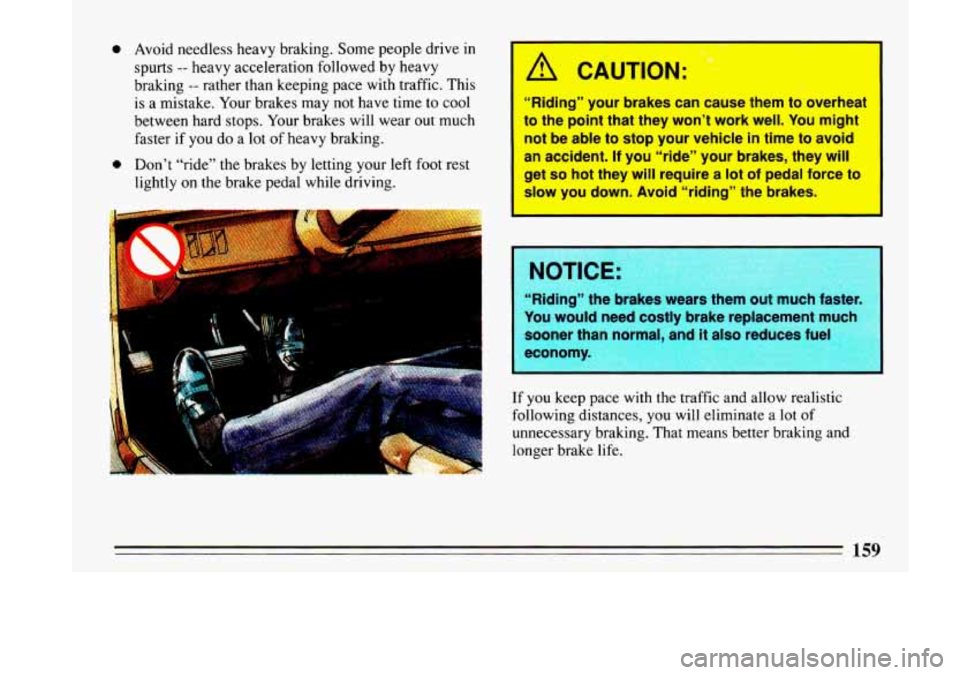
0 Don’t “ride” the brakes by letting your left foot rest
lightly
on the brake pedal while driving.
I A CAUTION: -’+
“Riding” your brakes can cause them to overheat
to the point that they won’t work well. You might
not be able to stop your vehicfe
in time to avoid
an accident. If you “ride’’ your brakes, they will
get so hot they will iequire a lot of pedal force to
slow you down. Avoid “riding” the brakes.
Riding” the brakes wears them
out much
I You would need costly brake replacement much
If you keep pace with the traffic and allow realistic
following distances,
you will eliminate a lot of
unnecessary braking. That means better braking and
longer brake life.
159
Page 162 of 324

0 If your engine ever stops while you’re driving, brake
normally but don’t pump your brakes.
If you do, the
pedal may get harder to push down.
If your engine
stops, you will still have some power brake assist.
But
you will use it when you brake. Once the power assist
is used up, it may take longer to stop and the brake
pedal will be harder to push.
Anti-Lock Brakes (ABS)
Your Buick has an advanced electronic braking system
that will help prevent skidding.
This light
on the instrument panel will go on when you
start your vehicle.
See “Anti-lock Brake System Warning Light”
in the
Index.
@
ANTI
LOCK
‘1 ”. j ’ ;I
- -’ y- ..-
a,
rn
e,
Here’s how anti-lock works. Let’s say the road is wet.
You’re. driving safely. Suddenly an animal jumps
out in
front
of you.
You slam on the brakes. Here’s what happens with ABS.
A computer senses that wheels are slowing down. The
computer separately works the brakes at each front
wheel and at the rear wheels.
The anti-lock system can change the brake pressure
faster than any driver could. The computer
is
programmed to make the most of available tire and road
conditions.
160
Page 164 of 324
Traction Control System (Option)
Your vehicle may have a traction control system that
limits wheel spin. This is especially
useful in slippery
road conditions. The traction control system works at
low speeds only, such
as when you accelerate from a
stop. It applies brake pressure
to an individual wheel
that the system senses is about to spin.
You may feel the system working, or
you may notice
some noise, but this is normal.
OFF
The “TRACTION OFF” warning light lets you know if
your traction control system is not working. See
“Traction Control System Warning Light” in the Index.
Disc Brake Wear Indicators
Your Buick has front disc brakes and rear drum brakes.
Disc brake pads have built-in wear indicators that make a
high-pitched warning sound when the brake pads are
worn and new pads are needed. The sound may come and
go or be heard all the time your vehicle is moving (except
when you are pushing
on the brake pedal firmly).
A CAUTION:
0
The brake wear warning sound means that
sooner or later your brakes won’t work well. That
could lead to an accident. When you hear the
brake wear warning sound, have your vehicle
serviced.
Some driving conditions or climates may cause a brake
squeal when the brakes are first applied or lightly
1 LC3
Page 166 of 324
the front wheels. If there’s no traction, inertia will keep
the vehicle going in the same direction. If you’ve ever
tried to steer
a vehicle on wet ice, you’ll understand this.
The traction you can get in a curve depends on the
condition of your tires and the road surface, the angle at
which the curve is banked, and y.our speed. While
you’re in a curve, speed is the one factor you can
control.
Suppose you’re steering through a sharp curve. Then
you suddenly accelerate.
Those two control systems
-- steering and acceleration --
can overwhelm those places where the tires meet the
road and make you lose control.
What should you do
if this ever happens? Let up on the
accelerator pedal, steer the vehicle the way you want it
to go, and slow down.
Speed limit signs near curves warn that you should
adjust your speed. Of course, the posted speeds are
based on good weather and road conditions. Under less
favorable conditions you’ll want to go slower.
If you need to reduce your speed as you approach
a
curve, do it before you enter the curve, while your front
wheels are straight ahead. Try to adjust your speed
so you can
“drive” through the
curve. Maintain a reasonable, steady speed. Wait to
accelerate until you are out of the curve, and then
accelerate gently into the straightaway.
When you drive into a curve at night, it’s harder to see
the road ahead of you because it bends away from the
straight beams of your lights. This is one good reason to
drive slower.
Steering in Emergencies
There are times when steering can be more effective
than braking. For example, you come over a hill and
find a truck stopped
in your lane, or a car suddenly pulls
out from nowhere, or a child darts out from between
parked cars and stops right in front of you. You can
avoid these problems
by braking -- if you can stop in
time. But sometimes you can’t; there isn’t room. That’s\
the time for evasive action
-- steering around the
problem.
Your Buick can perform very well
in emergencies like
these. First apply your brakes.
It is better to remove as
much speed as you can from a possible collision. Then
steer around
the problem, to the left or right depending
on the space available,
An emergency like this requires close attention and a
quick decision. If you are holding the steering wheel at
164
Page 170 of 324
0 Try not to pass more than one vehicle at a time on
two-lane roads. Reconsider before passing the
next
vehicle.
Don’t overtake a slowly moving vehicle too rapidly.
Even though
the brake lights are not flashing, it may
be slowing down or starting to turn.
following driver to get ahead of you. Perhaps
you
can ease a little to the right.
If you’re being passed, make it easy for the
Loss of Control
Let’s review what driving experts say about what
happens when the three control systems (brakes, steering
and acceleration) don’t have enough friction where the
tires meet the road
to do what the driver has asked.
In
any emergency, don’t give up. Keep trying to steer and
constantly seek an escape route or area of less danger.
Skidding
In a skid, a driver can lose control of the vehicle.
Defensive drivers avoid most skids by taking reasonable
care suited to existing conditions, and by
not “over-
driving” those conditions. But skids are always possible. The
three types of skids correspond
to your Buick‘s
three control systems. In
the braking skid your wheels
aren’t rolling. In
the steering or cornering skid, too
much speed or steering in a curve causes tires to slip and
lose cornering force. And in the acceleration skid too
much throttle causes the driving wheels
to spin.
A cornering skid and an acceleration skid are best
handled by easing your
foot off the accelerator pedal.
If your vehicle starts to slide (as when
you turn a comer
on a wet, snow-or icexovered road), ease your foot off
the accelerator pedal as soon as your feel the vehicle start
to slide. Quickly steer the way
you want the vehicle to
go. If you start steering quickly enough, your vehicle will
straighten
out. As it does, straighten the front wheels.
Of course, traction is reduced when water, snow, ice,
gravel, or other material is
on the road. For safety, you’ll
want
to slow down and adjust your driving to these
conditions. It is important to slow down
on slippery
surfaces because stopping distance will be longer and
vehicle control more limited.
While driving
on a surface with reduced traction, try
your best
to avoid sudden steering, acceleration, or
braking (including engine braking by shifting
to a lower
gear). Any sudden changes could cause tires to slide.
You may
not realize the surface is slippery until your
168
Page 174 of 324
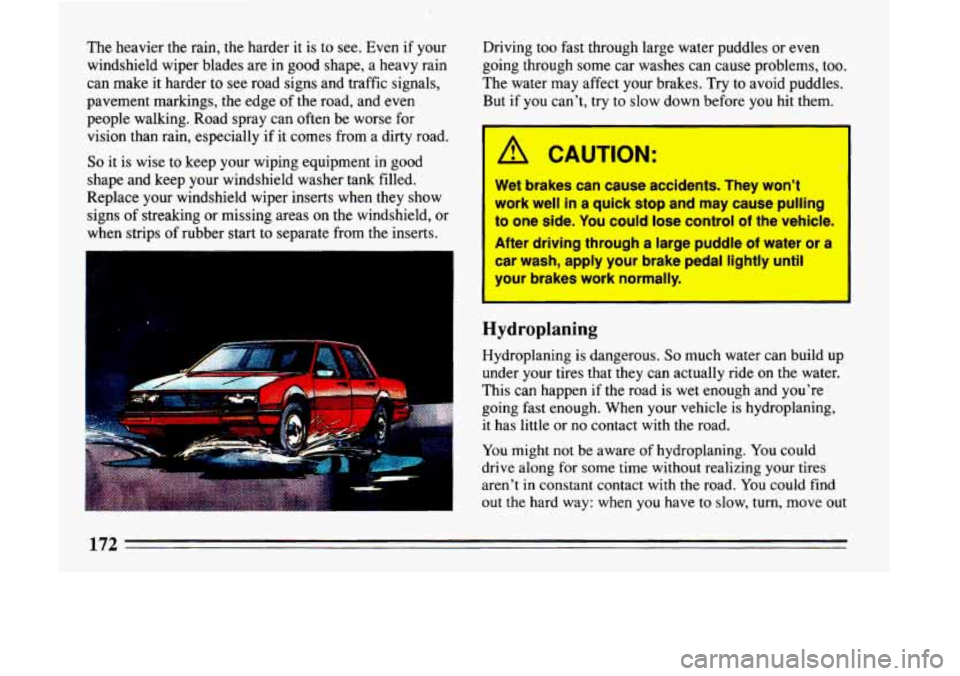
The heavier the rain, the harder it is to see. Even if your
windshield wiper blades are in good shape, a heavy rain
can make it harder
to see road signs and traffic signals,
pavement markings, the edge of the road, and even
people walking. Road spray can often be worse for
vision than rain, especially if it comes from a dirty road.
So it is wise to keep your wiping equipment in good
shape and keep your windshield washer tank filled.
Replace your windshield wiper inserts when they show
signs
of streaking or missing areas on the windshield, or
when strips of rubber start to separate from the inserts. Driving
too fast through large water puddles or even
going through some car washes can cause problems, too.
The water may affect your brakes. Try
to avoid puddles.
But if you can’t, try to slow down before you hit them.
A CAUTION:
Wet brakes can cause accidents. They won’t
work well in a quick stop and may cause pulling
to one side. You could lose control
of the vehicle.
After driving through a large puddle
of water or a
car wash, apply your brake pedal lightly until
your brakes work normally.
I
Hydroplaning
Hydroplaning is dangerous. So much water can build up
under your tires that they can actually ride on the water.
This can happen
if the road is wet enough and you’re
going fast enough. When your vehicle is hydroplaning,
it has little or no contact with the road.
You might
not be aware of hydroplaning. You could
drive along for some time without realizing your tires
aren’t in constant contact with
the road. You could find
out the hard way: when you have to slow, turn, move out
172