1993 BUICK LESABRE brake light
[x] Cancel search: brake lightPage 179 of 324
If you are on a three-lane freeway, treat the right lane as
the slower-speed through lane, the middle lane as the
higher-speed through lane, and the left lane
as the
passing lane.
Before changing lanes, check your rearview mirrors.
Then use your turn signal.
Just before
you leave the lane, glance quickly over your
shoulder to make sure there isn’t another vehicle in your
“blind” spot.
If you are moving from an outside
to a center lane on a
freeway having more than two lanes, make sure another
vehicle isn’t about to move into the same spot. Look at
the vehicles two lanes over and watch for telltale signs:
turn signals flashing, an increase in speed, or moving
toward the edge of the lane. Be prepared
to delay your
move.
Once
you are moving on the freeway, make certain you
allow
a reasonable following distance. Expect to move
slightly slower at night.
Leaving the Freeway
When you want to leave the freeway, move to the proper
lane well in advance. Dashing across lanes at the last
minute
is dangerous. If you miss your exit do not, under any circumstances, stop
and back up. Drive
on to the
next exit.
AI each exit point is a deceleration lane. Ideally it
should
be long enough for you to enter it at freeway
speed (after signaling,
of course) and then do your
braking before moving onto the exit ramp.
Unfortunately,
not all deceleration lanes are long enough
-- some are too short for all the braking. Decide when to
start braking. If you must brake on the through lane, and
if there is traffic close behind you, you can allow a little
extra time and flash your brake lights
(in addition to
your turn signal) as extra warning that
you are about to
slow down and exit.
The exit ramp can be curved, sometimes quite sharply.
I ne exit speed is usually posted. Reduce your speed
according to your speedometer, not
to your sense of
motion. After driving for any distance at higher speeds,
you may tend
to think you are going slower than you
actually are.
For example, 40 mph (65 km/h) might
seem like only
20 mph (30 km/h). Obviously, this could
lead to serious trouble on a ramp designed for
20 mph
(30 km/h)!
177
Page 194 of 324
e e Will you have to make any holes in the body of your vehicle when you install a trailer hitch? If you
do,
then be sure to seal the holes later when you remove
the hitch. If you don’t seal them, deadly carbon
monoxide
(CO) from your exhaust can get into your
vehicle (see “Carbon Monoxide” in the Index). Dirt
and water can, too.
The bumpers on your vehicle are not intended for
hitches.
Do not attach rental hitches or other
bumper-type hitches to them. adequate.
Be sure to read and follow the instructions for
the trailer brakes
so you’ll be able to install, adjust and
maintain them properly. Because you have anti-lock
brakes, do not try to tap into your vehicle’s brake
system.
If you do, both brake systems won’t work well,
or at all.
Driving with a Trailer
Towing a trailer requires a certain amount of experience.
Before setting out for the open road, you’ll want to get
to know your rig. Acquaint yourself with the feel of
handling and braking with the added weight of the
trailer. And always keep in mind that the vehicle you are
driving is now a good deal longer and not nearly
so
responsive as your vehicle is by itself.
Safety Chains
You should always attach chains between your vehicle
and your trailer.
Cross the safety chains under the
tongue
of the trailer so that the tongue will not drop to
the road if it becomes separated from the hitch.
Instructions about safety chains may be provided by the
hitch manufacturer or by the trailer manufacturer.
Follow the manufacturer’s recommendation for
attaching safety chains. Always leave just enough slack
so you can turn with your rig. And, never allow safety
chains to drag
on the ground.
Trailer Brakes
If your trailer weighs more than 1,000 pounds (450 kg)
loaded, then it needs its own brakes
-- and they must be
192
~-
Before you start, check the trailer hitch and platform,
safety chains, electrical connector, lights, tires
and
mirror adjustment. If the trailer has electric brakes, start
your vehicle and trailer moving and then apply the
trailer brake controller by hand to be sure the brakes are
working. This lets you check your electrical connection
at the same time.
During your trip, check occasionally
to be sure that the
load is secure, and that the lights and any trailer brakes
are still working.
Page 195 of 324
Following Distance
Stay at least twice as far behind the vehicle ahead as you
would when driving your vehicle without a trailer. This
can help
you avoid situations that require heavy braking
and sudden turns.
Passing
You’ll need more passing distance up ahead when
you’re towing a trailer. And, because you’re a good deal
longer, you’ll need to go much farther beyond the
passed vehicle before you can return
to your lane.
Backing Up
Hold the bottom of the steering wheel with one hand.
Then,
to move the trailer to the left, just move that hand
to the left. To move the trailer to the right, move your
hand
to the right. Always back up slowly and, if
possible, have someone guide you.
Making nrns
When you’re turning with a trailer, make wider turns
than normal. Do this
so your trailer won’t strike soft
shoulders, curbs, road signs, trees, or other objects.
Avoid jerky or sudden maneuvers. Signal well
in
advance.
Turn Signals When Towing a Trailer
When you tow a trailer, your vehicle has to have a
different turn signal flasher and extra wiring. The green
arrows
on your instrument panel will flash whenever
you signal a turn
or lane change. Properly hooked up,
the trailer lights will also flash, telling other drivers
you’re about to turn, change lanes or stop.
When towing a trailer, the green arrows on your
instrument panel will flash for turns even if the bulbs on
the trailer are burned out.
Thus, you may think drivers
behind you are seeing your signal when they are
not. It’s
important to check occasionally to be sure the trailer
bulbs are still working.
Driving On Grades
Reduce speed and shift to a lower gear before you start
down a long or steep downgrade. If you don’t shift
down,
you might have to use your brakes so much that
they would get hot and no longer work well.
On a long uphill grade, shift down to “D” (Drive) and
reduce your speed to around
45 mph (70 km/h) to
reduce the possibility of engine and transaxle
overheating.
193
Page 201 of 324
’
A CAUTION:
You could be injured if the vehicles roll. Set the
parking brake firmly on each vehicle. Put an
automatic transaxle in
“P” (Park) or a manual
transaxle
in “N” (Neutral).
3. Turn off the ignition on both vehicles. Turn off all
lights that aren’t needed, and radios. This will avoid
sparks and help save both batteries. And
it could
save
your radio!
If you leave your radio on, It could be my
damaged. The repairs wouldn’t be covered by
your warranty.
1
4. Open the hoods and locate the batteries.
‘
A CAUTION:
An electric fan can start up even when the engine
is not running and can injure you. Keep hands,
clothing
and tools away from any underhood
electric fan.
I
Find the positive (+) and negative (-) terminals on each
battery.
Page 229 of 324
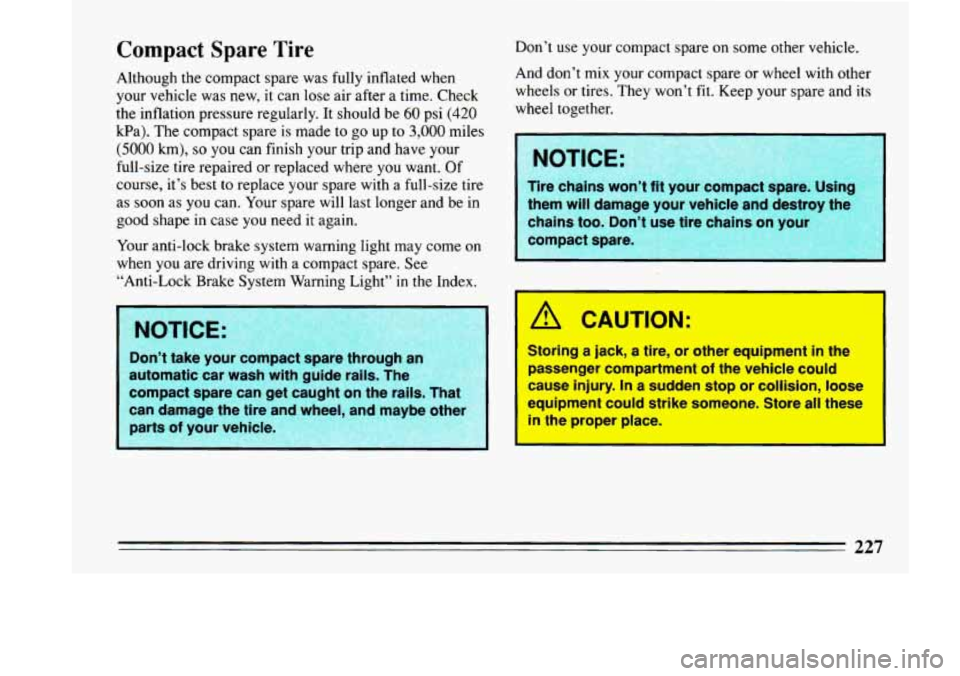
Compact Spare Tire
Although the compact spare was fully inflated when
your vehicle was new, it can lose air after a time. Check
the inflation pressure regularly. It should be
60 psi (420
Wa). The compact spare is made to go up to 3,000 miles
(5000 km), so you can finish your trip and have your
full-size tire repaired or replaced where you want. Of
course, it’s best
to replace your spare with a full-size tire
as soon as
you can. Your spare will last longer and be in
good shape in case you need it again.
Your anti-lock brake system warning light may come
on
when you are driving with a compact spare. See
“Anti-Lock Brake System Warning Light” in the Index. Don’t
use your
compact spare on some other vehicle.
And don’t mix your compact spare or wheel with other
wheels or tires. They won’t fit. Keep your spare and its
wheel together.
Tire chains wo
them will damage
y
chains too. Do
compact spar I
A CnUTION:
Storing a jack, a tire, or other equipment in the
passenger compartment of the vehicle could
cause injury. In a sudden stop or colllsian, loose
mwipment could strike someone. Store all these
.__ the proper place.
I
227
Page 250 of 324

Brake Master Cylinder
Your brake master cylinder is here. It is filled with
DOT-3 brake fluid. won’t
work at all.
So, it isn’t a good idea to “top off’
your brake fluid. Adding brake fluid won’t correct a
leak.
If you add fluid when your linings are worn, then
you’ll have too much fluid when you get new brake
linings. You should add (or remove) brake fluid, as
necessary, only when work
is done on the brake
hydraulic system.
A CAUTION:
If you have too much brake fluid, it can spill on
the engine. The fluid will burn if the engine is hat
,..ough. You or others could be burned, and you1
vehicle could be damaged. Add brake fluid only
when work is done on the brake hydraulic
system.
There are only two reasons why the brake fluid level in
your master cylinder might
go down. The first is that the
brake fluid goes down to an acceptable level during
normal brake lining wear. When new linings are put in,
the fluid level goes back up.
The other reason is that
fluid
is leaking out of the brake system. If it is, you
should have your brake system fixed, since a leak means
that sooner
or later your brakes won’t work well, or When your brake
fluid falls to a low level, your brake
warning light will come on. See “Brake System Warning
Light” in the Index.
When your brake fluid falls to a low
level, your brake
warning light will come
on and a chime will sound.
248
Page 263 of 324
‘A CAUTION:
0
Using the wrong replacement wheels, wheel
bolts,
or whwl nuts on your vehicle can be
dangerous. It could affect the braking and
handling
of your vehicle, make your tires lose air
and make you lose control.
You could have a
collision in which you or others could be injured.
Always use the correctwheel, wheel bolts, and
wheel
nuts for replacement.
NOTICE:
I
The wrong wheel can also cause problems with
bearing life, brake cooling,
speedometerlodometer calibration, headlight
aim, bumper height, vehicle ground clearance,
and tire
or tire chai
Used Rep1 Vheels - - -
’A CAUTION:
Putting a used wheel on your vehicle is
dangerous. You can’t know how it’s been used or
how many miles it’s been driven.
It could fail
suddenly and cause an accident. If you have to
replace a wheel use anew
GM original
equipment wheel.
I
Tire Chains
NOTICE
Use tire chains
SAE Class “S”
size for your
and tighten them as tightly as possible with
ends securely fastened. Drive
slowly and fol
the chain ma
hear the chai
retighten them.
If the contact continues, .elow
down until it stops. Driving ton fast with 4
on will damage your vehicle.
261
Page 272 of 324
Fuses and Circuit Breakers
The wiring circuits in your car are protected from short
circuits by a combination
of fuses, circuit breakers, and
fusible thermal links
in the wiring itself. This greatly
reduces the chance
of fires caused by electrical
problems.
You’ll find some spare
fuses in the fuse block. Be sure
to use the correct fuse.
If you ever have a problem on
the road and don’t have a spare fuse,
you can “borrow”
one
of the correct value. Just pick some feature of your
car that
you can get along without -- like the radio or
cigarette lighter
-- and use its fuse, if it is of the value
you need. Replace it as soon as you can.
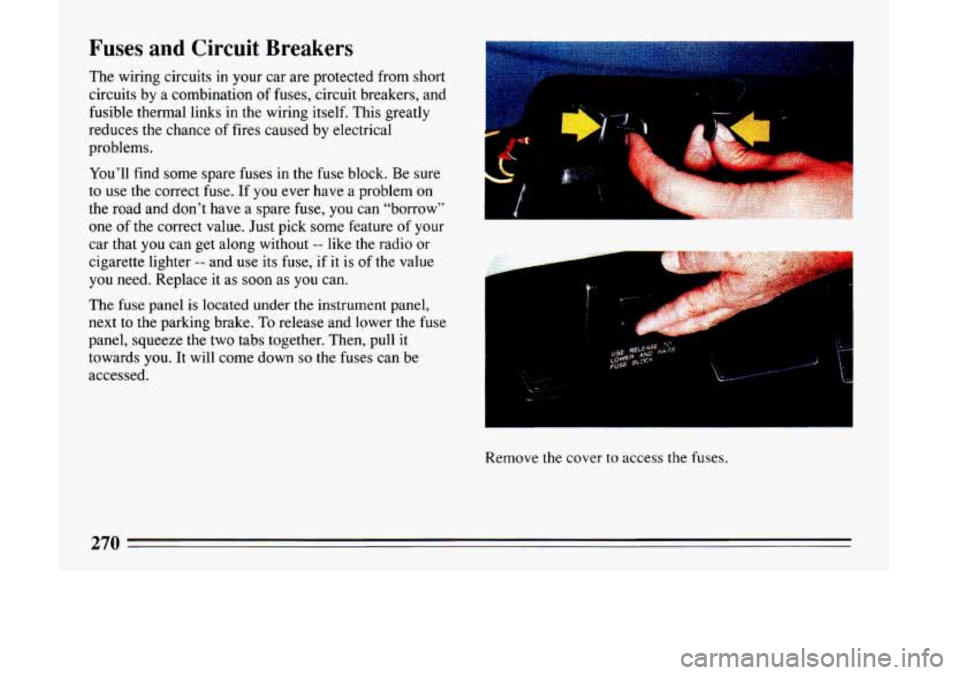
The fuse panel
is located under the instrument panel,
next to the parking brake.
To release and lower the fuse
panel, squeeze the two tabs together. Then, pull it
towards you.
It will come down so the fuses can be
accessed.
c m
k
Remove the cover to access the fuses.
270