Page 84 of 324
F- LA- 1
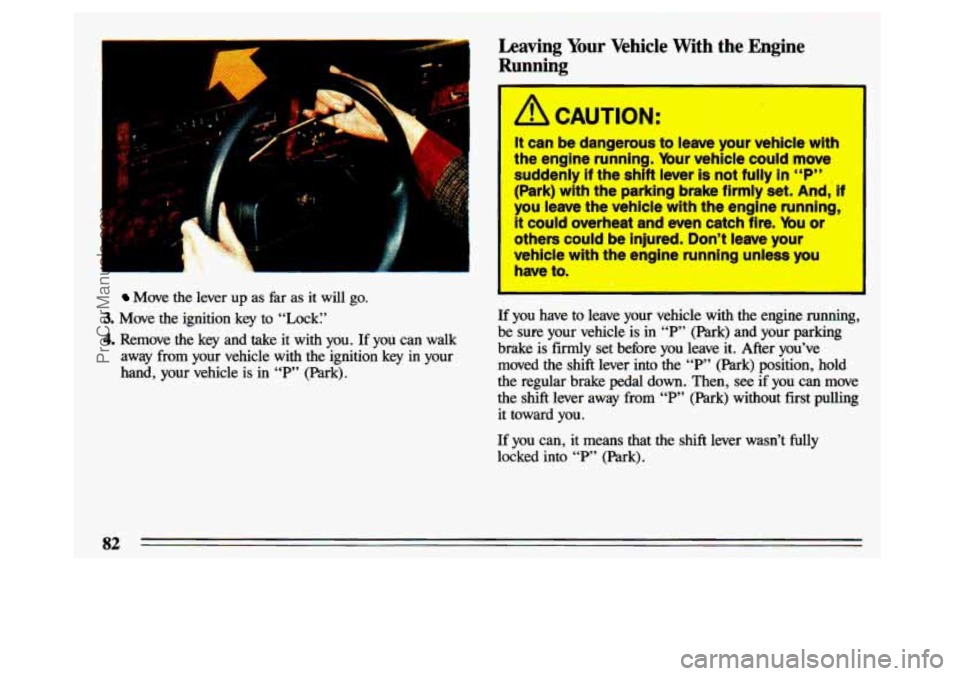
Move the lever up as far as it will go.
3. Move the ignition key to “Lock:’
4. Remove the key and take it with you. If you can walk
away from your vehicle with the ignition key in your
hand, your vehicle is
in “P” (Park).
Leaving Your Vehicle With the Engine
Running
It can be dangerous to leave your vehicle with
the engine running. Your vehicle could move
suddenly if the shift lever is not fully in
“P”
(Park) with the parking brake firmly set. And, if
you leave the vehicle with the engine running,
it could overheat and even catch fire. Ybu or
others could be injured. Don’t leave your
vehicle with the engine running unless you
have to.
If you have to leave your vehicle with the engine running,
be sure your vehicle
is in “P” (Park) and your parking
brake is firmly set before you leave it. After you’ve
moved the shift lever into
the “P” (Park) position, hold
the regular brake pedal down. Then, see if you can move
the shift lever away from
“P” (Park) without first pulling
it toward you.
If you can, it means that the shift lever wasn’t hlly
locked into
“P’ (Park).
82
ProCarManuals.com
Page 105 of 324
$9.
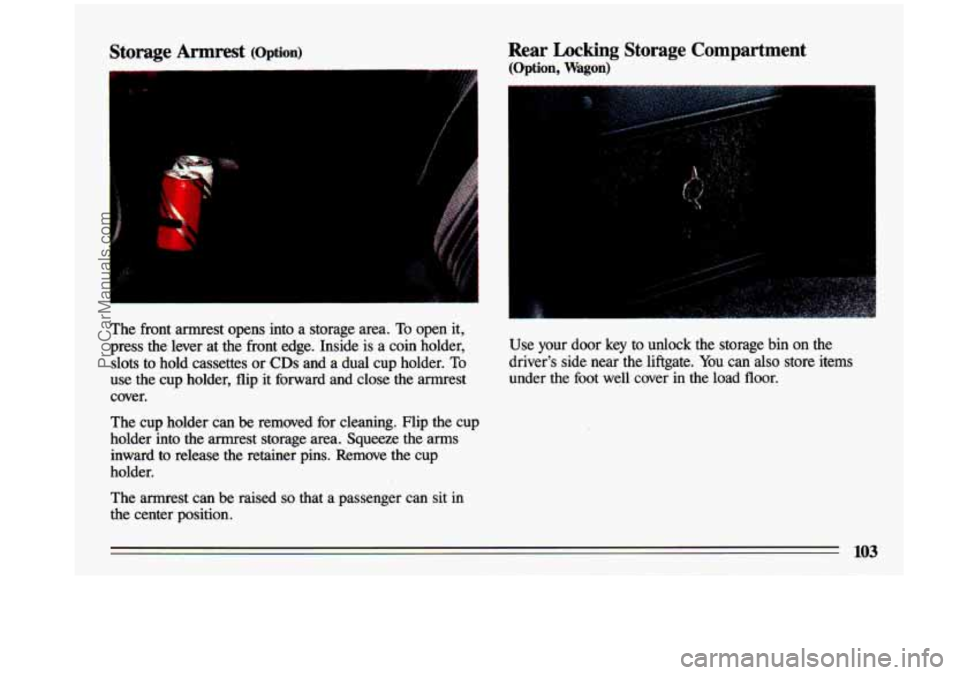
The front armrest opens into a storage area. To open it,
press the lever at the front edge. Inside is a coin holder,
slots to hold cassettes or
CDs and a dual cup holder. To
use the cup holder, flip it forward and close the armrest
cover.
The cup holder can be removed for cleaning. Flip the cup
holder into the armrest storage area. Squeeze the
arms
inward to release the retainer pins. Remove the cup
holder.
The armrest can be raised
so that a passenger can sit in
the center position.
Rear Locking Storage Compartment
(Option, Wagon)
Use your door key to unlock the storage bin on the
driver's side near the liftgate.
You can also store items
under the foot well cover in the load floor.
103
ProCarManuals.com
Page 108 of 324

Speedometer and Odometer
Your speedometer lets you see your speed in both miles per
hour (mph) and kilometers per hour (ludh). Your odometer
shows how
fkr your vehicle has been driven, in either
miles (used
in the U.S.) or kilometers (used in Canada).
Your Buick has a “tamper-resistant odometer? If you can
see silver lines between the numbers, probably someone
has
tried to turn it back. The numbers may not be true.
You
may wonder what happens if a vehicle has to have a
new odometer installed. If possible, the new one has to
be set to the same reading the old one had. If it can’t \
be,
then it’s set at zero, but a label on the driver’s door\
must show the old reading and when the new one was installed.
Trip Odometer
The trip odometer can tell
you how
far your vehicle
has been driven since you last set the trip odometer to
zero.
To set the trip odometer to
zero, press the reset knob to
the right of the trip
odometer.
Warning Lights, Gages and
Indicators
This section describes the warning lights and gages that may
be on your vehicle. The pictures will help you locate them.
Warning lights and gages can signal that something is
wrong before it becomes serious enough to cause an
expensive repair or replacement. Paying attention to your
warning lights and gages could
also save you or others
from injury.
Warning lights go on when there may be or is a problem
with one
of your vehicle’s functions. As you will see in
the details on the next few pages, some warning lights
come on briefly when you
turn the ignition key just to let
you know they’re working. If you are familiar with this
section, you should not be alarmed when this happens.
Gages can indicate when there may be or is a problem
with one of your vehicle’s functions. Often gages and
warning lights work together to let you know when
there’s a problem with your vehicle.
When one of the warning lights comes on and stays on
when you are driving, or when one of the gages shows
there may be a problem, check the section that tells you
what to do about it. Please follow the manual’s advice.
Waiting to do repairs can be costly-and even dangerous.
So please get to know your warning lights and gages.
They’re a big help.
ProCarManuals.com
Page 146 of 324
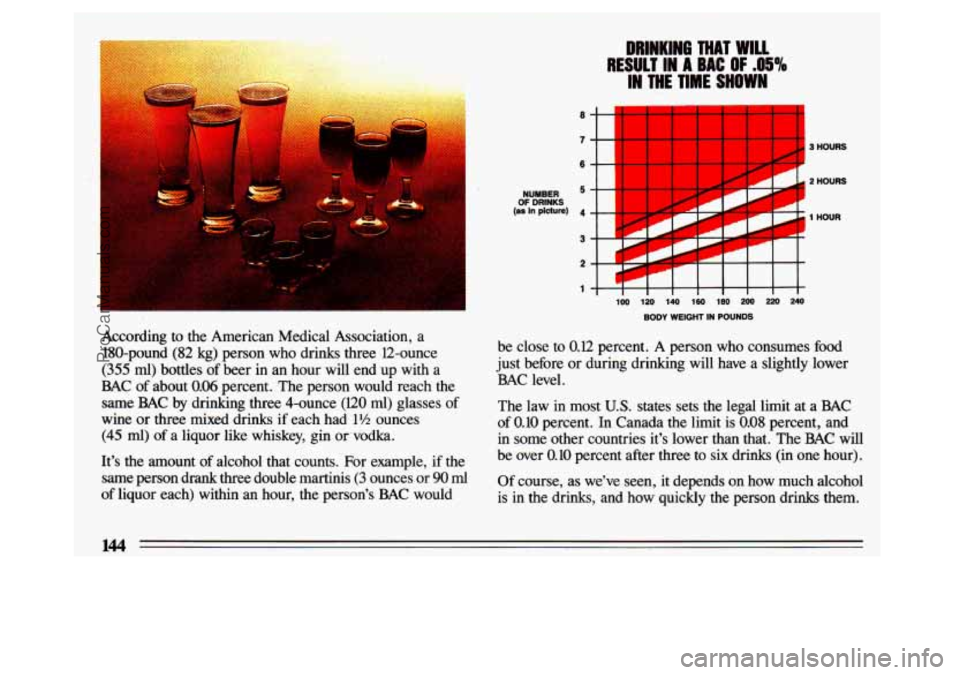
According to the American Medical Association, a
18O-pound’(82 kg) person who drinks three 12-ounce
(355 ml) bottles of beer in an hour will end up with a
BAC of about 0.06 percent. The person would reach the
same BAC
by drinking three 4-ounce (120 ml) glasses of
wine or three mixed drinks if each had
1% ounces
(45
ml) of a liquor like whiskey, gin or.vodka.
It’s the amount of alcohol that counts. For example,
if the
same person
drank three double martinis (3 ounces or 90 ml
of liquor each) within an hour, the person’s BAC would
DRINKING THAT WILL
RESULT IN A BAC OF .05%
IN THE TIME SHOWN
OF DRINKS
NUMBER (as in picture) 4
I HOURS
IFglT 1 &
100 120 140 160 1ao 200 220 240
BODY WEIGHT IN POUNDS
be close to 0.12 percent. A person who consumes food
just
before or during drinking will have a slightly lower
BAC level.
The law in most
U.S. states sets the legal limit at a BAC
of 0.10 percent. In Canada the limit
is 0.08 percent., and
in some other countries it’s lower than that. The BAC will
be over
0.10 percent after three to six drinks (in one hour).
Of course, as we’ve seen, it depends on how much alcohol
is in the drinks, and how quickly the person drinks them.
144
ProCarManuals.com
Page 186 of 324
Hazard Warning Flashers
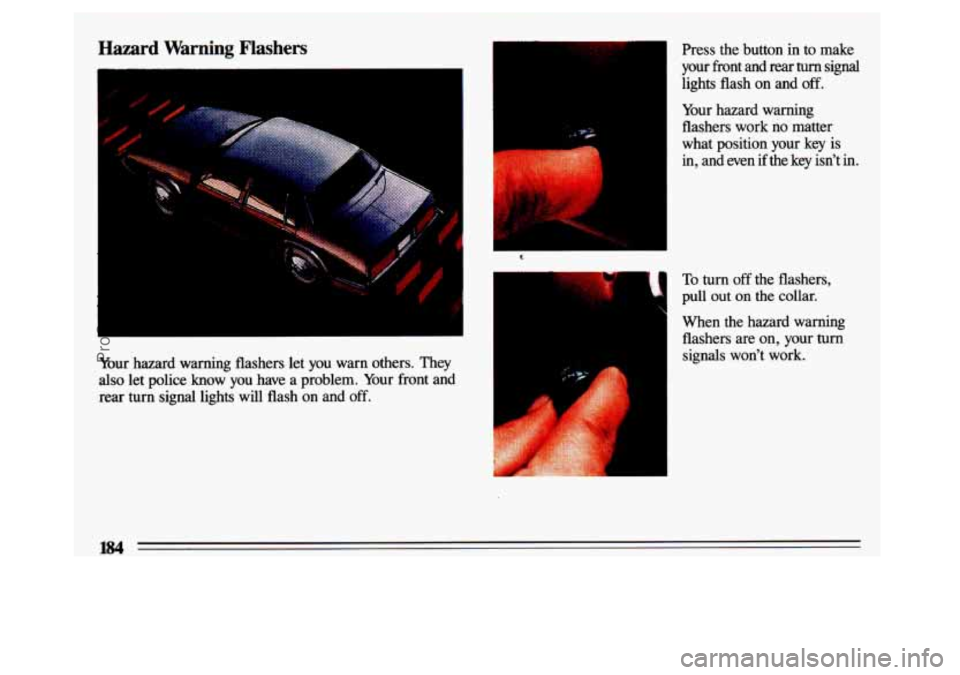
Your hazard warning flashers let you warn others. They
also let police know you have a problem. Your front and
rear turn signal lights will flash on
and off.
Press the button in to make
your front and
rear turn signal
lights flash on and
off.
Your hazard warning flashers work no matter
what position your key is
in, and even if the key isn't in.
To turn off the flashers,
pull out on
the collar.
When the hazard warning flashers are on, your
turn
signals won't work.
ProCarManuals.com
Page 193 of 324
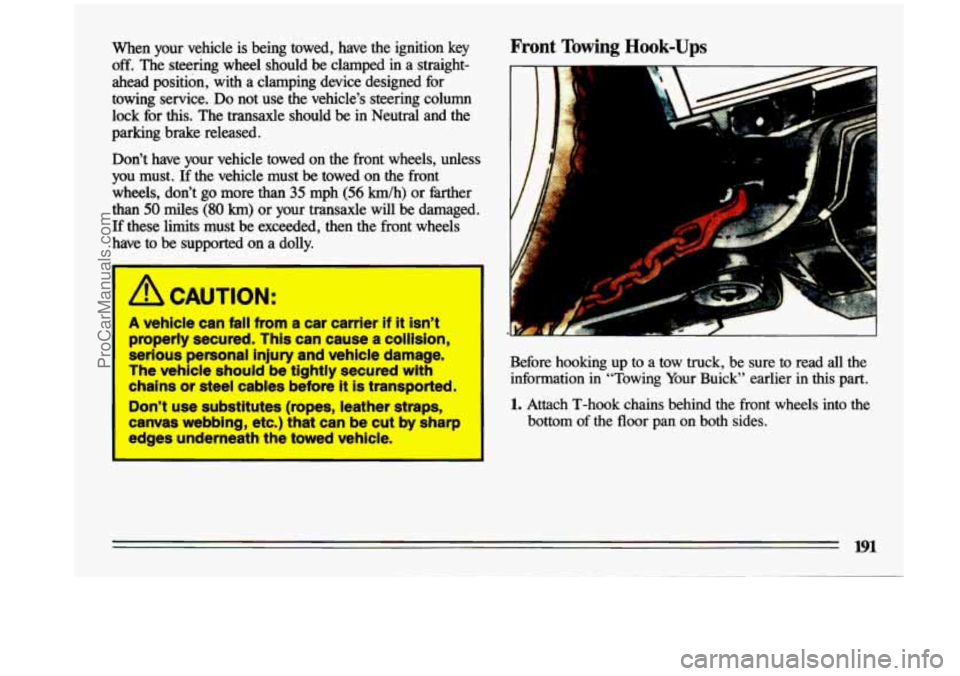
when your vehicle is being towed, have the ignition key Front Towing Hook-Ups
off. The steering wheel should be clamped in a straight-
ahead position, with a clamping device designed for
towing service.
Do not use the vehicle’s steering column
lock for
this. The transaxle should be in Neutral and the
parking brake released.
I
Don’t have your vehicle towed on the front wheels, unless
you must. If the vehicle must be towed on the front
wheels, don’t go more than
35 mph (56 km/h) or farther
than
50 miles (80 km) or your transaxle will be damaged.
If these limits must be exceeded, then the front wheels
have
to be supported on a dolly.
1
I
&!, CAUTION:
A vehicle can fall from a car carrier if It Isn’t
properly secured.
This can cause a colllsion,
serious personal injury and vehicle damage.
The vehicle should be tightly secured with Before hooking up to a tow truck, be sure to read all the
chains or steel cables before it is transported. information in “Towing Your Buick” earlier in this part.
Don’t use substitutes (ropes, leather straps, I
1. Attach T-hook chains behind the front wheels into the
canvas webbing, etc.) that can be cut by sharp bottom of the floor pan on both sides.
edges underneath the towed vehicle. I
191
ProCarManuals.com
Page 212 of 324
Standard Wheel Cover Wire Wheel Cover
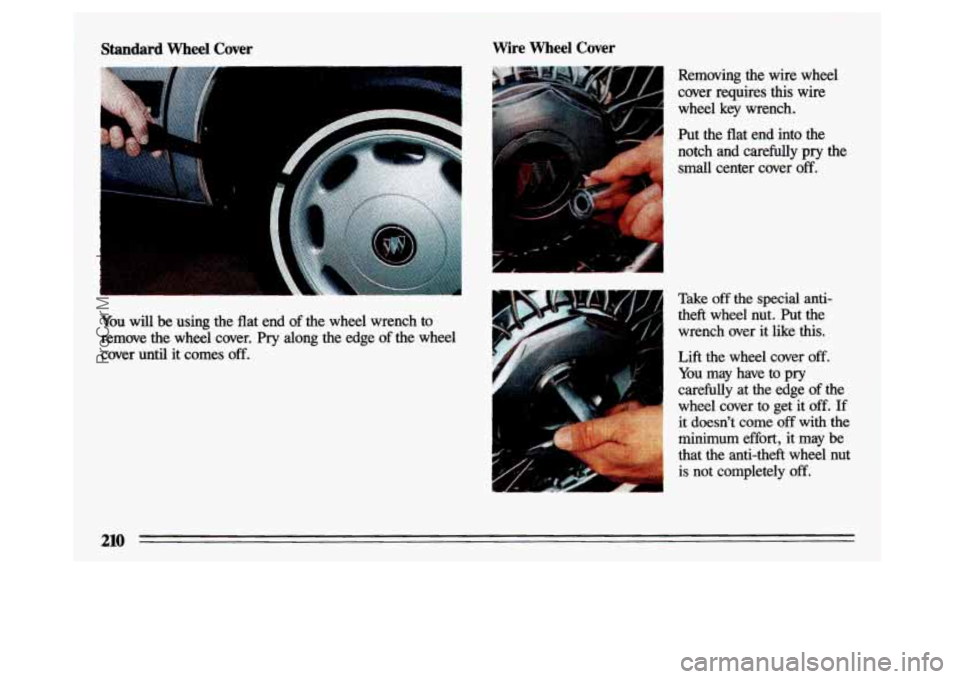
You will be using
the flat end of the wheel wrench to
remove the wheel cover. Pry along the edge of the wheel
cover until it comes off.
4 Removing the wire wheel
cover requires
this wire
wheel key wrench.
Put the flat end into the
notch and carefully pry the small center cover
off.
Take off the special anti-
theft wheel nut. Put the wrench over it like
this.
Lift the wheel cover off.
You may have to pry
carefully at the edge of the wheel cover to get it off.
If
it doesn’t come off with the
minimum effort, it may be
that the anti-theft wheel nut is not completely
off.
210
ProCarManuals.com
Page 290 of 324
At Least Once a Year
CHECK
OR SERVICE I WHAT TO DO
I
Key Lock Cylinders I Lubricate the key lock cylinders with the lubricant specified in Section D.
Body Lubrication Lubricate all body door hinges. Also lubricate all hinges and \
latches, including those for the
hood, glove box door and console door. Section
D tells you what to use. I
Starter Switch
When you are doing this check, the vehicle could move suddenly\
. If it does,
1. Before you start, be sure you have enough room around the vehicle.
2. Firmly apply both the parking brake (see “Parking Brake” \
in the Index if necessary) and
NOTE: Do not use the accelerator pedal, and be ready to turn off the engine immediately if
it starts.
3. Try to start the engine in each gear. The starter should work onl\
y in “P” (Park) or “N”
the regular brake.
(Neutral). If the starter works in any other position, your \
vehicle needs service.
288
ProCarManuals.com