1992 VOLKSWAGEN TRANSPORTER stop start
[x] Cancel search: stop startPage 81 of 164
Downloaded from www.Manualslib.com manuals search engine
DRIVING
TIPS
Driving economically and ecologically
.'arious
factors determine the fuel
con
sumption,
the burden on the environment
and
the wear on the engine, brakes and
lyres.
The personal style of driving
Determines
to a great extent the economi-
:al
aspect and the exhaust and noise
devel
opment:
jOp
Do not
warm
up the
engine
with
W» the
vehicle
stationary.
At idling speed it takes a very long
time
until
the engine becomes operationally
warm. However, in the warm-up phase,
wear and the discharge of pollutants is
oarticularly high. For
this
reason, drive
off immediately the engine has started
and avoid
high
engine speeds.
f
h Avoid
full
throttle
acceleration.
of only is the
fuel
consumption reduced
considerably
if one accelerates
with
feel
ing, but the disturbance to the environ
ment
and the wear are also reduced.
rflri
Do not
drive
with
unnecessarily
high
engine
revs
-
change
up as
soon as possible,
only
change
down
when
the
engine
no
longer
runs
smoothly.
The
fuel
consumption is for example
more
than
twice as
high
in 2nd gear
than
it is in top
gear.
At the same
time,
the re duced engine speed means a reduction
in engine noise.
On vehicles
with
an automatic gearbox
the economy programme should be se
lected.
c^p
Try not to
drive
at
maximum
TO
speed.
The
fuel
consumption, exhaust pollution
and noise increase disproportionately at
high
speeds. If approximately only 3
quarters of top speed is utilised, the
fuel
consumption
will
be reduced by about
half.
Experience has shown
that
the loss in
time
is only marginal.
c
j-,
Drive
as
smoothly
as possible and
look
well
ahead.
Unnecessary
acceleration and braking
must
be paid for
with
higher
fuel
con
sumption and more disturbance to the environment.
Switch
the
engine
off
during
hold-ups. The individual
operating
condi
tions
Naturally
also
affect fuel consumption.
The
following factors for instance are not fa
vourable
to good fuel consumption:
•
High traffic density, particularly large
.towns with numerous traffic lights.
•
Frequent stop/start driving, always restarting and warming up the engine.
•
Driving in heavy, slow moving traffic in
low
gear so that the engine speed is
rela
tively high in relation to the distance cov
ered.
CQ~, One
should,
therefore,
plan
trips
in
advance
and try to
avoid
local
traffic
and
overcrowded
motor
ways.
Obviously
the fuel consumption is
also
af
fected
by factors over which the driver has
no
control. It is for example normal for the
consumption
to increase in the winter or in
arduous
conditions (bad roads, trailer tow ing etc.).
79
www.vwT4camper.info - a useful website for owners and enthusiasts of VW T4 Transporter Campervans
Page 92 of 164
Downloaded from www.Manualslib.com manuals search engine
GENERAL MAINTENANCE
Paint damage
Small marks in the paint such as scratches
or stone damage should be touched up im mediately with paint (Volkswagen touch-up
stick or spray can) before the metal starts to rust.
However, should rust be found at any time
it must be removed thoroughly and then the
area treated first with an anti-corrosion primer and then the correct paint applied.
You can of course have this work done by a
Volkswagen dealer.
The number of the original vehicle paint is given on the data sticker (see page 154 ).
Windows
Remove snow and ice from windows and
mirrors with a plastic scraper only. To avoid
scratches due to dirt on the glass, the
scraper should only be pushed in one direc
tion and not moved to and fro.
Traces of rubber, oil, wax, grease or silicone
can be removed with a window cleaning
sol
ution or a silicone remover.
The windows should also be cleaned on the inside at regular intervals. Do not dry the windows with the leather
used for the paintwork because traces of
paint cleaner will cause streaks to appear on
the glass.
To avoid damaging the
heating element
wires
in the rear window do not put
stickers over the wires on the inside.
Door, boot
and
window
weatherstrips
The weatherstrips will remain flexible and last longer if they are rubbed lightly with a
rubber protective compound from time to
time.
This will also stop the weatherstrips
from freezing on in the winter.
Plastic parts
and
leatherette
Exterior plastic parts are cleaned with nor
mal washing and interior parts with a damp
cloth.
If this is not sufficient, these parts and leatherette may only be cleaned with
special solvent-free
plastic cleaners.
Curtains
The curtains may only be cleaned chemi cally. They should not be washed as the.
could shrink, and/or the fire-resistant properties could be washed out.
Upholstery cloth
and
textile
trim
Upholstery cloth and textile trim on doc-
panels, parcel shelves, luggage compart ment covers, headlining etc. must be
cleaned with special cleaners or dry foarr
and a soft brush.
Cleaning seat belts Keep belts clean
because they may nc:
retract properly if very dirty.
Dirty belts can be cleaned by washing with
a mild soap solution without taking the belt; out of the vehicle.
Note
Inertia reel belts should be completely dr.
before they are allowed to roll up.
90
www.vwT4camper.info - a useful website for owners and enthusiasts of VW T4 Transporter Campervans
Page 99 of 164
Downloaded from www.Manualslib.com manuals search engine
GENERAL
MAINTENANCE
The
multigrade-improved
lubricity
oils as per VW
Specification
500 00 m/e in addition the following advantages:
-
All year round use at practically all tem peratures.
-
Low frictional
losses
in the engine.
-
Best possible starting even at very low temperatures.
»Jotes
I
Single
grade
oils. Due to their limited
i-scosity
ranges these oils are not generally
j_::eptable for all year round use. "erefore these oils should only be used in
-
:reme climatic
zones.
•
When using SAE 5 W-30 multigrade oil, xntinuous high engine speeds and engine
seeding
should be avoided. This restriction
::es
not apply to multigrade-improved lu-
r city oils.
Checking
oil
level
Every
engine uses a certain amount of oil.
The
oil
consumption
can be up to 1.0
litres per 1000 km - see also page 80. The
engine oil level must therefore be checked
at regular intervals, preferably when filling
the tank and before a long journey.
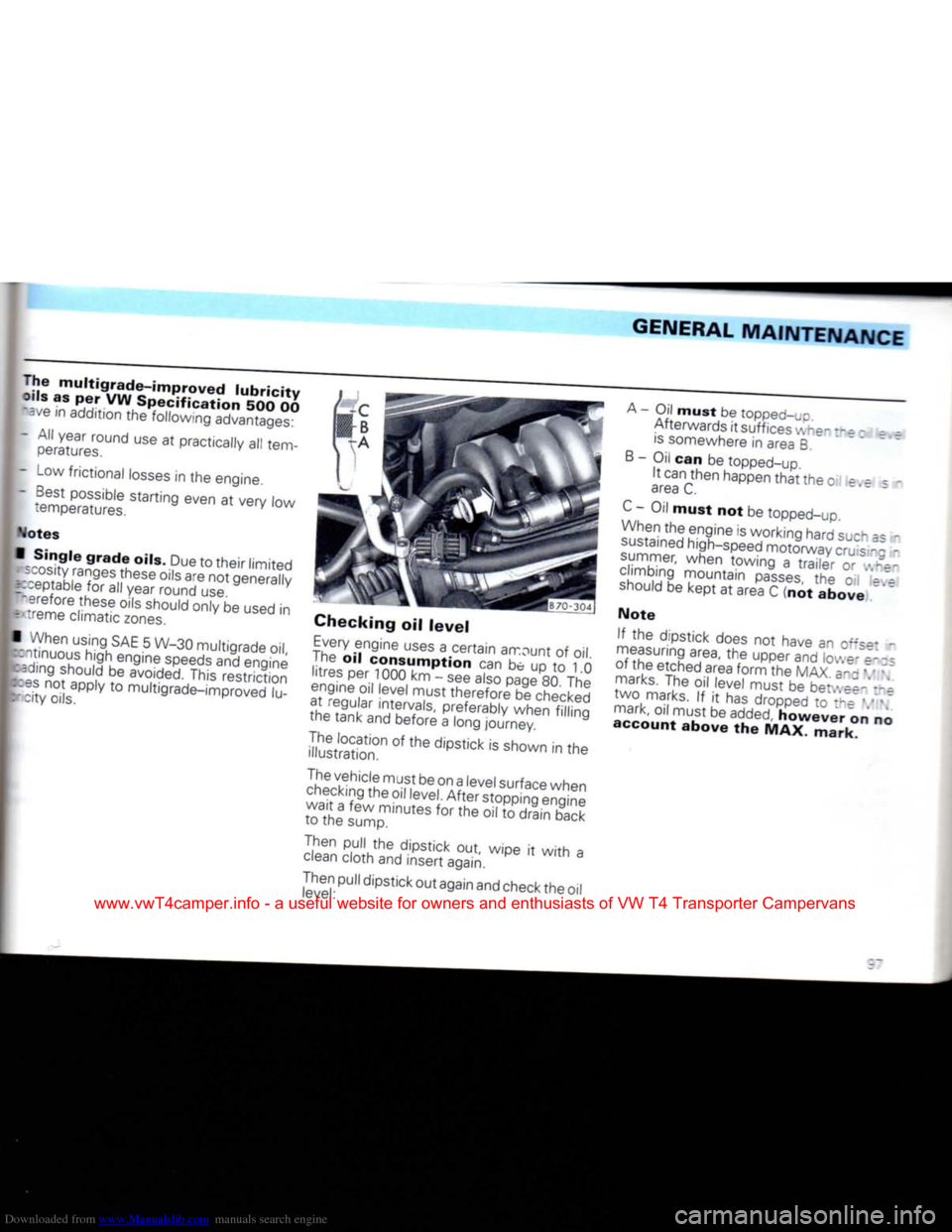
The
location of the dipstick is shown in the illustration.
The
vehicle must be on a level surface when
checking
the oil level. After stopping engine
wait a few minutes for the oil to drain back
to the sump.
Then
pull the dipstick out, wipe it
with
a
clean
cloth and insert again.
Then
pull dipstick out again and check the oil
level:
A
- Oil
must
be topped-L.c.
Afterwards it suffices v.-5-:_e : e e
is
somewhere in area B.
B
- Oil can be topped-up. It can then happen
that
the c e.e s -
area
C.
C
- Oil
must
not be topped-up.
When
the engine is working hard sue as -
sustained
high-speed motorway cruising in
summer, when towing a trailer or :re~
climbing mountain
passes,
the c: e.e
should
be kept at area C (not
above
Note
If the dipstick does not have a- c"ee: -
measuring
area,
the upper and lows- e~zi
of the etched area form the MAX.
a~
z '.'
marks.
The oil level must be betv.ee- re
two marks. If it has dropped to 're '.' ". mark, oil must be added,
however
on no
account
above
the MAX.
mark.
www.vwT4camper.info - a useful website for owners and enthusiasts of VW T4 Transporter Campervans
Page 108 of 164
Downloaded from www.Manualslib.com manuals search engine
GENERAL
MAINTENANCE
Battery
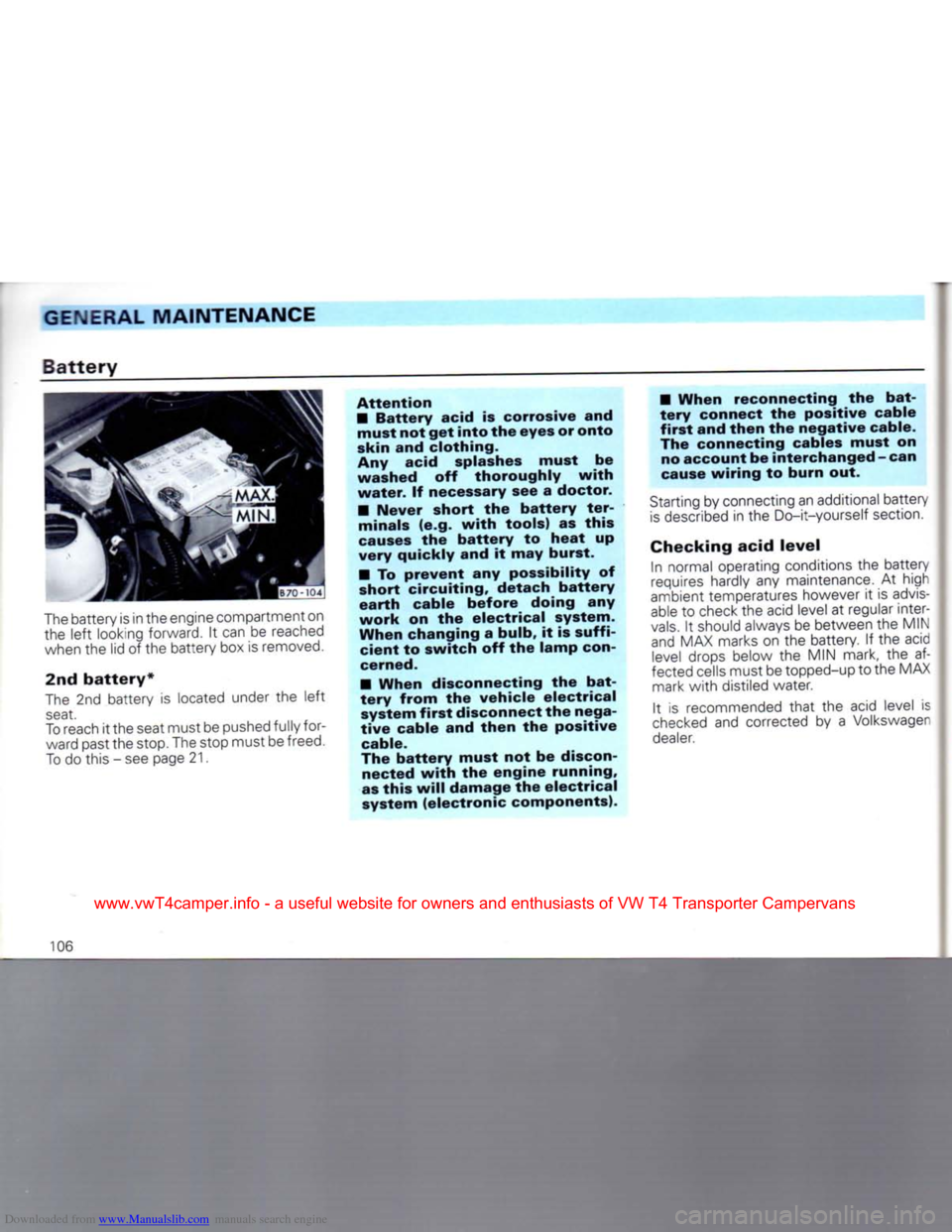
The
battery is in the engine compartment on
the left looking forward. It can be
reached
when
the lid of the battery box is
removed.
2nd
battery*
The
2nd battery is located under the left
seat.
To
reach
it the
seat
must be
pushed
fully for
ward
past the stop. The stop must be
freed.
To
do this - see page 21. Attention
•
Battery
acid is corrosive and must not get
into
the eyes or onto
skin and clothing.
Any
acid splashes must be
washed off thoroughly
with
water.
If necessary see a doctor.
•
Never short the
battery
ter
minals (e.g.
with
tools) as this
causes
the
battery
to
heat
up
very quickly and it may burst.
•
To prevent any possibility of
short circuiting, detach
battery
earth
cable before doing any
work
on the electrical system.
When changing a bulb, it is sufficient to switch off the lamp
con
cerned.
•
When disconnecting the
bat
tery
from the vehicle electrical system
first
disconnect the nega
tive
cable and
then
the positive cable.
The
battery
must not be discon nected
with
the engine running,
as this
will
damage the electrical
system (electronic components).
•
When reconnecting the
bat
tery
connect the positive cable
first
and
then
the negative cable.
The connecting cables must on no account be interchanged - can
cause
wiring
to burn out.
Starting
by
connecting
an additional battery
is
described
in the Do-it-yourself
section.
Checking
acid level In normal operating conditions the battery
requires
hardly any maintenance. At high
ambient
temperatures however it is
advis
able
to
check
the
acid
level at regular inter
vals.
It should always be between the MIN
and
MAX marks on the battery. If the
acid
level
drops below the MIN mark, the af
fected
cells
must be topped-up to the MAX
mark
with distiled water.
It is recommended that the
acid
level is
checked
and corrected by a
Volkswager
dealer.
106
www.vwT4camper.info - a useful website for owners and enthusiasts of VW T4 Transporter Campervans
Page 133 of 164
Downloaded from www.Manualslib.com manuals search engine
DO-IT-YOURSELF
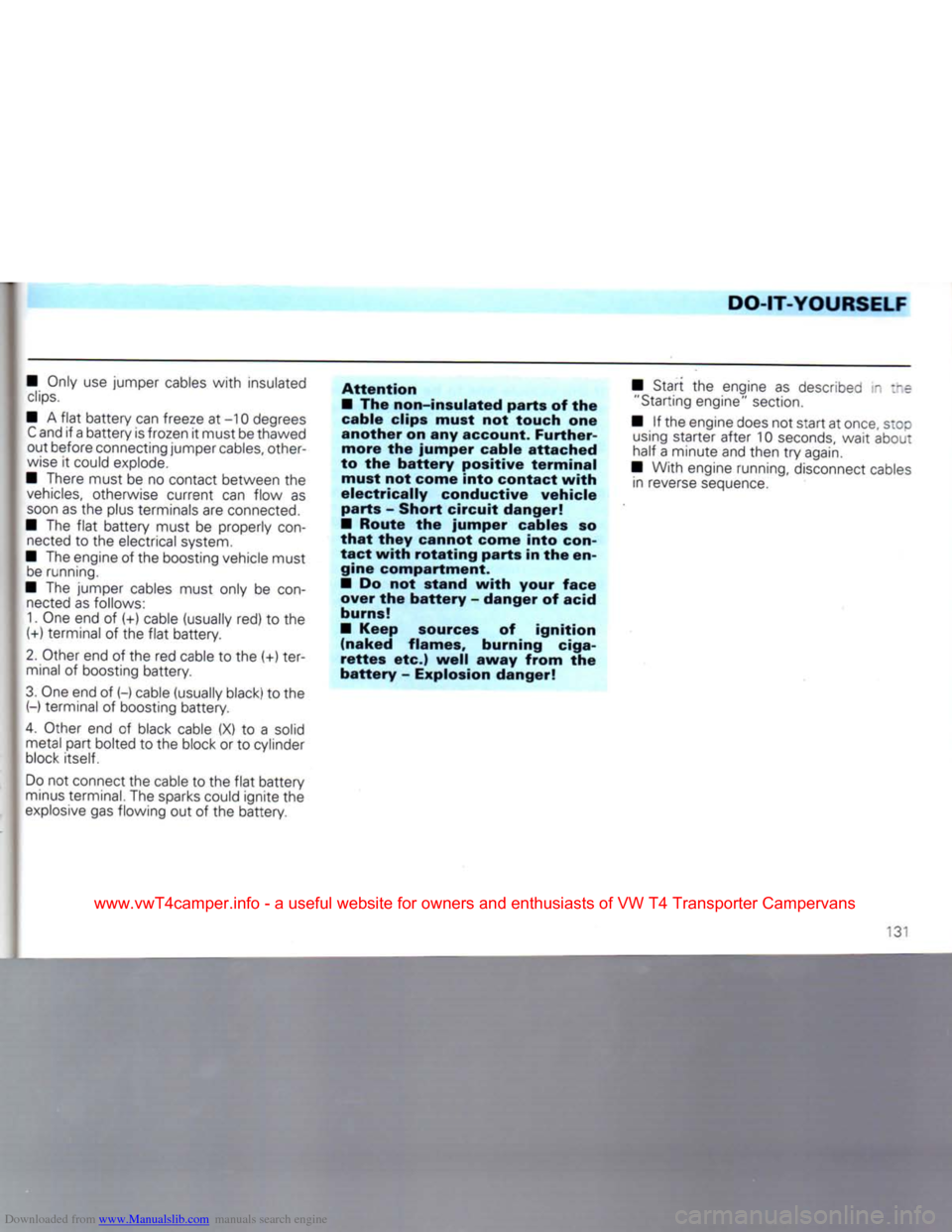
• Only
use
jumper cables
with
insulated
clips.
•
A
flat
battery can freeze
at
-10 degrees
C
and
if
a battery is frozen
it
must be thawed
out before connecting jumper
cables,
other
wise
it
could explode.
• There must
be no
contact between
the
vehicles,
otherwise current
can
flow
as
soon
as
the
plus terminals are connected.
•
The
flat
battery must
be
properly
con
nected
to the
electrical system.
• The engine
of
the boosting vehicle must be running.
•
The
jumper cables must only
be
con
nected as follows:
1. One end
of (+)
cable (usually red)
to the
(+)
terminal
of
the
flat
battery.
2.
Other end
of
the red cable
to the (+)
ter
minal
of
boosting battery.
3.
One end
of (-)
cable (usually black)
to the (-)
terminal
of
boosting battery.
4.
Other
end of
black cable
(X) to a
solid metal part bolted
to
the block
or to
cylinder
block itself.
Do
not
connect the cable
to
the
flat
battery
minus terminal. The sparks could ignite
the
explosive
gas flowing
out of the
battery.
Attention
•
The non-insulated parts of the
cable clips must not touch one
another on any account. Further more the jumper cable attached
to the
battery
positive terminal must not come into contact
with
electrically conductive vehicle parts - Short circuit danger!
•
Route the jumper cables so
that
they cannot come into
con
tact
with
rotating parts in the en gine compartment.
•
Do not stand
with
your face
over the
battery
- danger of acid
burns!
•
Keep sources of ignition (naked flames, burning
ciga
rettes
etc.)
well
away from the
battery
- Explosion danger!
• Start
the
engine
as
described
in the
"Starting engine" section.
•
If
the engine does not start
at
once, stop using starter after
10
seconds, wait about
half
a
minute and then
try
again.
• With engine running, disconnect cables in reverse sequence.
-.3'
www.vwT4camper.info - a useful website for owners and enthusiasts of VW T4 Transporter Campervans
Page 159 of 164

Downloaded from www.Manualslib.com manuals search engine
ALPHABETICAL
INDEX
Engine
-Code
letters 154
-Data
141
- Intervals of oil change 93
-Number
154
-Oil
96 - Oil capacity
1
53
- Oil change intervals 98
- Oil consumption 97
- Oil level 97
- Oil pressure 47
- Starting/stopping 37
Engine
compartment 95
Engine
compartment
light
72
Engine
number 154 Environment
- Activated charcoal
filter
738
-Battery
707
- Brake
fluid
705 - Care of car 88
- Coolant 103
- Driving environment consciously 79 - Driving
with
low emissions/noise 79
- Emission
control
system 737
- Engine oil 98
- Filling the
tank
85
-Fuel 86 - Maintenance 93
-Old oil 98 - Old
tyres
712 - Petrol vapour accumulator .... 738
-
Tyre
pressure
7
70
- Tyres 7 72
- Unleaded
fuel
86
- Washing the vehicle 89
F
Fan
103
Filling
the tank 85
Filter
preheating 87
First
aid kit 118
Fog
lights 51, 125
Folding
seat 25
Foot
mats 29
Fresh
air ventilation 56
Front axle load 148 Front seats 20
Fuel
86
-Additives
86, 87
-Consumption
79,143
- Filter 116
- Filter preheating 87 - Gauge 46
- Saving 79
Fuses
122
G
Gear
change marks 40, 77
Gear
lever 31
Gearbox
oil 99
Glove
box 74
Glow
plugs 38
H
Handbrake
31
Head
restraints 19
Headlight
beam control 50
Headlight
flasher 52
Headlight
washer system 54
Heated
rear window 51
Heating
55, 57
High
beams 48
Horn
4
I
Identification data 154
Ignition
lock 36
Increased
payload 149
Inertia
reel belts 16 Inside mirror 13
Inspection intervals 98
Installing seat 22
Instrument
lighting 50
Instruments 40
Interior
lights 72, 126
Intervals of inspection 93
Intervals of oil change 93
J
Jack
120
Jacking
points 120
Jumper
cable 130
157
www.vwT4camper.info - a useful website for owners and enthusiasts of VW T4 Transporter Campervans
Page 161 of 164
Downloaded from www.Manualslib.com manuals search engine
ALPHABETICAL
INDEX
S
Safety
for children 18
Seat
adjustment 20
Seat
belts 15
Seat
heating 51
Seat
stop 21
Seats
20
Selector
lever 33
Service
address list 2
Service
Schedule 2
Side
lights 50
Sleeping
surface 26
Sliding
door 9
Sliding
window 13
Sliding/tilting roof "71
Snow
chains 114
Spare
wheel 119
Spark
plugs 145
Speedometer
40
Starting the engine 37
Steering/starter lock 36
Stopping engine 39
Sun
roof 70
Sun
visors 73
Switches
50
T Tachograph 45 Tailgate 10
Tank capacity 153
Technical
Data 141
Technical
description 136 Telephone 117
Tilting roof 70, 71
Timer 65, 68
Tools
118 Tow starting 133
Tow-bar weight 151 Towing 133
Trailer socket 81
Trailer towing 81
Trailer weights 151
Tread depth 111 Trip recorder 40
Trolley jack 134 Turn signal lever 52
Turn signals 48, 125
Two way radios 117
Type plate 154 Tyre pressures 147
Tyres
110 - Condition 111
-
Inflation
pressure 110 - Pressures 147
u
Unbalanced
wheels 111
Undercoating 92
Unladen
weight 148
Unleaded
fuel 86
V
V-belts
145
Vehicle
data sticker 154
Vehicle
identification data 154
Vehicle
identification number 154
Vehicle
lift
134
Vehicle
literature
2
Vehicle
tools 118
Ventilation 55, 56, 57
w
Warning and control lights 6 Warning lamps 6, 47
Warning triangle 118
Warranty 2
Washing
88 Weights 148
Wheelbase
148
Wheels
110, 146
Windows 12
- De-icing 90
- Defrosting 56, 58
Windscreen
washer system 108
Windscreen
wiper 54
Windscreen
wiper blades 109
Wing doors 11 Winter driving 116
Winter tyres 114
Wipe/washer
system 54
159
www.vwT4camper.info - a useful website for owners and enthusiasts of VW T4 Transporter Campervans