Page 677 of 1164

CONVENTIONAL BRAKE SYSTEM P
03UOPX-02,
4
ADJUSTING BOLT
‘ ’
I ’ “-
03UOPX-025
r
03UOPX-02
6
ir
23UOPX.OC
OWOPX-028
Removal note
Brake pipe
Disconnect the brake pipe from the master cylinder with the
SST.
Caution
l Do not allow the brake fluid to get on painted sur-
faces. If it does, wlpe it off immediately.
Installation note
Master cylinder
Piston to push rod clearance
Before installing the master cylinder, check the clearance be-
tween the piston of the master cylinder and the push rod of
the power brake unit as follows.
1. Place the
SST atop top of the master cylinder. Turn the ad-
justing bolt until it bottoms in the push rod hole in the piston.
2. Apply 500
mmHg (19.7 in-Hg) vacuum to the power brake
unit with a vacuum pump.
3. Invert the adjustment gauge used in Step 1 and place it on
the power brake unit.
4. Measure the clearance between the end of the gauge and
the push rod of the power brake unit. If it is not
Omm (0
in),
loosen the push rod locknut and turn the push rod to
make the adjustment.
Note
l By making the above adjustment, the clearance be-
tween the push rod and piston (after Installation of
the brake master cylinder and the power brake unit)
will be as shown in the table below.
Push rod-to-piston clearance
When vacuum applied to unit is
0 mmHg (0 inHg) 0.4-0.6mm (0.016-0.024 in)
I
When vacuum applied to unit is
approx. 500 mmHg (19.7 inHg)
I O.l-0.4mm (0.004-0.016 in)
Brake pipe
1. Tighten the brake pipe flare nut with the SST.
Tightening torque:
13-22 N,m (1.3-2.2 m-kg, 9.4-16 ft-lb)
P-l 1
Page 678 of 1164
P CONVENTIONAL BRAKE SYSTEM
Disassembly / Assembly / Inspection
1. After removing the brake fluid, disassemble in the order shown in the figure.
2. Inspect all parts and repair or replace as necessary.
3. Assemble in the reverse order of disassembly.
Caution
l Secure the master cylinder flange in a vise when necessary.
l Replace the piston assembly, if necessary.
l Do not let foreign material enter the cylinder, and do not scratch the inside of the cylinder
or the outer surface of the piston.
REP1 .ACE
0.98-1.47 (10-15, 8.7-13.0)
o R,NG ,,,dcE @.96-2.45 (20-25, 17.4-21.7)
- 3
N.m (cm-kg, in-lb)
1. Reservoir cap assembly 5. Bushing 9. Primary piston assembly
2. Float 6. Stopper screw 10. Secondary piston assembly
3. Screw 7. Fluid level sensor 11. Master cylinder body
4. Reservoir 8. Snap ring
P-12
Page 679 of 1164

CONVENTIONALBRAKESYSTEM P
1 SUOPX-001
03UOPX-03
0
o3uoPx-os
0
POWER BRAKE UNIT
Quick Inspection, On-vehicle
Power brake unit function check
k:;;p{e method)
1. With the engine stopped, depress the pedal a few times.
2. With the pedal depressed, start the engine.
3. If immediately after the engine starts the pedal moves down
slightly, the unit is operating.
Step 2
1. Start the engine.
2. Stop the engine after it has run for
1 or 2 minutes.
3. Depress the pedal with the usual force.
4. If the first pedal stroke is long and becomes shorter with
subsequent strokes, the unit is operating.
5. If a problem is found, inspect for damage of the check valve
or vacuum hose and examine the installation. Repair if
necessary, and inspect it once again.
Step 3
1. Start the engine.
2. Depress the pedal with the usual force.
3. Stop the engine with the pedal held depressed.
4. Hold the pedal down for
about 30 seconds.
5. If the pedal height does not change, the unit is operating.
6. If there is a problem, check for damage to the check valve
or vacuum hose, and check the connection. Repair if neces-
sary and check once again.
If the nature of the problem is still not clear after the 3 steps
above, follow the more detailed check described in “Method-
using tester,” below.
(Method-using tester)
Connect a pressure gauge, vacuum gauge, and pedal depres-
sion force gauge as shown in the figure. After bleeding the
air from the pressure gauge, conduct the test as described
in the 3 steps below.
Note
l Use commercially available gauges and pedal
depression force gauge.
a) Checking for vacuum loss
Unloaded condition
1. Start the engine.
2. Stop the engine when the vacuum gauge reading reaches
500 mmHg (19.7 inHg).
3. Observe the vacuum gauge for 15 seconds. If the gauge
shows 475-500
mmHg (18.7-19.7 inHg), the unit is
operating.
P-13
Page 680 of 1164
P CONVENTIONAL BRAKE SYSTEM
0 8
500 mmHg
(19.7 inHg)
96 N (20 kg, 44 lb)
03UOPX-03
03UOPX-03
03UOPX-031
Loaded condition
1. Start the engine.
2. Depress the brake pedal with a force of 196 N (20 kg, 44
lb).
3. With the brake pedal depressed, stop the engine when the
vacuum gauge reading reaches 500 mmHg (19.7 inHg).
4. Observe the vacuum gauge for 15 seconds. If the gauge
shows 475-500 mmHg (18.7-19.7 inHg), the unit is
operating.
b) Checking for hydraulic pressure
1. If with the engine stopped (vacuum 0 mmHg) the fluid pres-
sure is within specification, the unit is operating.
Pedal force Fluid pressure
196 N (20 kg, 44 lb) 1 1,177 kPa (12 kg/cm2, 171 psi) min
2. Start the engine. Depress the brake pedal when the vacu-
um reaches 500 mmHg (19.7 inHg). If the fluid pressure
is within specification, the unit is operating.
Pedal force Fluid pressure
196 N (20 kg, 44 lb) 7,063 kPa (72 kg/cm’, 1,024 psi)
P-14
Page 681 of 1164
CONVENTIONAL BRAKE SYSTEM P
03UOPX-039
ARROW MARK
23UOPX-Old
Check valve
Inspection
1. Disconnect the vacuum hose (with intenal check valve) from
the engine side.
2. Apply suction and pressure to the hose from the engine side.
Verify that air flows only toward the engine.
Caution
l If the check valve is bad, replace the hose with the
valve.
3. Install the vacuum hose with the arrow facing the engine.
P-15
Page 682 of 1164

P CONVENTIONALBRAKESYSTEM
Removal / Installation
1. Remove in the order shown in the figure, referring to Removal Note.
2. install in the reverse order of removal, referring to Installation Note.
(1.9-2.6, 14-19)
1.3-2.2, 9.4-16)
(1 .O-1.6, 7.2-12)
13-22 (1.3-2.2, 9.4-16)
N.m (m-kg, ft-lb)
23UOPX-003
1. Connector 3. Master cylinder 6. Nut
2. Brake pipe
Installation Note 7. Power brake unit
Removal Note . . page P-l 1 . . . . . . . . . . . . . . . . . S ,,,.. page P-l 1 8. Gasket
Installation Note
4. Vacuum hose
. . . . . . . . . . . . . . . . . . . . . . . page P-l 1 5. Cotter pin and clevis pin
Cautlon
Take the following steps after installation:
l Add fluid and bleed the air. (Refer to page P-6.)
l Check all parts for fluid leakage. (Refer to page P-8.)
l Adjust and check the brake pedal. (Refer to page P-8.)
l Make an on-vehicle check of the unit. (Refer to page P-13.)
13uow007
03UOPX-043
t
0
A
.--- -------_- --
m--v
K/
6 B I)
P-l 6
DUAL PROPORTIONING VALVE
Inspection
1. Connect two pressure gauges (9,810 kPa [lo0 kg/cm’,
1,422 psi]) to the brake pipes with adapters as shown in
the figure.
Adapter and flare nut tightening torque:
13-22 N,m (1.3-2.2 m-kg, 9.4-18 f&lb)
Note
l Disconnect and connect the brake pipes with SST.
2. Bleed the air from the brake system.
(Refer to page P-6.)
3. Depress the brake pedal until the master cylinder pressure
equals A; then record rear brake pressure A’.
4. Depress the brake pedal again, apply additional pressure
until the pressure equals B; then record pressure 6’.
Fluid pressure kPa (kg/cm*, psi)
A A’ B B’
Rear drum 2,453 2,256-2,649 5,886 284%3,434
brake
(25, 356) (23-27, 327-384) (60, 853) (29-35, 412-498) --.-,
Rear disc 2,453 2,256-2,649 5,886 3,188-3,777
brake (25, 356) (23-27, 327-384) (60, 853) (32.5-38.5, 462-547)
Page 683 of 1164
CONVENTIONAL BRAKE SYSTEM P
Caution
l Do not attempt to adjust the dual proportioning
valve.
l After the inspection, bleed the air from the brake
system and check for fluid leakage.
l If the measurements are not within specification,
replace the valve assembly.
03UOPX-045
13-22 (1.3-2.2, 9.4-16) TJ
R P @ 19-23 (1.9-2.3, 14-17)
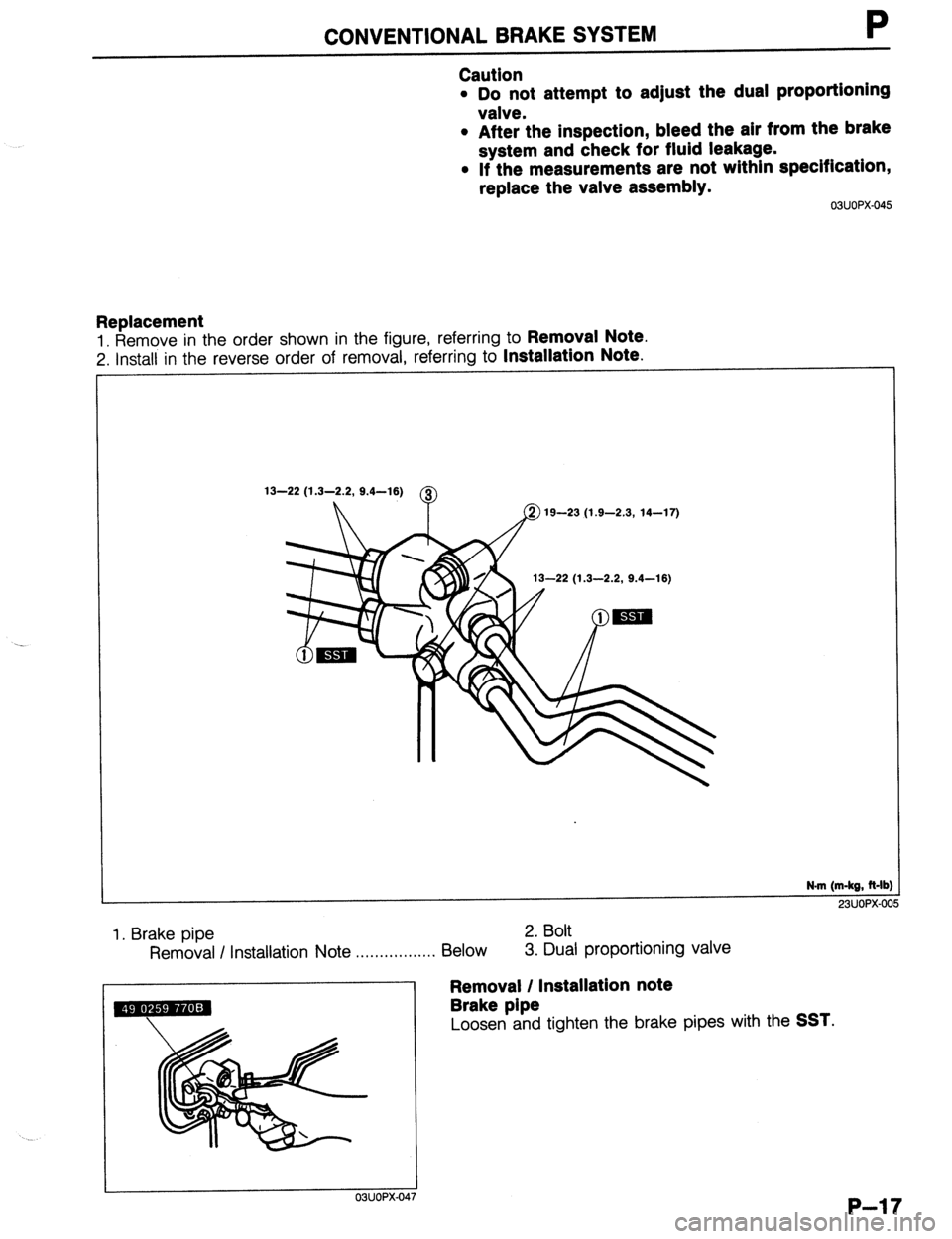
Replacement
1. Remove in the order shown in the figure, referring to Removal Note.
2. install in the reverse order of removal, referring to Installation Note.
13-22 (1.3-2.2, 9.4-16)
_-. .--.. ^. uwurx-047 N-m (m-kg, R-lb)
23UOPX-oc
1. Brake pipe 2. Bolt
Removal I Installation Note . . . . . . . . . . . . . . . . . Below 3. Dual proportioning valve
Removal / Installation note
Brake pipe
Loosen and tighten the brake pipes with the SST.
P-17
Page 684 of 1164
CONVENTIONAL BRAKE SYSTEM
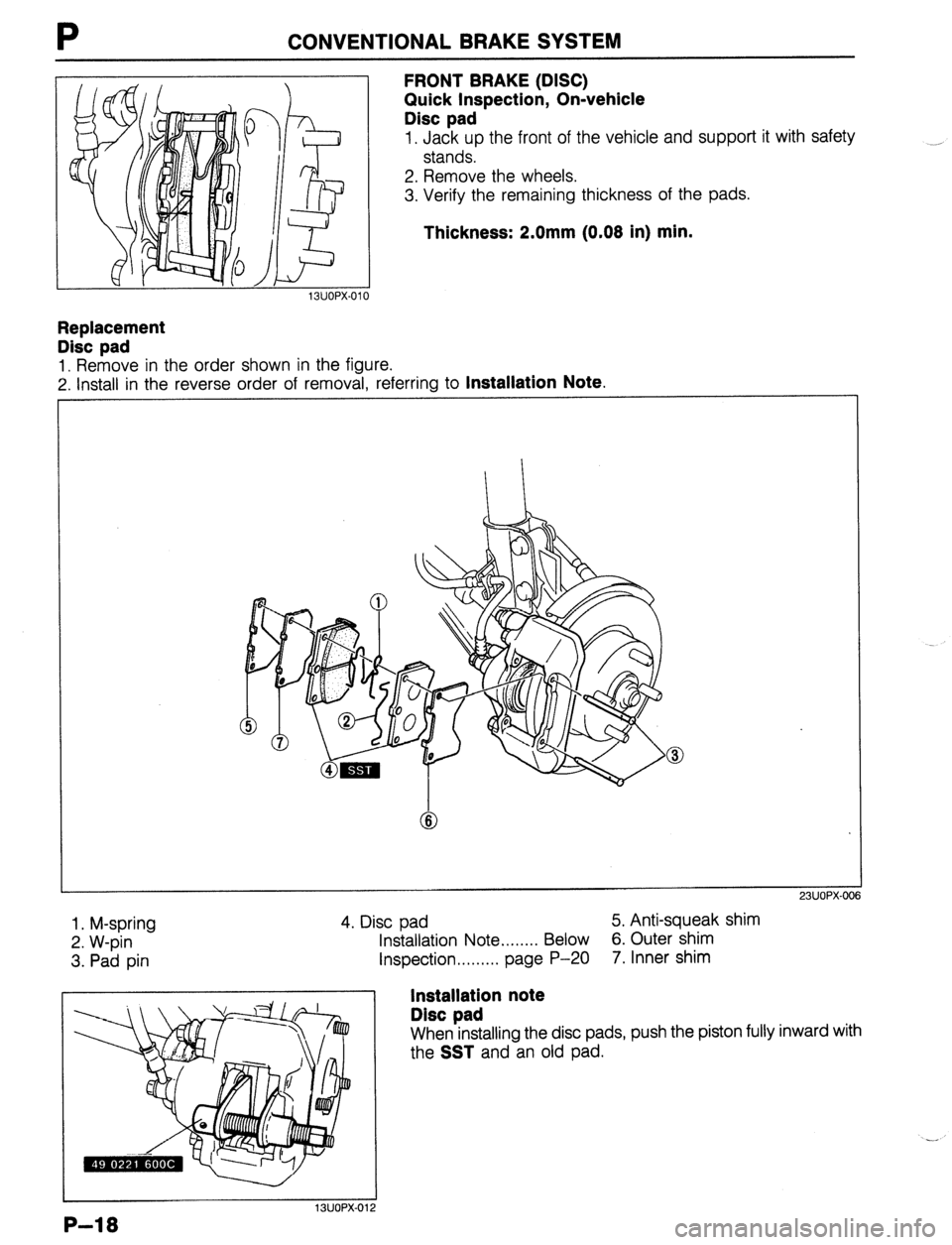
FRONT BRAKE (DISC)
Quick Inspection, On-vehicle
Disc pad
1. Jack up the front of the vehicle and support it with safety
stands.
2. Remove the wheels.
3. Verify the remaining thickness of the pads.
Thickness: 2.0mm (0.08 in) min.
Replacement
Disc pad
1. Remove in the order shown in the figure.
2. Install in the reverse order of removal, referring to
Installation Note.
23UOPX-oc
1. M-spring 4. Disc pad 5. Anti-squeak shim
2. W-pin Installation Note . . . . . . . . Below 6. Outer shim
3. Pad pin Inspection ,.,..,... page P-20 7. Inner shim
P-18
IBUOPX-01
Installation note
Disc pad
When installing the disc pads, push the piston fully inward with
the
SST and an old pad.