Page 132 of 225
Fluid Locations
Maintenance
BRAKE FLUID
(Gray cap)
(5-M/T only)
CLUTCH FLUID (Gray cap)
ENGINE OIL
FILLER CAP
POWER STEERING
FLUID (Red cap)
ANTI-LOCK BRAKE
RESERVOIR
(Gray cap)
COOLANT
RESERVOIR
AUTOMATIC
TRANSMISSION FLUID DIPSTICK
(Yellow loop)
ENGINE OIL DIPSTICK
(Orange loop)WASHER FLUID
(Blue cap)ProCarManuals.comMain Menu Table of Contents s t
Page 144 of 225
Brake and Clutch Fluid
Brake and Clutch Fluid
Check the fluid level in the reser-
voirs monthly. There are up to
three reservoirs, depending on
model. They are:
Brake fluid reservoir (all models) Clutch fluid reservoir
(5-speed transmission only)
ABS reservoir
(Si and Si 4WS models in U.S.
and SR and SR 4WS models in
Canada)
The brake fluid in the brake and
Anti-lock brake systems should be
replaced every 2 years or 48,000 km
(30,000 miles).
Brake System
The fluid should be between the MIN and MAX marks on the side
of the reservoir. If the level is at or
below the MIN mark, it is an indication that your brake system
needs attention. Have the brake
system inspected for leaks or worn
brake pads. If you add brake fluid to bring it up
to the MAX mark, use Genuine
Honda Brake Fluid or an equiva-
lent that is marked DOT3 or DOT4
only. Brake fluid marked DOT5 is
not compatible with your car's
braking system.
Maintenance
MAX
MINProCarManuals.comMain Menu Table of Contents s t
Page 145 of 225
Brake and Clutch Fluid
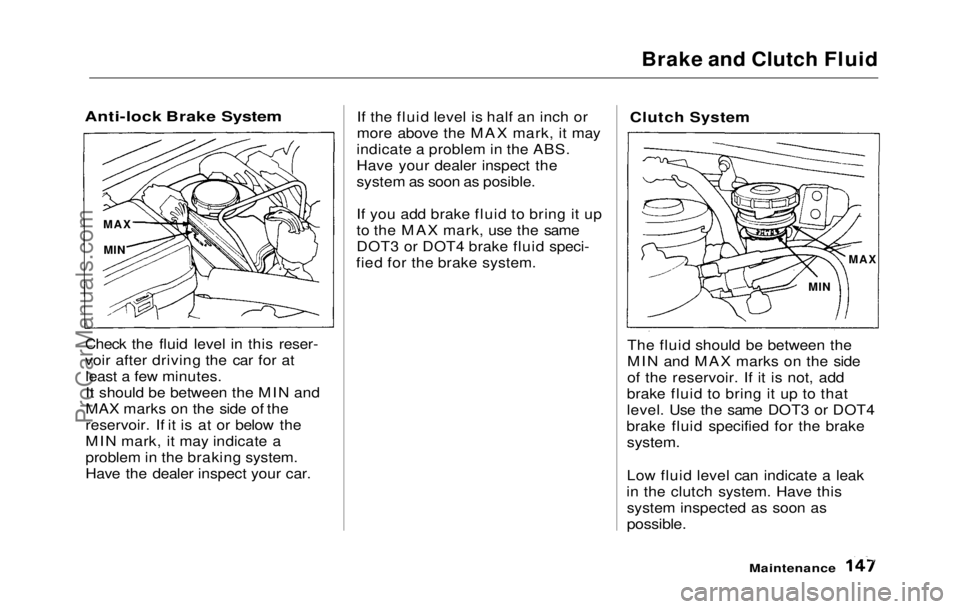
Anti-lock Brake System
Check the fluid level in this reser-
voir after driving the car for atleast a few minutes.
It should be between the MIN and
MAX marks on the side of the
reservoir. If it is at or below the
MIN mark, it may indicate a
problem in the braking system.
Have the dealer inspect your car. If the fluid level is half an inch or
more above the MAX mark, it may
indicate a problem in the ABS.
Have your dealer inspect the
system as soon as posible.
If you add brake fluid to bring it up
to the MAX mark, use the same
DOT3 or DOT4 brake fluid speci-
fied for the brake system.
Clutch System
The fluid should be between the
MIN and MAX marks on the side
of the reservoir. If it is not, add
brake fluid to bring it up to that
level. Use the same DOT3 or DOT4
brake fluid specified for the brake
system.
Low fluid level can indicate a leak
in the clutch system. Have this system inspected as soon as
possible.
Maintenance
MAX
MIN MAX
MINProCarManuals.comMain Menu Table of Contents s t
Page 161 of 225

Tires
Winter Driving
Tires that are marked "M+S" or "All Season" on the sidewall have
an all-weather tread design. They should be suitable for most winter
driving conditions. Tires without
these markings are designed for optimum traction in dry conditions.
They may not provide adequateperformance in winter driving.
For the best performance in snowy
or icy conditions, you should install
snow tires or tire chains. They may
be required by local laws under certain conditions. Snow Tires
If you mount snow tires on your
Honda, make sure they are radial
tires of the same size and load
range as the original tires. Mount snow tires on all four wheels to
balance your car's handling in all
weather conditions. Keep in mind
the traction provided by snow tires on dry roads may not be as high as
your car's original-equipment tires.
You should drive cautiously even
when the roads are clear. Check
with the tire dealer for maximum speed recommendations.
Tire Chains Mount snow chains on your car
when warranted by driving condi-
tions or required by local laws.
Make sure the chains are the cor-
rect size for your tires. Install them
only on the front tires. If metal
chains are used, they must be SAE
class"S". Cable type traction de-
vices can also be used. When installing chains, follow the
manufacturer's instructions and
mount them as tightly as you can.
Drive slowly with chains installed.
If you hear the chains contacting
the body or chassis, stop and
tighten them. If they still make
contact, slow down until it stops.
Remove the chains as soon as you
begin driving on cleared roads.
Chains of the wrong size or that are
improperly installed can damage
your car's brake lines, suspension,
body, and wheels. Stop driving if
you hear the chains hitting any part
of
the car.
Maintenance
NOTICEProCarManuals.comMain Menu Table of Contents s t
Page 162 of 225

Lights
Check the operation of your car's
exterior lights at least once a
month. A burned out bulb can
create an unsafe condition by
reducing your car's visibility and
the ability to signal your intentions
to other drivers. Check the following:
Headlights (low and high beam) Parking lights
Taillights
Brake lights
High-mount brake light
Turn signals Back-up lights
Hazard light function
License plate light
Side marker lights
Daytime running lights
(Canadian cars)
If you find any
bulbs are burned
out, replace them as soon as
possible. Refer to the chart on page
207 to determine what
type of
replacement bulb is needed.
Replacing a Headligh
t Bulb
Your car has two bulbs on each
side, four in total. Make sure you
are replacing the bulb that is
burned out. Your car uses halogen
headlight bulbs. When replacing a
bulb, handle it by its plastic case
and protect the glass from contact
with your skin or hard objects. If
you touch the glass, clean it with
denatured alcohol and a clean cloth.
Halogen headlight bulbs get very
hot when lit. Oil, perspiration, or a
scratch on the glass can cause the
bulb to overheat and shatter.
1. Open the hood.
If you need to change the high
beam headlight bulb
on
the
passenger's side, remove the
radiator reserve tank by pulling
it straight up.
2. To disconnect the bulb from the
electrical harness, push on the
end of the lock tab to release the
connector then push the connec-
tor straight down.
Maintenance
NOTICEProCarManuals.comMain Menu Table of Contents s t
Page 166 of 225
Lights
5. Push the bulb holder into the
turn signal assembly and turn it
clockwise until it locks.
6. Test the turn signals to make sure the new bulb is working.
7. Put the turn signal assembly into
the bumper. Make sure the tab
on the turn signal assembly fits
into the bumper slot. Tighten the
mounting screw.
Replacing a High-moun
t
Brake Light Bulb
1. Remove the cover by pulling it
down and sliding it forward.
2. Determin e
which bulb is burned
out.
3. Pul
l
the bulb straight out of its
socket.
Push the new bulb straight into
the socket until it bottoms.
4. Tes t
the lights to make sure the
new bulb is working.
5. Reinstal
l
the cover by sliding it
into position and pushing it up.
Maintenance
COVER
ProCarManuals.comMain Menu Table of Contents s t
Page 171 of 225

Storing Your Car
If you need to park your car for an
extended period (more than 1
month), there are several things
you should do to prepare it for
storage. Proper preparation helps
prevent deterioration and makes it
easier to get your car back on the
road. It is best to store your car indoors if at all possible. Fill the gas tank.
Change the engine oil and filter
(see page 137).
Wash and dry the exterior
completely.
Clean the interior. Make sure the
carpeting, floor mats, etc. are
completely dry.
Leave the parking brake off. Put
the transmission in Reverse (5-
speed) or Park (automatic). Block the rear wheels.
If the car is to be stored for a
longer period, it should be
supported on jackstands so the
tires are off the ground.
Leave one window open slightly
(if the car is being stored indoors).
Disconnect the battery.
Cover the car with a "breathable" car cover, one made
from a porous material such as
cotton. Nonporous materials,
such as plastic sheeting, trap
moisture which can damage the
paint. If possible, run the engine for a
while periodically (preferably once a month). If you store your car for 12 months
or longer, have your Honda dealer
perform the inspections called for
in the 24 months/48,000 km (30,000
miles) maintenance schedule as
soon as you take it out of storage
(see page 133). The replacements
called for in the maintenance
schedule are not needed unless the
car has actually reached that time or mileage.
MaintenanceProCarManuals.comMain Menu Table of Contents s t
Page 181 of 225

Changing a Flat Tire
If you
have a flat tire while driving,
stop in a safe place to change it.
Stopping in traffic or on the shoul-
der of a busy road is dangerous.
Drive slowly along the shoulder
until you get to an exit or an area to stop that is far away from the traf-
fic lanes.
1. Park the car on firm, level ground away from traffic. Turnon the hazard warning lights and
turn the ignition to LOCK (0). 2. Put the transmission in Park
(automatic) or Reverse (5-speed).
Set the parking brake.
3. Open the trunk. Raise the trunk floor by lifting up on the back
edge.
4. Take the tool kit out of the trunk. 5. Unscrew the wing bolt and take
the spare tire out of the trunk.
Taking Care of the Unexpected
CONTINUED
The car can easily roll off the
jack, seriously injuring anyone
underneath.
Follow the directions for chang-
ing a tire exactly, and never
get under the car when it is
supported only by the jack.
TRUNK FLOOR
JACK
SPARE TIRE
TOOL KITProCarManuals.comMain Menu Table of Contents s t


