1992 HONDA PRELUDE Gas
[x] Cancel search: GasPage 187 of 225

If Your Engine Won't Start, Jump Starting
The Starter Operates
Normally
In this case, the starter motor
sounds normal when you turn the
ignition switch to START (III), but
the engine does not run. Are you using the proper starting
procedure? Refer to Starting
the Engine on page 109 . Do you have gas? Turn the
ignition switch to ON (II) for a
minute and watch the fuel gauge.
There may be an electrical
problem, such as no power to the
fuel pump. Check all the fuses
(see page 199 ).
If you find nothing wrong, you will
need a qualified technician to find
the problem. See Towing on page
202.
Jump Starting
If your car's battery has run down,
you may be able to start the engine
by using a booster battery. Although this seems like a simple
procedure, there are several precau-
tions you should take. Follow the
directions closely.
You cannot start a Honda with an
automatic transmision by pushingor pulling it. To jump start your car:
1. Open the hood and check the physical condition of the battery
(see page 152 ). In very cold
weather, check the condition of the electrolyte. If it seems slushy
or like ice, do not try jump
starting until it thaws.
If a battery sits in extreme cold, the
electrolyte inside can freeze.
Attempting to jump start with a frozen battery can cause it to
rupture or explode.
2. Turn off all the electrical acces- sories: heater, A/C, stereo system,
lights, etc. Put the transmission in Neutral
or Park and set the parking
brake.
Taking Care of the Unexpected
CONTINUED
A battery can explode if you
do not follow the correct
procedure, seriously injuring
anyone nearby.
Keep all sparks, open flames,
and smoking materials away
from the battery.
NOTICE
ProCarManuals.comMain Menu Table of Contents s t
Page 199 of 225

Technical Information
The diagrams in this section give
you the dimensions and capacities
of your Honda, and the locations of
the identification numbers. The explanations of several electronic
and mechanical systems on your Honda are for the more technically-
oriented owner. Identification Numbers............... 204
Specifications................................ 206
Anti-lock Brake System ............. 208
Supplemental Restraint
System........................................ 209
Four Wheel Steering ................... 210
Emission Controls......................... 211 The Clean Air Act.................... 211
Crankcase Emission Control
System.................................... 211
Evaporative Emission Control
System.................................... 211
Exhaust Emission Controls.... 212 PGM-FI System.................... 212
Ignition Timing Control
System................................ 212
Exhaust Gas
Recirculation..................... 212
Catalytic Converter............. 212
Replacement Parts................... 212
Catalytic Converter..................... 213
Technical InformationProCarManuals.comMain Menu s t
Page 205 of 225

Supplemental Restraint System
The Honda
Supplemental Restraint
System (SRS) is standard on all
Preludes sold in the U.S. and the
SR, SR 4WS sold in Canada.
The SRS includes the steering
wheel airbag assembly, sensors in the dashboard, and a control unit
with sensors behind the center
console.
(On Si 4WS model)
The system also has a dashboard-
mounted airbag assembly for the
passenger.
The sensors are decelerometers,
set to trigger in a frontal impact that generates more force than a 10
mile per hour barrier crash. For the
SRS to activate, at least two sen-
sors must trigger. This duplication
is to prevent accidental activation. When the control unit receives
trigger signals from at least two
sensors, it sends voltage to the
airbag. The control unit stores this
charge in capacitors to insure
reliability even if a severe impact damages the car's battery or
electrical connections.
The electrical charge sent to the
airbag assembly ignites its propel-
lant, which burns instantaneously.
The gas produced by the burning propellant inflates the airbag in
about 40 milliseconds (1/25 of a
second).
The airbag is vented so it stays inflated for only an instant and
does not block the driver's vision.
Smoke from the burned propellant
comes out of the airbag and into
the car's interior. This is normal
and does not mean there is a fire.
The airbag collapses onto the driver's lap. The airbag unit can inflate only one
time. After use, your Honda dealer
must check the complete Supple-
mental Restraint System and re-
place the airbag assembly.
To ensure long-term reliability, the
SRS uses gold-plated electrical
connections throughout. Exposed
components are sealed with epoxy.
The control unit monitors the SRS circuitry whenever the ignition is
ON (II). If the control unit senses
any faults, it turns on the SRS
indicator light on the instrument
panel. Take the car to your Honda
dealer to diagnose and repair the system as soon as possible.
The SRS needs no regular mainte-
nance other than an inspection by
your Honda dealer ten years after
manufacture.
Technical InformationProCarManuals.comMain Menu Table of Contents s t
Page 207 of 225

Emission Controls
The burning of gasoline in your
car's engine produces several by-
products. Some of these are carbon
monoxide (CO), oxides of nitrogen
(NOx) and hydrocarbons (HC).
Gasoline evaporating from the tank
also produces hydrocarbons. Con-
trolling the production of NOx, CO,
and HC is important to the environ-
ment. Under certain conditions of
sunlight and climate, NOx and HC
react to form photochemical "smog."
Carbon monoxide does not contri-
bute to smog creation, but it is a
poisonous gas.
The Clean Air Act
The United States Clean Air Act*
sets standards for automobile
emissions. It also requires that
automobile manufacturers explain
to owners how their emission
controls work and what to do to
maintain them. This section
summarizes how the emission con-
trols work. Scheduled maintenance
is on page 129 .
* In Canada, Honda vehicles
comply with the Canadian Motor
Vehicle Safety Standards (CMVSS)
for Emissions valid at the time they
are manufactured.
Crankcase Emission Control
System
Your car has a Positive Crankcase
Ventilation (PCV) System. This
keeps gasses that build up in the engine's Crankcase from going into
the atmosphere. The PCV valve
routes them from the crankcase
back to the intake manifold. They
are then drawn into the engine and
burned.
Evaporative Emission
Control SystemAs gasoline evaporates in the fuel
tank, a canister filled with charcoal
adsorbs the vapor. It is stored in
this canister while the engine is off.
After the engine is started and
warmed up, the vapor is drawn into the engine and burned during
driving.
Technical Informatio n
ProCarManuals.comMain Menu Table of Contents s t
Page 208 of 225

Emission Controls
Exhaust Emission Controls
The exhaust emission controls
include four systems: PGM-FI,
Ignition Timing Control, Exhaust
Gas Recirculation and Catalytic
Converter. These four systems
work together to control the engine's combustion and minimize
the amount of HC, CO, and NOx
that comes out the tailpipe. The
exhaust emission control systems
are separate from the crankcase
and evaporative emission control
systems.
PGM-FI System
The PGM-FI System on your car
has three sub systems: Air Intake,
Electronic Control, and Fuel
Control. The Electronic Control
Unit (ECU) uses various sensors to
determine how much air is going
into the engine. It then controls
how much fuel to inject under all
operating conditions. Ignition Timing Control System
This system constantly adjusts the
ignition timing, reducing the
amount of HC, CO and NOx
produced.
Exhaust Gas Recirculation (EGR)
The EGR system takes some of the
exhaust gas and routes it back into
the intake manifold. Adding ex-
haust gas to the air/fuel mixture re-
duces the amount of NOx produced
when the fuel is burned.
Catalytic Converter
The catalytic converter is in the exhaust system. Through chemical
reactions, it converts HC, CO, and
NOx in the engine's exhaust to
carbon dioxide (CO 2), dinitrogen
(N 2), and water vapor.
Replacement Parts
The emission control systems are
designed and certified to work to-
gether in reducing emissions to
levels that comply with the Clean
Air Act. To make sure the emis-
sions remain low, you should use
only new genuine Honda replace-
ment parts or their equivalent for
repairs. Using lower quality parts
may increase the emissions from
your car .
The emissions control systems are
covered b y
warranties separate
from the rest of your car. Read
your warranty manual for more
information.
Technical InformationProCarManuals.comMain Menu Table of Contents s t
Page 209 of 225
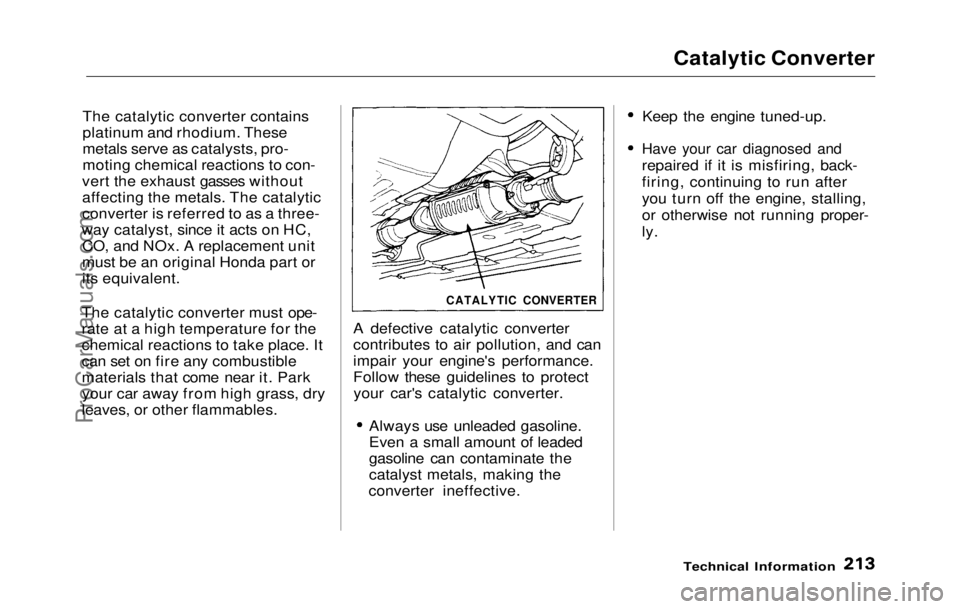
Catalytic Converter
The catalytic converter contains
platinum and rhodium. These
metals serve as catalysts, pro-
moting chemical reactions to con-
vert the exhaust gasses without
affecting the metals. The catalytic
converter is referred to as a three-
way catalyst, since it acts on HC, CO, and NOx. A replacement unit
must be an original Honda part or
its equivalent.
The catalytic converter must ope-
rate at a high temperature for the
chemical reactions to take place. It
can set on fire any combustible
materials that come near it. Park your car away from high grass, dry
leaves, or other flammables. A defective catalytic converter
contributes to air pollution, and can
impair your engine's performance.
Follow these guidelines to protect
your car's catalytic converter.
Always use unleaded gasoline.
Even a small amount of leaded
gasoline can contaminate the
catalyst metals, making the
converter ineffective. Keep the engine tuned-up.Have your car diagnosed and
repaired if
it is misfiring, back-
firing, continuing to run after
you turn off the engine, stalling,
or otherwise not running proper-
ly.
Technical Information
CATALYTIC CONVERTERProCarManuals.comMain Menu Table of Contents s t
Page 217 of 225

Index
Accessories
Installation................................. 105
ACCESSORY
(Ignition Key Position).............. 48
Adding
Automatic Transmission
Fluid........................................ 144
Brake Fluid............................... 146 Clutch Fluid.............................. 147
Engine Oil...:.............................. 135
Manual Transmission Fluid... 145
Power Steering Fluid.............. 148
Radiator Coolant...................... 139
Windshield Washer fluid ........ 143
Additional Safety Information .... 16
Door Locks.................................. 16
Driving with Pets....................... 17
Seat-back Position..................... 16
Storing Cargo Safely................. 17
Additives, Engine Oil................... 136
Adjustments
Mirrors....................................... .
59
Seats............................................. 51
Steering Wheel..........................
43
Airbag (SRS).................................. 1
0
Air Conditioning............................. 68
Maintenance..............................
157
Usage............................................ 6 8
Ai
r Filter........................................
149
Air Outlet
s
(Vents)......................... 68
Air Pressure, Tires ......................
159
Alcohol an d
Drugs.......................... 24
Alcohol in Gasoline........................ 98
Antifreeze......................................
139
Anti-lock Brake s
(ABS)
Description................................
208
Indicator Light.................. .
34,
118
Operation................................... 117
Anti-theft Steerin
g
Column
Lock.............................................. 48
Appearance Care..........................
175
Ashtray............................................. 65
Audio System................................. .
75
Automatic Speed Control............. 44
Automatic Transmission............ 112
Capacity, Fluid........................
.
206
Checking Fluid Level.............. 144
Shifting
...................................... 113
Shift Leve r
Positions...............
112
Shift Lock Release................... 115
Battery
Charging System Light............. 33
Jump Starting............................ 191
Maintenance.............................. 152
Specifications............................ 207
Before Driving
................................ 97
Belts, Seat ......................................... 4
Body Repair
...................................
181
Brakes
Anti-lock Syste
m (ABS)..........
117
Break-in, Ne
w
Linings.............. 98
Fluid............................................
146
Light, Burned-out................... .
169
Parking......................................... 61
System Light.............................. .
33
Wear Indicators.....................
116
Brakes, AB S
Description...............................
.
208
Operation................................... 117
System Indicator...............
.
34,
118
Braking System...........................
.
116
Break-in, Ne
w
Car ......................... 98
CONTINUEDProCarManuals.comMain Menu s t
Page 219 of 225

Index
DANGER, Explanation of.............. ii
Dashboard........................................ 30
Daytime Running Lights.............. 40
Dead Battery, What to Do........... 191
Defects, Reporting Safety ............ 26
Defogger, Rear Window ............... 56
Defrosting the Windows............... 74
DEXRON ®
II Automatic
Transmission Fluid.................. 144
Dimensions.................................... 206
Dimming the Headlight
s .............. 40
Dipstick Automatic Transmission........
144
Engine Oil................................. .
135
Directional Signals........................
.
41
Disabled, Towing Your Car If ... 202
Disc Brake Wear Indicators.......
116
Disposal o f
Used Oil.....................
138
Doors
Locking an
d Unlocking ............ 48
Power Door Locks ..................... 48
DOT Tire Quality Grading......... 161
Downshifting,
5-speed Transmission.............. 111
Driving .......................................... .
107
Economy.................................... 104
In Bad Weather......................... 119
In Foreign Countries................. 99
Economy, Fuel.............................. 104
Emergencies on the Road........... 183 Battery, Jump Starting............ 191
Changing a Flat Tire............... 185
Charging System Light........... 196
Check Engine Light................. 197
Checking the Fuses.................
200
Low Oi l
Pressure Light........... 195
Manually Closing Sunroof...... 198
Overheated Engine.................. 193
Emergency Brake ......................... 61
Emergency Flashers...................... 56
Emission Controls......................... 211
Engine Check Light....................... 34, 197
Coolant Temperature Gauge... 38
Oil Pressure Light............. 33, 195
Oil, What Kind to Use .............
135
Overheating............................... 193
Specifications........................... 206
Ethano l
in Gasoline........................ 98
Evaporative Emission Controls......................................
211
Exhaust Fumes.............................. .
25
Expectant Mothers, Use of Seat Belts by.................................. 8
Exterior, Cleaning the.................
176
Fabric, Cleaning........................... 179
Fan, Interior.................................... 68
Fan, Radiator.................................. 27
Features, Comfort
and Convenience........................ 67
Filling the Gas Tank.................... 100
Filters
Air
............................................... 149
Fuel............................................. 150
Oil ............................................... 137
First Gear, Shifting...................... 111
5-Speed Transmissio n
Checkin
g Fluid Level..............
145
CONTINUED
ProCarManuals.comMain Menu s t