1992 HONDA PRELUDE Gas
[x] Cancel search: GasPage 105 of 225
Loading Cargo
The maximum load you can carry
in your Honda is 325 kg (700 Ibs). It
includes the total weight of all
passengers and their belongings,
any accessories, and the tongue
weight of a trailer. This 325 kg (700
Ibs) figure
is shown as the Vehicle
Capacity Weight on the tire infor-
mation label attached to the driver's
door jamb.
To figure out how much cargo you
can carry:
Figure the total "occupant
weight" you will be transporting.
To do this, multiply the number
of people (driver and all passen-
gers) by 70 kg (150 Ibs). Subtract this number from the
Vehicle Capacity Weight (325 kg/
700 Ibs).
If you are towing a trailer,
subtract the tongue weight. See
Towing a Trailer on page 121.
This final number is the total
weight of cargo you can load in or on the car. With four occupants
(driver and three passengers), the
maximum recommended weight
for cargo is 45 kg (100 Ibs). Where you store this cargo, and
how well you secure it, are just as
important as how much it weighs.
Make sure you load cargo so it will
not shift while driving. Items
stored in the trunk should be placed as far forward as possible.
You could store additional items on
the floor behind the front seats. Make sure they cannot roll under
the front seat and interfere with
the pedals.
If you must carry large objects that
prevent you from closing the trunk
lid, be aware that exhaust gas can enter the interior. See Carbon
Monoxide Hazard on page 25 .
Never place items on the shelf
behind the back seat. Those items
can fly forward and injure you or
your passengers if you brake hard
or are involved in a collision.
Before DrivingProCarManuals.comMain Menu Table of Contents s t
Page 126 of 225

Maintenance Schedule
The Required Maintenance Schedule specifies how often you
should have your car serviced, and
what things need attention. It is
essential that your car be serviced
as scheduled to retain its high level of safety, dependability, and
emission control performance.
The services and time or mileage intervals shown in the maintenance
schedule assume you will use your
car as normal transportation for
passengers and their possessions.
You should:
Avoid exceeding your car's loadlimit. This puts excess strain on
the engine, brakes, and many
other parts of your car. The load
limit is shown on the label in the
glove box. Operate your car on reasonable
roads within the legal speed limit. Drive your car regularly over a
distance of several miles.
Always use unleaded gasoline
with the proper octane (see page
98).
Your authorized Honda dealer
knows your car best, and can provide competent, efficient
service. However, service at a
dealer is not mandatory to keep
your warranties in effect. Mainte-
nance may be done by any qualified
service facility or person who is
skilled in this type of automotive
service. Keep all the receipts as
proof of completion, and have the
person who does the work fill out
the maintenance record on page 131. Check your warranty booklet
for more information. We recommend the use of Genuine
Honda parts and fluids or their
equivalent whenever you have
maintenance done. These are the
same high-quality items that went
into your car when it was new, so you can be sure they fit and
perform flawlessly.
U.S. Cars:
Maintenance, replacement or
repair of emission control
devices and systems may be
done by any automotive re-
pair establishment or indi-
vidual using parts that are "certified" to EPA standards.
Vehicles sold in California have
slightly different maintenance
requirements. These are noted in
the Required Maintenance Sche-
dule. Other maintenance operations
are required by California regula-
tions, and condition the emission
warranty.
MaintenanceProCarManuals.comMain Menu Table of Contents s t
Page 131 of 225

Periodic Checks
You should check the following items at the specified intervals. If
you are unsure of how to perform
any check, turn to the page given. Engine oil level — Check every
time you fill the gas tank. See
page 102.
Engine coolant level — Check
the radiator reserve tank every
time you fill the gas tank. See
page 103.
Windshield washer fluid —
Check the level in the reservoir
monthly. If weather conditions
cause you to use the washers
frequently, check the reservoir each time you stop for gas. See
page 143 .
Automatic transmission — Check the fluid level monthly.
See page 144. Brakes, clutch and power
steering — Check the fluid level
monthly. See page 146.Tires — Check the tire pressure
monthly. Examine the tread for
wear and foreign objects. See
page 159.
Battery — Check its condition
and the terminals for corrosion
monthly. See page 152.
Air conditioner — Check its operation weekly. See page 157.
Lights — Check the operation of
the headlights, parking lights,
taillights, high-mount brake light,
turn signals, brake lights, and
license plate lights monthly. See
page 164.
MaintenanceProCarManuals.comMain Menu Table of Contents s t
Page 141 of 225

Cooling System, Windshield Washers
10.Turn off the engine. Check the
level in the radiator, add coolant
if needed. Install the radiator cap,
tighten it fully.
11.Fill the
reserve tank to the MAX
mark. Install the reserve tank
cap.
Windshield Washers
Chec
k the level in the windshield
washer reservoir at least monthly
during normal usage. In bad
weather, when you use the washers often, check the level every time
you stop for gas.
The windshield washer reservoir is
located behind the left headlight.
Check the reservoir's fluid level by
removing the cap and looking at the float. It should be up to the top of the neck. If the float is at the
bottom of the neck, the reservoir is
nearly empty.
Fill the reservoir with a good- quality windshield washer fluid.
This increases the cleaning
capability and prevents freezing in cold weather.
Do not use engine antifreeze or a
vinegar/water solution in the
windshield washer reservoir.
Antifreeze can damage your car's paint, while a vinegar/water
solution can damage the windshield
washer pump.
Use only commercially-available
windshield washer fluid.
Maintenance
NOTICE
RESERVE TANK
FLOATProCarManuals.comMain Menu Table of Contents s t
Page 147 of 225
Air Filter
The air filter element should be
replaced every 2 years or 48,000 km
(30,000 miles), whichever comes
first. Under severe driving condi-
tions, it should also be cleaned every 12 months or 24,000 km
(15,000 miles), whichever comes
first.
Cleaning (Severe Conditions)
Clean the air cleaner element by
blowing compressed air through it in the opposite direction to normal
air flow. If you do not have access
to compressed air (such as a gas station), ask your Honda dealer to
do this service.
Follow the replacement procedure
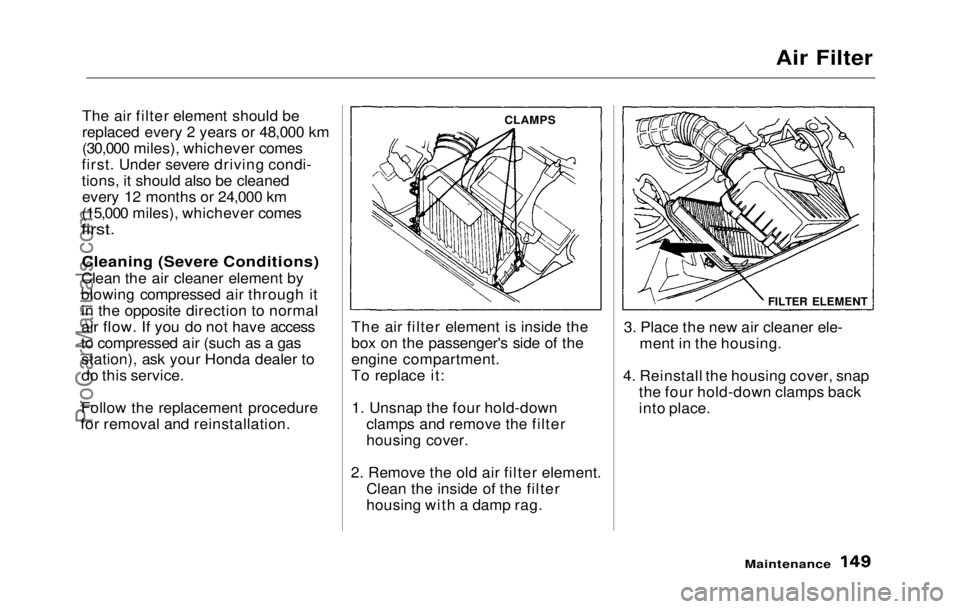
for removal and reinstallation. The air filter element is inside the
box on the passenger's side of the
engine compartment.
To replace it:
1. Unsnap the four hold-down clamps and remove the filter
housing cover.
2. Remove the old air filter element. Clean the inside of the filter
housing with a damp rag. 3. Place the new air cleaner ele-
ment in the housing.
4. Reinstall the housing cover, snap the four hold-down clamps back
into place.
Maintenance
FILTER ELEMENT
CLAMPSProCarManuals.comMain Menu Table of Contents s t
Page 148 of 225
Fuel Filter, Spark Plugs
Fuel Filter
The fuel filter should be replaced
every 4 years or 96,000 km (60,000
miles), whichever comes first.
Have a qualified technician change
the fuel filter. Since the fuel system is under pressure, gasoline can
spray out and create a hazard if all
fuel line connections are not han- dled correctly.
The filter may require replacement sooner if you happen to buy one ormore tankfuls of contaminated
gasoline. Have the filter tested or
replaced if you suspect it has been
clogged by contaminants.
Spark Plugs
The original spark plugs in your
car need to be replaced every 2
years or 48,000 km (30,000 miles),
whichever comes first.
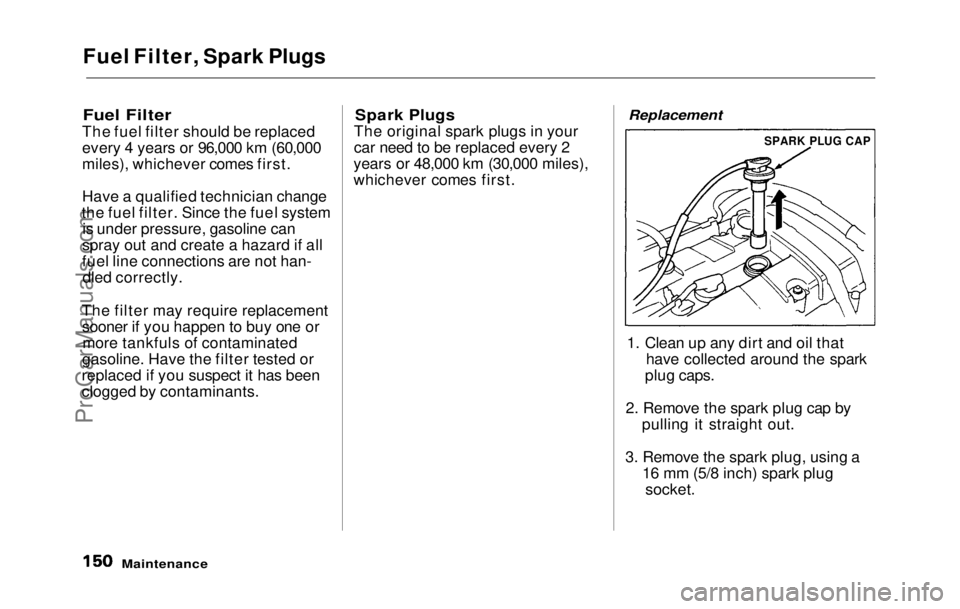
Replacement
1. Clean up any dirt and oil that have collected around the spark
plug caps.
2. Remove the spark plug cap by pulling it straight out.
3. Remove the spark plug, using a 16 mm (5/8 inch) spark plug
socket.
Maintenance
SPARK PLUG CAPProCarManuals.comMain Menu Table of Contents s t
Page 150 of 225

Spark Plugs, Battery
Specifications:
Battery
Check the condition of your car's
battery monthly. You should check
for proper electrolyte level and
corrosion on the terminals.
Maintenance
The battery gives off explo-
sive hydrogen gas during nor-
mal operation. A spark or open
flame can cause the battery to
explode with enough force to
kill or seriously hurt you.
Wear protective clothing and a
face shield, or have a skilled mechanic do the battery main-
tenance. The battery contains sulfuric
acid (electrolyte) which is
highly corrosive and poisonous.
Getting electrolyte in your
eyes or on your skin can cause
serious burns. Wear protective
clothing and eye protection
when working near the battery.
Swallowing electrolyte can
cause fatal poisoning if immedi- ate action is not taken.
KEEP OUT OF THE REACH OF
CHILDREN
(US: S, Canada: S)
Normal driving conditions
NGK:
Nippondenso:
Hot climates, or continuous high
speed driving NGK:
Nippondenso:
(US: Si, Si 4WS, Canada: SR, SR 4WS)
Normal driving conditions NGK:
Nippondenso:
Hot climates, or continuous high
speed driving NGK:
Nippondenso:
ZFR5F-11
KJ16CR-L11
ZFR6F-11
KJ20CR-L11
ZFR6F-11
KJ20CR-L11
ZFR7F-11
KJ22CR-L11ProCarManuals.comMain Menu Table of Contents s t
Page 171 of 225

Storing Your Car
If you need to park your car for an
extended period (more than 1
month), there are several things
you should do to prepare it for
storage. Proper preparation helps
prevent deterioration and makes it
easier to get your car back on the
road. It is best to store your car indoors if at all possible. Fill the gas tank.
Change the engine oil and filter
(see page 137).
Wash and dry the exterior
completely.
Clean the interior. Make sure the
carpeting, floor mats, etc. are
completely dry.
Leave the parking brake off. Put
the transmission in Reverse (5-
speed) or Park (automatic). Block the rear wheels.
If the car is to be stored for a
longer period, it should be
supported on jackstands so the
tires are off the ground.
Leave one window open slightly
(if the car is being stored indoors).
Disconnect the battery.
Cover the car with a "breathable" car cover, one made
from a porous material such as
cotton. Nonporous materials,
such as plastic sheeting, trap
moisture which can damage the
paint. If possible, run the engine for a
while periodically (preferably once a month). If you store your car for 12 months
or longer, have your Honda dealer
perform the inspections called for
in the 24 months/48,000 km (30,000
miles) maintenance schedule as
soon as you take it out of storage
(see page 133). The replacements
called for in the maintenance
schedule are not needed unless the
car has actually reached that time or mileage.
MaintenanceProCarManuals.comMain Menu Table of Contents s t