Page 1130 of 1146
55-48FULL AUTO AIR CONDITIONER - Troubleshooting
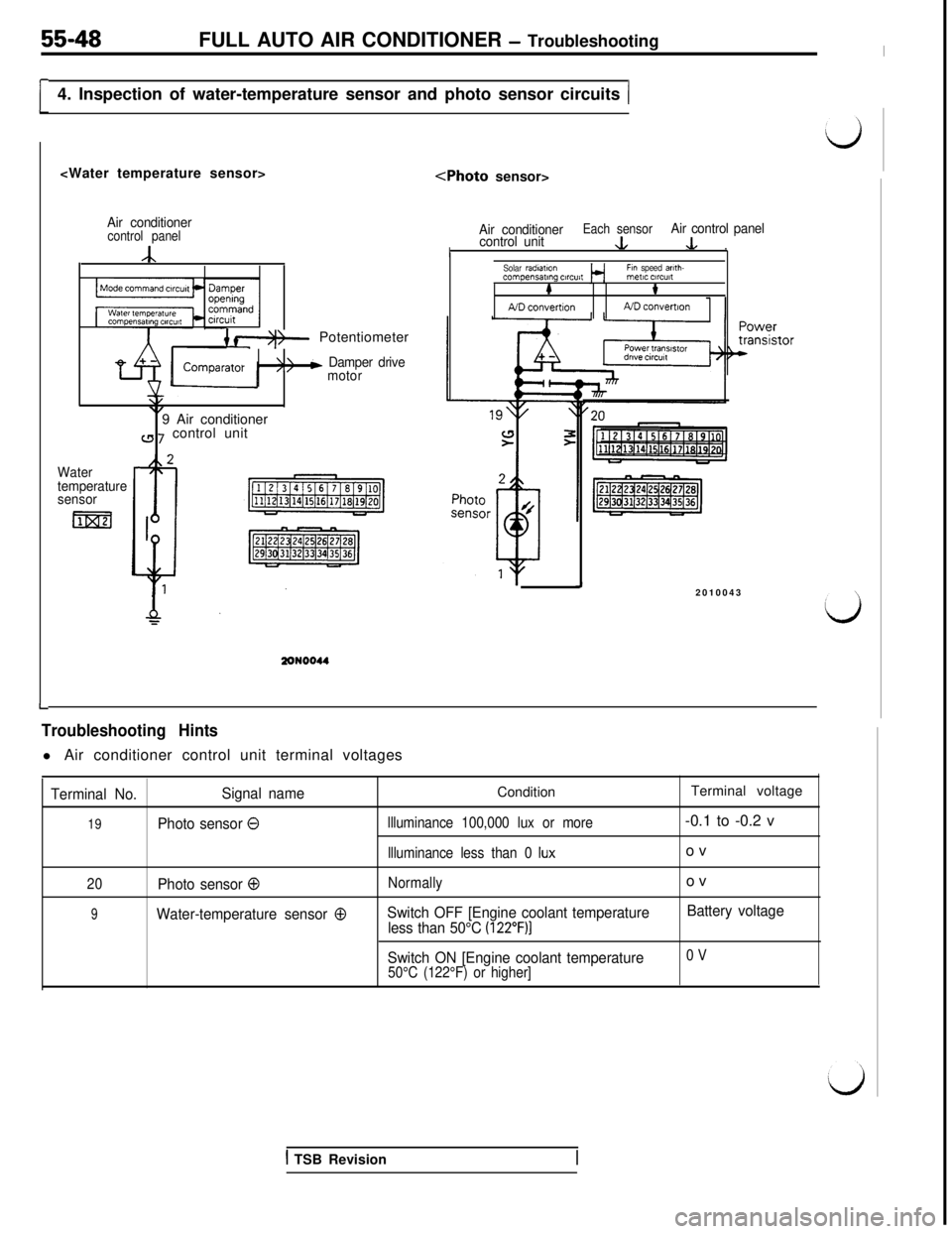
[4. Inspection of water-temperature sensor and photo sensor circuits (
Air conditionercontrol panel
A
{ f*)- Potentiometer
‘>/b Damper drive
motor
\/\,9 Air conditioner
a 7 control unit
Water
temperature
sensor
m
Air conditionerEach sensorcontrol unit&
Air control panel
I.L .Solar radmtmnFin speed arlth-compensating ClrC”itmetIC ClrCUlt#t
A/D convertionND convemon
J2010043
I-
Troubleshooting Hintsl Air conditioner control unit terminal voltages
Terminal No.Signal nameConditionTerminal voltage
19Photo sensor 0llluminance 100,000 lux or more-0.1 to -0.2 v
llluminance less than 0 Iuxov
20Photo sensor 0Normallyov
9Water-temperature sensor 0Switch OFF [Engine coolant temperature
less than 50°C (122”F)]
Battery voltage
Switch ON [Engine coolant temperature
0 V
50°C (122°F) or higher]
1 TSB Revision
Page 1131 of 1146
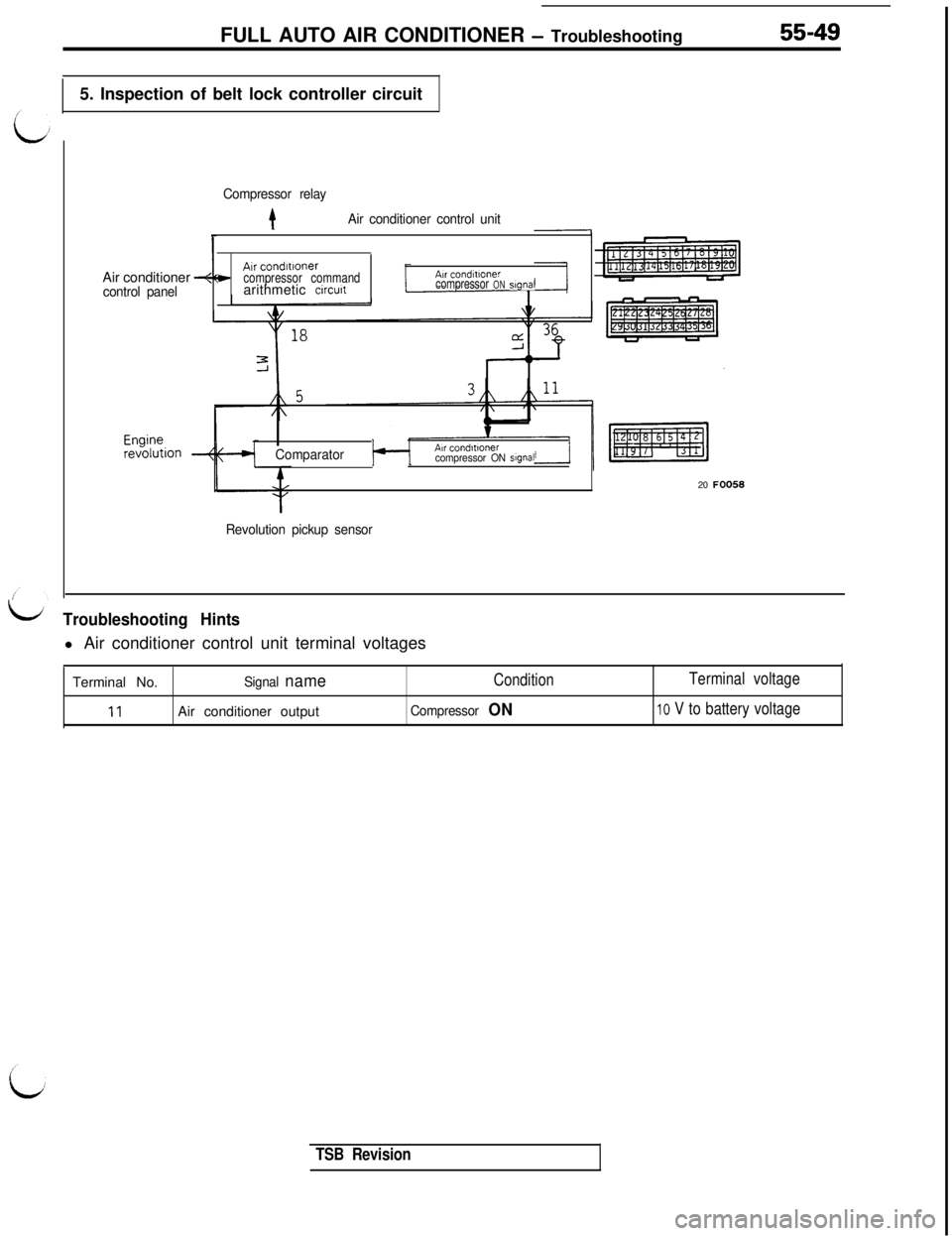
FULL AUTO AIR CONDITIONER - Troubleshooting55-495. Inspection of belt lock controller circuit
Compressor relay
tAir conditioner control unitAir conditioner
+control panelAir
condltloner,c.compressor commandAH condmonerarithmetic
circuitcompressor ONstgnal
ComparatorAir condltlonercompressor ON signal20 FOO58
Revolution pickup sensor
LiTroubleshooting Hintsl Air conditioner control unit terminal voltages
Terminal No.
Signal nameConditionTerminal voltage
11Air conditioner outputCompressor ONIO V to battery voltage
TSB Revision
Page 1135 of 1146
FULL AUTO AIR CONDITIONER - Troubleshootina55-53r
---.__------
2OFOO8:
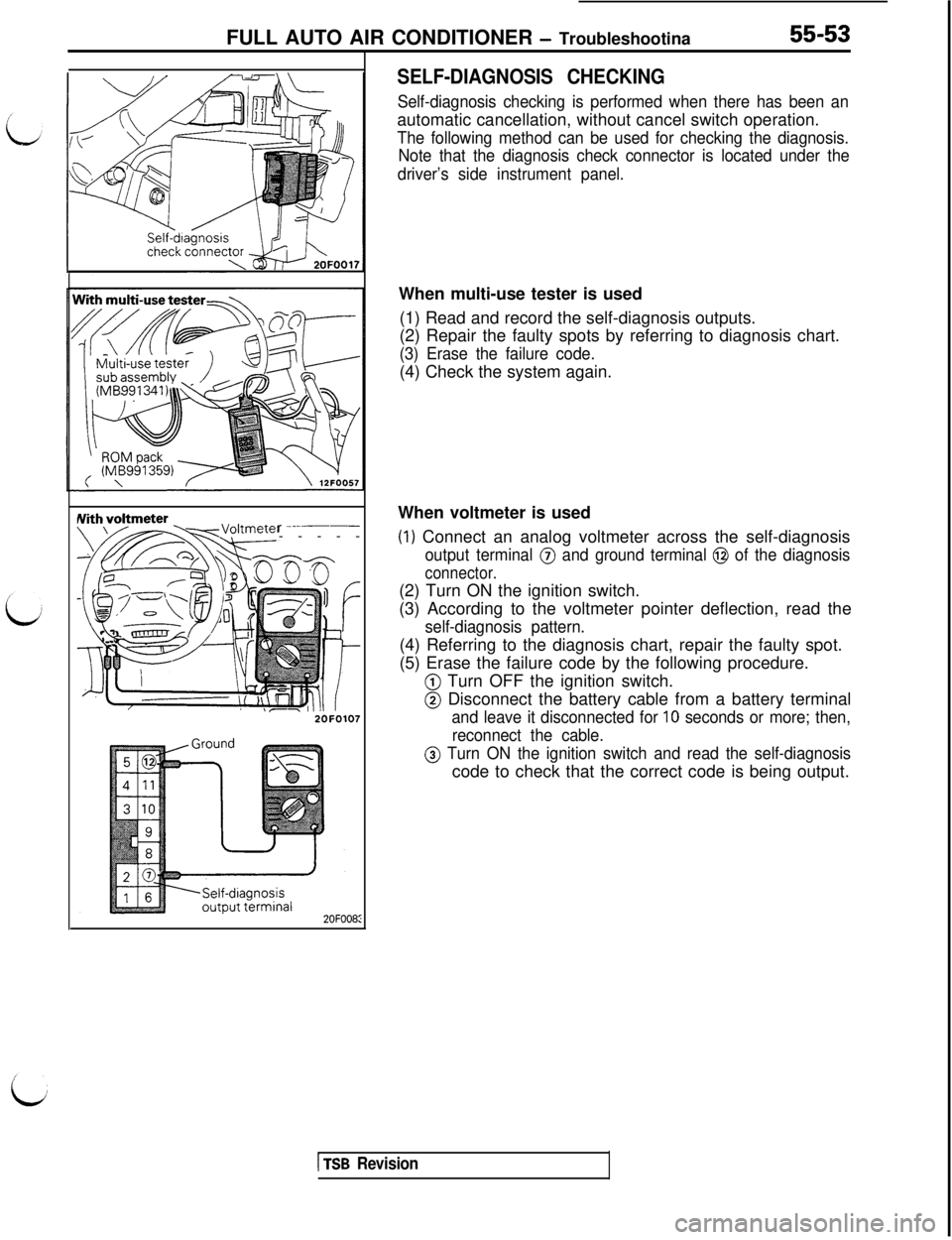
SELF-DIAGNOSIS CHECKING
Self-diagnosis checking is performed when there has been anautomatic cancellation, without cancel switch operation.
The following method can be used for checking the diagnosis.
Note that the diagnosis check connector is located under the
driver’s side instrument panel.When multi-use tester is used
(1) Read and record the self-diagnosis outputs.
(2) Repair the faulty spots by referring to diagnosis chart.
(3) Erase the failure code.(4) Check the system again.
When voltmeter is used
(1) Connect an analog voltmeter across the self-diagnosis
output terminal @ and ground terminal @ of the diagnosis
connector.(2) Turn ON the ignition switch.
(3) According to the voltmeter pointer deflection, read the
self-diagnosis pattern.(4) Referring to the diagnosis chart, repair the faulty spot.
(5) Erase the failure code by the following procedure.
@ Turn OFF the ignition switch.
@ Disconnect the battery cable from a battery terminal
and leave it disconnected for 10 seconds or more; then,
reconnect the cable.
@ Turn ON the ignition switch and read the self-diagnosiscode to check that the correct code is being output.
1 TSB Revision
Page 1141 of 1146
FULL AUTO AIR CONDITIONER -Damper Control Motor Assembly55-59
II
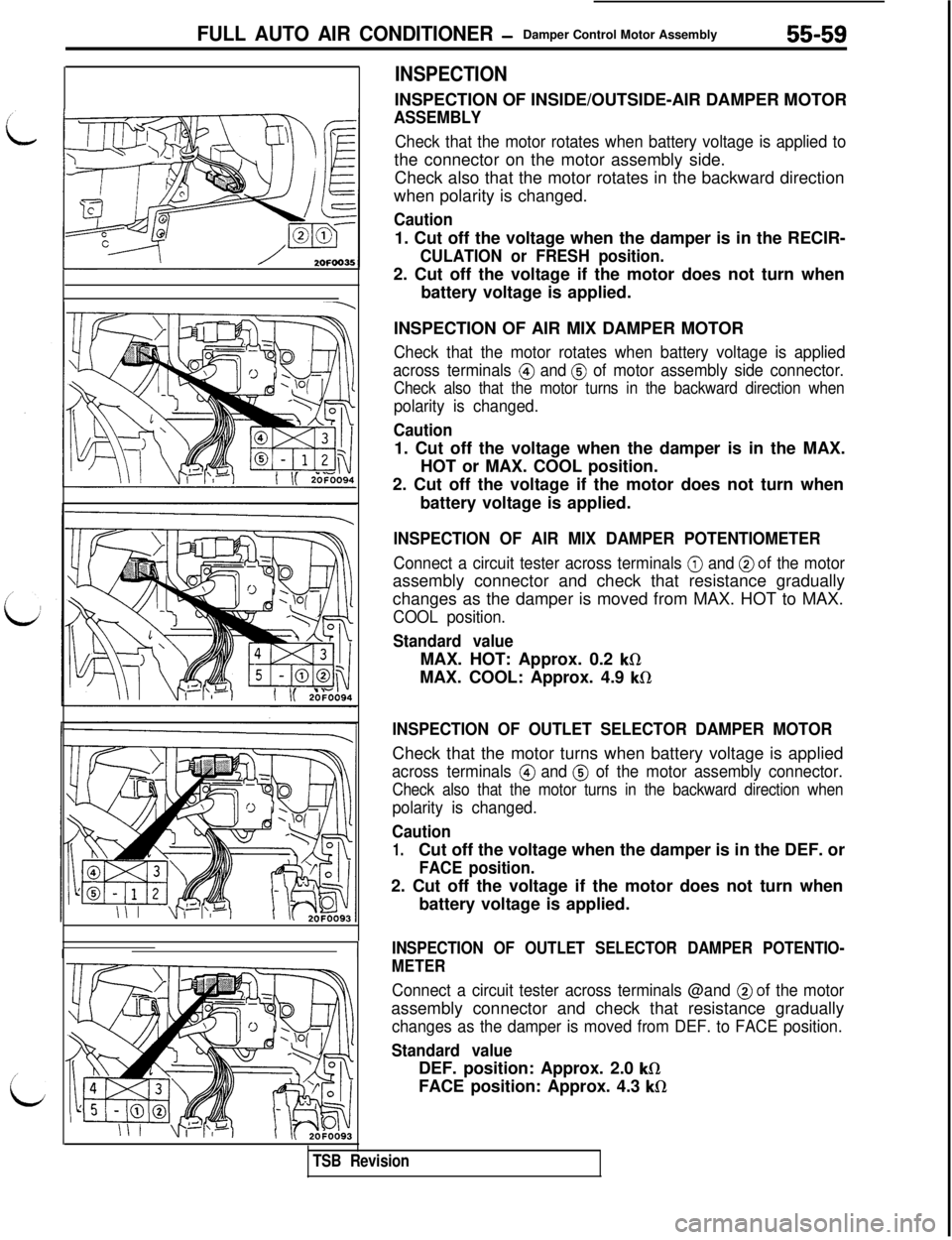
INSPECTIONINSPECTION OF INSIDE/OUTSIDE-AIR DAMPER MOTOR
ASSEMBLY
Check that the motor rotates when battery voltage is applied tothe connector on the motor assembly side.
Check also that the motor rotates in the backward direction
when polarity is changed.
Caution1. Cut off the voltage when the damper is in the RECIR-
CULATION or FRESH position.2. Cut off the voltage if the motor does not turn when
battery voltage is applied.
INSPECTION OF AIR MIX DAMPER MOTOR
Check that the motor rotates when battery voltage is applied
across terminals
@ and @ of motor assembly side connector.
Check also that the motor turns in the backward direction when
polarity is changed.
Caution1. Cut off the voltage when the damper is in the MAX.
HOT or MAX. COOL position.
2. Cut off the voltage if the motor does not turn when
battery voltage is applied.
INSPECTION OF AIR MIX DAMPER POTENTIOMETER
Connect a circuit tester across terminals @ and @of the motorassembly connector and check that resistance gradually
changes as the damper is moved from MAX. HOT to MAX.
COOL position.
Standard valueMAX. HOT: Approx. 0.2
klRMAX. COOL: Approx. 4.9
kR
INSPECTION OF OUTLET SELECTOR DAMPER MOTORCheck that the motor turns when battery voltage is applied
across terminals @ and @ of the motor assembly connector.
Check also that the motor turns in the backward direction when
polarity is changed.
Caution
1.Cut off the voltage when the damper is in the DEF. or
FACE position.2. Cut off the voltage if the motor does not turn when
battery voltage is applied.
INSPECTION OF OUTLET SELECTOR DAMPER POTENTIO-
METER
Connect a circuit tester across terminals @and @of the motorassembly connector and check that resistance gradually
changes as the damper is moved from DEF. to FACE position.
Standard valueDEF. position: Approx. 2.0
kRFACE position: Approx. 4.3 kfl
TSB Revision