Page 9 of 4087
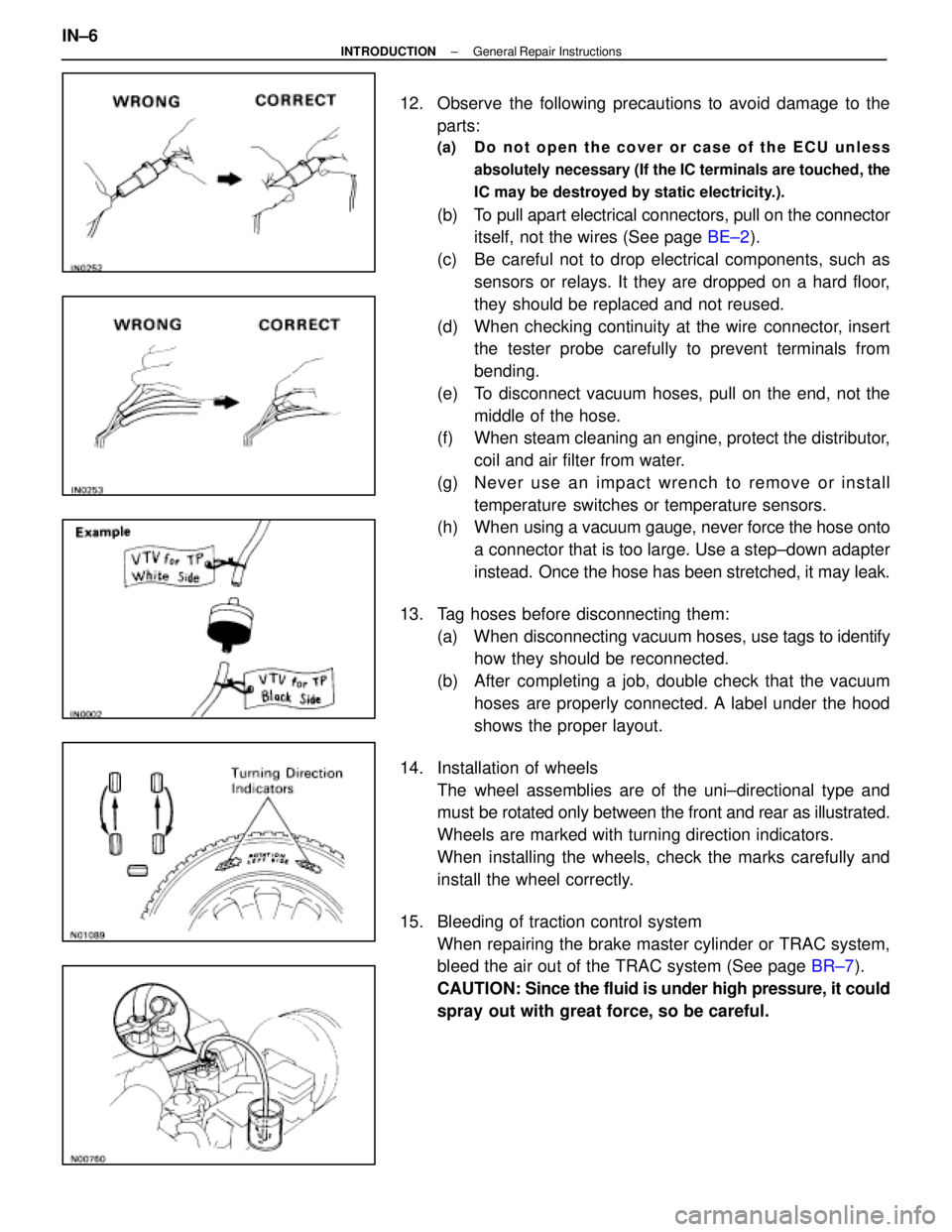
12. Observe the following precautions to avoid damage to theparts:
(a) Do not open the cover or case of the ECU unless
absolutely necessary (If the IC terminals are touched, the
IC may be destroyed by static electricity.).
(b) To pull apart electrical connectors, pull on the connectoritself, not the wires (See page BE±2).
(c) Be careful not to drop electrical components, such as sensors or relays. It they are dropped on a hard floor,
they should be replaced and not reused.
(d) When checking continuity at the wire connector, insert the tester probe carefully to prevent terminals from
bending.
(e) To disconnect vacuum hoses, pull on the end, not the middle of the hose.
(f) When steam cleaning an engine, protect the distributor,
coil and air filter from water.
(g) Ne ve r use an imp a ct wre n ch to re mo ve or in sta ll temperature switches or temperature sensors.
(h) When using a vacuum gauge, never force the hose onto
a connector that is too large. Use a step±down adapter
instead. Once the hose has been stretched, it may leak.
13. Tag hoses before disconnecting them: (a) When disconnecting vacuum hoses, use tags to identify
how they should be reconnected.
(b) After completing a job, double check that the vacuum hoses are properly connected. A label under the hood
shows the proper layout.
14. Installation of wheels The wheel assemblies are of the uni±directional type and
must be rotated only between the front and rear as illustrated.
Wheels are marked with turning direction indicators.
When installing the wheels, check the marks carefully and
install the wheel correctly.
15. Bleeding of traction control system When repairing the brake master cylinder or TRAC system,
bleed the air out of the TRAC system (See page BR±7).
CAUTION: Since the fluid is under high pressure, it could
spray out with great force, so be careful.
IN±6
±
INTRODUCTION General Repair Instructions
WhereEverybodyKnowsYourName
Page 39 of 4087

R±12 AIR CONDITIONER SYSTEM RETROFIT ± AC001±98 April 3, 1998
Page 2 of 4
A. Required Equipment:
1. R±12 recovery/recycling/recharging equipment
2. R134a recovery/recycling/recharging equipment
3. Measuring cylinder (for compressor oil)
4. Valve core remover for service valves
5. Air conditioner service tool set
6. Torque Wrench Set, P/N 00002±50284±01, includes the following*: 14 mm 00002±51410±01
17 mm 00002±51710±01
22 mm 00002±52216±01
27 mm 00002±52724±01
B. Required Parts & Materials: **
1. R134a Refrigerant
2. Service Fitting Adaptors
3. Caution Labels
4. ND±OIL 8 compressor oil (PAG type oil)
5. Receiver
6. O±Rings for compressor, line & hose connections ***
7. Loctite 262 or equivalent
* required size dependent upon model.
** see parts information section of this bulletin on page 1.
*** it is not necessary to replace any O±rings on ES 300, SC 300 and SC 400 models\
.
A. Refrigerant and Oil Charges
Oil and refrigerant charge amounts are different after the R±12 system has been
retrofitted to R134a. Refrigerant charge amounts are less, while oil ch\
arge
amounts are greater, compared to R±12 system requirements. Refer to the
ND OIL
8
and CHARGE columns in ªParts Informationº table on page 1 for proper amounts\
.
B. System Performance A slight decrease in system performance may be noticed on some vehicles \
under
certain operating conditions.
C. Refrigerant Pressures
R134a high side pressures are greater than that of R±12 above ambient\
temperatures of 68 °F.
D. Flushing Requirements There is no need to remove or flush R±12 mineral oil from the system.\
Simply
charge the system with the specified amount of ND±Oil 8 to provide pr\
oper
lubrication.
E. Use of Sight Glass Mineral based R±12 oil remains and circulates in the A/C system and d\
oes not
dissolve in R134a refrigerant. This results in a cloudy appearance at th\
e sight
glass making it impossible to judge the refrigerant charge amount by us\
ing the
sight glass method. To prevent misdiagnosis on retrofit vehicles, apply black
paint to the sight glass on block±joint (FF) type Receivers. Union\
±nut joint (BAG)
type retrofit Receivers are manufactured without a sight glass.
Required
Tools &
Materials
Retrofitting Overview
WhereEverybodyKnowsYourName
Page 41 of 4087
R±12 AIR CONDITIONER SYSTEM RETROFIT ± AC001±98 April 3, 1998
Page 4 of 4
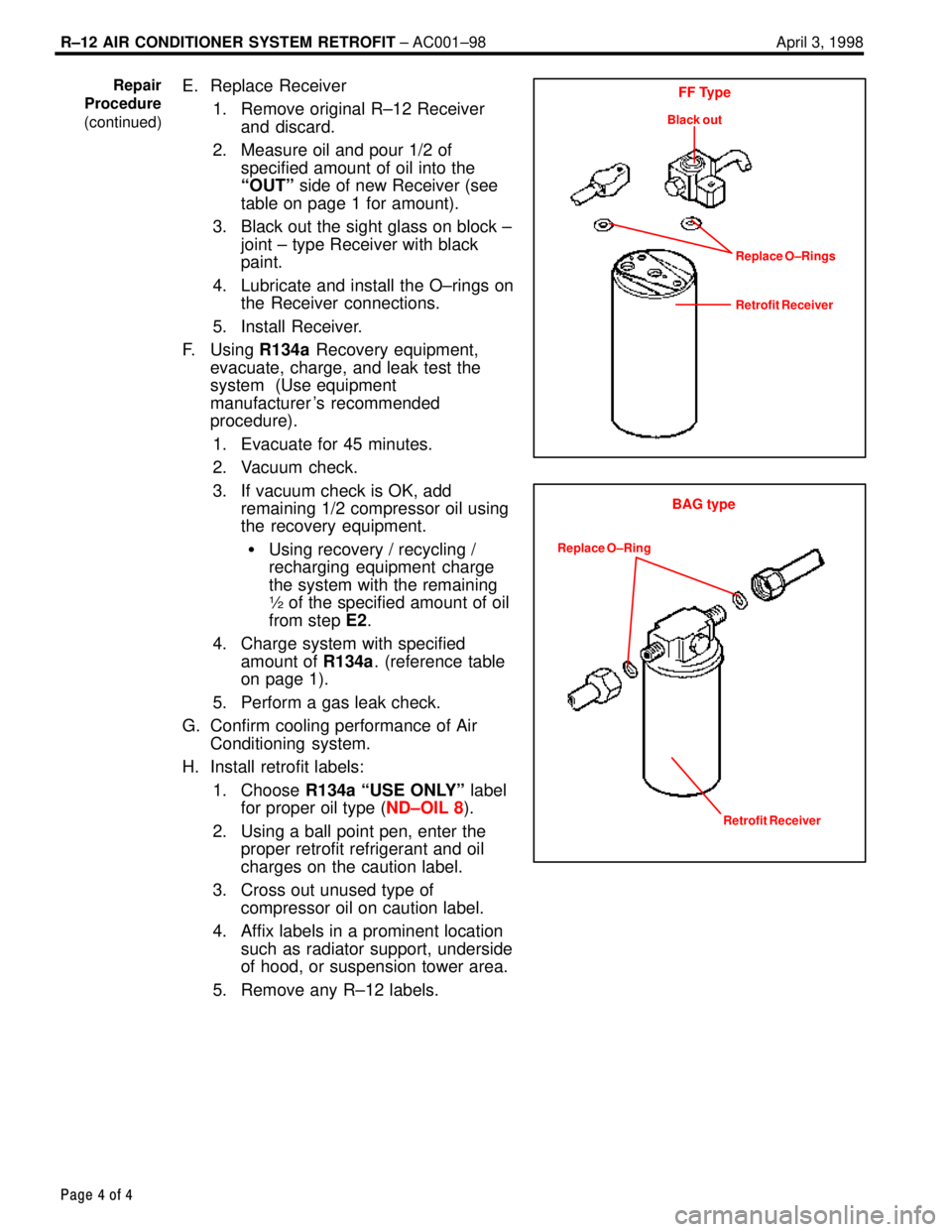
E. Replace Receiver
1. Remove original R±12 Receiverand discard.
2. Measure oil and pour 1/2 of specified amount of oil into the
ªOUTº side of new Receiver (see
table on page 1 for amount).
3. Black out the sight glass on block ± joint ± type Receiver with black
paint.
4. Lubricate and install the O±rings on the Receiver connections.
5. Install Receiver.
F. Using R134a Recovery equipment,
evacuate, charge, and leak test the
system (Use equipment
manufacturer 's recommended
procedure).
1. Evacuate for 45 minutes.
2. Vacuum check.
3. If vacuum check is OK, add remaining 1/2 compressor oil using
the recovery equipment.
Using recovery / recycling /
recharging equipment charge
the system with the remaining
½ of the specified amount of oil
from step E2.
4. Charge system with specified amount of R134a. (reference table
on page 1).
5. Perform a gas leak check.
G. Confirm cooling performance of Air Conditioning system.
H. Install retrofit labels:
1. Choose R134a ªUSE ONLYº label
for proper oil type ( ND±OIL 8).
2. Using a ball point pen, enter the proper retrofit refrigerant and oil
charges on the caution label.
3. Cross out unused type of compressor oil on caution label.
4. Affix labels in a prominent location such as radiator support, underside
of hood, or suspension tower area.
5. Remove any R±12 labels.Repair
Procedure
(continued)FF Type
Black out
Replace O±Rings
Retrofit Receiver
BAG type
Replace O±Ring
Retrofit Receiver
WhereEverybodyKnowsYourName
Page 86 of 4087
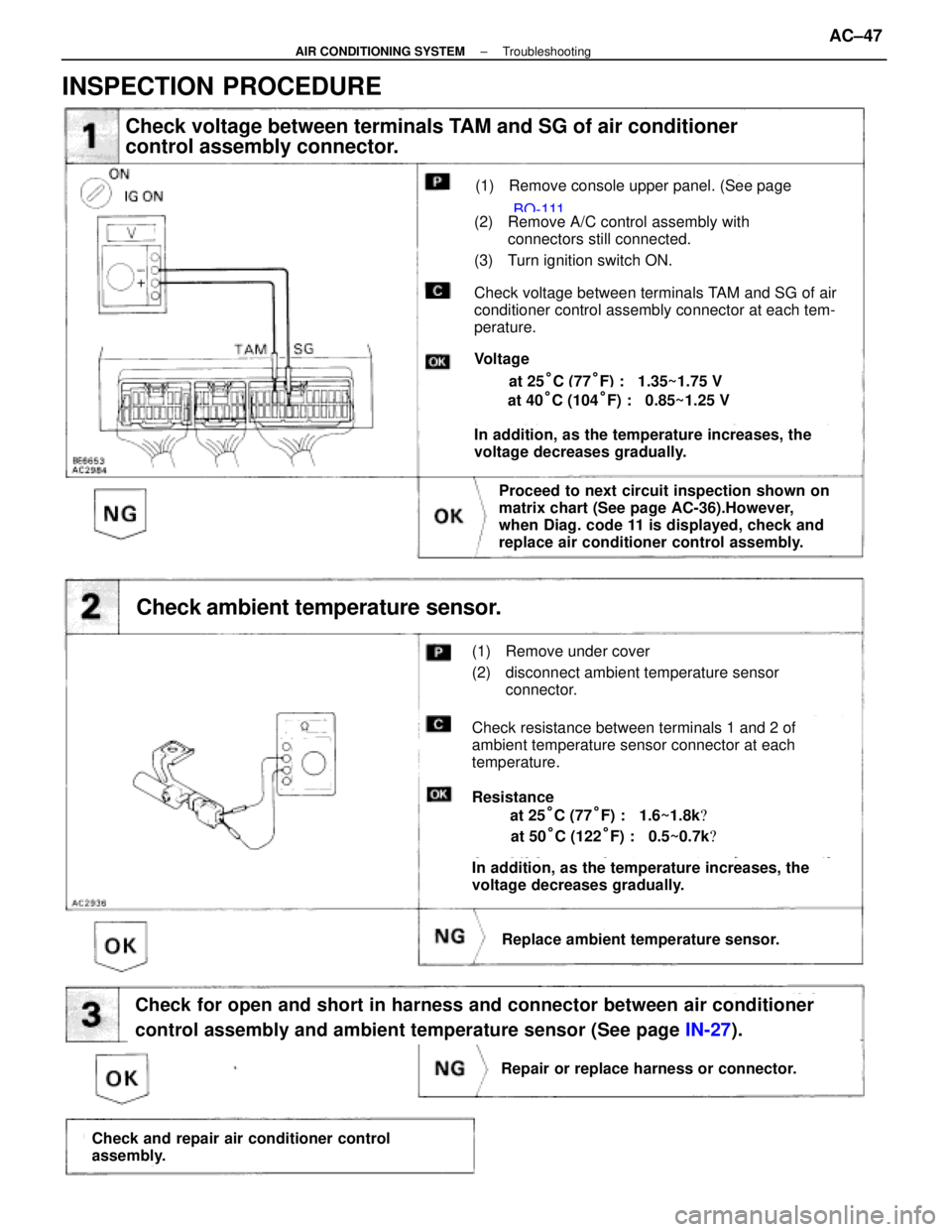
Check voltage between terminals TAM and SG of air conditioner
control assembly connector.
(1) Remove console upper panel. (See page BO-111
(2) Remove A/C control assembly with
connectors still connected.
(3) Turn ignition switch ON.
Check voltage between terminals TAM and SG of air
conditioner control assembly connector at each tem-
perature.
at 25°C (77°F) : 1.35~1.75 V
at 40°C (104°F) : 0.85~1.25 V
In addition, as the temperature increases, the
voltage decreases gradually.
Proceed to next circuit inspection shown on
matrix chart (See page AC-36).However,
when Diag. code 11 is displayed, check and
replace air conditioner control assembly.
Check ambient temperature sensor.
(1) Remove under cover
(2) disconnect ambient temperature sensor connector.
Check resistance between terminals 1 and 2 of
ambient temperature sensor connector at each
temperature.
Resistance
at 25°C (77°F) : 1.6~1.8k �
at 50°C (122°F) : 0.5~0.7k�
In addition, as the temperature increases, the
voltage decreases gradually.
Replace ambient temperature sensor.
Check for open and short in harness and connector between air conditioner
control assembly and ambient temperature sensor (See page IN-27).
Repair or replace harness or connector.
Check and repair air conditioner control
assembly.
Voltage
INSPECTION PROCEDURE
±
AIR CONDITIONING SYSTEM TroubleshootingAC±47
WhereEverybodyKnowsYourName
Page 149 of 4087
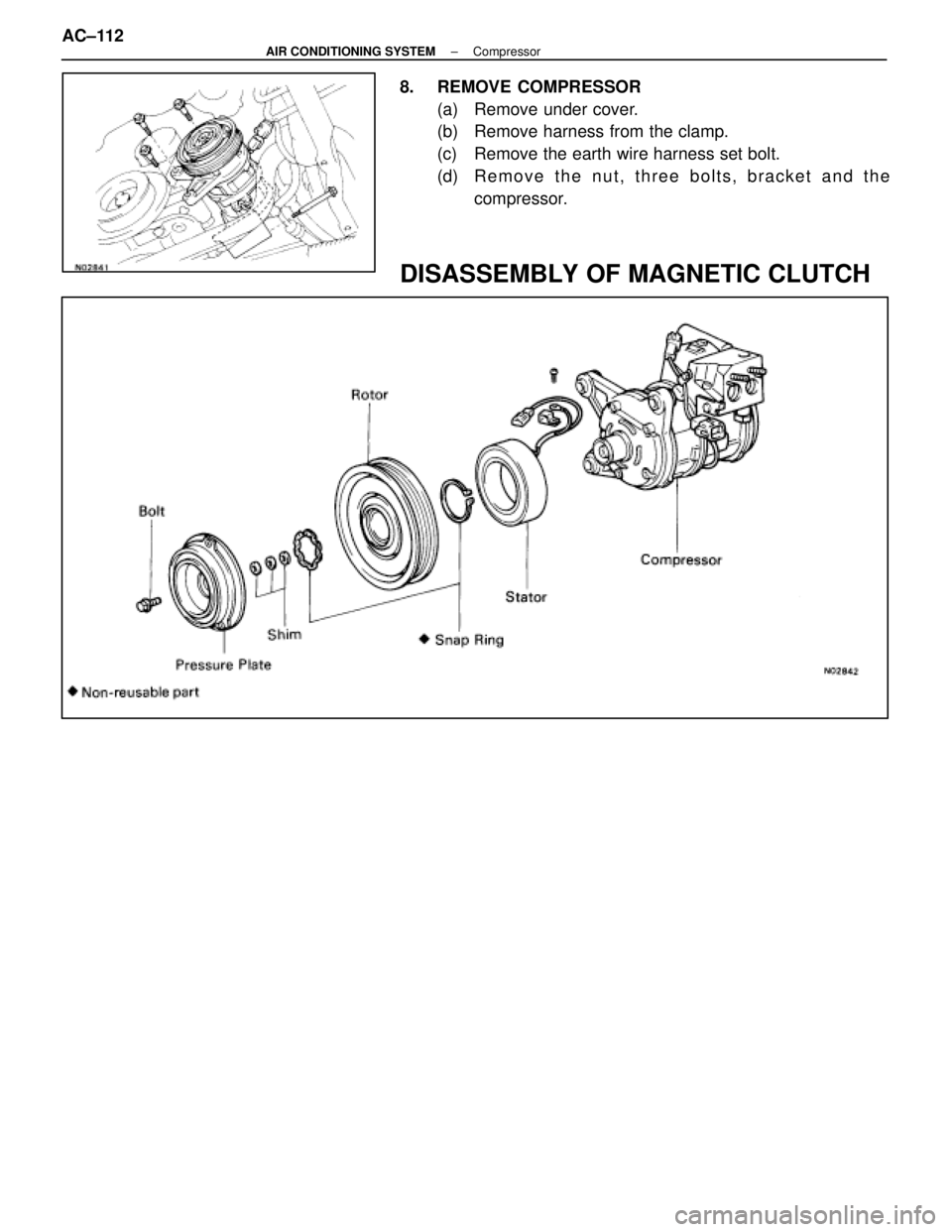
8. REMOVE COMPRESSOR(a) Remove under cover.
(b) Remove harness from the clamp.
(c) Remove the earth wire harness set bolt.
(d) R e m o v e t h e n u t , t h r e e b o l t s , b r a c k e t a n d t h ecompressor.
DISASSEMBLY OF MAGNETIC CLUTCH
AC±112±
AIR CONDITIONING SYSTEM Compressor
WhereEverybodyKnowsYourName
Page 157 of 4087
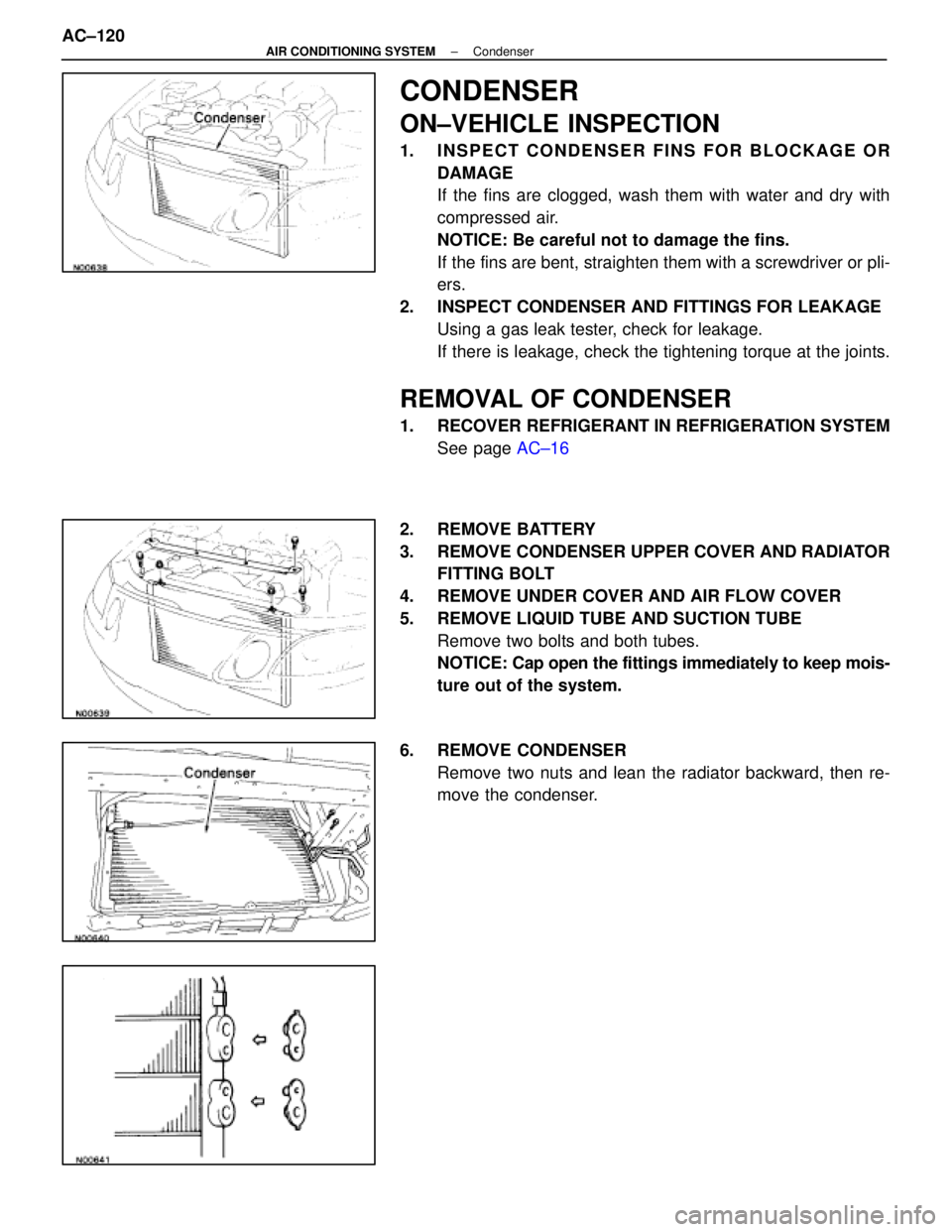
CONDENSER
ON±VEHICLE INSPECTION
1. INSPECT CONDENSER FINS FOR BLOCKAGE OR
DAMAGE
If the fins are clogged, wash them with water and dry with
compressed air.
NOTICE: Be careful not to damage the fins.
If the fins are bent, straighten them with a screwdriver or pli-
ers.
2. INSPECT CONDENSER AND FITTINGS FOR LEAKAGE Using a gas leak tester, check for leakage.
If there is leakage, check the tightening torque at the joints.
REMOVAL OF CONDENSER
1. RECOVER REFRIGERANT IN REFRIGERATION SYSTEMSee page AC±16
2. REMOVE BATTERY
3. REMOVE CONDENSER UPPER COVER AND RADIATOR FITTING BOLT
4. REMOVE UNDER COVER AND AIR FLOW COVER
5. REMOVE LIQUID TUBE AND SUCTION TUBE Remove two bolts and both tubes.
NOTICE: Cap open the fittings immediately to keep mois-
ture out of the system.
6. REMOVE CONDENSER Remove two nuts and lean the radiator backward, then re-
move the condenser.
AC±120
±
AIR CONDITIONING SYSTEM Condenser
WhereEverybodyKnowsYourName
Page 159 of 4087
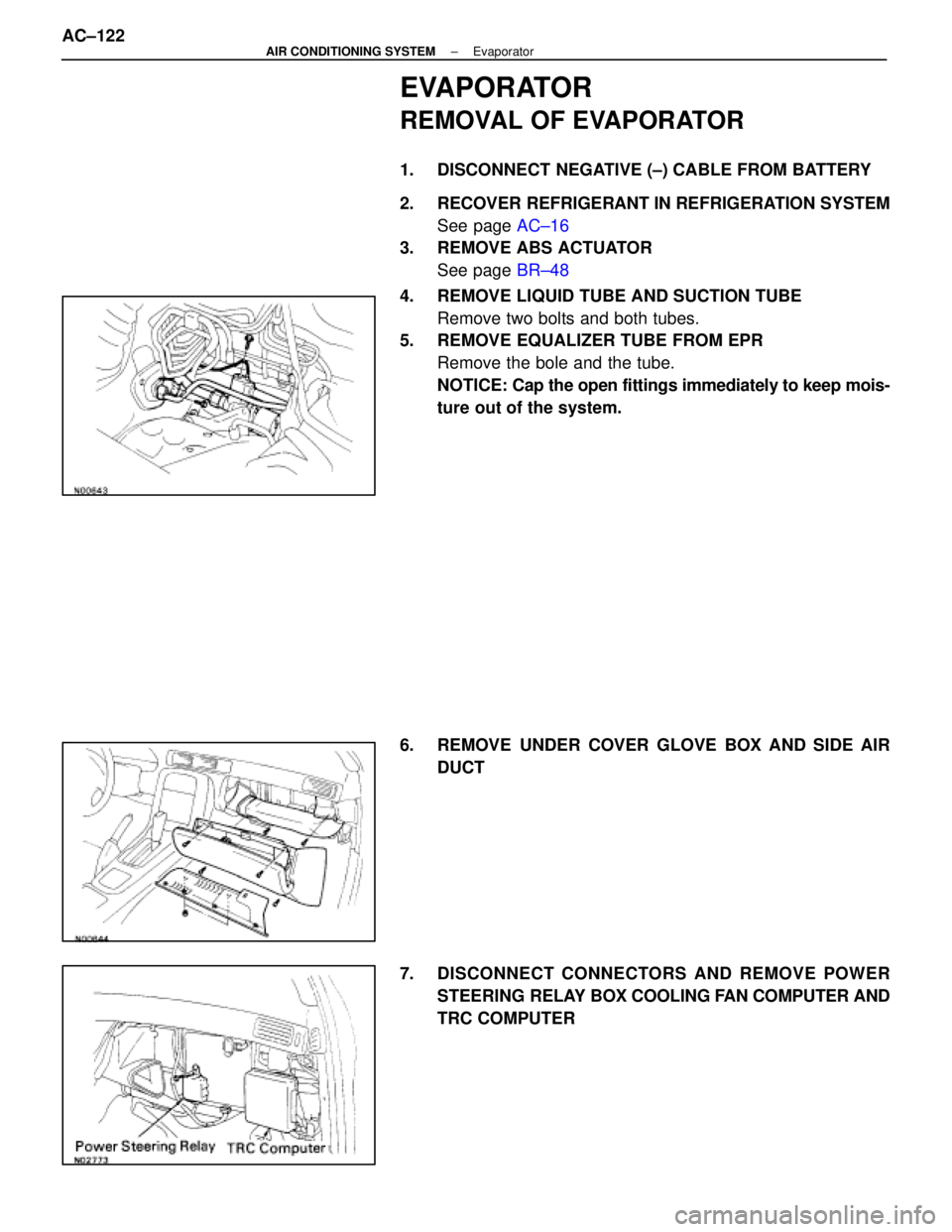
EVAPORATOR
REMOVAL OF EVAPORATOR
1. DISCONNECT NEGATIVE (±) CABLE FROM BATTERY
2. RECOVER REFRIGERANT IN REFRIGERATION SYSTEMSee page AC±16
3. REMOVE ABS ACTUATOR
See page BR±48
4. REMOVE LIQUID TUBE AND SUCTION TUBE Remove two bolts and both tubes.
5. REMOVE EQUALIZER TUBE FROM EPR
Remove the bole and the tube.
NOTICE: Cap the open fittings immediately to keep mois-
ture out of the system.
6. REMOVE UNDER COVER GLOVE BOX AND SIDE AIR DUCT
7. DISCONNECT CONNECTORS AND REMOVE POWER STEERING RELAY BOX COOLING FAN COMPUTER AND
TRC COMPUTER
AC±122
±
AIR CONDITIONING SYSTEM Evaporator
WhereEverybodyKnowsYourName
Page 170 of 4087
AMBIENT TEMPERATURE SENSOR
REMOVAL OF AMBIENT TEMPERATURE
SENSOR
1. REMOVE ENGINE UNDER COVER
2. REMOVE SENSOR
(a) Remove the clip and the sensor.
(b) Disconnect the connector.
INSPECTION OF AMBIENT
TEMPERATURE SENSOR
See page AC±46
INSTALLATION OF AMBIENT
TEMPERATURE SENSOR
1. INSTALL SENSOR
(a) Connect the connector.
(b) Install the sensor with the clip.
2. INSTALL ENGINE UNDER COVER
±
AIR CONDITIONING SYSTEM Ambient Temperature SensorAC±133
WhereEverybodyKnowsYourName