Page 3397 of 4087

YESNO
NOYES
YES
NO
OKNG
BASIC INSPECTION
When the normal code is displayed in the diagnostic code check, troubleshoot\
ing should be performed in the
order for all possible circuits to be considered as the causes of the pr\
oblems.
In many cases, by carrying out the basic engine check shown in the follo\
wing flow chart, the location causing
the problem can be found quickly and ef ficiently. Therefore, use of this check is essential in engine troubleshoot-
ing.
1Is battery voltage 11 V or more when engine is stopped?
Charge or replace battery.
2Is engine cracnked?
Proceed to matrix to matrix chart of problem
symptoms on page TR±35.
3Does engine start?
Go to step [7]
4Check air filter
C
Hint
PRemove air filter
Visially check that the air cleaner element is not exces-
sively damaged or oily.
If necessary, clean element with compressed air. First
blow from inside thoroughly, then blow off outside of ele-
ment.
Repair or replace
Go to Step [5].
TR±24±
ENGINE TROUBLESHOOTING Basic Inspection
WhereEverybodyKnowsYourName
Page 3400 of 4087

FAIL±SAFE CHART
If any of the following codes is recorded, the ECU enters fail±safe mod\
e.
Code No.Fail±Safe OperationFail±Safe Deactivation Conditions
14Fuel cut1 IGF detected in consecutive 3 ignitions.
16Torque control prohibited.Returned to normal condition.
22THW is fixed at 805C (176 5F).Returned to normal condition.
24THA is fixed at 20 5C (68 5F).Returned to normal condition.
31� Ignition timing fixed at 10 5 BTDC.
� Injection time fixed
Starting 9 m sec.KS input 15 times/sec. or more.
IDL ON 3.6 m sec.
IDL OFF 6.7 m sec.
35Atmospheric pressure is fixed at 101.3 kPa
(760 mmHg 29 92 in Hg)
Returned to normal condition.
(760 mmHg, 29.92 in.Hg).
41VTA1 is fixed at 05.The following must each be repeated at least 241VTA1 is fixed at 0 5.The following must each be re eated at least 2
time consecutively.time consecutively.
(w/o TRAC)(w/o TRAC)
� 0.1 V ? VTA ? 0.95 V 0.1 V ? VTA ? 0.95 V
� IDL : ON
( / TRAC)(w/ TRAC)
025V?VTA?095V � 0.25 V ? VTA ? 0.95 V
� IDL:ON � IDL : ON
52Max. timing retardation.IG switch OFF.
53Max. timing retardation.Returned to normal condition.
55Max. timing retardation.IG switch OFF.
Back±Up Function
If there is trouble with the program in the ECU and the ignition signals\
(IGT) are not output, the ECU controls
fuel injection and ignition timing at predetermined levels as a back±up f\
unction to make it possible to continue
to operate the vehicle.
Furthermore, the injection duration is calculated from the starting sign\
al (STA) and the throttle position signal
(IDL). Also, the ignition timing is fixed at the initial ignition timing, 10 5 BTDC, without relation to the engine speed.
HINT: If the engine is controlled by the back±up function, the ºCHECKº\
engine warning light lights up to warn
the driver of the malfunction but the diagnostic code is not output. TR±26
±
ENGINE TROUBLESHOOTING Fail±Safe Chart
WhereEverybodyKnowsYourName
Page 3404 of 4087
TERMINALS OF ECU
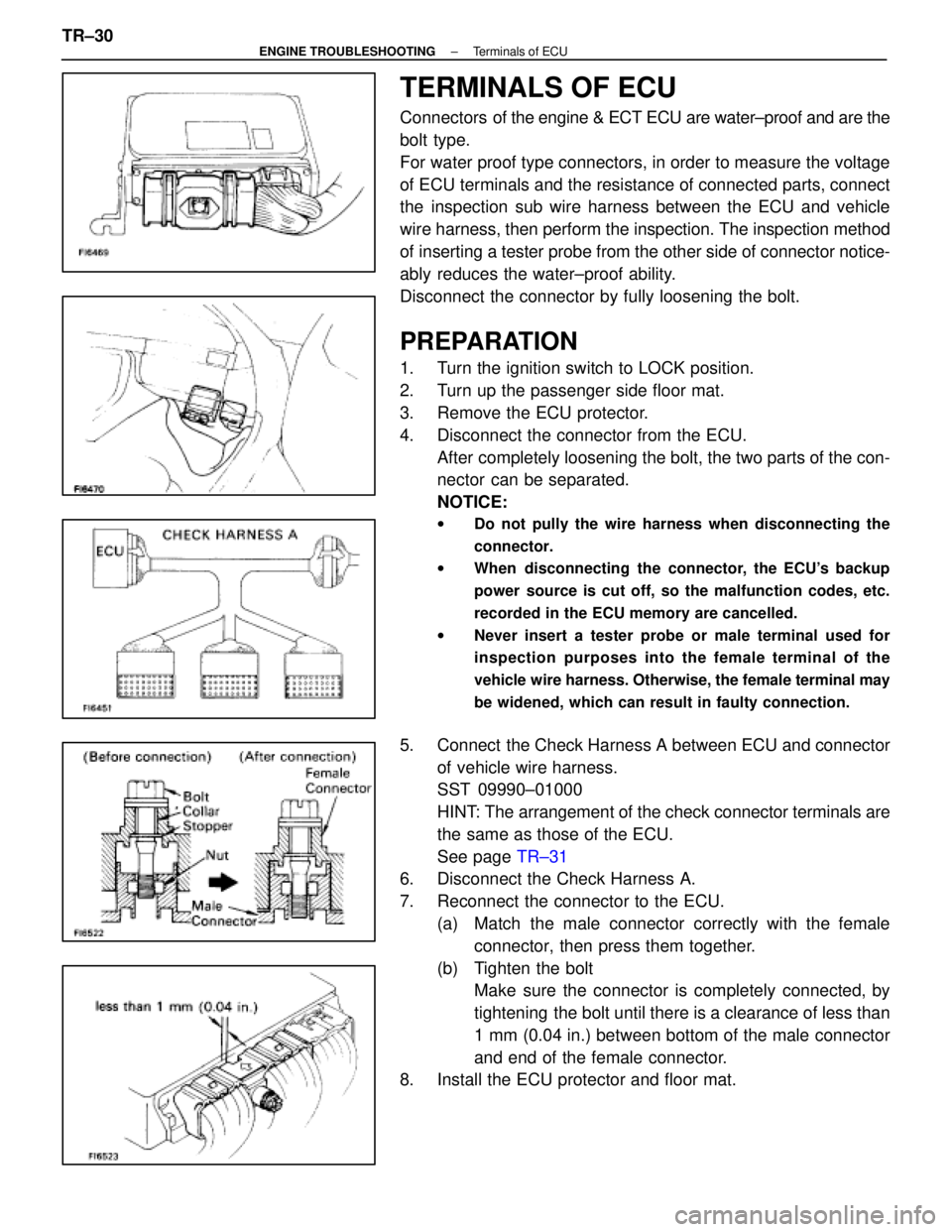
Connectors of the engine & ECT ECU are water±proof and are the
bolt type.
For water proof type connectors, in order to measure the voltage
of ECU terminals and the resistance of connected parts, connect
the inspection sub wire harness between the ECU and vehicle
wire harness, then perform the inspection. The inspection method
of inserting a tester probe from the other side of connector notice-
ably reduces the water±proof ability.
Disconnect the connector by fully loosening the bolt.
PREPARATION
1. Turn the ignition switch to LOCK position.
2. Turn up the passenger side floor mat.
3. Remove the ECU protector.
4. Disconnect the connector from the ECU. After completely loosening the bolt, the two parts of the con-
nector can be separated.
NOTICE:
w Do not pully the wire harness when disconnecting the
connector.
w When disconnecting the connector, the ECU's backup
power source is cut off, so the malfunction codes, etc.
recorded in the ECU memory are cancelled.
w Never insert a tester probe or male terminal used for
inspection purposes into the female terminal of the
vehicle wire harness. Otherwise, the female terminal may
be widened, which can result in faulty connection.
5. Connect the Check Harness A between ECU and connector
of vehicle wire harness.
SST 09990±01000
HINT: The arrangement of the check connector terminals are
the same as those of the ECU.
See page TR±31
6. Disconnect the Check Harness A.
7. Reconnect the connector to the ECU.
(a) Match the male connector correctly with the femaleconnector, then press them together.
(b) Tighten the bolt Make sure the connector is completely connected, by
tightening the bolt until there is a clearance of less than
1 mm (0.04 in.) between bottom of the male connector
and end of the female connector.
8. Install the ECU protector and floor mat.
TR±30
±
ENGINE TROUBLESHOOTING Terminals of ECU
WhereEverybodyKnowsYourName
Page 3412 of 4087
TERMINALS OF ECU
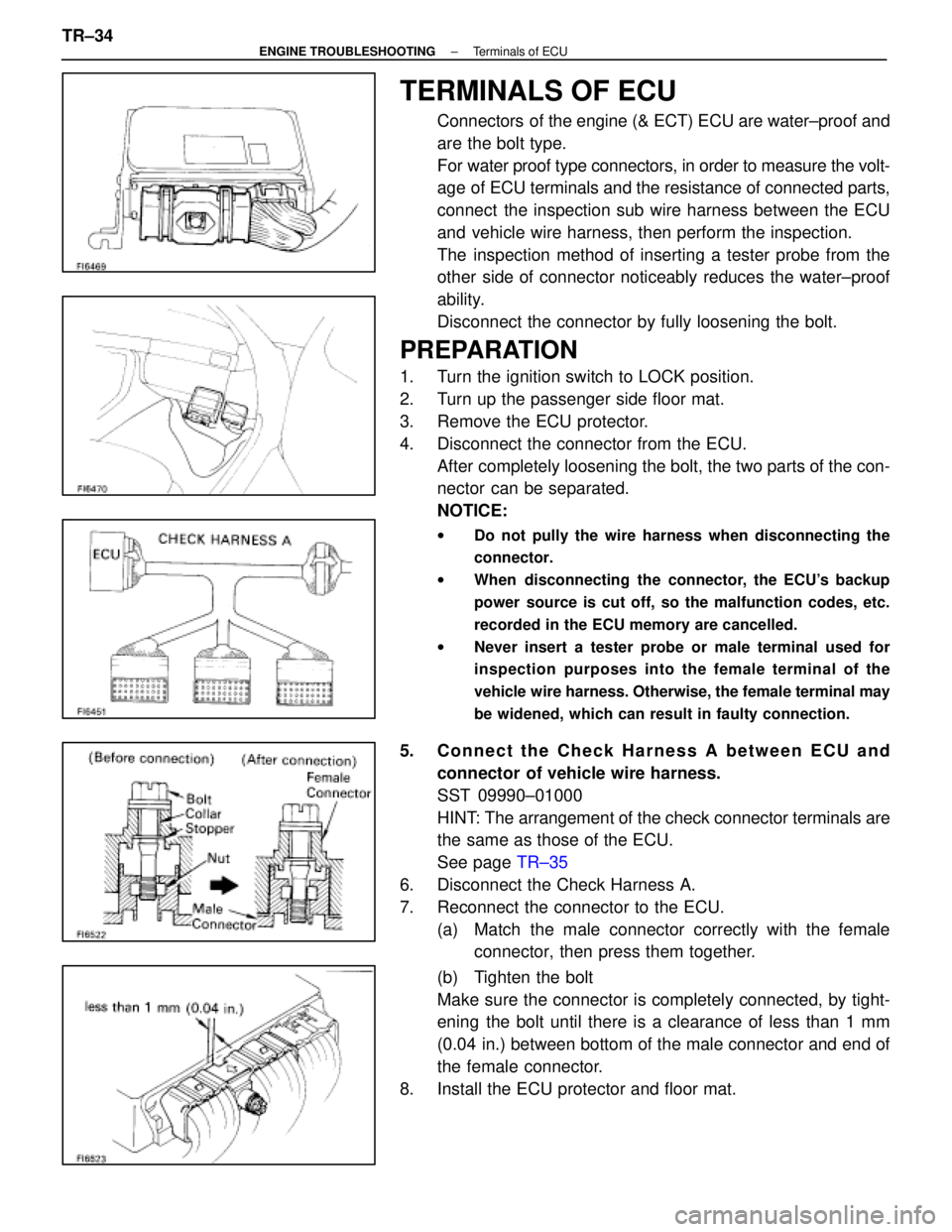
Connectors of the engine (& ECT) ECU are water±proof and
are the bolt type.
For water proof type connectors, in order to measure the volt-
age of ECU terminals and the resistance of connected parts,
connect the inspection sub wire harness between the ECU
and vehicle wire harness, then perform the inspection.
The inspection method of inserting a tester probe from the
other side of connector noticeably reduces the water±proof
ability.
Disconnect the connector by fully loosening the bolt.
PREPARATION
1. Turn the ignition switch to LOCK position.
2. Turn up the passenger side floor mat.
3. Remove the ECU protector.
4. Disconnect the connector from the ECU.After completely loosening the bolt, the two parts of the con-
nector can be separated.
NOTICE:
w Do not pully the wire harness when disconnecting the
connector.
w When disconnecting the connector, the ECU's backup
power source is cut off, so the malfunction codes, etc.
recorded in the ECU memory are cancelled.
w Never insert a tester probe or male terminal used for
inspection purposes into the female terminal of the
vehicle wire harness. Otherwise, the female terminal may
be widened, which can result in faulty connection.
5. Connect the Check Harness A between ECU and
connector of vehicle wire harness.
SST 09990±01000
HINT: The arrangement of the check connector terminals are
the same as those of the ECU.
See page TR±35
6. Disconnect the Check Harness A.
7. Reconnect the connector to the ECU. (a) Match the male connector correctly with the femaleconnector, then press them together.
(b) Tighten the bolt
Make sure the connector is completely connected, by tight-
ening the bolt until there is a clearance of less than 1 mm
(0.04 in.) between bottom of the male connector and end of
the female connector.
8. Install the ECU protector and floor mat.
TR±34
±
ENGINE TROUBLESHOOTING Terminals of ECU
WhereEverybodyKnowsYourName
Page 3415 of 4087
TR±88
TR±10
0
TR±12
2
TR±13
0
TR±13
6
TR±14
0
TR±11
4
TR±14
2 TR±108
TR±11
8
TR±12
4
TR±13
2
AC±84
ST±24
IG±24 IG±6
EM±30
AT±66
IN±32BE±381IG±7
IG±9
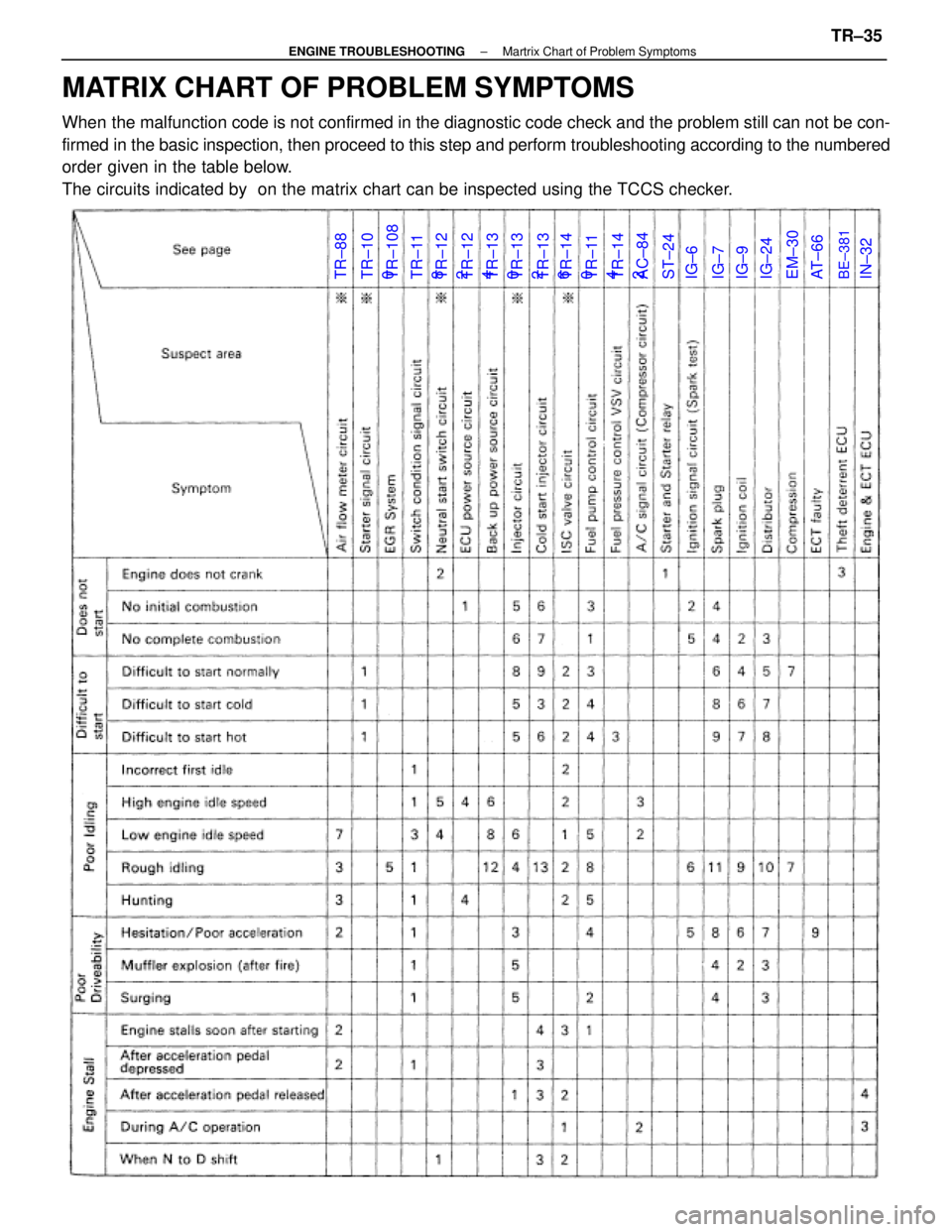
MATRIX CHART OF PROBLEM SYMPTOMS
When the malfunction code is not confirmed in the diagnostic code check and \
the problem still can not be con-
firmed in the basic inspection, then proceed to this step and perform troubles\
hooting according to the numbered
order given in the table below.
The circuits indicated by on the matrix chart can be inspected using th\
e TCCS checker.
±
ENGINE TROUBLESHOOTING Martrix Chart of Problem SymptomsTR±35
WhereEverybodyKnowsYourName
Page 3430 of 4087
TR±82
TR±96
TR±104
TR±114
TR±118
TR±120
TR±126
TR±128
TR±132
TR±110
AC±68
ST±13 14
IG±6
IG±7
IG±10
IG±10
EM±22
AT±68
BE±398
IN±32
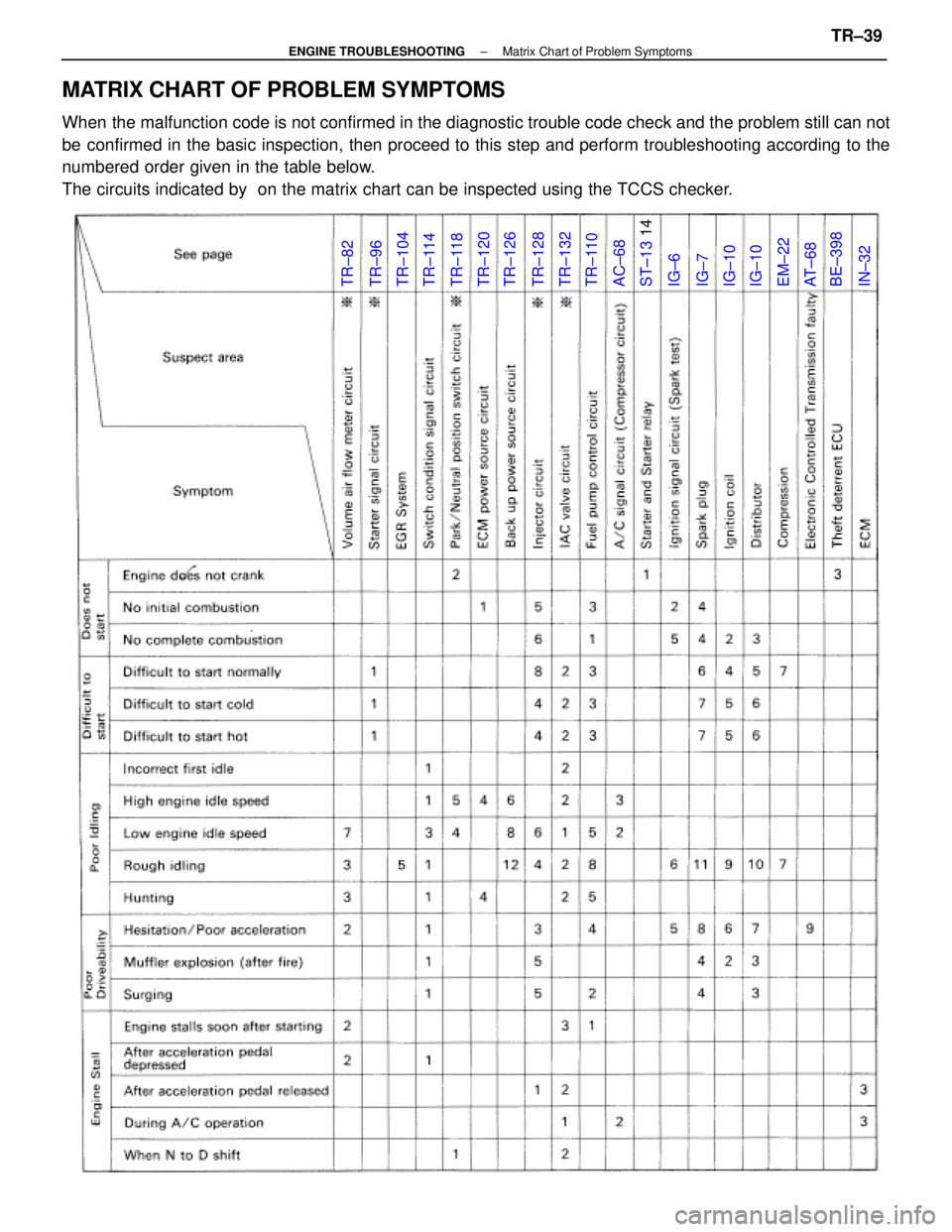
MATRIX CHART OF PROBLEM SYMPTOMS
When the malfunction code is not confirmed in the diagnostic trouble code ch\
eck and the problem still can not
be confirmed in the basic inspection, then proceed to this step and perfor\
m troubleshooting according to the
numbered order given in the table below.
The circuits indicated by on the matrix chart can be inspected using th\
e TCCS checker.
±
ENGINE TROUBLESHOOTING Matrix Chart of Problem SymptomsTR±39
WhereEverybodyKnowsYourName
Page 3437 of 4087

CIRCUIT DESCRIPTION
The distributor in the Engine Control System contains three pick±up coil\
s (G1, G2 and NE).
The G1, G2 signals inform")
CIRCUIT INSPECTIONDiag. Code 12
RPM Signal Circuit (No. 1)
CIRCUIT DESCRIPTION
The distributor in the Engine Control System contains three pick±up coil\
s (G1, G2 and NE).
The G1, G2 signals inform the ECU of the standard crankshaft angle.
The NE signals inform the ECU of the crankshaft angle and the engine spe\
ed.
����� �����Code No.����������������� �����������������Diagnostic Code Detecting Condition�������������� ��������������Trouble Area
����� ���������������������� �����������������
NoºNEºorºG1ºandºG2ºsignal to ECU within 2
�������������� ��������������
�Open or short in NE G circuit����� ���������������������� �����������������No ºNEº or ºG1º and ºG2º signal to ECU within 2
sec after cranking�������������� ��������������� Open or short in NE, G circuit.
� Distributor
����� �����12����������������� �����������������sec. after cranking.�������������� ��������������� Distributor
� Open or short in STA circuit.
ECU����� ���������������������� �����������������Open in ºGº � circuit.�������������� ��������������
Oen or short in STA circuit.
� ECU
TR±46±
ENGINE TROUBLESHOOTING Circuit Inspection
WhereEverybodyKnowsYourName
Page 3441 of 4087

CIRCUIT DESCRIPTION
Cam position sensors (G1 and G2 signals) and engine speed sensor (NE sig\
nal) consist of a signal plate
and a pick up c")
CIRCUIT INSPECTIONDiag. Code 12
RPM Signal Circuit (No.1)
CIRCUIT DESCRIPTION
Cam position sensors (G1 and G2 signals) and engine speed sensor (NE sig\
nal) consist of a signal plate
and a pick up coil.
The G1, G2 signal plates have one tooth each on its outer circumference and\
are mounted on the left and
right bank camshafts.
When the camshafts rotate, the protrusion on the signal plate and the air gap on the pick up coil change,
causing fluctuations in the magnetic field and generating an electromotive forc\
e in the pick up coil.
The NE signal plate has 12 teeth and is mounted on the crankshaft. The NE s\
ignal sensor generates 12
NE signals per engine revolution. The ECU detects the standard crankshaf\
t angle based on the G1, G2
signals, and the actual crankshaft angle and the engine speed by the NE \
signals.
Code No.Diagnostic Code Detecting ConditionTrouble Area
wOpen or short in engine speed sensor, No. 1,w Oen or short in engine s eed sensor, No. 1,
No. 2 cam position sensor circuit
12No ºNEº or ºG1º and ºG2º signal to ECU
No. 2 cam osition sensor circuit
w Engine speed sensor12No NE or G1 and G2 signal to ECU
within 2 sec. after cranking.
wEngine s eed sensor
wNo. 1, No. 2 cam position sensorgNo. 1, No. 2 cam osition sensor
wStarter
wECU
TR±48±
ENGINE TROUBLESHOOTING Circuit Inspection
WhereEverybodyKnowsYourName