Page 87 of 136
Spark Plugs
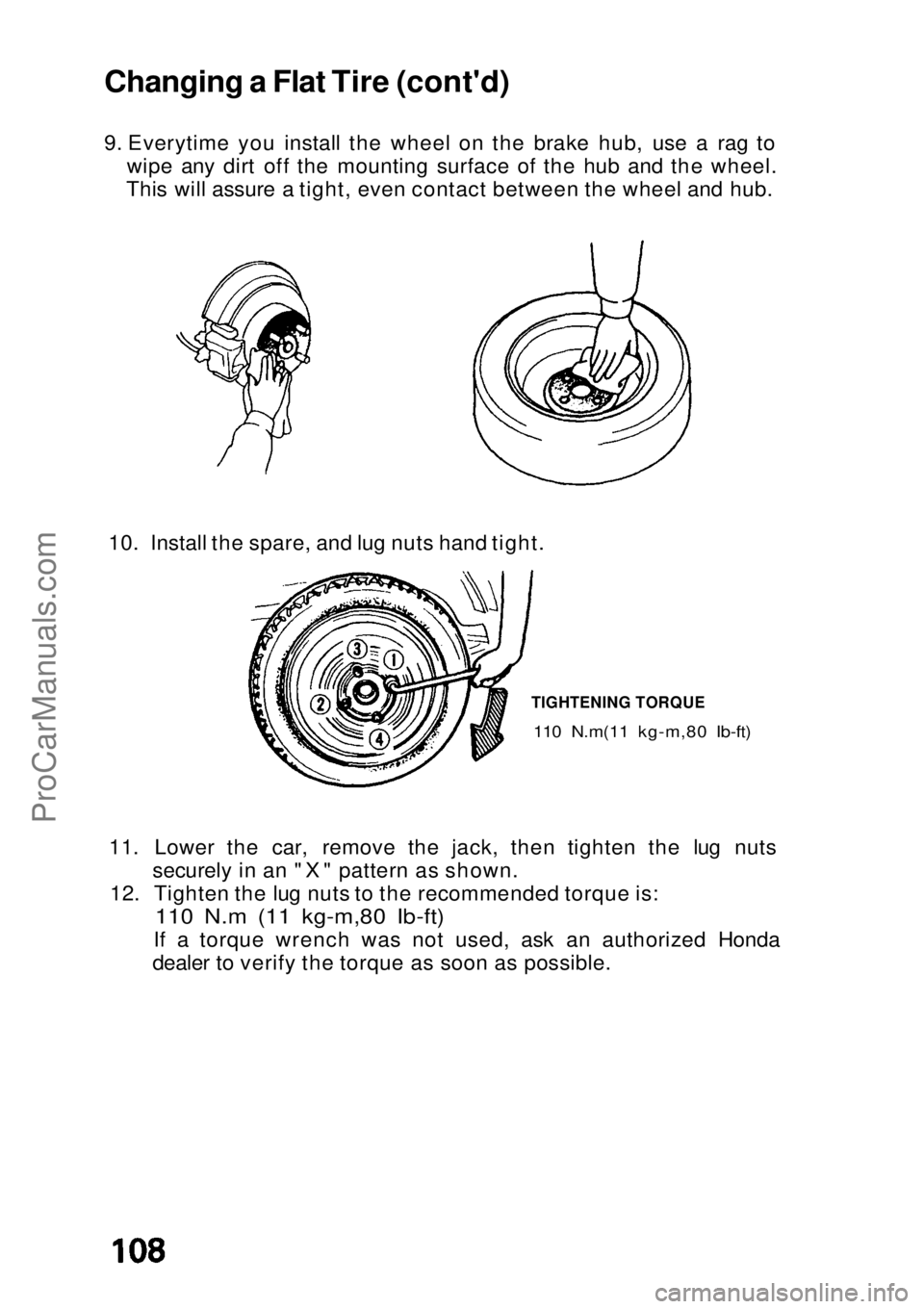
Spark plugs should be replaced every 24 months or 30,000 miles (48,000 km), whichever comes first.
Recommended spark plugs:
CAUTION:
Never use spark plugs with an improper heat range; they will adversely affect engine performance and durability.
Spark Plug Replacement
Replace plugs one at a time, so you don't get the wires mixed up.1. Clean any dirt from around the spark plug base.
2. Disconnect the plug cap, then remove and discard the old plug.
3. Check the gap of the new spark plug before installation.
Plug gap should be:
1.1 mm (0.04 in)
4. Thread the new spark plug in by hand to prevent cross-threading. 5. After the plug seats against the cylinder head, tighten 1/2 turn with a spark plug wrench to compress the washer.
6. Reinstall the spark plug cap.
CAUTION:
The spark plugs must be securely tightened, but not overtightened. A plug that's too loose can get very hot and possibly damage the
engine; one that's too tight could damage the threads in the
cylinder head. PLUG CAPProCarManuals.comMain Menu s t
Page 108 of 136
Changing a Flat Tire (cont'd)
9. Everytime you install the wheel on the brake hub, use a rag to
wipe any dirt off the mounting surface of the hub and the wheel.
This will assure a tight, even contact between the wheel and hub.
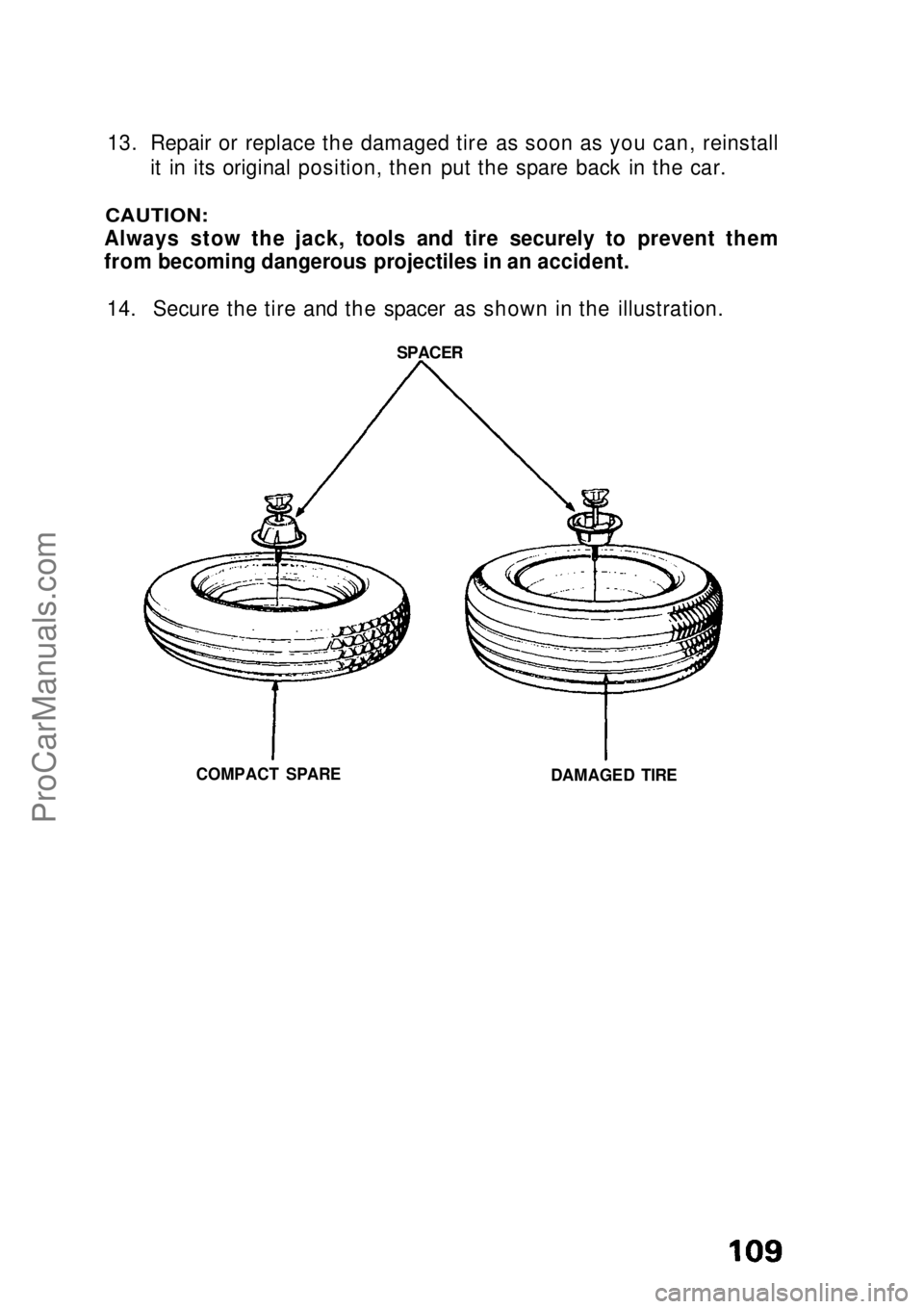
10. Install the spare, and lug nuts hand tight.
TIGHTENING TORQUE
110 N.m(11 kg-m,80 Ib-ft)
11. Lower the car, remove the jack, then tighten the lug nuts securely in an "X" pattern as shown.
12. Tighten the lug nuts to the recommended torque is:
110 N.m (11 kg-m,80 Ib-ft)
If a torque wrench was not used, ask an authorized Honda
dealer to verify the torque as soon as possible.
ProCarManuals.comMain Menu s t
Page 109 of 136
13. Repair or replace the damaged tire as soon as you can, reinstall
it in its original position, then put the spare back in the car.
CAUTION:
Always stow the jack, tools and tire securely to prevent them
from becoming dangerous projectiles in an accident.
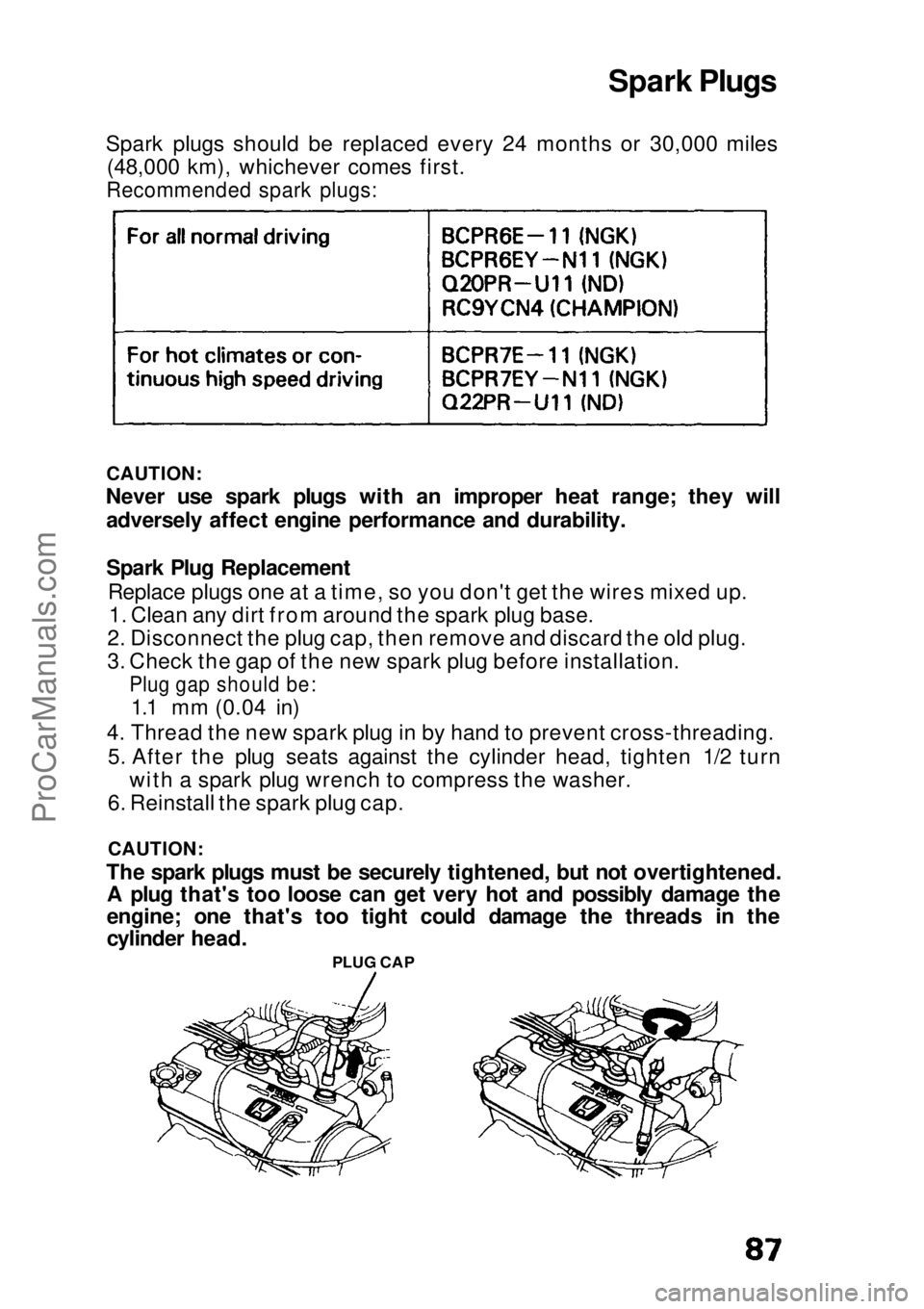
14. Secure the tire and the spacer as shown in the illustration.
COMPACT SPARE DAMAGED TIRE
SPACERProCarManuals.comMain Menu s t
Page 125 of 136

Evaporative Emission Control System
The Evaporative Emission Control System is designed to prevent
fuel vapors from escaping into the atmosphere. Fuel vapors from the fuel tank are directed into the charcoal
canister where they are adsorbed and stored while the engine is stopped or idling. When the coolant temperature rises to a certain
value, the vapors are drawn into the engine through the throttlebody and the intake manifold during normal engine operation.
Engine Exhaust Emission Controls
The engine exhaust emission control systems are designed to control combustion during idle, acceleration, cruise, and deceleration.
These systems are entirely separate from the crankcase and evaporative emission control systems described previously.
HONDA PGM-FI System
The PGM-FI system consists of three independent sub-systems; Air Intake, Electronic Control and Fuel Control, thus allowing moreaccurate control of air/fuel ratios under all operating conditions.
The Electronic Control Unit (ECU) detects the amount of air
drawn into the cylinders and determines the amount of fuel to be injected to provide the optimum air/fuel ratio for all engine needs.
Ignition Timing Control System
This system automatically controls the ignition timing to reduce
the amount of HC and NOx.
Catalytic Converter
Three Way Catalyst
The catalyst is used to convert hydrocarbons (HC), carbon monoxide (CO) and oxides of nitrogen (NOx) in the exhaust gas,
to carbon dioxide (CO 2
), dinitrogen (N 2
) and water vapor.
Exhaust Gas Recirculation (EGR) (California automatic models except EX Sedan)
The EGR system is designed to control the formation of oxides of nitrogen (NOx) caused when fuel mixture burns at high
temperature. It works by recirculating exhaust gas through the EGR valve and intake manifold into the combustion chambers
where it reduces peak temperature by diluting the air/fuel mixture.ProCarManuals.comMain Menu s t
Page:
< prev 1-8 9-16 17-24