1991 HONDA CIVIC engine
[x] Cancel search: enginePage 3 of 136
Introduction
This manual contains important information about the safe operation and maintenance of your car.
We urge you to read it carefully, become familiar with the controls itdescribes, and follow its recommendations, to help make your
driving trouble-free and enjoyable.
Statements or labels on the product preceded by the following
words are of special significance:
indicates severe personal injury or death will result if
instructions are not followed.indicates a strong possibility of severe personal
injury or death if instructions are not followed.means hazards or unsafe practices which could
cause minor personal injury or product or property
damage.
NOTE: gives helpful information.
Break-in Period
During the first 600 miles (1,000 km) of driving, avoid full throttle
starts and cruising for extended periods at a constant speed.
NOTE:
This break-in procedure also applies to exchanged or overhauled
engines.
During and after the break-in period, drive the car at moderate
speeds until the engine is fully warmed up.
During the first 200 miles (300 km), try to avoid severe braking.
Brake misuse during this period will reduce future braking efficiency.
Remember, your Honda Automobile dealer knows your car best,and should be consulted for service assistance and advice.ProCarManuals.comMain Menu s t
Page 29 of 136

Speedometer
The speed is indicated in miles per hour (outside scale) and kilometers per hour (inside).
Odometer
The numbers on the odometer indicate miles.
The odometer registers total distance traveled, and serves as your guide for determining when periodic maintenance is due. Federal lawmakes it illegal to alter the odometer of any motor vehicle with the
intent to change the number of miles indicated.
Trip Meter The numbers on the trip meter indicate miles.
The trip meter can be returned to zero by pushing in the reset button. Use it for checking fuel consumption or distance traveled
per trip.
Tachometer (Si Hatchback and LX/EX Sedan) The tachometer indicates engine speed in revolutions per minute.
The beginning of the RED ZONE indicates the maximum allowableengine R.P.M. Do not run the engine with the tachometer indicator
needle in the RED ZONE.
Fuel Gauge
FUEL TANK CAPACITY: 45 (11.9 US gal ,9.9 Imp gal)
As a convenience, the gauge continues to show the same fuel level
as when the ignition was last on. After refueling, the gauge will
slowly change to the new fuel level when the ignition is switched on.
When the needle first indicates E (empty), you have a usable
reserve left in the tank of about:
4 (1.1 US gal, 0.9 Imp gal)
Coolant Temperature Gauge
CAUTION:
The needle should stay within the white range. If the needle reaches the red line at "H" (Hot), pull safely off the road, stop theengine and check the coolant level in the reserve tank on the
driver's side of the radiator under the hood.
Do not remove the radiator cap when the engine is hot. The
coolant is under pressure and may blow out and scald you.
GaugesProCarManuals.comMain Menu s t
Page 31 of 136
Warning and Indicator Lights (cont'd)
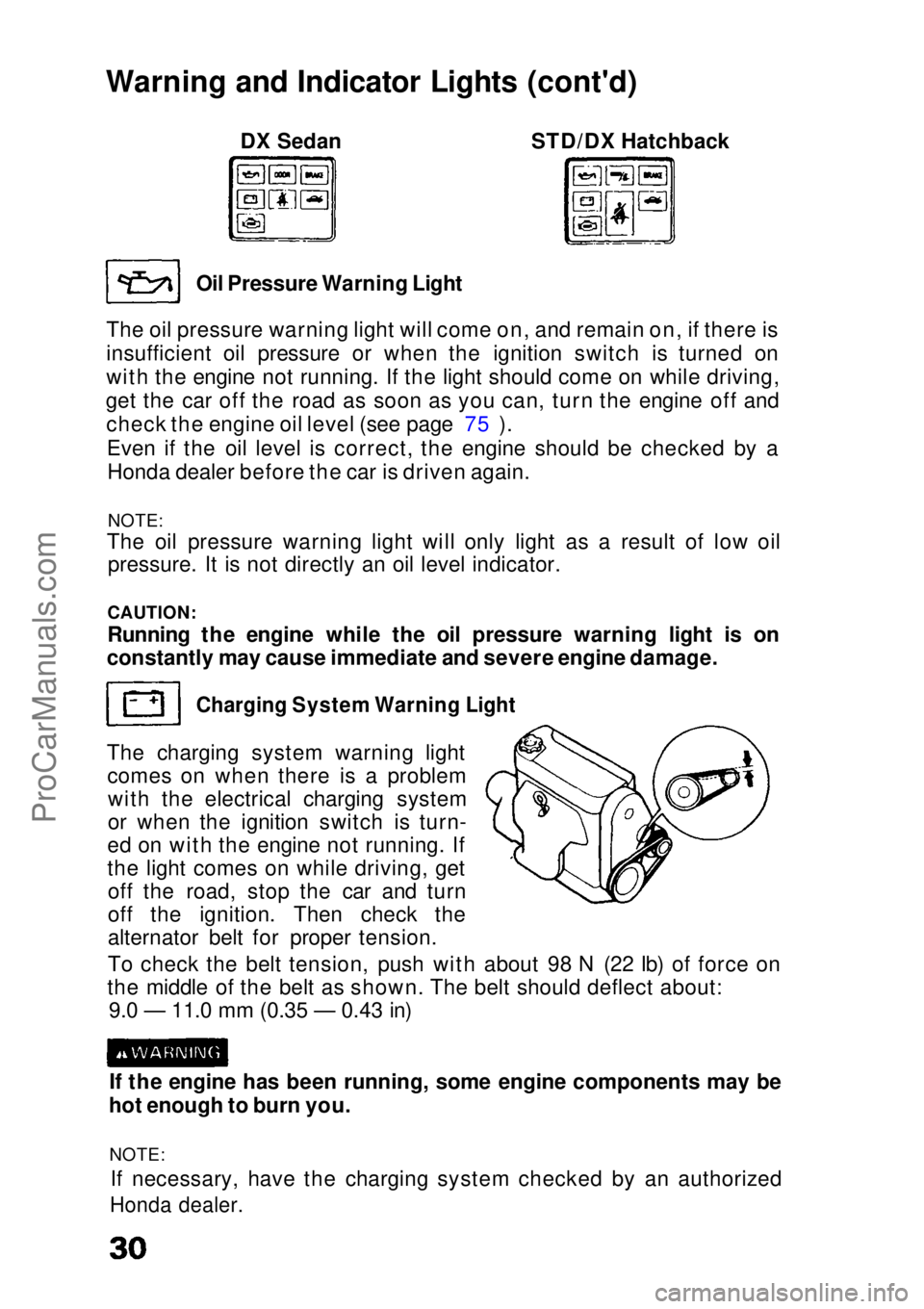
DX Sedan STD/DX Hatchback
Oil Pressure Warning Light
The oil pressure warning light will come on, and remain on, if there is
insufficient oil pressure or when the ignition switch is turned on
with the engine not running. If the light should come on while driving,
get the car off the road as soon as you can, turn the engine off and check the engine oil level (see page 75 ).
Even if the oil level is correct, the engine should be checked by aHonda dealer before the car is driven again.
NOTE:
The oil pressure warning light will only light as a result of low oil
pressure. It is not directly an oil level indicator.
CAUTION:
Running the engine while the oil pressure warning light is on
constantly may cause immediate and severe engine damage.
Charging System Warning Light
The charging system warning light comes on when there is a problemwith the electrical charging system
or when the ignition switch is turn-
ed on with the engine not running. If
the light comes on while driving, get off the road, stop the car and turn
off the ignition. Then check the
alternator belt for proper tension.
To check the belt tension, push with about 98 N (22 Ib) of force on
the middle of the belt as shown. The belt should deflect about: 9.0 — 11.0 mm (0.35 — 0.43 in)
If the engine has been running, some engine components may be
hot enough to burn you.
NOTE: If necessary, have the charging system checked by an authorized
Honda dealer.ProCarManuals.comMain Menu s t
Page 32 of 136
LX/EX Sedan
Si Hatchback
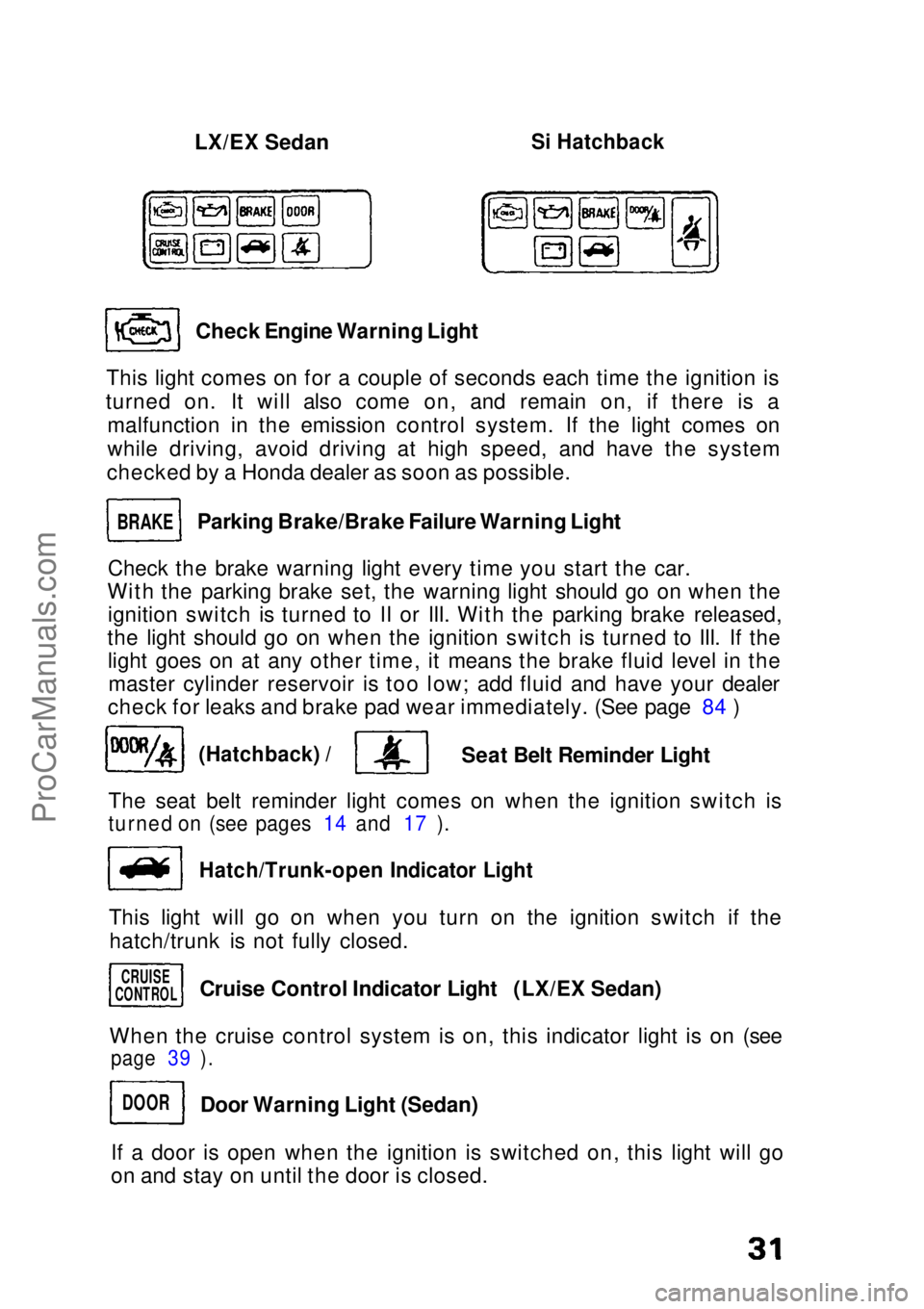
Check Engine Warning Light
This light comes on for a couple of seconds each time the ignition is
turned on. It will also come on, and remain on, if there is a malfunction in the emission control system. If the light comes on
while driving, avoid driving at high speed, and have the system
checked by a Honda dealer as soon as possible.
Parking Brake/Brake Failure Warning Light
Check the brake warning light every time you start the car.
With the parking brake set, the warning light should go on when the ignition switch is turned to II or III. With the parking brake released,
the light should go on when the ignition switch is turned to III. If the light goes on at any other time, it means the brake fluid level in themaster cylinder reservoir is too low; add fluid and have your dealer
check for leaks and brake pad wear immediately. (See page 84 )
(Hatchback) /
Seat Belt Reminder Light
The seat belt reminder light comes on when the ignition switch is
turned on (see pages 14 and 17 ).
Hatch/Trunk-open Indicator Light
This light will go on when you turn on the ignition switch if the hatch/trunk is not fully closed.
When the cruise control system is on, this indicator light is on (see
page 39 ).
If a door is open when the ignition is switched on, this light will go
on and stay on until the door is closed.
BRAKE
CRUISE
CONTROL
DOOR
Cruise Control Indicator Light (LX/EX Sedan)
Door Warning Light (Sedan)ProCarManuals.comMain Menu s t
Page 50 of 136
To Cool (with optional air conditioner)
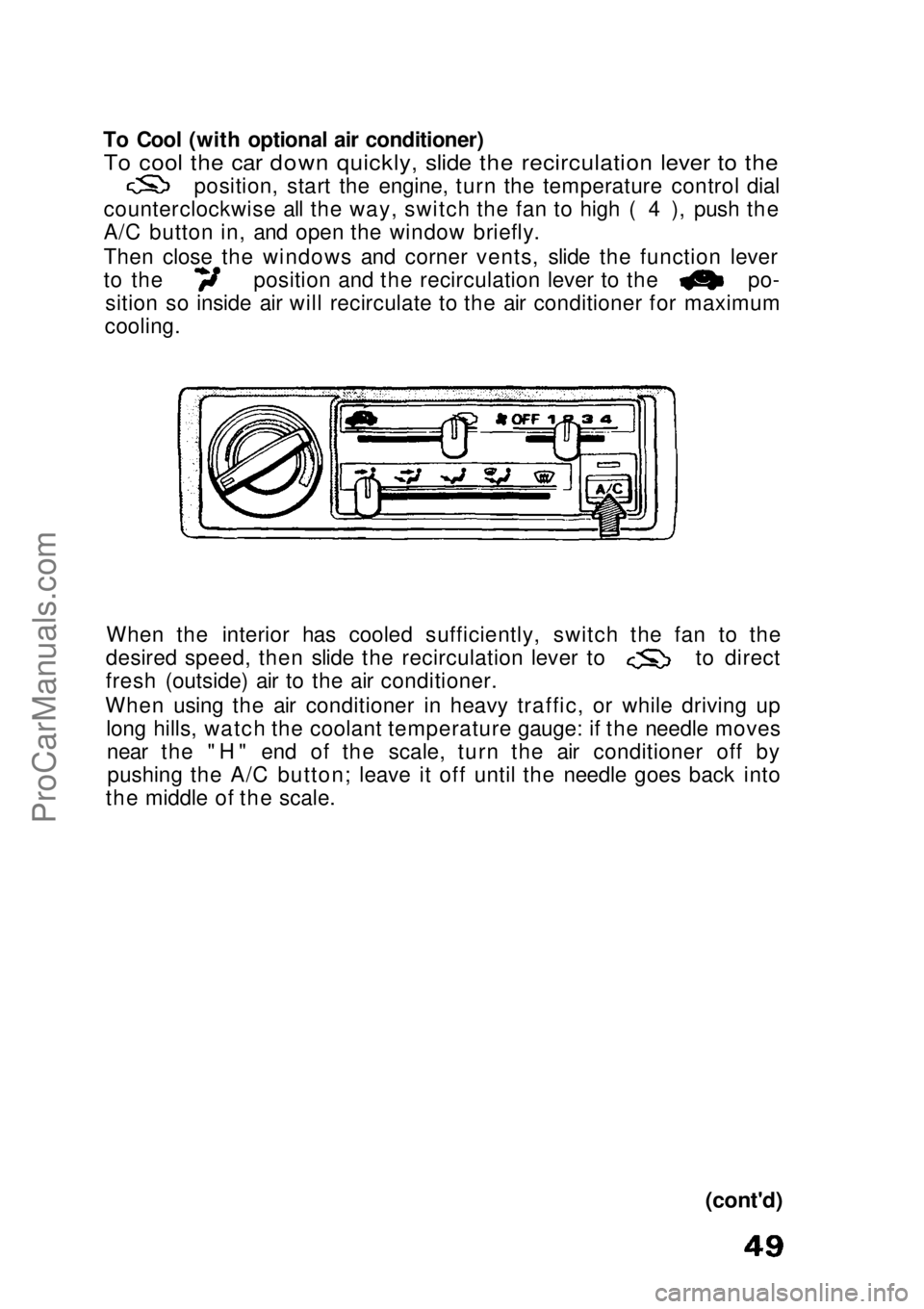
To cool the car down quickly, slide the recirculation lever to the
position, start the engine, turn the temperature control dial
counterclockwise all the way, switch the fan to high ( 4 ), push the
A/C button in, and open the window briefly.
Then close the windows and corner vents, slide the function lever to the position and the recirculation lever to the po-
sition so inside air will recirculate to the air conditioner for maximum
cooling.
When the interior has cooled sufficiently, switch the fan to the desired speed, then slide the recirculation lever to to direct
fresh (outside) air to the air conditioner.
When using the air conditioner in heavy traffic, or while driving up long hills, watch the coolant temperature gauge: if the needle movesnear the "H" end of the scale, turn the air conditioner off bypushing the A/C button; leave it off until the needle goes back into
the middle of the scale.
(cont'd)ProCarManuals.comMain Menu s t
Page 55 of 136

For proper operation of your car's emission controls, your engine is
designed to use unleaded fuel only.
CAUTION:
Using leaded or even low-lead gasoline could damage some of your
emission controls, and also void their coverage under the emission
controls warranty.
Use gasoline from pumps labeled unleaded, with a pump octane
number of 86 or higher. The pump octane number is an average of
the Research (R) octane and Motor (M) octane numbers. Use of a lower octane gasoline can cause persistent, heavy "spark knock" (ametallic rapping noise), which can lead to engine damage if severe.
CAUTION:
If you notice steady spark knock while holding a steady speed on a
level road, try changing brands of gasoline. If the spark knock persists, consult your Honda dealer. Failure to do so is considered
misuse, and misuse is not covered under the New Car Warranty.
Occasionally you may notice light spark knock while accelerating or
driving up hills. This is no cause for concern, it simply means your
engine is running at its most economical.
Gasoline Containing AlcoholIf you decide to use a gasoline containing alcohol ("gasohol"), be
sure its octane rating is at least as high as that recommended for
unleaded gasoline. There are two types of "gasohol": that
containing ethanol, and that containing methanol. Do not use
gasohol that contains more than 10% ethanol. Do not use gasoline
containing methanol (methyl or wood alcohol) that does not also contain cosolvents and corrosion inhibitors for methanol. Never use
gasoline containing more than 5% methanol, even if it has cosolvents and corrosion inhibitors.
NOTE.
Fuel system damage or vehicle performance problems resulting
from the use of such fuels is not covered under the new car warranties. Honda cannot endorse the use of fuels containing methanol since evidence of their suitability is as yet incomplete. Before purchasing fuel from an unfamiliar station, try to confirm
whether the fuel contains alcohol, of what kind, and how much. If
you notice any undesirable operating symptoms after using a
gasoline that contains alcohol; or one that you think contains alcohol, switch to an unleaded gasoline, as recommended above.
GasolineProCarManuals.comMain Menu s t
Page 56 of 136
Operation In Foreign Countries
In order to comply with U.S. Federal Emissions Regulations, you
must use unleaded fuels of the recommended octane rating. These
fuels may not be available in other countries. If you intend taking
your car outside the U.S. or Canada, write to American Honda Consumer Affairs (stating the year and model of your car) at the
address below for information regarding modifications you may need to have done.
American Honda Motor Co., Inc.
Consumer Affairs
1919 Torrance Blvd.
Torrance, CA 90501-2722
Fuel Filler Door and Cap
Gasoline is extremely flammable and is explosive under certain
conditions. Perform this operation in a wel-ventilated area with
the engine stopped. Do not smoke or allow open flames or sparks in the area or where gasoline is stored.
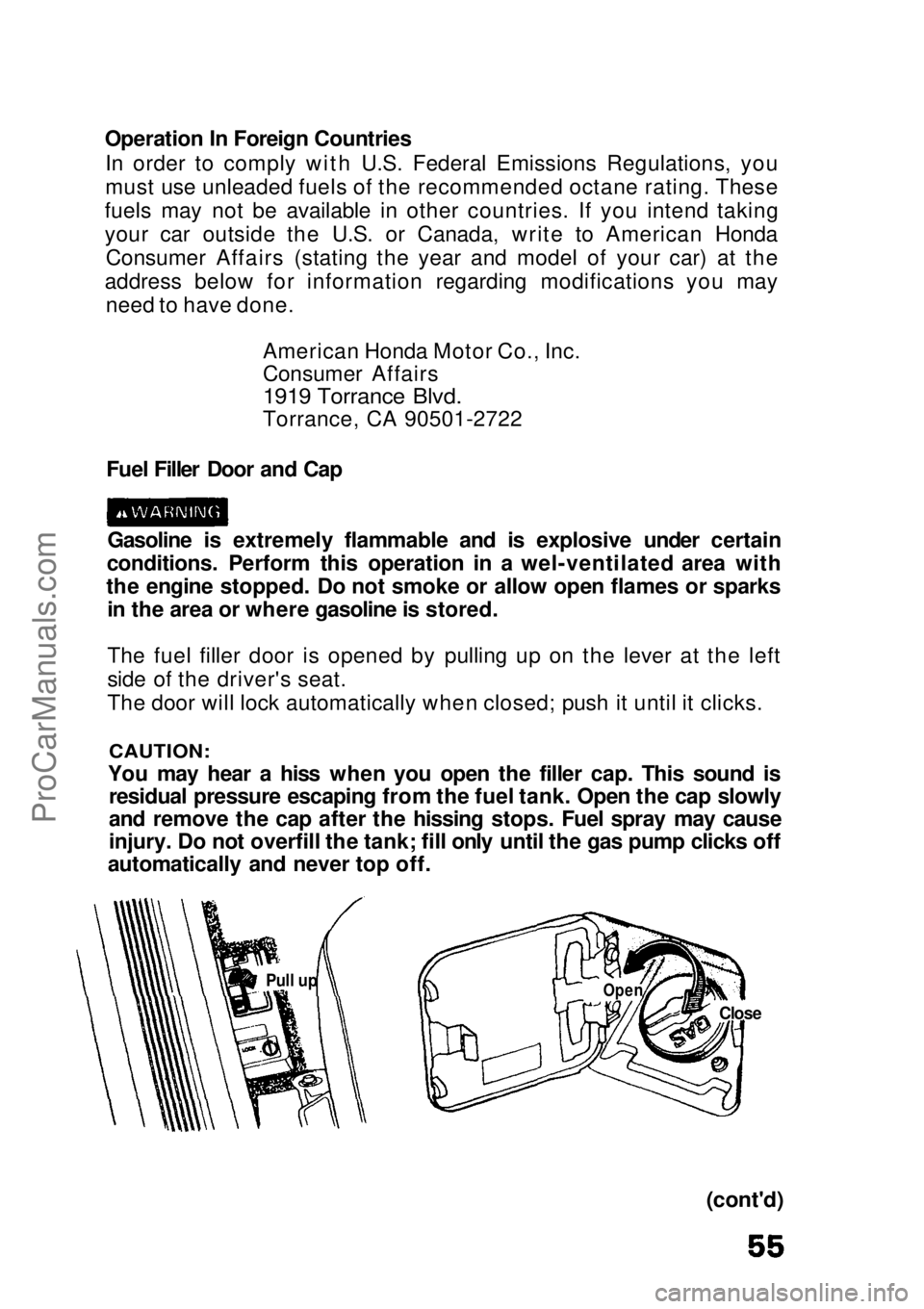
The fuel filler door is opened by pulling up on the lever at the left
side of the driver's seat.
The door will lock automatically when closed; push it until it clicks.
CAUTION:
You may hear a hiss when you open the filler cap. This sound is residual pressure escaping from the fuel tank. Open the cap slowly
and remove the cap after the hissing stops. Fuel spray may cause
injury. Do not overfill the tank; fill only until the gas pump clicks off
automatically and never top off.
(cont'd)
Pull up
Close
OpenProCarManuals.comMain Menu s t
Page 57 of 136
Gasoline (cont'd)
Fuel vapor is extremely hazardous under certain conditions.
Always stop the engine before refueling, and never refuel near
sparks or open flames. CAUTION:
When reinstalling the fuel cap, be sure both tabs on the cap are
engaged in the slots of the filler neck and turn the cap until it stops. If you replace the cap, use only a genuine Honda replacement part
or its equivalent. Failure to use the proper part could cause serious
fuel system problems.
How to Improve Your Gas Mileage: Drive at a smooth, steady pace to avoid unnecessary decele-
rations and stops — accelerating back to speed uses more fuel.Plan trips to avoid rush hour traffic if possible. Make sure the parking brake is completely released.
Consolidate trips whenever possible.
Keep vehicle weight to a minimum by removing unnecessary
items from the luggage area.
Whenever possible, use fresh air from the dash vents to keep
cool when driving; open windows, or use of the optional air
conditioning both affect fuel economy.
Keep the tires adjusted to the recommended pressure.
Tire Pressure (measured cold): STD Hatchback front 240 kPa (35 psi)
rear 220 kPa (32 psi)
DX Hatchback front 220 kPa (32 psi)
rear 220 kPa (32 psi)
Si Hatchback front 195 kPa (28 psi)
rear 195 kPa (28 psi)
DX Sedan front 220 kPa (32 psi)
rear 220 kPa (32 psi)
LX Sedan front 180 kPa (26 psi)
rear 180 kPa (26 psi)
EX Sedan front 180 kPa (26 psi)
rear 180 kPa (26 psi)
Condition of Your Car You can only get maximum fuel economy if your car is in toprunning condition. Have all required maintenance done at the proper
intervals. Check tire pressures and tire wear frequently. If tire wear is uneven, have the alignment checked by your Honda dealer.
Proper alignment saves gasoline and prolongs tire life.ProCarManuals.comMain Menu s t