Page 82 of 136
Cooling System (cont'd)
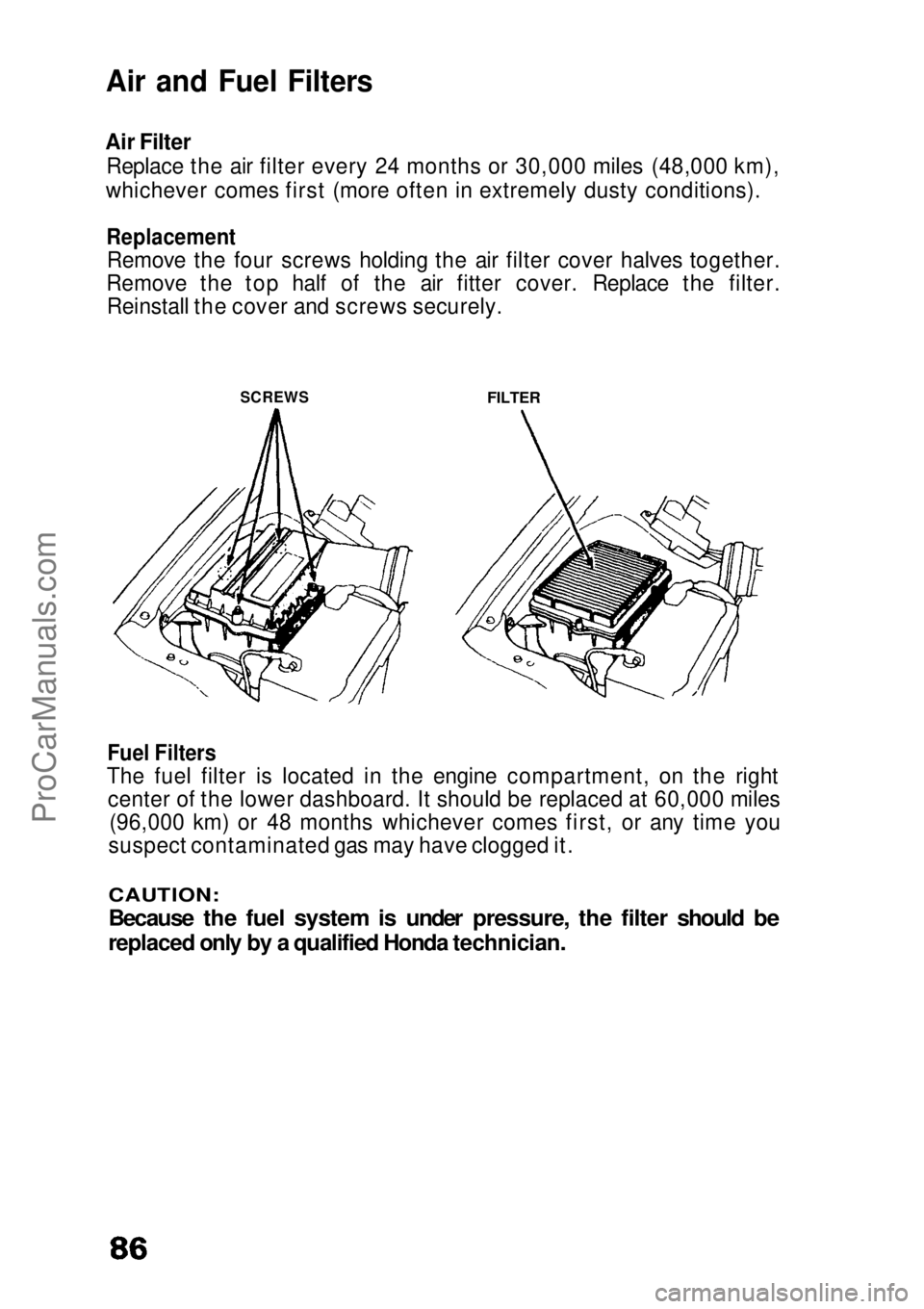
1. Set the heater temperature control dial to maximum heat.
2. Remove the radiator cap, splash shield and drain plug when the radiator is cool, and drain the radiator.
3. Remove the drain bolt from the front side of the cylinder block,and drain the engine and heater.
4. Apply non-hardening sealant to the drain bolt threads, then rein-stall the bolt and tighten it se-
curely.
5. Tighten the radiator drain plug se-
curely.
6. Mix the recommended antifreeze with an equal amount of low-mineral or distilled water and fill
the reservoir to maximum, as illustrated.
7. Loosen the air bleed bolt in the thermostat housing, then fill the radiator to the filler neck with the coolant mixture. Tighten the
bleed bolt as soon as coolant starts to run out in a steady stream
without bubbles.
8. With the radiator cap off, start the engine and let it run until warmed up (fan goes on at least twice). Then, if necessary, addmore coolant mix to bring the level back up to the filler neck.
9. Put the radiator cap on, then run the engine again and check for
leaks.
RADIATOR
CAP
BLEED BOLT
DRAIN BOLT
DRAIN PLUG
Fill to
here
FILLER
NECK
Fill to here
MAXProCarManuals.comMain Menu s t
Page 83 of 136
Brakes
Brake System Design
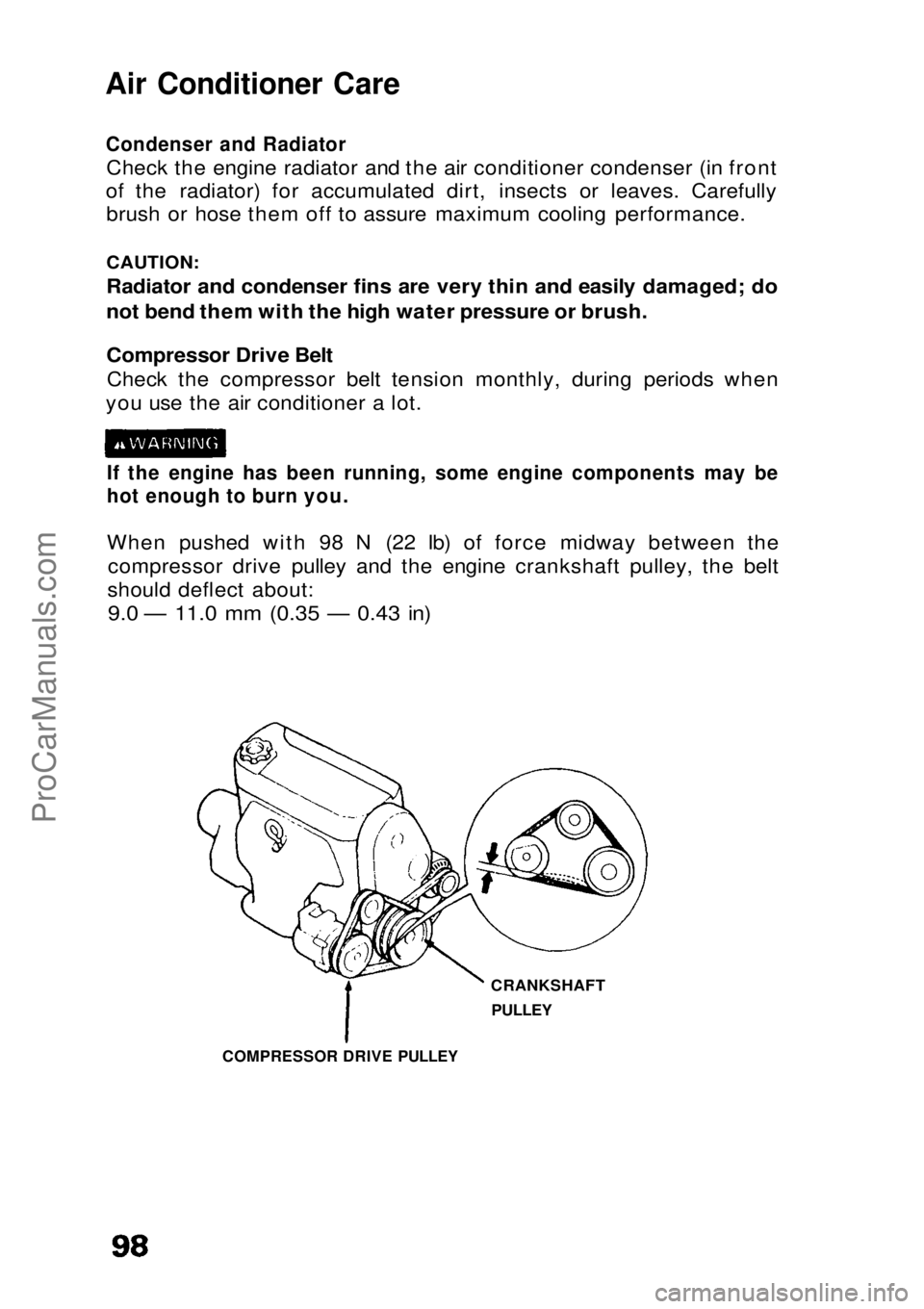
The diagonally-separated dual serv-
ice brake system is designed so half
the system will still provide braking action if the other half fails.
Stopping the car after losing the brake fluid from half the system will
require more pedal pressure and pedal travel than normal. Also, the
distance required to stop will be longer using only half the brake
system. If the brakes fail suddenly, downshift to a lower gear for increased engine braking, and pull off the road as soon as possible.
It is dangerous to drive your car with a problem in either thebrake electrical or hydraulic system; have your dealer check
both systems if you suspect brake trouble.
Driving through deep water may affect the brakes.Check their effectiveness by pressing the brake pedal gently.
If the car does not slow down at the normal rate, continue
gently applying the brakes, while maintaining a safe speed, until
they dry out and normal performance returns. Do not ride the brakes. In other words, don't put your foot on
the brake pedal unless you intend to brake. This causes excessive brake wear and can damage, or lead to loss of braking
effectiveness through overheating. Your brake lights may also
confuse drivers behind you.
Brake Wear Both front and rear brakes should be inspected for wear at the
intervals shown in the Maintenance Schedule on page 70.
When the brakes require maintenance, use only genuine Honda
replacement parts or their equivalent.
(cont'd)ProCarManuals.comMain Menu s t
Page 85 of 136
Power Steering
The Sedan (except DX with manual transmission) and DX Hatch- back with automatic transmission are equipped with power steering.
The power steering on your car provides easy handling while parking and maneuvering in traffic, without loss of road "feel" at
highway speeds. An engine-driven hydraulic pump provides full
power assist at low speeds and decreasing assist as the car goes
faster.
CAUTION:
If the power steering system should fail, or if the engine should
stall, the car can still be steered. However, much greater effort
will be required, particularly in sharp turns at low speed.
NOTE:
You may feel a slight clunk or knock when turning the wheel with
the engine off. This is a normal condition due to the design of the
system.
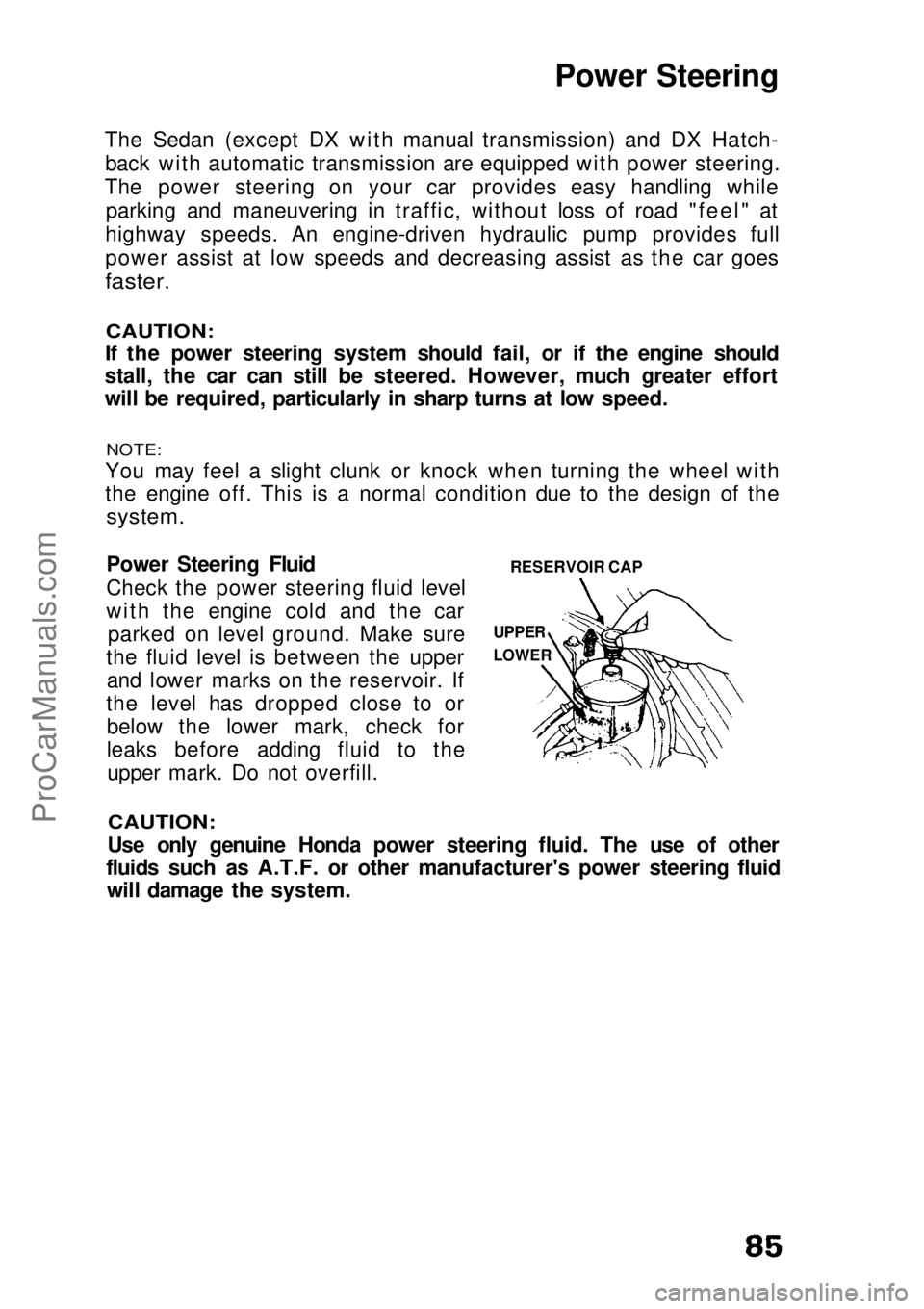
RESERVOIR CAP
UPPER
LOWER
Power Steering Fluid
Check the power steering fluid level
with the engine cold and the car
parked on level ground. Make sure
the fluid level is between the upper and lower marks on the reservoir. If
the level has dropped close to or below the lower mark, check for
leaks before adding fluid to theupper mark. Do not overfill.
CAUTION:
Use only genuine Honda power steering fluid. The use of other
fluids such as A.T.F. or other manufacturer's power steering fluid will damage the system.ProCarManuals.comMain Menu s t
Page 86 of 136
Air and Fuel Filters
Air Filter Replace the air filter every 24 months or 30,000 miles (48,000 km),
whichever comes first (more often in extremely dusty conditions).
Replacement
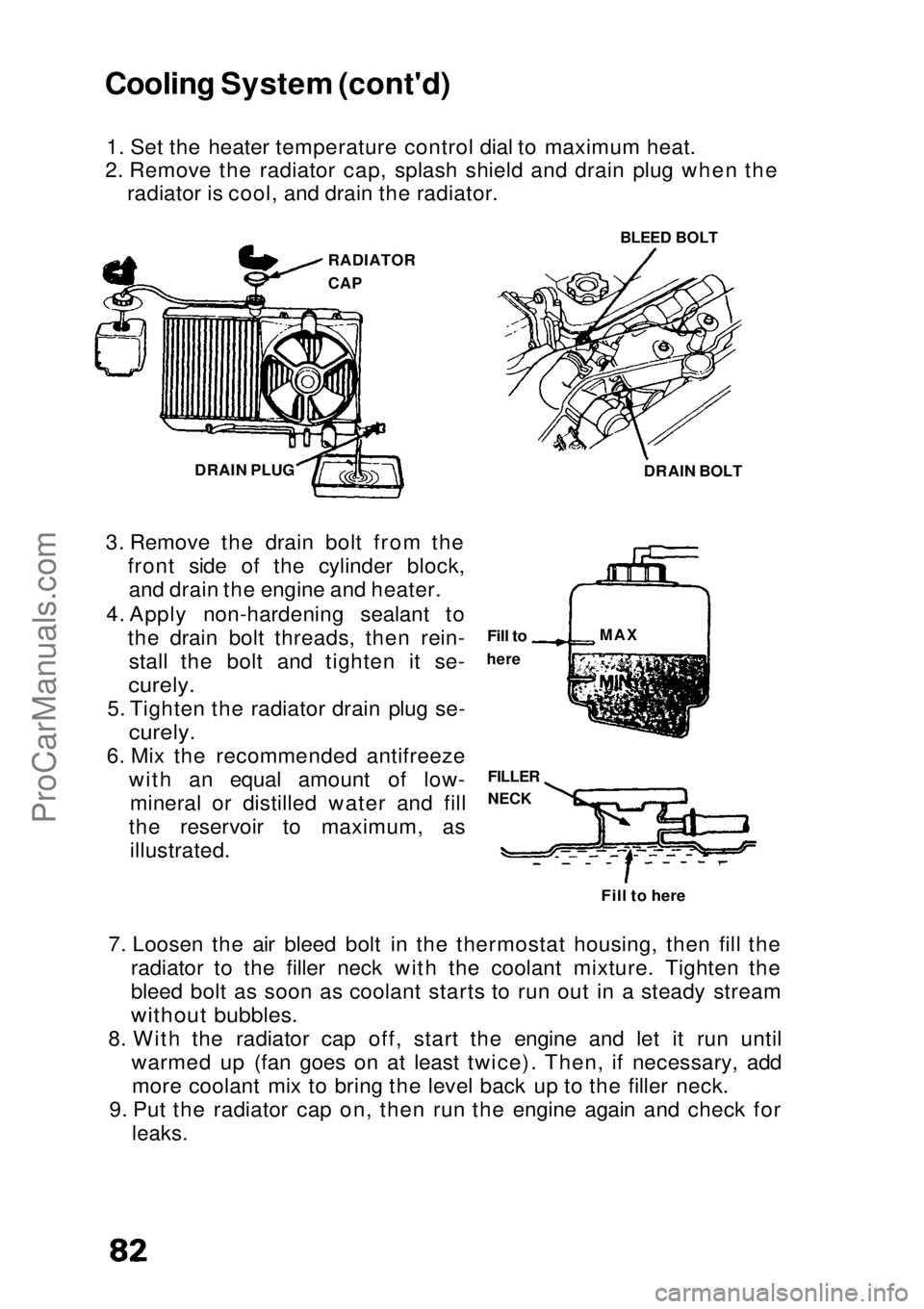
Remove the four screws holding the air filter cover halves together.
Remove the top half of the air fitter cover. Replace the filter. Reinstall the cover and screws securely.
SCREWS
FILTER
Fuel Filters
The fuel filter is located in the engine compartment, on the right center of the lower dashboard. It should be replaced at 60,000 miles (96,000 km) or 48 months whichever comes first, or any time you
suspect contaminated gas may have clogged it.
CAUTION:
Because the fuel system is under pressure, the filter should be
replaced only by a qualified Honda technician.ProCarManuals.comMain Menu s t
Page 87 of 136
Spark Plugs
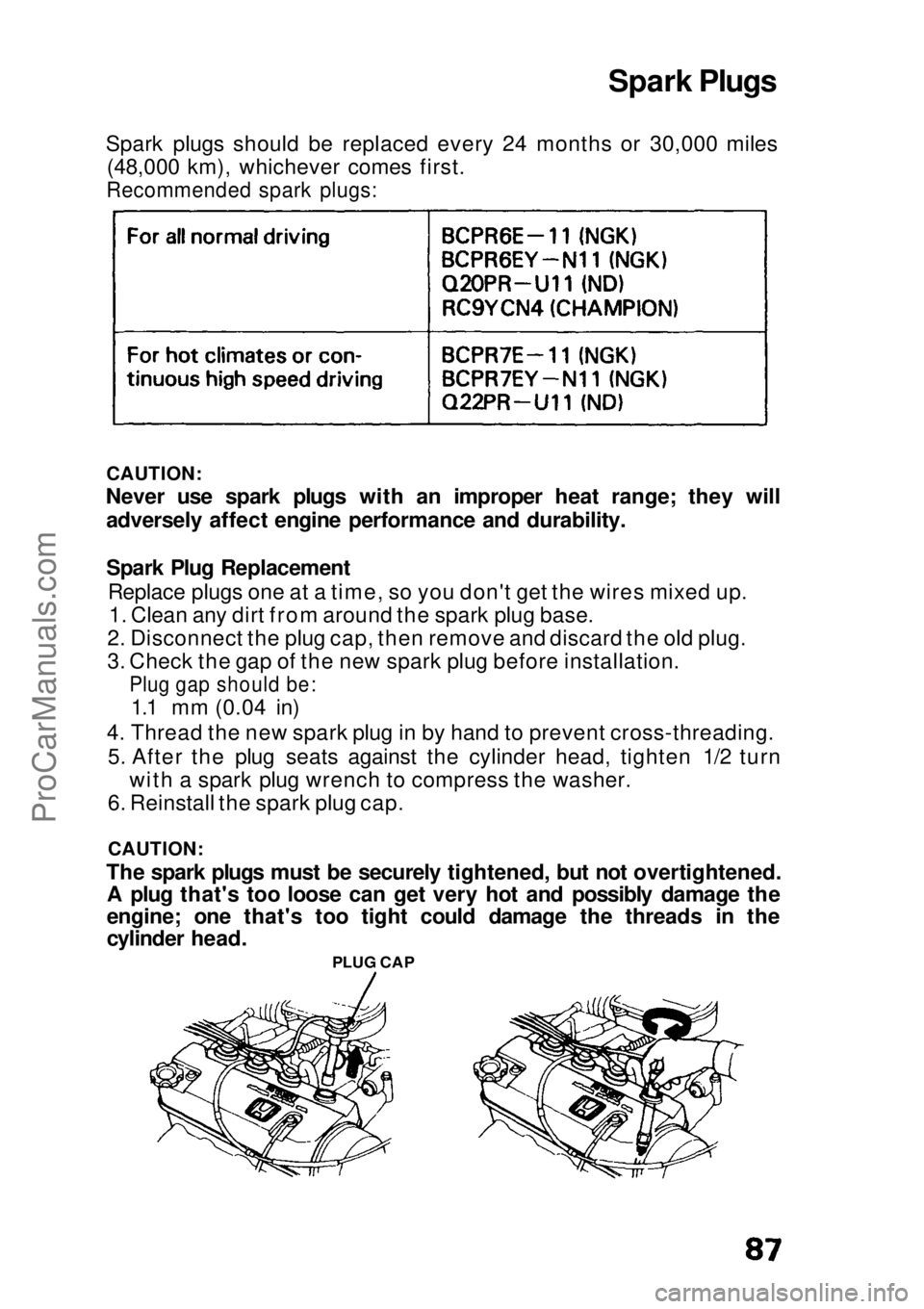
Spark plugs should be replaced every 24 months or 30,000 miles (48,000 km), whichever comes first.
Recommended spark plugs:
CAUTION:
Never use spark plugs with an improper heat range; they will adversely affect engine performance and durability.
Spark Plug Replacement
Replace plugs one at a time, so you don't get the wires mixed up.1. Clean any dirt from around the spark plug base.
2. Disconnect the plug cap, then remove and discard the old plug.
3. Check the gap of the new spark plug before installation.
Plug gap should be:
1.1 mm (0.04 in)
4. Thread the new spark plug in by hand to prevent cross-threading. 5. After the plug seats against the cylinder head, tighten 1/2 turn with a spark plug wrench to compress the washer.
6. Reinstall the spark plug cap.
CAUTION:
The spark plugs must be securely tightened, but not overtightened. A plug that's too loose can get very hot and possibly damage the
engine; one that's too tight could damage the threads in the
cylinder head. PLUG CAPProCarManuals.comMain Menu s t
Page 98 of 136
Air Conditioner Care
Condenser and Radiator
Check the engine radiator and the air conditioner condenser (in front
of the radiator) for accumulated dirt, insects or leaves. Carefully brush or hose them off to assure maximum cooling performance.
CAUTION:
Radiator and condenser fins are very thin and easily damaged; do
not bend them with the high water pressure or brush.
Compressor Drive Belt
Check the compressor belt tension monthly, during periods when
you use the air conditioner a lot.
If the engine has been running, some engine components may be
hot enough to burn you.
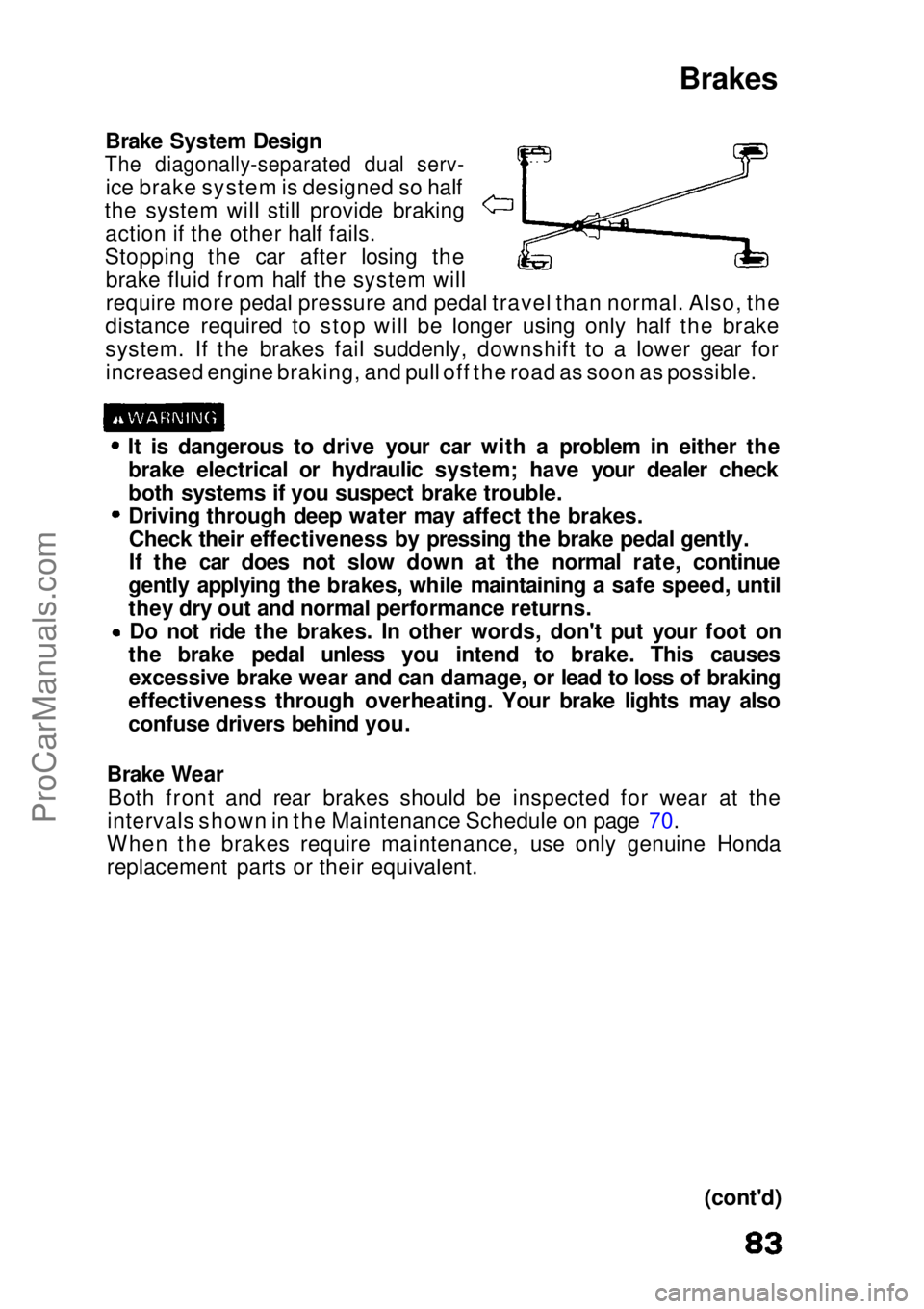
When pushed with 98 N (22 Ib) of force midway between thecompressor drive pulley and the engine crankshaft pulley, the belt
should deflect about:
9.0 — 11.0 mm (0.35 — 0.43 in)
CRANKSHAFTPULLEY
COMPRESSOR DRIVE PULLEYProCarManuals.comMain Menu s t
Page 106 of 136
Changing a Flat Tire
Do not attempt to change a tire unless the car is on firm, level
ground and well out of the flow of traffic.
Park the car on a firm, level surface, apply the parking brake, turn
on the hazard warning switch and put the transmission in gear (Park
for automatic).
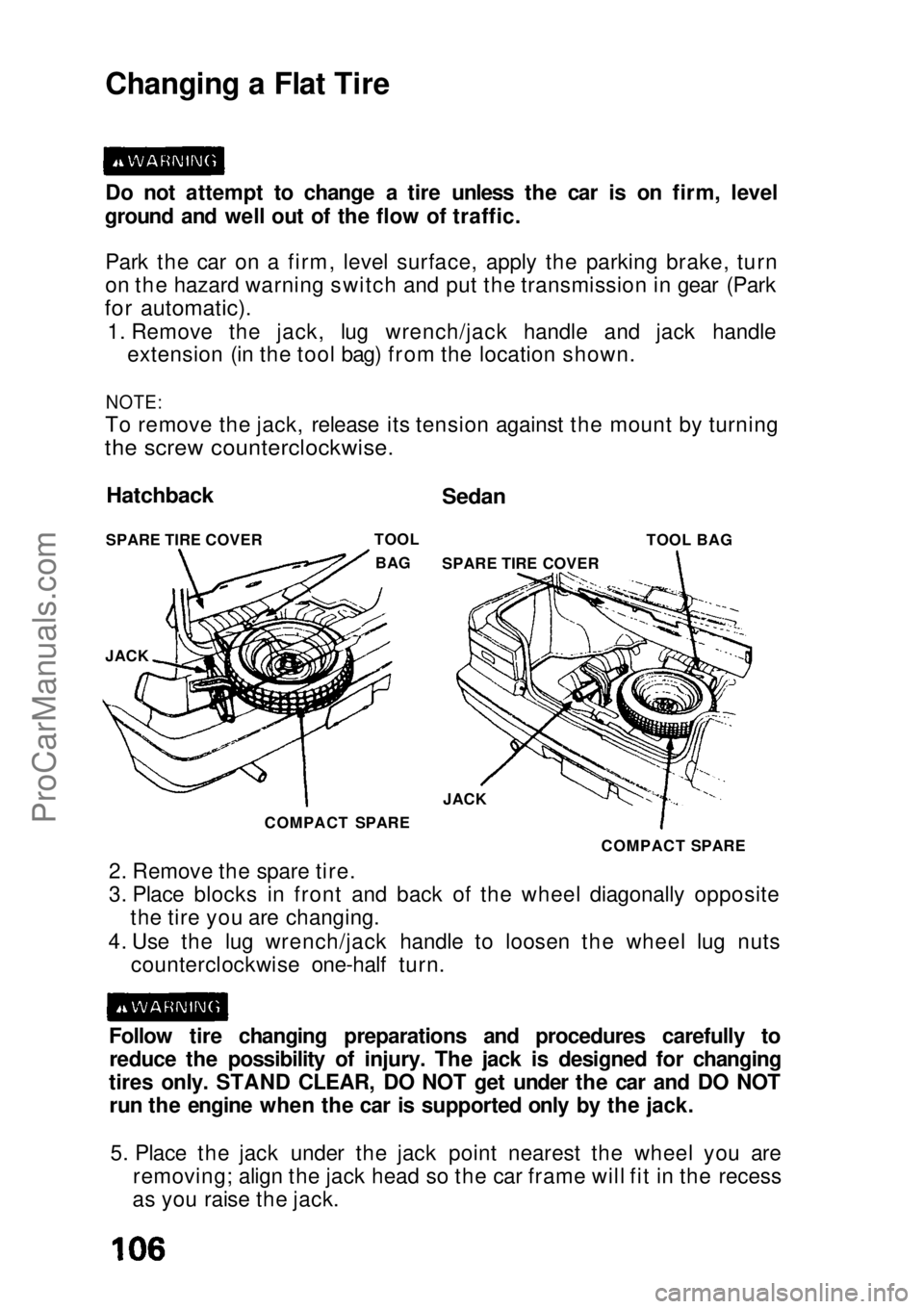
1. Remove the jack, lug wrench/jack handle and jack handle extension (in the tool bag) from the location shown.
NOTE:
To remove the jack, release its tension against the mount by turning
the screw counterclockwise.
JACK TOOL BAG
Follow tire changing preparations and procedures carefully to reduce the possibility of injury. The jack is designed for changing
tires only. STAND CLEAR, DO NOT get under the car and DO NOT run the engine when the car is supported only by the jack.
5. Place the jack under the jack point nearest the wheel you are removing; align the jack head so the car frame will fit in the recess
as you raise the jack.
Hatchback
SPARE TIRE COVER
Sedan
TOOL BAG SPARE TIRE COVER
JACK
COMPACT SPARE COMPACT SPARE
2. Remove the spare tire.
3. Place blocks in front and back of the wheel diagonally opposite the tire you are changing.
4. Use the lug wrench/jack handle to loosen the wheel lug nuts counterclockwise one-half turn.ProCarManuals.comMain Menu s t
Page 110 of 136
Jump Starting
To start a car with a dead battery, use another battery of the samevoltage, and the proper jumper cables.
Procedures other than those below could cause injury or
damage from battery acid spray, explosion or charging system
overload.
Never connect the jumper cable directly to the negative post of
the "dead" battery.
Never allow the two cars to touch each other. Never allow the jumper cable clamps to touch each other.
Never lean over the battery when making connections.
Never attempt to jump start a vehicle with a frozen battery. The
battery could rupture and explode. If you suspect a frozenbattery, remove the vent caps and check the fluid. If there
seems to be no fluid, or if you see ice, do not attempt a jump
start until the fluid thaws.
CAUTION:
If jumper cables are connected backwards, the car's main fuse
may blow.
1.Turn off all lights, heater and other electrical loads, set parking brake, and shift the transmission to Neutral or Park.
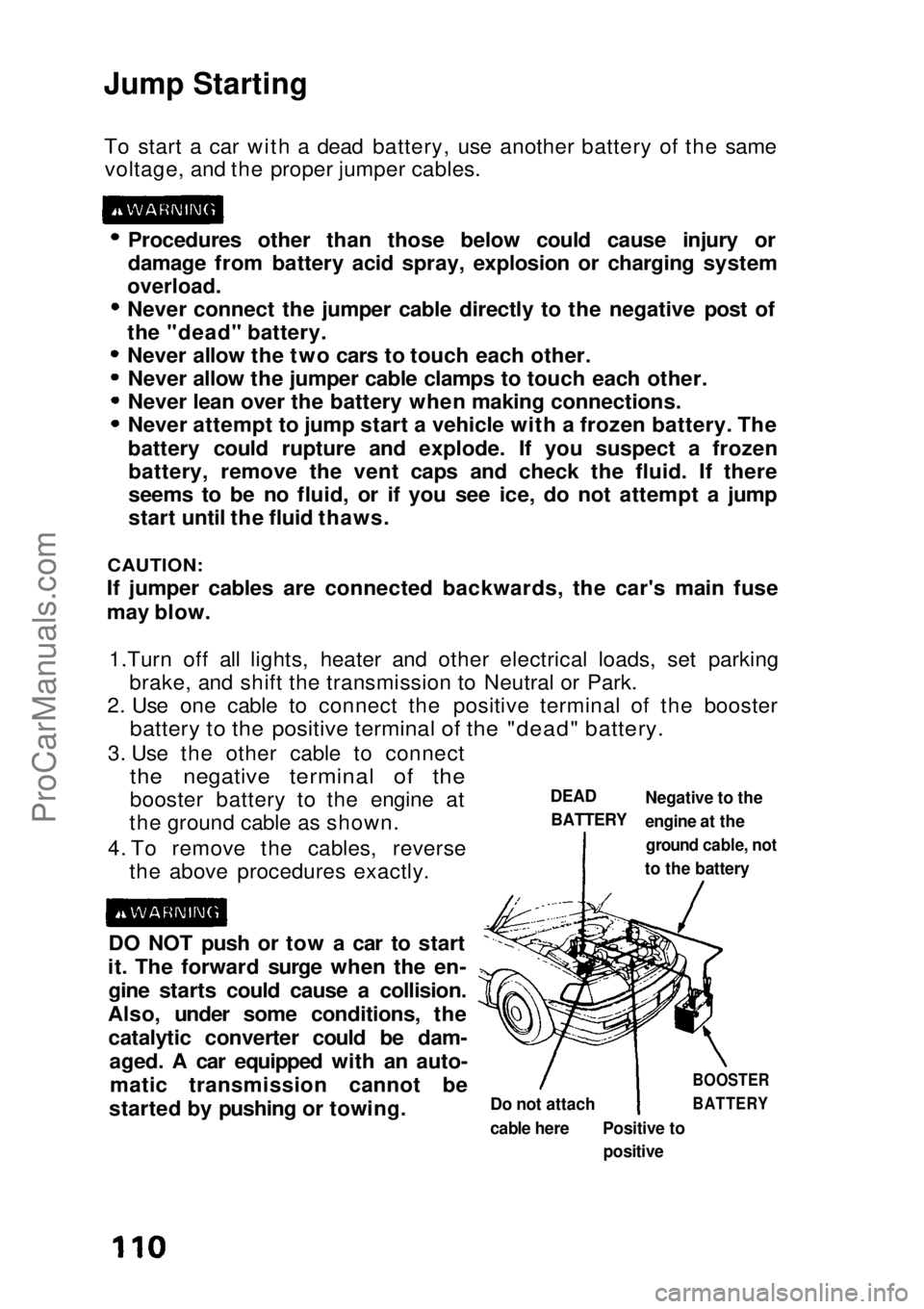
2. Use one cable to connect the positive terminal of the booster
battery to the positive terminal of the "dead" battery.
3. Use the other cable to connect
the negative terminal of the
booster battery to the engine at
the ground cable as shown.
4. To remove the cables, reverse the above procedures exactly.
DO NOT push or tow a car to start
it. The forward surge when the en- gine starts could cause a collision.
Also, under some conditions, the catalytic converter could be dam- aged. A car equipped with an auto-matic transmission cannot be
started by pushing or towing.
DEAD
BATTERY
Negative to the
engine at the
ground cable, not
to the battery
Do not attach
cable here
Positive to
positive
BOOSTER
BATTERYProCarManuals.comMain Menu s t