Page 14 of 136
Never use one belt for more than one person, child or adult.
Comfort clips sold on the open market are not recommended
since they could impair the function and safety of the belts. Make sure the strap of the shoulder belt and the lap belt are not
crossed.
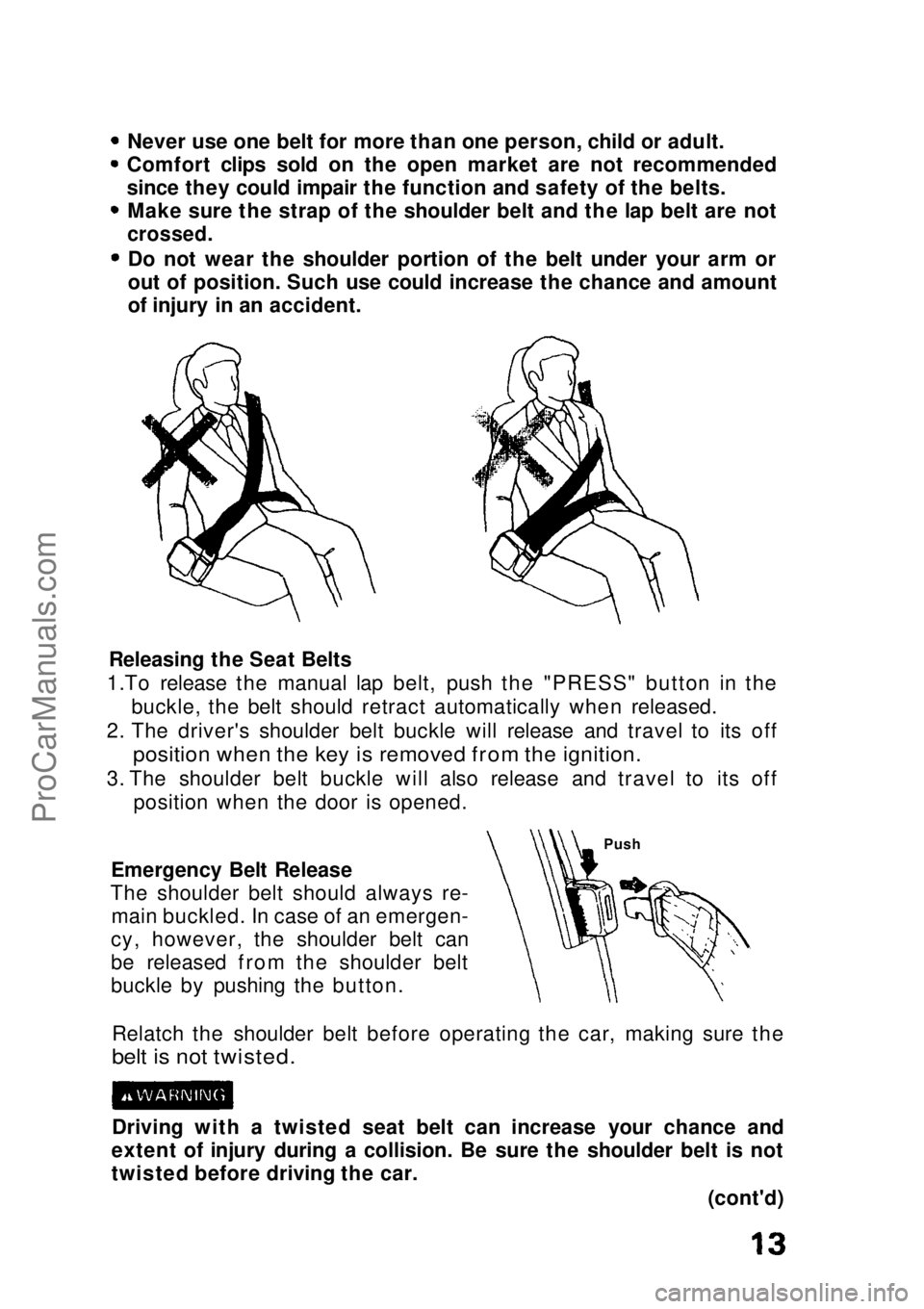
Do not wear the shoulder portion of the belt under your arm or
out of position. Such use could increase the chance and amount
of injury in an accident.
Releasing the Seat Belts
1.To release the manual lap belt, push the "PRESS" button in the buckle, the belt should retract automatically when released.
2. The driver's shoulder belt buckle will release and travel to its off
position when the key is removed from the ignition.
3. The shoulder belt buckle will also release and travel to its off position when the door is opened.
Emergency Belt Release
The shoulder belt should always re- main buckled. In case of an emergen-
cy, however, the shoulder belt can
be released from the shoulder belt
buckle by pushing the button.
Relatch the shoulder belt before operating the car, making sure the
belt is not twisted.
Driving with a twisted seat belt can increase your chance and
extent of injury during a collision. Be sure the shoulder belt is not
twisted before driving the car. Push
(cont'd)ProCarManuals.comMain Menu s t
Page 15 of 136
Seat Belts (cont'd)
Fasten Seat Belt Warning Light and Warning Beeper
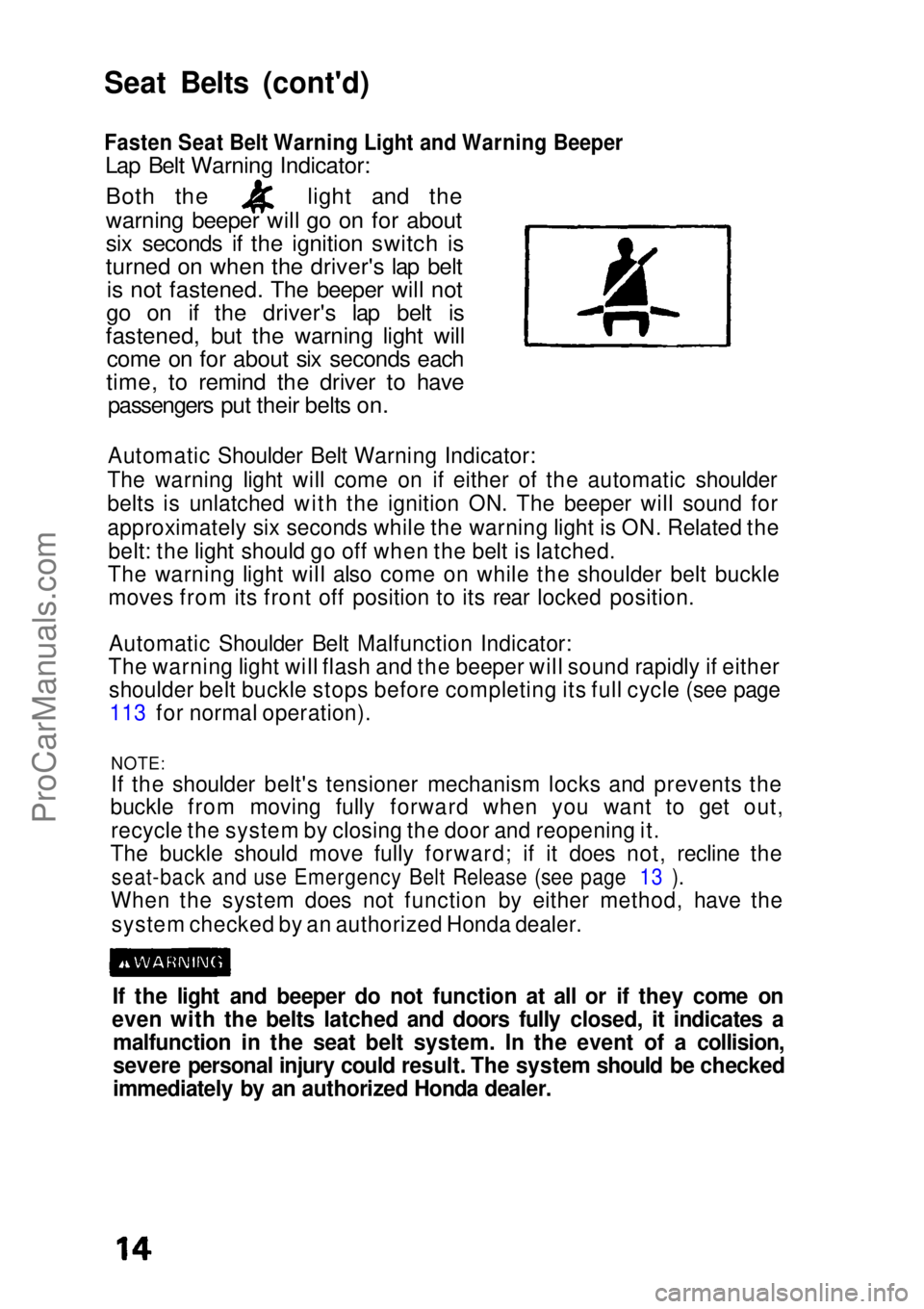
Lap Belt Warning Indicator: Both the light and the
warning beeper will go on for about
six seconds if the ignition switch is
turned on when the driver's lap belt
is not fastened. The beeper will not
go on if the driver's lap belt is
fastened, but the warning light will come on for about six seconds each
time, to remind the driver to have passengers put their belts on.
Automatic Shoulder Belt Warning Indicator:
The warning light will come on if either of the automatic shoulder
belts is unlatched with the ignition ON. The beeper will sound for
approximately six seconds while the warning light is ON. Related the belt: the light should go off when the belt is latched.
The warning light will also come on while the shoulder belt buckle moves from its front off position to its rear locked position.
Automatic Shoulder Belt Malfunction Indicator:
The warning light will flash and the beeper will sound rapidly if either shoulder belt buckle stops before completing its full cycle (see page113 for normal operation).
NOTE:
If the shoulder belt's tensioner mechanism locks and prevents the
buckle from moving fully forward when you want to get out,
recycle the system by closing the door and reopening it.
The buckle should move fully forward; if it does not, recline the
seat-back and use Emergency Belt Release (see page 13 ).
When the system does not function by either method, have the
system checked by an authorized Honda dealer.
If the light and beeper do not function at all or if they come on
even with the belts latched and doors fully closed, it indicates a malfunction in the seat belt system. In the event of a collision,
severe personal injury could result. The system should be checked
immediately by an authorized Honda dealer.ProCarManuals.comMain Menu s t
Page 16 of 136
![HONDA CIVIC 1991 Owners Manual [Hatchback]
Wearing the Front Seat Berts The automatic ("passive") lap/shoulder belt systems with emer-
gency locking retractors are designed to lock only during a suddenstop or impact. Other](/manual-img/13/57901/w960_57901-15.png "HONDA CIVIC 1991 Owners Manual [Hatchback]
Wearing the Front Seat Berts The automatic (\"passive\") lap/shoulder belt systems with emer-
gency locking retractors are designed to lock only during a suddenstop or impact. Other")
[Hatchback]
Wearing the Front Seat Berts The automatic ("passive") lap/shoulder belt systems with emer-
gency locking retractors are designed to lock only during a suddenstop or impact. Otherwise, they allow you some freedom of move-ment in the seat. The lap/shoulder belt must remain permanently
latched.
NOTE:
The motion sensing lock mechanisms for the front belts are located in each door. Therefore, if a door is opened too quickly, the belt may
lock and the door cannot be opened further. If this happens, close
the door and open it again more slowly. Enter the car and close the door completely.
If a door is not completely closed, the warning lights in the ceiling
and in the instrument panel will come on and the beeper will
sound when the ignition switch is turned on (see page 17).
The driver's seat should be moved to a comfortable distance from
the steering wheel. Sit straight up and well back in the seat.
The seat belt should fit snugly against your body. The shoulder portion of the belt should go over your shoulder and across your
body to evenly distribute the belt's restraining force. Check that the lap portion of the belt is positioned low on your
hipbone and below your abdomen. This way, if the car is involved
in an accident, you will be less likely to slide under the seat belts.
If the belt is too near your neck and throat, move toward the
center of the seat.
Never drive the car with the doors ajar. The front doors must be
closed completely for the front seat belts to function properly.
(cont'd)ProCarManuals.comMain Menu s t
Page 17 of 136
Seat Belts (cont'd)
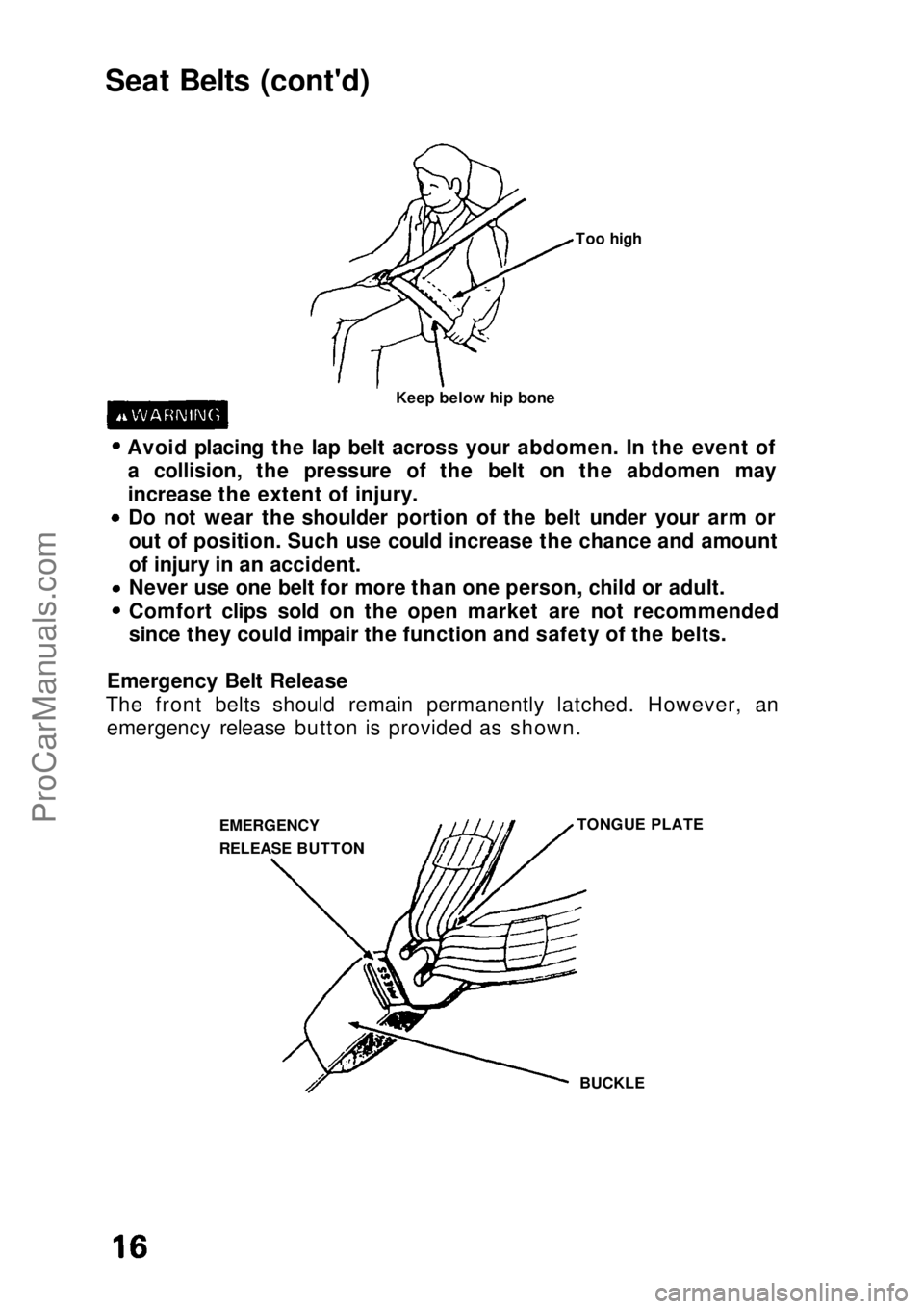
Avoid placing the lap belt across your abdomen. In the event ofa collision, the pressure of the belt on the abdomen may
increase the extent of injury. Do not wear the shoulder portion of the belt under your arm or
out of position. Such use could increase the chance and amount
of injury in an accident.
Never use one belt for more than one person, child or adult. Comfort clips sold on the open market are not recommended
since they could impair the function and safety of the belts.
Emergency Belt Release
The front belts should remain permanently latched. However, an emergency release button is provided as shown.
EMERGENCY
RELEASE BUTTON TONGUE PLATE
BUCKLE
Too high
Keep below hip boneProCarManuals.comMain Menu s t
Page 18 of 136
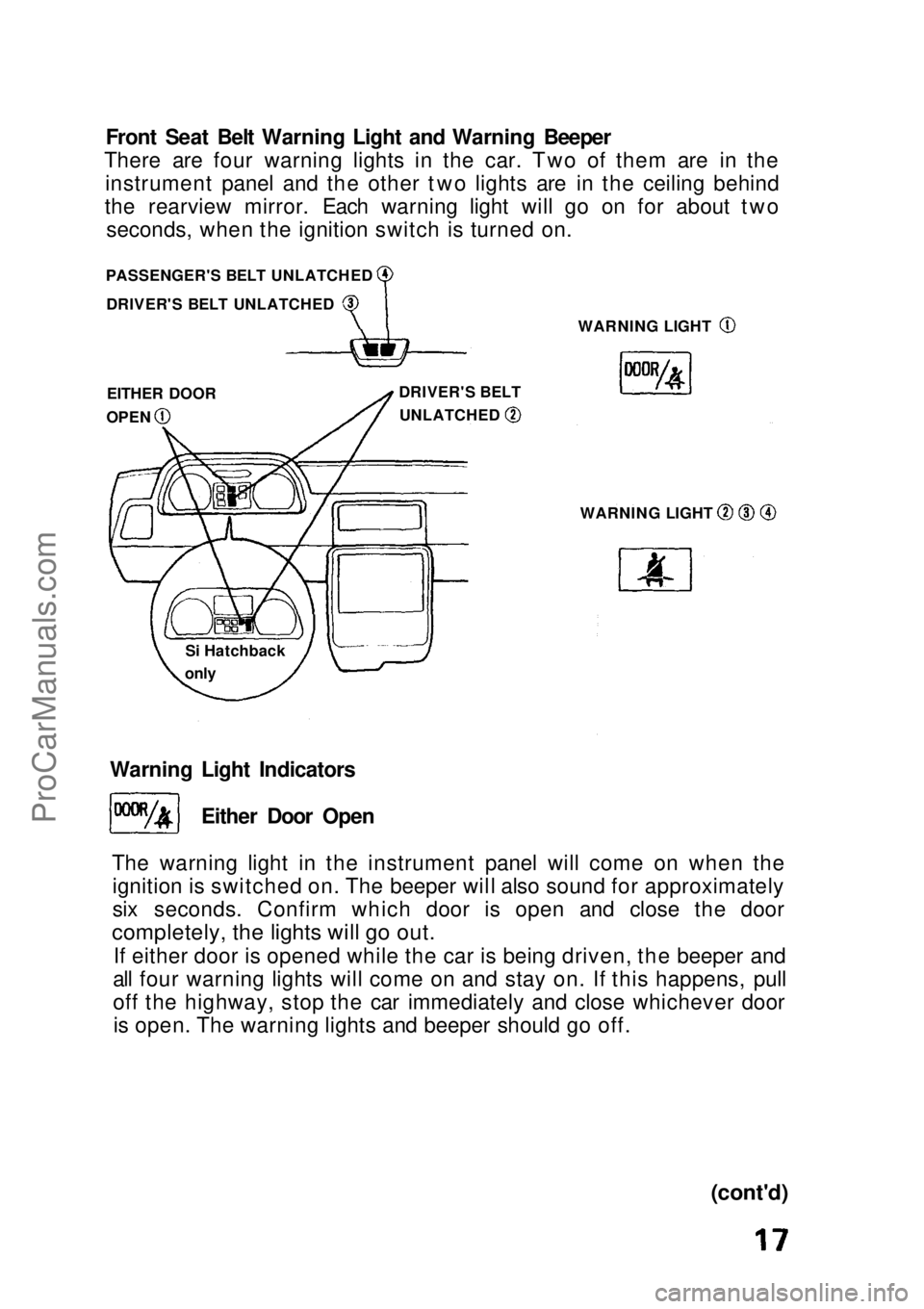
Front Seat Belt Warning Light and Warning Beeper
There are four warning lights in the car. Two of them are in the instrument panel and the other two lights are in the ceiling behind
the rearview mirror. Each warning light will go on for about two seconds, when the ignition switch is turned on.
Warning Light Indicators Either Door Open
The warning light in the instrument panel will come on when the ignition is switched on. The beeper will also sound for approximately
six seconds. Confirm which door is open and close the door
completely, the lights will go out.
If either door is opened while the car is being driven, the beeper and
all four warning lights will come on and stay on. If this happens, pull
off the highway, stop the car immediately and close whichever door is open. The warning lights and beeper should go off.
(cont'd)
PASSENGER'S BELT UNLATCHED
DRIVER'S BELT UNLATCHED WARNING LIGHT
DRIVER'S BELT UNLATCHED
EITHER DOOR
OPEN
WARNING LIGHT
Si Hatchback
onlyProCarManuals.comMain Menu s t
Page 19 of 136
Seat Belts (cont'd)
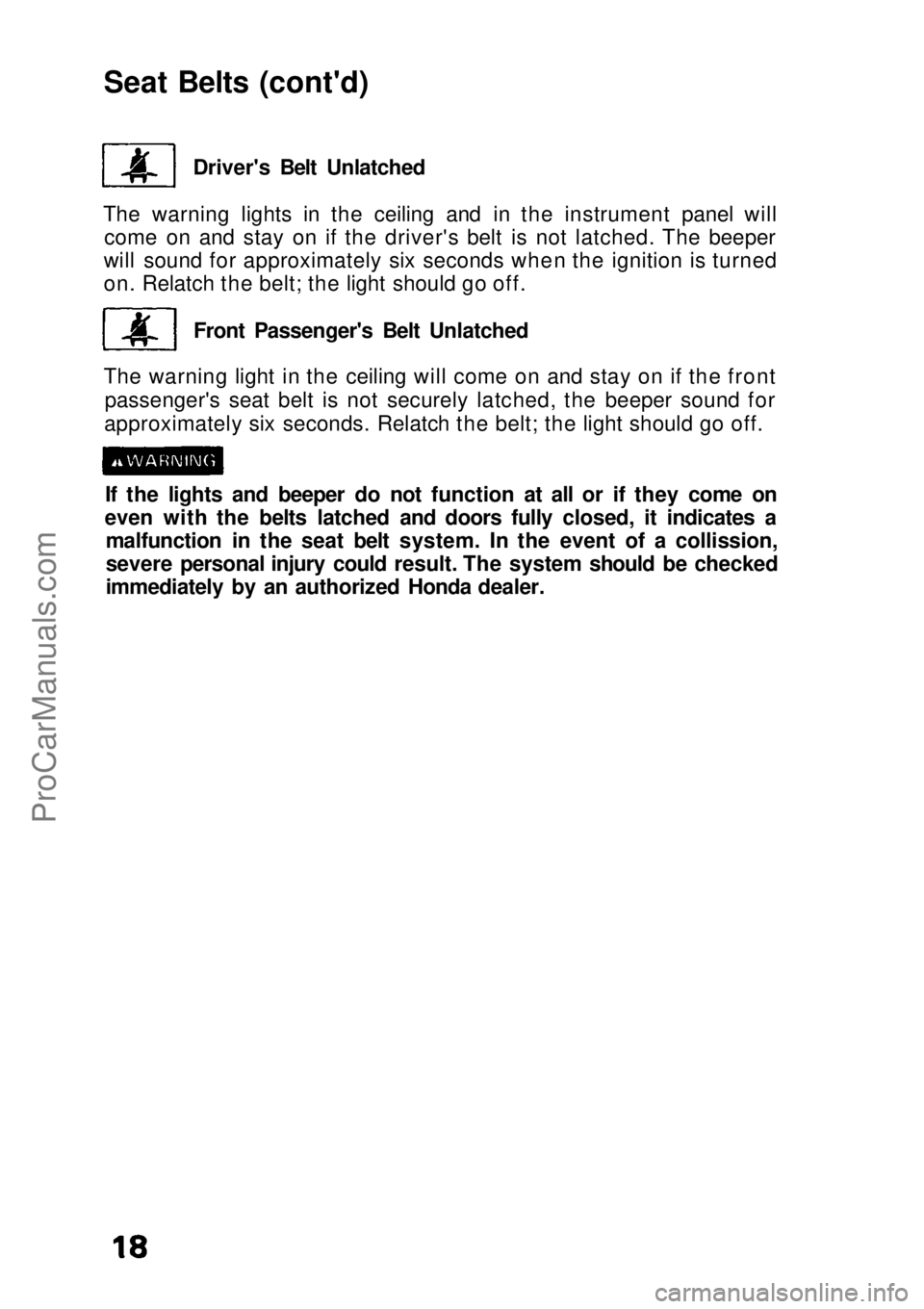
Driver's Belt Unlatched
The warning lights in the ceiling and in the instrument panel will come on and stay on if the driver's belt is not latched. The beeper
will sound for approximately six seconds when the ignition is turned
on. Relatch the belt; the light should go off.
Front Passenger's Belt Unlatched
The warning light in the ceiling will come on and stay on if the front passenger's seat belt is not securely latched, the beeper sound for
approximately six seconds. Relatch the belt; the light should go off.
If the lights and beeper do not function at all or if they come on
even with the belts latched and doors fully closed, it indicates a malfunction in the seat belt system. In the event of a collission,
severe personal injury could result. The system should be checked
immediately by an authorized Honda dealer.ProCarManuals.comMain Menu s t
Page 20 of 136
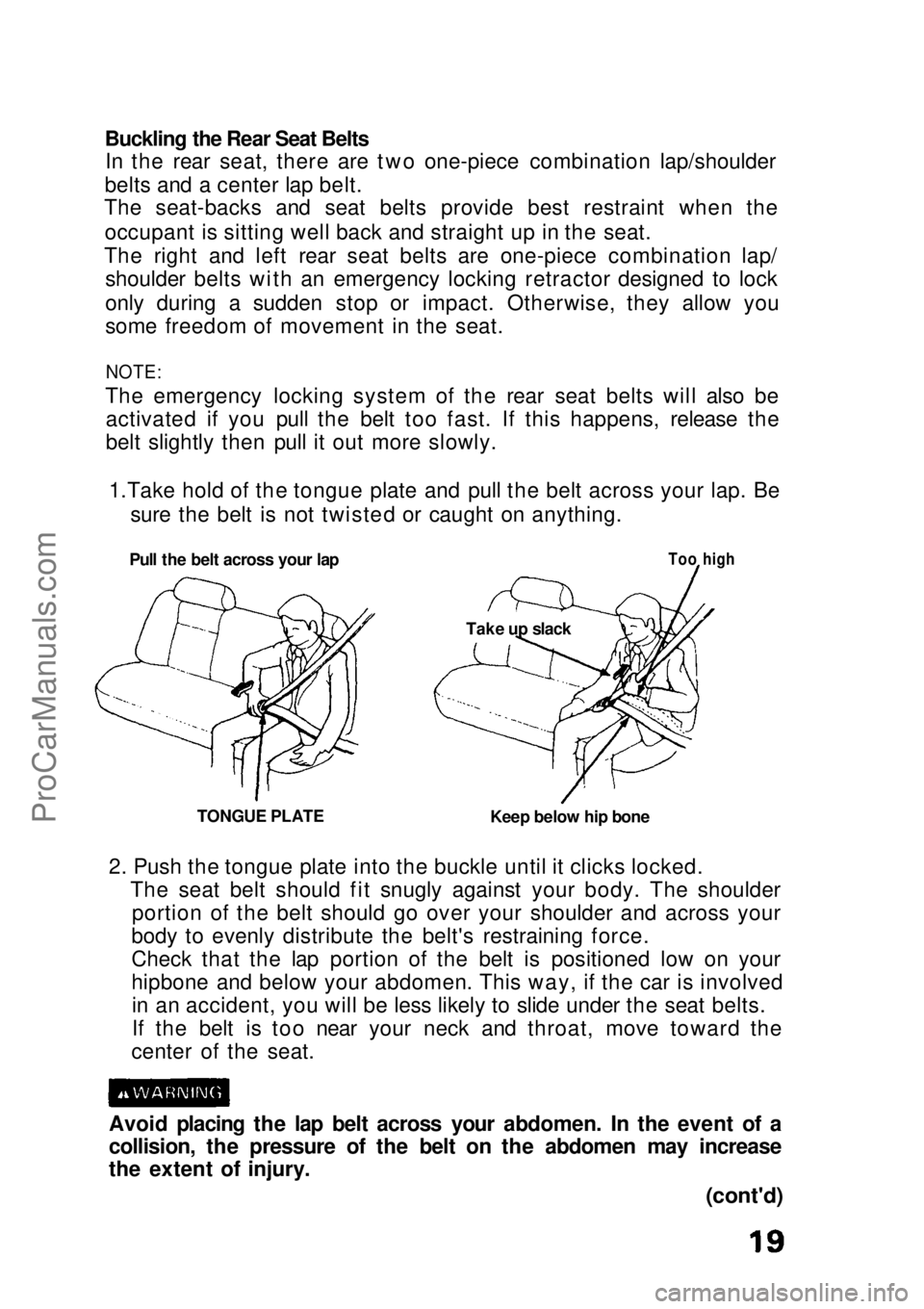
Buckling the Rear Seat Belts
In the rear seat, there are two one-piece combination lap/shoulder
belts and a center lap belt.
The seat-backs and seat belts provide best restraint when the
occupant is sitting well back and straight up in the seat.
The right and left rear seat belts are one-piece combination lap/ shoulder belts with an emergency locking retractor designed to lock
only during a sudden stop or impact. Otherwise, they allow you
some freedom of movement in the seat.
NOTE:
The emergency locking system of the rear seat belts will also be activated if you pull the belt too fast. If this happens, release the
belt slightly then pull it out more slowly.
1.Take hold of the tongue plate and pull the belt across your lap. Be sure the belt is not twisted or caught on anything.
2. Push the tongue plate into the buckle until it clicks locked. The seat belt should fit snugly against your body. The shoulderportion of the belt should go over your shoulder and across your
body to evenly distribute the belt's restraining force.
Check that the lap portion of the belt is positioned low on your
hipbone and below your abdomen. This way, if the car is involved in an accident, you will be less likely to slide under the seat belts.
If the belt is too near your neck and throat, move toward the
center of the seat.
Avoid placing the lap belt across your abdomen. In the event of a
collision, the pressure of the belt on the abdomen may increase
the extent of injury.
(cont'd)
Pull the belt across your lap
TONGUE PLATE
Too high
Take up slack
Keep below hip bone
ProCarManuals.comMain Menu s t
Page 21 of 136
Seat Belts (cont'd)
3. To release the seat belt, push the "PRESS" button in the buckle;
the belt
should retract automatically when released. If the belt
does not fully retract, pull it out and check for kinks or twists.
CAUTION:
Make sure both rear shoulder belts are positioned in front of the rear seat-backs whenever the seat-backs are in their upright
position.
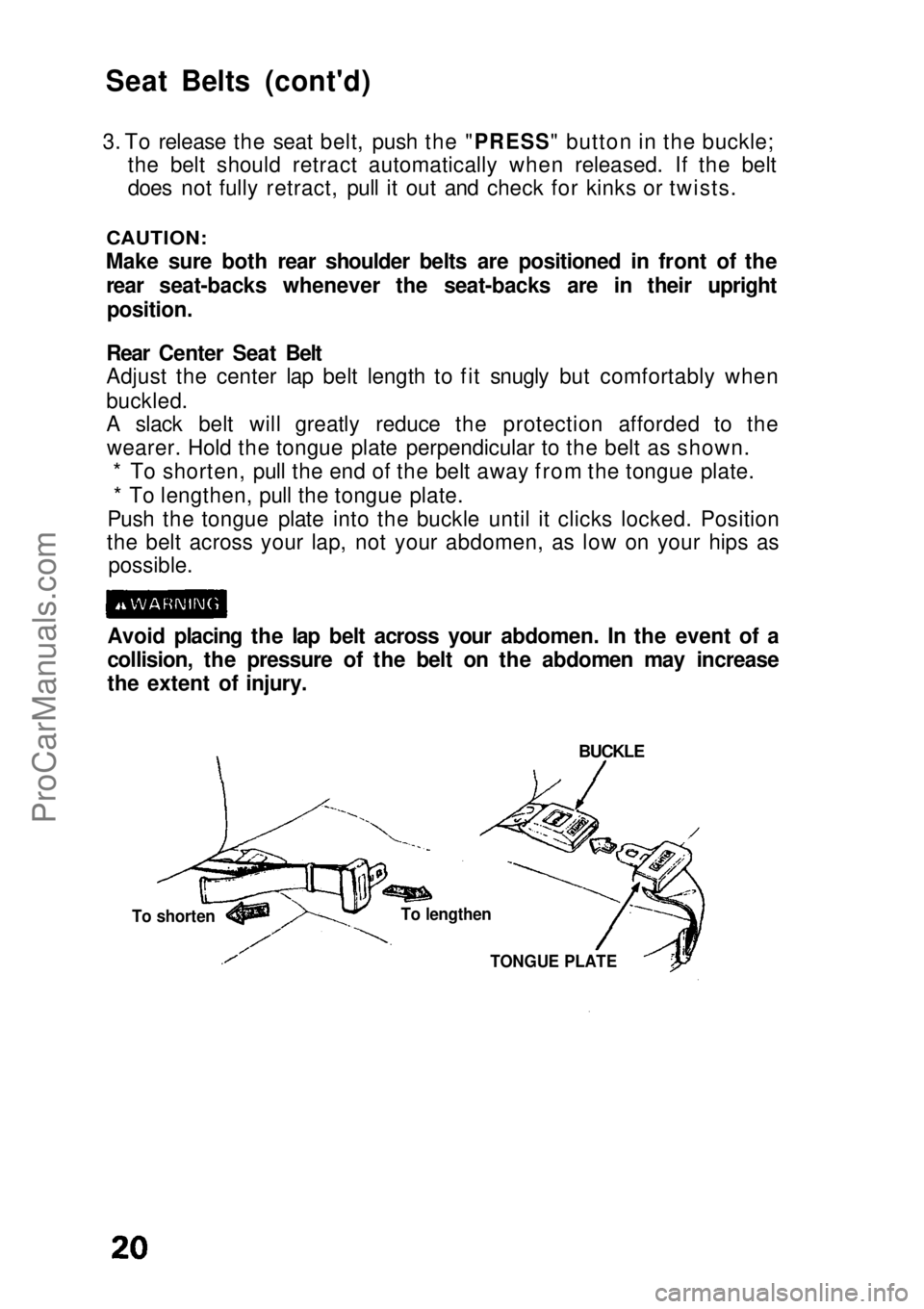
Rear Center Seat Belt
Adjust the center lap belt length to fit snugly but comfortably when
buckled.
A slack belt will greatly reduce the protection afforded to the wearer. Hold the tongue plate perpendicular to the belt as shown. * To shorten, pull the end of the belt away from the tongue plate.
* To lengthen, pull the tongue plate.
Push the tongue plate into the buckle until it clicks locked. Position
the belt across your lap, not your abdomen, as low on your hips as possible.
Avoid placing the lap belt across your abdomen. In the event of a
collision, the pressure of the belt on the abdomen may increase
the extent of injury.
BUCKLE
To lengthen
To shorten
TONGUE PLATEProCarManuals.comMain Menu s t