Page 22 of 136
Child Restraint
Children riding in the car should be restrained to minimize the risk of
injury in an accident, sudden stop or sudden maneuver.
According to accident statistics provided to the National Highway
Traffic Safety Administration (NHTSA), children are safer when
properly restrained in the rear seating positions than in the front
seat.
For smaller children, we strongly recommend the use of a
commercially available child restraint system that meets the Federal
Motor Vehicle Safety Standard (FMVSS) because it offers the most
protection against injury. All states now have laws which require
that small children must be seated in a child passenger seat restraint
system. Check local laws.
Before buying a particular child restraint system, make sure it fits
your car seat and seat belts, and fits your child. Follow the child seat manufacturer's instructions when installing the seat.
Children who have outgrown the child restraint system should useone of the seat belts.
Make sure the belt is snug against the child's body with the
shoulder portion going over the shoulder and across the body to
evenly distribute the belt's restraining force.
Check that the lap portion of the belt is positioned low on the
child's hipbone and below the abdomen.
This way if the car is involved in an accident, the child would be less likely to slide under the seat belts. If the belt is too close to the child's neck or throat, you may want
to consider putting the child in an automobile booster seat that meets the Federal Motor Vehicle Safety Standard (FMVSS).
Children should never ride unrestrained in an automobile.
Never use an infant carrier or child safety seat that "hooks"
over a seat-back; it may not provide adequate security in an
accident. Never allow a child to be held in a person's arms while they are
in a moving vehicle. Holding a child in a moving vehicle does not
provide the child with any means of protection during an
accident, even if the person holding the child is wearing a seat
belt.
(cont'd)ProCarManuals.comMain Menu s t
Page 23 of 136
Seat Belts (cont'd)
[Hatchback]
Installation of Child Seat
All child restraint systems are designed to be secured by lap belts or
the lap belt portion of a lap-shoulder belt. Children could be endangered in a crash, if their child restraints are not properlysecured. Follow the child seat manufacturer's instructions when
installing the seat.
Your Honda automobile is equipped with attachment points
specifically for a rear seat mounted child restraint system which
uses a top tether.
The tether attachment points are located on the rear panel beside
the taillight bulb inspection cover.
The automatic lap/shoulder restraint system at the front passengerseat cannot be used to secure a child restraint system. Instead, an
optional lap belt must be installed specifically for securing a child restraint system. Two anchor points have been provided behind the
front passenger seat for installation. The optional lap belt is available
from your Honda dealer.ProCarManuals.comMain Menu s t
Page 24 of 136
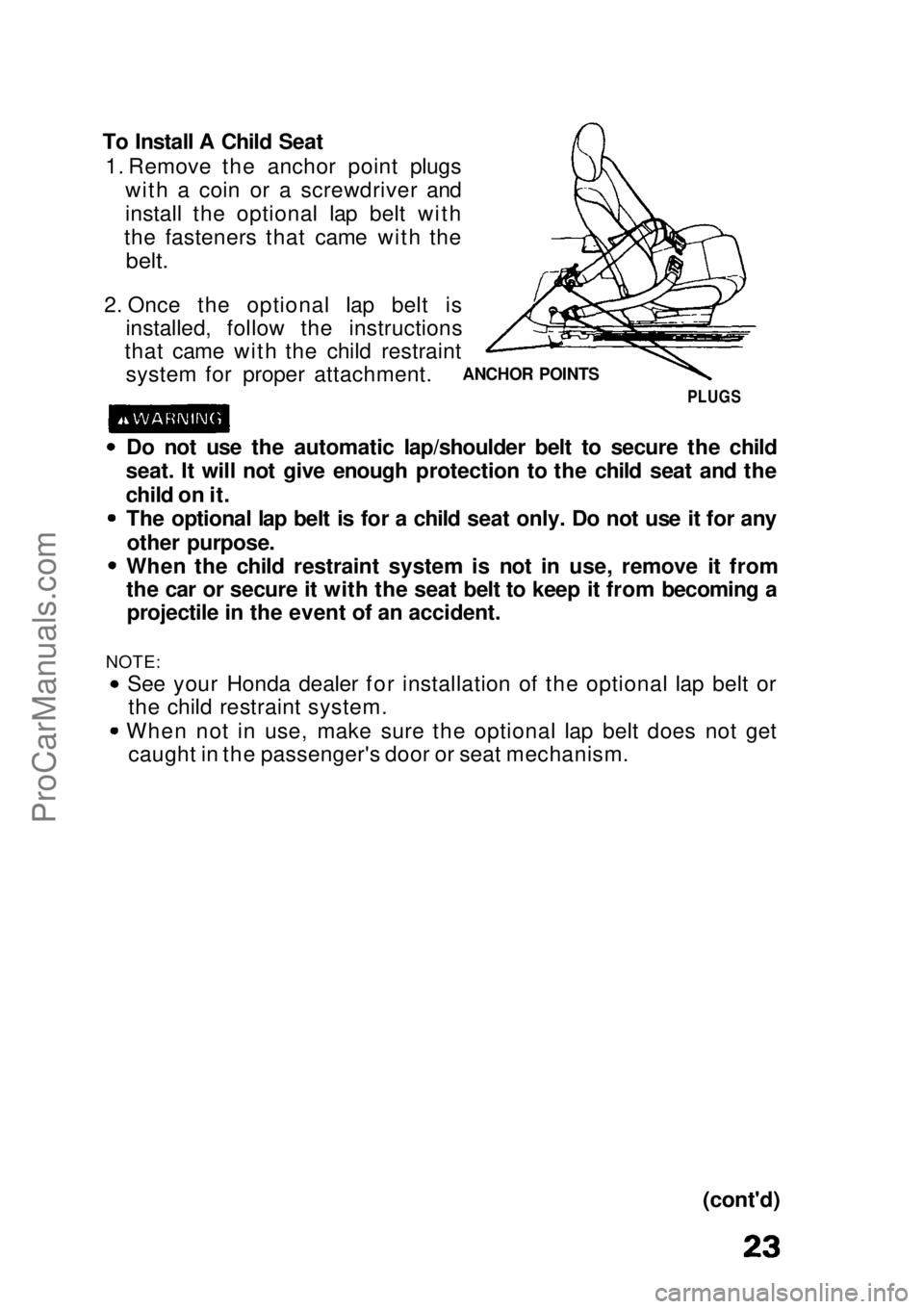
To Install A Child Seat
1. Remove the anchor point plugs with a coin or a screwdriver and
install the optional lap belt with
the fasteners that came with the
belt.
2. Once the optional lap belt is installed, follow the instructions
that came with the child restraint system for proper attachment.
Do not use the automatic lap/shoulder belt to secure the child
seat. It will not give enough protection to the child seat and the
child on it. The optional lap belt is for a child seat only. Do not use it for any
other purpose. When the child restraint system is not in use, remove it from
the car or secure it with the seat belt to keep it from becoming a
projectile in the event of an accident.
NOTE: See your Honda dealer for installation of the optional lap belt orthe child restraint system. When not in use, make sure the optional lap belt does not get
caught in the passenger's door or seat mechanism.
(cont'd)
ANCHOR POINTS
PLUGSProCarManuals.comMain Menu s t
Page 25 of 136
![HONDA CIVIC 1991 Owners Manual
Seat Belts (cont'd)
[Sedan]
Installation of Child Seat
All child restraint systems are designed to be secured by lap belts or
the lap belt portion of a lap-shoulder belt. The automatic shoulder](/manual-img/13/57901/w960_57901-24.png "HONDA CIVIC 1991 Owners Manual
Seat Belts (cont'd)
[Sedan]
Installation of Child Seat
All child restraint systems are designed to be secured by lap belts or
the lap belt portion of a lap-shoulder belt. The automatic shoulder")
Seat Belts (cont'd)
[Sedan]
Installation of Child Seat
All child restraint systems are designed to be secured by lap belts or
the lap belt portion of a lap-shoulder belt. The automatic shoulder belt system at the front passenger seat should not be used to
secure the child restraint system. If a child seat must be installed on
the front seat, place the shoulder portion of the belt behind the child seat and secure the child seat with the lap belt only.
Children could be endangered in a crash, if their child restraints are
not properly secured. Follow the child seat manufacturer's
instructions when installing the seat.
Your Honda automobile is equipped with attachment pointsspecifically for a rear seat mounted child restraint system which
uses a top tether.
The tether attachment points are located on the rear tray, just behind the rear seat-back.
When the child restraint system is not in use, remove it from the
car or secure it with the seat belt to keep it from becoming aprojectile in the event of an accident.
NOTE:
See your Honda dealer for installation of the child restraint system.ProCarManuals.comMain Menu s t
Page 26 of 136
Pregnant Women
A pregnant woman should use the shoulder and lap belts to help lessen the chance of injury and/or the amount of injury in anaccident.
It is desirable that a pregnant woman ask her doctor at each
medical check-up if she can drive, and also ask about the most
appropriate way of wearing the lap/shoulder belt.Lap belts should be worn as low and snugly as possible over the
hips.
Inspection
All parts of the seat belts, including the belt fabric, should beregularly inspected for fraying, loosening, wear and other damage.Keep the belts in good condition at all times to reduce the chance of
being injured in an accident, and to minimize any injuries that dooccur. Make sure the buckles, retractors, tongue plates, guides and
anchors all work properly.
Don't let anything get inside the buckle or the retractor; it could
cause latch or retractor failure.
Cleaning
The belts should always be kept clean and dry; wet or damp belts can cause rewinding problems. To clean the belts, pull them all the
way out of their retractors and use warm water and a mild soap;
then let them air-dry fully extended, in the shade, with the carwindows open.
Never bleach, dye or clean the belts with chemical solvents; itwill weaken the fabric. Do not remove the seat belts from the car to wash them.
Replacement
Replace the seat belt if:
1. The belting is cut, punctured, burned, etc.
2.The buckle or retractor does not work properly.
3. It was being worn at the time of a collision (also check for deformation damage at all seat belt anchor points).
4. Its condition is questionable.ProCarManuals.comMain Menu s t
Page 32 of 136
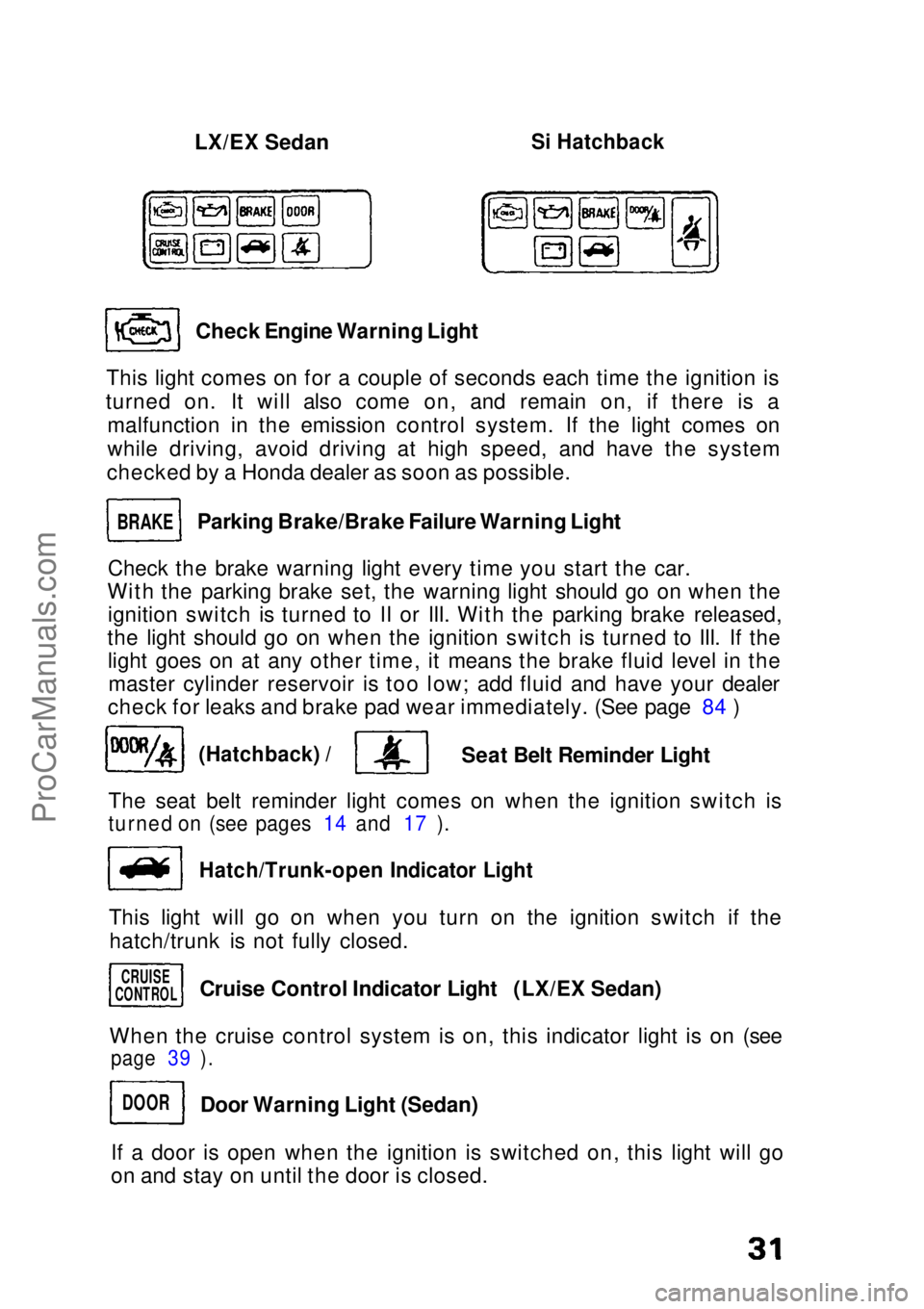
LX/EX Sedan
Si Hatchback
Check Engine Warning Light
This light comes on for a couple of seconds each time the ignition is
turned on. It will also come on, and remain on, if there is a malfunction in the emission control system. If the light comes on
while driving, avoid driving at high speed, and have the system
checked by a Honda dealer as soon as possible.
Parking Brake/Brake Failure Warning Light
Check the brake warning light every time you start the car.
With the parking brake set, the warning light should go on when the ignition switch is turned to II or III. With the parking brake released,
the light should go on when the ignition switch is turned to III. If the light goes on at any other time, it means the brake fluid level in themaster cylinder reservoir is too low; add fluid and have your dealer
check for leaks and brake pad wear immediately. (See page 84 )
(Hatchback) /
Seat Belt Reminder Light
The seat belt reminder light comes on when the ignition switch is
turned on (see pages 14 and 17 ).
Hatch/Trunk-open Indicator Light
This light will go on when you turn on the ignition switch if the hatch/trunk is not fully closed.
When the cruise control system is on, this indicator light is on (see
page 39 ).
If a door is open when the ignition is switched on, this light will go
on and stay on until the door is closed.
BRAKE
CRUISE
CONTROL
DOOR
Cruise Control Indicator Light (LX/EX Sedan)
Door Warning Light (Sedan)ProCarManuals.comMain Menu s t
Page 54 of 136
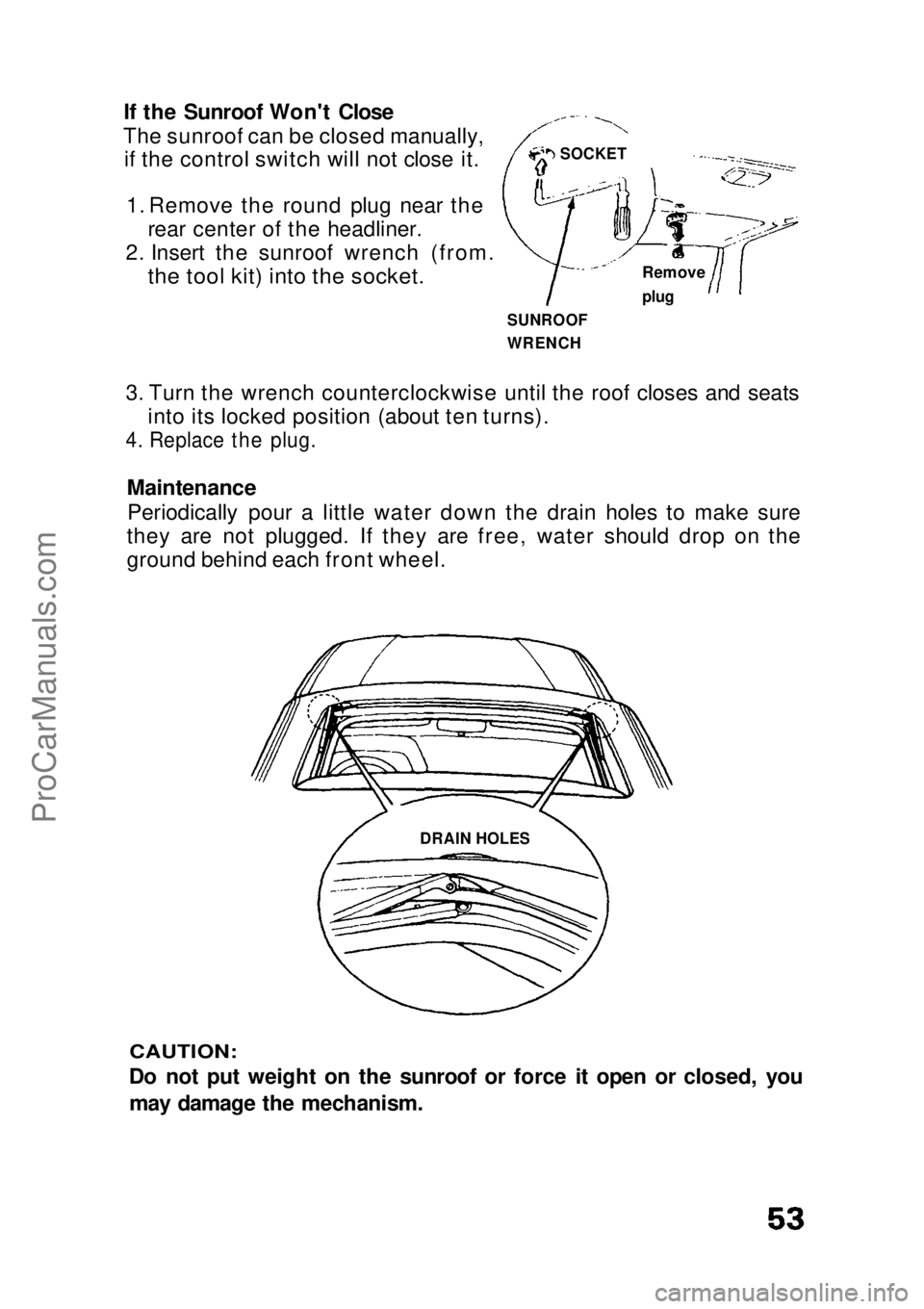
If the Sunroof Won't Close
The sunroof can be closed manually, if the control switch will not close it.
1. Remove the round plug near the rear center of the headliner.
2. Insert the sunroof wrench (from.
the tool kit) into the socket.
SUNROOF
WRENCH
3. Turn the wrench counterclockwise until the roof closes and seats into its locked position (about ten turns).
4. Replace the plug.
Maintenance
Periodically pour a little water down the drain holes to make sure
they are not plugged. If they are free, water should drop on the
ground behind each front wheel.
CAUTION:
Do not put weight on the sunroof or force it open or closed, you
may damage the mechanism.
DRAIN HOLESSOCKET
Remove
plugProCarManuals.comMain Menu s t
Page 56 of 136
Operation In Foreign Countries
In order to comply with U.S. Federal Emissions Regulations, you
must use unleaded fuels of the recommended octane rating. These
fuels may not be available in other countries. If you intend taking
your car outside the U.S. or Canada, write to American Honda Consumer Affairs (stating the year and model of your car) at the
address below for information regarding modifications you may need to have done.
American Honda Motor Co., Inc.
Consumer Affairs
1919 Torrance Blvd.
Torrance, CA 90501-2722
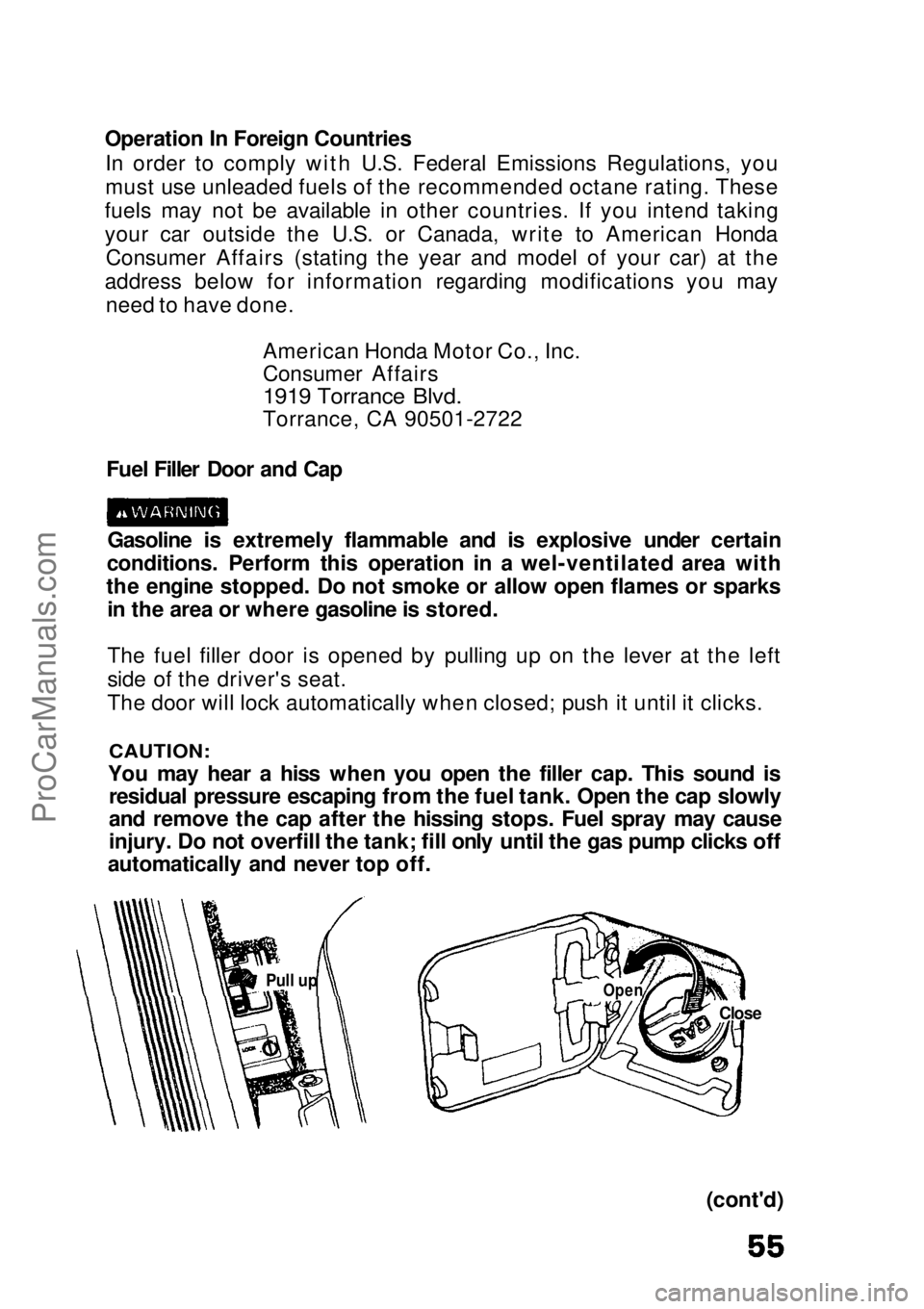
Fuel Filler Door and Cap
Gasoline is extremely flammable and is explosive under certain
conditions. Perform this operation in a wel-ventilated area with
the engine stopped. Do not smoke or allow open flames or sparks in the area or where gasoline is stored.
The fuel filler door is opened by pulling up on the lever at the left
side of the driver's seat.
The door will lock automatically when closed; push it until it clicks.
CAUTION:
You may hear a hiss when you open the filler cap. This sound is residual pressure escaping from the fuel tank. Open the cap slowly
and remove the cap after the hissing stops. Fuel spray may cause
injury. Do not overfill the tank; fill only until the gas pump clicks off
automatically and never top off.
(cont'd)
Pull up
Close
OpenProCarManuals.comMain Menu s t
![HONDA CIVIC 1991 Owners Manual Seat Belts (cont'd)
[Hatchback]
Installation of Child Seat
All child restraint systems are designed to be secured by lap belts or
the lap belt portion of a lap-shoulder belt. Children could be e](/manual-img/13/57901/w960_57901-22.png "HONDA CIVIC 1991 Owners Manual Seat Belts (cont'd)
[Hatchback]
Installation of Child Seat
All child restraint systems are designed to be secured by lap belts or
the lap belt portion of a lap-shoulder belt. Children could be e")