1991 FORD FESTIVA engine
[x] Cancel search: enginePage 270 of 454

Fig. 16: Cutaway View Of Typical Integrated Electronic EGR Valve
Courtesy of GENERAL MOTORS CORP.
SPARK CONTROLS (SPK)
Spark control systems are designed to ensure the air/fuel mixture is ignited at the best possible moment to provide optimum efficiency and
power and cleaner emissions.
Ensure vacuum hoses to the distributor, carburetor, spark delay valves, thermal vacuum switches, etc., are in place and routed properly. On
Computerized Engine Controls (CEC), check for presence of required sensors (O2, MAP, CTS, TPS, etc.). Ensure they have not been
tampered with or modified.
Check for visible modification or replacement of the feedback carburetor, fuel injection unit or injector(s) with a non-feedback carburetor or
fuel injection system. Check for modified emission-related components unacceptable for use on pollution-controlled vehicles.
AIR INJECTION SYSTEM (AIS)
Air Pump Injection System (AP)
The air pump is a belt-driven vane type pump, mounted to engine in combination with other accessories. The air pump itself consists of the
pump housing, an inner air cavity, a rotor and a vane assembly. As the vanes turn in the housing, filtered air is drawn in through the intake port
and pushed out through the exhaust port. See Fig. 17
.
Check for missing or disconnected belt, check valve(s), diverter valve(s), air distribution manifolds, etc. Check air injection system for proper
hose routing.
Page 10 of 12 MITCHELL 1 ARTICLE - EMISSION CONTROL VISUAL INSPECTION PROCEDURES 1983-93 GENERAL INFORMA...
3/10/2009 http://www.eautorepair.net/app/PrintItems.asp?S0=2097152&S1=0&SG=%7B9B990D68%2D660A%2D45E9%2D8F46%2DE
...
Page 271 of 454

Fig. 17: Typical Air Pump Injection System
Courtesy of GENERAL MOTORS CORP.
Pulsed Secondary Air Injection (PAIR) System
PAIR eliminates the need for an air pump and most of the associated hardware. Most systems consists of air delivery pipe(s), pulse valve(s) and
check valve(s). The check valve prevents exhaust gases from entering the air injection system. See Fig. 18
.
Ensure required check valve(s), diverter valve(s), air distribution manifolds, etc., are present. Check air injection system for proper hose
routing.
Fig. 18: Typical Pulsed Secondary Air Injection System
Courtesy of GENERAL MOTORS CORP.
OXYGEN SENSOR (O2)
The O2 sensor is mounted in the exhaust system where it monitors oxygen content of exhaust gases. Some vehicles may use 2 O2 sensors. The
O2 sensor produces a voltage signal which is proportional to exhaust gas oxygen concentration (0-3%) compared to outside oxygen (20-21%).
This voltage signal is low (about .1 volt) when a lean mixture is present and high (1.0 volt) when a rich mixture is present.
As ECM compensates for a lean or rich condition, this voltage signal constantly fluctuates between high and low, crossing a reference voltage
supplied by the ECM on the O2 signal line. This is referred to as cross counts. A problem in the O2 sensor circuit should set a related trouble
code.
COMPUTERIZED ENGINE CONTROLS (CEC)
The CEC system monitors and controls a variety of engine/vehicle functions. The CEC system is primarily an emission control system designed
to maintain a 14.7:1 air/fuel ratio under most operating conditions. When the ideal air/fuel ratio is maintained, the catalytic converter can
control oxides of nitrogen (NOx), hydrocarbon (HC) and carbon monoxide (CO) emissions.
The CEC system consists of the following sub-systems: Electronic Control Module (ECM), input devices (sensors and switches) and output
signals.
EARLY FUEL EVAPORATION (EFE)
The EFE valve is actuated by either a vacuum actuator or a bimetal spring (heat-riser type). The EFE valve is closed when engine is cold. The
closed valve restricts exhaust gas flow from the exhaust manifold. This forces part of the exhaust gas to flow up through a passage below the
Page 11 of 12 MITCHELL 1 ARTICLE - EMISSION CONTROL VISUAL INSPECTION PROCEDURES 1983-93 GENERAL INFORMA...
3/10/2009 http://www.eautorepair.net/app/PrintItems.asp?S0=2097152&S1=0&SG=%7B9B990D68%2D660A%2D45E9%2D8F46%2DE
...
Page 272 of 454
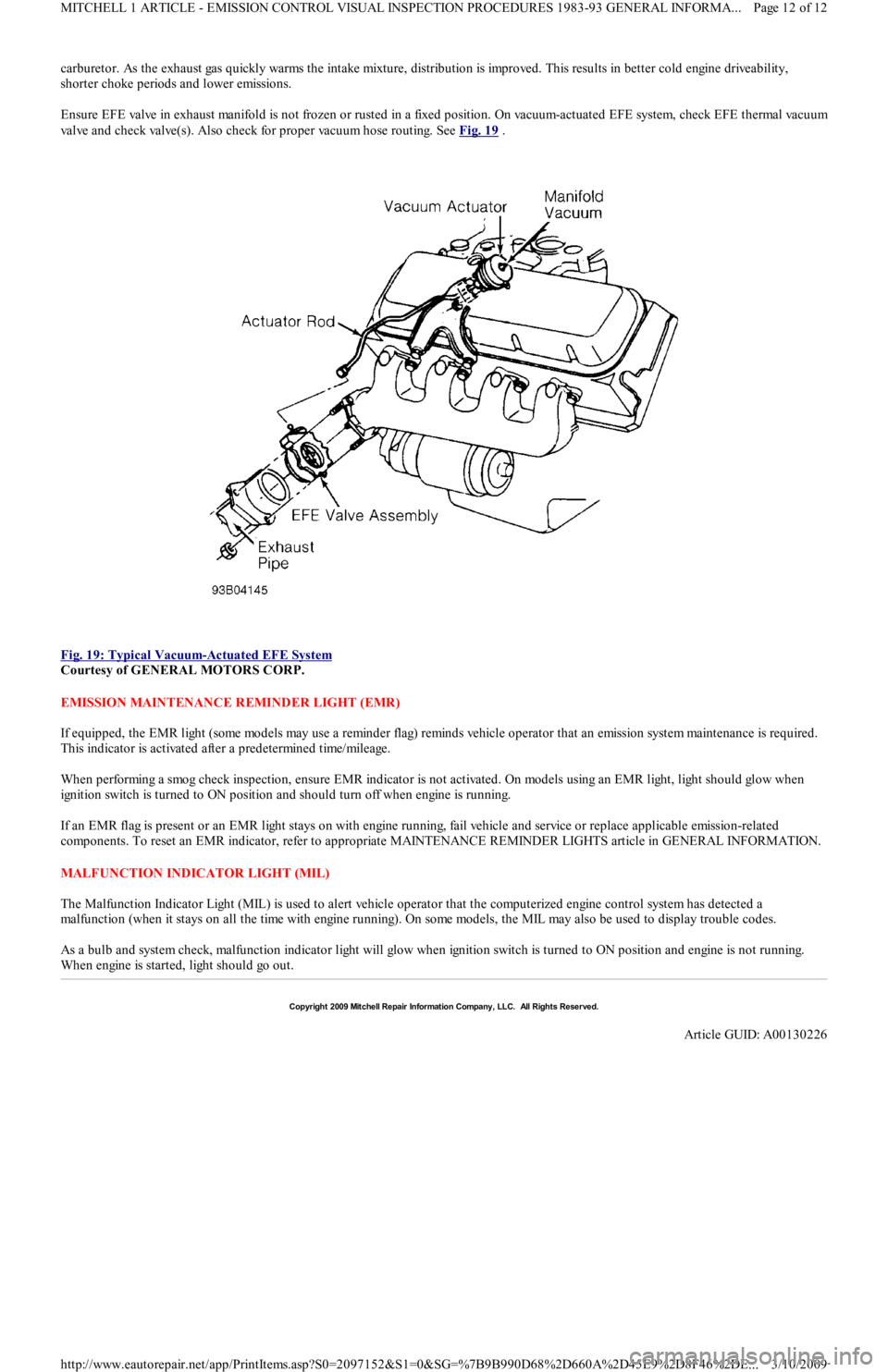
carburetor. As the exhaust gas quickly warms the intake mixture, distribution is improved. This results in better cold engine driveability,
shorter choke periods and lower emissions.
Ensure EFE valve in exhaust manifold is not frozen or rusted in a fixed position. On vacuum-actuated EFE system, check EFE thermal vacuu
m
valve and check valve(s). Also check for proper vacuum hose routing. See Fig. 19
.
Fig. 19: Typical Vacuum
-Actuated EFE System
Courtesy of GENERAL MOTORS CORP.
EMISSION MAINTENANCE REMINDER LIGHT (EMR)
If equipped, the EMR light (some models may use a reminder flag) reminds vehicle operator that an emission system maintenance is required.
This indicator is activated after a predetermined time/mileage.
When performing a smog check inspection, ensure EMR indicator is not activated. On models using an EMR light, light should glow when
ignition switch is turned to ON position and should turn off when engine is running.
If an EMR flag is present or an EMR light stays on with engine running, fail vehicle and service or replace applicable emission-related
components. To reset an EMR indicator, refer to appropriate MAINTENANCE REMINDER LIGHTS article in GENERAL INFORMATION.
MALFUNCTION INDICATOR LIGHT (MIL)
The Malfunction Indicator Light (MIL) is used to alert vehicle operator that the computerized engine control system has detected a
malfunction (when it stays on all the time with engine running). On some models, the MIL may also be used to display trouble codes.
As a bulb and system check, malfunction indicator light will glow when ignition switch is turned to ON position and engine is not running.
When engine is started, light should go out.
Copyr ight 2009 Mitchell Repair Information Company, LLC. All Rights Reserved.
Article GUID: A00130226
Page 12 of 12 MITCHELL 1 ARTICLE - EMISSION CONTROL VISUAL INSPECTION PROCEDURES 1983-93 GENERAL INFORMA...
3/10/2009 http://www.eautorepair.net/app/PrintItems.asp?S0=2097152&S1=0&SG=%7B9B990D68%2D660A%2D45E9%2D8F46%2DE
...
Page 273 of 454
Back To Article
GENERAL INFORMATION
Engine Perform ance Diagnostic Routine Outline
* PLEASE READ THIS FIRST *
WHERE DOES DRIVEABILITY DIAGNOSIS START?
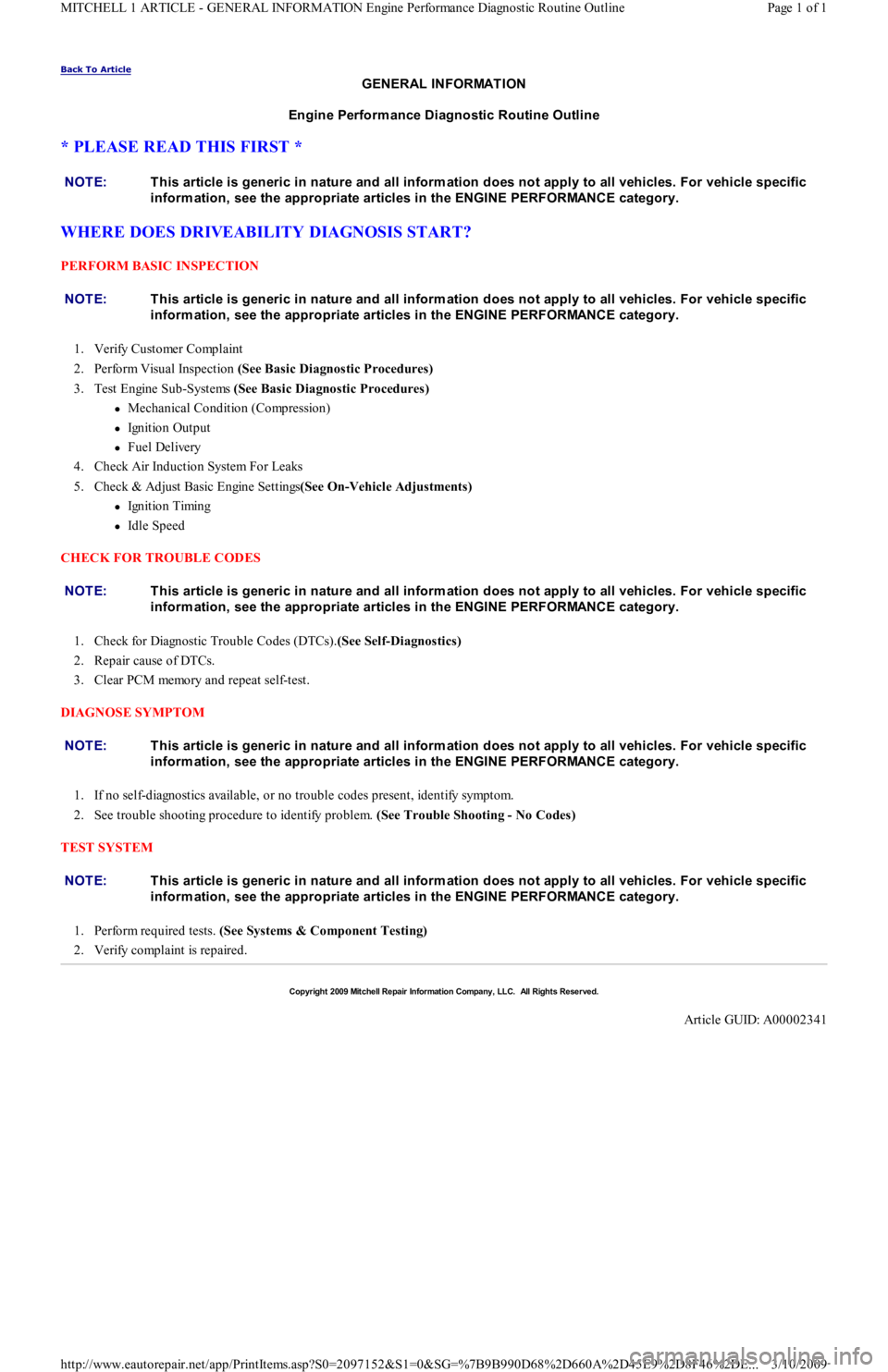
PERFORM BASIC INSPECTION
1. Verify Customer Complaint
2. Perform Visual Inspection (See Basic Diagnostic Procedures)
3. Test Engine Sub-Systems (See Basic Diagnostic Procedures)
Mechanical Condition (Compression)
Ignition Output
Fuel Delivery
4. Check Air Induction System For Leaks
5. Check & Adjust Basic Engine Settings(See On-Vehicle Adjustments)
Ignition Timing
Idle Speed
CHECK FOR TROUBLE CODES
1. Check for Diagnostic Trouble Codes (DTCs).(See Self-Diagnostics)
2. Repair cause of DTCs.
3. Clear PCM memory and repeat self-test.
DIAGNOSE SYMPTOM
1. If no self-diagnostics available, or no trouble codes present, identify symptom.
2. See trouble shooting procedure to identify problem. (See Trouble Shooting - No Codes)
TEST SYSTEM
1. Perform required tests. (See Systems & Component Testing)
2. Verify complaint is repaired. NOTE:T his article is generic in nature and all inform ation does not apply to all vehicles. For vehicle specific
inform ation, see the appropriate articles in the ENGINE PERFORMANCE category.
NOTE:T his article is generic in nature and all inform ation does not apply to all vehicles. For vehicle specific
inform ation, see the appropriate articles in the ENGINE PERFORMANCE category.
NOTE:T his article is generic in nature and all inform ation does not apply to all vehicles. For vehicle specific
inform ation, see the appropriate articles in the ENGINE PERFORMANCE category.
NOTE:T his article is generic in nature and all inform ation does not apply to all vehicles. For vehicle specific
inform ation, see the appropriate articles in the ENGINE PERFORMANCE category.
NOTE:T his article is generic in nature and all inform ation does not apply to all vehicles. For vehicle specific
inform ation, see the appropriate articles in the ENGINE PERFORMANCE category.
Copyr ight 2009 Mitchell Repair Information Company, LLC. All Rights Reserved.
Article GUID: A00002341
Page 1 of 1 MITCHELL 1 ARTICLE - GENERAL INFORMATION Engine Performance Diagnostic Routine Outline
3/10/2009 http://www.eautorepair.net/app/PrintItems.asp?S0=2097152&S1=0&SG=%7B9B990D68%2D660A%2D45E9%2D8F46%2DE
...
Page 274 of 454
Back To Article
GENERAL INFORMATION
Engine Perform ance Safety Precautions
Always refer to Emission Decal in engine compartment before servicing vehicle. If manual and decal differ, always use decal
specifications.
Do not allow or create a condition of misfire in more than one cylinder for an extended period of time. Damage to converter may occur
due to loading converter with unburned air/fuel mixture.
Always turn ignition off and disconnect negative battery cable BEFORE disconnecting or connecting computer or other electrical
components.
DO NOT drop or shock electrical components such as computer, airflow meter, etc.
DO NOT use fuel system cleaning compounds that are not recommended by the manufacturer. Damage to gaskets, diaphragm materials
and catalytic converter may result.
Before performing a compression test or cranking engine using a remote starter switch, disconnect coil wire from distributor and secure it
to a good engine ground, or disable ignition.
Before disconnecting any fuel system component, ensure fuel system pressure is released.
Use a shop towel to absorb any spilled fuel to prevent fire.
DO NOT create sparks or have an open flame near battery.
If any fuel system components such as hoses or clamps are replaced, ensure they are replaced with components designed for fuel system
use.
Always reassemble throttle body components with new gaskets, "O" rings and seals.
If equipped with an inertia switch, DO NOT reset switch until fuel system has been inspected for leaks.
We a r sa fe t y go ggl e s wh e n d r il l in g o r gr in d in g.
Wear proper clothing which protects against chemicals and other hazards.
Copyr ight 2009 Mitchell Repair Information Company, LLC. All Rights Reserved.
Article GUID: A00002342
Page 1 of 1 MITCHELL 1 ARTICLE - GENERAL INFORMATION Engine Performance Safety Precautions
3/10/2009 http://www.eautorepair.net/app/PrintItems.asp?S0=2097152&S1=0&SG=%7B9B990D68%2D660A%2D45E9%2D8F46%2DE
...
Page 275 of 454

Back To Article
GENERAL INFORMATION
How To Use The Engine Perform ance Section - 1989 & Newer Models
* PLEASE READ THIS FIRST *
HOW TO USE THE ENGINE PERFORMANCE SECTION
Congratulations, you have purchased the most advanced automotive repair and service information available. This information can help you, as
a professional automotive technician, to maintain top vehicle performance, and correct driveability problems on today's high-tech vehicles.
For your convenience and ease in use, all of our engine performance service and repair information is consistently organized by manufacturer,
using a progressive diagnostic/workflow approach. Due to the differences in how each manufacturer approaches diagnosis and repair, once
started and inside of an article, that manufacturer may drive the workflow in a direction other than what is outlined here.
The progressive diagnostic/workflow of our data is as follows:
APPLICATION to identify vehicle and system usage.
EMISSION APPLICATION to identify emission system usage.
SPECIFICATIONS to quickly find an engine performance service specification.
ADJUSTMENTS to perform engine performance related routine adjustments.
THEORY & OPERATION to familiarize yourself with new systems and technologies.
BASIC DIAGNOSTIC PROCEDURES located under TESTING & DIAGNOSTICS, also referred to as BASIC TESTING, is used for
performing a basic vehicle inspection and is also the starting point for diagnosis of a "no-start" condition.
SELF-DIAGNOSTICS located under TESTING & DIAGNOSTICS, also referred to as TESTS W/CODES, is where manufacturer
specific procedures for retrieving, identifying and diagnosing DTCs (trouble codes) retained in a control modules memory are located.
TROUBLE SHOOTING - NO CODES located under TESTING & DIAGNOSTICS, also referred to as TESTS W/O CODES, is where
an engine performance problem that does not set a DTC can be potentially isolated through either a SYMPTOM or INTERMITTENTS
duplication procedure.
SYSTEM & COMPONENT TESTING located under TESTING & DIAGNOSTICS, also referred to as SYSTEM/COMPONENT
TESTS, once directed to this article, specific system and component tests can be performed to help isolate faulty component/system
prior to replacement.
PIN VOLTAGE CHARTS provide supplemental information to help determine correct control module input and output signals. Pin
charts may also be referred to as PID charts by some manufacturers.
SENSOR RANGE CHARTS help determine if a sensor is out of calibration. In some cases an out-of-calibration sensor will not set a
DTC (trouble code), resulting in difficult to diagnose driveability symptoms.
VACUUM DIAGRAMS help determine correct routing of vacuum hoses when reinstalling components or performing emission
inspections.
REMOVE, OVERHAUL & INSTALL provides procedures necessary for removing and installing engine performance related
components.
WIRING DIAGRAMS can be used to identify circuits, terminals, wire colors and components referenced in testing procedures. NEW
COLOR WIRING DIAGRAMS (system diagrams) provide an easy method of identifying and tracing circuits.
APPLICATION
INTRODUCTION/ENGINE/VIN ID
Here you will find out how to identify an engine by its Vehicle Identification Number (VIN). The manufacturer's MODEL COVERAGE chart
lists each model and engine option, the fuel system, ignition system and engine code. Engine serial number locations are also shown here, as
well as the VIN code breakdown. Using model lookup in conjunction with VIN and engine ID will identify application information necessary
for servicing vehicle and ordering parts.
EMISSION APPLICATIONS
EMISSION APPLICATION TABLES
Here you will find a chart listing what emission control devices apply to each model. This can be helpful when performing government-
required emissions inspections. For quick reference, major emission systems and devices are listed in bold type in the emission table. Sub
components are listed in light type.
SPECIFICATIONS
NOTE:T his article is generic in nature and all inform ation does not apply to all vehicles. For vehicle specific
inform ation, see the appropriate articles in the ENGINE PERFORMANCE category.
NOTE:T his article is generic in nature and all inform ation does not apply to all vehicles. For vehicle specific
inform ation, see the appropriate articles in the ENGINE PERFORMANCE category.
NOTE:T his article is generic in nature and all inform ation does not apply to all vehicles. For vehicle specific
inform ation, see the appropriate articles in the ENGINE PERFORMANCE category.
NOTE:T his article is generic in nature and all inform ation does not apply to all vehicles. For vehicle specific
inform ation, see the appropriate articles in the ENGINE PERFORMANCE category.
Page 1 of 3 MITCHELL 1 ARTICLE - GENERAL INFORMATION How To Use The Engine Performance Section - 1989 & Newer Models
3/10/2009 http://www.eautorepair.net/app/PrintItems.asp?S0=2097152&S1=0&SG=%7B9B990D68%2D660A%2D45E9%2D8F46%2DE
...
Page 276 of 454
SERVICE & ADJUSTMENT SPECIFICATIONS
If you want a specification quickly, this is the place to look. Instead of hunting through a long article, we've separated out the important
specifications and arranged them into easy-to-use tables in a centralized location. You can find valuable information like spark plug wire
resistance, valve clearance, timing, firing orders, etc.
ADJUSTMENT
ON-VEHICLE ADJUSTMENTS
The ON-VEHICLE ADJUSTMENTS article contains the type of information that was previously thought of as TUNE-UP information.
Procedures for checking and adjusting valves, base ignition timing and idle speed are found in this section. Use this section in conjunction with
SERVICE & ADJUSTMENT SPECIFICATIONS for performing routine maintenance. Also, if you have a driveability problem, ensure all on-
vehicle adjustments are within specification before attempting further diagnosis.
THEORY & OPERATION
This article covers basic THEORY & OPERATION of engine performance-related systems and components. Before diagnosing vehicles or new
systems with which you are not completely familiar, read this article.
TESTING & DIAGNOSTICS
BASIC DIAGNOSTIC PROCEDURES/BASIC TESTING
The procedures listed in this article can help you avoid skipping a simple step early, like checking base timing, which could be costly in both
time and money later. This is also a potential starting point for diagnosis of a "no-start" condition. If all systems check out okay here, proceed
to SELF-DIAGNOSTICS/TESTS W/CODES or TROUBLE SHOOTING - NO CODES/TESTS W/O CODES article.
SELF-DIAGNOSTICS/TESTS W/CODES
Use this information to retrieve and interpret Diagnostic Trouble Codes (DTCs) accessed from the vehicle's self-diagnostic system. Once
information is retrieved, manufacturer diagnostic procedures are given to help pinpoint and repair computer system/component faults. Also
included are steps for clearing trouble codes once these faults are repaired. If there is a driveability symptom with no trouble codes set,
proceed to TROUBLE SHOOTING - NO CODES/TESTS W/O CODES article.
TROUBLE SHOOTING - NO CODES/TESTS W/O CODES
This is where to go when you have a problem that does not set a trouble code. It can help determine cause of problem using driveability
symptoms and intermittent testing procedures. Procedures in this information should lead you to a specific component or system test.
SYSTEM & COMPONENT TESTING
Here you will find various tests for engine performance systems and their components, such as air induction (turbochargers and superchargers),
fuel control, ignition control and emission systems.
PIN VOLTAGE CHARTS
These are supplied (when available from manufacturer) to quicken the diagnostic process. By checking pin voltages at the Powertrain Control
Module (PCM), you can determine if the PCM is receiving and/or transmitting proper voltage signals. Pin charts may also be referred to as PID
charts by some manufacturers.
SENSOR RANGE CHARTS
SENSOR OPERATING RANGE CHARTS
These are supplied (when available from manufacturer) to determine if a sensor is out of calibration. An out-of-calibration sensor may not set a
trouble code, but it may cause driveability problems.
VACUUM DIAGRAMS
NOTE:T his article is generic in nature and all inform ation does not apply to all vehicles. For vehicle specific
inform ation, see the appropriate articles in the ENGINE PERFORMANCE category.
NOTE:T his article is generic in nature and all inform ation does not apply to all vehicles. For vehicle specific
inform ation, see the appropriate articles in the ENGINE PERFORMANCE category.
NOTE:T his article is generic in nature and all inform ation does not apply to all vehicles. For vehicle specific
inform ation, see the appropriate articles in the ENGINE PERFORMANCE category.
NOTE:T his article is generic in nature and all inform ation does not apply to all vehicles. For vehicle specific
inform ation, see the appropriate articles in the ENGINE PERFORMANCE category.
NOTE:T his article is generic in nature and all inform ation does not apply to all vehicles. For vehicle specific
inform ation, see the appropriate articles in the ENGINE PERFORMANCE category.
NOTE:T his article is generic in nature and all inform ation does not apply to all vehicles. For vehicle specific
inform ation, see the appropriate articles in the ENGINE PERFORMANCE category.
Page 2 of 3 MITCHELL 1 ARTICLE - GENERAL INFORMATION How To Use The Engine Performance Section - 1989 & Newer Models
3/10/2009 http://www.eautorepair.net/app/PrintItems.asp?S0=2097152&S1=0&SG=%7B9B990D68%2D660A%2D45E9%2D8F46%2DE
...
Page 277 of 454
Here we give you underhood views or schematics of vacuum-hose routing which can help you find incorrectly routed hoses. Remember, a
vacuum leak or incorrectly routed vacuum hose on computer-controlled vehicle can cause many driveability problems.
REMOVAL, OVERHAUL & INSTALLATION
After you've diagnosed the problem, this is where to go for the nuts-and-bolts of the job. Here you'll find procedures and specifications for
removing, overhauling (if available) and installing components.
WIRING DIAGRAMS - ENGINE PERFORMANCE
2002 & EARLIER
On 2002 and earlier models, once ENGINE PERFORMANCE is selected as the service category, the expanded menu will display a WIRING
DIAGRAMS - ENGINE PERFORMANCE heading. Once the wiring diagrams article is selected, select the engine performance wiring
diagrams for your lookup model.
2003 & LATER
On models newer than 2002, we have moved all wiring diagrams under a centralized first level model-specific lookup titled WIRING
DIAGRAMS-ALL. When selected, SYSTEM WIRING DIAGRAMS article will display in the center panel. This article contains all available
wiring diagrams related to the selected vehicle. These same wiring diagrams can also be found under the ELECTRICAL/WIRING DIAGRAMS
heading. NOTE:T his article is generic in nature and all inform ation does not apply to all vehicles. For vehicle specific
inform ation, see the appropriate articles in the ENGINE PERFORMANCE category.
NOTE:T his article is generic in nature and all inform ation does not apply to all vehicles. For vehicle specific
inform ation, see the appropriate articles in the ENGINE PERFORMANCE category.
NOTE:T his article is generic in nature and all inform ation does not apply to all vehicles. For vehicle specific
inform ation, see the appropriate articles in the ENGINE PERFORMANCE category.
NOTE:System Wiring diagram s for have been enhanced to include COLORS. T his will enable you to m ore
easily trace a circuit from its source to its destination, without losing your circuit due to parallel or
intersecting lines. Using these diagram s, you can easily identify and trace com ponent circuits, to help
locate shorts and opens in circuits. T hese diagram s can also help you understand how individual
circuits function within a system .
Copyr ight 2009 Mitchell Repair Information Company, LLC. All Rights Reserved.
Article GUID: A00002340
Page 3 of 3 MITCHELL 1 ARTICLE - GENERAL INFORMATION How To Use The Engine Performance Section - 1989 & Newer Models
3/10/2009 http://www.eautorepair.net/app/PrintItems.asp?S0=2097152&S1=0&SG=%7B9B990D68%2D660A%2D45E9%2D8F46%2DE
...