Page 113 of 143

Volvo 1990 240 Model
pg. 82 Wheels and tires
Checking and correcting tire pressure
Check the tire pressure when refueling. The tire pressure should only be\
corrected when the tires are
cold. With warm tires, correct only when the pressure is too low. The ti\
re temperature (and, thus,
pressure) rises after driving just a few miles.
Warning: Improperly inflated tires will reduce tire life, adversely affe\
ct vehicle handling and can
possibly lead to failure resulting in loss of vehicle control without pr\
ior warning.
Vehicle Loading
The tires on your Volvo will perform to specifications at all normal loa\
ds when inflated as
recommended on the tire information label located on the rear facing sid\
e of the right front door. This
label lists both tire and vehicle design limits.
Do not load your car beyond the load limits indicated.
Tire Pressure Label
The tire pressure label is located on the rear facing side of the right \
front door.
See section titled ''Specifications'' and Consumer Information Booklet f\
or complete tire pressure
information.
Wear indicator
The tires have a so-called "wear indicator in the form of a number of na\
rrow strips running across or
parallel to the tread. When approx 1/16 " (1.5 mm) is left on the trea\
d, these strips show up and indicate
the tire should be replaced.
Tires with less than 1/16" (1.5 mm) tread have a very poor grip in rai\
n or snow.
pg. 83 Wheels and tires
file:///K|/ownersdocs/1990/1990_240/90240_17.htm (1 of 2)12/30/2006 8:\
25:10 AM
Page 123 of 143

Volvo 1990 240 Model
pg. 91 Long distance trips, Cold weather
Prior to a long distance trip
Have your car checked at a Volvo dealer. Preventive maintenance will hel\
p to ensure a trouble free trip.
Remember to take along a Volvo dealer directory.
The main items to check are listed below:
1. Brakes, front wheel alignment and steering gear.
2. Engine running condition.
3. Fuel system operation.
4. Oil leaks: engine, transmission, rear axle.
5. Cooling system for leaks or worn hoses.
6. Examine tires carefully, replace worn tires.
7. Battery and terminals.
8. Tool equipment.
9. Lighting.
10. Drive belts, for tightness and wear.
11. All fluid levels.
Cold weather/Engine fuel system
During the winter, large variations in temperature cause condensation to\
form in the fuel tank and can
impair the running of the engine. This can be reduced by adding dry gas \
to the fuel. There is less risk of
condensation forming in the fuel tank if it is kept full or nearly full.\
Engine cooling system
Volvo type C (blue-green) coolant should be used all year round. The c\
ooling system should always
contain water plus anti-freeze and rust inhibitor, even during the summe\
r. Experience has also shown
that extremely weak anti-freeze solutions (10-25 percent) are ineffect\
ive for rust protection. For this
reason, the quantity of antifreeze/summer coolant should be about 50 per\
cent of the solution. This
lowers the freezing point to - 30 ° F (-35 ° C).
Engine lubricating system
file:///K|/ownersdocs/1990/1990_240/90240_19.htm (1 of 7)12/30/2006 8:\
25:13 AM
Page 124 of 143
 improves cold-we")
Volvo 1990 240 Model
During the winter, multigrade oil 10W-30 should be used in the engine. \
The viscosity of the engine oil is important. Oil with low viscosity (t\
hinner oil) improves cold-weather
starting as well as decreasing fuel consumption while the engine is warm\
ing up. To avoid difficult cold
start conditions (during extreme winter weather), use of 5W-30 oil, pa\
rticularly the synthetic type, is
recommended.
Be sure to use good quality oil but do not use this cold-weather oil for\
hard driving or in warm weather.
See section "Engine oil" for more information.
Electrical system
The electrical system is subject to greater stresses during the winter. \
Lighting and starter motor are used
more often. The battery capacity is reduced at low air temperature. The \
state of charge must be checked
more frequently, and if necessary the battery should be recharged. The b\
attery can freeze if the state of
charge is too low.
Windshield washers
Anti-freeze washer fluid should also be added to the washer fluid contai\
ner for the windshield and rear
window (tailgate, wagon model) washer.
This is particularly important during the winter because the windshield \
frequently becomes dirty and is
often splashed with water which freezes rapidly. This may necessitate th\
e frequent use of the windshield
washer and wipers. Your Volvo dealer can supply you with suitable anti-f\
reeze for this purpose. Suitable
mixtures of anti-freeze and water are:
Down to +14 ° F (-10 ° C) 1 part anti-freeze 4 parts water.
Down to + 7 ° F (-14 ° C) 1 part anti-freeze 3 parts water.
Down to 0 ° F (-18 ° C) 1 part anti-freeze 2 parts water.
Down to -18 ° F (-28 ° C) 1 part anti-freeze 1 part water.
Use Volvo Teflon lock spray or grease in the locks. They can be purchase\
d from your Volvo dealer
Note: Avoid the use of de-icing sprays as they can cause damage to the
locks.
pg. 92 Service diagnosis
The diagnoses outlined below are intended to serve only as a guide to lo\
cate and temporarily correct
minor faults. Causes of unsatisfactory performance should be investigate\
d and corrected by your Volvo
file:///K|/ownersdocs/1990/1990_240/90240_19.htm (2 of 7)12/30/2006 8:\
25:13 AM
Page 126 of 143
Volvo 1990 240 Model
Possible cause Correction
Intake system leaking. Check vacuum hose connections at manifold and
auxiliary air valve.
No fuel reaching engine. Check for fuel in the tank.
Check fuse No 4.
No spark Check that the high tension lead from the coil to the
distributor cap is connected and that the wires to the
distributor and coil are connected.
Check the fuse for the engine control system. The fuse
is located in the engine compartment on the left wheel
housing by the ignition coil.
Spark plugs, high tension leads or distributor
cap wet or defective. Clean the parts with a dry cloth or spray with a moisture
remover. Replace defective or worn parts.
If no fault is found following the above steps, contact
your Volvo dealer.
pg. 94 Service diagnosis
Condition: Erratic idle (misfiring)
Possible cause Correction
Intake system leaking. Check hose connections.
file:///K|/ownersdocs/1990/1990_240/90240_19.htm (4 of 7)12/30/2006 8:\
25:13 AM
Page 127 of 143
Volvo 1990 240 Model
Spark plugs, high tension leads or distributor
cap worn (defective) Clean distributor cap and leads, check the cap for
cracks. Replace defective or worn parts.
Worn spark plugs. Remove. Clean or replace spark plugs.
Condition: Engine stalls at irregular intervals
Possible cause Correction
Defective wires. Check wire terminals at: fuel pump, fuse No. 5 and 7, coil, distributor,\
ignition
switch and relays.
Intake system
leaking. Check vacuum hose connections at manifold and auxiliary air valve.
Fuel filter clogged. Clean fuel tank filter and replace line fuel filter.
pg. 95 Service diagnosis
Condition: Excessive fuel consumption
Possible cause Correction
Fuel lines
leaking. Check
tightness.
Spark plugs
worn. Replace plugs.
Condition: Misfiring at highway driving speed
file:///K|/ownersdocs/1990/1990_240/90240_19.htm (5 of 7)12/30/2006 8:\
25:13 AM
Page 130 of 143
Volvo 1990 240 Model
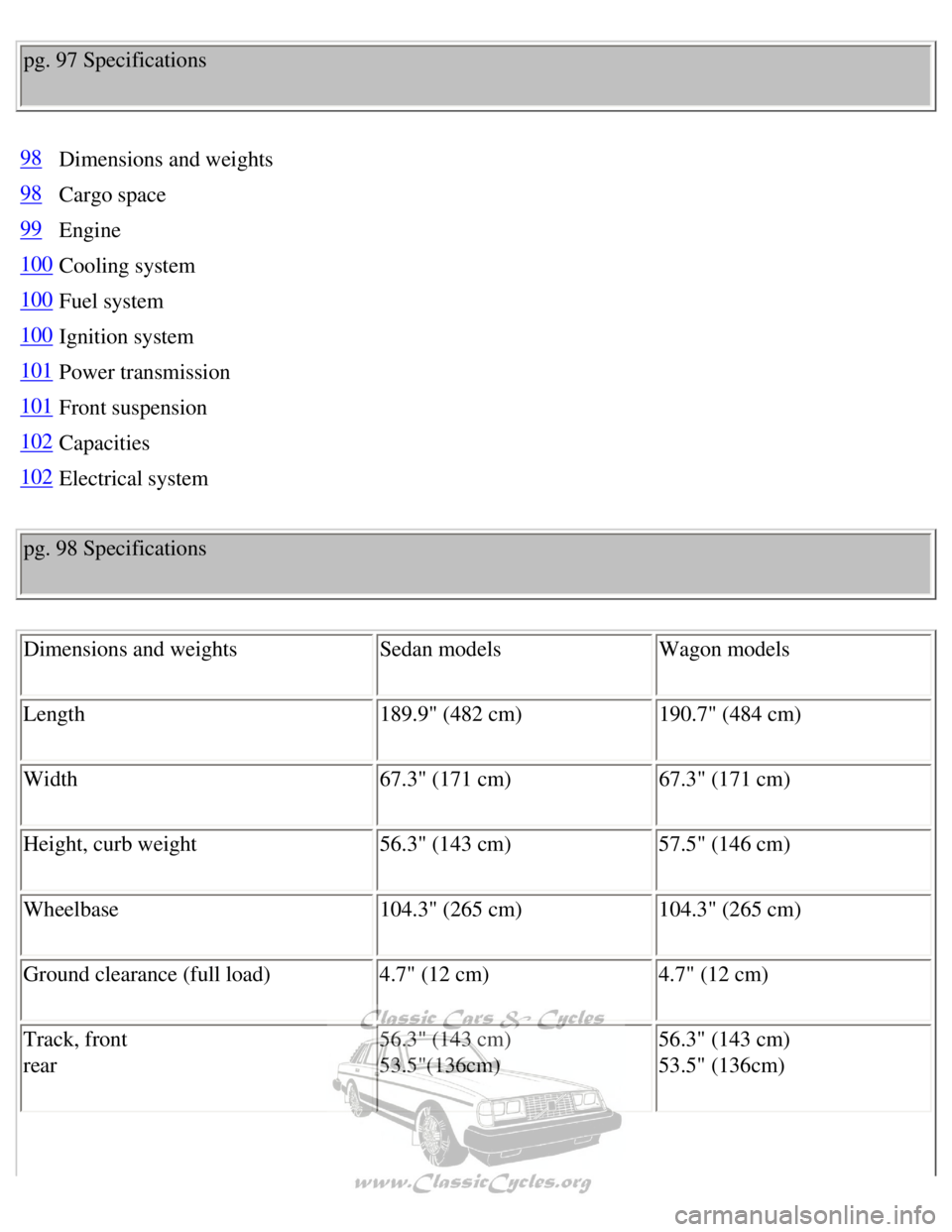
pg. 97 Specifications
98Dimensions and weights
98Cargo space
99Engine
100Cooling system
100Fuel system
100Ignition system
101Power transmission
101Front suspension
102Capacities
102Electrical system
pg. 98 Specifications
Dimensions and weights Sedan models Wagon models
Length 189.9" (482 cm) 190.7" (484 cm)
Width 67.3" (171 cm) 67.3" (171 cm)
Height, curb weight 56.3" (143 cm) 57.5" (146 cm)
Wheelbase 104.3" (265 cm) 104.3" (265 cm)
Ground clearance (full load) 4.7" (12 cm) 4.7" (12 cm)
Track, front
rear 56.3" (143 cm)
53.5"(136cm) 56.3" (143 cm)
53.5" (136cm)
file:///K|/ownersdocs/1990/1990_240/90240_20.htm (1 of 14)12/30/2006 8\
:25:15 AM
Page 133 of 143
Volvo 1990 240 Model
filter. Exhaust-emission control accomplished by fuel injection, Lambda-\
sond system and catalytic
converter.
Output (SAE J1349) 114 hp at 5400 rpm (85 kW at 90 rps)
Max. torque (SAE J1349) 136 ft. lbs. (185 Nm) at 2700 rpm
Number of cylinders 4
Bore 3.78" (96 mm)
Stroke 3.15" (80 mm)
Displacement 2.32 liters (141 cu. in.)
Compression ratio 9.8:1
Valve clearance, cold engine
inlet and exhaust Checking:
0.012-0.016"
(0.30-0.40 mm) Adjusting:
0.014-0.016"
(0.35-0.40 mm)
Valve clearance, warm
engine
inlet and exhaust 0.014-0.018"
(0.35-0.45 mm)
0.016-0.018"
(0.40-0.45 mm)
All specifications are subject to change without notice. pg. 100 Specifications
Engine B230F
Cooling System
file:///K|/ownersdocs/1990/1990_240/90240_20.htm (4 of 14)12/30/2006 8\
:25:15 AM
Page 134 of 143
Volvo 1990 240 Model
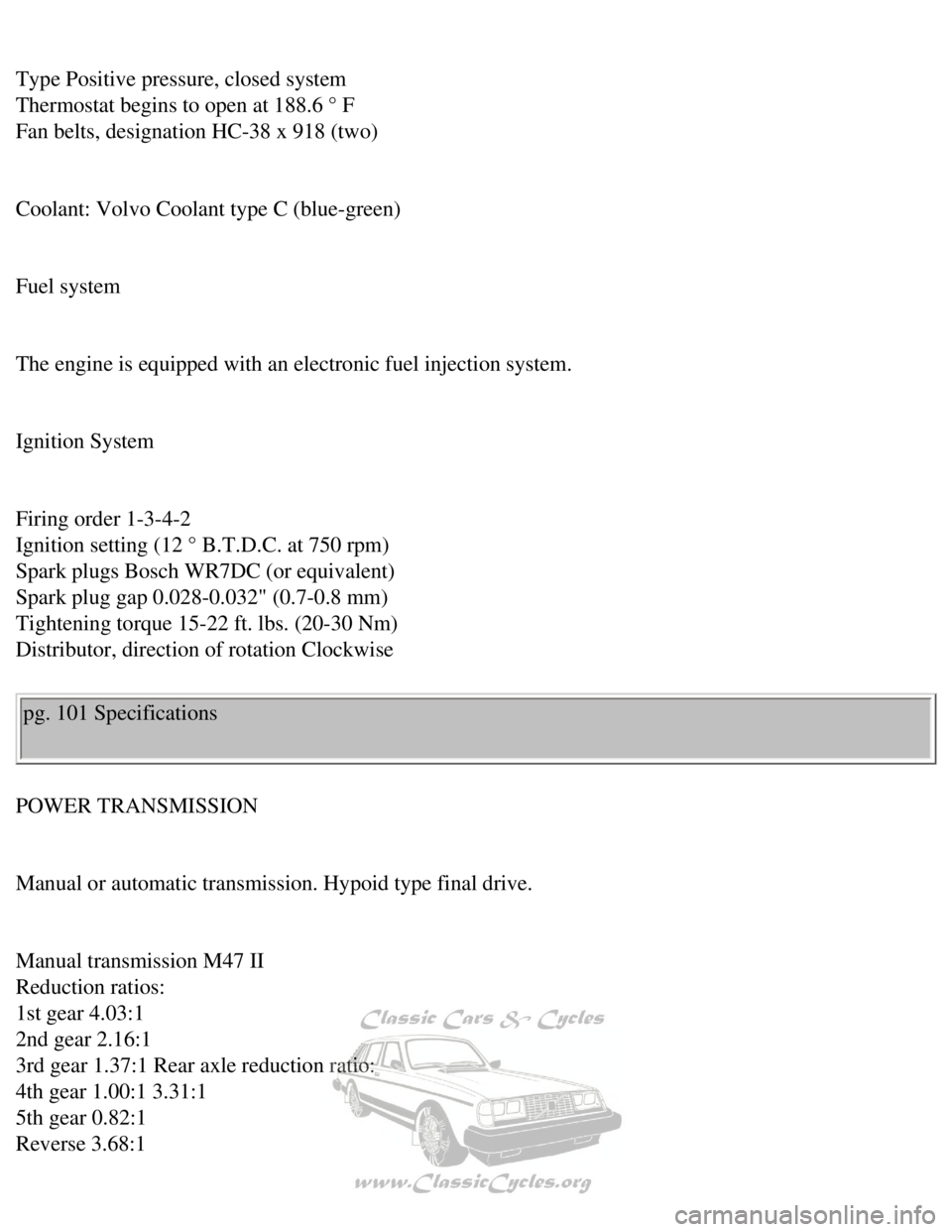
Type Positive pressure, closed system
Thermostat begins to open at 188.6 ° F
Fan belts, designation HC-38 x 918 (two)
Coolant: Volvo Coolant type C (blue-green)
Fuel system
The engine is equipped with an electronic fuel injection system.
Ignition System
Firing order 1-3-4-2
Ignition setting (12 ° B.T.D.C. at 750 rpm)
Spark plugs Bosch WR7DC (or equivalent)
Spark plug gap 0.028-0.032" (0.7-0.8 mm)
Tightening torque 15-22 ft. lbs. (20-30 Nm)
Distributor, direction of rotation Clockwise pg. 101 Specifications
POWER TRANSMISSION
Manual or automatic transmission. Hypoid type final drive.
Manual transmission M47 II
Reduction ratios:
1st gear 4.03:1
2nd gear 2.16:1
3rd gear 1.37:1 Rear axle reduction ratio:
4th gear 1.00:1 3.31:1
5th gear 0.82:1
Reverse 3.68:1
file:///K|/ownersdocs/1990/1990_240/90240_20.htm (5 of 14)12/30/2006 8\
:25:15 AM


 114 hp at 5400 rpm (85 kW at 90 rps)
Max. t")