1990 VOLKSWAGEN CORRADO heating
[x] Cancel search: heatingPage 459 of 906
E - THEORY/OPERATION - DIGIFANT
Article Text (p. 9)
1990 Volkswagen Corrado
For Volkswagen Technical Site: http://vw.belcom.ru
Copyright © 1998 Mitchell Repair Information Company, LLC
Thursday, March 23, 2000 09:43PM
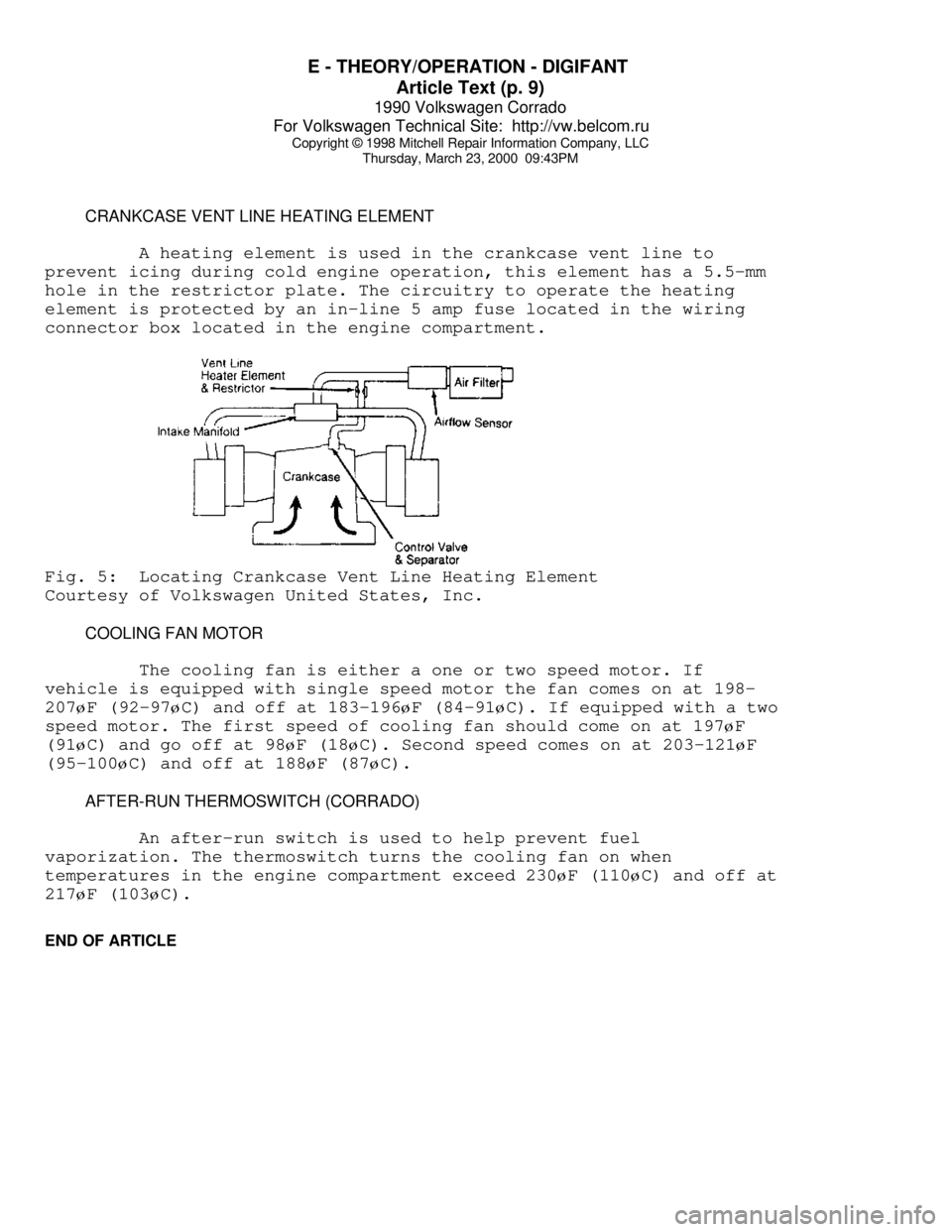
CRANKCASE VENT LINE HEATING ELEMENT
A heating element is used in the crankcase vent line to
prevent icing during cold engine operation, this element has a 5.5-mm
hole in the restrictor plate. The circuitry to operate the heating
element is protected by an in-line 5 amp fuse located in the wiring
connector box located in the engine compartment.Fig. 5: Locating Crankcase Vent Line Heating Element
Courtesy of Volkswagen United States, Inc.
COOLING FAN MOTOR
The cooling fan is either a one or two speed motor. If
vehicle is equipped with single speed motor the fan comes on at 198-
207øF (92-97øC) and off at 183-196øF (84-91øC). If equipped with a two
speed motor. The first speed of cooling fan should come on at 197
øF
(91
øC) and go off at 98øF (18øC). Second speed comes on at 203-121øF
(95-100
øC) and off at 188øF (87øC).
AFTER-RUN THERMOSWITCH (CORRADO)
An after-run switch is used to help prevent fuel
vaporization. The thermoswitch turns the cooling fan on when
temperatures in the engine compartment exceed 230
øF (110øC) and off at
217
øF (103øC).
END OF ARTICLE
Page 564 of 906
FUSES & CIRCUIT BREAKERS
Article Text (p. 2)
1990 Volkswagen Corrado
For Volkswagen Technical Site: http://vw.belcom.ru
Copyright © 1998 Mitchell Repair Information Company, LLC
Thursday, March 23, 2000 09:45PM
Right Tail & Side Lights
8 - 10 Amp
Left Tail & Side Lights
9 - 20 Amp
Rear Window & Mirror Heating
10 - 15 Amp
Foglights
11 - 10 Amp
Left High Beam, High Beam Indicator
12 - 10 Amp
Right High Beam
13 - 10 Amp
Horn, Radiator Fan
14 - 15 Amp
Back-Up Lights, Electric Mirrors, Heated Windshield Washer
Jets
15 - 10 Amp
Engine Electronic
16 - 15 Amp
Warning/Indicator Lights, Multi-Function Indicator, Glove Box
Light, Cassette Storage Light, Rear Spoiler
17 - 10 Amp
Turn Signals
18 - 20 Amp
Fuel Pump, Oxygen Sensor
19 - 30 Amp
Radiator Fan, Air Conditioner
20 - 10 Amp
Brakelights, Cruise Control
21 - 15 Amp
Dome & Luggage Compartment Lights, Cigarette Lighter, Central
Locking System, Multi-Function Indicator
22 - 10 Amp
Radio
CAUTIONS & WARNINGS
ELECTRICAL SHOCK
WARNING: Contact with live components of ignition system while
engine is running could lead to a fatal electric shock.
RADIATOR FAN
Keep hands away from radiator fan. Fan is controlled by a
thermostatic switch which may come on or run for up to 15 minutes even
after engine is turned off.
RADIATOR CAP
CAUTION: Always disconnect the fan motor when working near the
radiator fan. The fan is temperature controlled and could
Page 566 of 906
FUSES & CIRCUIT BREAKERS
Article Text (p. 4)
1990 Volkswagen Corrado
For Volkswagen Technical Site: http://vw.belcom.ru
Copyright © 1998 Mitchell Repair Information Company, LLC
Thursday, March 23, 2000 09:45PM
position from passenger's side of vehicle in case of
accidental air bag inflation
ANTI-LOCK BRAKE SYSTEM
The anti-lock brake system contains electronic equipment that
can be susceptible to interference caused by improperly installed or
high output radio transmitting equipment. Since this interference
could cause the possible loss of the anti-lock braking capability,
such equipment should be installed by qualified professionals.
CATALYTIC CONVERTER
To prevent catalytic converter overheating, DO NOT allow
engine to idle for more than 20 minutes.
END OF ARTICLE
Page 572 of 906
GENERAL COOLING SYSTEM SERVICING
Article Text (p. 2)
1990 Volkswagen Corrado
For Volkswagen Technical Site: http://vw.belcom.ru
Copyright © 1998 Mitchell Repair Information Company, LLC
Thursday, March 23, 2000 09:45PM
To flush engine, remove thermostat and replace housing.
Connect flushing gun to water outlet of engine. Flush using short air
bursts until water runs clean.
Heater Core
Flush heater core as described for radiator. Ensure heater
control valve is set to maximum heat position before flushing heater.
REFILLING
To prevent air from being trapped in engine block, engine
should be running when refilling cooling system. After system is full,
continue running engine until thermostat is open, then recheck fill
level. Do not overfill system.
TESTING
THERMOSTAT
1) Visually inspect thermostat for corrosion and proper
sealing of valve and seat. If okay, suspend thermostat and thermometer
in a 50/50 mixture of coolant and water. See Fig. 1. Do not allow
thermostat or thermometer to touch bottom of container. Heat water
until thermostat just begins to open.
2) Read temperature on thermometer. This is the initial
opening temperature and should be within specification. Continue
heating water until thermostat is fully open and note temperature.
This is the fully opened temperature. If either reading is not to
specification, replace thermostat.Fig. 1: Testing Thermostat in Anti-Freeze/Water Solution
PRESSURE TESTING
A pressure tester is used to check both radiator cap and
complete cooling system. Test components as follows, following tool
Page 577 of 906

H - TESTS W/O CODES
Article Text (p. 4)
1990 Volkswagen Corrado
For Volkswagen Technical Site: http://vw.belcom.ru
Copyright © 1998 Mitchell Repair Information Company, LLC
Thursday, March 23, 2000 09:45PM
cleaning additives. Prolonged use of poor quality fuel can
cause injector clogging and carbon build-up on intake system.
ENGINE MISFIRES OR HESITATES
CIS-E & CIS-E MOTRONIC
* Ensure injector spray patterns and volume are correct. Replace
faulty injectors.
* Check fuel system and control system pressure. Replace pressure
regulator if necessary.
* Check Oxygen (O2) sensor system operation.
* Check fuel lines and connections for leaks.
* Test coolant temperature sensor and wiring. Repair or replace
as required.
* Check airflow meter and throttle switch. Replace if faulty.
* Ensure vacuum hoses are not disconnected or damaged.
* Ensure electrical harness connectors and wires are not
broken or loose.
* Check cold start valve for leaking (engine warm).
DIGIFANT II
* Check airflow sensor flap and sensor resistance. Replace
if faulty.
* Inspect intake air components for leaking hoses, connections
or cracks. Repair as required.
* Test intake air preheating system. Replace faulty components
as required.
* Check fuel system and control system pressure. Replace pressure
regulator if necessary.
* Ensure vacuum hoses are not disconnected or damaged.
* Ensure electrical harness connectors and wires are not
broken or loose.
* Check cold start valve for leaking (engine warm).
* Check coolant temperature sensor operation.
* Check Oxygen (O2) sensor voltage output.
EXCESSIVE FAST IDLE
* Inspect accelerator pedal and cable for worn parts or binding.
* Test idle switch (if equipped).
* Test auxiliary air regulator and replace if necessary
(if equipped).
* Inspect throttle valve and adjust or replace as required.
* Check carbon canister solenoid valves (CIS-E Motronic).
* Test idle boost valve system operation (1.8L 8-valve engine
only). Replace faulty parts as necessary.
* Test coolant temperature sensor and wiring (Digifant II). Repair
or replace as required.
* Check throttle cable adjustment.
* Verify vacuum hose routing is correct.
Page 578 of 906

H - TESTS W/O CODES
Article Text (p. 5)
1990 Volkswagen Corrado
For Volkswagen Technical Site: http://vw.belcom.ru
Copyright © 1998 Mitchell Repair Information Company, LLC
Thursday, March 23, 2000 09:45PM
* Ensure there are no vacuum leaks.
* Check idle stabilizer operation (if equipped).
* Ensure fuel system pressure and volume are correct.
* Check auxiliary air by-pass regulator.
* Check cold start valve for leaking (engine warm).
ENGINE HESITATES ON ACCELERATION
* Inspect intake air components for leaking hoses
* Check injector spray pattern. Check for faulty injectors.
* Check cold start valve for leaking (engine warm).
* Check airflow sensor plate movement. Replace fuel distributor
as necessary.
* Check airflow sensor plate position. Adjust as necessary.
* Check fuel system and control system pressure. Replace pressure
regulator if necessary.
* Test airflow sensor plate potentiometer. Adjust or replace
as necessary.
* Perform system electrical checks.
* Check idle mixture CO adjustment. Adjust as necessary.
ENGINE LACKS POWER
* Test coolant temperature sensor and wiring. Repair or
replace as required.
* Check fuel system and control system pressure. Replace pressure
regulator if necessary.
* Check throttle cable adjustment.
* Check throttle switch. Adjust or replace as necessary.
* Check airflow sensor screen for damage or incorrect installation
(if equipped).
* Check ignition timing and knock sensor control (if equipped).
Adjust as necessary.
* Check EGR system for correct operation (if equipped).
* Ensure base timing is correct and timing advance system
is functional.
* Check transmission for correct downshift (auto. trans.)
* Check fuel tank filler tube for tampering of restrictor. If
tampering has occurred, check catalytic converter for lead
contamination and exhaust system restriction.
* Check for use of poor quality fuel containing insufficient
cleaning additives. Prolonged use of poor quality fuel can
cause injector clogging and carbon build-up on intake system.
* Inspect intake air element, housing, and preheating system.
* Check airflow sensor plate movement. Replace if necessary.
POOR FUEL MILEAGE
* Ensure idle speed, base timing and timing advance are
set to specifications.
* Check cold start valve for leaking (engine warm).
Page 579 of 906

H - TESTS W/O CODES
Article Text (p. 6)
1990 Volkswagen Corrado
For Volkswagen Technical Site: http://vw.belcom.ru
Copyright © 1998 Mitchell Repair Information Company, LLC
Thursday, March 23, 2000 09:45PM
* Check fuel system and control system pressure. Replace
pressure regulator if necessary.
* Check thermo time switch operation.
* Check airflow sensor voltage output.
* Check air induction system for leaks.
* Check fuel injector operation.
* Check coolant temperature sensor operation.
* Check Oxygen (O2) sensor operation.
ENGINE DIESELING
CIS-E & CIS-E MOTRONIC
* Ensure ignition timing and timing advance are set to
specifications.
* Check for engine overheating.
* Check cold start valve for leaking (engine warm).
* Check for leaking injectors.
* Check airflow sensor plate/control plunger rest position.
Adjust as necessary.
* Check carbon canister solenoid valve.
* Verify no leaks in exhaust system.
FAILED EMISSIONS TEST
* Test lambda control system. Replace if faulty.
* Check air/fuel mixture. Adjust if necessary.
* Ensure air intake system is not restricted.
* Ensure engine is at normal operating temperature.
* Ensure fuel system pressure is correct.
* Check cold start valve for leaking (engine warm).
* Check thermo time switch operation.
* Verify base timing is correct.
* Check for correct PCV valve operation.
* Check crankcase for gasoline contamination.
* Check idle stabilizer operation.
* Check EGR system for correct operation (if equipped).
* Check vapor recovery system operation.
* Check operation of coolant temperature sensor.
* Check fuel tank filler tube for tampering of restrictor.
If tampering has occurred, check catalytic converter for
lead contamination and exhaust system restriction.
* Check for use of poor quality fuel containing insufficient
cleaning additives. Prolonged use of poor quality fuel can
cause injector clogging and carbon build-up on intake system.
INTERMITTENT PROBLEM DIAGNOSIS
Intermittent fault testing requires duplicating circuit or
component failure to identify the problem. If necessary, monitor
voltage or resistance values using a DVOM while attempting to
Page 581 of 906

HEATER SYSTEM
Article Text
1990 Volkswagen Corrado
For Volkswagen Technical Site: http://vw.belcom.ru
Copyright © 1998 Mitchell Repair Information Company, LLC
Thursday, March 23, 2000 09:45PM
ARTICLE BEGINNING
1990 HEATER SYSTEMS
Volkswagen
Cabriolet, Corrado, Fox, Golf GL, GTI, Jetta,
Jetta GLi, Vanagon
WARNING: To avoid accidental air bag deployment, see AIR BAG
DEACTIVATION SERVICING PRECAUTIONS in this article.
DESCRIPTION
The heater is a water-valve type that combines heating,
defrosting and ventilation into one unit. Controls include fan control
knob and air distribution and temperature control levers. Blower fan
provides 3 speeds.
NOTE: Vanagon heater system information is not available from
manufacturer. For wiring diagram information, see WIRING
DIAGRAMS at end of this article.
OPERATION
When air distribution lever (upper lever) is in the center
stop position and lower temperature control lever is to the far left,
no air enters vehicle. As air distribution lever is moved to the left,
air is directed to floor vents. As distribution lever is moved to the
right, air is directed to defroster vents.
As heater lever (lower lever) is moved to the right, heater
turns on and heat output is increased. As the fan control knob is
turned to the right, the fan turns on and can be switched across its 3
speeds.
AIR BAG DEACTIVATION SERVICING PRECAUTIONS
WARNING: Some models are equipped with driver's side air bag
restraint system. Air bag-equipped vehicles have AIRBAG
stamped on the steering wheel horn pad. Air bag system
capacitor maintains a voltage charge sufficient to cause air
bag deployment for up to 20 MINUTES after ignition switch is
turned off and battery is disconnected.
DISABLING SYSTEM
Ensure ignition switch is OFF. Disconnect negative battery
cable and insulate terminal. Wait at least 20 MINUTES before
proceeding with repairs.
SYSTEM FUNCTIONAL CHECK