1990 HONDA PRELUDE engine
[x] Cancel search: enginePage 55 of 143

Gasoline
For proper operation of your car's emission controls, your engine is
designed to use unleaded fuel only.
CAUTION:
Using leaded or even low-lead gasoline could damage some of your
emission controls, and also void their coverage under the emission
controls warranty.
Use gasoline from pumps labeled unleaded, with a pump octane
number of 86 or higher. The pump octane number is an average of
the Research (R) octane and Motor (M) octane numbers. Use of a
lower octane gasoline can cause persistent, heavy "SPARK
KNOCK" (a metallic rapping noise), which can lead to engine damage
if severe.
CAUTION:
If you notice steady spark knock while holding a steady speed on a
level road, try changing brands of gasoline. If the spark knock persists, consult your Honda dealer. Failure to do so is considered
misuse, and misuse is not covered under the New Car Warranty.
Occasionally you may notice light spark knock while accelerating or
driving up hills. This is no cause for concern, it simply means your engine is running at its most economical.
Gasoline Containing Alcohol
If you decide to use a gasoline containing alcohol ("gasohol"), be
sure its octane rating is at least as high as that recommended for
unleaded gasoline. There are two types of "gasohol": that
containing ethanol, and that containing methanol. Do not use
gasohol that contains more than 10% ethanol. Do not use gasoline
containing methanol (methyl or wood alcohol) that does not also contain cosolvents and corrosion inhibitors for methanol. Never use
gasoline containing more than 5% methanol, even if it hascosolvents and corrosion inhibitors.
(cont'd)ProCarManuals.comMain Menu t s
Page 56 of 143

Gasoline (cont'd)
NOTE:
Fuel system damage or vehicle performance problems resulting
from the use of such fuels is not covered under the new car warranties. Honda cannot endorse the use of fuels containingmethanol since evidence of their suitability is as yet incomplete. Before purchasing fuel from an unfamiliar station, try to confirm
whether the fuel contains alcohol; of what kind, and how much. If
you notice any undesirable operating symptoms after using a
gasoline that contains alcohol, or one that you think contains
alcohol, switch to an unleaded gasoline, as recommended on page 55.
Operation In Foreign Countries In order to comply with U.S. Federal Emissions Regulations, you
must use unleaded fuels of the recommended octane rating. These
fuels may not be available in other countries. If you intend taking your car outside the U.S. or Canada, write to American Honda
Consumer Affairs (stating the year and model of your car) at the
address below for information regarding modifications you mayneed to have done.
American Honda Motor Co., Inc.
Consumer Affairs
100 W. AIondra Blvd.,
Gardena, CA 90248
Fuel Filler Door and Cap
Gasoline is extremely flammable and is explosive under certain
conditions. Perform this operation in a well-ventilated area with
the engine stopped. Do not smoke or allow open flames or sparks in the area or where gasoline is stored.
The fuel filler door is opened by pulling up on the lever at the leftside of the driver's seat.
The door will lock automatically when closed; push it until it clicks.
CAUTION:
You may hear a hiss when you open the filler cap. This sound is residual pressure escaping from the fuel tank. Open the cap slowly
and remove the cap after the hissing stops. Do not overfill the tank;
fill only until the gas pump clicks off automatically and never top off.ProCarManuals.comMain Menu t s
Page 57 of 143

Open
Close
Fuel vapor is extremely hazardous under certain conditions.
Always stop the engine before refueling, and never refuel near
sparks or open flames.
CAUTION:
When reinstalling the fuel cap, be sure both tabs on the cap are engaged in the slots of the filler neck and turn the cap until it stops.
If you replace the cap, use only a genuine Honda replacement part
or Its equivalent. Failure to use the proper part could cause serious
fuel system problems.
How to Improve Your Gas Mileage:
Drive at a smooth, steady pace to avoid unnecessary
decelerations and stops — accelerating back to speed uses more
fuel.
Plan trips to avoid rush hour traffic if possible.Make sure the parking brake is completely released.
Consolidate trips whenever possible.
Keep vehicle weight to a minimum by removing unnecessary
items from the luggage area.
Whenever possible, use fresh air from the dash vents to keep
cool when driving; open windows, or use of the air conditioningboth affect fuel economy.
Keep the tires adjusted to the recommended pressure.
Tire Pressure (measured cold)
Front: 195 kPa (28 psi)
Rear: 180 kPa (26 psi)
195 kPa (28 psi) : (Si with 4WS)
Condition of Your Car
You can only get maximum fuel economy if your car is in top running condition. Have all required maintenance done at theproper intervals. Check tire pressures and tire wear frequently. If
tire wear is uneven, have the alignment checked by your Honda dealer. Proper alignment saves gasoline and prolongs tire life.
RELEASE LEVER
Pull upProCarManuals.comMain Menu t s
Page 61 of 143

Starting the Engine
Before Starting
Manual Transmission:
1 . Apply the parking brake.
2 . Push the clutch pedal all the way in (see NOTE below).
3 . Shift the transmission to neutral.
NOTE:
On cars equipped with manual transmissions, the engine will
not crank unless the clutch pedal is fully depressed.
Automatic Transmission: 1. Make sure the shift lever is in Park (P).
2. Apply the parking brake and the foot brake.
Starting a Cold Engine(2.0 S)
NOTE:
When starting in cold weather, keep all unnecessary electrical
circuits off (lights, defogger, etc.) for the best battery output.
1. Above 32°F(0°C) Push the accelerator to the floor 1 time and slowly release it.
Below 32°F(0°C)
Push the accelerator to the floor 2 or 3 times and slowly
release it.
Below 0°F(-18°C)
Push the accelerator to the floor 3 or 4 times and slowly
release it.
DO NOT pump while cranking.
2. With your foot OFF the accelerator, crank the engine until it starts and runs. (It may require more than 5 seconds of cranking.)
NOTE:
If the engine won't start, push the accelerator pedal down 1 more
time and slowly release it, then start the engine.Repeat once more if necessary,
If the engine still won't start, push the accelerator down about halfway; hold it there and crank the engine until it starts. Once the
engine starts, release the accelerator gradually as the enginewarms up.If the engine doesn't start within 15 seconds of cranking, turn the
key off
and wait 10 seconds before trying again.
3. If the outside temperature is below freezing, or if your car has not been driven for several days, warm up the engine for a few
minutes before driving.
(cont'd)ProCarManuals.comMain Menu t s
Page 62 of 143

Starting the Engine (cont'd)
Starting a Warm Engine (2.0 S)
Start it without pushing the accelerator down. If it won't start, push
the accelerator pedal about halfway and hold it there while cranking the engine until it starts. It may take 20 to 30 seconds of cranking. DO NOT pump the accelerator.
Once the engine starts, release the accelerator gradually as the
engine speeds up.
Starting the Engine (2.0 Si,Si) NOTE: When starting in cold weather, keep all unnecessary electrical
circuits off (lights, defogger, etc.) for the best battery output.
Do not crank the engine for more than 15 seconds at a time. Wait
10 seconds before going to the next step.
1. With YOUR FOOT OFF THE ACCELERATOR start the engine by turning the key to the III position.
2. If the engine won't start within 15 seconds or starts but fails to continue to run, push the accelerator pedal halfway, and hold it
there while cranking the engine. Once the engine starts, release
the accelerator gradually as the engine speeds up.
3. If it doesn't start within 15 seconds, push the accelerator pedal down to the floor and hold it there while cranking in order to clear
flooding. Try step 2 again.
Cold Weather at High Altitude Starting (2.0 Si,Si) NOTE: When starting in cold weather, keep all unnecessary electrical
circuits off (lights, defogger, etc.) for the best battery output.
Do not crank the engine for more than 15 seconds at a time. Wait
10 seconds before going to the next step.
1. When starting in cold weather at high altitude (above 8,000 feet), push the accelerator pedal about halfway and hold it there while
cranking the engine. Once the engine starts, release the
accelerator gradually as the engine speeds up.
2. If it doesn't start within 15 seconds, push the accelerator pedal down to the floor and hold it there while cranking in order to clear
flooding. Try step 1 again.
NOTE:
If the outside temperature is below freezing, or if your car has not
been driven for several days, warm up the engine for a few minutes
before driving.ProCarManuals.comMain Menu t s
Page 64 of 143
Engine Exhaust Gas Warning
A properly maintained car is your best protection against exhaust
gas entering the passenger compartment. The exhaust system should be thoroughly inspected by acompetent mechanic whenever:
The car is raised for an oil change.
You notice a change in the sound of the exhaust.
The exhaust system or the rear or underside of the car is
damaged.
Avoid breathing exhaust gases. They contain carbon monoxide, which is a colorless, odorless gas that can cause loss of
consciousness and eventual death. If you suspect that exhaust gas is entering the passenger compartment, have the cause
determined and corrected as soon as possible. If you must drive
under these conditions, drive only with all windows fully open. Do not drive with the trunk lid open. An open trunk may draw
exhaust gases into the passenger compartment. If you must
drive with the trunk lid open, drive only with all the windows
wide open.
Do not run the engine in confined areas, such as garages, any
longer than necessary to move the car in or out. If you must sit in a parked car with the engine running for more
than a short time, adjust the heating/ventilation system as
follows:
1. Push the
and buttons on.
2. Set the temperature lever for best comfort.
3.Turn the fan to the highest speed.
NOTE:
To insure proper operation of the car's ventilation system, keep the
front air inlet clear of snow, mud, leaves or other obstructions.ProCarManuals.comMain Menu t s
Page 65 of 143
Shifting the 5 Speed
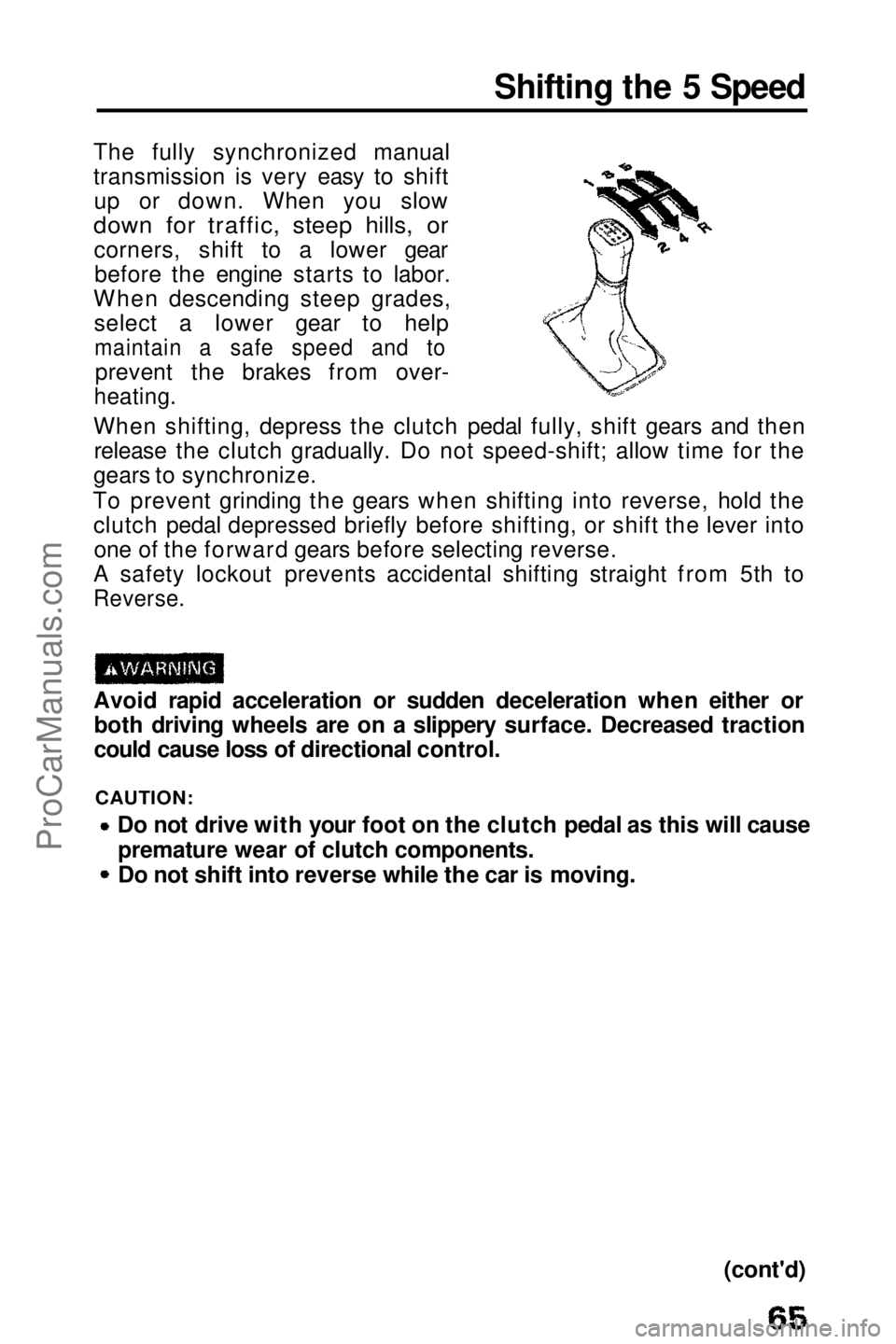
The fully synchronized manual
transmission is very easy to shift up or down. When you slow
down for traffic, steep hills, or
corners, shift to a lower gearbefore the engine starts to labor.
When descending steep grades, select a lower gear to help
maintain a safe speed and to
prevent the brakes from over-
heating.
When shifting, depress the clutch pedal fully, shift gears and then release the clutch gradually. Do not speed-shift; allow time for the
gears to synchronize.
To prevent grinding the gears when shifting into reverse, hold the clutch pedal depressed briefly before shifting, or shift the lever intoone of the forward gears before selecting reverse.
A safety lockout prevents accidental shifting straight from 5th to
Reverse.
Avoid rapid acceleration or sudden deceleration when either or both driving wheels are on a slippery surface. Decreased traction
could cause loss of directional control.
CAUTION:
Do not drive with your foot on the clutch pedal as this will causepremature wear of clutch components.
Do not shift into reverse while the car is moving.
(cont'd)ProCarManuals.comMain Menu t s
Page 66 of 143
Shifting the 5 Speed (cont'd)
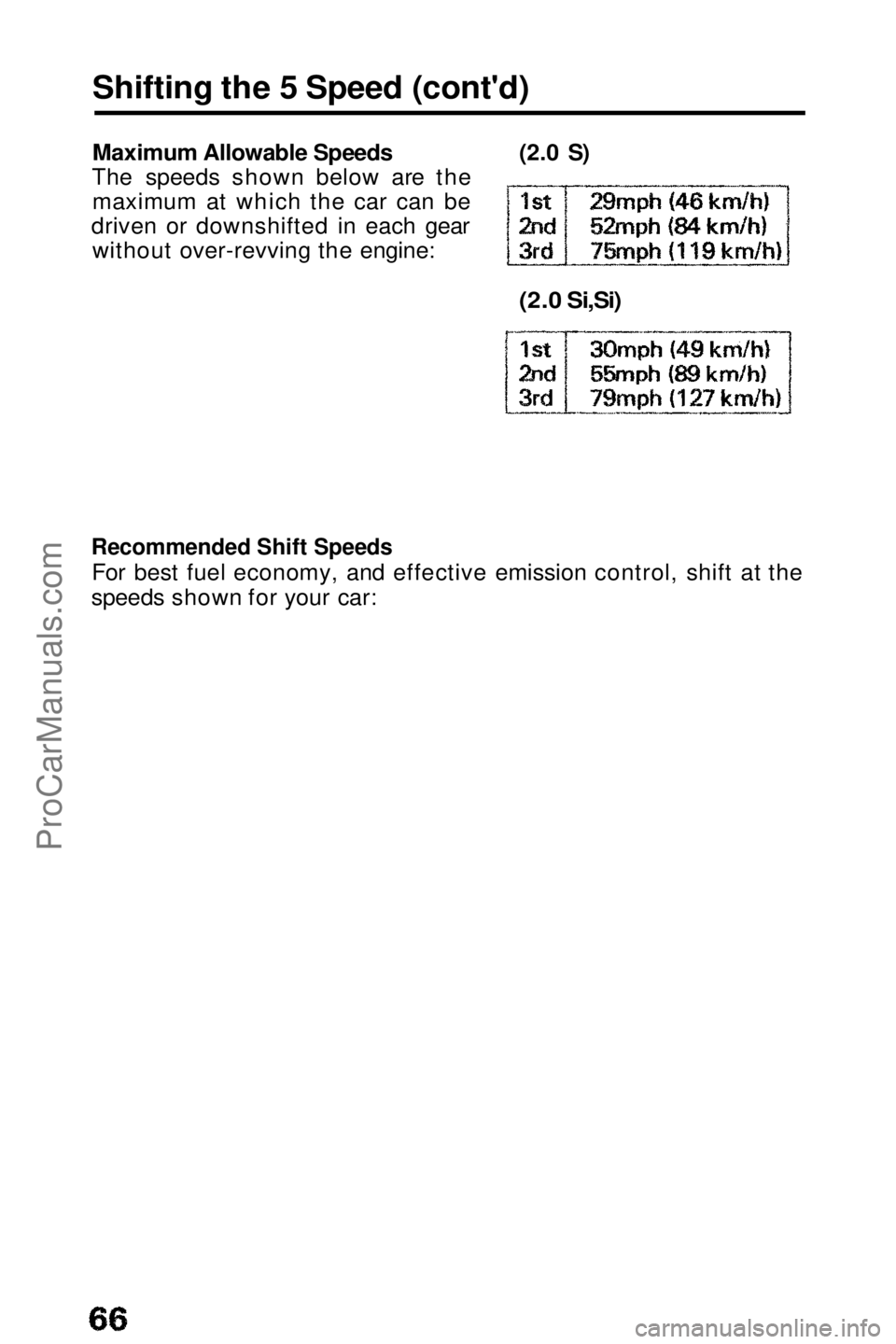
Maximum Allowable Speeds
The speeds shown below are the maximum at which the car can be
driven or downshifted in each gear without over-revving the engine: (2.0 S)
(2.0 Si,Si)
Recommended Shift Speeds
For best fuel economy, and effective emission control, shift at the
speeds shown for your car:ProCarManuals.comMain Menu t s