1990 HONDA PRELUDE brake
[x] Cancel search: brakePage 53 of 143
Sunroof
Sunroof
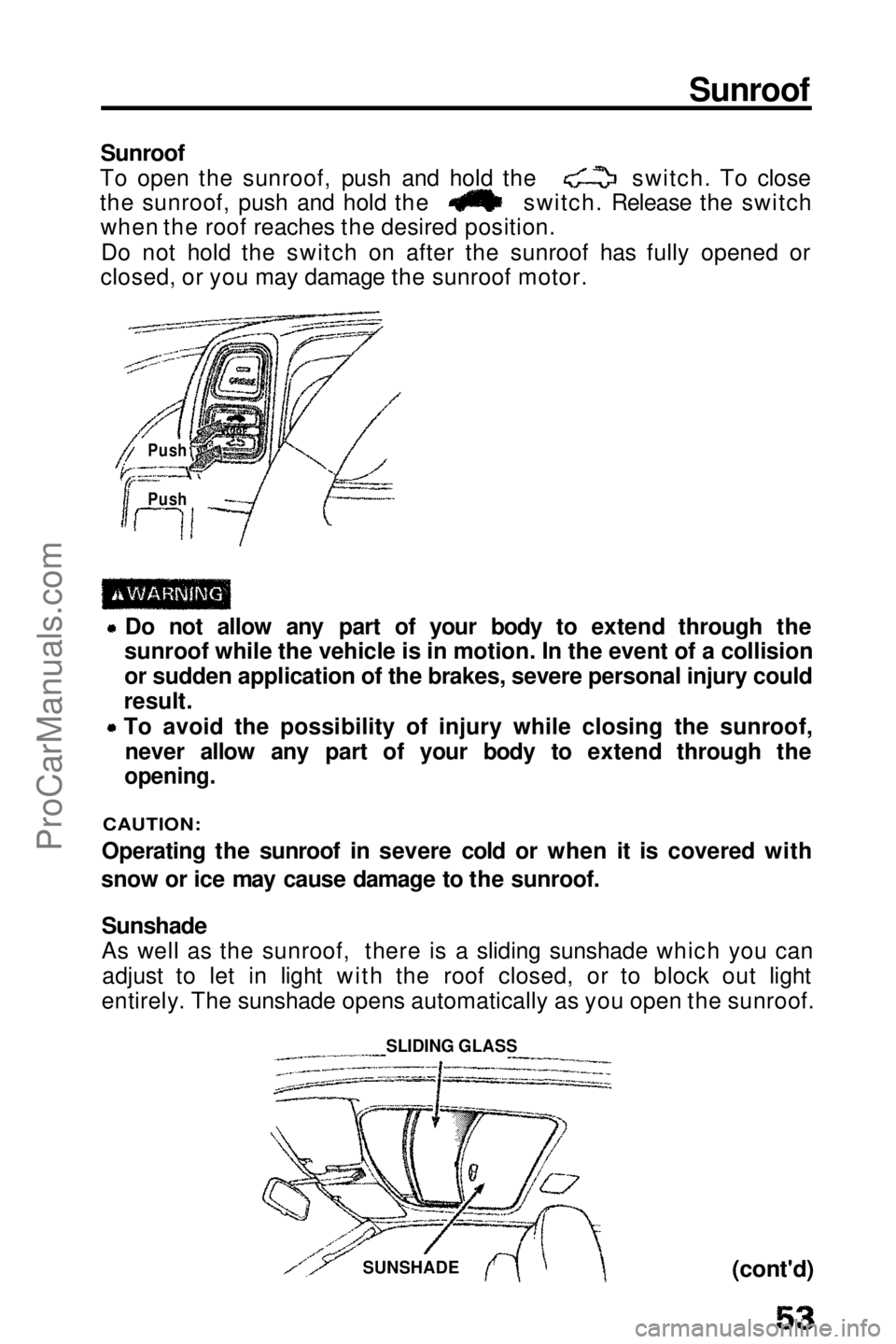
To open the sunroof, push and hold the switch. To close
the sunroof, push and hold the switch. Release the switch
when the roof reaches the desired position.
Do not hold the switch on after the sunroof has fully opened or
closed, or you may damage the sunroof motor. Do not allow any part of your body to extend through the
sunroof while the vehicle is in motion. In the event of a collision
or
sudden application of the brakes, severe personal injury could
result.
To avoid the possibility of injury while closing the sunroof,
never allow
any part of your body to extend through the
opening.
CAUTION:
Operating the sunroof in severe cold or when it is covered with
snow or ice may cause damage to the sunroof.
Sunshade
As well as the sunroof, there is a sliding sunshade which you canadjust to let in light with the roof closed, or to block out light
entirely. The sunshade opens automatically as you open the sunroof.
(cont'd)
Push
Push
SUNSHADE
SLIDING GLASSProCarManuals.comMain Menu t s
Page 57 of 143

Open
Close
Fuel vapor is extremely hazardous under certain conditions.
Always stop the engine before refueling, and never refuel near
sparks or open flames.
CAUTION:
When reinstalling the fuel cap, be sure both tabs on the cap are engaged in the slots of the filler neck and turn the cap until it stops.
If you replace the cap, use only a genuine Honda replacement part
or Its equivalent. Failure to use the proper part could cause serious
fuel system problems.
How to Improve Your Gas Mileage:
Drive at a smooth, steady pace to avoid unnecessary
decelerations and stops — accelerating back to speed uses more
fuel.
Plan trips to avoid rush hour traffic if possible.Make sure the parking brake is completely released.
Consolidate trips whenever possible.
Keep vehicle weight to a minimum by removing unnecessary
items from the luggage area.
Whenever possible, use fresh air from the dash vents to keep
cool when driving; open windows, or use of the air conditioningboth affect fuel economy.
Keep the tires adjusted to the recommended pressure.
Tire Pressure (measured cold)
Front: 195 kPa (28 psi)
Rear: 180 kPa (26 psi)
195 kPa (28 psi) : (Si with 4WS)
Condition of Your Car
You can only get maximum fuel economy if your car is in top running condition. Have all required maintenance done at theproper intervals. Check tire pressures and tire wear frequently. If
tire wear is uneven, have the alignment checked by your Honda dealer. Proper alignment saves gasoline and prolongs tire life.
RELEASE LEVER
Pull upProCarManuals.comMain Menu t s
Page 61 of 143

Starting the Engine
Before Starting
Manual Transmission:
1 . Apply the parking brake.
2 . Push the clutch pedal all the way in (see NOTE below).
3 . Shift the transmission to neutral.
NOTE:
On cars equipped with manual transmissions, the engine will
not crank unless the clutch pedal is fully depressed.
Automatic Transmission: 1. Make sure the shift lever is in Park (P).
2. Apply the parking brake and the foot brake.
Starting a Cold Engine(2.0 S)
NOTE:
When starting in cold weather, keep all unnecessary electrical
circuits off (lights, defogger, etc.) for the best battery output.
1. Above 32°F(0°C) Push the accelerator to the floor 1 time and slowly release it.
Below 32°F(0°C)
Push the accelerator to the floor 2 or 3 times and slowly
release it.
Below 0°F(-18°C)
Push the accelerator to the floor 3 or 4 times and slowly
release it.
DO NOT pump while cranking.
2. With your foot OFF the accelerator, crank the engine until it starts and runs. (It may require more than 5 seconds of cranking.)
NOTE:
If the engine won't start, push the accelerator pedal down 1 more
time and slowly release it, then start the engine.Repeat once more if necessary,
If the engine still won't start, push the accelerator down about halfway; hold it there and crank the engine until it starts. Once the
engine starts, release the accelerator gradually as the enginewarms up.If the engine doesn't start within 15 seconds of cranking, turn the
key off
and wait 10 seconds before trying again.
3. If the outside temperature is below freezing, or if your car has not been driven for several days, warm up the engine for a few
minutes before driving.
(cont'd)ProCarManuals.comMain Menu t s
Page 63 of 143

Safety Items
Before driving away, check that: The doors are closed properly. The mirrors are properly adjusted, and the windows clean.
The driver and passengers are wearing properly adjusted seat
belts.
The head restraints are properly adjusted.
The warning and indicator lights are operating properly.
The brake pedal feels normal.
All luggage and cargo is secured.
Nothing is interfering with the driver's feet or blocking vision to
the rear.
While driving remember to: Always drive defensively; expect the unexpected. Reduce your speed during night hours and bad weather.
Follow at a safe distance; don't tailgate.
Get off the highway when you are tired; stop and take a rest.
When stopping for repairs: Park the car well off the road.
Turn on the hazard warning flasher. Use flares or other warning devices to warn other motorists.
After parking your car: Apply the parking brake and shift to first gear if equipped withmanual transmission, or PARK on automatic transmission
equipped cars.
Make sure the windows are closed and all doors are locked.
If parked on a hill:
Turn the front wheels away from the curb if facing uphill.
Turn the front wheels toward the curb if facing downhill. Never leave children unattended in a parked car.
Take your
keys.ProCarManuals.comMain Menu t s
Page 65 of 143
Shifting the 5 Speed
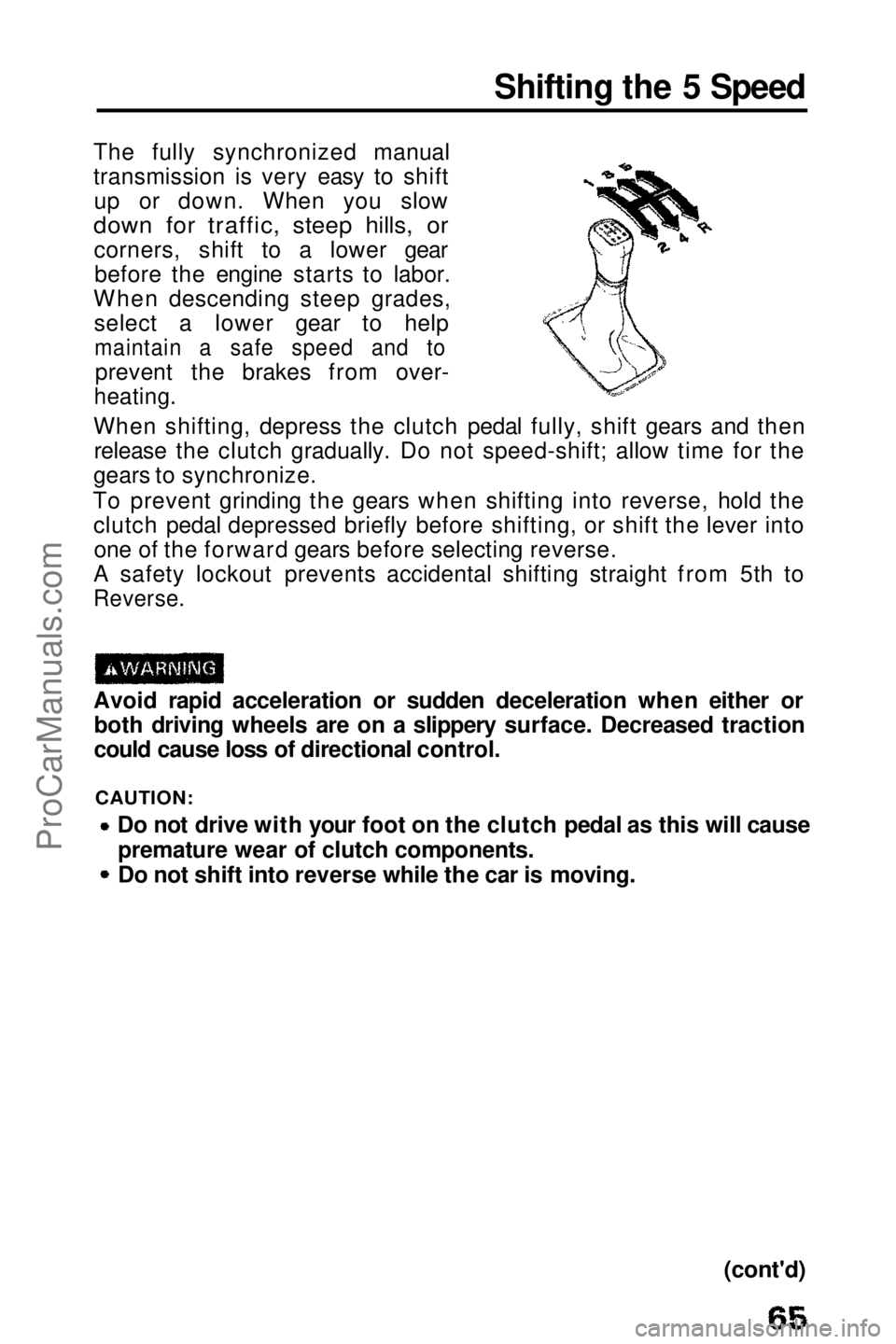
The fully synchronized manual
transmission is very easy to shift up or down. When you slow
down for traffic, steep hills, or
corners, shift to a lower gearbefore the engine starts to labor.
When descending steep grades, select a lower gear to help
maintain a safe speed and to
prevent the brakes from over-
heating.
When shifting, depress the clutch pedal fully, shift gears and then release the clutch gradually. Do not speed-shift; allow time for the
gears to synchronize.
To prevent grinding the gears when shifting into reverse, hold the clutch pedal depressed briefly before shifting, or shift the lever intoone of the forward gears before selecting reverse.
A safety lockout prevents accidental shifting straight from 5th to
Reverse.
Avoid rapid acceleration or sudden deceleration when either or both driving wheels are on a slippery surface. Decreased traction
could cause loss of directional control.
CAUTION:
Do not drive with your foot on the clutch pedal as this will causepremature wear of clutch components.
Do not shift into reverse while the car is moving.
(cont'd)ProCarManuals.comMain Menu t s
Page 67 of 143

Shifting the Automatic
The automatic transmission shift lever has a locking mechanism to prevent accidental shifting into Reverse (R), Park (P) or 2nd (2). Also,
the Automatic Shift Lock prevents you from shifting out of Park unless the brake pedal is already depressed and the ignition switch isin the II position.
Push the button on the shift handle to shift into 2nd, Reverse or
Park; depress the brake pedal and then push the button on the shifthandle to shift out of Park.
: Depress the brake pedal first and push the button, then shift.
: Push the button, then shift.
: Shift as desired.
If you cannot shift out of Park with
the brake pedal depressed and the ignition switch in the II position:
1. Turn the ignition switch off and
remove the key.
2. Insert the key in the Shift Lock Release located to the right of the
shift lever.
3. Press and hold the key down, then press the button on the shifthandle and move the shift lever to
Neutral.
4. Return the key to the ignition switch, depress the brake pedal
and restart the engine. Depress
buttonNOTE:
If you
encounter any problem shifting out of Park, have your
authorized Honda dealer check the system as soon as possible. KEY
Insert
SHIFT LOCK RELEASE
(cont'd)ProCarManuals.comMain Menu t s
Page 68 of 143

Operating Tips
For smoother operation, apply the brakes when shifting from
Neutral or Park to a forward or reverse gear.
When parking: bring the car to a stop with the foot brake, hold the brake on and shift into Park, set the hand brake and then turn off
the engine.
NOTE:
Your 4 speed automatic transmission is equipped with a torque
converter lock-up clutch. Because of this, you may notice what
feels like an extra shift as the clutch engages.
CAUTION: Shift into P only after the car has come to a complete stop.
Shift into or out of R only after the car has come to a complete
stop.
Do not "rev-up" the engine when the brake is on and the shift
lever is in D, S, 2 or R.
When stopped on a hill, use the brakes to hold your position, not the accelerator pedal.Do not shift from N or P into D, S, 2 or R when the engine is
above idle speed. Before shifting into gear, make sure your foot
is firmly on the brake pedal. Do not rest your hand on the shift lever or push the shift button
while driving.
Driving Technique
D-4th
Use the D range for normal in-town and highway driving. The car
will start off in 1st and shift automatically to 2nd, 3rd, and 4th. The
further down you push the accelerator, the later the transmission will shift and the faster the car will accelerate.
S3/S4
The "S" shift selector range changes the shift points under part
throttle acceleration, allowing the transmission to stay in each lower
gear for a longer period before automatically upshifting. With the shift selector in the "S" range, the "S3" indicator light in the dashpanel will come on and the transmission will shift from 1st to 2nd
and 3rd but not 4th. This is especially useful when climbing or
descending grades. While driving in the "S" range, the car's performance is improved but fuel economy is reduced.
Shifting the Automatic (cont'd)ProCarManuals.comMain Menu t s
Page 72 of 143

Towing a Trailer (cont'd)
Hitches
Use only a hitch recommended by your Honda dealer. The hitch
should be bolted securely to the car and installed by a qualified
technician. Do not use a hitch designed for temporary installation
and never use one that attaches only to the bumper.
Trailer Brakes and safety chains
The Honda Automobile Division recommends that trailers equippedwith brakes, should conform to any applicable federal and stateregulations, When using a trailer equipped with electric brakes, a
trailer brake controller that connects to the car's electrical system is recommended. Installing a brake controller that connects to the car's
brake hydraulic system could result in brake fluid contamination or
leaks, A safety chain must always be used between the car and the
trailer. Leave sufficient slack in the chain so that it does not bind in
sharp turns. The chain should cross under the trailer tongue to prevent the tongue from dropping to the ground.
Tires
Make sure your car's are properly inflated. Adjust tire pressure
to the recommended tire pressure indicated on the label attached to
the edge of the driver's door.The trailer tires should be of the proper size, load rating and inflated to the pressure recommended
by the trailer manufacturer.
Trailer Lights
Trailer light must comply with federal, state and local regulations. See your local recreation vehicle dealer or rental agency for the
correct type of lighting and wiring for your trailer, Check for correct
operation of the turn signals and stop lights each time you hitch up.
CAUTION:
Connections to your car's electrical system should be made by
your Honda dealer or a qualified electrician.Improper installation
may damage your vehicle's electrical system and cause a
malfunction of the lights.
ProCarManuals.comMain Menu t s