1989 MITSUBISHI GALANT check engine
[x] Cancel search: check enginePage 145 of 1273
FUEL SYSTEM
FUEL SYSTEM
GENERAL INFORMATION
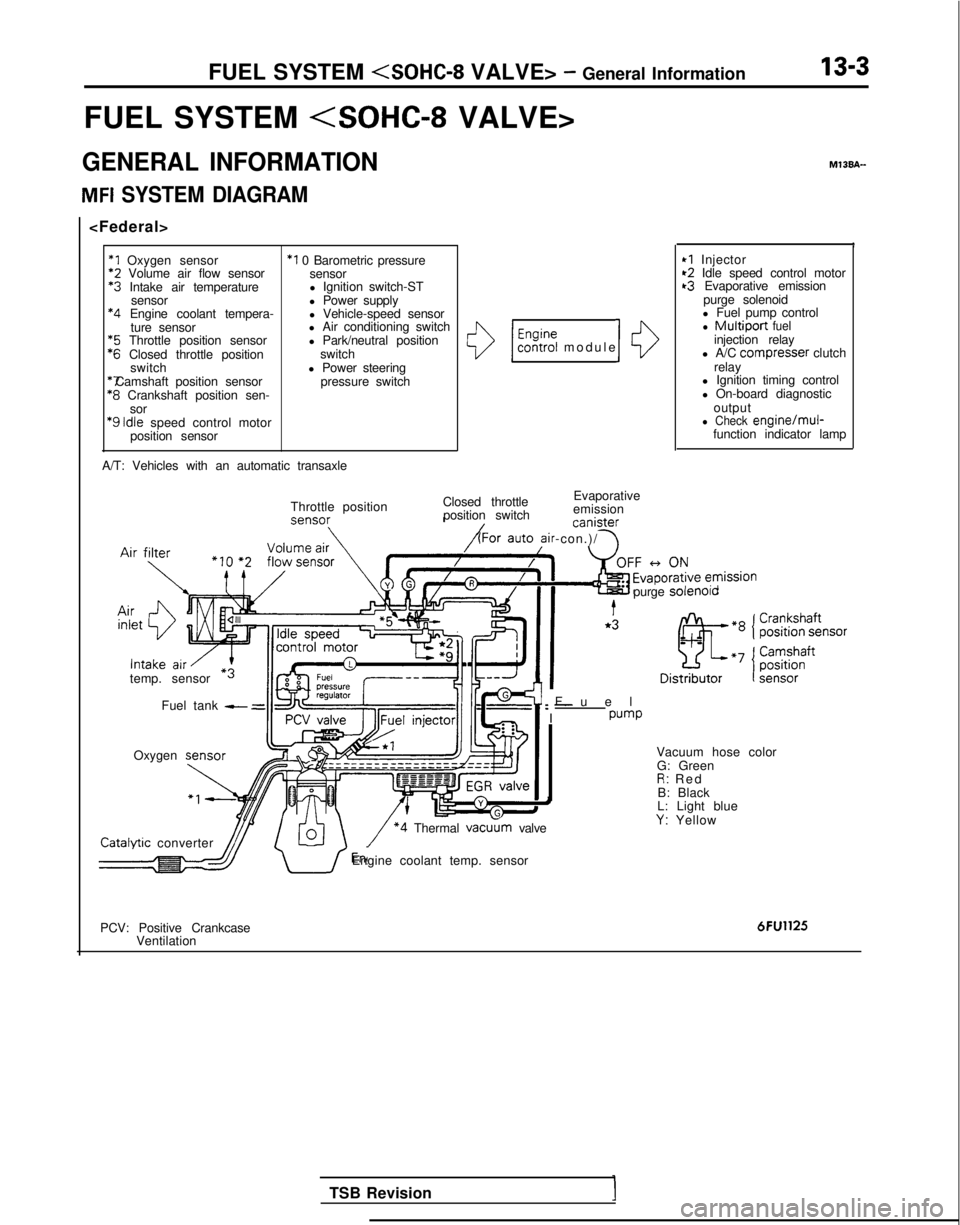
MFI SYSTEM DIAGRAM
*1 Oxygen sensor
*2
Volume air flow sensor *3
Intake air temperature
sensor *4
Engine coolant tempera-
ture sensor *5
Throttle position sensor *6
Closed throttle position
switch *7 Camshaft position sensor
*8
Crankshaft position sen-
sor
‘9 Idle
speed control motor
position sensor
*I 0 Barometric pressure sensor
l Ignition switch-ST
l Power supply
l Vehicle-speed sensor
l Air conditioning switch
l Park/neutral position
switch
l Power steering pressure switch
A/T: Vehicles with an automatic transaxle
()/ $%?i modul
e
Closed throttle Evaporative
position switch emission canister
ir-con.)/ \
10
Throttle position
temp. sensor Fuel tank
- =
Oxygen M13BA-
I
*I Injector~2 Idle speed control motort3 Evaporative emission
purge solenoid
l Fuel pump control
l Multiport fuelinjection relay
l A/C compresser clutch
relay
l Ignition timing control
l On-board diagnostic
output
l Check engine/mul-function indicator lamp
Fue
l
: -
I
pump
purge
solenolo Catalvtic
converter
\/ *4 Thermal vacu
G: Green
R: Re
d
B: Black
L: Light blue
Y: Yellow
dJJ/ U’Engine coolant temp. sensor
PCV: Positive Crankcase Ventilation
6FU1125
TSB Revision
Page 146 of 1273
13-4FUEL SYSTEM
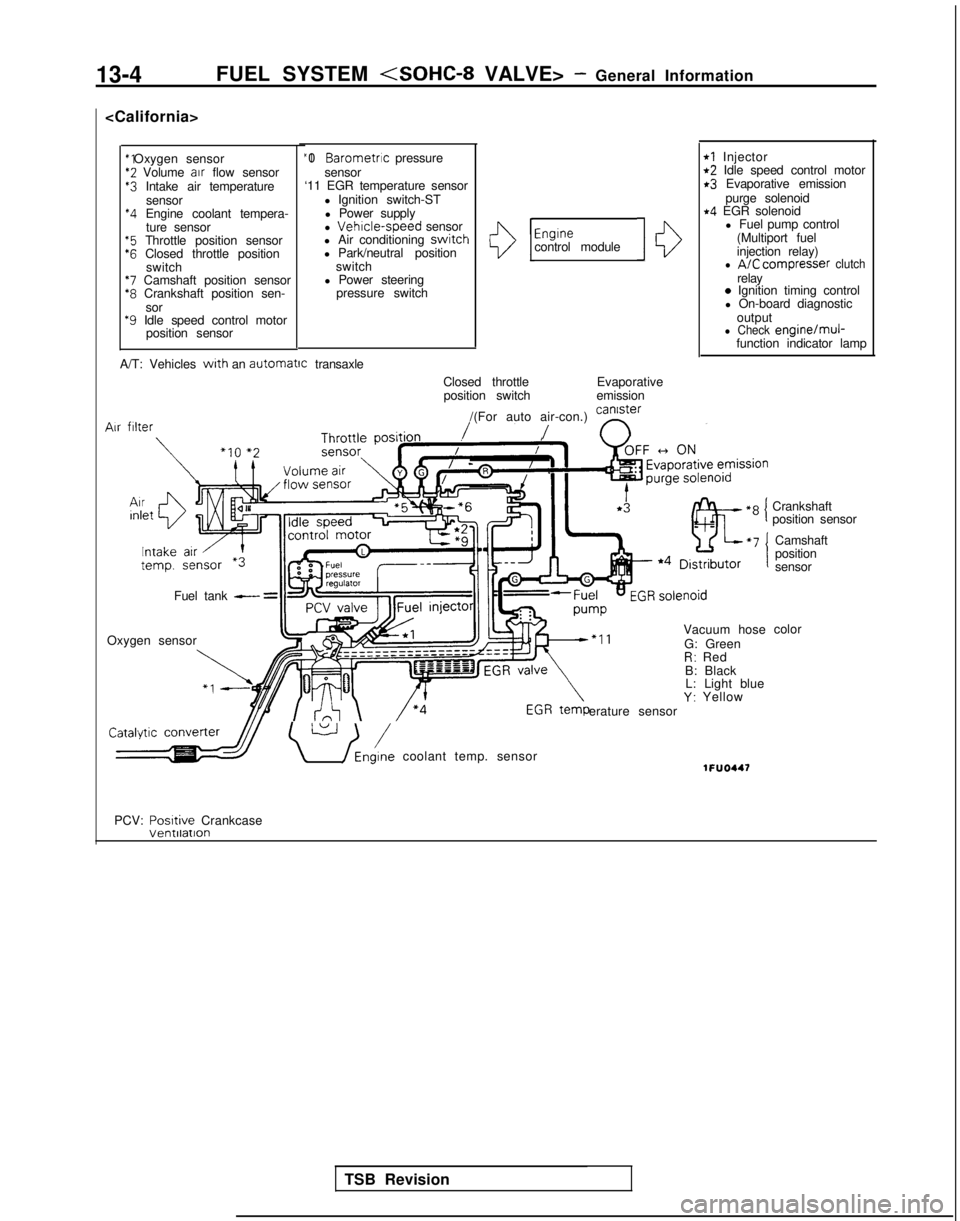
*2 Volume
air
flow sensor$3 Intake air temperature
sensor
*4 Engine coolant tempera-ture sensor
“5 Throttle position sensor‘6 Closed throttle position switch
*7 Camshaft position sensor*8 Crankshaft position sen-
sor
*9 Idle speed control motor position sensor “I 0
Barometric pressure
sensor
‘11 EGR temperature sensor
l Ignition switch-STl Power supply
l
Vehrcle-speed sensor
l Air conditioning switch
l Park/neutral position
switch
l Power steering pressure switchI13
Engrnecontrol module10
rl Injectort2 Idle speed control motorr3 Evaporative emission
purge solenoid
r4 EGR solenoidl Fuel pump control
(Multiport fuel
injection relay)
l A/C compresser clutchrelay0 Ignition timing control
l On-board diagnostic
output
l Check engine/muj-function indicator lamp
A/T: Vehicles
with an automatrc
transaxle
Closed throttleposition switch Evaporative
emission
/(For auto air-con.) can’ster
/ n
Vacuum hose
G: Green
R: Red
B: Black L: Light blue
Y: Yellow
erature sensor Air
filter
Fuel tank - =
Oxygen sensor
\ U /Eni coolant temp. sensor1FUO447
Crankshaft
position sensor
Camshaft
position
sensor
color
PCV: Posrtive
Crankcase
TSB Revision
Page 150 of 1273
13-8
FUEL SYSTEM
TROUBLESHOOTING
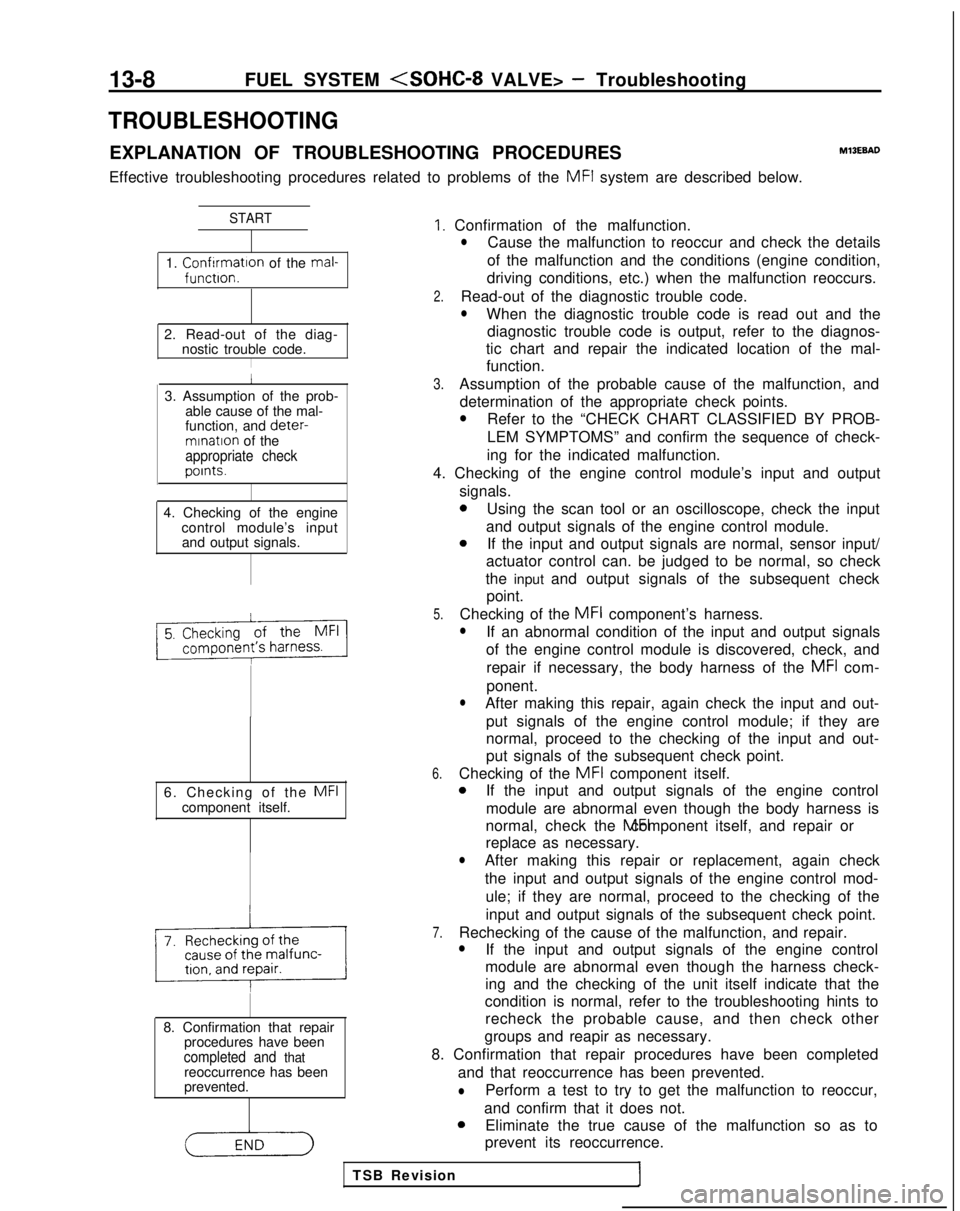
EXPLANATION OF TROUBLESHOOTING PROCEDURESMlBEBAD
Effective troubleshooting procedures related to problems of the MFI
system are described below.
START
1. Confrrmatron of the mal-functron.
2. Read-out of the diag-
nostic trouble code.
I
I
3. Assumption of the prob-
able cause of the mal-
function, and deter-
mrnatron of theappropriate checkpoints.
4. Checking of the engine
control module’s inputand output signals.
6. Checking of the
MFIcomponent itself.
8. Confirmation that repair procedures have been
completed and thatreoccurrence has been
prevented.
I. Confirmation of the malfunction.lCause the malfunction to reoccur and check the details
of the malfunction and the conditions (engine condition,
driving conditions, etc.) when the malfunction reoccurs.
2.Read-out of the diagnostic trouble code.
lWhen the diagnostic trouble code is read out and the diagnostic trouble code is output, refer to the diagnos-
tic chart and repair the indicated location of the mal- function.
3.Assumption of the probable cause of the malfunction, and
determination of the appropriate check points.
lRefer to the “CHECK CHART CLASSIFIED BY PROB-
LEM SYMPTOMS” and confirm the sequence of check-
ing for the indicated malfunction.
4. Checking of the engine control module’s input and output signals.
0Using the scan tool or an oscilloscope, check the input
and output signals of the engine control module.
aIf the input and output signals are normal, sensor input/
actuator control can. be judged to be normal, so check
the input and output signals of the subsequent check point.
5.Checking of the MFI
component’s harness.lIf an abnormal condition of the input and output signals
of the engine control module is discovered, check, and
repair if necessary, the body harness of the
MFI com-
ponent.
lAfter making this repair, again check the input and out- put signals of the engine control module; if they are
normal, proceed to the checking of the input and out-
put signals of the subsequent check point.
6.Checking of the MFI
component itself.aIf the input and output signals of the engine control
module are abnormal even though the body harness is
normal, check the MFI component itself, and repair or
replace as necessary.
lAfter making this repair or replacement, again check
the input and output signals of the engine control mod-
ule; if they are normal, proceed to the checking of the
input and output signals of the subsequent check point.
7.Rechecking of the cause of the malfunction, and repair.lIf the input and output signals of the engine control
module are abnormal even though the harness check-
ing and the checking of the unit itself indicate that the
condition is normal, refer to the troubleshooting hints to recheck the probable cause, and then check other
groups and reapir as necessary.
8. Confirmation that repair procedures have been completed and that reoccurrence has been prevented.
lPerform a test to try to get the malfunction to reoccur,
and confirm that it does not.
aEliminate the true cause of the malfunction so as to
prevent its reoccurrence.
TSB Revision
Page 152 of 1273
13-10
FUEL SYSTEM
at sensor side
1\~“‘,““W,O,’ ‘\*N 4-cnDQ5a,, \llllf,,
c 3 c-11 ‘.<-!
( .[&
;%* \ g ~ &.$$~&%,;
0%: E
.Oj-,,
giI lOWI -,n
/ ~ ( ~~‘-~~~
-.mo .u. m,.0 - rj*> ;;
indicator lamp68AOO93
l
If the voltage (power-supply voltage) supplied to a sensor
is not normal, repair the harness. If the voltage to the sensor is still not normal after the har-
ness has been repaired, repalce the engine control module
and check again.
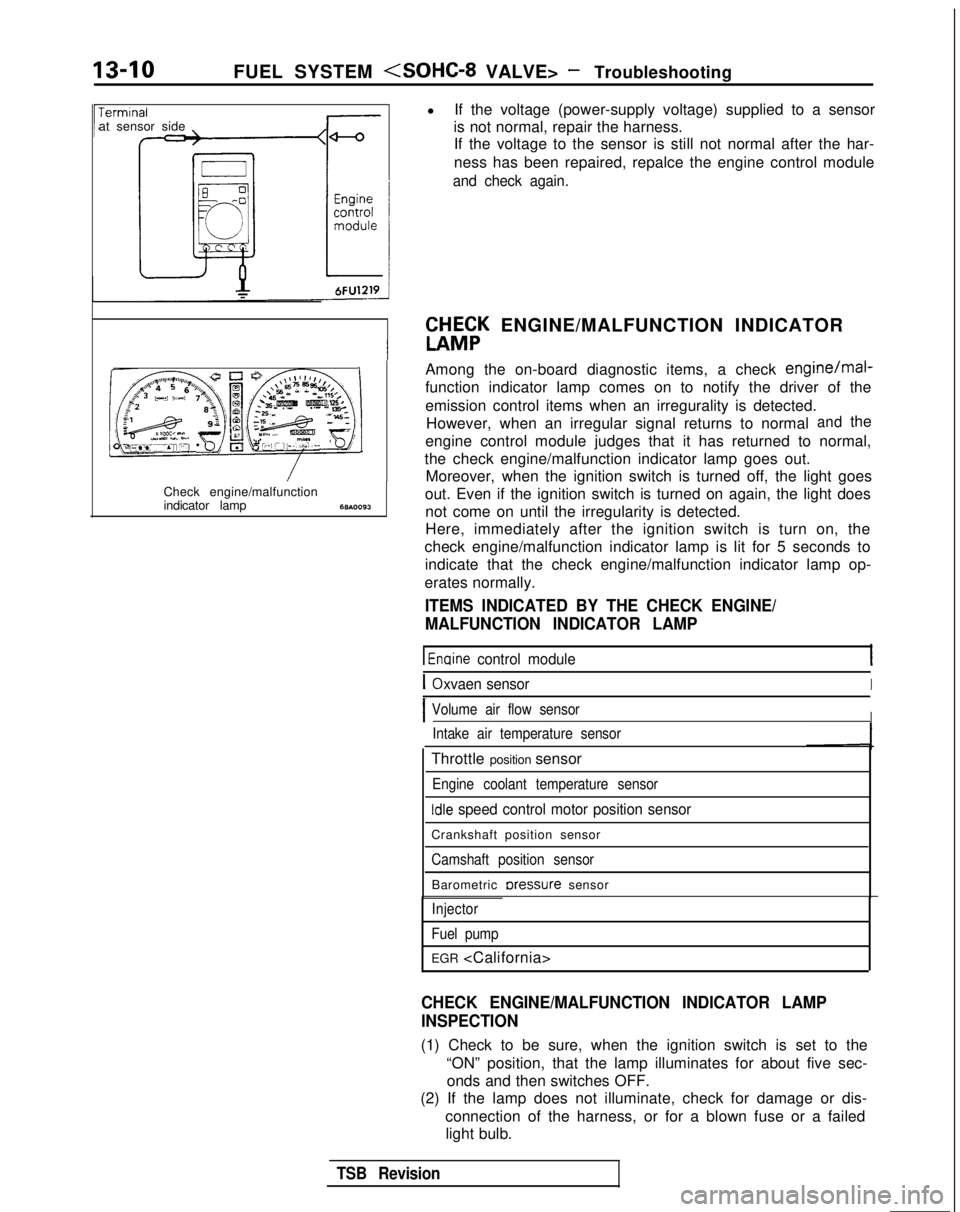
W&K ENGINE/MALFUNCTION INDICATOR
Among the on-board diagnostic items, a check
engine/mal-
function indicator lamp comes on to notify the driver of the
emission control items when an irregurality is detected. However, when an irregular signal returns to normal
andthe
engine control module judges that it has returned to normal,
the check engine/malfunction indicator lamp goes out. Moreover, when the ignition switch is turned off, the light goes
out. Even if the ignition switch is turned on again, the light does not come on until the irregularity is detected.
Here, immediately after the ignition switch is turn on, the
check engine/malfunction indicator lamp is lit for 5 seconds to indicate that the check engine/malfunction indicator lamp op-
erates normally.
ITEMS INDICATED BY THE CHECK ENGINE/
MALFUNCTION INDICATOR LAMP
1 Enaine control module
IOxvaen sensorI
IVolume air flow sensorIIntake air temperature sensor
Throttle position sensor
Engine coolant temperature sensor
Idle speed control motor position sensor
Crankshaft position sensor
Camshaft position sensor
Barometric rxessure sensor
Injector
Fuel pump
EGR
CHECK ENGINE/MALFUNCTION INDICATOR LAMP
INSPECTION
(1) Check to be sure, when the ignition switch is set to the “ON” position, that the lamp illuminates for about five sec-onds and then switches OFF.
(2) If the lamp does not illuminate, check for damage or dis-
connection of the harness, or for a blown fuse or a failedlight bulb.
TSB Revision
Page 153 of 1273
FUEL SYSTEM
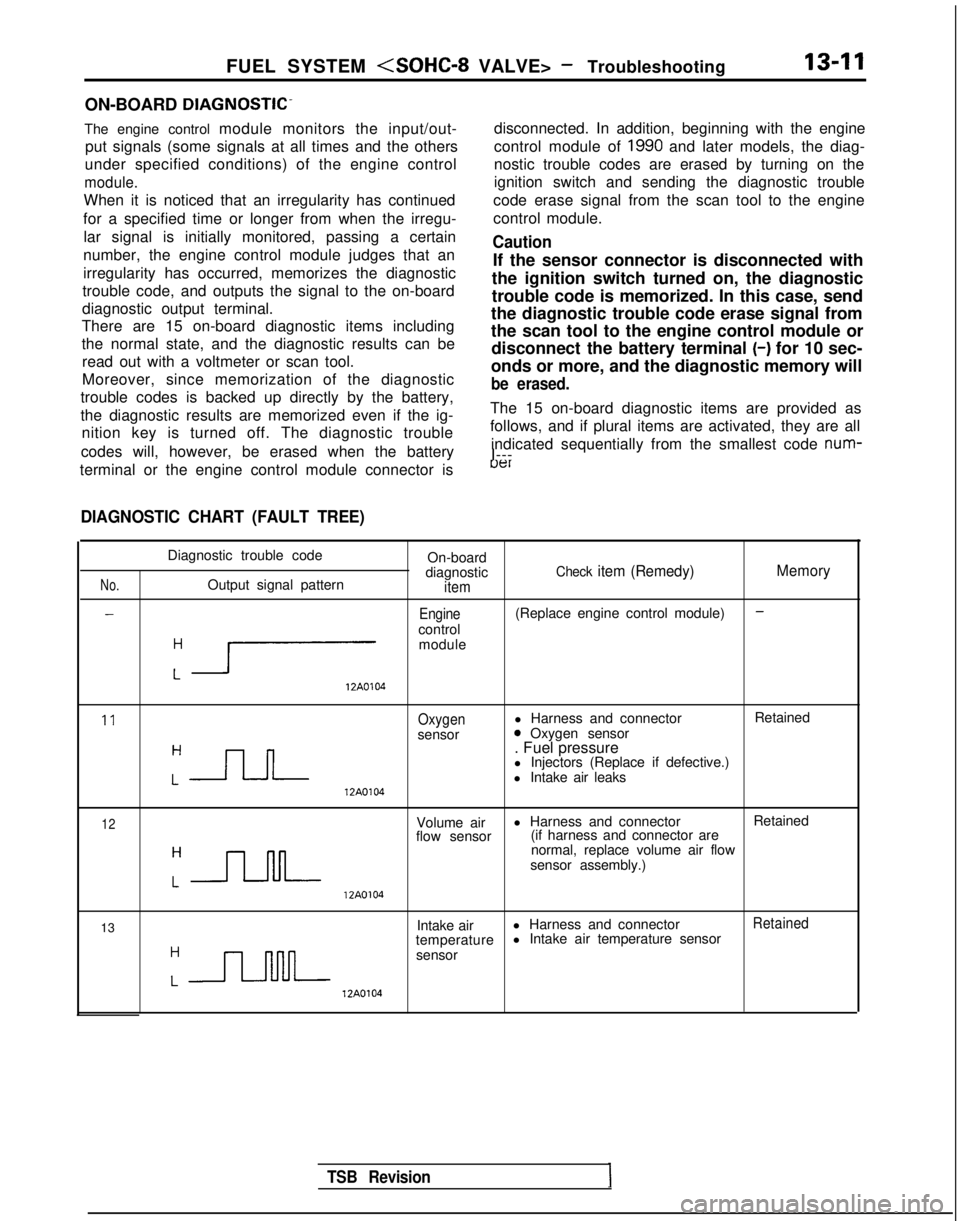
ON-BOARD DIAGNOSTIC-
The engine control module monitors the input/out-
put signals (some signals at all times and the others
under specified conditions) of the engine control
module.
When it is noticed that an irregularity has continued
for a specified time or longer from when the irregu- lar signal is initially monitored, passing a certain
number, the engine control module judges that an
irregularity has occurred, memorizes the diagnostic
trouble code, and outputs the signal to the on-board
diagnostic output terminal.
There are 15 on-board diagnostic items including
the normal state, and the diagnostic results can be
read out with a voltmeter or scan tool.
Moreover, since memorization of the diagnostic
trouble codes is backed up directly by the battery,
the diagnostic results are memorized even if the ig- nition key is turned off. The diagnostic trouble
codes will, however, be erased when the battery disconnected. In addition, beginning with the engine
control module of
1990 and later models, the diag-
nostic trouble codes are erased by turning on the
ignition switch and sending the diagnostic trouble
code erase signal from the scan tool to the engine
control module.
Caution
If the sensor connector is disconnected with
the ignition switch turned on, the diagnostic
trouble code is memorized. In this case, send
the diagnostic trouble code erase signal from
the scan tool to the engine control module or disconnect the battery terminal (-)
for 10 sec-
onds or more, and the diagnostic memory will
be erased.
The 15 on-board diagnostic items are provided as
follows, and if plural items are activated, they are all
indicated sequentially from the smallest code num-
I---
terminal or the engine control module connector is
uer
DIAGNOSTIC CHART (FAULT TREE)
No.
-
Diagnostic trouble code On-board
diagnostic
Check item (Remedy) MemoryOutput signal patternitem
-Engine(Replace engine control module)
control
:r
module 12A0104
11Oxygenl Harness and connector
Retained
sensor0 Oxygen sensor
:-JLJ--
. Fuel pressure
l Injectors (Replace if defective.)
l Intake air leaks 12A0104
12Volume air
l Harness and connector
Retained
flow sensor (if harness and connector are
:-JJ-M-
normal, replace volume air flow
sensor assembly.) 12A0104
13 Intake air
l Harness and connector
Retained
temperature l Intake air temperature sensor
:n
sensor 12A0104
TSB Revision
Page 154 of 1273
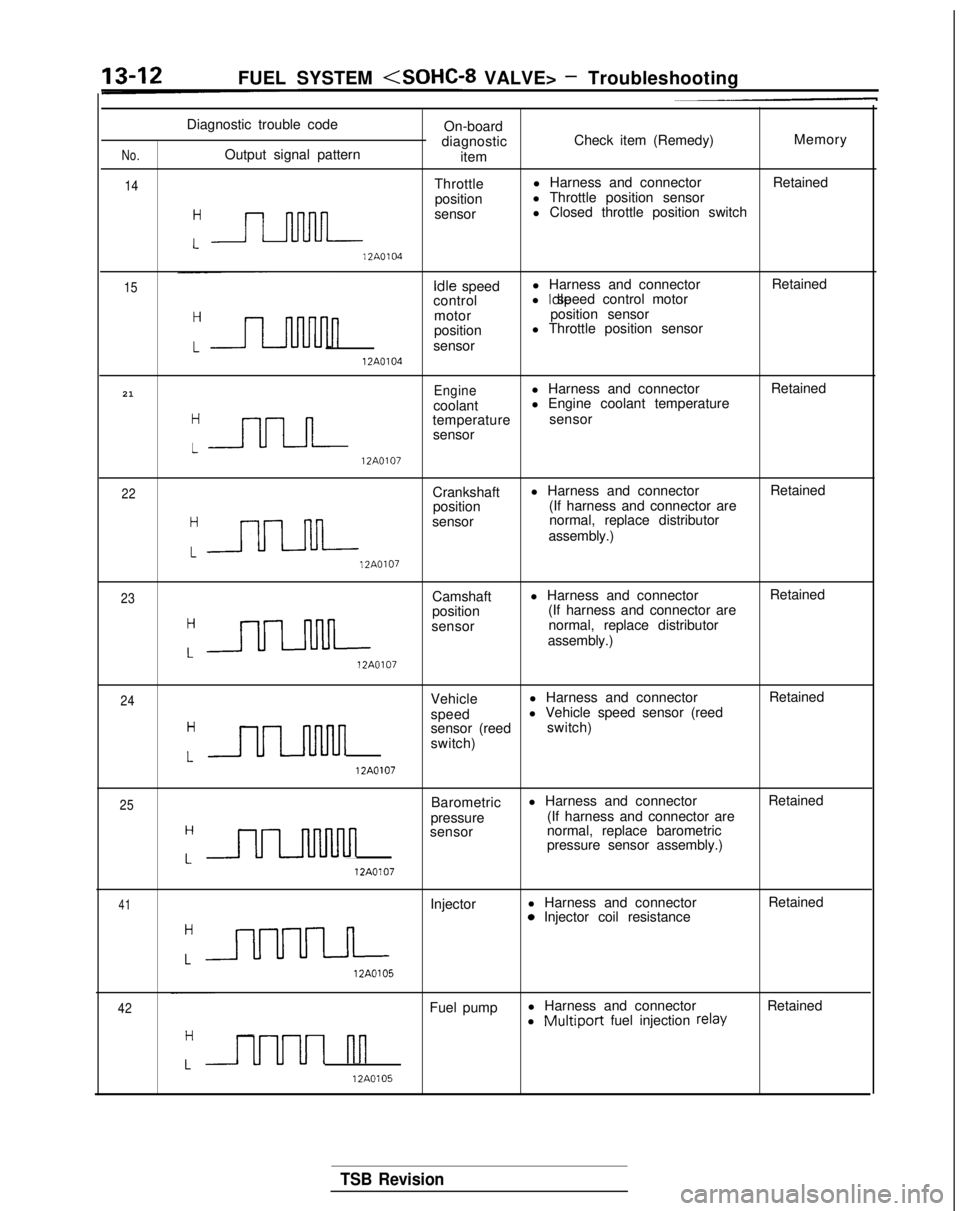
13-12
FUEL SYSTEM
No.
14
Diagnostic trouble code
On-board
diagnostic Check item (Remedy)
Memory
Output signal pattern item
Throttle l Harness and connector
Retained
position l Throttle position sensor
:-
sensor l Closed throttle position switch 12A0104
15
Idle
speed l Harness and connector
Retained
control l Idle speed control motor
n
motor
position sensor
position l Throttle position sensor
sensor 12A0104
21
Enginel Harness and connector Retained
coolant l Engine coolant temperature
“=
temperature
sensor
sensor 12A0107
22Crankshaft
l Harness and connector
Retained
position (If harness and connector are
:-
sensor normal, replace distributor
assembly.) 12A0107
23Camshaft
l Harness and connector
Retained
position (If harness and connector are
:=
sensor normal, replace distributor
assembly.) 12A0107
24Vehicle
l Harness and connector
Retained
speed l Vehicle speed sensor (reed
H
uulnnn
sensor (reed
switch)
switch)
L 12A0107
25Barometric
l Harness and connector
Retained
pressure (If harness and connector are
H
ULnMnn
sensor
normal, replace barometric
pressure sensor assembly.)
L 12A0107
41Injector
l Harness and connector
Retained0 Injector coil resistance
:a 12A0105
42Fuel pump
l Harness and connector
Retained
l Multiport fuel injection relay
Luuul nn
12A0105
TSB Revision
Page 155 of 1273
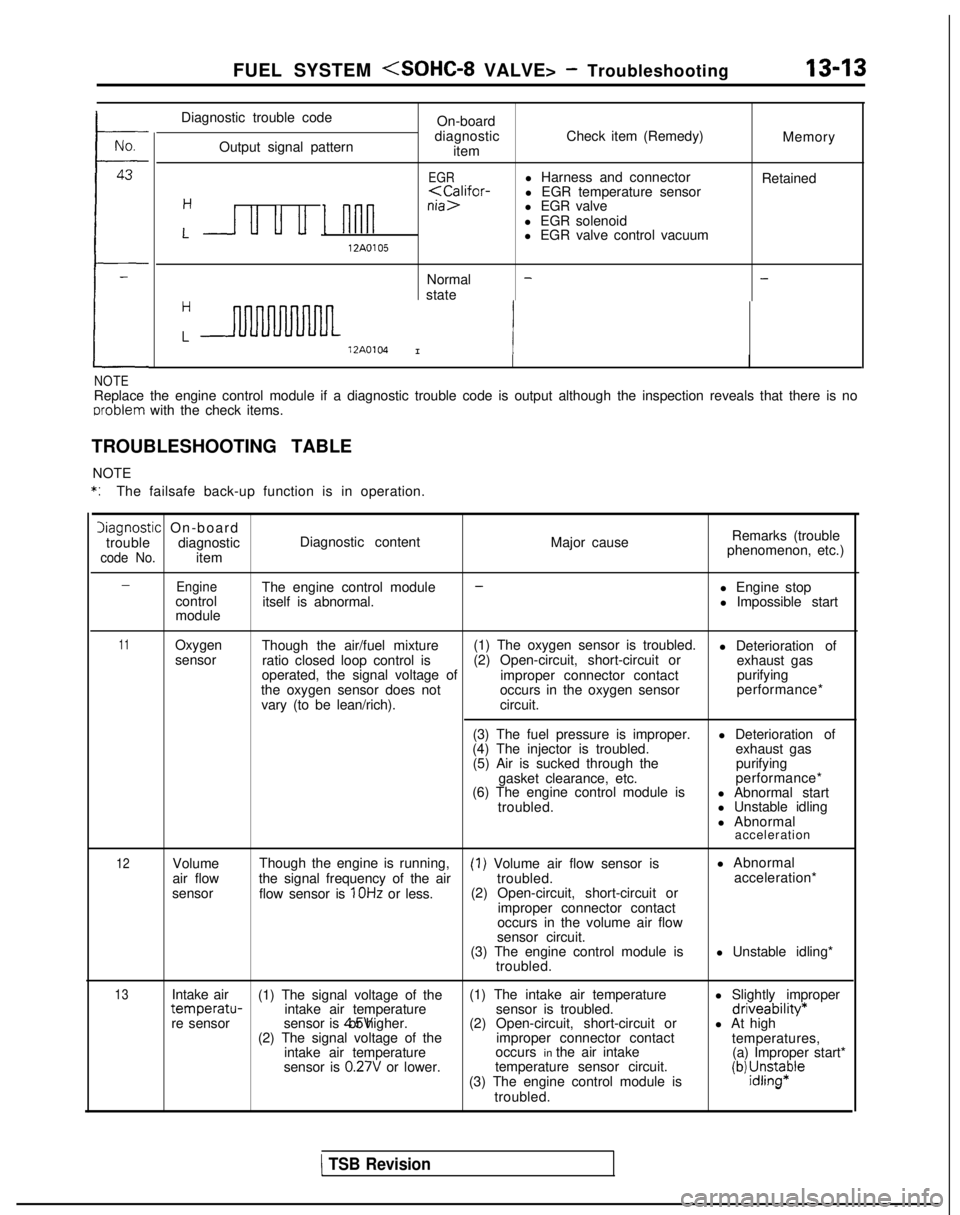
FUEL SYSTEM
No.
43
4
-
Diagnostic trouble code
Output signal pattern On-board
diagnostic item Check item (Remedy)
Memory
EGRl Harness and connector
Retained
l EGR solenoid
L u u u I nnnl EGR valve control vacuum12A0105
Normal -state
-
H
L12A0104I 1
NOTEReplace the engine control module if a diagnostic trouble code is output\
although the inspection reveals that there is no
oroblem
with the check items.
TROUBLESHOOTING TABLE NOTE
*:The failsafe back-up function is in operation.
Diagnostic On-board
trouble diagnostic Diagnostic content
code No.item Major cause
Remarks (trouble
phenomenon, etc.)
-EngineThe engine control module-l Engine stop
control itself is abnormal. l Impossible start
module
11Oxygen Though the air/fuel mixture (1) The oxygen sensor is troubled.
l Deterioration of
sensor ratio closed loop control is (2) Open-circuit, short-circuit or
exhaust gas
operated, the signal voltage of improper connector contactpurifying
the oxygen sensor does not occurs in the oxygen sensorperformance*
vary (to be lean/rich). circuit.
(3) The fuel pressure is improper. l Deterioration of
(4) The injector is troubled. exhaust gas
(5) Air is sucked through the purifying
gasket clearance, etc. performance*
(6) The engine control module is l Abnormal start
troubled. l Unstable idling
l Abnormal
acceleration
12Volume
air flow
sensor Though the engine is running,(I) Volume air flow sensor is
l Abnormal
the signal frequency of the air troubled.acceleration*
flow sensor is
1 OHz or less. (2) Open-circuit, short-circuit or
improper connector contact
occurs in the volume air flow
sensor circuit.
(3) The engine control module is l Unstable idling*
troubled.
13Intake air (1) The signal voltage of the (1) The intake air temperature
l Slightly impropertemperatu-intake air temperaturesensor is troubled.driveability*re sensorsensor is 4.5V or higher.
(2) Open-circuit, short-circuit or l At high
(2) The signal voltage of the improper connector contact
temperatures,
intake air temperature occurs in the air intake
(a) Improper start*
sensor is
0.27V or lower. temperature sensor circuit.
(3) The engine control module is(b) ;J;pe
troubled.
1 TSB Revision
Page 158 of 1273

13-16
FUEL SYSTEM
FAILSAFE/BACK-UP FUNCTIONS LIST
If trouble with any major sensor is detected by the on-board diagnostic,\
the vehicle will be kept in the safe
driving conditions according to the preset control logic.
Trouble item Control content for trouble
Volume air flow Fuel injection timing and ignition timing are determined according to th\
e throttle position
sensor sensor
(TPS) and engine revolution speed signal (crankshaft position sensor signal)\
.
Intake air temperature The control is executed with the suction air temperature regarded as
25°C (77°F).
sensor
Throttle position The fuel injection rate is not increased for acceleration according to t\
he throttle position
sensor
(TPS)sensor signal.
Idle speed control After the idle speed control motor plunger is driven and contracted, the\
idle revolution speed
motor position sensor is not controlled.
Engine coolant The control is executed with the engine coolant temperature regarded as \
8OO.C (176°F).temperature sensor (Even if the sensor signal becomes normal again, the control is continued
until the ignltlon
switch is turned off.)
Camshaft position Simultaneous injection of fuel is executed for all cylinders. (In this \
case, the
No.1 cylinder top
sensor dead center is not detected at all after the ignition key is turned on.)\
Barometric pressure The control is executed with the pressure regarded as 760 mmHg
(30
in.Hg).
sensor
Oxygen sensor Closed loop control of the air/fuel mixture ratio is not executed.
i
READ OUT OF DIAGNOSTIC TROUBLE CODE
Precautions for operation
(1) When battery voltage is low, no detection of failure is possible. Be sure to check the battery for voltage and
other conditions before starting the test.
(2) On-board diagnostic item is erased if the battery or the engine control module connector is discon-
nected. Do not disconnect the battery before the di-
agnostic result is completely read.
Using Scan Tool
(1) Switch OFF the ignition switch.
(2) Connect the power-source terminal of the scan tool to the
cigarette lighter socket.
(3) Connect the scan tool to the data link connector. (4) Turn ignition switch to ON.
(5) Using the scan tool, read out and make a note of the
on-
board diagnostic output.
(6) Refer to the diagnostic chart, and repair the indicated loca-
tion of malfunction.
(7) Erase the diagnostic trouble code. (Refer to
P.13-17.)
1 TSB RevisionI