1988 OPEL VECTRA battery
[x] Cancel search: batteryPage 18 of 525
5Direction indicator/lighting
switch - removal and refitting
2
Removal
1Disconnect the battery negative lead.
2Turn the steering wheel as necessary to
expose the two front steering column shroud
securing screws, which are covered by plastic
caps. Prise out the caps and remove the
screws.
3Remove the three securing screws from the
underside of the lower column shroud, then
remove both the upper and lower shrouds.
4Disconnect the wiring plug from the switch.
5Depress the switch retaining clip, and
withdraw the switch from the housing.
Refitting
6Refitting is a reversal of removal.
6Wash/wipe switch - removal
and refitting
2
Proceed as described in Section 5.
7Facia panel switches -
removal and refitting
2
1Disconnect the battery negative lead.
Lighting switch
Removal
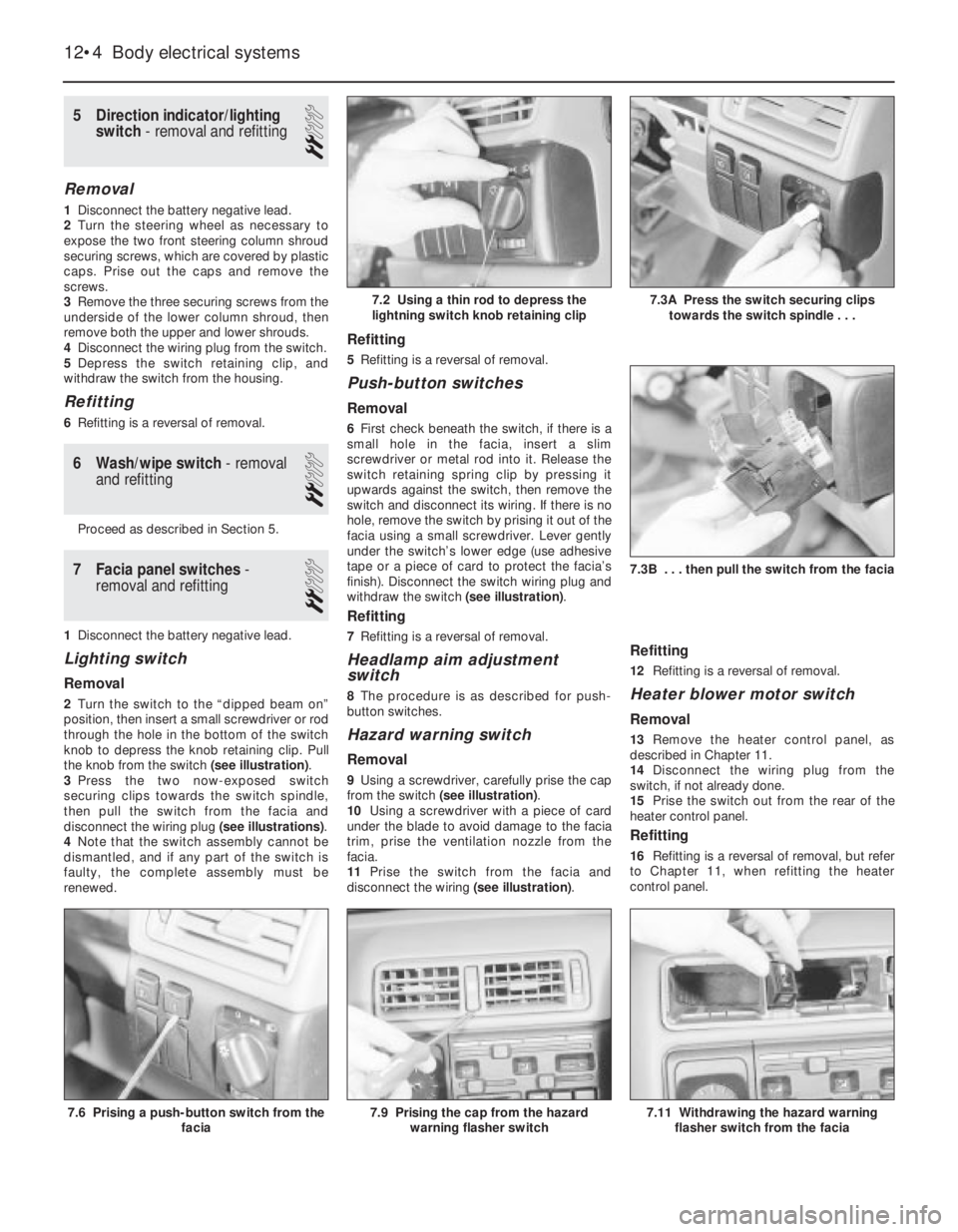
2Turn the switch to the “dipped beam on”
position, then insert a small screwdriver or rod
through the hole in the bottom of the switch
knob to depress the knob retaining clip. Pull
the knob from the switch (see illustration).
3Press the two now-exposed switch
securing clips towards the switch spindle,
then pull the switch from the facia and
disconnect the wiring plug (see illustrations).
4Note that the switch assembly cannot be
dismantled, and if any part of the switch is
faulty, the complete assembly must be
renewed.
Refitting
5Refitting is a reversal of removal.
Push-button switches
Removal
6First check beneath the switch, if there is a
small hole in the facia, insert a slim
screwdriver or metal rod into it. Release the
switch retaining spring clip by pressing it
upwards against the switch, then remove the
switch and disconnect its wiring. If there is no
hole, remove the switch by prising it out of the
facia using a small screwdriver. Lever gently
under the switch’s lower edge (use adhesive
tape or a piece of card to protect the facia’s
finish). Disconnect the switch wiring plug and
withdraw the switch (see illustration).
Refitting
7Refitting is a reversal of removal.
Headlamp aim adjustment
switch
8The procedure is as described for push-
button switches.
Hazard warning switch
Removal
9Using a screwdriver, carefully prise the cap
from the switch (see illustration).
10Using a screwdriver with a piece of card
under the blade to avoid damage to the facia
trim, prise the ventilation nozzle from the
facia.
11Prise the switch from the facia and
disconnect the wiring (see illustration).
Refitting
12Refitting is a reversal of removal.
Heater blower motor switch
Removal
13Remove the heater control panel, as
described in Chapter 11.
14Disconnect the wiring plug from the
switch, if not already done.
15Prise the switch out from the rear of the
heater control panel.
Refitting
16Refitting is a reversal of removal, but refer
to Chapter 11, when refitting the heater
control panel.
12•4Body electrical systems
7.2 Using a thin rod to depress the
lightning switch knob retaining clip
7.3B . . . then pull the switch from the facia
7.11 Withdrawing the hazard warning
flasher switch from the facia7.9 Prising the cap from the hazard
warning flasher switch7.6 Prising a push-button switch from the
facia
7.3A Press the switch securing clips
towards the switch spindle . . .
Page 19 of 525
8Electric door mirror switch -
removal and refitting
2
Removal
1Disconnect the battery negative lead.
2Prise the plastic surround from the door
interior handle.
3Free the trim panel from the top edge of the
door by releasing the securing clips. This can
be done using a screwdriver, but it is
preferable to use a forked tool, to minimise
the possibility of damage to the trim panel and
the clips.
4Note the position of the mirror switch wiring
connector in the bracket at the top of the
door, then separate the two halves of the
connector.
5Prise the switch from the door trim panel,
and feed the wiring through the panel.
Refitting
6Refitting is a reversal of removal, but ensure
that the wiring is correctly routed, so as not to
foul the door interior handle mechanism.
9Sunroof operating switch -
removal and refitting
2
Removal
1Disconnect the battery negative lead.
2Prise the courtesy lamp from the roof trim
panel, and disconnect the wiring.
3Remove the two trim panel securing
screws, and withdraw the trim panel from the
roof, disconnecting the wiring from the
sunroof operating switch.
4Release the securing clips, then pull the
switch from the rear face of the trim panel.
Refitting
5Refitting is a reversal of removal.
10Courtesy lamp switch -
removal and refitting
2
Removal
1Disconnect the battery negative lead.
2Open the door and remove the switch
securing screw.
3Withdraw the switch from the door pillar,
and pull the wiring out sufficiently to prevent it
from springing back into the pillar.4Disconnect the wiring and remove the
switch.
Refitting
5Refitting is a reversal of removal.
11Luggage compartment lamp
switch - removal and refitting
2
Removal
1Disconnect the battery negative lead.
2Open the boot lid or tailgate, as applicable,
and remove the switch securing screw.
3Withdraw the switch from the body panel,
and pull the wiring out sufficiently to prevent it
from springing back into the body.
4Disconnect the wiring and remove the
switch.
Refitting
5Refitting is a reversal of removal.
12Brake lamp switch - removal
and refitting
2
Removal
1Disconnect the battery negative lead.
2Remove the lower trim panel from the
driver’s footwell.
3Disconnect the wiring plug from the brake
lamp switch, then twist the switch
anti-clockwise and remove it from its bracket.
Refitting
4Refitting is a reversal of removal.
13Handbrake “on” warning
lamp switch - removal and
refitting
3
For access to the switch, the handbrake
lever must be removed. Removal and refitting
of the switch is described as part of the
handbrake lever removal and refitting
procedure, in Chapter 9.
14Oil pressure warning lamp
switch - removal and refitting
3
Removal
1Disconnect the battery negative lead.
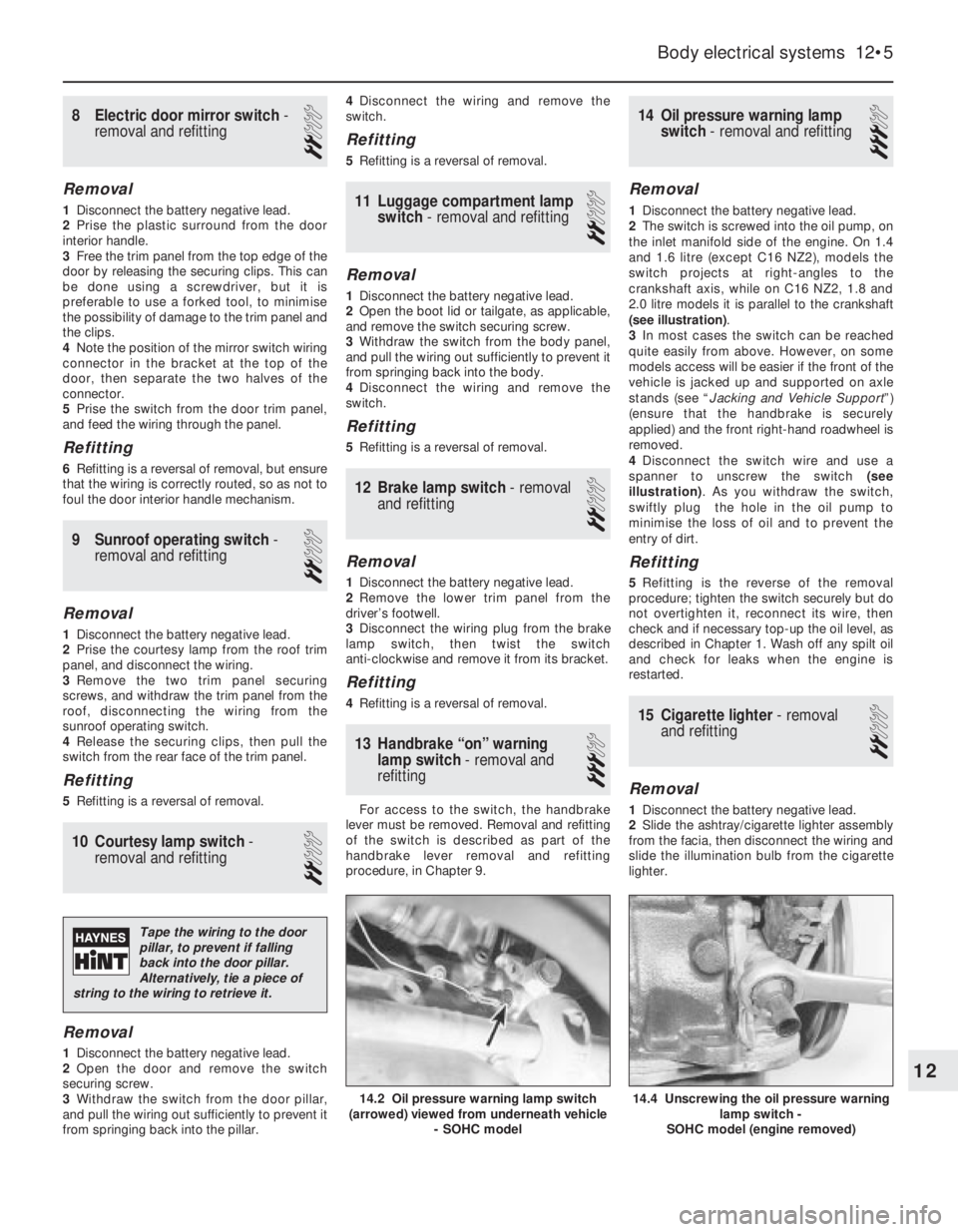
2The switch is screwed into the oil pump, on
the inlet manifold side of the engine. On 1.4
and 1.6 litre (except C16 NZ2), models the
switch projects at right-angles to the
crankshaft axis, while on C16 NZ2, 1.8 and
2.0 litre models it is parallel to the crankshaft
(see illustration).
3In most cases the switch can be reached
quite easily from above. However, on some
models access will be easier if the front of the
vehicle is jacked up and supported on axle
stands (see “Jacking and Vehicle Support”)
(ensure that the handbrake is securely
applied) and the front right-hand roadwheel is
removed.
4Disconnect the switch wire and use a
spanner to unscrew the switch (see
illustration). As you withdraw the switch,
swiftly plug the hole in the oil pump to
minimise the loss of oil and to prevent the
entry of dirt.
Refitting
5Refitting is the reverse of the removal
procedure; tighten the switch securely but do
not overtighten it, reconnect its wire, then
check and if necessary top-up the oil level, as
described in Chapter 1. Wash off any spilt oil
and check for leaks when the engine is
restarted.
15Cigarette lighter - removal
and refitting
2
Removal
1Disconnect the battery negative lead.
2Slide the ashtray/cigarette lighter assembly
from the facia, then disconnect the wiring and
slide the illumination bulb from the cigarette
lighter.
Body electrical systems 12•5
14.4 Unscrewing the oil pressure warning
lamp switch -
SOHC model (engine removed)14.2 Oil pressure warning lamp switch
(arrowed) viewed from underneath vehicle
- SOHC model
12
Tape the wiring to the door
pillar, to prevent if falling
back into the door pillar.
Alternatively, tie a piece of
string to the wiring to retrieve it.
Page 20 of 525
3To remove the cigarette lighter assembly,
simply pull it from the illumination ring
assembly. If desired, the illumination ring
assembly can be removed, by pulling it from
the housing after depressing the retaining
clips.
Refitting
4Refitting is a reversal of removal.
16Clock - removal and refitting
2
Removal
1Disconnect the battery negative lead.
2Using a thin-bladed screwdriver, carefully
prise the clock from the facia panel.
3Disconnect the wiring plugs and withdraw
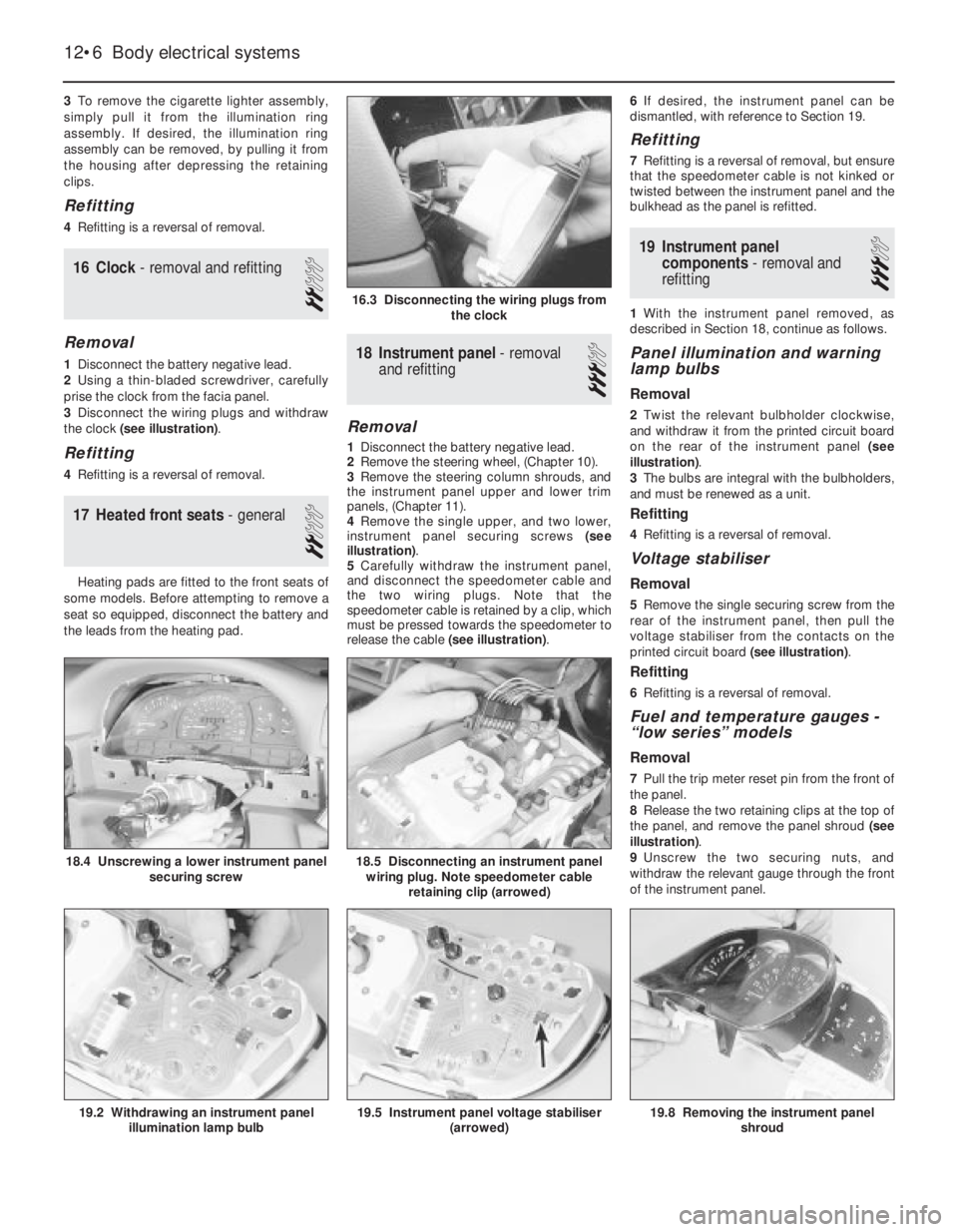
the clock (see illustration).
Refitting
4Refitting is a reversal of removal.
17Heated front seats - general
2
Heating pads are fitted to the front seats of
some models. Before attempting to remove a
seat so equipped, disconnect the battery and
the leads from the heating pad.
18Instrument panel -removal
and refitting
3
Removal
1Disconnect the battery negative lead.
2Remove the steering wheel, (Chapter 10).
3Remove the steering column shrouds, and
the instrument panel upper and lower trim
panels, (Chapter 11).
4Remove the single upper, and two lower,
instrument panel securing screws (see
illustration).
5Carefully withdraw the instrument panel,
and disconnect the speedometer cable and
the two wiring plugs. Note that the
speedometer cable is retained by a clip, which
must be pressed towards the speedometer to
release the cable (see illustration).6If desired, the instrument panel can be
dismantled, with reference to Section 19.
Refitting
7Refitting is a reversal of removal, but ensure
that the speedometer cable is not kinked or
twisted between the instrument panel and the
bulkhead as the panel is refitted.
19Instrument panel
components - removal and
refitting
3
1With the instrument panel removed, as
described in Section 18, continue as follows.
Panel illumination and warning
lamp bulbs
Removal
2Twist the relevant bulbholder clockwise,
and withdraw it from the printed circuit board
on the rear of the instrument panel (see
illustration).
3The bulbs are integral with the bulbholders,
and must be renewed as a unit.
Refitting
4Refitting is a reversal of removal.
Voltage stabiliser
Removal
5Remove the single securing screw from the
rear of the instrument panel, then pull the
voltage stabiliser from the contacts on the
printed circuit board (see illustration).
Refitting
6Refitting is a reversal of removal.
Fuel and temperature gauges -
“low series” models
Removal
7Pull the trip meter reset pin from the front of
the panel.
8Release the two retaining clips at the top of
the panel, and remove the panel shroud (see
illustration).
9Unscrew the two securing nuts, and
withdraw the relevant gauge through the front
of the instrument panel.
12•6Body electrical systems
16.3 Disconnecting the wiring plugs from
the clock
18.5 Disconnecting an instrument panel
wiring plug. Note speedometer cable
retaining clip (arrowed)
19.8 Removing the instrument panel
shroud19.5 Instrument panel voltage stabiliser
(arrowed)19.2 Withdrawing an instrument panel
illumination lamp bulb
18.4 Unscrewing a lower instrument panel
securing screw
Page 21 of 525
Refitting
10Refitting is a reversal of removal.
Fuel and temperature gauge
assembly -“high series” models
11The procedure is as described in
paragraphs 7 to 10 inclusive, except that the
gauge assembly is secured by four nuts.
Tachometer
12The procedure is as described in
paragraphs 7 to 10 inclusive except that the
tachometer is secured by three nuts (see
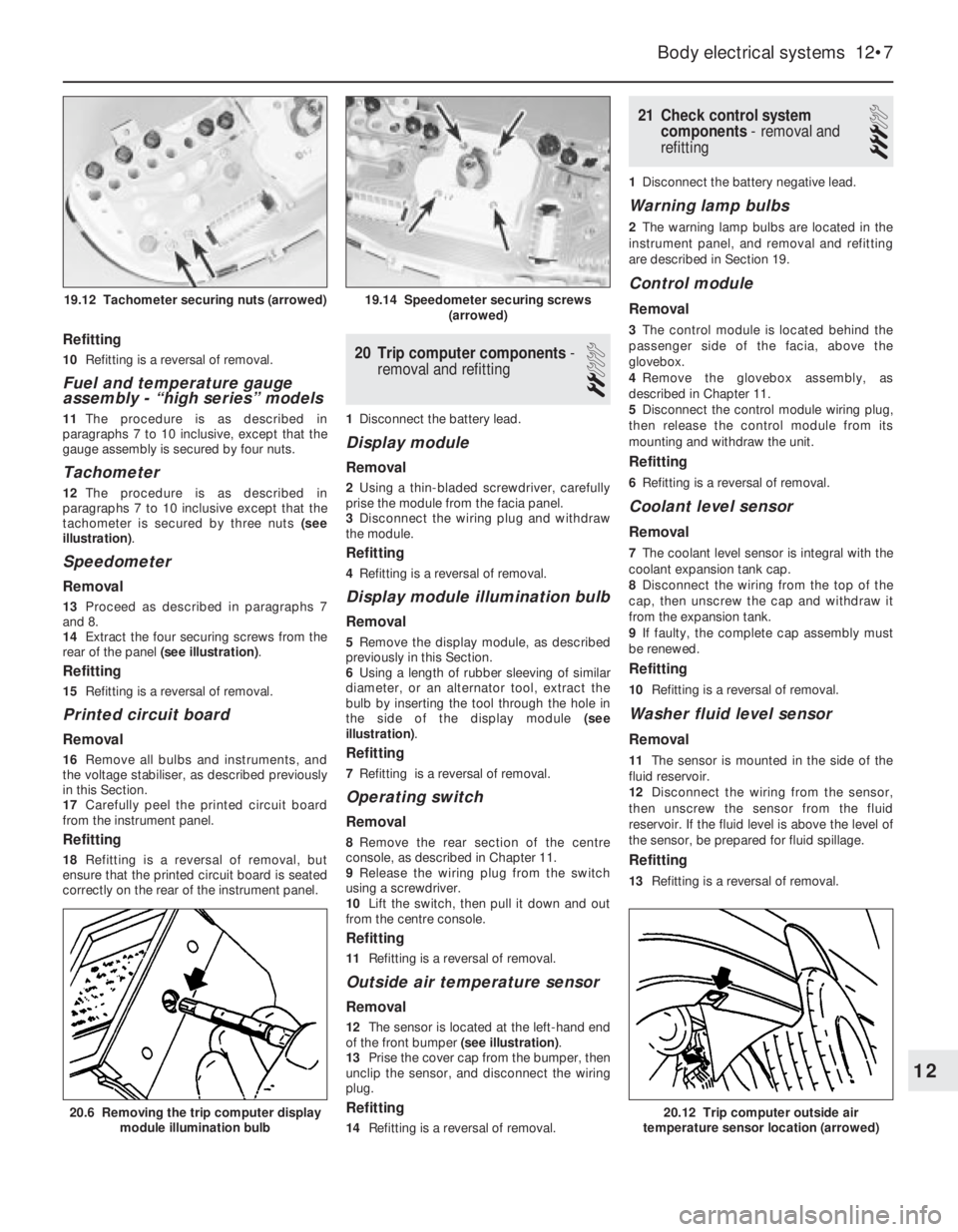
illustration).
Speedometer
Removal
13Proceed as described in paragraphs 7
and 8.
14Extract the four securing screws from the
rear of the panel (see illustration).
Refitting
15Refitting is a reversal of removal.
Printed circuit board
Removal
16Remove all bulbs and instruments, and
the voltage stabiliser, as described previously
in this Section.
17Carefully peel the printed circuit board
from the instrument panel.
Refitting
18Refitting is a reversal of removal, but
ensure that the printed circuit board is seated
correctly on the rear of the instrument panel.
20Trip computer components -
removal and refitting
2
1Disconnect the battery lead.
Display module
Removal
2Using a thin-bladed screwdriver, carefully
prise the module from the facia panel.
3Disconnect the wiring plug and withdraw
the module.
Refitting
4Refitting is a reversal of removal.
Display module illumination bulb
Removal
5Remove the display module, as described
previously in this Section.
6Using a length of rubber sleeving of similar
diameter, or an alternator tool, extract the
bulb by inserting the tool through the hole in
the side of the display module (see
illustration).
Refitting
7Refitting is a reversal of removal.
Operating switch
Removal
8Remove the rear section of the centre
console, as described in Chapter 11.
9Release the wiring plug from the switch
using a screwdriver.
10Lift the switch, then pull it down and out
from the centre console.
Refitting
11Refitting is a reversal of removal.
Outside air temperature sensor
Removal
12The sensor is located at the left-hand end
of the front bumper (see illustration).
13Prise the cover cap from the bumper, then
unclip the sensor, and disconnect the wiring
plug.
Refitting
14Refitting is a reversal of removal.
21Check control system
components - removal and
refitting
3
1Disconnect the battery negative lead.
Warning lamp bulbs
2The warning lamp bulbs are located in the
instrument panel, and removal and refitting
are described in Section 19.
Control module
Removal
3The control module is located behind the
passenger side of the facia, above the
glovebox.
4Remove the glovebox assembly, as
described in Chapter 11.
5Disconnect the control module wiring plug,
then release the control module from its
mounting and withdraw the unit.
Refitting
6Refitting is a reversal of removal.
Coolant level sensor
Removal
7The coolant level sensor is integral with the
coolant expansion tank cap.
8Disconnect the wiring from the top of the
cap, then unscrew the cap and withdraw it
from the expansion tank.
9If faulty, the complete cap assembly must
be renewed.
Refitting
10Refitting is a reversal of removal.
Washer fluid level sensor
Removal
11The sensor is mounted in the side of the
fluid reservoir.
12Disconnect the wiring from the sensor,
then unscrew the sensor from the fluid
reservoir. If the fluid level is above the level of
the sensor, be prepared for fluid spillage.
Refitting
13Refitting is a reversal of removal.
Body electrical systems 12•7
20.6 Removing the trip computer display
module illumination bulb20.12 Trip computer outside air
temperature sensor location (arrowed)
19.14 Speedometer securing screws
(arrowed)19.12 Tachometer securing nuts (arrowed)
12
Page 22 of 525
Brake fluid level sensor
14The procedure is as described for the
coolant level sensor in paragraphs 7 to 10
inclusive.
Engine oil level sensor
Removal
15Apply the handbrake, jack up the front of
the vehicle, and support securely on axle
stands (see “Jacking and Vehicle Support”)
positioned under the body side members.
16On DOHC models, remove the engine
undershield, as described in Chapter 11.
17Disconnect the sensor wiring plug.
18Unscrew the three or four sensor securing
screws, as applicable, and withdraw the
sensor, manipulating the float through the hole
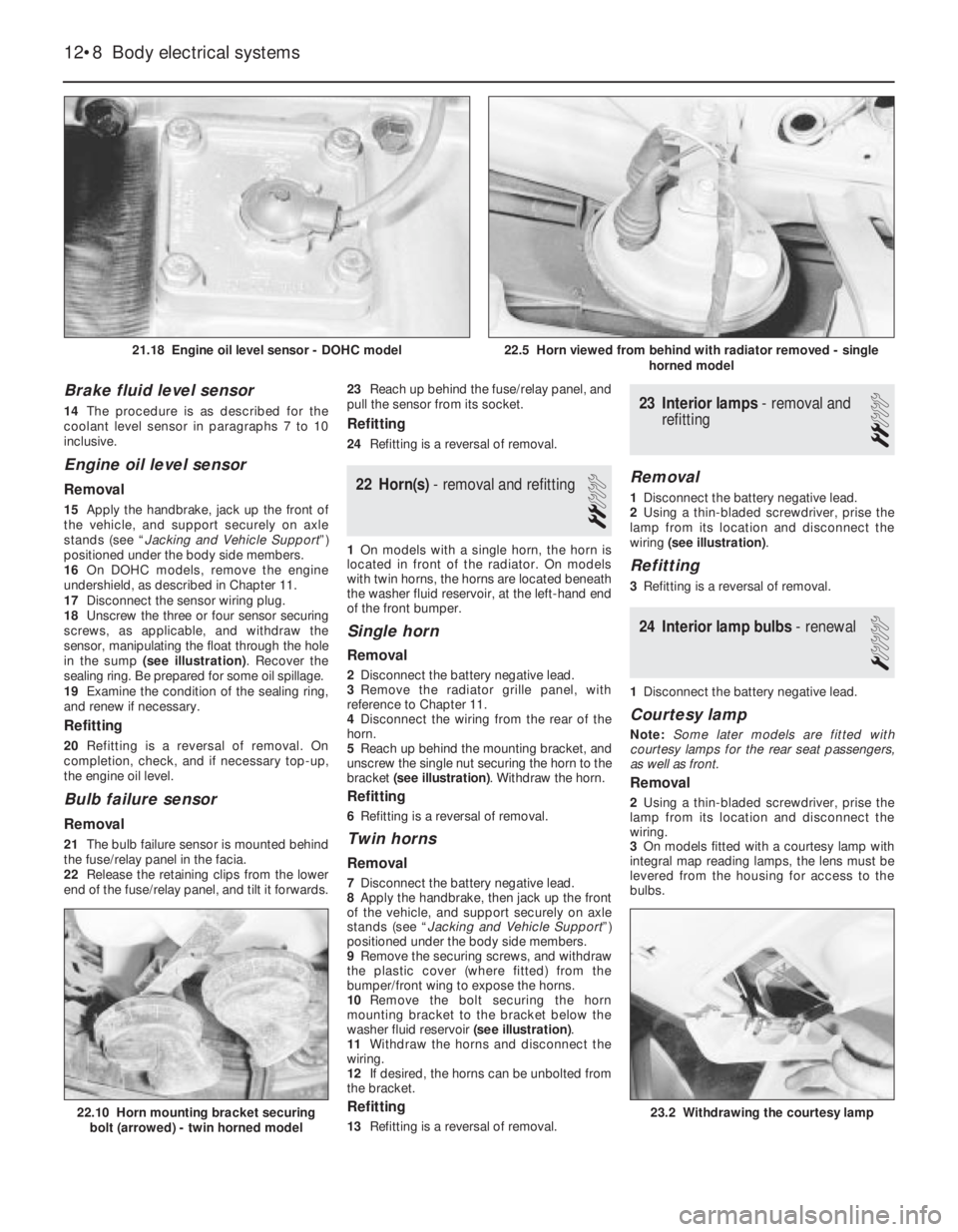
in the sump (see illustration). Recover the
sealing ring. Be prepared for some oil spillage.
19Examine the condition of the sealing ring,
and renew if necessary.
Refitting
20Refitting is a reversal of removal. On
completion, check, and if necessary top-up,
the engine oil level.
Bulb failure sensor
Removal
21The bulb failure sensor is mounted behind
the fuse/relay panel in the facia.
22Release the retaining clips from the lower
end of the fuse/relay panel, and tilt it forwards.23Reach up behind the fuse/relay panel, and
pull the sensor from its socket.
Refitting
24Refitting is a reversal of removal.
22Horn(s) - removal and refitting
2
1On models with a single horn, the horn is
located in front of the radiator. On models
with twin horns, the horns are located beneath
the washer fluid reservoir, at the left-hand end
of the front bumper.
Single horn
Removal
2Disconnect the battery negative lead.
3Remove the radiator grille panel, with
reference to Chapter 11.
4Disconnect the wiring from the rear of the
horn.
5Reach up behind the mounting bracket, and
unscrew the single nut securing the horn to the
bracket (see illustration). Withdraw the horn.
Refitting
6Refitting is a reversal of removal.
Twin horns
Removal
7Disconnect the battery negative lead.
8Apply the handbrake, then jack up the front
of the vehicle, and support securely on axle
stands (see “Jacking and Vehicle Support”)
positioned under the body side members.
9Remove the securing screws, and withdraw
the plastic cover (where fitted) from the
bumper/front wing to expose the horns.
10Remove the bolt securing the horn
mounting bracket to the bracket below the
washer fluid reservoir (see illustration).
11Withdraw the horns and disconnect the
wiring.
12If desired, the horns can be unbolted from
the bracket.
Refitting
13Refitting is a reversal of removal.
23Interior lamps - removal and
refitting
2
Removal
1Disconnect the battery negative lead.
2Using a thin-bladed screwdriver, prise the
lamp from its location and disconnect the
wiring (see illustration).
Refitting
3Refitting is a reversal of removal.
24Interior lamp bulbs - renewal
1
1Disconnect the battery negative lead.
Courtesy lamp
Note: Some later models are fitted with
courtesy lamps for the rear seat passengers,
as well as front.
Removal
2Using a thin-bladed screwdriver, prise the
lamp from its location and disconnect the
wiring.
3On models fitted with a courtesy lamp with
integral map reading lamps, the lens must be
levered from the housing for access to the
bulbs.
12•8Body electrical systems
21.18 Engine oil level sensor - DOHC model
22.10 Horn mounting bracket securing
bolt (arrowed) - twin horned model23.2 Withdrawing the courtesy lamp
22.5 Horn viewed from behind with radiator removed - single
horned model
Page 25 of 525
29Front indicator lamp unit -
removal and refitting
2
Removal
1Disconnect the battery negative lead.
2Remove the single indicator lamp unit
securing screw, which is accessible through
the hole in the upper body panel (see
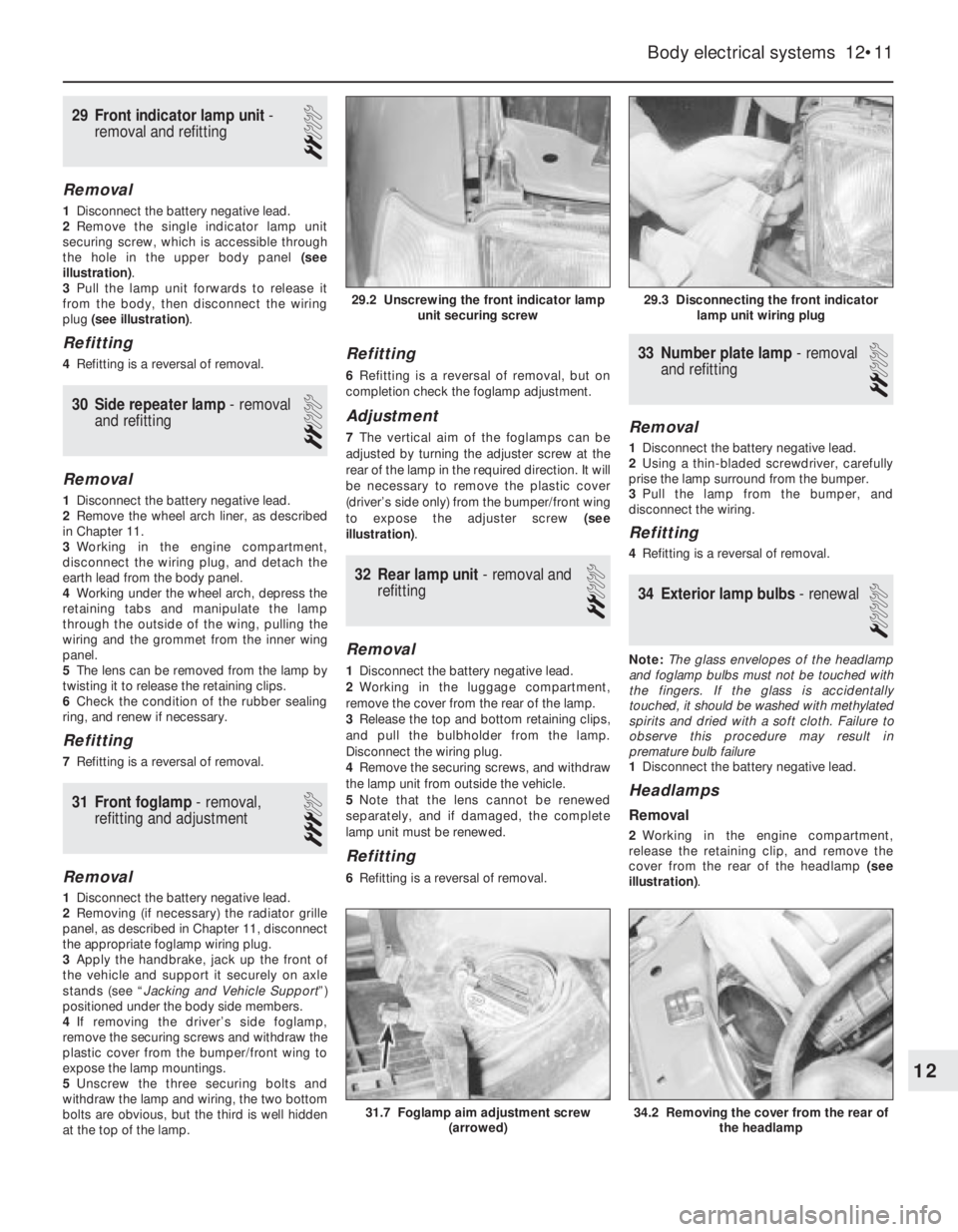
illustration).
3Pull the lamp unit forwards to release it
from the body, then disconnect the wiring
plug (see illustration).
Refitting
4Refitting is a reversal of removal.
30Side repeater lamp -removal
and refitting
2
Removal
1Disconnect the battery negative lead.
2Remove the wheel arch liner, as described
in Chapter 11.
3Working in the engine compartment,
disconnect the wiring plug, and detach the
earth lead from the body panel.
4Working under the wheel arch, depress the
retaining tabs and manipulate the lamp
through the outside of the wing, pulling the
wiring and the grommet from the inner wing
panel.
5The lens can be removed from the lamp by
twisting it to release the retaining clips.
6Check the condition of the rubber sealing
ring, and renew if necessary.
Refitting
7Refitting is a reversal of removal.
31Front foglamp - removal,
refitting and adjustment
3
Removal
1Disconnect the battery negative lead.
2Removing (if necessary) the radiator grille
panel, as described in Chapter 11, disconnect
the appropriate foglamp wiring plug.
3Apply the handbrake, jack up the front of
the vehicle and support it securely on axle
stands (see “Jacking and Vehicle Support”)
positioned under the body side members.
4If removing the driver’s side foglamp,
remove the securing screws and withdraw the
plastic cover from the bumper/front wing to
expose the lamp mountings.
5Unscrew the three securing bolts and
withdraw the lamp and wiring, the two bottom
bolts are obvious, but the third is well hidden
at the top of the lamp.
Refitting
6Refitting is a reversal of removal, but on
completion check the foglamp adjustment.
Adjustment
7The vertical aim of the foglamps can be
adjusted by turning the adjuster screw at the
rear of the lamp in the required direction. It will
be necessary to remove the plastic cover
(driver’s side only) from the bumper/front wing
to expose the adjuster screw (see
illustration).
32Rear lamp unit - removal and
refitting
2
Removal
1Disconnect the battery negative lead.
2Working in the luggage compartment,
remove the cover from the rear of the lamp.
3Release the top and bottom retaining clips,
and pull the bulbholder from the lamp.
Disconnect the wiring plug.
4Remove the securing screws, and withdraw
the lamp unit from outside the vehicle.
5Note that the lens cannot be renewed
separately, and if damaged, the complete
lamp unit must be renewed.
Refitting
6Refitting is a reversal of removal.
33Number plate lamp -removal
and refitting
2
Removal
1Disconnect the battery negative lead.
2Using a thin-bladed screwdriver, carefully
prise the lamp surround from the bumper.
3Pull the lamp from the bumper, and
disconnect the wiring.
Refitting
4Refitting is a reversal of removal.
34Exterior lamp bulbs - renewal
1
Note: The glass envelopes of the headlamp
and foglamp bulbs must not be touched with
the fingers. If the glass is accidentally
touched, it should be washed with methylated
spirits and dried with a soft cloth. Failure to
observe this procedure may result in
premature bulb failure
1Disconnect the battery negative lead.
Headlamps
Removal
2Working in the engine compartment,
release the retaining clip, and remove the
cover from the rear of the headlamp (see
illustration).
Body electrical systems 12•11
31.7 Foglamp aim adjustment screw
(arrowed)34.2 Removing the cover from the rear of
the headlamp
29.3 Disconnecting the front indicator
lamp unit wiring plug29.2 Unscrewing the front indicator lamp
unit securing screw
12
Page 28 of 525
2Disconnect the washer hose and withdraw
the nozzle.
Refitting
3To refit, reconnect the washer hose to the
nozzle, and push the nozzle into its locating
hole.
4The nozzles can be adjusted by inserting a
pin into the jet, and swivelling it to the
required position.
1991-on models
5The nozzles on all later models are fitted
with twin jets.
6On some later models, the nozzles are
heated; the circuit is fed through fuse 29 and
is live whenever the ignition is switched on.
Current is regulated by a Positive
Temperature Coefficient (PTC) resistor that
takes outside temperature into account.
38Windscreen wiper motor and
linkage - removal and refitting
3
Removal
1Disconnect the battery negative lead.
2Remove the wiper arms, as described in
Section 36.
3Remove the windscreen cowl panel, as
described in Chapter 11.
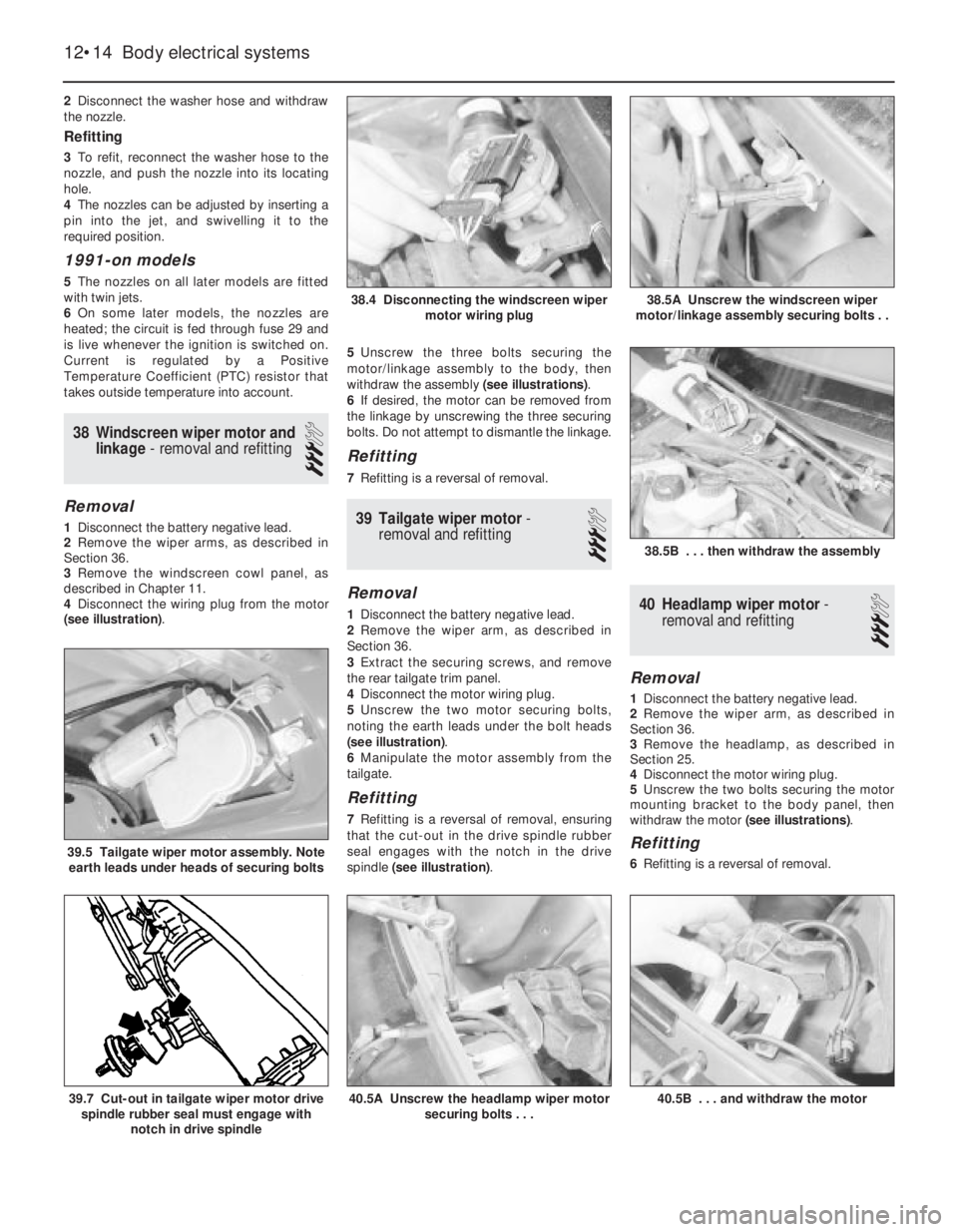
4Disconnect the wiring plug from the motor
(see illustration). 5Unscrew the three bolts securing the
motor/linkage assembly to the body, then
withdraw the assembly (see illustrations).
6If desired, the motor can be removed from
the linkage by unscrewing the three securing
bolts. Do not attempt to dismantle the linkage.
Refitting
7Refitting is a reversal of removal.
39Tailgate wiper motor -
removal and refitting
3
Removal
1Disconnect the battery negative lead.
2Remove the wiper arm, as described in
Section 36.
3Extract the securing screws, and remove
the rear tailgate trim panel.
4Disconnect the motor wiring plug.
5Unscrew the two motor securing bolts,
noting the earth leads under the bolt heads
(see illustration).
6Manipulate the motor assembly from the
tailgate.
Refitting
7Refitting is a reversal of removal, ensuring
that the cut-out in the drive spindle rubber
seal engages with the notch in the drive
spindle (see illustration).
40Headlamp wiper motor -
removal and refitting
3
Removal
1Disconnect the battery negative lead.
2Remove the wiper arm, as described in
Section 36.
3Remove the headlamp, as described in
Section 25.
4Disconnect the motor wiring plug.
5Unscrew the two bolts securing the motor
mounting bracket to the body panel, then
withdraw the motor (see illustrations).
Refitting
6Refitting is a reversal of removal.
12•14Body electrical systems
38.4 Disconnecting the windscreen wiper
motor wiring plug
38.5B . . . then withdraw the assembly
40.5B . . . and withdraw the motor40.5A Unscrew the headlamp wiper motor
securing bolts . . .39.7 Cut-out in tailgate wiper motor drive
spindle rubber seal must engage with
notch in drive spindle
39.5 Tailgate wiper motor assembly. Note
earth leads under heads of securing bolts
38.5A Unscrew the windscreen wiper
motor/linkage assembly securing bolts . .
Page 29 of 525
41Washer fluid reservoir -
removal and refitting
2
1Disconnect the battery negative lead.
Models without headlamp wash
Removal
2Disconnect the wiring from the washer
pump.
3Disconnect the washer fluid hose from the
pump. Be prepared for fluid spillage.
4Remove the screw(s) securing the reservoir
to the body, and withdraw the reservoir.
Refitting
5Refitting is a reversal of removal.
Models with headlamp wash
Removal
6On models with headlamp wash, the
reservoir is in two sections, the upper section,
which can be removed from the engine
compartment, and the lower section, which
must be removed from under the wheel arch.
7Disconnect the wiring from the headlamp
wash non-return valve in the top of the
reservoir.
8Disconnect the washer fluid hoses from the
non-return valve. Be prepared for fluid spillage.
9Remove the screw securing the upper
section of the reservoir to the wing panel.
10Loosen the plastic collar securing the
upper section of the reservoir to the lower
section, then withdraw the upper section of
the reservoir from the engine compartment.
11To remove the lower section of the
reservoir, continue as follows.
12Apply the handbrake, then jack up the
front of the vehicle, and support on axle
stands (see “Jacking and Vehicle Support”)
positioned under the body side members.
13Remove the securing screws, and
withdraw the plastic cover from thebumper/front wing to expose the lower
section of the reservoir.
14Remove the horns, (Section 22).
15Remove the wheel arch liner, (Chapter 11).
16Disconnect the wiring and the fluid hoses
from the washer pump. Be prepared for fluid
spillage.
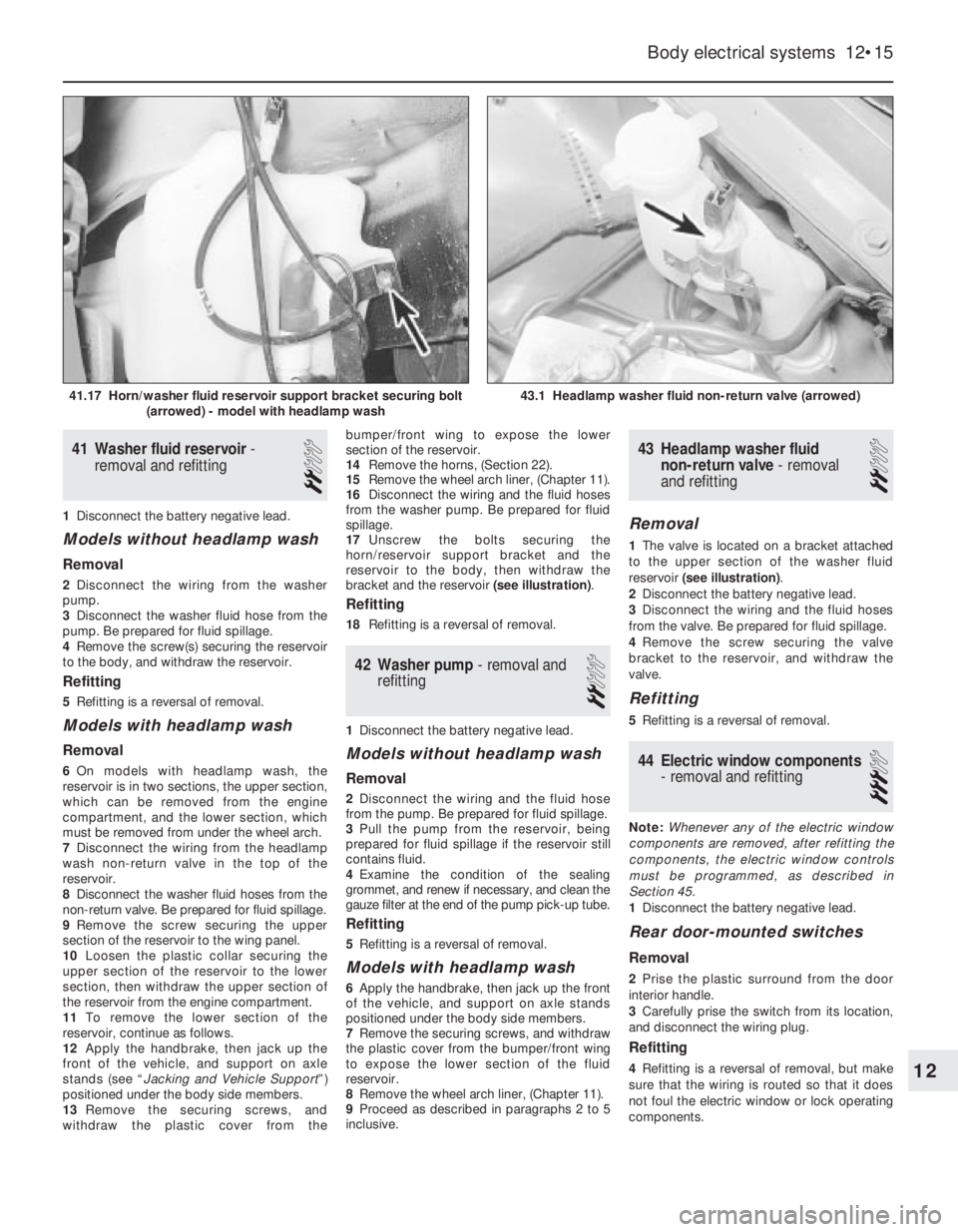
17Unscrew the bolts securing the
horn/reservoir support bracket and the
reservoir to the body, then withdraw the
bracket and the reservoir (see illustration).
Refitting
18Refitting is a reversal of removal.
42Washer pump -removal and
refitting
2
1Disconnect the battery negative lead.
Models without headlamp wash
Removal
2Disconnect the wiring and the fluid hose
from the pump. Be prepared for fluid spillage.
3Pull the pump from the reservoir, being
prepared for fluid spillage if the reservoir still
contains fluid.
4Examine the condition of the sealing
grommet, and renew if necessary, and clean the
gauze filter at the end of the pump pick-up tube.
Refitting
5Refitting is a reversal of removal.
Models with headlamp wash
6Apply the handbrake, then jack up the front
of the vehicle, and support on axle stands
positioned under the body side members.
7Remove the securing screws, and withdraw
the plastic cover from the bumper/front wing
to expose the lower section of the fluid
reservoir.
8Remove the wheel arch liner, (Chapter 11).
9Proceed as described in paragraphs 2 to 5
inclusive.
43Headlamp washer fluid
non-return valve -removal
and refitting
2
Removal
1The valve is located on a bracket attached
to the upper section of the washer fluid
reservoir (see illustration).
2Disconnect the battery negative lead.
3Disconnect the wiring and the fluid hoses
from the valve. Be prepared for fluid spillage.
4Remove the screw securing the valve
bracket to the reservoir, and withdraw the
valve.
Refitting
5Refitting is a reversal of removal.
44Electric window components
- removal and refitting
3
Note: Whenever any of the electric window
components are removed, after refitting the
components, the electric window controls
must be programmed, as described in
Section 45.
1Disconnect the battery negative lead.
Rear door-mounted switches
Removal
2Prise the plastic surround from the door
interior handle.
3Carefully prise the switch from its location,
and disconnect the wiring plug.
Refitting
4Refitting is a reversal of removal, but make
sure that the wiring is routed so that it does
not foul the electric window or lock operating
components.
Body electrical systems 12•15
43.1 Headlamp washer fluid non-return valve (arrowed)41.17 Horn/washer fluid reservoir support bracket securing bolt
(arrowed) - model with headlamp wash
12