1988 OPEL CALIBRA tow bar
[x] Cancel search: tow barPage 11 of 525
5Remove the three screws securing the
choke assembly to the carburettor body.
Allow the choke assembly to drop down, but
do not disconnect the choke linkage.
6Remove the star clip that secures the
diaphragm unit to the carburettor top cover,
and withdraw the diaphragm unit.
Refitting
7Refitting is a reversal of removal, but use a
new star clip to secure the diaphragm unit to
the carburettor top cover. Before refitting the
air box to the top of the carburettor, check
and if necessary adjust the choke pull-down,
as follows.
Vacuum pull-down
Adjustment
8With the air cleaner or air box removed from
the top of the carburettor, as described in
Section 17, paragraph 2, continue as follows.
9Note the position of the bi-metal housing
alignment marks as an aid to refitting, if
necessary making additional marks for clarity,
then remove the three securing screws, and
lift off the bi-metal housing. Place the housing
to one side, taking care not to strain the
coolant hoses or electric choke heater wiring.
10Position the fast idle speed adjustment
screw on the highest step of the fast idle cam,
and check that the choke valve is closed.
11Move the pull-down arm towards the
diaphragm unit by pushing on the adjustment
screw until resistance is felt. Hold the arm in
this position.
12Using a drill shank of appropriate
diameter, or a similar item, measure the
clearance between the lower side of the
choke plate and the wall of the primary barrel
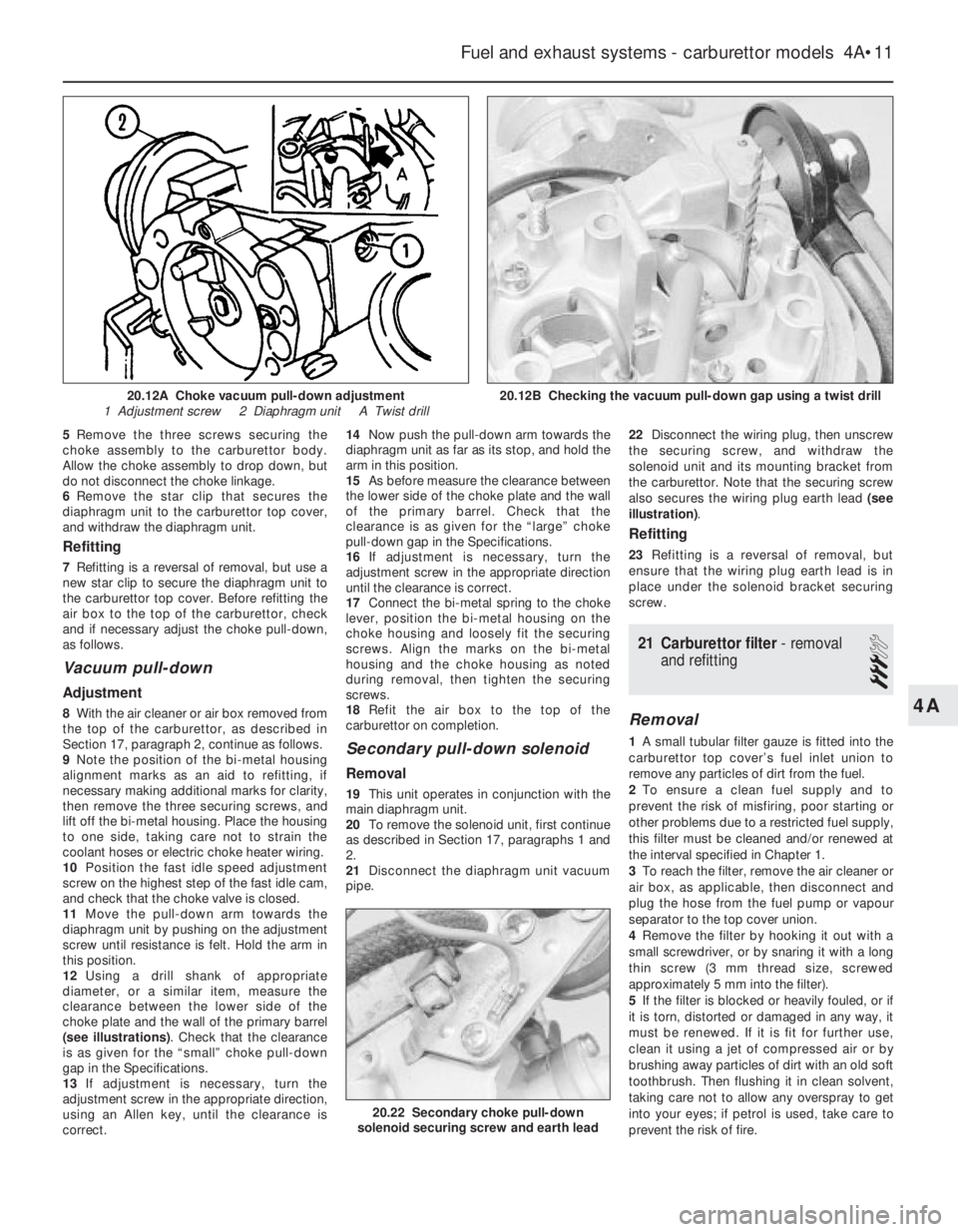
(see illustrations). Check that the clearance
is as given for the “small” choke pull-down
gap in the Specifications.
13If adjustment is necessary, turn the
adjustment screw in the appropriate direction,
using an Allen key, until the clearance is
correct.14Now push the pull-down arm towards the
diaphragm unit as far as its stop, and hold the
arm in this position.
15As before measure the clearance between
the lower side of the choke plate and the wall
of the primary barrel. Check that the
clearance is as given for the “large” choke
pull-down gap in the Specifications.
16If adjustment is necessary, turn the
adjustment screw in the appropriate direction
until the clearance is correct.
17Connect the bi-metal spring to the choke
lever, position the bi-metal housing on the
choke housing and loosely fit the securing
screws. Align the marks on the bi-metal
housing and the choke housing as noted
during removal, then tighten the securing
screws.
18Refit the air box to the top of the
carburettor on completion.
Secondary pull-down solenoid
Removal
19This unit operates in conjunction with the
main diaphragm unit.
20To remove the solenoid unit, first continue
as described in Section 17, paragraphs 1 and
2.
21Disconnect the diaphragm unit vacuum
pipe.22Disconnect the wiring plug, then unscrew
the securing screw, and withdraw the
solenoid unit and its mounting bracket from
the carburettor. Note that the securing screw
also secures the wiring plug earth lead (see
illustration).
Refitting
23Refitting is a reversal of removal, but
ensure that the wiring plug earth lead is in
place under the solenoid bracket securing
screw.
21Carburettor filter -removal
and refitting
3
Removal
1A small tubular filter gauze is fitted into the
carburettor top cover’s fuel inlet union to
remove any particles of dirt from the fuel.
2To ensure a clean fuel supply and to
prevent the risk of misfiring, poor starting or
other problems due to a restricted fuel supply,
this filter must be cleaned and/or renewed at
the interval specified in Chapter 1.
3To reach the filter, remove the air cleaner or
air box, as applicable, then disconnect and
plug the hose from the fuel pump or vapour
separator to the top cover union.
4Remove the filter by hooking it out with a
small screwdriver, or by snaring it with a long
thin screw (3 mm thread size, screwed
approximately 5 mm into the filter).
5If the filter is blocked or heavily fouled, or if
it is torn, distorted or damaged in any way, it
must be renewed. If it is fit for further use,
clean it using a jet of compressed air or by
brushing away particles of dirt with an old soft
toothbrush. Then flushing it in clean solvent,
taking care not to allow any overspray to get
into your eyes; if petrol is used, take care to
prevent the risk of fire.
Fuel and exhaust systems - carburettor models 4A•11
20.12B Checking the vacuum pull-down gap using a twist drill
20.22 Secondary choke pull-down
solenoid securing screw and earth lead
20.12A Choke vacuum pull-down adjustment
1 Adjustment screw 2 Diaphragm unit A Twist drill
4A
Page 266 of 525
Pierburg 2E3 carburettor- 4A•5
Piston rings- 2A•30
Piston/connecting rod- 2A•29
Plastic components- 11•3
Potentiometer- 4B•12, 4B•16
Power steering fluid - 0•14, 0•17, 1•2, 1•12
Power steering pump- 10•22
Power steering system bleeding- 10•22
Punctures- 0•8
RRadiator- 3•3
Radiator cooling fan- 3•5
Radiator grille- 11•12
Radio/cassette anti theft system- REF•5
Radio/cassette player- 12•18
Rear hub- 10•10, 10•15
Rear lamps- 12•11
Rear suspension assembly- 10•15
Relays- 12•3
Release bearing (clutch)- 6•6
Repair procedures- REF •4
Respraying- 11•2
Reversing lamp switch- 7A•6
Road test- 1•13
Roll bars- 10•8, 10•13, 10•17
Routine maintenance - 1•1 et seq
SSafety first!- 0•5
Scratches- 11•2
Seat belts- 11•21
Seats- 11•20, 11•22
Seats heated- 12•6
Selector cable (automatics)- 7B•4
Selector lever- 7B•4
Sender unit fuel level- 4A•4, 4B•8
Sender units (temperature gauge)- 3•6
Servicing - see Routine maintenance
Servo unit (braking system)- 9•15
Shock absorber- 10•11
Shoes (brake)- 9•6
Short-circuit finding- 12•2
Spark plugs- 1•3, 1•14, 1•16
Speakers- 12•17
Speedometer cable- 12•18
Speedometer drive- 7A•6
Starter inhibitor switch- 7B•3
Starter motor- 5•8
Starting problems- 0•6
Steering wheel alignment- 10•1, 10•24
Steering- 10•1 et seq
camber - 10•1 10•24
castor - 10•1, 10•24
column - 10•18
damper - 10•21
fault diagnosis - REF•12, REF•17gear - 10•21
power steering system bleeding - 10•22
power steering fluid - 0•17, 1•2
power steering pump - 10•22
shaft rubber coupling - 10•18
tie-rod end - 10•23
toe setting - 10•1, 10•24
wheel - 10•17
wheel bearing - 10•4, 10•9, 10•14
wheel with airbag - 12•20
Stub axle- 10•13
Subframe- 10•5
Sump- 2A•27, 2B•9
Sunroof- 11•13
Sunroof motor- 12•18
Sunroof switch- 12•5
Suspension- 10•1 et seq
anti-roll bars - 10•8, 10•13, 10•17
assembly (rear) - 10•15
coil spring (rear) - 10•12, 10•15
fault diagnosis - REF•12, REF•17
level control system - 10•14
lower arm (front) - 10•7
rear hub - 10•10, 10•15
shock absorber - 10•11
strut (front) - 10•6
stub axle - 10•13
sub frame - 10•5
trailing arms - 10•12, 10•16
wheel bearing - 10•4, 10•9, 10•14
Suspension/steering checks- 1•10
Switches:
brake lamp - 12•5
cooling fan - 3•6
courtesy lamp - 12•5
electric door mirror - 12•5
handbrake warning lamp - 12•5
hazard warning - 12•4
heater blower motor - 12•4
ignition - 12•3
indicator - 12•4
kickdown - 7B•3
lights - 12•4
luggage compartment - 12•5
oil pressure warning lamp - 12•5
push button - 12•4
reversing lamp - 7A•6
starter inhibitor - 7B•3
sunroof - 12•5
TTailgate- 11•5
Temperature gauge sender- 3•6
Temperature sensor (automatics)- 7B•5
Thermostat- 3•4
Throttle cable- 4A•5, 4B•9
Throttle pedal- 4A•5Tie-rod end- 10•23
Timing- 5•2, 5•13
Timing belt- 1•16, 2A•13, 2B•3, 2B•6
Toe setting- 10•1, 10•24
Tools and working facilities- REF•4, REF•6,
REF•7
Towing- 0•9
Trim panel (door)- 11•6
Tyre checks- 0•16, 0•17
Tyre pressures- 0•17
UUnderbody- 11•1
Underbody views- 1•7
Underbonnet views- 0•10, 1•5
Upholstery and carpets- 11•2
VVacuum servo unit (braking system)- 9•15
Valve lifters- 2A•24, 2B•9
Valves- 2A•5, 2B•2
Vehicle identification numbers- REF•3
Ventilation system- 3•1 et seq
Vents- 3•8
WWasher fluid- 0•13, 1•2
Washers- 12•13, 12•15
Water pump- 3•4
Weekly checks- 0•10et seq
Wheelalignment- 10•1, 10•24
Wheel arch liners- 11•12
Wheel bearing- 10•4, 10•9, 10•14
Wheel changing- 0•8
Wheel cylinder- 9•11
Window glass- 11•9
Window regulator- 11•10
Windscreen- 11•9, 11•12
Wiper blades- 0•15, 12•13
Wiper motors- 12•14
Wiring diagrams- 12•22 et seq
Index REF•27
REF