1988 OPEL CALIBRA engine coolant
[x] Cancel search: engine coolantPage 6 of 525

2A separate idle system operates
independently from the main jet system,
supplying fuel by way of the mixture control
screw.
3The main jets are calibrated to suit engine
requirements at mid-range throttle openings.
To provide the necessary fuel enrichment at
full throttle, a vacuum-operated power valve is
used. The valve provides extra fuel under the
low vacuum conditions associated with wide
throttle openings.
4To provide an enriched mixture during
acceleration, an accelerator pump delivers
extra fuel to the primary main venturi. The
accelerator pump is operated mechanically by
a cam on the throttle linkage.
5A fully automatic choke is fitted, operated
by a coolant and electrically heated bi-metal
coil. When the engine is cold, the bi-metal coil
is fully wound up, holding the choke plate
(fitted to the primary barrel) closed. As the
engine warms up, the bi-metal coil is heated
and therefore unwinds, progressively opening
the choke plate. A vacuum operated pull-
down system is employed, whereby, if the
engine is under choke but is only cruising (i.e.
not under heavy load) the choke plate is
opened against the action of the bi-metal coil.
The pull-down system prevents an over-rich
mixture, which reduces fuel economy and
may cause unnecessary engine wear when
the engine is cold. A secondary pull-down
solenoid is fitted, which operates in
conjunction with the main diaphragm unit to
modify the pull-down characteristics,
improving fuel economy.
61.8 litre models are fitted with an idle cut-off
solenoid. This is an electrically operated valve,
which interrupts the idle mixture circuit when
the ignition is switched off, this preventing
engine “run-on”.13Carburettor - removal,
overhaul and refitting
3
Note: Refer to Section 2 before proceeding.
New gasket(s) must be used when refitting the
carburettor. A tachometer and an exhaust gas
analyser will be required to check the idle
speed and mixture on completion
Removal
1Disconnect the battery negative lead.
2Remove the air cleaner, on early models.
On later models, disconnect the air trunking
from the air cleaner, then disconnect the
vacuum pipe and breather hose from the air
box. Extract the three securing screws and lift
off the air box, complete with air trunking.
3On 1.4 litre models, disconnect the fuel
supply hose from the carburettor, and on 1.6
and 1.8 litre models, disconnect the fuel
supply and return hoses from the vapour
separator. Be prepared for fuel spillage, and
take adequate fire precautions. Plug the ends
of the hoses, to prevent dirt ingress and
further fuel spillage.
4Extract the clip from the throttle cable end
fitting at the bracket on the carburettor, then
slide the cable end grommet from the bracket,
and slide the cable end from the throttle valve
lever.
5Disconnect the coolant hoses from the
automatic choke housing noting their
locations, as an aid to refitting. Be prepared
for coolant spillage, and plug the hoses, or
secure them with their ends facing upwards,
to prevent further coolant loss.
6Disconnect the vacuum pipes from the front
of the carburettor, noting their locations and
routing for use when refitting (see
illustration).
7Disconnect the choke heater wire and any
additional wiring.8Unscrew the three securing nuts, and
withdraw the carburettor from the inlet
manifold studs.
9Recover the gasket(s) and insulator block
that fit between the carburettor and the inlet
manifold.
Overhaul
10With the carburettor removed from the
vehicle, drain the fuel from the float chamber
and vapour separator (where applicable).
Clean the outside of the carburettor, then
remove the top cover (Section 15).
11Blow through the jets and drillings with
compressed air, or air from a foot pump - do
not probe them with wire. If it is wished to
remove the jets, unscrew them carefully with
well-fitting tools.
12Remove the fuel filter gauze from the inlet
union, refer to Section 21, for details. Vauxhall
recommend that it is renewed whenever the
carburettor is cleaned.
4A•6Fuel and exhaust systems - carburettor models
12.1B Side view of carburettor, showing automatic choke
housing (1), vapour separator (2) and secondary throttle valve
vacuum diaphragm (3)12.1C Side view of carburettor, showing secondary choke pull-
down solenoid (1) and power valve (2)
13.6 Disconnecting the air box vacuum
pipe from the carburettor - 1.6 litre model
Aerosol cans of carburettor
cleaner are widely available
and can prove useful in
helping to clean internal
passages of stubborn obstructions.
Page 7 of 525

13Clean any foreign matter from the float
chamber. Renew the float, the float needle
valve and seat if wear is evident, or if the float
is punctured or otherwise damaged. Check
that the needle valve closes completely before
the float reaches the top of its movement. See
Section 15, for details of float level checking.
14Renew the diaphragms in the part-load
enrichment valve and in the accelerator pump.
If additional pump or valve parts are supplied
in the overhaul kit, renew these parts also.
15Further dismantling is not recommended.
Pay particular attention to the throttle opening
mechanism arrangement if it is decided to
dismantle it; the interlocking arrangement is
important.
16Reassemble in the reverse order to
dismantling. Use new gaskets and seals
throughout; lubricate linkages with a smear of
molybdenum based grease.
Refitting
17Carry out the following procedure before
refitting.
a)Position the fast idle adjustment screw on
the highest step of the fast idle cam.
b)Use a gauge rod or twist drill of the
specified diameter to measure the
opening of the primary throttle valve.
c)Adjust if necessary at the fast idle
adjustment screw.
d)Note that this is a preliminary adjustment;
final adjustment of the fast idle speed
should take place with the engine running.
18Refitting is a reversal of removal, but
renew the gasket(s).
19After refitting, carry out the following
checks and adjustments.
20Check the throttle cable free play and
adjust if necessary, as described in Section 11.
21Check and if necessary top-up the
coolant level, as described in Chapter 3.
22Check and if necessary adjust the idle
speed and mixture, as described in Section 14.
14Idle speed and mixture -
adjustment
3
Note: Refer to Section 2 before proceeding.
To carry out the adjustments, an accurate
tachometer and an exhaust gas analyser (CO
meter) will be required
1To check the idle speed and mixture
adjustment, the following conditions must be
met:
a)The engine must be at normal operating
temperature
b)All electrical consumers (cooling fan,
heater blower, headlamps, etc.) must be
switched off
c)The ignition timing and spark plug gaps
must be correctly adjusted - see Chapters
1 and 5
d)The throttle cable free play must be
correctly adjusted - see Section 11
e)The air inlet trunking must be free from
leaks, and the air filter must be cleanf)On automatic models, always select
position, “P”.
2Connect a tachometer and an exhaust gas
analyser to the vehicle, according to the
equipment manufacturer’s instructions.
3Start the engine, and run it at 2000 rpm for
approximately 30 seconds, then allow it to
idle. If the idle speed is outside the specified
limits, adjust by means of the throttle stop
screw (see illustration).
4When the idle speed is correct, check the
CO level in the exhaust gas. If it is outside the
specified limits, adjust by means of the idle
mixture adjustment screw. In production, the
screw is covered by a tamperproof plug;
ensure that no local or national laws are being
broken before removing the plug (see
illustration).
5On automatic models, when position “D” is
selected (all electrical systems switched off),
the idle speed should not drop perceptibly. If
it does, the vehicle should be taken to a
Vauxhall dealer for the idle-up system to be
checked using special Vauxhall test
equipment.
6With the idle mixture correct, readjust the
idle speed if necessary.
7If the cooling fan cuts in during the
adjustment procedure, stop the adjustments,
and continue when the cooling fan stops.
8When both idle speed and mixture are
correctly set, stop the engine and disconnect
the test equipment.
9Fit a new tamperproof plug to the idle
mixture adjustment screw, where this is
required by law.
15Needle valve and float -
removal, inspection and
refitting
4
Note: Refer to Section 2 before proceeding. A
new carburettor top cover gasket must be
used on reassembly. A tachometer and an
exhaust gas analyser will be required to check
the idle speed and mixture on completion
Removal
1Disconnect the battery negative lead.
2Remove the round air cleaner, on
applicable models. On other models,
disconnect the air trunking from the air
cleaner, then disconnect the vacuum pipe and
breather hose from the air box. Extract the
three securing screws and lift off the air box,
complete with air trunking.
3Thoroughly clean all external dirt from the
carburettor.
4Disconnect the fuel supply hose at the
carburettor. Be prepared for fuel spillage, and
take adequate fire precautions. Plug the end
of the hose, to prevent dirt ingress and further
fuel spillage.
5Identify the automatic choke coolant hose
locations as an aid to refitting, then
disconnect the hoses. Be prepared for
coolant spillage, and either plug the hoses, or
secure them with their ends facing upwards,
to prevent further coolant loss.
6Disconnect the choke heater wiring plug.
7Disconnect the lower vacuum hoses from
the choke pull-down unit.
8Remove the four carburettor top cover
securing screws, noting their locations, as two
lengths of screw are used (see illustration).
9Lift off the top cover and recover the
gasket.
Inspection
10Hold the cover vertically, so that the float
is hanging from its pivot. Then tilt the cover
until the float needle valve is just closed - the
needle spring must not be compressed by the
weight of the float.
11Measure the distance, dimension x (see
illustration),from the bottom of the float to
the gasket surface on the top cover’s
Fuel and exhaust systems - carburettor models 4A•7
15.8 Carburettor top cover securing
screws (arrowed)14.4 Tamperproof plug (arrowed) covering
idle mixture adjustment screw
14.3 Carburettor idle speed adjustment
(throttle stop) screw (arrowed)
4A
Page 10 of 525
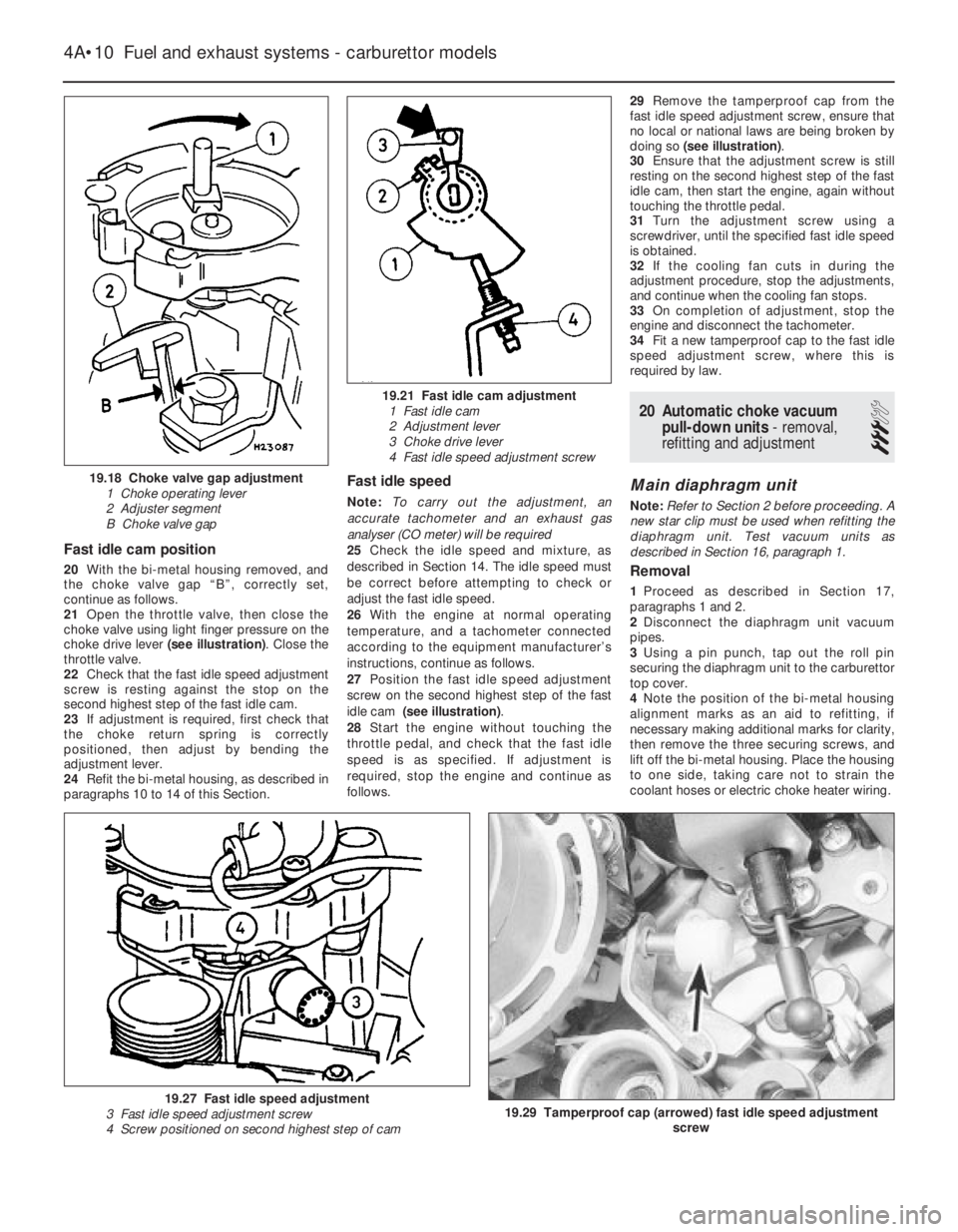
Fast idle cam position
20With the bi-metal housing removed, and
the choke valve gap “B”, correctly set,
continue as follows.
21Open the throttle valve, then close the
choke valve using light finger pressure on the
choke drive lever (see illustration). Close the
throttle valve.
22Check that the fast idle speed adjustment
screw is resting against the stop on the
second highest step of the fast idle cam.
23If adjustment is required, first check that
the choke return spring is correctly
positioned, then adjust by bending the
adjustment lever.
24Refit the bi-metal housing, as described in
paragraphs 10 to 14 of this Section.
Fast idle speed
Note: To carry out the adjustment, an
accurate tachometer and an exhaust gas
analyser (CO meter) will be required
25Check the idle speed and mixture, as
described in Section 14. The idle speed must
be correct before attempting to check or
adjust the fast idle speed.
26With the engine at normal operating
temperature, and a tachometer connected
according to the equipment manufacturer’s
instructions, continue as follows.
27Position the fast idle speed adjustment
screw on the second highest step of the fast
idle cam (see illustration).
28Start the engine without touching the
throttle pedal, and check that the fast idle
speed is as specified. If adjustment is
required, stop the engine and continue as
follows.29Remove the tamperproof cap from the
fast idle speed adjustment screw, ensure that
no local or national laws are being broken by
doing so (see illustration).
30Ensure that the adjustment screw is still
resting on the second highest step of the fast
idle cam, then start the engine, again without
touching the throttle pedal.
31Turn the adjustment screw using a
screwdriver, until the specified fast idle speed
is obtained.
32If the cooling fan cuts in during the
adjustment procedure, stop the adjustments,
and continue when the cooling fan stops.
33On completion of adjustment, stop the
engine and disconnect the tachometer.
34Fit a new tamperproof cap to the fast idle
speed adjustment screw, where this is
required by law.
20Automatic choke vacuum
pull-down units - removal,
refitting and adjustment
3
Main diaphragm unit
Note: Refer to Section 2 before proceeding. A
new star clip must be used when refitting the
diaphragm unit. Test vacuum units as
described in Section 16, paragraph 1.
Removal
1Proceed as described in Section 17,
paragraphs 1 and 2.
2Disconnect the diaphragm unit vacuum
pipes.
3Using a pin punch, tap out the roll pin
securing the diaphragm unit to the carburettor
top cover.
4Note the position of the bi-metal housing
alignment marks as an aid to refitting, if
necessary making additional marks for clarity,
then remove the three securing screws, and
lift off the bi-metal housing. Place the housing
to one side, taking care not to strain the
coolant hoses or electric choke heater wiring.
4A•10Fuel and exhaust systems - carburettor models
19.18 Choke valve gap adjustment
1 Choke operating lever
2 Adjuster segment
B Choke valve gap
19.21 Fast idle cam adjustment
1 Fast idle cam
2 Adjustment lever
3 Choke drive lever
4 Fast idle speed adjustment screw
19.29 Tamperproof cap (arrowed) fast idle speed adjustment
screw19.27 Fast idle speed adjustment
3 Fast idle speed adjustment screw
4 Screw positioned on second highest step of cam
Page 12 of 525
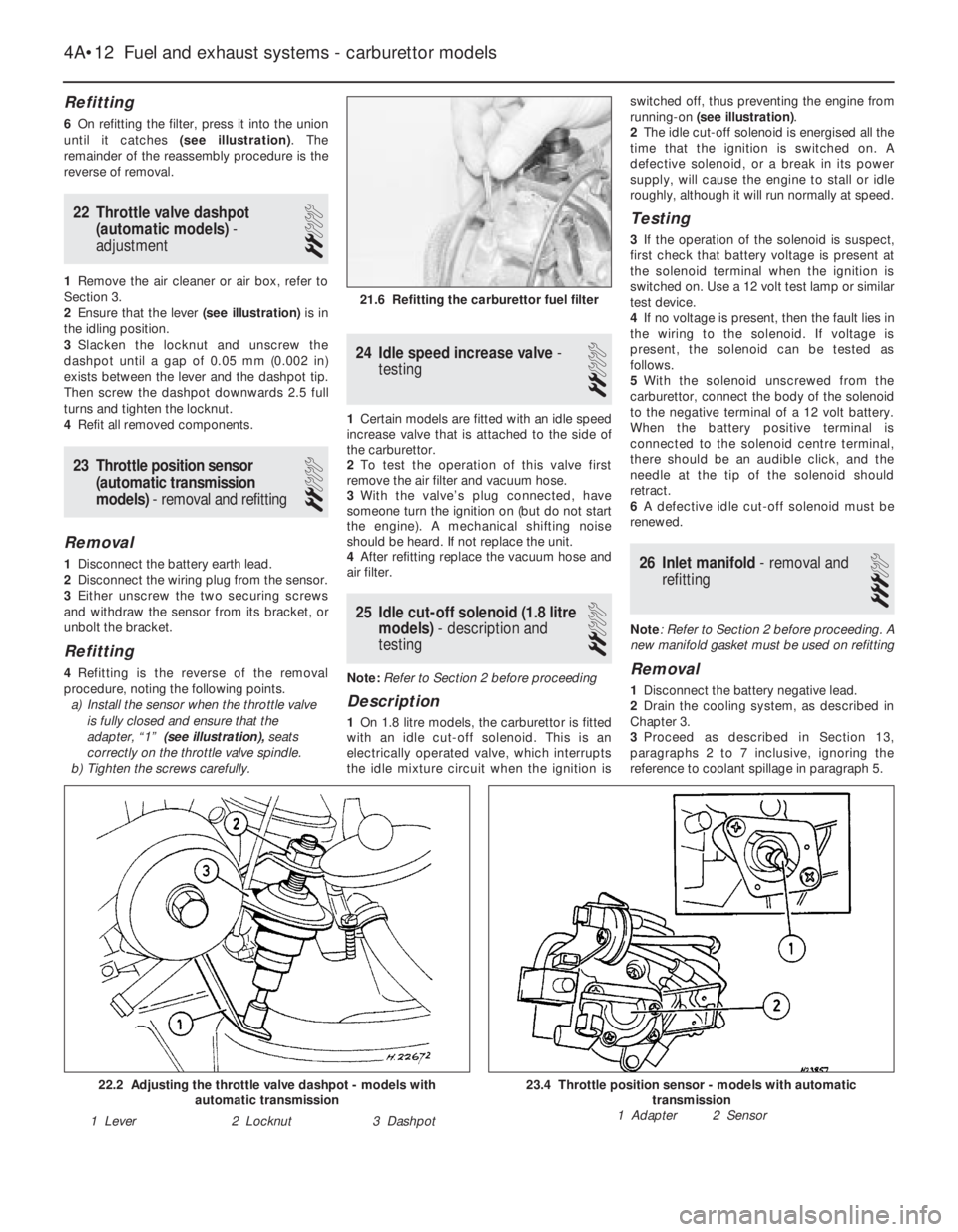
Refitting
6On refitting the filter, press it into the union
until it catches (see illustration). The
remainder of the reassembly procedure is the
reverse of removal.
22Throttle valve dashpot
(automatic models) -
adjustment
2
1Remove the air cleaner or air box, refer to
Section 3.
2Ensure that the lever (see illustration)is in
the idling position.
3Slacken the locknut and unscrew the
dashpot until a gap of 0.05 mm (0.002 in)
exists between the lever and the dashpot tip.
Then screw the dashpot downwards 2.5 full
turns and tighten the locknut.
4Refit all removed components.
23Throttle position sensor
(automatic transmission
models) - removal and refitting
2
Removal
1Disconnect the battery earth lead.
2Disconnect the wiring plug from the sensor.
3Either unscrew the two securing screws
and withdraw the sensor from its bracket, or
unbolt the bracket.
Refitting
4Refitting is the reverse of the removal
procedure, noting the following points.
a)Install the sensor when the throttle valve
is fully closed and ensure that the
adapter, “1” (see illustration),seats
correctly on the throttle valve spindle.
b)Tighten the screws carefully.
24Idle speed increase valve -
testing
2
1Certain models are fitted with an idle speed
increase valve that is attached to the side of
the carburettor.
2To test the operation of this valve first
remove the air filter and vacuum hose.
3With the valve’s plug connected, have
someone turn the ignition on (but do not start
the engine). A mechanical shifting noise
should be heard. If not replace the unit.
4After refitting replace the vacuum hose and
air filter.
25Idle cut-off solenoid (1.8 litre
models) - description and
testing
2
Note: Refer to Section 2 before proceeding
Description
1On 1.8 litre models, the carburettor is fitted
with an idle cut-off solenoid. This is an
electrically operated valve, which interrupts
the idle mixture circuit when the ignition isswitched off, thus preventing the engine from
running-on (see illustration).
2The idle cut-off solenoid is energised all the
time that the ignition is switched on. A
defective solenoid, or a break in its power
supply, will cause the engine to stall or idle
roughly, although it will run normally at speed.
Testing
3If the operation of the solenoid is suspect,
first check that battery voltage is present at
the solenoid terminal when the ignition is
switched on. Use a 12 volt test lamp or similar
test device.
4If no voltage is present, then the fault lies in
the wiring to the solenoid. If voltage is
present, the solenoid can be tested as
follows.
5With the solenoid unscrewed from the
carburettor, connect the body of the solenoid
to the negative terminal of a 12 volt battery.
When the battery positive terminal is
connected to the solenoid centre terminal,
there should be an audible click, and the
needle at the tip of the solenoid should
retract.
6A defective idle cut-off solenoid must be
renewed.
26Inlet manifold - removal and
refitting
3
Note: Refer to Section 2 before proceeding. A
new manifold gasket must be used on refitting
Removal
1Disconnect the battery negative lead.
2Drain the cooling system, as described in
Chapter 3.
3Proceed as described in Section 13,
paragraphs 2 to 7 inclusive, ignoring the
reference to coolant spillage in paragraph 5.
4A•12Fuel and exhaust systems - carburettor models
21.6 Refitting the carburettor fuel filter
23.4 Throttle position sensor - models with automatic
transmission
1 Adapter 2 Sensor22.2 Adjusting the throttle valve dashpot - models with
automatic transmission
1 Lever2 Locknut3 Dashpot
Page 13 of 525
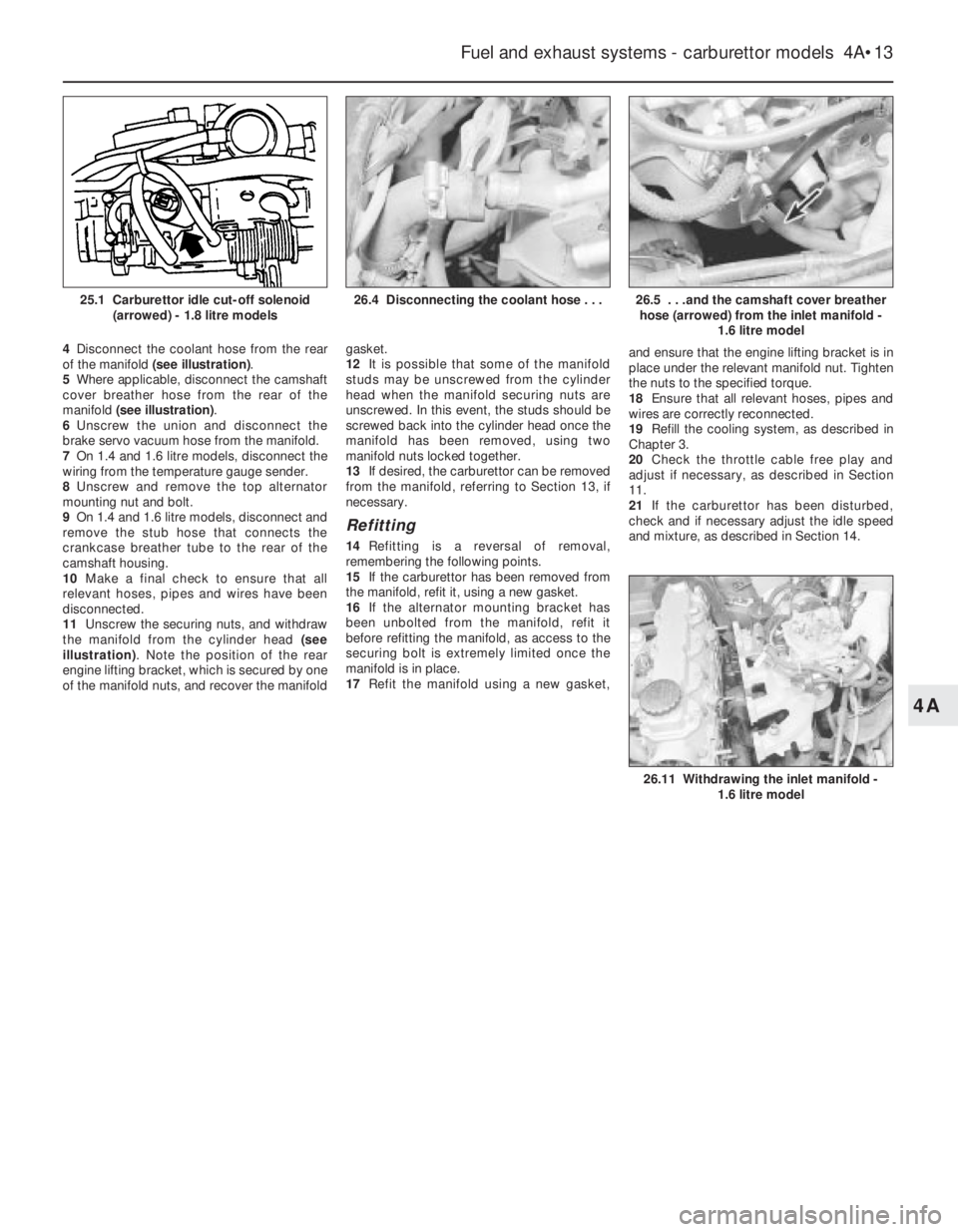
4Disconnect the coolant hose from the rear
of the manifold (see illustration).
5Where applicable, disconnect the camshaft
cover breather hose from the rear of the
manifold (see illustration).
6Unscrew the union and disconnect the
brake servo vacuum hose from the manifold.
7On 1.4 and 1.6 litre models, disconnect the
wiring from the temperature gauge sender.
8Unscrew and remove the top alternator
mounting nut and bolt.
9On 1.4 and 1.6 litre models, disconnect and
remove the stub hose that connects the
crankcase breather tube to the rear of the
camshaft housing.
10Make a final check to ensure that all
relevant hoses, pipes and wires have been
disconnected.
11Unscrew the securing nuts, and withdraw
the manifold from the cylinder head (see
illustration). Note the position of the rear
engine lifting bracket, which is secured by one
of the manifold nuts, and recover the manifoldgasket.
12It is possible that some of the manifold
studs may be unscrewed from the cylinder
head when the manifold securing nuts are
unscrewed. In this event, the studs should be
screwed back into the cylinder head once the
manifold has been removed, using two
manifold nuts locked together.
13If desired, the carburettor can be removed
from the manifold, referring to Section 13, if
necessary.
Refitting
14Refitting is a reversal of removal,
remembering the following points.
15If the carburettor has been removed from
the manifold, refit it, using a new gasket.
16If the alternator mounting bracket has
been unbolted from the manifold, refit it
before refitting the manifold, as access to the
securing bolt is extremely limited once the
manifold is in place.
17Refit the manifold using a new gasket,and ensure that the engine lifting bracket is in
place under the relevant manifold nut. Tighten
the nuts to the specified torque.
18Ensure that all relevant hoses, pipes and
wires are correctly reconnected.
19Refill the cooling system, as described in
Chapter 3.
20Check the throttle cable free play and
adjust if necessary, as described in Section
11.
21If the carburettor has been disturbed,
check and if necessary adjust the idle speed
and mixture, as described in Section 14.
Fuel and exhaust systems - carburettor models 4A•13
26.5 . . .and the camshaft cover breather
hose (arrowed) from the inlet manifold -
1.6 litre model
26.11 Withdrawing the inlet manifold -
1.6 litre model
26.4 Disconnecting the coolant hose . . .
4A
25.1 Carburettor idle cut-off solenoid
(arrowed) - 1.8 litre models
Page 22 of 525
Brake fluid level sensor
14The procedure is as described for the
coolant level sensor in paragraphs 7 to 10
inclusive.
Engine oil level sensor
Removal
15Apply the handbrake, jack up the front of
the vehicle, and support securely on axle
stands (see “Jacking and Vehicle Support”)
positioned under the body side members.
16On DOHC models, remove the engine
undershield, as described in Chapter 11.
17Disconnect the sensor wiring plug.
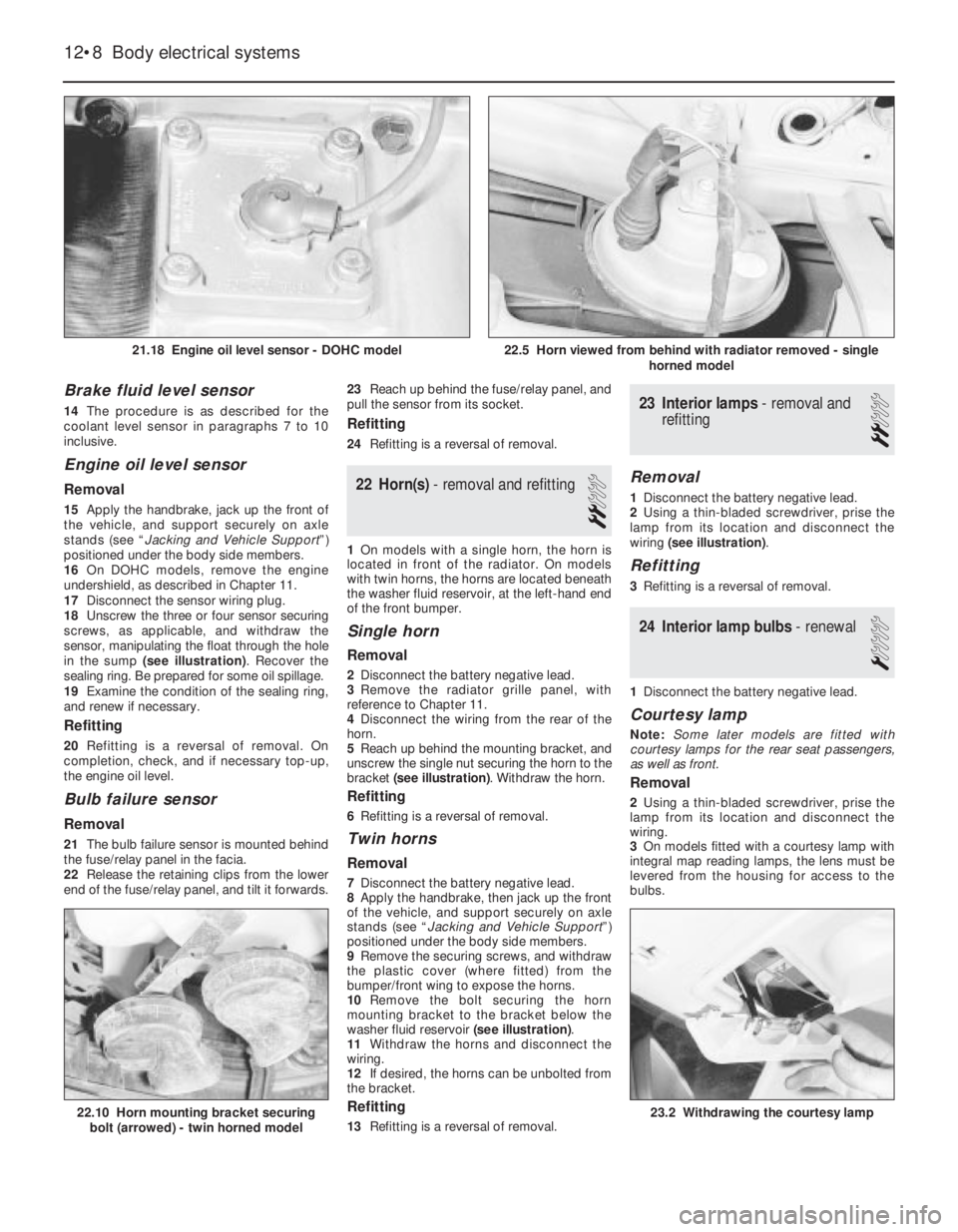
18Unscrew the three or four sensor securing
screws, as applicable, and withdraw the
sensor, manipulating the float through the hole
in the sump (see illustration). Recover the
sealing ring. Be prepared for some oil spillage.
19Examine the condition of the sealing ring,
and renew if necessary.
Refitting
20Refitting is a reversal of removal. On
completion, check, and if necessary top-up,
the engine oil level.
Bulb failure sensor
Removal
21The bulb failure sensor is mounted behind
the fuse/relay panel in the facia.
22Release the retaining clips from the lower
end of the fuse/relay panel, and tilt it forwards.23Reach up behind the fuse/relay panel, and
pull the sensor from its socket.
Refitting
24Refitting is a reversal of removal.
22Horn(s) - removal and refitting
2
1On models with a single horn, the horn is
located in front of the radiator. On models
with twin horns, the horns are located beneath
the washer fluid reservoir, at the left-hand end
of the front bumper.
Single horn
Removal
2Disconnect the battery negative lead.
3Remove the radiator grille panel, with
reference to Chapter 11.
4Disconnect the wiring from the rear of the
horn.
5Reach up behind the mounting bracket, and
unscrew the single nut securing the horn to the
bracket (see illustration). Withdraw the horn.
Refitting
6Refitting is a reversal of removal.
Twin horns
Removal
7Disconnect the battery negative lead.
8Apply the handbrake, then jack up the front
of the vehicle, and support securely on axle
stands (see “Jacking and Vehicle Support”)
positioned under the body side members.
9Remove the securing screws, and withdraw
the plastic cover (where fitted) from the
bumper/front wing to expose the horns.
10Remove the bolt securing the horn
mounting bracket to the bracket below the
washer fluid reservoir (see illustration).
11Withdraw the horns and disconnect the
wiring.
12If desired, the horns can be unbolted from
the bracket.
Refitting
13Refitting is a reversal of removal.
23Interior lamps - removal and
refitting
2
Removal
1Disconnect the battery negative lead.
2Using a thin-bladed screwdriver, prise the
lamp from its location and disconnect the
wiring (see illustration).
Refitting
3Refitting is a reversal of removal.
24Interior lamp bulbs - renewal
1
1Disconnect the battery negative lead.
Courtesy lamp
Note: Some later models are fitted with
courtesy lamps for the rear seat passengers,
as well as front.
Removal
2Using a thin-bladed screwdriver, prise the
lamp from its location and disconnect the
wiring.
3On models fitted with a courtesy lamp with
integral map reading lamps, the lens must be
levered from the housing for access to the
bulbs.
12•8Body electrical systems
21.18 Engine oil level sensor - DOHC model
22.10 Horn mounting bracket securing
bolt (arrowed) - twin horned model23.2 Withdrawing the courtesy lamp
22.5 Horn viewed from behind with radiator removed - single
horned model
Page 53 of 525
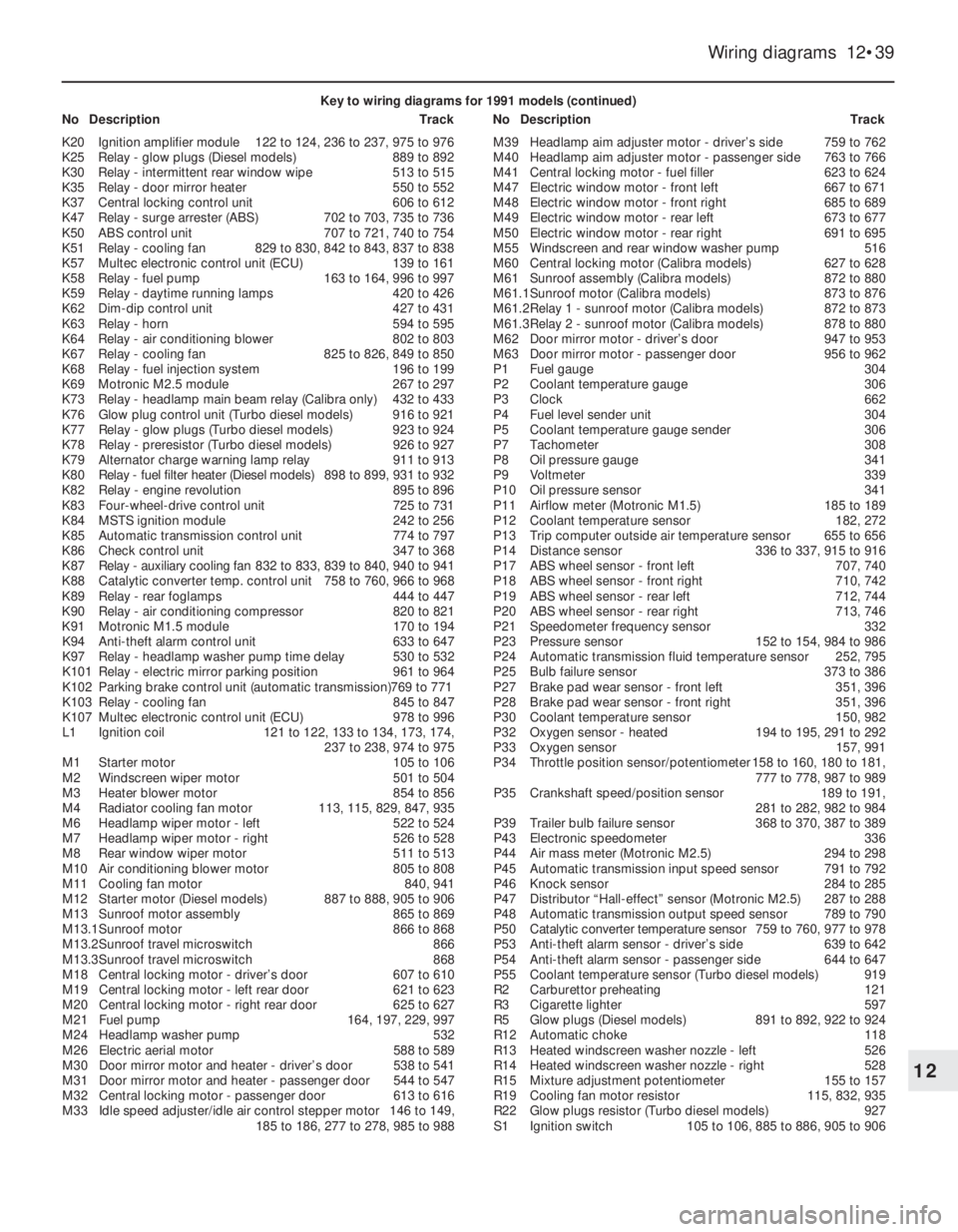
Wiring diagrams 12•39
12
Key to wiring diagrams for 1991 models (continued)
NoDescriptionTrackNoDescriptionTrack
K20Ignition amplifier module122 to 124, 236 to 237, 975 to 976
K25Relay - glow plugs (Diesel models)889 to 892
K30Relay - intermittent rear window wipe513 to 515
K35Relay - door mirror heater550 to 552
K37Central locking control unit606 to 612
K47Relay - surge arrester (ABS)702 to 703, 735 to 736
K50ABS control unit707 to 721, 740 to 754
K51Relay - cooling fan829 to 830, 842 to 843, 837 to 838
K57Multec electronic control unit (ECU)139 to 161
K58Relay - fuel pump163 to 164, 996 to 997
K59Relay - daytime running lamps420 to 426
K62Dim-dip control unit427 to 431
K63Relay - horn594 to 595
K64Relay - air conditioning blower802 to 803
K67Relay - cooling fan825 to 826, 849 to 850
K68Relay - fuel injection system196 to 199
K69Motronic M2.5 module267 to 297
K73Relay - headlamp main beam relay (Calibra only)432 to 433
K76Glow plug control unit (Turbo diesel models)916 to 921
K77Relay - glow plugs (Turbo diesel models)923 to 924
K78Relay - preresistor (Turbo diesel models)926 to 927
K79Alternator charge warning lamp relay911 to 913
K80Relay - fuel filter heater (Diesel models)898 to 899, 931 to 932
K82Relay - engine revolution895 to 896
K83Four-wheel-drive control unit725 to 731
K84MSTS ignition module242 to 256
K85Automatic transmission control unit774 to 797
K86Check control unit347 to 368
K87Relay - auxiliary cooling fan832 to 833, 839 to 840, 940 to 941
K88Catalytic converter temp. control unit758 to 760, 966 to 968
K89Relay - rear foglamps444 to 447
K90Relay - air conditioning compressor820 to 821
K91Motronic M1.5 module170 to 194
K94Anti-theft alarm control unit633 to 647
K97Relay - headlamp washer pump time delay530 to 532
K101Relay - electric mirror parking position961 to 964
K102Parking brake control unit (automatic transmission)769 to 771
K103Relay - cooling fan845 to 847
K107Multec electronic control unit (ECU)978 to 996
L1Ignition coil121 to 122, 133 to 134, 173, 174,
237 to 238, 974 to 975
M1Starter motor105 to 106
M2Windscreen wiper motor501 to 504
M3Heater blower motor854 to 856
M4Radiator cooling fan motor113, 115, 829, 847, 935
M6Headlamp wiper motor - left522 to 524
M7Headlamp wiper motor - right526 to 528
M8Rear window wiper motor511 to 513
M10Air conditioning blower motor805 to 808
M11Cooling fan motor840, 941
M12Starter motor (Diesel models)887 to 888, 905 to 906
M13Sunroof motor assembly865 to 869
M13.1Sunroof motor866 to 868
M13.2Sunroof travel microswitch866
M13.3Sunroof travel microswitch868
M18Central locking motor - driver’s door607 to 610
M19Central locking motor - left rear door621 to 623
M20Central locking motor - right rear door625 to 627
M21Fuel pump164, 197, 229, 997
M24Headlamp washer pump532
M26Electric aerial motor588 to 589
M30Door mirror motor and heater - driver’s door538 to 541
M31Door mirror motor and heater - passenger door544 to 547
M32Central locking motor - passenger door613 to 616
M33Idle speed adjuster/idle air control stepper motor146 to 149,
185 to 186, 277 to 278, 985 to 988M39Headlamp aim adjuster motor - driver’s side759 to 762
M40Headlamp aim adjuster motor - passenger side763 to 766
M41Central locking motor - fuel filler623 to 624
M47Electric window motor - front left667 to 671
M48Electric window motor - front right685 to 689
M49Electric window motor - rear left673 to 677
M50Electric window motor - rear right691 to 695
M55Windscreen and rear window washer pump516
M60Central locking motor (Calibra models)627 to 628
M61Sunroof assembly (Calibra models)872 to 880
M61.1Sunroof motor (Calibra models)873 to 876
M61.2Relay 1 - sunroof motor (Calibra models)872 to 873
M61.3Relay 2 - sunroof motor (Calibra models)878 to 880
M62Door mirror motor - driver’s door947 to 953
M63Door mirror motor - passenger door956 to 962
P1Fuel gauge304
P2Coolant temperature gauge306
P3Clock662
P4Fuel level sender unit304
P5Coolant temperature gauge sender306
P7Tachometer308
P8Oil pressure gauge341
P9Voltmeter339
P10Oil pressure sensor341
P11Airflow meter (Motronic M1.5)185 to 189
P12Coolant temperature sensor182, 272
P13Trip computer outside air temperature sensor655 to 656
P14Distance sensor336 to 337, 915 to 916
P17ABS wheel sensor - front left707, 740
P18ABS wheel sensor - front right710, 742
P19ABS wheel sensor - rear left712, 744
P20ABS wheel sensor - rear right713, 746
P21Speedometer frequency sensor332
P23Pressure sensor152 to 154, 984 to 986
P24Automatic transmission fluid temperature sensor252, 795
P25Bulb failure sensor373 to 386
P27Brake pad wear sensor - front left351, 396
P28Brake pad wear sensor - front right351, 396
P30Coolant temperature sensor150, 982
P32Oxygen sensor - heated194 to 195, 291 to 292
P33Oxygen sensor157, 991
P34Throttle position sensor/potentiometer158 to 160, 180 to 181,
777 to 778, 987 to 989
P35Crankshaft speed/position sensor189 to 191,
281 to 282, 982 to 984
P39Trailer bulb failure sensor368 to 370, 387 to 389
P43Electronic speedometer336
P44Air mass meter (Motronic M2.5)294 to 298
P45Automatic transmission input speed sensor791 to 792
P46Knock sensor284 to 285
P47Distributor “Hall-effect” sensor (Motronic M2.5)287 to 288
P48Automatic transmission output speed sensor789 to 790
P50Catalytic converter temperature sensor759 to 760, 977 to 978
P53Anti-theft alarm sensor - driver’s side639 to 642
P54Anti-theft alarm sensor - passenger side644 to 647
P55Coolant temperature sensor (Turbo diesel models)919
R2Carburettor preheating121
R3Cigarette lighter597
R5Glow plugs (Diesel models)891 to 892, 922 to 924
R12Automatic choke118
R13Heated windscreen washer nozzle - left526
R14Heated windscreen washer nozzle - right528
R15Mixture adjustment potentiometer155 to 157
R19Cooling fan motor resistor115, 832, 935
R22Glow plugs resistor (Turbo diesel models)927
S1Ignition switch105 to 106, 885 to 886, 905 to 906
Page 69 of 525

Wiring diagrams 12•55
12
Key to wiring diagrams for 1992 and later models
NoDescriptionTrackNoDescriptionTrack
E1Left parking lamp506
E2Left tail lamp507, 745
E3Licence plate lamp513
E4Right parking lamp509
E5Right tail lamp510, 746
E6Engine compartment lamp515
E7Left high beam 535
E8Right high beam536
E9Left low beam537, 747
E10Right low beam538, 748
E11Instrument lights728, 729
E12Selector lever lamp 498, 499
E13Boot lamp585
E14Passenger compartment lamp587
E15Glove box lamp677
E16Cigarette lighter lamp676
E17Left reversing lamp597
E18Right reversing lamp598
E19Heated back window652
E20Left fog lamp553
E21Right fog lamp554
E24Left rear fog lamp548
E25Left front heating mat660
E27Left rear reading lamp680, 681
E28Right rear reading lamp683, 684
E30Right front heating mat664
E32Clock lamp863
E37Left mirror make-up lamp686
E38Computer lamp854
E39Right rear foglamp549
E40Right mirror make-up lamp688
E41Passenger compartment delay lamp 588 to 590
E50Driver door lamp866
E51Passenger door lamp884
F1 onFusesVarious
F35Voltage stabilizer702
G1Battery101
G2Alternator114
G6Diesel alternator 402 to 405
H1Radio784 to 798
H3Turn signal lamp telltale716, 718
H4Oil pressure telltale710
H5Brake fluid telltale712
H6Telltale hazard warning system570
H7Charging indicator lamp710
H8High beam telltale722
H9Left stop lamp561, 749
H10Right stop lamp562, 750
H11Left front turn signal lamp572
H12Left rear turn signal lamp573
H13Right front turn signal lamp581
H14Right rear turn signal lamp582
H15Fuel telltale705, 706
H16Preheating time telltale715
H17Trailer turn signal lamp telltale717
H18Horn670
H19Headlamps on warning buzzer594, 595
H21Parking brake telltale713
H23Airbag telltale719
H25Heated back window & mirror telltale642, 765
H26ABS telltale721
H27Safety checking warning buzzer996 to 998
H28Seat belt warning telltale723
H30Engine telltale724H33Left auxiliary turn signal lamp576
H34Right auxiliary turn signal lamp578
H36Additional stop lamp563
H37Left front loudspeaker788 to 790
H38Right front loudspeaker794 to 796
H39Left rear loudspeaker788, 789
H40Right rear loudspeaker791, 792
H42Automatic program power telltale725
H45Four wheel drive telltale727
H46Catalytic converter temperature telltale729
H47Anti-theft warning unit horn838
H48Horn671
H51Traction control telltale720
H52Left front tweeter787 to 791
H53Right front tweeter793 to 797
K3Starter relay anti-theft warning unit109, 110
K5Fog lamps relay554 to 555
K6Air conditioning relay901, 902
K7Four stage air conditioning blower relay904, 905
K8Windshield wiper interval relay603 to 606
K9Headlamps washer unit relay619, 620
K10Flasher unit567 to 569
K20Ignition coil module149, 150, 171, 172, 241, 242, 302 to 305,
361 to 364, 1001 to 1005, 1055 to 1061
K22Coolant pump relay133, 134, 969, 970
K25Glow time relay440 to 443
K26Radiator blower relays972 to 974
K27Radiator blower relay137 to 139
K30Back window wiper interval relay613 to 615
K31Airbag control unit1191 to 1198
K34Radiator blower time delay relay356 to 358, 956 to 958
K35Heated back window & mirror time delay relay650 to 652
K37Central locking control unit805 to 812
K51Radiator blower relay430, 431, 942, 943, 956, 957
K52Radiator blower relay145 to 147, 433,435,
982 to 984, 960 to 962
K57Multec unit control211 to 230, 244 to 262
K58Fuel pump relay231, 232, 262, 263
K59Running light relay520 to 525
K60Compressor relay931,932
K61Motronic control unit270 to 294, 307 to 337,
366 to 396, 1007 to 1037, 1063 to 1096
K63Horn relay671, 672
K641 stage air conditioning blower relay913, 914
K67Radiator blower relay142, 143, 436, 437, 948,
949, 964, 965, 986, 987
K68Fuel injection unit relay295 to 299, 393 to 397,
334 to 338, 1093 to 1097, 1034 to 1038
K73High beam relay (Calibra)530, 531
K76Glow time control unit413 to 417
K77Glow plugs relay419, 420
K78Preresistor relay (70A)422, 423
K79Charge indicator relay406 to 408
K80Filter heating relay426, 427, 452, 453
K82Engine revolution relay447, 448
K83Four wheel drive unit control342 to 349
K84EZ Plus control unit155 to 166, 177 to 191
K85Automatic transmission control unit473 to 496
K86Check control unit736 to 752
K87Radiator blower relay945, 946, 953, 954, 977, 978
K88Catalytic converter temperature control unit462 to 464
K89Rear fog lamp relay543 to 545
K90Compressor relay (automatic transmission only)930, 931
K94Anti-theft warning unit control unit833 to 847