1988 OPEL CALIBRA key battery
[x] Cancel search: key batteryPage 168 of 525
4B
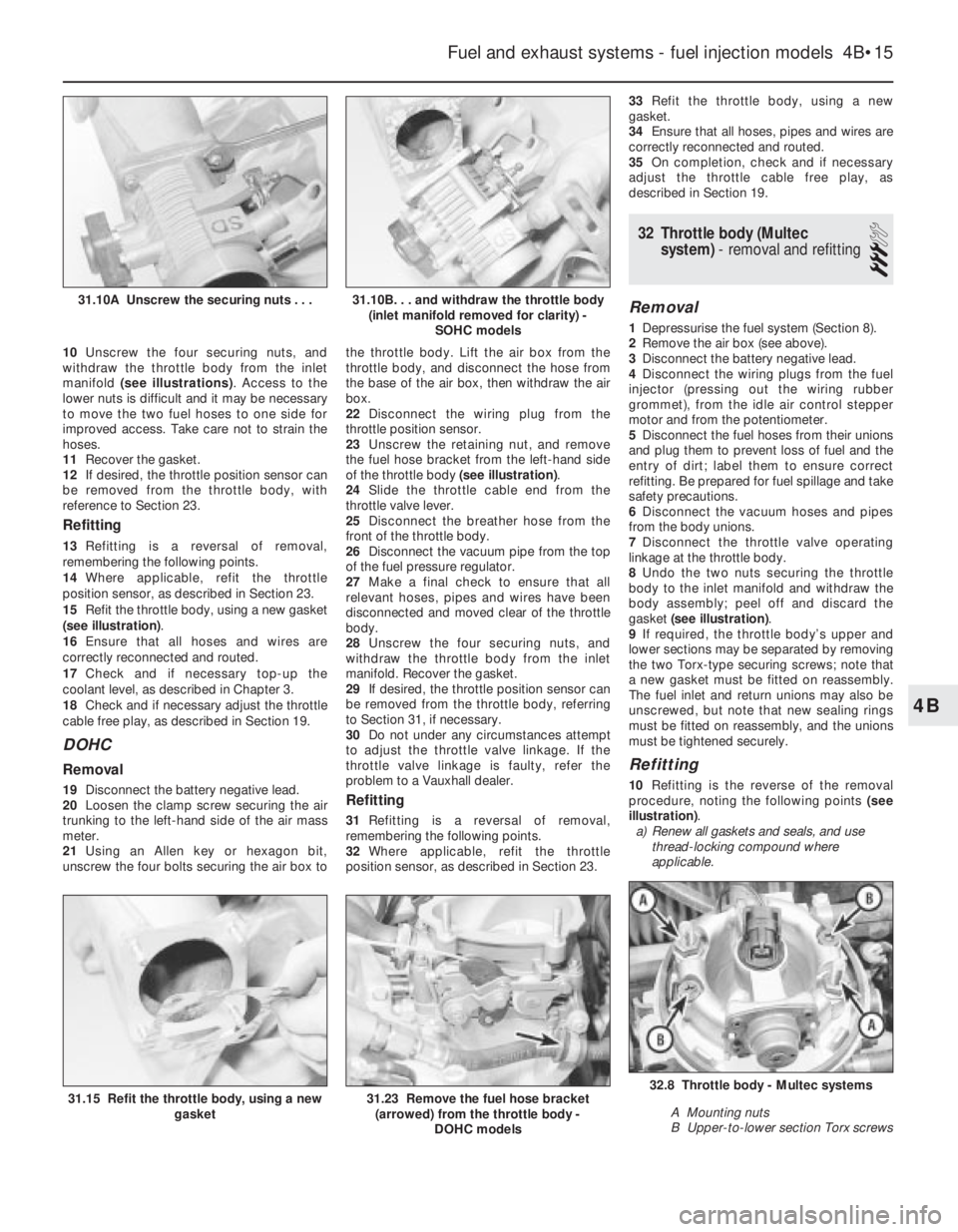
10Unscrew the four securing nuts, and
withdraw the throttle body from the inlet
manifold (see illustrations). Access to the
lower nuts is difficult and it may be necessary
to move the two fuel hoses to one side for
improved access. Take care not to strain the
hoses.
11Recover the gasket.
12If desired, the throttle position sensor can
be removed from the throttle body, with
reference to Section 23.
Refitting
13Refitting is a reversal of removal,
remembering the following points.
14Where applicable, refit the throttle
position sensor, as described in Section 23.
15Refit the throttle body, using a new gasket
(see illustration).
16Ensure that all hoses and wires are
correctly reconnected and routed.
17Check and if necessary top-up the
coolant level, as described in Chapter 3.
18Check and if necessary adjust the throttle
cable free play, as described in Section 19.
DOHC
Removal
19Disconnect the battery negative lead.
20Loosen the clamp screw securing the air
trunking to the left-hand side of the air mass
meter.
21Using an Allen key or hexagon bit,
unscrew the four bolts securing the air box tothe throttle body. Lift the air box from the
throttle body, and disconnect the hose from
the base of the air box, then withdraw the air
box.
22Disconnect the wiring plug from the
throttle position sensor.
23Unscrew the retaining nut, and remove
the fuel hose bracket from the left-hand side
of the throttle body (see illustration).
24Slide the throttle cable end from the
throttle valve lever.
25Disconnect the breather hose from the
front of the throttle body.
26Disconnect the vacuum pipe from the top
of the fuel pressure regulator.
27Make a final check to ensure that all
relevant hoses, pipes and wires have been
disconnected and moved clear of the throttle
body.
28Unscrew the four securing nuts, and
withdraw the throttle body from the inlet
manifold. Recover the gasket.
29If desired, the throttle position sensor can
be removed from the throttle body, referring
to Section 31, if necessary.
30Do not under any circumstances attempt
to adjust the throttle valve linkage. If the
throttle valve linkage is faulty, refer the
problem to a Vauxhall dealer.Refitting
31Refitting is a reversal of removal,
remembering the following points.
32Where applicable, refit the throttle
position sensor, as described in Section 23. 33Refit the throttle body, using a new
gasket.
34Ensure that all hoses, pipes and wires are
correctly reconnected and routed.
35On completion, check and if necessary
adjust the throttle cable free play, as
described in Section 19.
32Throttle body (Multec
system) - removal and refitting
3
Removal
1Depressurise the fuel system (Section 8).
2Remove the air box (see above).
3Disconnect the battery negative lead.
4Disconnect the wiring plugs from the fuel
injector (pressing out the wiring rubber
grommet), from the idle air control stepper
motor and from the potentiometer.
5Disconnect the fuel hoses from their unions
and plug them to prevent loss of fuel and the
entry of dirt; label them to ensure correct
refitting. Be prepared for fuel spillage and take
safety precautions.
6Disconnect the vacuum hoses and pipes
from the body unions.
7Disconnect the throttle valve operating
linkage at the throttle body.
8Undo the two nuts securing the throttle
body to the inlet manifold and withdraw the
body assembly; peel off and discard the
gasket (see illustration).
9If required, the throttle body’s upper and
lower sections may be separated by removing
the two Torx-type securing screws; note that
a new gasket must be fitted on reassembly.
The fuel inlet and return unions may also be
unscrewed, but note that new sealing rings
must be fitted on reassembly, and the unions
must be tightened securely.
Refitting
10Refitting is the reverse of the removal
procedure, noting the following points (see
illustration).
a)Renew all gaskets and seals, and use
thread-locking compound where
applicable.
Fuel and exhaust systems - fuel injection models 4B•15
31.15 Refit the throttle body, using a new
gasket32.8 Throttle body - Multec systems
A Mounting nuts
B Upper-to-lower section Torx screws31.23 Remove the fuel hose bracket
(arrowed) from the throttle body -
DOHC models
31.10B. . . and withdraw the throttle body
(inlet manifold removed for clarity) -
SOHC models31.10A Unscrew the securing nuts . . .
Page 171 of 525

12Unscrew and remove the top alternator
mounting nut and bolt.
13Make a final check to ensure that all
relevant hoses, pipes and wires have been
disconnected.
14Unscrew the securing nuts, and withdraw
the manifold from the cylinder head. Recover
the gasket (see illustrations).
15It is possible that some of the manifold
studs may be unscrewed from the cylinder
head when the manifold securing nuts are
unscrewed. In this event, the studs should be
screwed back into the cylinder head once the
manifold has been removed, using two
manifold nuts locked together.
16If desired, the ancillary components can
be removed from the manifold, referring to the
relevant Chapter.
Refitting
17Refitting is a reversal of removal,
remembering the following points.
18Where applicable refit any ancillary
components to the manifold, with reference to
relevant Sections of Chapters 4A or 4B.
19If the alternator mounting bracket has
been unbolted from the manifold, refit it
before refitting the manifold, as access to the
securing bolt is extremely limited once the
manifold is in place.
20Refit the manifold using a new gasket,
and tighten the securing nuts to the specified
torque.
21Ensure that all relevant hoses, pipes and
wires are correctly reconnected.
22On completion, check and if necessary
top-up the coolant level, (Chapter 3).
23Check and if necessary adjust the throttle
cable free play, as described in Chapters 4A
or 4B, as applicable.
24If any of the fuel system components have
been disturbed or renewed, check and if
necessary adjust the idle mixture, as
described in Chapters 4A or 4B, as applicable.
39Inlet manifold (SOHCwith
Multec) - removal and refitting
3
Removal
1Depressurise the fuel system Section 8).
2Remove the air box (see Section 5).
3Disconnect the battery negative lead.
4Either remove the throttle body assembly
(see Section 32), or disconnect the throttle
cable, wiring, fuel and vacuum hoses and
pipes to allow the manifold to be removed
with the throttle body.
5Drain the cooling system (see Chapter 3).
6Continue as described in Chapter 4A,
Section 26, paragraph 4 onwards.
Refitting
7Refitting is the reverse of the removal
procedure; renew all gaskets and seals
disturbed.
40Inlet manifold (DOHC
models) - removal and
refitting
3
Removal
1Disconnect the battery negative lead.
2Disconnect the wiring plug from the air
mass meter. Recover the sealing ring.
3Loosen the clamp screw securing the air
trunking to the right-hand end of the air mass
meter.
4Using an Allen key or hexagon bit, unscrew
the four bolts securing the air box to the
throttle body. Lift the air box from the throttle
body, and disconnect the hose from the base
of the air box then withdraw the air box/air
mass meter assembly.
5Disconnect the wiring plug from the throttle
position sensor.
6Slide the throttle cable end from the throttle
valve lever. Then pull the cable end grommet
from the bracket on the inlet manifold and
move the throttle cable to one side out of the
way.
7Disconnect the two breather hoses from the
rear of the camshaft cover. Disconnect the
larger hose from the throttle body, and
remove the hose completely.
8Position a wad of rag beneath one of the
fuel hose unions on the fuel rail, to absorb the
fuel that will be released as the union is
disconnected.
9Slowly loosen the fuel hose union, to
gradually relieve the pressure in the fuel feed
line, then disconnect the hose from the fuel
rail. Be prepared for fuel spillage, and take
adequate fire precautions. Plug the end of the
fuel hose, to prevent dirt ingress and further
fuel leakage.
10Repeat paragraphs 9 and 10 for the
remaining fuel hose-to-fuel rail union.
11Disconnect the vacuum pipe from the top
of the fuel pressure regulator.
12Disconnect the wiring harness housing
from the fuel injectors and move it to one side,
taking care not to strain the wiring. Pull up on
the wiring harness housing, and compress the
wiring plug retaining clips to release the
housing from the injectors.
13Unscrew the union nut, and disconnectthe brake servo vacuum hose from the left-
hand side of the inlet manifold (see
illustration).
14Unscrew the retaining nut, and remove
the fuel hose bracket from the left-hand side
of the throttle body.
15Unscrew the securing nuts, and
disconnect the earth leads from the fuel rail
securing studs at either end of the fuel rail.
16Unscrew the securing bolt, and remove
the cable/hose bracket from the left-hand end
of the inlet manifold.
17Remove the idle speed adjuster, as
described in Section 22.
18Unscrew and remove the top alternator
mounting nut and bolt.
19Make a final check to ensure that all
relevant hoses, pipes and wires have been
disconnected.
20Unscrew the securing nuts, and withdraw
the manifold from the cylinder head. Recover
the gasket.
21It is possible that some of the manifold
studs may be unscrewed from the cylinder
head when the manifold securing nuts are
unscrewed. In this event, the studs should be
screwed back into the cylinder head once the
manifold has been removed, using two
manifold nuts locked together.
22If desired, the ancillary components can
be removed from the manifold, with reference
to the relevant Sections of Chapters 4A or 4B.
Refitting
23Refitting is a reversal of the removal
procedure.
4B•18Fuel and exhaust systems - fuel injection models
38.14A Unscrew the securing nuts
40.13 Brake servo vacuum hose
connection at inlet manifold (arrowed) -
DOHC models
38.14B ...and withdraw the inlet manifold -
SOHC models
Page 172 of 525
1
Chapter 1
Routine maintenance and servicing
Air cleaner element - renewal . . . . . . . . . . . . . . . . . . . . . . . . . . . . . . .27
Air inlet temperature control check . . . . . . . . . . . . . . . . . . . . . . . . . .28
Alternator V-belt check . . . . . . . . . . . . . . . . . . . . . . . . . . . . . . . . . . . .22
Automatic transmission check . . . . . . . . . . . . . . . . . . . . . . . . . . . . . .34
Automatic transmission fluid level check . . . . . . . . . . . . . . . . . . . . . . .7
Automatic transmission fluid renewal . . . . . . . . . . . . . . . . . . . . . . . . .38
Bodywork check . . . . . . . . . . . . . . . . . . . . . . . . . . . . . . . . . . . . . . . . .20
Brake fluid renewal . . . . . . . . . . . . . . . . . . . . . . . . . . . . . . . . . . . . . . .14
Brake pad check . . . . . . . . . . . . . . . . . . . . . . . . . . . . . . . . . . . . . . . . .15
Brake shoe check . . . . . . . . . . . . . . . . . . . . . . . . . . . . . . . . . . . . . . . .35
Clutch cable check . . . . . . . . . . . . . . . . . . . . . . . . . . . . . . . . . . . . . . .32
Coolant renewal . . . . . . . . . . . . . . . . . . . . . . . . . . . . . . . . . . . . . . . . .26
Distributor and HT lead check . . . . . . . . . . . . . . . . . . . . . . . . . . . . . .31
Door lock key battery - replacement . . . . . . . . . . . . . . . . . . . . . . . . .24
Driveshaft gaiter check . . . . . . . . . . . . . . . . . . . . . . . . . . . . . . . . . . . . .6
Engine oil and filter - renewal . . . . . . . . . . . . . . . . . . . . . . . . . . . . . . . .3
Exhaust system check . . . . . . . . . . . . . . . . . . . . . . . . . . . . . . . . . . . .11
Fuel filter renewal . . . . . . . . . . . . . . . . . . . . . . . . . . . . . . . . . . . . . . . .29
Handbrake linkage check . . . . . . . . . . . . . . . . . . . . . . . . . . . . . . . . . .16Headlamp alignment . . . . . . . . . . . . . . . . . . . . . . . . . . . . . . . . . . . . . .23
Hose and fluid leak check . . . . . . . . . . . . . . . . . . . . . . . . . . . . . . . . . .4
Idle speed and mixture - adjustment . . . . . . . . . . . . . . . . . . . . . . . . . .9
Ignition timing . . . . . . . . . . . . . . . . . . . . . . . . . . . . . . . . . . . . . . . . . . .13
Intensive maintenance . . . . . . . . . . . . . . . . . . . . . . . . . . . . . . . . . . . . .2
Introduction . . . . . . . . . . . . . . . . . . . . . . . . . . . . . . . . . . . . . . . . . . . . .1
Lock and hinge check . . . . . . . . . . . . . . . . . . . . . . . . . . . . . . . . . . . .21
Manual transmission fluid check . . . . . . . . . . . . . . . . . . . . . . . . . . . .33
Power steering fluid check . . . . . . . . . . . . . . . . . . . . . . . . . . . . . . . . .17
Power steering pump drivebelt check . . . . . . . . . . . . . . . . . . . . . . . .18
Radiator inspection and cleaning . . . . . . . . . . . . . . . . . . . . . . . . . . . . .8
Rear suspension level control system check . . . . . . . . . . . . . . . . . . .19
Road test . . . . . . . . . . . . . . . . . . . . . . . . . . . . . . . . . . . . . . . . . . . . . .25
Spark plug renewal (SOHC) . . . . . . . . . . . . . . . . . . . . . . . . . . . . . . . .30
Spark plug renewal (DOHC) . . . . . . . . . . . . . . . . . . . . . . . . . . . . . . . .37
Steering and suspension check . . . . . . . . . . . . . . . . . . . . . . . . . . . . . .5
Throttle linkage maintenance . . . . . . . . . . . . . . . . . . . . . . . . . . . . . . .10
Timing belt renewal . . . . . . . . . . . . . . . . . . . . . . . . . . . . . . . . . . . . . . .36
Wiring check . . . . . . . . . . . . . . . . . . . . . . . . . . . . . . . . . . . . . . . . . . . .12
1•1
Contents
Easy,suitable for
novice with little
experienceFairly easy,suitable
for beginner with
some experienceFairly difficult,
suitable for competent
DIY mechanic
Difficult,suitable for
experienced DIY
mechanicVery difficult,
suitable for expert DIY
or professional
Degrees of difficulty
54321
Page 175 of 525
1•4Maintenance schedule
Every 250 miles (400 km) or weekly
MRefer to “Weekly checks”
Basic service, every 9000 miles
(15 000 km) or 12 months -
whichever comes sooner
Along with the items in “Weekly checks”, carry out the
following:
MRenew the engine oil and oil filter (Section 3).
MCheck all hoses and other components for fluid
leaks (Section 4).
MCheck the steering and suspension components
(Section 5).
MCheck the condition of the driveshaft rubber
gaiters (Section 6).
MCheck the automatic transmission fluid level (if
applicable), (Section 7).
MCheck the radiator for blockage (e.g. dead insects)
and clean as necessary (Section 8).
MCheck and adjust the idle speed and mixture (if
applicable), (Section 9).
MCheck the throttle linkage and lubricate if
necessary (Section 10).
MCheck the exhaust system for corrosion, leaks and
security (Section 11).
MCheck all wiring for condition and security
(Section 12).
MCheck and adjust the ignition timing (if applicable),
(Section 13).
MRenew the brake fluid (Section 14).
MCheck the brake pad friction material for wear
(Section 15).
MCheck the handbrake linkage (Section 16).
MCheck the power steering fluid level (if applicable),
(Section 17).
MCheck the power steering pump drivebelt (if
applicable), (Section 18).
MCheck the rear suspension level control system
height, if fitted (Section 19).
MCheck the bodywork (Section 20).
MLubricate all locks and hinges (Section 21).
MCheck the alternator V-belt (Section 22).
MCheck the headlamp alignment (Section 23).
MReplace battery in the door-lock key (if applicable),
(Section 24).
MCarry out a road test (Section 25).
Note: Vauxhall specify that an Exhaust Emissions Test should be
carried out at least annually. However, this requires special
equipment, and is performed as part of the MOT test (refer to the
end of the manual).
Full service, every 18 000 miles
(30 000 km) or 24 months -
whichever comes sooner
Along with the ‘basic service’, carry out the following:
MRenew the coolant (Section 26).
MRenew the air cleaner element (Section 27).
MCheck the operation of the air cleaner air inlet
temperature control (carburettor models only),
(Section 28).
MRenew the fuel filter (Section 29).
MRenew the spark plugs (SOHC only), (Section 30) *.
MInspect and clean the distributor cap and HT leads
(Section 31).
MCheck the clutch cable adjustment (Section 32).
MCheck the manual transmission oil level (Section 33).
MCheck the automatic transmission (Section 34).
MCheck the brake drum shoe for wear (Section 35).
Major service, every 36 000 miles
(60 000 km) or 48 months -
whichever comes sooner
Along with the ‘full service’, carry out the following:
MRenew timing belt (Section 36).
MRenew the spark plugs (DOHC models only),
(Section 37).
MRenew automatic transmission fluid (Section 38) *.
* Note: If a vehicle is used for heavy-duty work (e.g. taxi work,
caravan/trailer towing, mostly short-distance, stop-start city driving)
the fluid must be changed every 36 months or 27 000 miles (45 000
km), whichever occurs first.
Page 184 of 525

tighten the mounting nuts and bolts. On no
account lever at the free end of the alternator,
as serious internal damage could be caused.
3For details of replacement, see Chapter 5.
23Headlamp alignment
2
Refer to Chapter 12 for details.
24Door lock key battery -
replacement
1
1Carefully prise open the outer cover from
the key. Take care not to lose any of the
internal components, as they are loose.
2Remove the battery and discard it safely.
3Place the new battery, “+” side up (see
illustration). Check the operation of the key. If
the bulb does not light obtain a replacement.
4Replace the outer cover.
25Road test
1
Instruments and electrical
equipment
1Check the operation of all instruments and
electrical equipment.
2Make sure that all instruments read
correctly, and switch on all electrical
equipment in turn to check that it functions
properly.
Steering and suspension
3Check for any abnormalities in the steering,
suspension, handling or road “feel”.
4Drive the vehicle, and check that there are
no unusual vibrations or noises.5Check that the steering feels positive, with
no excessive “sloppiness”, or roughness, and
check for any suspension noises when
cornering, or when driving over bumps.
Drivetrain
6Check the performance of the engine,
clutch, transmission and driveshafts.
7Turn the radio/cassette off and listen for
any unusual noises from the engine, clutch
and transmission.
8Make sure that the engine runs smoothly
when idling, and that there is no hesitation
when accelerating.
9Check that the clutch action is smooth and
progressive, that the drive is taken up
smoothly, and that the pedal travel is not
excessive. Also listen for any noises when the
clutch pedal is depressed.
10Check that all gears can be engaged
smoothly, without noise, and that the gear
lever action is not abnormally vague or
“notchy”.
11Listen for a metallic clicking sound from
the front of the vehicle, as the vehicle is driven
slowly in a circle with the steering on full lock.
Carry out this check in both directions. If a
clicking noise is heard, this indicates wear in a
driveshaft joint, in which case, the complete
driveshaft must be renewed (see Chapter 8).
26Coolant renewal
2
Refer to Chapter 3 for details.
27Air cleaner element - renewal
2
Early round type
1Release the spring clips from the perimeter
of the air cleaner cover.
2Unscrew and remove the small cross-head
screw securing the cover extension to the
main body near the inlet duct.3Unscrew and remove the three central
cross-head cap nuts securing the air cleaner
to the carburettor, taking care not to drop the
washers and seals (see illustration).
4Separate the cover from the main body,
then lift out the element (see illustration).
5Wipe clean the inside surfaces of the cover
and main body.
6Locate the new element in the air cleaner
body, and refit the cover using a reversal of
the removal procedure.
Square type with air box
7If desired, to improve access, unclip the
coolant expansion tank hose from the air
cleaner cover.
8Release the two clips from the left-hand
side of the cover, and unscrew the two
screws from the right-hand side, then lift the
cover sufficiently to remove the element.
9Wipe clean the inside surfaces of the cover
and main body.
10Refitting is a reversal of removal, noting
that the element fits with the rubber locating
flange uppermost.
Every 18 000 miles or 24 months 1•13
24.3 Replacing the battery in the door lock
key
1 Battery (note, positive ‘+’ side up)
2 Bulb
27.4 Removing the air cleaner element -
note clip for crankcase ventilation hose
(arrowed)
27.3 Air cleaner-to-carburettor mounting
cap nuts
1
Full service, every 18 000 miles (30 000 km) or 24 months
Warning: Wait until the engine is
cold before starting the
procedure. Do not allow
antifreeze to come in contact
with your skin or with painted surfaces of
the vehicle. Rinse off spills with plenty of
water. Never leave antifreeze lying around
in an open container. Always clean spilt
fluids, as it can be harmful if swallowed.
Page 212 of 525
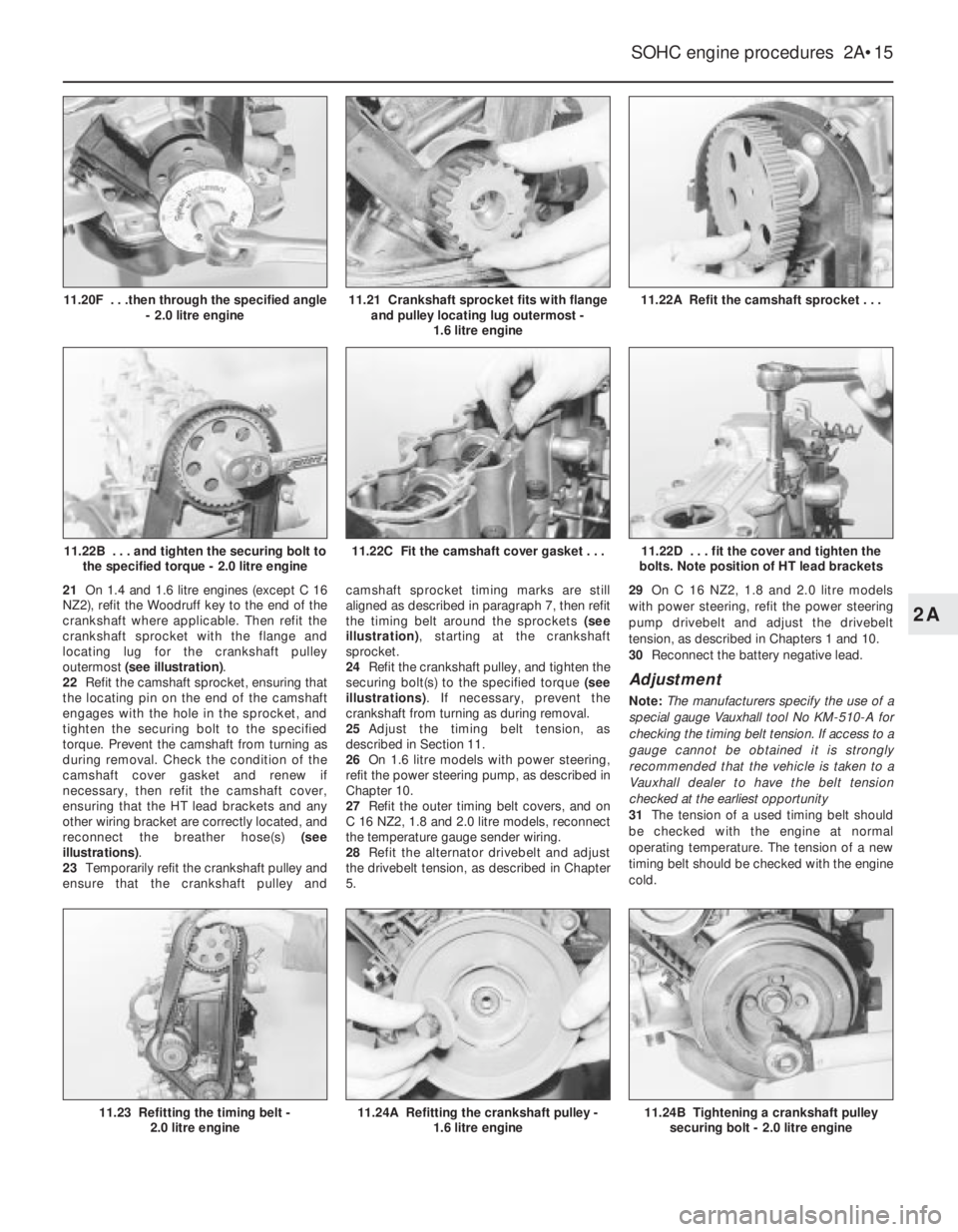
21On 1.4 and 1.6 litre engines (except C 16
NZ2), refit the Woodruff key to the end of the
crankshaft where applicable. Then refit the
crankshaft sprocket with the flange and
locating lug for the crankshaft pulley
outermost (see illustration).
22Refit the camshaft sprocket, ensuring that
the locating pin on the end of the camshaft
engages with the hole in the sprocket, and
tighten the securing bolt to the specified
torque. Prevent the camshaft from turning as
during removal. Check the condition of the
camshaft cover gasket and renew if
necessary, then refit the camshaft cover,
ensuring that the HT lead brackets and any
other wiring bracket are correctly located, and
reconnect the breather hose(s) (see
illustrations).
23Temporarily refit the crankshaft pulley and
ensure that the crankshaft pulley andcamshaft sprocket timing marks are still
aligned as described in paragraph 7, then refit
the timing belt around the sprockets (see
illustration), starting at the crankshaft
sprocket.
24Refit the crankshaft pulley, and tighten the
securing bolt(s) to the specified torque (see
illustrations). If necessary, prevent the
crankshaft from turning as during removal.
25Adjust the timing belt tension, as
described in Section 11.
26On 1.6 litre models with power steering,
refit the power steering pump, as described in
Chapter 10.
27Refit the outer timing belt covers, and on
C 16 NZ2, 1.8 and 2.0 litre models, reconnect
the temperature gauge sender wiring.
28Refit the alternator drivebelt and adjust
the drivebelt tension, as described in Chapter
5.29On C 16 NZ2, 1.8 and 2.0 litre models
with power steering, refit the power steering
pump drivebelt and adjust the drivebelt
tension, as described in Chapters 1 and 10.
30Reconnect the battery negative lead.
Adjustment
Note: The manufacturers specify the use of a
special gauge Vauxhall tool No KM-510-A for
checking the timing belt tension. If access to a
gauge cannot be obtained it is strongly
recommended that the vehicle is taken to a
Vauxhall dealer to have the belt tension
checked at the earliest opportunity
31The tension of a used timing belt should
be checked with the engine at normal
operating temperature. The tension of a new
timing belt should be checked with the engine
cold.
SOHC engine procedures 2A•15
11.22A Refit the camshaft sprocket . . .
11.24B Tightening a crankshaft pulley
securing bolt - 2.0 litre engine11.24A Refitting the crankshaft pulley -
1.6 litre engine11.23 Refitting the timing belt -
2.0 litre engine
11.22D . . . fit the cover and tighten the
bolts. Note position of HT lead brackets11.22C Fit the camshaft cover gasket . . .11.22B . . . and tighten the securing bolt to
the specified torque - 2.0 litre engine
11.21 Crankshaft sprocket fits with flange
and pulley locating lug outermost -
1.6 litre engine11.20F . . .then through the specified angle
- 2.0 litre engine
2A
Page 259 of 525
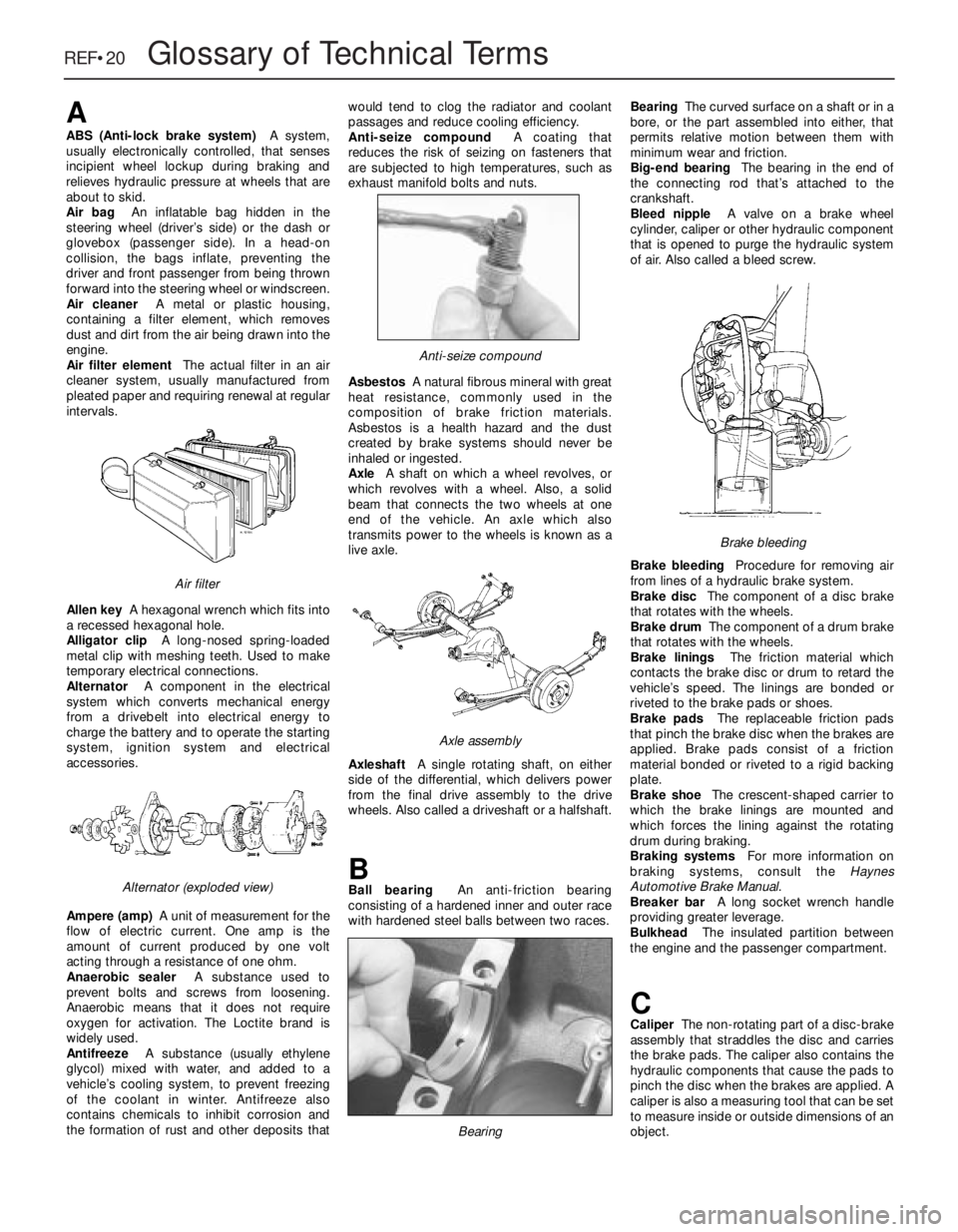
REF•20Glossary of Technical Terms
A
ABS (Anti-lock brake system)A system,
usually electronically controlled, that senses
incipient wheel lockup during braking and
relieves hydraulic pressure at wheels that are
about to skid.
Air bag An inflatable bag hidden in the
steering wheel (driver’s side) or the dash or
glovebox (passenger side). In a head-on
collision, the bags inflate, preventing the
driver and front passenger from being thrown
forward into the steering wheel or windscreen.
Air cleanerA metal or plastic housing,
containing a filter element, which removes
dust and dirt from the air being drawn into the
engine.
Air filter elementThe actual filter in an air
cleaner system, usually manufactured from
pleated paper and requiring renewal at regular
intervals.
Allen keyA hexagonal wrench which fits into
a recessed hexagonal hole.
Alligator clipA long-nosed spring-loaded
metal clip with meshing teeth. Used to make
temporary electrical connections.
AlternatorA component in the electrical
system which converts mechanical energy
from a drivebelt into electrical energy to
charge the battery and to operate the starting
system, ignition system and electrical
accessories.
Ampere (amp)A unit of measurement for the
flow of electric current. One amp is the
amount of current produced by one volt
acting through a resistance of one ohm.
Anaerobic sealerA substance used to
prevent bolts and screws from loosening.
Anaerobic means that it does not require
oxygen for activation. The Loctite brand is
widely used.
AntifreezeA substance (usually ethylene
glycol) mixed with water, and added to a
vehicle’s cooling system, to prevent freezing
of the coolant in winter. Antifreeze also
contains chemicals to inhibit corrosion and
the formation of rust and other deposits thatwould tend to clog the radiator and coolant
passages and reduce cooling efficiency.
Anti-seize compoundA coating that
reduces the risk of seizing on fasteners that
are subjected to high temperatures, such as
exhaust manifold bolts and nuts.
AsbestosA natural fibrous mineral with great
heat resistance, commonly used in the
composition of brake friction materials.
Asbestos is a health hazard and the dust
created by brake systems should never be
inhaled or ingested.
AxleA shaft on which a wheel revolves, or
which revolves with a wheel. Also, a solid
beam that connects the two wheels at one
end of the vehicle. An axle which also
transmits power to the wheels is known as a
live axle.
AxleshaftA single rotating shaft, on either
side of the differential, which delivers power
from the final drive assembly to the drive
wheels. Also called a driveshaft or a halfshaft.
BBall bearingAn anti-friction bearing
consisting of a hardened inner and outer race
with hardened steel balls between two races.BearingThe curved surface on a shaft or in a
bore, or the part assembled into either, that
permits relative motion between them with
minimum wear and friction.
Big-end bearingThe bearing in the end of
the connecting rod that’s attached to the
crankshaft.
Bleed nippleA valve on a brake wheel
cylinder, caliper or other hydraulic component
that is opened to purge the hydraulic system
of air. Also called a bleed screw.
Brake bleedingProcedure for removing air
from lines of a hydraulic brake system.
Brake discThe component of a disc brake
that rotates with the wheels.
Brake drumThe component of a drum brake
that rotates with the wheels.
Brake liningsThe friction material which
contacts the brake disc or drum to retard the
vehicle’s speed. The linings are bonded or
riveted to the brake pads or shoes.
Brake padsThe replaceable friction pads
that pinch the brake disc when the brakes are
applied. Brake pads consist of a friction
material bonded or riveted to a rigid backing
plate.
Brake shoeThe crescent-shaped carrier to
which the brake linings are mounted and
which forces the lining against the rotating
drum during braking.
Braking systemsFor more information on
braking systems, consult the Haynes
Automotive Brake Manual.
Breaker barA long socket wrench handle
providing greater leverage.
BulkheadThe insulated partition between
the engine and the passenger compartment.
CCaliperThe non-rotating part of a disc-brake
assembly that straddles the disc and carries
the brake pads. The caliper also contains the
hydraulic components that cause the pads to
pinch the disc when the brakes are applied. A
caliper is also a measuring tool that can be set
to measure inside or outside dimensions of an
object.
Brake bleeding
Bearing
Axle assembly
Anti-seize compound
Alternator (exploded view)
Air filter
Page 264 of 525
AABS components- 9•2, 9•16
Accelerator cable- 4A•5, 4B•9
Accelerator pedal- 4A•5
Acknowledgements- 0•4
Aerial- 12•17
Air cleaner- 1•3, 1•13, 4A•3, 4B•4
Air box- 4B•5
Air pump/cut off valve- 4C•2
Air temp control- 4B•5
Air vents- 3•8
Airbag- 12•19
Airflow meters- 4B•12
Alternator- 5•5
Alternator V-belt check- 1•12
Anti theft alarm- 12•19
Anti-roll bars- 10•8, 10•13, 10•17
Antifreeze mixture- 0•12, 0•17, 1•2, 3•3
ATF- 0•17, 1•2, 1•11, 7B•3
Automatic choke unit- 4A•9
Automatic transmission- 7B•1 et seq
cooler pipes and hoses - 7B•5
ECU - 7B•5
fault diagnosis - REF•12, REF•16
fluid - 0•17, 1•2, 1•11, 7B•3
kickdown switch - 7B•3
removal and refitting - 7B•6
selector control cable - 7B•4
speed sensors - 7B•6
starter inhibitor switch - 7B•3
temperature sensor - 7B•5
BBattery- 0•6, 0•15, 5•5
Bearings (engine)- 2A•31
Bleeding the brakes- 9•3
Bleeding the power steering- 10•22
Blower motor- 3•7
Body damage- 11•2
Body electrical systems - 12•1 et seq
Bodywork and fittings- 11•1 et seq
Bonnet- 11•4
Bonnet lock/release cable- 11•4
Boot lid- 11•4
Boot lid lock- 11•5
Bores- 2A•33
Brake checks- 1•12,
Braking system- 9•1 et seq
ABS components - 9•2, 9•16
backplate - 9•12
bleeding the brakes - 9•3
brake caliper - 9•8
brake disc - 9•10
brake drum - 9•11
brake fluid pipes and hoses - 9•18
brake lamp switch - 12•5
brake pads - 9•4
brake pedal - 9•21
brake shoes - 9•6
disc shield - 9•13
fault diagnosis - REF•12, REF•17
fluid - 0•13, 0•17handbrake adjustment - 9•18
handbrake cables - 9•19
handbrake lever - 9•20
master cylinder - 9•13
pressure valves - 9•18
vacuum servo unit - 9•15
wheel cylinder - 9•11
Bulbs- 12•2, 12•7, 12•11
Bumpers- 11•11
CCables:
bonnet release - 11•4
clutch - 6•2
handbrake - 9•19
selector automatic transmission - 7B•4
speedometer - 12•18
throttle - 4A•5, 4B•9
Caliper (brake)- 9•8
Camber- 10•1, 10•24
Camshaft- 2A•19, 2B•6
Camshaft housing- 2A•18
Camshaft oil seals- 2A•18
Capacities- 1•2
Carbon canister- 4C•4
Carburettor- 4A•5, 4A•11
Carpets- 11•2
Castor- 10•1, 10•24
Catalytic converter- 4C•3
Central door locking- 12•16
Centre console- 11•18
Cigarette lighter- 12•5
Clock- 12•6
Clutch- 6•1 et seq
cable - 6•2
fault diagnosis - REF•12, REF•15
pedal - 6•3
release bearing - 6•6
removal, inspection and refitting - 6•3
Coil- 5•9
Coil spring (rear)- 10•12, 10•15
Compression test- 2A•8
Computer components- 12•7
Connecting rods- 2A•29
Contents- 0•2
Control units- 4B•16, 7B•5
Conversion factors- REF•2
Coolant- 0•12, 0•17, 1•2, 3•3
Cooling, heating and ventilation systems-
3•1 et seq
blower motor - 3•7
coolant level sensor - 3•5
coolant pump - 3•4
cooling fan - 3•5
draining - 3•2
expansion tank - 3•5
fan switch - 3•6
fault diagnosis - REF•12, REF•15
filling - 3•2
flushing - 3•2
heater control panel - 3•6
heater matrix - 3•7
radiator - 3•3temperature gauge sender - 3•6
thermostat - 3•4
vents - 3•8
Courtesy lamp switch- 12•5
Crankcase ventilation system- 2A•7
Crankshaft- 2A•31
Crankshaft oil seals- 2A•26, 2B•6, 2B•9
Cylinder bores- 2A•33
Cylinder head- 2A•19, 2A•22, 2B•7DDents- 11•2
Depressurising fuel system- 4B•5
Differential bearing oil seal- 7A•3
Dimensions and weights- REF•1
Disc (brake)- 9•10
Distributor- 5•10
Door- 11•6
handle - 11•7
inner trim panel - 11•6
lock key battery - 1•13
mirror - 11•11
Driveshafts- 8•1 et seq
fault diagnosis - REF•12, REF•16
gaiter - 8•4
joint renewal - 8•4
Drum (brake)- 9•11
EEarth fault finding- 12•2
ECU’s - 4B•16, 7B•5
EGR components- 4C•2
Electric windows- 12•15
Electrical fault finding- 12•2
Electrical system (body)- 12•1 et seq
Electrical system- 0•14, 5•2
Electrical system fault diagnosis- REF•12,
REF•18
Electronic control units- 4B•16, 7B•5
Engine:
bearings - 2A•31
camshaft - 2A•19, 2B•6
camshaft housing - 2A•18
camshaft oil seals - 2A•18, 2B•6
codes - 2A•1, 2B•1
compartment - 0•10, 1•5
compression test - 2A•8
connecting rods - 2A•29
crankcase ventilation - 2A•7
crankshaft - 2A•31
crankshaft oil seals - 2A•26, 2B•6, 2B•9
cylinder bores - 2A•33
cylinder head - 2A•19, 2A•22, 2B•7
dismantling - 2A•12
DOHC - 2B•1 et seq
electrical systems - 5•1 et seq
fault diagnosis - REF•12, REF•13
flexplate (automatic transmission) - 2A•26
flywheel - 2A•26
main and big-end bearings - 2A•31
mountings (engine/transmission) - 2A•12,
2B•3
Index REF•25
REF
Note:References throughout this index are in the form - “Chapter number” • “page number”