Page 7 of 346
INTRODUCTION - General Repair Instructions
IN-S
(b) Recoating of Precoated Parts
(1) Clean off the old adhesive from the part’s
threads.
(2) Dry with compressed air.
(3) Apply the specified seal lock adhesive to the
part’s threads.
(c) Precoated parts are indicated in the component
illustrations by the “*” symbol.
7. When necessary, use a sealer or gaskets to prevent leaks.
8. Carefully observe all specifications for bolt torques.
Always use a torque wrench.
9. Use of special service tools (SST) and special service
materials (SSM) may be required, depending on the nature
of the repair. Be sure to use SST and SSM where specified
and follow the proper work procedure. A list of SST and
SSM can be found at the back of this manual.
10. When replacing fuses, be sure the new fuse is the correct
amperage. DO NOT exceed the fuse amp rating or use one
of a lower rating.
11. Care must be taken when jacking up and supporting the
vehicle. Be sure to lift and support the vehicle at the
proper locations.
(a) If the vehicle is to be jacked up only at the front or
rear end, be sure to block the wheels in order to
ensure safety.
(b) After the vehicle is jacked up, be sure to support it on
stands. It is extremely dangerous to do any work on
the vehicle raised on a jack alone, even for a small job
that can be finished quickly.
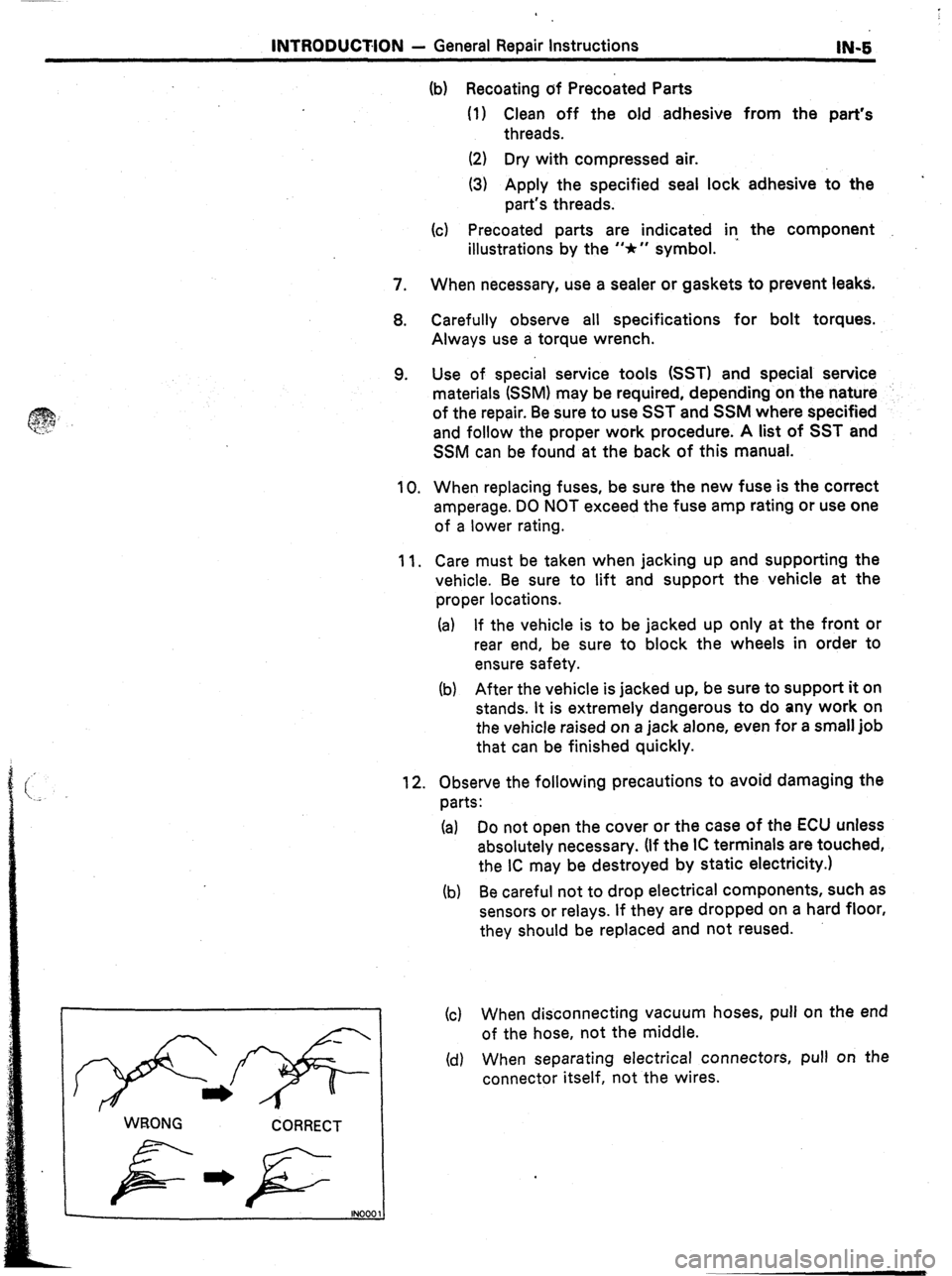
WRONG
CORRECT 12. Observe the following precautions to avoid damaging the
parts:
(a) Do not open the cover or the case of the ECU unless
absolutely necessary. (If the IC terminals are touched,
the IC may be destroyed by static electricity.)
(b) Be careful not to drop electrical components, such as
sensors or relays. If they are dropped on a hard floor,
they should be replaced and not reused.
(c) When disconnecting vacuum hoses, pull on the end
of the hose, not the middle.
(d) When separating electrical connectors, pull on the
connector itself, not the wires.
Page 45 of 346
EFI SYSTEM
- inspection Precautions
FI-11
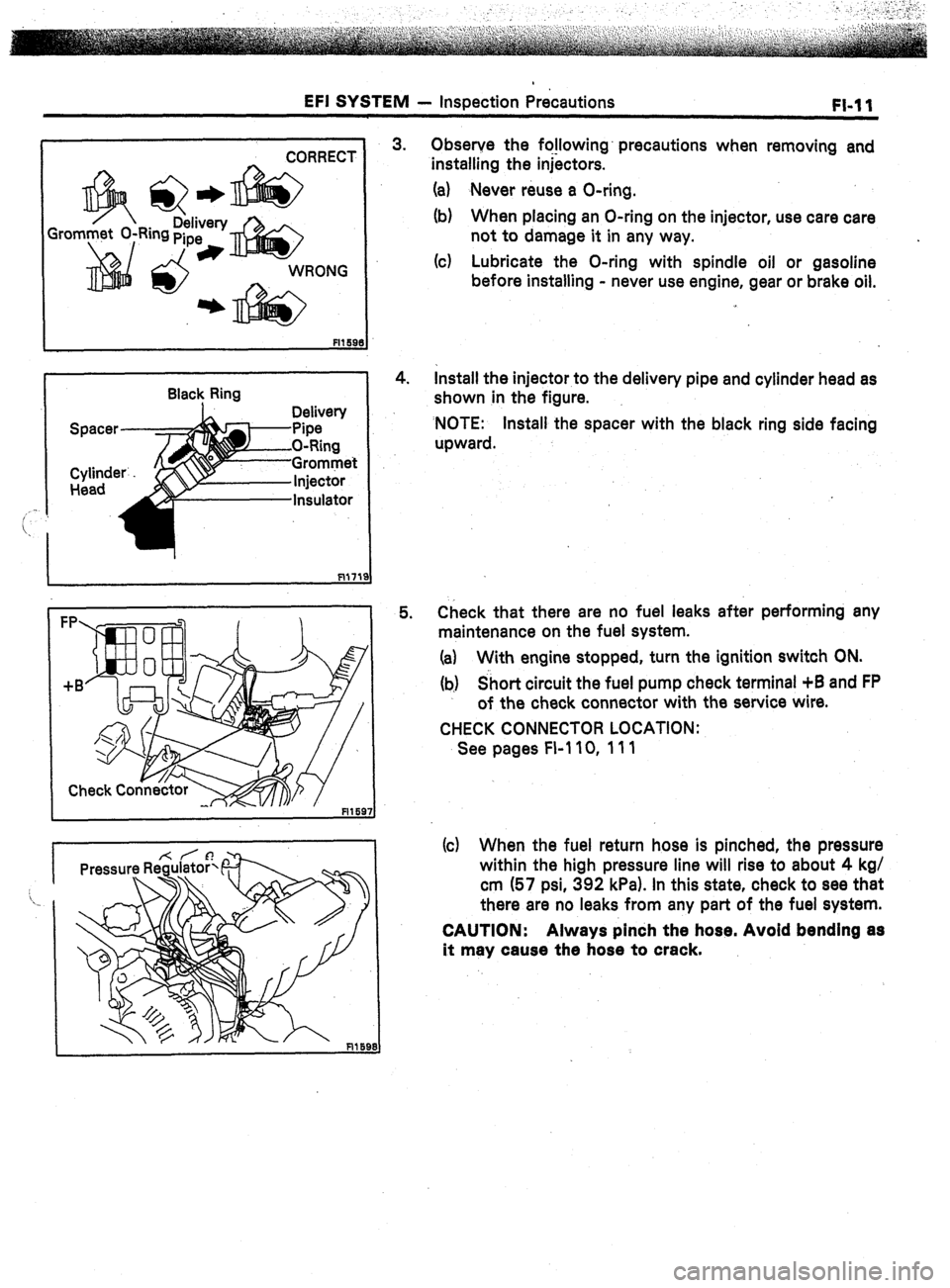
I CORRECT i
Gro
Q * Delivery
Ring pipe
*
Black Ring
Delivew
Pipe -
O-Ring
-Grommet
3.
4.
5. Observe the fo!lowing’ precautions when removing and
installing the injectors.
(a) Never reuse a O-ring.
(b) When placing an O-ring on the injector, use care care
not to damage it in any way.
(c) Lubricate the O-ring with spindle oil or gasoline
before installing - never use engine, gear or brake oil.
Install the injector to the delivery pipe and cylinder head as
shown in the figure.
‘NOTE: Install the spacer with the black ring side facing
upward.
Check that there are no fuel leaks after performing any
maintenance on the fuel system.
(a) With engine stopped, turn the ignition switch ON.
(b) Short circuit the fuel pump check terminal +B and FP
of the check connector with the service wire.
CHECK CONNECTOR LOCATION:
See pages FI-110, 111
(c) When the fuel return hose is pinched, the pressure
within the high pressure line will rise to about 4 kg/
cm (57 psi, 392 kPa). In this state, check to see that
there are no leaks from any part of the fuel system.
CAUTION: Always pinch the hose. Avoid bending as
it may cause the hose to crack.
Page 61 of 346
Osc db-5 hus 4J -7.
EFI SYSTEM w
-. - Diagnosis System
FI-27
“CHECK ENGINE” Warning Light FlO29
Code No. 13 Code No. 32
(Seconds)
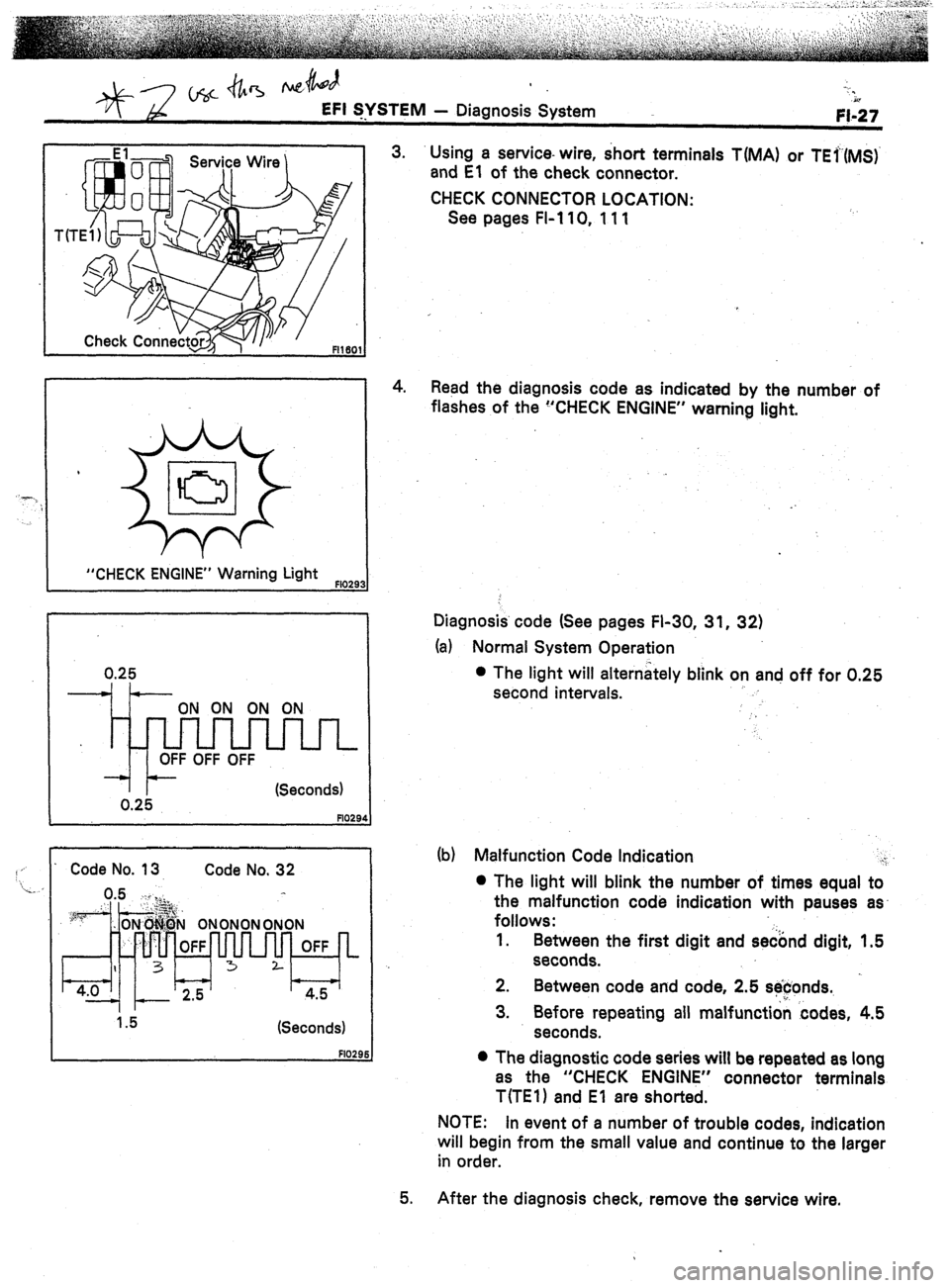
3. Using a service- wire, short terminals T(MA) or TEr(MS)
and El of the check connector.
CHECK CONNECTOR LOCATION:
See pages FI-110, 111
4. Read the diagnosis code as indicated by the number of
flashes of the “CHECK ENGINE” warning light.
Diagnosis. code (See pages FI-30, 31, 32)
(a) Normal System Operation
l The light will alternately blink on and off for 0.25
second intervals.
.)
(b) Malfunction Code Indication i
l The light will blink the number of times equal to
the malfunction code indication with pauses as-
follows:
1.
Between the first digit and se&d digit, 1.5
seconds.
2.
Between code and code, 2.5 se$onds.
3. Before repeating all malfunction codes, 4.5
seconds.
0 The diagnostic code series will be repeated as long
as the “CHECK ENGINE” connector terminals
T(TE1) and El are shorted.
NOTE: In event of a number of trouble codes, indication
will begin from the small value and continue to the larger
in
order.
After the diagnosis check, remove the service wire.
Page 62 of 346
EFI SYSTEM; Diagnosis System
S)
------) -.
I Fl281
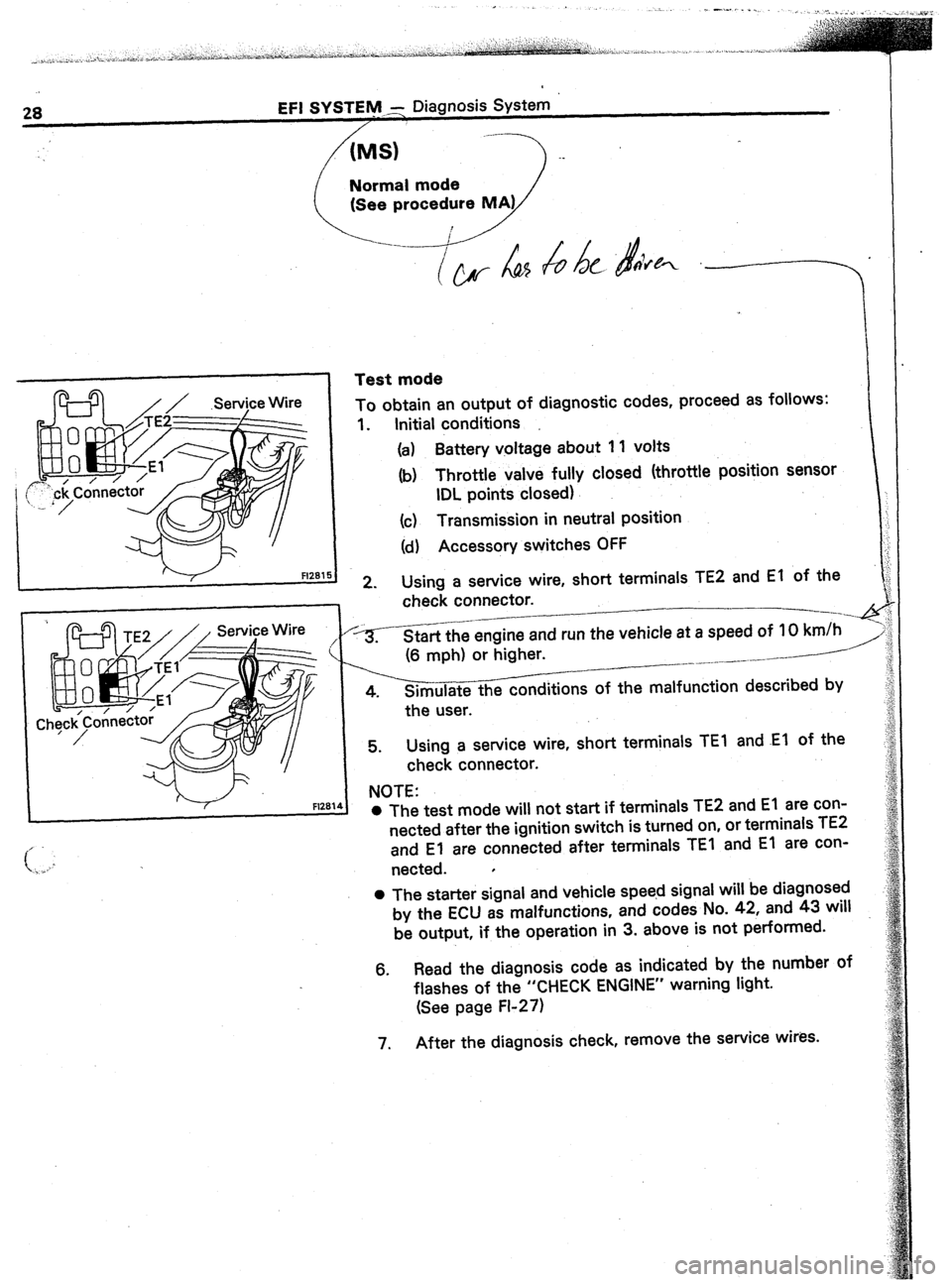
Test mode
i
To obtain an output of diagnostic codes, proceed as follows:
1. Initial conditions
(a) Battery voltage about 1 1 volts
(b) Throttle valve fully closed (throttle position sensor
IDL points closed)
(c) Transmission in neutral position
(d) Accessory switches OFF
2. Using a service wire, short terminals TE2 and El of the j
check connector.
-----.-q
*-heengine and run the vehicle at a speed of IO km/h I
(6 mph) or higher. __-- /---’
_ ___ _.--.--.
4. Simulate the conditions of the malfunction described by
the user.
5. Using a service wire, short terminals TEl and .El of the
check connector.
NOTE:
l The test mode will not start if terminals TE2 and El are con-
nected after the ignition switch is turned on, or terminals TE2
and El are connected after terminals TEI and El are con-
nected.
l
0 The starter signal and vehicle speed signal will be diagnosed
by the ECU as malfunctions, and codes No. 42, and 43 will
be output, if the operation in 3. above is not performed.
6. Read the diagnosis code as indicated by the number of
flashes of the “CHECK ENGINE” warning light.
(See page FI-27)
7. After the diagnosis check, remove the service wires.
Page 108 of 346
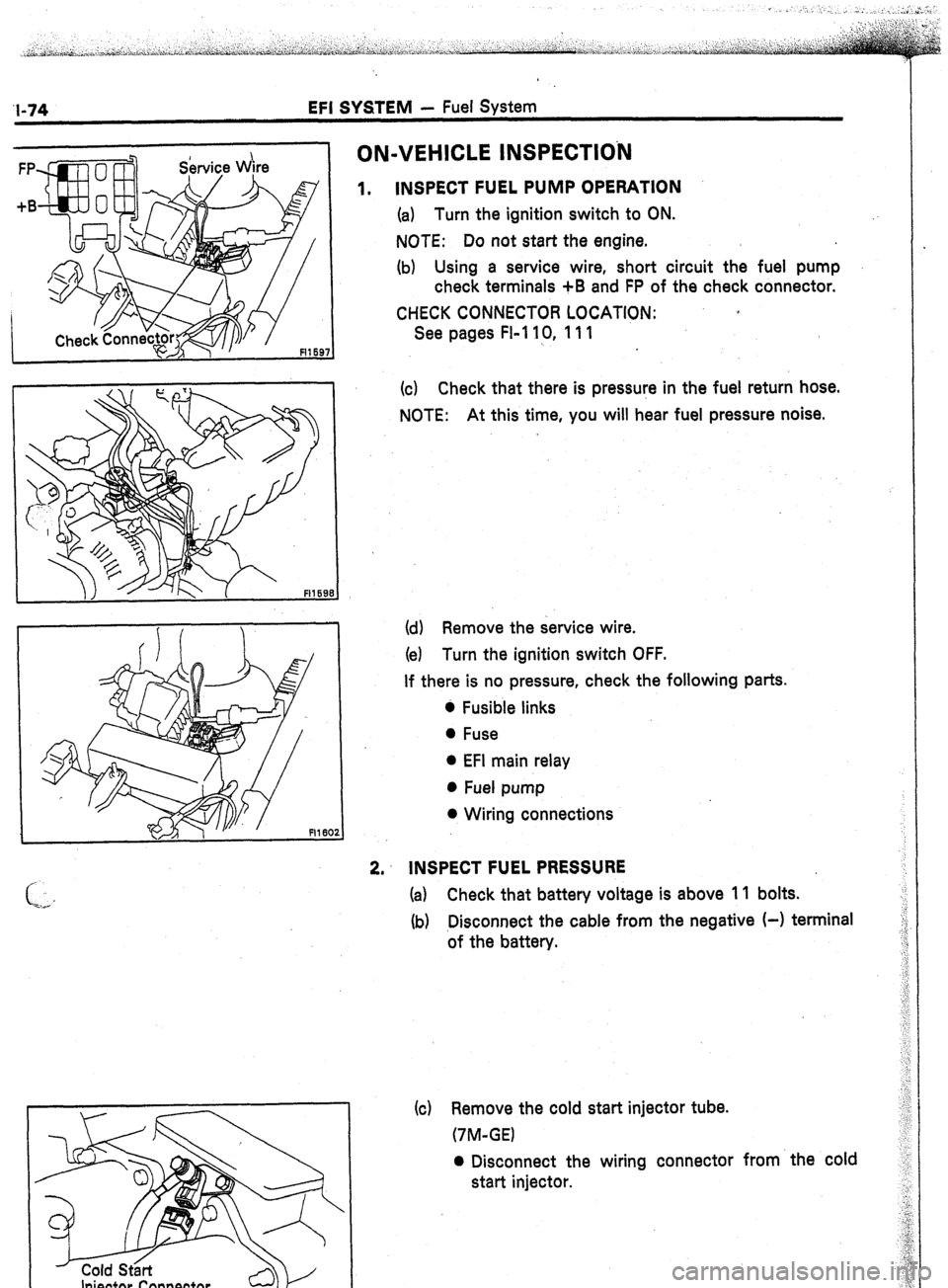
‘I-74 EFI SYSTEM - Fuel System
Fl169
ON-VEHICLE INSPECTlOiU
1.
INSPECT FUEL PUMP OPERATION
(a) Turn the ignition switch to ON. :
NOTE: Do not start the engine.
(b) Using a service wire, short circuit the fuel pump
check terminals +B and FP of the check connector.
CHECK CONNECTOR LOCATION:
See pages FI-1 10, 111
(c) Check that there is pressure in the fuel return hose.
NOTE: At this time, you will hear fuel pressure noise.
(d) Remove the service wire.
(el Turn the ignition switch OFF.
If there is no pressure, check the following parts.
i Fusible links
0 Fuse
0 EFI main relay
0 Fuel pump
0 Wiring connections
2. INSPECT FUEL PRESSURE
(a) Check that battery voltage is above 11 bolts.
(b) Disconnect the cable from the negative (-) terminal
of the battery.
(c) Remove the cold start injector tube.
(7M-GE)
0 Disconnect the wiring connector from the cold
start injector.
Page 110 of 346
FI-76 EFI SYSTEM - Fuel S$stem
:’ ‘=-
r
Fl165
1
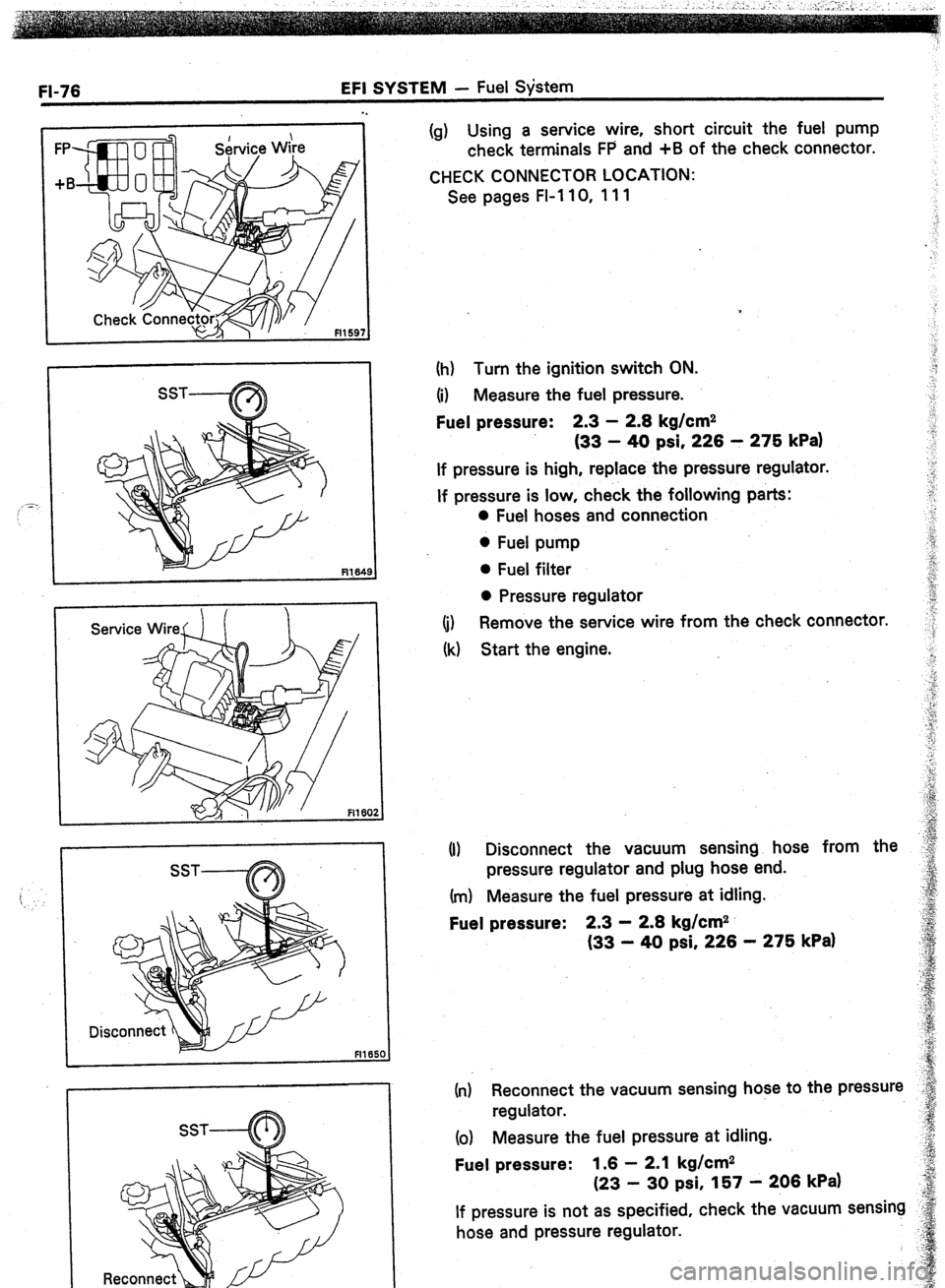
(g) Using a service wire, short circuit the fuel pump
check terminals FP and +B of the check connector.
CHECK CONNECTOR LOCATION:
See pages FI-110, 111
(h) Turn the ignition switch ON.
6) Measure the fuel pressure.
Fuel pressure: 2.3 - 2.8 kg/cm2
(33 - 40 psi, 226 - 275 kPa)
If pressure is high, replace the pressure regulator.
If pressure is low, check the following parts:
0 Fuel hoses and connection
0 Fuel pump
l Fuel filter
0 Pressure regulator
(j) Remove the service wire from the check connector.
(k) Start the engine.
(I) Disconnect the vacuum sensing hose from the
pressure regulator and plug hose end.
(m) Measure the fuel pressure at idling.
Fuel pressure: 2.3 - 2.8 kg/cm2
(33 - 40 psi, 226 - 275 kPa)
(r-r) Reconnect the vacuum sensing hose to the pressure
regulator.
10) Measure the fuel pressure at idling.
Fuel pressure: 1.6 - 2.1 kg/cm2
(23 - 30 psi, 157 - 206 kPa)
If pressure is not as specified, check the vacuum sensing
hose and pressure regulator.
Page 116 of 346
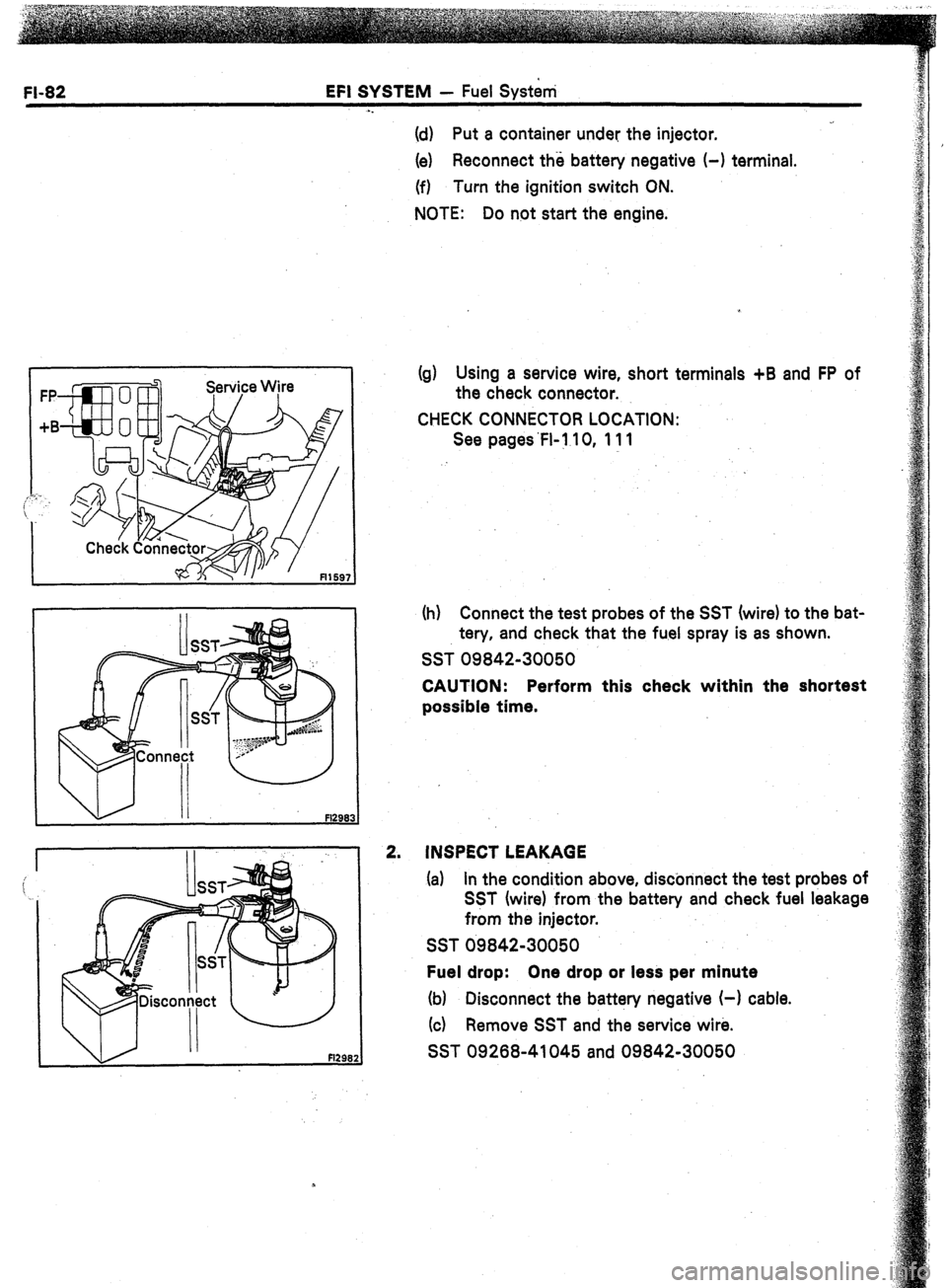
Fl-82 EFI SYSTEM - Fuel System
(d) Put a container under the injector.
(e) Reconnect the battery negative (-1 terminal.
(f) Turn the ignition switch ON.
NOTE: Do not start the engine.
Fl298:
!g) Using a service wire, short terminals +B and FP of
the check connector.
CHECK CONNECTOR LOCATION:
See pages ‘FI-j 10, 111
(h) Connect the test probes of the SST (wire) to the bat-
tery, and check that the fuel spray is as shown.
SST 09842-30050
CAUTION: Perform this check within the shortest
possible time.
2. INSPECT LEAKAGE
(a) In the condition above, disconnect the test probes of
SST (wire) from the battery and check fuel leakage
from the injector.
SST 09842-30050
Fuel drop: One drop or less per minute
(b) Disconnect the battery negative (-1 cable.
(c) Remove SST and the service wire.
SST 09268-41045 and 09842-30050
Page 125 of 346
EFI SYSTEM - Fuel System
FI-91
SST
(Hose)
Vinyl Tube
R167r
FP
+B
SST (Resistor Wire)
Graduated
Cylinder
Vinyl Tube
fllB'I
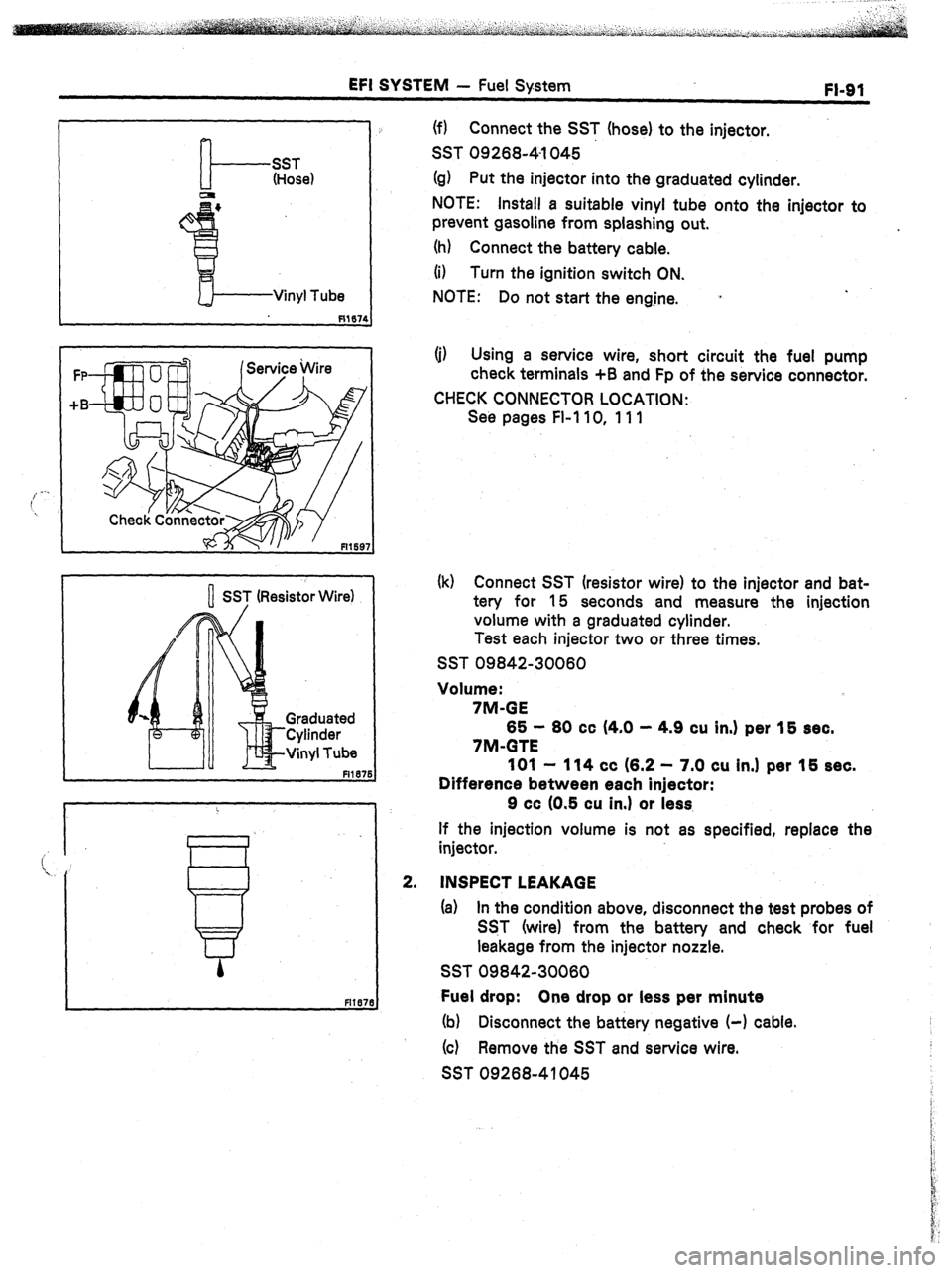
(f) Connect the SST (hose) to the injector.
SST 0926841045
(g) Put the injector into the graduated cylinder.
NOTE: Install a suitable vinyl tube onto the injector to
prevent gasoline from splashing out.
(h) Connect the battery cable.
(i) Turn the ignition switch ON.
NOTE: Do not start the engjne. *
(j) Using a service wire, short circuit the fuel pump
check terminals +B and Fp of the service connector.
CHECK CONNECTOR LOCATION:
Se6 pages Fl-110, 111
(k) Connect SST (resistor wire) to the injector and bat-
tery for 15 seconds and measure the injection
volume with a graduated cylinder.
Test each injector two or three times.
SST 09842-30060
Volume:
7M-GE
65 - 60 cc (4.0 - 4.9 cu in.) per 15 sec.
7M-GTE
101 - 114 cc (6.2 - 7.0 cu in.1 per 15 sec.
Difference between each injector:
9 cc (0.5 cu in.1 or less,
If the injection volume is not as specified, replace the
injector.
INSPECT LEAKAGE
(a) In the condition above, disconnect the test probes of
SST (wire) from the battery and check for fuel
leakage from the injector nozzle.
SST 09842-30060
Fuel drop: One drop or less per minute
(b) Disconnect the battery negative (-1 cable.
(c) Remove the SST and service wire.
SST 09268-41045