1987 PORSCHE 944 Oil
[x] Cancel search: OilPage 44 of 66
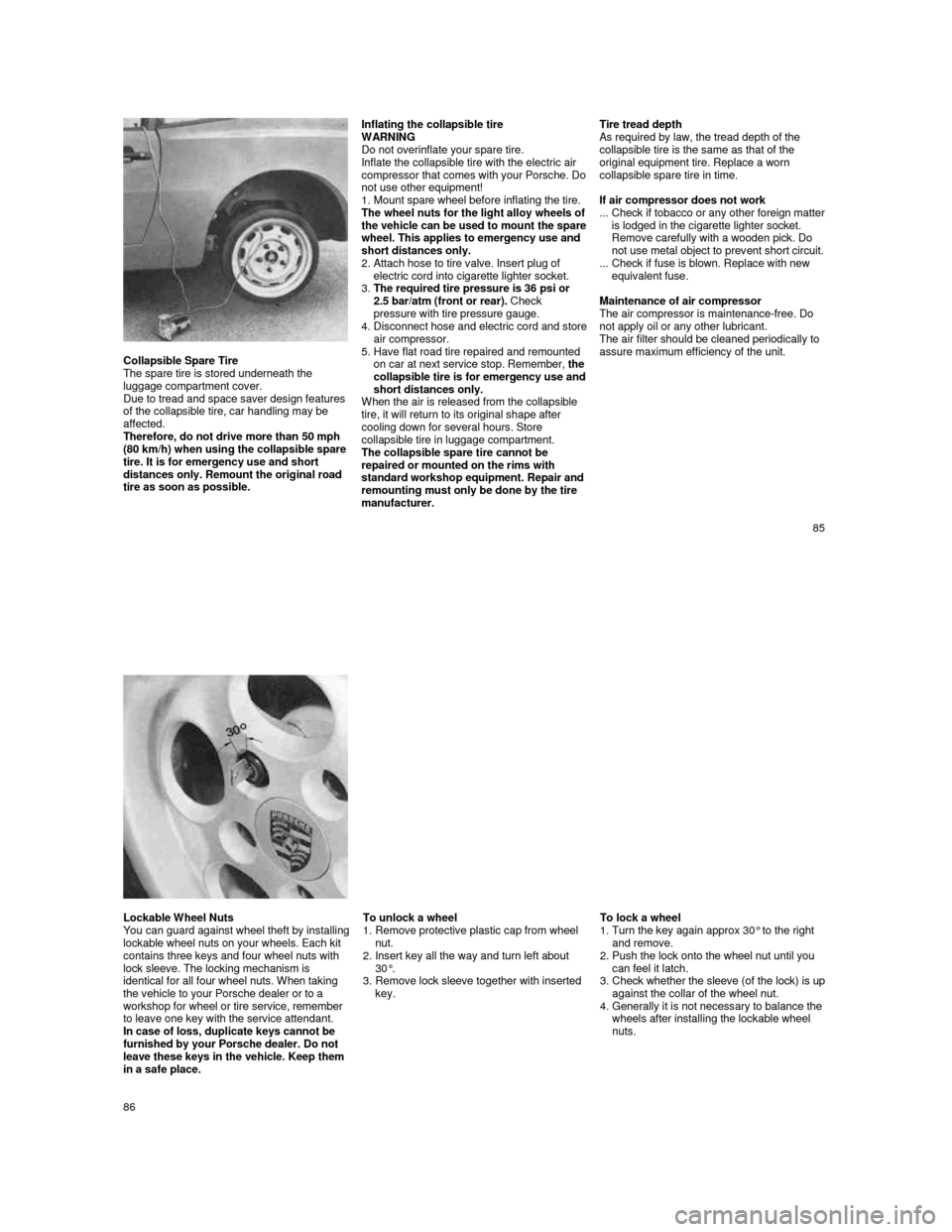
Collapsible Spare Tire
The spare tire is stored underneath the
luggage compartment cover.
Due to tread and space saver design features
of the collapsible tire, car handling may be
affected.
Therefore, do not drive more than 50 mph
(80 km/h) when using the collapsible spare tire. It is for emergency use and short
distances only. Remount the original road
tire as soon as possible.
Inflating the collapsible tire WARNING
Do not overinflate your spare tire.
Inflate the collapsible tire with the electric air
compressor that comes with your Porsche. Do not use other equipment!
1. Mount spare wheel before inflating the tire.The wheel nuts for the light alloy wheels of the vehicle can be used to mount the spare wheel. This applies to emergency use and
short distances only.
2.
Attach hose to tire valve. Insert plug of electric cord into cigarette lighter socket.
3. The required tire pressure is 36 psi or 2.5 bar/atm (front or rear). Check
pressure with tire pressure gauge.
4.
Disconnect hose and electric cord and store air compressor.
5. Have flat road tire repaired and remounted
on car at next service stop. Remember, the collapsible tire is for emergency use and short distances only.
When the air is released from the collapsible
tire, it will return to its original shape after
cooling down for several hours. Store
collapsible tire in luggage compartment.
The collapsible spare tire cannot be
repaired or mounted on the rims with
standard workshop equipment. Repair and
remounting must only be done by the tire
manufacturer.
Tire tread depth As required by law, the tread depth of the collapsible tire is the same as that of the
original equipment tire. Replace a worn
collapsible spare tire in time.
If air compressor does not work
...
Check if tobacco or any other foreign matter is lodged in the cigarette lighter socket.
Remove carefully with a wooden pick. Do
not use metal object to prevent short circuit.
... Check if fuse is blown. Replace with new
equivalent fuse.
Maintenance of air compressor
The air compressor is maintenance-free. Do
not apply oil or any other lubricant.
The air filter should be cleaned periodically to
assure maximum efficiency of the unit.
85
Lockable Wheel Nuts You can guard against wheel theft by installing lockable wheel nuts on your wheels. Each kit
contains three keys and four wheel nuts with
lock sleeve. The locking mechanism is
identical for all four wheel nuts. When taking
the vehicle to your Porsche dealer or to a
workshop for wheel or tire service, remember to leave one key with the service attendant.
In case of loss, duplicate keys cannot be
furnished by your Porsche dealer. Do not
leave these keys in the vehicle. Keep them
in a safe place.
To unlock a wheel
1. Remove protective plastic cap from wheel
nut.
2.
Insert key all the way and turn left about
30°.
3.
Remove lock sleeve together with inserted
key.
To lock a wheel
1. Turn the key again approx 30° to the right and remove.
2.
Push the lock onto the wheel nut until you
can feel it latch.
3.
Check whether the sleeve (of the lock) is up against the collar of the wheel nut.
4. Generally it is not necessary to balance the wheels after installing the lockable wheel nuts.
86
Page 45 of 66
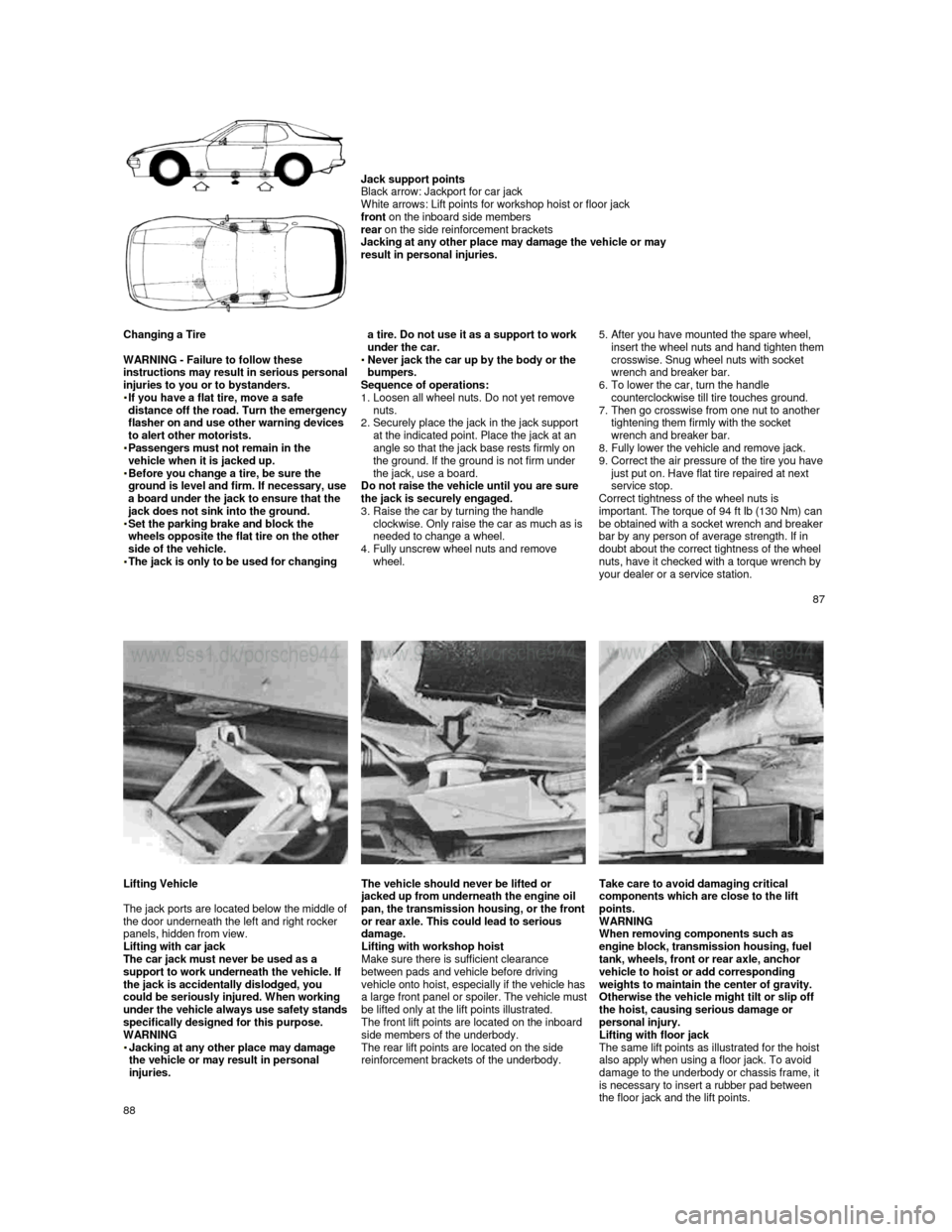
Jack support points
Black arrow: Jackport for car jack
White arrows: Lift points for workshop hoist or flo or jack
front on the inboard side members
rear on the side reinforcement brackets
Jacking at any other place may damage the vehicle o r may
result in personal injuries.
Changing a Tire
WARNING - Failure to follow these
instructions may result in serious personal injuries to you or to bystanders.
If you have a flat tire, move a safe distance off the road. Turn the emergency flasher on and use other warning devices
to alert other motorists.
Passengers must not remain in the vehicle when it is jacked up. Before you change a tire, be sure the ground is level and firm. If necessary, use a board under the jack to ensure that the jack does not sink into the ground. Set the parking brake and block the wheels opposite the flat tire on the other
side of the vehicle.
The jack is only to be used for changing
a tire. Do not use it as a support to work
under the car.
Never jack the car up by the body or the bumpers.
Sequence of operations:
1.
Loosen all wheel nuts. Do not yet remove
nuts.
2.
Securely place the jack in the jack support
at the indicated point. Place the jack at an
angle so that the jack base rests firmly on
the ground. If the ground is not firm under
the jack, use a board.
Do not raise the vehicle until you are sure
the jack is securely engaged.
3.
Raise the car by turning the handle
clockwise. Only raise the car as much as is
needed to change a wheel.
4.
Fully unscrew wheel nuts and remove wheel.
5. After you have mounted the spare wheel, insert the wheel nuts and hand tighten them crosswise. Snug wheel nuts with socket wrench and breaker bar.
6. To lower the car, turn the handle
counterclockwise till tire touches ground.
7.
Then go crosswise from one nut to another
tightening them firmly with the socket
wrench and breaker bar.
8. Fully lower the vehicle and remove jack.
9. Correct the air pressure of the tire you have just put on. Have flat tire repaired at next service stop.
Correct tightness of the wheel nuts is
important. The torque of 94 ft Ib (130 Nm) can
be obtained with a socket wrenc
h and breaker bar by any person of average strength. If in
doubt about the correct tightness of the wheel
nuts, have it checked with a torque wrench by
your dealer or a service station.
87
Lifting Vehicle
The jack ports are located below the middle of the door underneath the left and right rocker
panels, hidden from view.
Lifting with car jack
The car jack must never be used as a
support to work underneath the vehicle. If
the jack is accidentally dislodged, you
could be seriously injured. When working
under the vehicle always use safety stands specifically designed for this purpose.
WARNING
Jacking at any other place may damage the vehicle or may result in personal injuries.
The vehicle should never be lifted or jacked up from underneath the engine oil pan, the transmission housing, or the front or rear axle. This could lead to serious
damage.
Lifting with workshop hoist
Make sure there is sufficient clearance
between pads and vehicle before driving
vehicle onto hoist, especially if the vehicle
has a large front panel or spoiler. The vehicle must be lifted only at the lift points illustrated.
The front lift points are located on the inboard
side members of the underbody.
The rear lift points are located on the side
reinforcement brackets of the underbody.
Take care to avoid damaging critical
components which are close to the lift
points.
WARNING
When removing components such as
engine block, transmission housing, fuel
tank, wheels, front or rear axle, anchor
vehicle to hoist or add corresponding
weights to maintain the center of gravity.
Otherwise the vehicle might tilt or slip off
the hoist, causing serious damage or
personal injury.
Lifting with floor jack
The same lift points as illustrated for the hoist
also apply when using a floor jack. To avoid
damage to the underbody or chassis frame, it
is necessary to insert a rubber pad between
the floor jack and the lift points.
88
Page 46 of 66
If it fails to light up, the fuse is defective and
must be replaced. Replace black plastic
cover.
The central electrical system contains plug in
relays for various electrical switching
functions.
Defective relays should be tested and
replaced by an authorized Porsche dealer.
To prevent damage to the electrical system
we recommend having all work - including the
installation of electrical accessories -carried
out by your authorized Porsche dealer. . ,
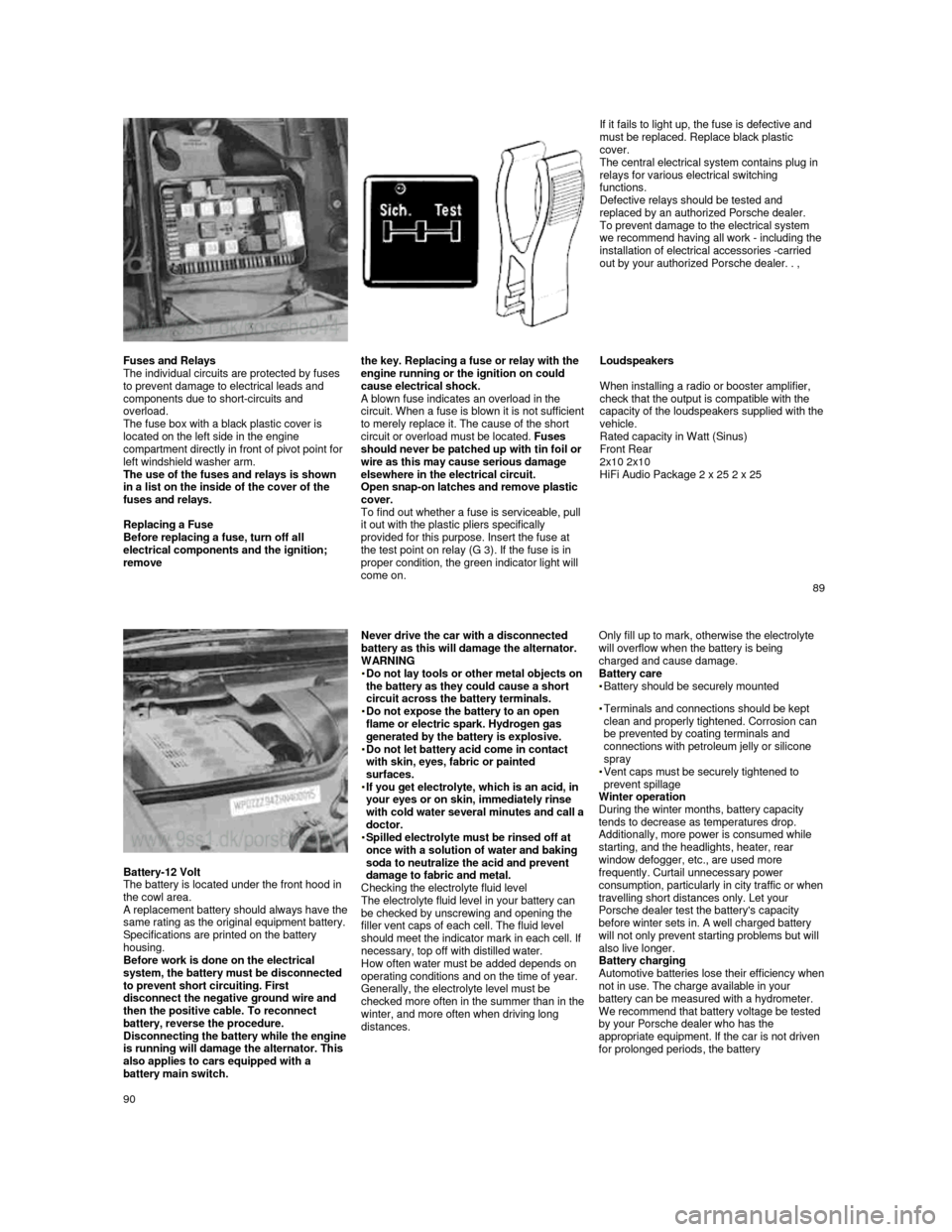
Fuses and Relays
The individual circuits are protected by fuses
to prevent damage to electrical leads and
components due to short-circuits and
overload.
The fuse box with a black plastic cover is
located on the left side in the engine
compartment directly in front of pivot point for
left windshield washer arm.
The use of the fuses and relays is shown
in a list on the inside of the cover of the
fuses and relays.
Replacing a Fuse
Before replacing a fuse, turn off all
electrical components and the ignition;
remove the key. Replacing a fuse or relay with the
engine running or the ignition on could
cause electrical shock.
A blown fuse indicates an overload in the circuit. When a fuse is blown it is not sufficient
to merely replace it. The cause of the short
circuit or overload must be located. Fuses
should never be patched up with tin foil or
wire as this may cause serious damage
elsewhere in the electrical circuit.
Open snap-on latches and remove plastic
cover.
To find out whether a fuse is serviceable, pull
it out with the plastic pliers specifically
provided for this purpose. Insert the fuse at
the test point on relay (G 3). If the fuse is in
proper condition, the green indicator light will
come on.
Loudspeakers
When installing a radio or booster amplifier,
check that the output is compatible with the
capacity of the loudspeakers supplied with the vehicle.
Rated capacity in Watt (Sinus)
Front Rear
2x10 2x10
HiFi Audio Package 2 x 25 2 x 25
89
Battery-12 Volt
The battery is located under the front hood in
the cowl area.
A replacement battery should always have the same rating as the original equipment battery.
Specifications are printed on the battery
housing.
Before work is done on the electrical
system, the battery must be disconnected
to prevent short circuiting. First
disconnect the negative ground wire and
then the positive cable. To reconnect
battery, reverse the procedure.
Disconnecting the battery while the engine is running will damage the alternator. This
also applies to cars equipped with a
battery main switch.
Never drive the car with a disconnected battery as this will damage the alternator. WARNING
Do not lay tools or other metal objects on the battery as they could cause a short
circuit across the battery terminals.
Do not expose the battery to an open flame or electric spark. Hydrogen gas
generated by the battery is explosive.
Do not let battery acid come in contact with skin, eyes, fabric or painted
surfaces.
If you get electrolyte, which is an acid, in your eyes or on skin, immediately rinse
with cold water several minutes and call a doctor. Spilled electrolyte must be rinsed off at once with a solution of water and baking
soda to neutralize the acid and prevent
damage to fabric and metal.
Checking the electrolyte fluid level
The electrolyte fluid level in your battery can
be checked by unscrewing and opening the
filler vent caps of each cell. The fluid level
should meet the indicator mark in each cell. If
necessary, top off with distilled water.
How often water must be added depends on
operating conditions and on the time of year.
Generally, the electrolyte level must be
checked more often in the summer than in the winter, and more often when driving long distances.
Only fill up to mark, otherwise the electrolyte will overflow when the battery is being charged and cause damage.
Battery care
Battery should be securely mounted
Terminals and connections should be kept
clean and properly tightened. Corrosion can
be prevented by coating terminals and
connections with petroleum jelly or silicone
spray
Vent caps must be securely tightened to
prevent spillage
Winter operation
During the winter months, battery capacity
tends to decrease as temperatures drop.
Additionally, more power is consumed while starting, and the headlights, heater, rear window defogger, etc., are used more
frequently. Curtail unnecessary power
consumption, particularly in city traffic or when travelling short distances only. Let your
Porsche dealer test the battery's capacity
before winter sets in. A well charged battery
will not only prevent starting problems but will
also live longer.
Battery charging
Automotive batteries lose their efficiency when not in use. The charge available in your
battery can be measured with a hydrometer.
We recommend that battery voltage be tested
by your Porsche dealer who has the
appropriate equipment. If the car is not driven
for prolonged periods, the battery
90
Page 52 of 66
How Emission Control Works
When an automobile engine is running, it uses energy generated through the combustion of a mixture of air and fuel. Depending on whether
a car is driven fast or slowly or whether the
engine is cold or hot, some of the fuel
(hydrocarbons) may not be burned completely but be discharged into the engine crankcase
or exhaust system. Additional hydrocarbons
may enter the atmosphere through
evaporation of fuel from the fuel tank. These
hydrocarbons (HC), when released into the
air, contribute to undesirable pollution.
In addition, carbon monoxide (CO) and oxides of nitrogen (NOx) contribute to engine
emissions. They, too, are formed during the
combustion process and discharged into the
exhaust system.
To reduce these pollutants, your Porsche is
equipped with a precisely calibrated fuel
injection system to assure a finely balanced
air/fuel mixture under all operating conditions.
Oxygen Sensor
The oxygen sensor, installed in the exhaust
pipe continuously senses the oxygen content
of the exhaust and signals the information to
an electronic control unit. The control unit
corrects the air/fuel ratio, so that the engine
always receives an accurately metered air fuel mixture. .
Crankcase Ventilation
Through Crankcase Ventilation undesirable
emissions from the engine crankcase are not
permitted to reach the outside atmosphere.
These emissions are recirculated from the
crankcase to the air intake system. From here
the emissions mix with the intake air and are
later burned in the engine.
Catalytic converter
The catalytic converter is an efficient
"cleanup" device built into the exhaust system
of the vehicle. The catalytic converter burns
the undesirable pollutants in the exhaust gas
before it is released into the atmosphere.
The exclusive use of unleaded fuel is critically important for the life of the
catalytic converter. Therefore, only
unleaded gasoline without additives must
be used.
The catalytic converter will be damaged by
push or tow starting your vehicle
misfiring of the engine turning off the ignition while the vehicle is moving or
by other unusual operating conditions.
Do not continue to operate your vehicle
under these conditions, as otherwise fuel
can reach the catalytic converter. This
could result in overheating of the
converter.
Federal law prohibits use of leaded
gasoline in this car.
The Emission Control System and its other
related components are illustrated and
described on the following pages.
101
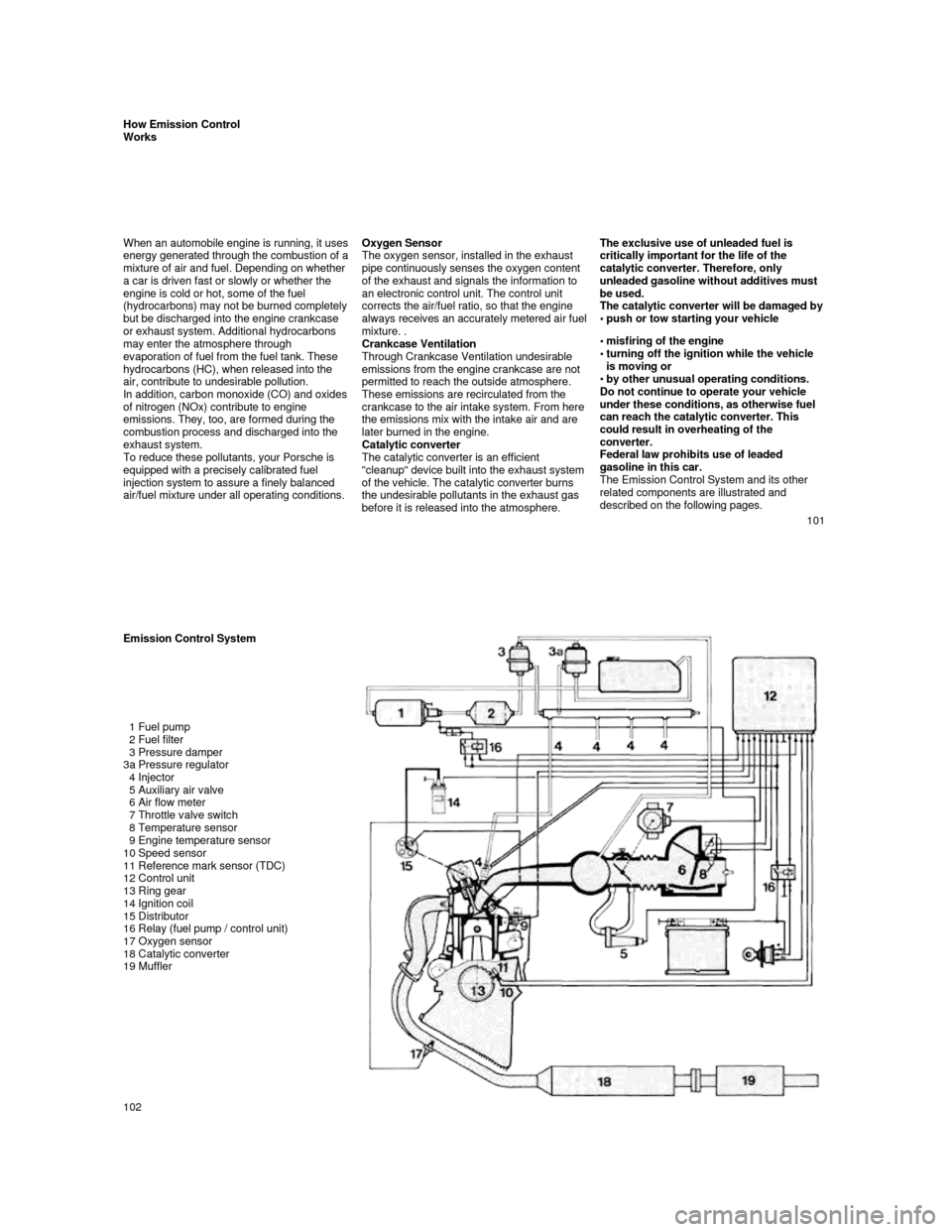
Emission Control System
1 Fuel pump
2 Fuel filter
3 Pressure damper
3a Pressure regulator
4 Injector
5 Auxiliary air valve
6 Air flow meter
7 Throttle valve switch
8 Temperature sensor
9 Engine temperature sensor
10 Speed sensor
11 Reference mark sensor (TDC)
12 Control unit
13 Ring gear
14 Ignition coil
15 Distributor
16 Relay (fuel pump / control unit)
17 Oxygen sensor
18 Catalytic converter
19 Muffler
102
Page 56 of 66

Engine Design Specifications
Design
Operating cycle
Lubrication
Cylinder block
Cylinder head
Valve operation
Camshaft drive
Crankshaft
Fuel injection 4-cylinder, in-line engine, front mount with two ba
lance-shafts
4-stroke
Pressure oil circulation from oil sump,
full flow filter
Light metal
Light metal
Overhead camshaft
(944 S: 2 overhead camshafts)
Spur belt drive
Forged, 5 main bearings
AFC (Air Flow Control) Power Train
Manual transmission
Gear ratio
1st gear
2nd gear
3rd gear
4th gear
5th gear
Axle ratio Gear ratio 944
3.600:1
2.125:1
1.458:1
1.071:1
0.730:1
3.500:1
3.889:1 Gear ratio 944 S
3.500:1
2.059:1
1.400:1
1.034:1
0.829:1
3.500:1
3.889:1 Gear ratio 944 Turbo
3.500:1
2.059:1
1.400:1
1.034:1
0.829:1
3.500:1
3.375:1
Clutch
Power transmission Single plate dry disc, hydraulically operated
Double constant velocity joints and drive shaft
Automatic transmission 944
Gear ratio 1st gear
2nd gear
3rd gear
Reverse gear
Axle ratio
Clutch 2.714:1
1.500:1
1.000:1
2.429:1
3.455:1
Hydrodynamic torque converter
109
Filling Capacities
Engine oil With filter change approx. 6.34 (Turbo: approx. 6.87) U.S. qts. or 6 (Turbo: approx. 6.5) liters.
Check oil level with dipstick a few minutes after e ngine has stopped. The difference between
the max. and min. marks on the dipstick is approx. 1 U.S. qt. or 1 liter.
Only use brand name oil which has been tested and a pproved by Porsche.
Your authorized Porsche dealer will be glad to advi se you.
Porsche does not recommend the use of oil additives . See also "Engine Oils".
Cooling system with heating
Approx. 8,2 U.S. qts. or 7,8 liters. Factory filled to -31°F (-35°C). Only use phosphate-free
anti-freeze containing ethylene glycol recommended for aluminum engines and radiators.
Manual transmission
Approx. 0.53 U.S. gal. or 2.0 liters. Use hypoid oi l SAE 80 labeled "For Service API/GL4 or
Mil-L 2105".
Automatic transmission with
torque converter Approx. 1.72 U.S. gal. or 6.5 liters ATF Dexron®. At oil c hanges 3 U.S. qts. or 2.8 liters are
required.
Differential of automatic transmission
Approx. 1 U.S. qts. or 1 liter hypoid oil SAE 90 ac cording to API classification GL 5 or
Mil-L 2105 B.
Power steering
Approx. 0.63 U.S. qts. or 0.6 liter ATF Dexron®
Fuel tank Approx. 21.1 U.S. gals, or 80 liters including a re serve of 2.1 U.S. gals, or 8 liters.
Unleaded fuel only! Minimum octane rating 944 91 RO N (87 CLC or AKI ((R+M)/2) rating on fuel
pumps in U.S.A.), 944 S / 944 Turbo 95 RON (90 CLC or AKI ((R+M)/2) rating on fuel pumps in U.S.A.)
Brake fluid Approx. 0.42 U.S. pint or 0.2 liter. Only use brake fluid conforming to specifications
SAE J 1703, DOT 3 or DOT 4.
Windshield and headlight washer system
Approx. 1.59 U.S. gals, or 6.0 liters.
Refrigerant for air conditioning Approx. 33.5 oz or 950 g. Refrigerant R 12 (CCI2F2)
Cooling system mixing chart
(Approximate values)
Anti-freeze-Water
Consult your authorized dealer about
the approved anti-freeze mixtures. Temp, down to
-13° F (-25°C) -23° F (-30° C) -31° F (-35° C)
Anti-freeze
40%
45%
50% Water
60% 55% 50%
Anti-freeze
3.1 liters / 3.3 U.S. qts.3.5 liters / 3.7 U.S. qts.3.9 liters / 4.1 U.S. qts.
Water
4.7 liters / 5.0 U.S. qts.
4.3 liters / 4.5 U.S. qts. 3.9 liters / 4.1 U.S. qts.
110
Page 57 of 66
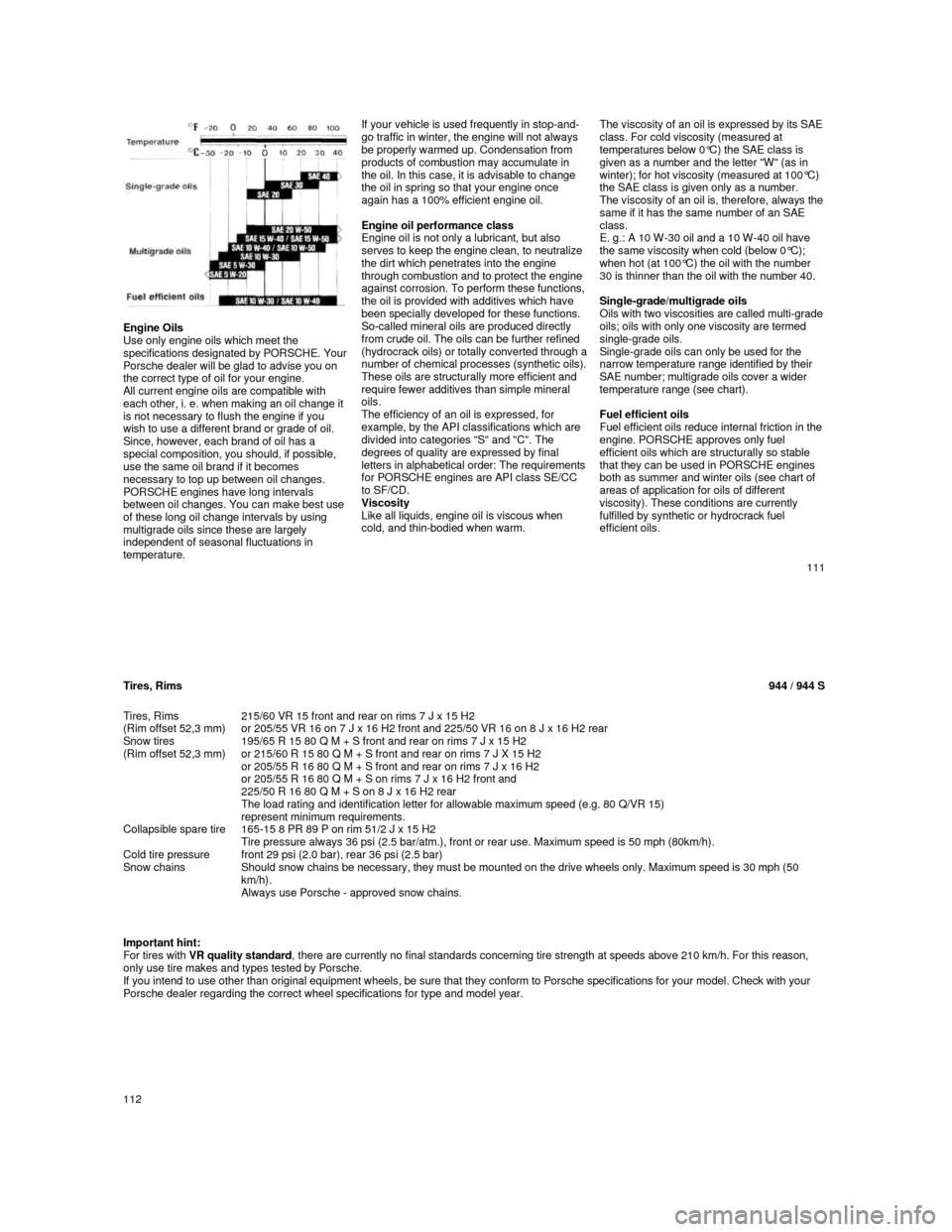
Engine Oils
Use only engine oils which meet the
specifications designated by PORSCHE. Your Porsche dealer will be glad to advise you on
the correct type of oil for your engine.
All current engine oils are compatible with each other, i. e. when making an oil change it
is not necessary to flush the engine if you
wish to use a different brand or grade of oil. Since, however, each brand of oil has a
special composition, you should, if possible,
use the same oil brand if it becomes
necessary to top up between oil changes.
PORSCHE engines have long intervals
between oil changes. You can make best use
of these long oil change intervals by using
multigrade oils since these are largely
independent of seasonal fluctuations in
temperature.
If your vehicle is used frequently in stop-and-
go traffic in winter, the engine will not always
be properly warmed up. Condensation from
products of combustion may accumulate in
the oil. In this case, it is advisable to change
the oil in spring so that your engine once
again has a 100% efficient engine oil.
Engine oil performance class
Engine oil is not only a lubricant, but also
serves to keep the engine clean, to neutralize
the dirt which penetrates into the engine
through combustion and to protect the engine
against corrosion. To perform these functions, the oil is provided with additives which have
been specially developed for these functions.
So-called mineral oils are produced directly
from crude oil. The oils can be further refined
(hydrocrack oils) or totally converted through a number of chemical processes (synthetic oils). These oils are structurally more efficient and
require fewer additives than simple mineral
oils.
The efficiency of an oil is expressed, for
example, by the API classifications which are
divided into categories "S" and "C". The
degrees of quality are expressed by final
letters in alphabetical order: The requirements for PORSCHE engines are API class SE/CC
to SF/CD.
Viscosity
Like all liquids, engine oil is viscous when
cold, and thin-bodied when warm.
The viscosity of an oil is expressed by its SAE class. For cold viscosity (measured at
temperatures below 0°C) the SAE class is
given as a number and the letter "W" (as in
winter); for hot viscosity (measured at 100°C) the SAE class is given only as a number. The viscosity of an oil is, therefore, always the same if it has the same number of an SAE
class.
E. g.: A 10 W -30 oil and a 10 W-40 oil have
the same viscosity when cold (below 0°C);
when hot (at 100°C) the oil with the number 30 is thinner than the oil with the number 40.
Single-grade/multigrade oils
Oils with two viscosities are called multi-g
rade oils; oils with only one viscosity are termed
single-grade oils.
Single-grade oils can only be used for the
narrow temperature range identified by their
SAE number; multigrade oils cover a wider
temperature range (see chart).
Fuel efficient oils
Fuel efficient oils reduce internal friction in the
engine. PORSCHE approves only fuel
efficient oils which are structurally so stable
that they can be used in PORSCHE engines
both as summer and winter oils (see chart of
areas of application for oils of different
viscosity). These conditions are currently
fulfilled by synthetic or hydrocrack fuel
efficient oils.
111
Tires, Rims 944 / 944 S
Tires, Rims
(Rim offset 52,3 mm) 215/60 VR 15 front and rear on rims 7 J x 15 H2
or 205/55 VR 16 on 7 J x 16 H2 front and 225/50 VR
16 on 8 J x 16 H2 rear
Snow tires
(Rim offset 52,3 mm) 195/65 R 15 80 Q M + S front and rear on rims 7 J x
15 H2
or 215/60 R 15 80 Q M + S front and rear on rims 7 J X 15 H2
or 205/55 R 16 80 Q M + S front and rear on rims 7 J x 16 H2
or 205/55 R 16 80 Q M + S on rims 7 J x 16 H2 front and
225/50 R 16 80 Q M + S on 8 J x 16 H2 rear
The load rating and identification letter for allow able maximum speed (e.g. 80 Q/VR 15)
represent minimum requirements.
Collapsible spare tire 165-15 8 PR 89 P on rim 51/2 J x 15 H2
Tire pressure always 36 psi (2.5 bar/atm.), front o r rear use. Maximum speed is 50 mph (80km/h).
Cold tire pressure front 29 psi (2.0 bar), rear 36 psi (2.5 bar)
Snow chains Should snow chains be necessary, they m ust be mounted on the drive wheels only. Maximum speed is 30 mph (50
km/h).
Always use Porsche - approved snow chains.
Important hint:
For tires with VR quality standard , there are currently no final standards concerning tire strength at speeds above 210 km/h. For this r eason,
only use tire makes and types tested by Porsche.
If you intend to use other than original equipment wheels, be sure that they conform to Porsche specif ications for your model. Check with your
Porsche dealer regarding the correct wheel specific ations for type and model year.
112
Page 58 of 66

Tires, Rims 944 Turbo
Tires, Rims
(Rim offset 52,3 mm) 205/55 VR 16 on rims 7 J x 16 H2 front and 225/50 V
R 16 on rims 8 J x 16 H2 rear
Snow tires
(Rim offset 52,3 mm) 205/55 R 16 82 Q M+S on rims 7 J x 16 H2 front and
rear
or 205/55 R 16 82 Q M + S on rims 7 J x 16 H2 front and
225/50 R 16 82 Q M + S on rims 8 J x 16 H2 rear
The load rating and identification letter for allow able maximum speed (e.g. 82 Q/VR 16)
represent minimum requirements.
Collapsible spare tire 165-15 8 PR 89 P on rim 51/2 J x 15 H2
Tire pressure always 36 psi (2.5 bar/atm.), front o r rear use. Maximum speed is 50 mph (80 km/h).
Cold tire pressure front and rear 36 psi (2.5 bar)
Snow chains Should snow chains be necessary, they m ust be mounted on the drive wheels only. Maximum
speed is 30 mph (50 km/h). Always use Porsche - app roved snow chains.
Important hint:
For tires with VR quality standard , there are currently no final standards concerning tire strength at speeds above 210 km/h. For this r eason,
only use tire makes and types tested by Porsche.
If you intend to use other than original equipment wheels, be sure that they conform to Porsche specif ications for your model. Check with your
Porsche dealer regarding the correct wheel specific ations for type and model year.
113
Dimensions
Length
Width
Height
Wheel base
Wheel track, front
Wheel track, rear
Ground clearance*
Tuning circle (curb to curb)
Tuning circle (wall to wall)
Overhang angle, front*
Overhang angle, rear*
944 / 944 S
168.90 in. / 4290 mm 68.31 in. / 1735 mm
50.20 in. / 1275 mm
94.49 in. / 2400 mm
58.15 in. / 1477 mm
57.13 in. / 1451 mm
4.72 in. / 120 mm
31.17 ft. / 9.5 m
33.80 ft./ 10.3 m
14°
15°
944 Turbo
168.90 in. / 4290 mm
68.31 in. / 1735 mm
50.20 in. / 1275 mm
94.49 in. / 2400 mm
58.15 in. / 1477 mm
57.13 in. / 1451 mm
4.72 in. / 120 mm
31.17 ft. / 9.5 m
33.80 ft./ 10.3 m
12,5°
15°
Weights
Curb weight
Maximum load capacity
Total permissible weight
Maximum axle load, front**
Maximum axle load, rear**
Permissible rack load**/***
944
2778 Ibs. / 1260kg
661 Ibs. / 300 kg
3439 Ibs. / 1560kg
1587 Ibs. / 720kg
1984 Ibs. / 900kg
165 Ibs. / 75kg 944 S
2866 Ibs. / 1300 kg
661 Ibs. / 300 kg
3527 Ibs. / 1600 kg
1609 Ibs. / 730kg
1984 Ibs. / 900 kg
165 Ibs. / 75kg 944 Turbo 2998 Ibs. / 1360 kg650 Ibs. / 285 kg 3626 Ibs. / 1645 kg1675 Ibs./ 760kg
2028 Ibs. / 920 kg 165 Ibs. / 75kg
* At total permissible weight. ** Do not exceed tot al permissible weight.
*** Applies only if the basic rack of the original Porsche Roof Transport System is used. If old type Porsche ski and luggage racks are used the
permissible roof weight is 35 kg (77 Ibs.).
The vehicle capacity weight (max. load), the Gross Vehicle Weight Rating (GVWR) and the Gross Axle Wei ght Ratings (GAWR) for front and
rear, are listed on the sticker on the left upper s ide member in the engine compartment.
The gross vehicle weight rating includes the weight of the basic vehicle plus full tank, oil and coolant, plus max. load which combines passenger
(150 pounds / 68 kg per designated position) and lu ggage weight. Luggage weight is not increased by th e use of roof, ski or luggage racks,
unless passenger capacity is reducted accordingly.
114
Page 59 of 66

Wheel Alignment
Wheel camber*
Toe-in*
Toe angle difference*
Caster*
* at DIN curb weight Front
Rear
Front
Rear
-20' ± 15',
maximum difference left to right 20'
-1° ± 20', maximum difference left to right 30'
+ 10' ±5'
0° ± 10', maximum difference left to right 20' at 20° to left and right -1° ± 20'
2,5° + 30' - 15'
Brake System
Hydraulic dual circuit brake system with
front/rear brake circuits
internally ventilated disc brakes front and rearBrake power assist
Parking brake acting on rear wheels
Chassis, Suspension
Unitized construction
Front suspension
Rear suspension
Shock absorbers
Stabilizers
Independent coil/shock absorber struts, positive ki
ng-pin offset
Independent - diagonal arm, one torsion bar each
Double acting hydraulic shock absorbers, front and rear
Diameter - front: 20 mm (optional 21,5), Turbo: 22. 5 mm or 24 x 3.7 mm
rear: 14 mm or 20 mm (optional), Turbo: 18 mm
115
Performance*
Maximum speed
Acceleration 0-60 mph Time at end 1/4 mile*
Time at end 1/4 mile*
Manual transmission944
131 mph (210 km/h) 8.3 seconds
16.2 seconds
30.1 seconds
944 S
142 mph (228 km/h)
7.7 seconds
15.4 seconds
27.8 seconds
944 Turbo
152 mph (245 km/h)
6.1 seconds
14.4 seconds
26.0 seconds
Automatic transmission944
131 mph (210 km/h)
9.8 seconds
17.2 seconds
17.2 seconds
* At curb weight and half-load capacity, excluding optional equipment and accessories.
Climbing Performance
1st gear
2nd gear
3rd gear
4th gear
5th gear
Manual transmission944
approx. 61%
approx. 33%
approx. 21%
approx. 14%
approx. 8%
944 S
approx. 62% approx. 36%
approx. 22%
approx. 14%
approx. 9%
944 Turbo
approx. 62%
approx. 49%
approx. 30%
approx. 20%
approx. 14%
Automatic transmission944
approx. 36%
approx. 18%
approx. 10%
116