1987 PORSCHE 944 maintenance
[x] Cancel search: maintenancePage 41 of 66
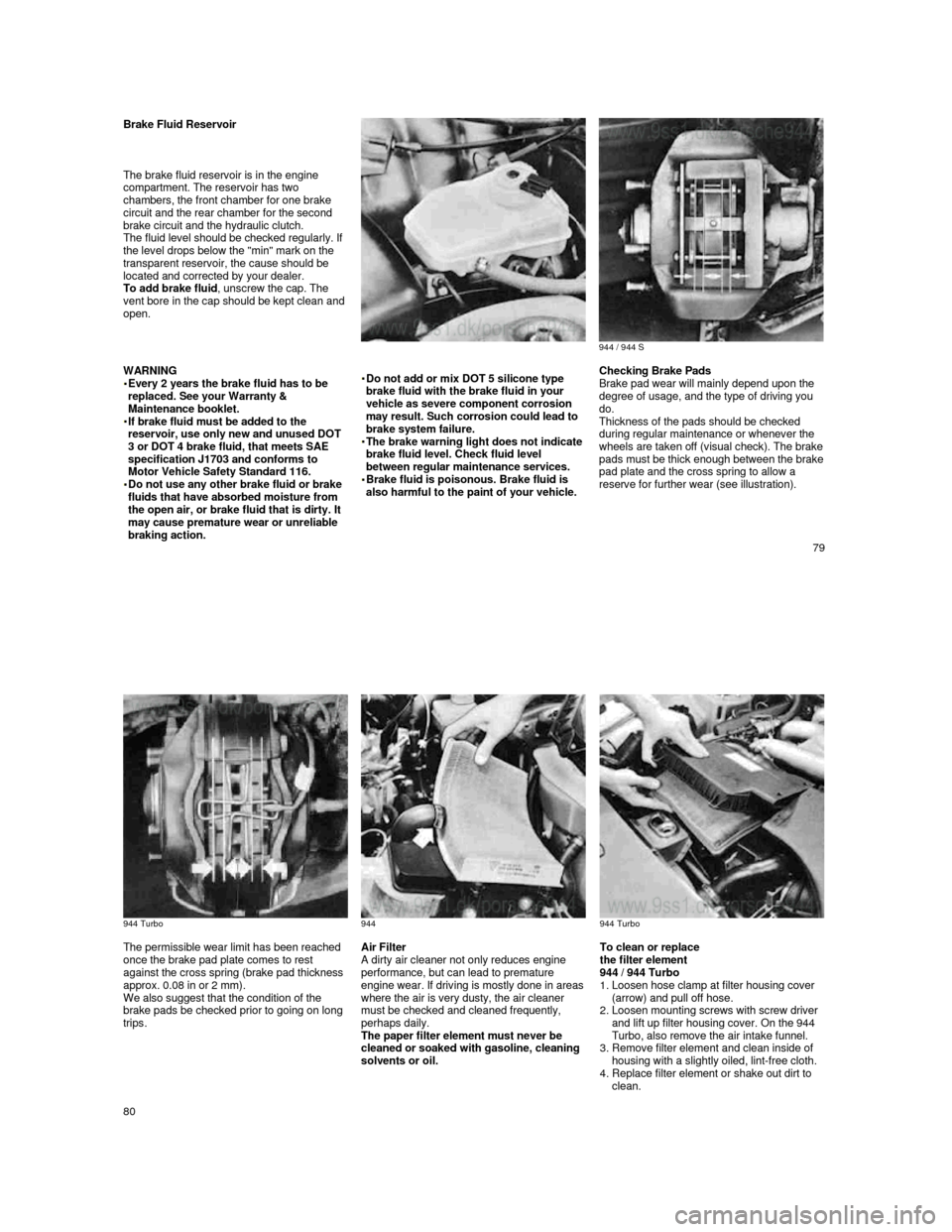
Brake Fluid Reservoir
The brake fluid reservoir is in the engine
compartment. The reservoir has two
chambers, the front chamber for one brake
circuit and the rear chamber for the second
brake circuit and the hydraulic clutch.
The fluid level should be checked regularly. If
the level drops below the "min" mark on the
transparent reservoir, the cause should be
located and corrected by your dealer.
To add brake fluid , unscrew the cap. The
vent bore in the cap should be kept clean and
open.
944 / 944 S WARNING
Every 2 years the brake fluid has to be replaced. See your Warranty &
Maintenance booklet.
If brake fluid must be added to the reservoir, use only new and unused DOT
3 or DOT 4 brake fluid, that meets SAE
specification J1703 and conforms to
Motor Vehicle Safety Standard 116.
Do not use any other brake fluid or brake fluids that have absorbed moisture from
the open air, or brake fluid that is dirty. It
may cause premature wear or unreliable
braking action.
Do not add or mix DOT 5 silicone type brake fluid with the brake fluid in your
vehicle as severe component corrosion
may result. Such corrosion could lead to
brake system failure.
The brake warning light does not indicate brake fluid level. Check fluid level
between regular maintenance services.
Brake fluid is poisonous. Brake fluid is also harmful to the paint of your vehicle.
Checking Brake Pads
Brake pad wear will mainly depend upon the
degree of usage, and the type of driving you
do.
Thickness of the pads should be checked
during regular maintenance or whenever the
wheels are taken off (visual check). The brake pads must be thick enough between the brake pad plate and the cross spring to allow a
reserve for further wear (see illustration).
79
944 Turbo
944
944 Turbo
The permissible wear limit has been reached
once the brake pad plate comes to rest
against the cross spring (brake pad thickness
approx. 0.08 in or 2 mm).
We also suggest that the condition of the
brake pads be checked prior to going on long
trips. Air Filter
A dirty air cleaner not only reduces engine performance, but can lead to premature
engine wear. If driving is mostly done in areas
where the air is very dusty, the air cleaner must be checked and cleaned frequently,
perhaps daily.
The paper filter element must never be
cleaned or soaked with gasoline, cleaning
solvents or oil.
To clean or replace
the filter element
944 / 944 Turbo
1. Loosen hose clamp at filter housing cover (arrow) and pull off hose.
2.
Loosen mounting screws with screw driver
and lift up filter housing cover. On the 944
Turbo, also remove the air intake funnel.
3.
Remove filter element and clean inside of
housing with a slightly oiled, lint-free cloth.
4.
Replace filter element or shake out dirt to
clean.
80
Page 44 of 66
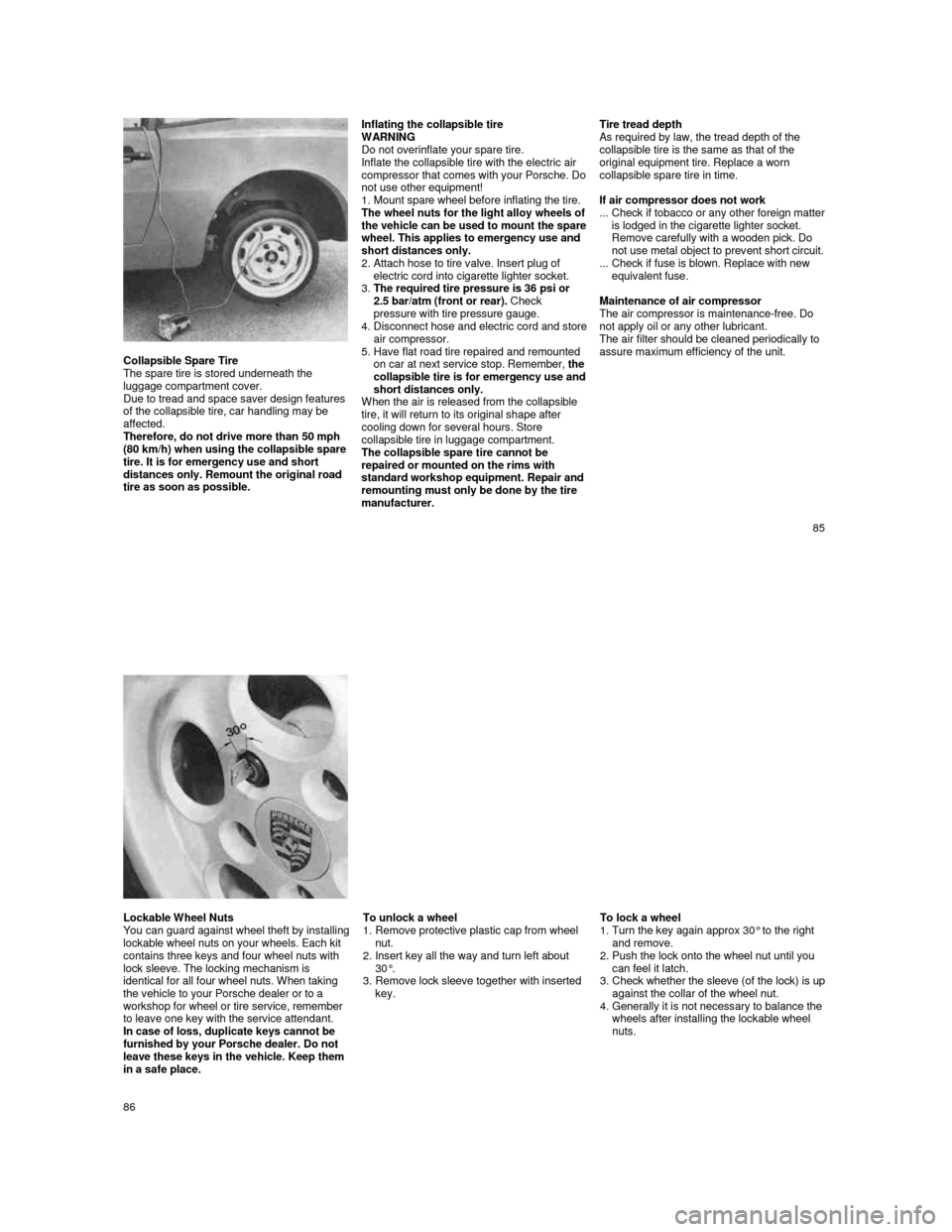
Collapsible Spare Tire
The spare tire is stored underneath the
luggage compartment cover.
Due to tread and space saver design features
of the collapsible tire, car handling may be
affected.
Therefore, do not drive more than 50 mph
(80 km/h) when using the collapsible spare tire. It is for emergency use and short
distances only. Remount the original road
tire as soon as possible.
Inflating the collapsible tire WARNING
Do not overinflate your spare tire.
Inflate the collapsible tire with the electric air
compressor that comes with your Porsche. Do not use other equipment!
1. Mount spare wheel before inflating the tire.The wheel nuts for the light alloy wheels of the vehicle can be used to mount the spare wheel. This applies to emergency use and
short distances only.
2.
Attach hose to tire valve. Insert plug of electric cord into cigarette lighter socket.
3. The required tire pressure is 36 psi or 2.5 bar/atm (front or rear). Check
pressure with tire pressure gauge.
4.
Disconnect hose and electric cord and store air compressor.
5. Have flat road tire repaired and remounted
on car at next service stop. Remember, the collapsible tire is for emergency use and short distances only.
When the air is released from the collapsible
tire, it will return to its original shape after
cooling down for several hours. Store
collapsible tire in luggage compartment.
The collapsible spare tire cannot be
repaired or mounted on the rims with
standard workshop equipment. Repair and
remounting must only be done by the tire
manufacturer.
Tire tread depth As required by law, the tread depth of the collapsible tire is the same as that of the
original equipment tire. Replace a worn
collapsible spare tire in time.
If air compressor does not work
...
Check if tobacco or any other foreign matter is lodged in the cigarette lighter socket.
Remove carefully with a wooden pick. Do
not use metal object to prevent short circuit.
... Check if fuse is blown. Replace with new
equivalent fuse.
Maintenance of air compressor
The air compressor is maintenance-free. Do
not apply oil or any other lubricant.
The air filter should be cleaned periodically to
assure maximum efficiency of the unit.
85
Lockable Wheel Nuts You can guard against wheel theft by installing lockable wheel nuts on your wheels. Each kit
contains three keys and four wheel nuts with
lock sleeve. The locking mechanism is
identical for all four wheel nuts. When taking
the vehicle to your Porsche dealer or to a
workshop for wheel or tire service, remember to leave one key with the service attendant.
In case of loss, duplicate keys cannot be
furnished by your Porsche dealer. Do not
leave these keys in the vehicle. Keep them
in a safe place.
To unlock a wheel
1. Remove protective plastic cap from wheel
nut.
2.
Insert key all the way and turn left about
30°.
3.
Remove lock sleeve together with inserted
key.
To lock a wheel
1. Turn the key again approx 30° to the right and remove.
2.
Push the lock onto the wheel nut until you
can feel it latch.
3.
Check whether the sleeve (of the lock) is up against the collar of the wheel nut.
4. Generally it is not necessary to balance the wheels after installing the lockable wheel nuts.
86
Page 51 of 66
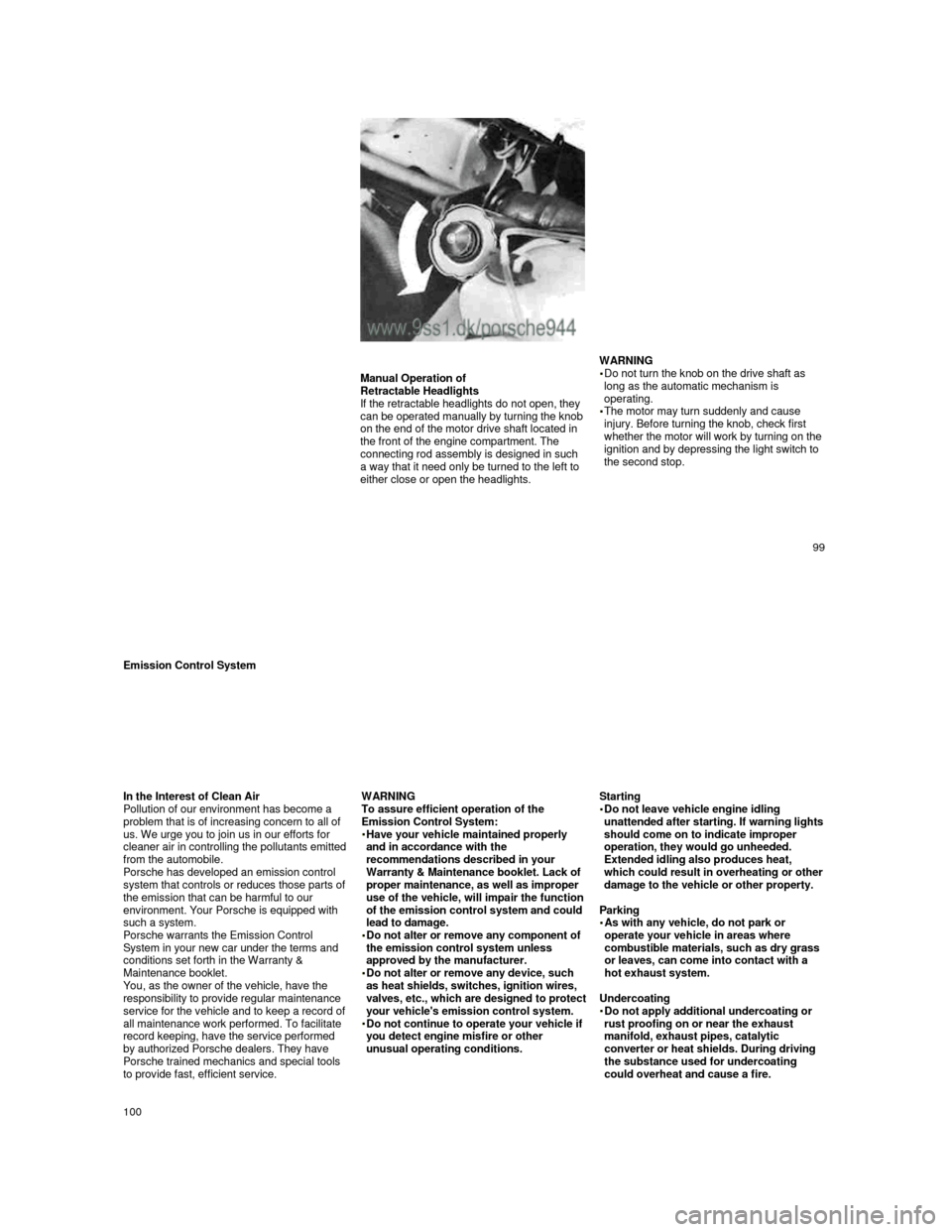
Manual Operation of
Retractable Headlights
If the retractable headlights do not open, they
can be operated manually by turning the knob
on the end of the motor drive shaft located in
the front of the engine compartment. The
connecting rod assembly is designed in such
a way that it need only be turned to the left to
either close or open the headlights.
WARNING
Do not turn the knob on the drive shaft as
long as the automatic mechanism is
operating.
The motor may turn suddenly and cause
injury. Before turning the knob, check first
whether the motor will work by turning on the ignition and by depressing the light switch to
the second stop.
99
Emission Control System
In the Interest of Clean Air
Pollution of our environment has become a
problem that is of increasing concern to all of
us. We urge you to join us in our efforts for
cleaner air in controlling the pollutants emitted from the automobile.
Porsche has developed an emission control
system that controls or reduces those parts of
the emission that can be harmful to our
environment. Your Porsche is equipped with
such a system.
Porsche warrants the Emission Control
System in your new car under the terms and
conditions set forth in the Warranty &
Maintenance booklet.
You, as the owner of the vehicle, have the
responsibility to provide regular maintenance
service for the vehicle and to keep a record of
all maintenance work performed. To facilitate
record keeping, have the service performed
by authorized Porsche dealers. They have
Porsche trained mechanics and special tools
to provide fast, efficient service.
WARNING To assure efficient operation of the
Emission Control System:
Have your vehicle maintained properly and in accordance with the
recommendations described in your
Warranty & Maintenance booklet. Lack of
proper maintenance, as well as improper
use of the vehicle, will impair the function
of the emission control system and could
lead to damage.
Do not alter or remove any component of the emission control system unless
approved by the manufacturer.
Do not alter or remove any device, such as heat shields, switches, ignition wires, valves, etc., which are designed to protect your vehicle's emission control system. Do not continue to operate your vehicle if you detect engine misfire or other
unusual operating conditions.
Starting
Do not leave vehicle engine idling unattended after starting. If warning lights should come on to indicate improper
operation, they would go unheeded.
Extended idling also produces heat,
which could result in overheating or other damage to the vehicle or other property.
Parking
As with any vehicle, do not park or operate your vehicle in areas where
combustible materials, such as dry grass
or leaves, can come into contact with a
hot exhaust system.
Undercoating
Do not apply additional undercoating or rust proofing on or near the exhaust
manifold, exhaust pipes, catalytic
converter or heat shields. During driving
the substance used for undercoating
could overheat and cause a fire.
100