1987 PORSCHE 944 fuel
[x] Cancel search: fuelPage 25 of 66

Break-in Hints for the first 1.000 miles /
1.600 kilometers
There are no specific break-in rules for your
Porsche. However, by observing a few
precautions you can help extend the service
life and performance of your engine.
During the first 1.000 miles / 1.600 km, all
working components of the engine adjust to
each other to a certain degree. Therefore:
Avoid full throttle starts and abrupt stops. Change speeds frequently. Vary the throttle
load.
Do not exceed maximum engine speed of
5.000 rpm (revolutions per minute).
Do not run a cold engine at high rpm or in
Neutral.
Do not let the engine labor, especially when
driving uphill. Shift to the next proper gear in
time (use the most favorable rpm range).
There may be a slight stiffness in the steering, gearshifting or other controls during the break-
in period, which will gradually disappear.
Never lug the engine in high gear at low
speeds. This rule applies all the time, not
just during the break-in period.
Breaking in brake pads
Brake pads do not possess maximum braking
efficiency when the car is new. Therefore
more pedal force is necessary during the first
100 to 150 miles (150 to 250 km). This also
applies to replacement brake pads.
New tires
New tires do not possess maximum traction.
They tend to
be slippery. Break in new tires by driving at moderate speeds during the first 60
to 120 miles (100 to 200 km), and longer
braking distances must be anticipated.
Engine Oil Consumption
During the break-in period oil consumption
may be higher than normal.
As always, the rate of oil consumption depends on the quality and viscosity of oil, the speed at which the engine is operated, the climate, road conditions as well as the amount of dilution and oxidation of the lubricant.
Check engine oil level, add if necessary. Make it a habit to have engine oil checked with
every fuel filling.
47
Engine Exhaust WARNING
Engine exhaust is dangerous if inhaled.
Never start or let the engine run in a closed garage. Never sit in your car for
prolonged periods with the engine on and
the car not moving.
Although exhaust fumes from the engine have many components which you can smell, they also contain carbon monoxide, which is a colorless and odorless gas.
Carbon monoxide can be fatal if inhaled.
If you smell gas fumes in the vehicle, drive with the windows open but keep the
hatchback closed. Have the cause
immediately located and corrected.
Because of inherent hazards, we do not recommend transporting objects larger
than those fitting safely into the luggage
compartment. Keep the hatchback closed
while driving to prevent poisonous
exhaust gas from being drawn into the
vehicle.
Never carry additional fuel containers in your vehicle. Such containers, full or
partially empty, may leak, cause an
explosion, or result in fire in case of a
collision.
Operating Your Porsche in other Countries Government regulations in the United States
and Canada require that automobiles meet
specific emission regulations and safety
standards.
Therefore cars built for the U.S. and Canada
differ from vehicles sold in other countries.
If you plan to take your Porsche outside the
continental limits of the United States or
Canada, there is the possibility that
unleaded fuel may not be available;
unleaded fuel may have a considerably lower octane rating. Excessive engine knock and
serious damage to both engine and catalytic
converter could result;
service may be inadequate due to lack of
proper service facilities, tools or diagnostic
equipment;
replacement parts may not be available or
very difficult to get.
Porsche cannot be responsible for the
mechanical damage that could result
because of inadequate fuel, service or
parts availability.
If you bought your car abroad and want to
bring it back home, be sure to find out about
shipping and forwarding requirements, as well as current import and customs regulations.
48
Page 26 of 66
Fuel Economy
Fuel economy will vary depending on where,
when and how you drive, optional equipment installed, and the general condition of your
car. A car tuned to specifications and correctly maintained, will help you get maximum fuel
economy.
Have your vehicle tuned to specifications.
Fuel injection should be adjusted to
specifications.
Spark plugs should be clean, properly
gapped and fire efficiently.
Air cleaner should be dirt free to allow proper engine "breathing". Battery should be fully charged. Wheels should be properly aligned. Tires should be inflated at correct pressures. Keep a light foot on the accelerator pedal. Drive smoothly, avoid abrupt changes in
speed as much as possible.
Avoid jack rabbit starts and sudden stops. Do not drive longer than necessary in the
lower gears. Shifting up early helps to save
fuel.
Avoid unnecessary idling. Turn the engine
off.
Prolonged "warm up" idling wastes gas. Start the vehicle just before you are ready to drive. Accelerate slowly and smoothly.
Any additional weight carried in the vehicle reduces fuel economy. Always keep cargo to
a minimum and remove all unnecessary
items.
Organize your trips to take in several
errands.
Use air conditioner only when needed. All electrical equipment contribute to increased fuel consumption.
The EPA estimated m.p.g. is to be used for
comparison purposes, actual mileage may be
different from the estimated m.p.g., depending on your driving speed, weather conditions and trip length. Your actual highway mileage will
probably be less than the estimated m.p.g.
Please observe all local and national speed
limits.
49
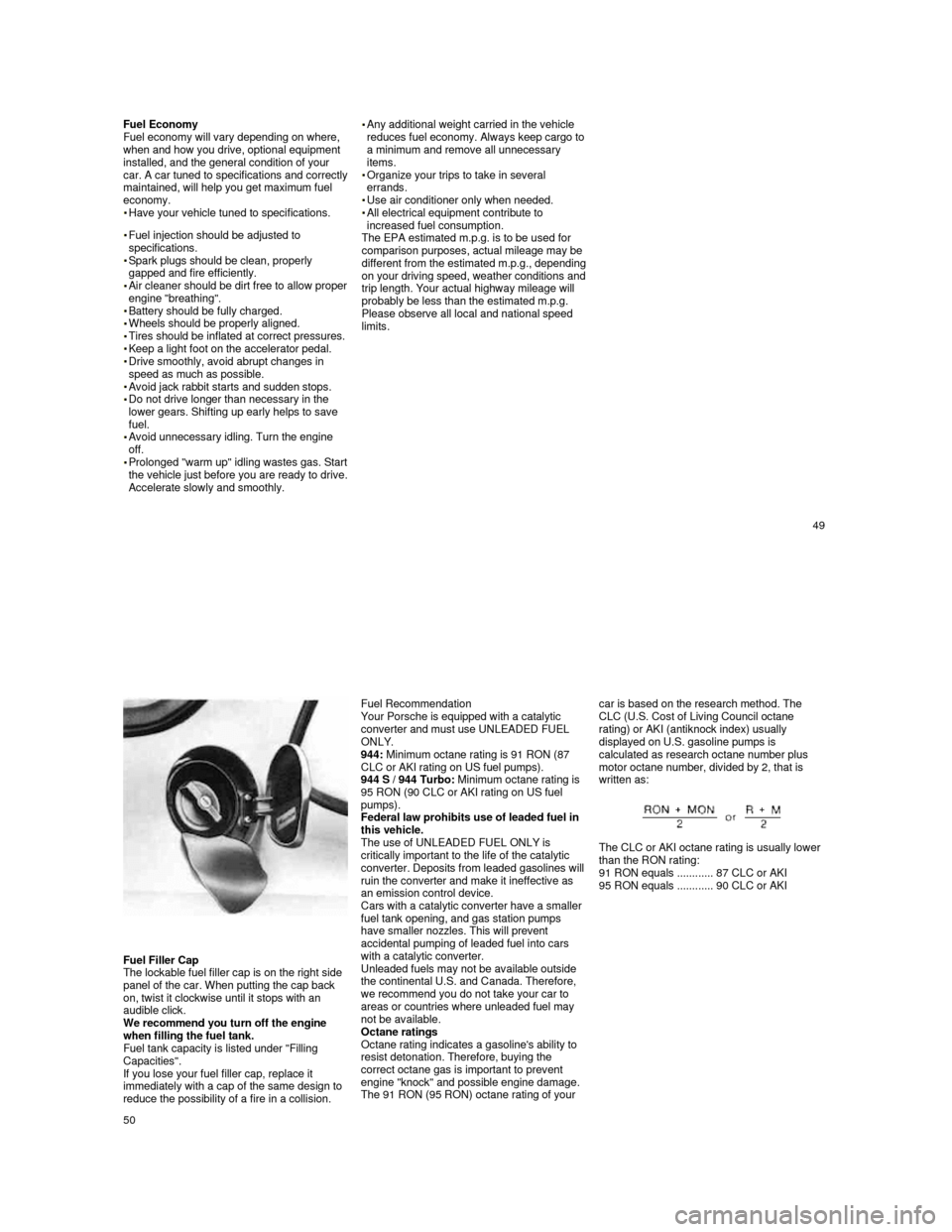
Fuel Filler Cap
The lockable fuel filler cap is on the right side
panel of the car. When putting the cap back
on, twist it clockwise until it stops with an
audible click.
We recommend you turn off the engine
when filling the fuel tank.
Fuel tank capacity is listed under "Filling
Capacities".
If you lose your fuel filler cap, replace it
immediately with a cap of the same design to
reduce the possibility of a fire in a collision.
Fuel Recommendation
Your Porsche is equipped with a catalytic
converter and must use UNLEADED FUEL
ONLY.
944:
Minimum octane rating is 91 RON (87
CLC or AKI rating on US fuel pumps).
944 S / 944 Turbo: Minimum octane rating is
95 RON (90 CLC or AKI rating on US fuel
pumps).
Federal law prohibits use of leaded fuel in
this vehicle.
The use of UNLEADED FUEL ONLY is
critically important to the life of the catalytic
converter. Deposits from leaded gasolines will ruin the converter and make it ineffective as
an emission control device.
Cars with a catalytic converter have a smaller
fuel tank opening, and gas station pumps
have smaller nozzles. This will prevent
accidental pumping of leaded fuel into cars
with a catalytic converter.
Unleaded fuels may not be available outside
the continental U.S. and Canada. Therefore,
we recommend you do not take your car to areas or countries where unleaded fuel may
not be available.
Octane ratings
Octane rating indicates a gasoline's ability to
resist detonation. Therefore, buying the
correct octane gas is important to prevent
engine "knock" and possible engine damage.
The 91 RON (95 RON) octane rating of your
car is based on the research method. The CLC (U.S. Cost of Living Council octane
rating) or AKI (antiknock index) usually
displayed on U.S. gasoline pumps is
calculated as research octane number plus
motor octane number, divided by 2, that is
written as:
The CLC or AKI octane rating is usually lower
than the RON rating:
91 RON equals ............ 87 CLC or AKI
95 RON equals ............ 90 CLC or AKI
50
Page 27 of 66
WARNING
Never carry additional fuel in portable containers in your car. Such containers,
full or partially empty, may leak, cause an
explosion, or result in fire in case of a
collision.
Porsche does not recommend the use of
fuel additives.
Do not use any fuel with octane ratings
lower than 91 RON or 87 CLC or AKI,
944S/944 Turbo 95 RON or 90 CLC or AKI.
Gasolines containing alcohol
Gasoline containing alcohol is available at gas
stations in some areas. The gas pump may not
be labeled to identify that alcohol is present in
the gasoline. If it is labeled, it may not identify
what amount and type(s) of alcohol
are used. We recommend you DO NOT use
fuels where the alcohol content cannot be
identified.
Gasolines containing methanol
DO NOT
use fuels containing methanol (methyl alcohol, wood alcohol). The use of fuel
containing this type of alcohol can result in
vehicle drivability and performance problems
and may damage critical parts of your vehicle's
fuel and emission control systems.
Gasolines containing ethanol
A mixture of unleaded gasoline and ethanol (ethyl alcohol, grain alcohol) is sold in some
areas. This mixture is sometimes called
"Gasohol".
You may use gasohol in your
Porsche, provided it contains no more than
10% ethanol, and the octane requirements for
your vehicle are met. However, we strongly
recommend to switch back to gasoline without
ethanol, if you experience any of the following
problems with your vehicle:
Deterioration of drivability and performance.
Substantially reduced fuel economy. Vapor lock and non-start problems, especially
at high altitude or at high temperatures.
Engine malfunction or stalling.
Continued use of gasohol under these
conditions may cause costly damage to the fuel system and the emission control system of your vehicle.
51
Gearshifting Manual Transmission
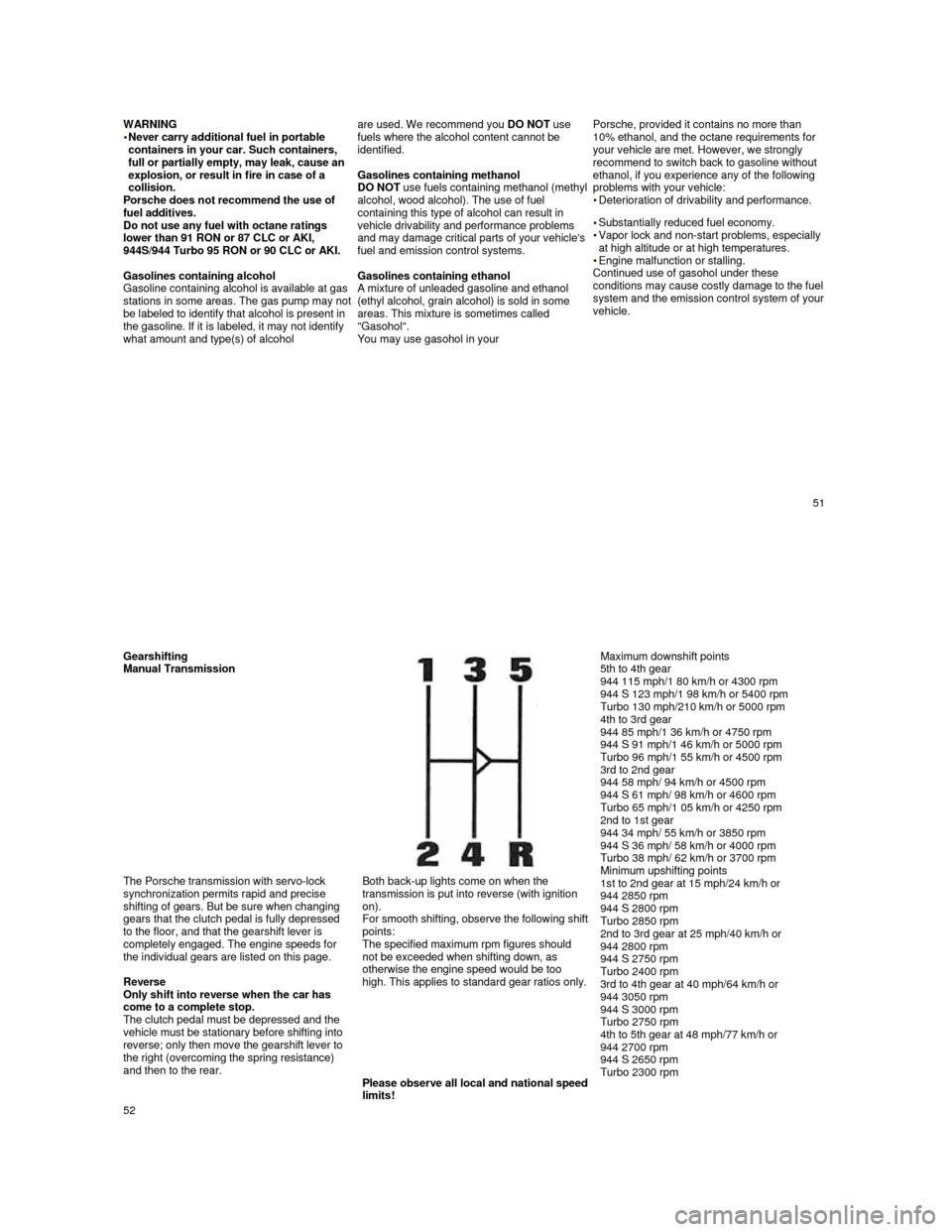
Maximum downshift points
5th to 4th gear
944 115 mph/1 80 km/h or 4300 rpm
944 S 123 mph/1 98 km/h or 5400 rpm
Turbo 130 mph/210 km/h or 5000 rpm
4th to 3rd gear
944 85 mph/1 36 km/h or 4750 rpm
944 S 91 mph/1 46 km/h or 5000 rpm
Turbo 96 mph/1 55 km/h or 4500 rpm
3rd to 2nd gear
944 58 mph/ 94 km/h or 4500 rpm
944 S 61 mph/ 98 km/h or 4600 rpm
Turbo 65 mph/1 05 km/h or 4250 rpm
2nd to 1st gear
944 34 mph/ 55 km/h or 3850 rpm
944 S 36 mph/ 58 km/h or 4000 rpm
Turbo 38 mph/ 62 km/h or 3700 rpm
Minimum upshifting points
1st to 2nd gear at 15 mph/24 km/h or
944 2850 rpm
944 S 2800 rpm
Turbo 2850 rpm
2nd to 3rd gear at 25 mph/40 km/h or
944 2800 rpm
944 S 2750 rpm
Turbo 2400 rpm
3rd to 4th gear at 40 mph/64 km/h or
944 3050 rpm
944 S 3000 rpm
Turbo 2750 rpm
4th to 5th gear at 48 mph/77 km/h or
944 2700 rpm
944 S 2650 rpm
Turbo 2300 rpm
The Porsche transmission with servo-lock
synchronization permits rapid and precise
shifting of gears. But be sure when changing
gears that the clutch pedal is fully depressed
to the floor, and that the gearshift lever is
completely engaged. The engine speeds for
the individual gears are listed on this page.
Reverse
Only shift into reverse when the car has
come to a complete stop.
The clutch pedal must be depressed and the
vehicle must be stationary before shifting into
reverse; only then move the gearshift lever to
the right (overcoming the spring resistance)
and then to the rear. Both back-up lights come on when the
transmission is put into reverse (with ignition
on).
For smooth shifting, observe the following shift points:
The specified maximum rpm figures should
not be exceeded when shifting down, as
otherwise the engine speed would be too
high. This applies to standard gear ratios only.
Please observe all local and national speed limits!
52
Page 29 of 66
Neutral
Shift to this position for standing with brakes
applied.
Never use Neutral for coasting downhill.
You may lose control over the car because of reduced braking and cause serious damage to the transmission when a driving range has to be selected. CAUTION: While driving with the automatic speed control set (at speeds above 25 mph or 40 km/h), do not bring shift lever into
the Neutral position as excessive engine
rpm and severe engine damage may result.
Maneuvering
When alternating between forward (D) and
reverse (R) (for instance, while maneuvering
the car into a tight parking space), only shift
into Reverse or Drive
when the car has come to a full stop and the engine is running at idle
speed.
Stuck in snow, mud or sand
When alternating between Drive and
Reverse in an effort to free the vehicle,
depress the accelerator pedal lightly while the
transmission is in gear, and release the
accelerator pedal while shifting. Do not race
the engine and avoid spinning the wheels.
Do not repeat "rocking" back and forth
with wheels spinning at high engine speed
and heavy throttle, as serious damage may be caused to the automatic transmission
and other critical parts.
If you cannot free the vehicle after a few
"rocking" attempts, call for help or a tow truck.
Accelerator Pedal
For good fuel economy we recommend
smooth and even acceleration. Very fast, racy
driving, alternating between full throttle and
hard braking, raises the fuel consumption
considerably. Also, tires and brake linings
wear faster. It is more economical to drive smoothly and at a fairly constant speed.
Accelerator "Kickdown"
When depressing the accelerator pedal you
will find resistance near the full throttle position. By applying greater pressure the
pedal can be pushed beyond this point to the
kick-down position. The transmission will now
shift automatically into the next lower gear to
give you maximum acceleration, and only shift up again after the engine has reached
maximum speed in that particular gear.
WARNING
Be careful when using the kickdown on
slippery roads. Rapid acceleration may
cause skidding.
Please observe the following when applying
the accelerator kickdown:
With the selector lever in D, you can apply the kickdown to make the transmission shift down into second gear when driving below 88 mph
or 140 km/h and down to first gear when
driving below 47 mph or 75 km/h.
With the selector lever in "2", you can apply
the kickdown to make the transmission shift
down into first gear when driving below 47
mph or 75 km/h.
As soon as you release the pedal from the kickdown position the next higher gear is
automatically engaged.
Please observe all local and national speed limits.
55
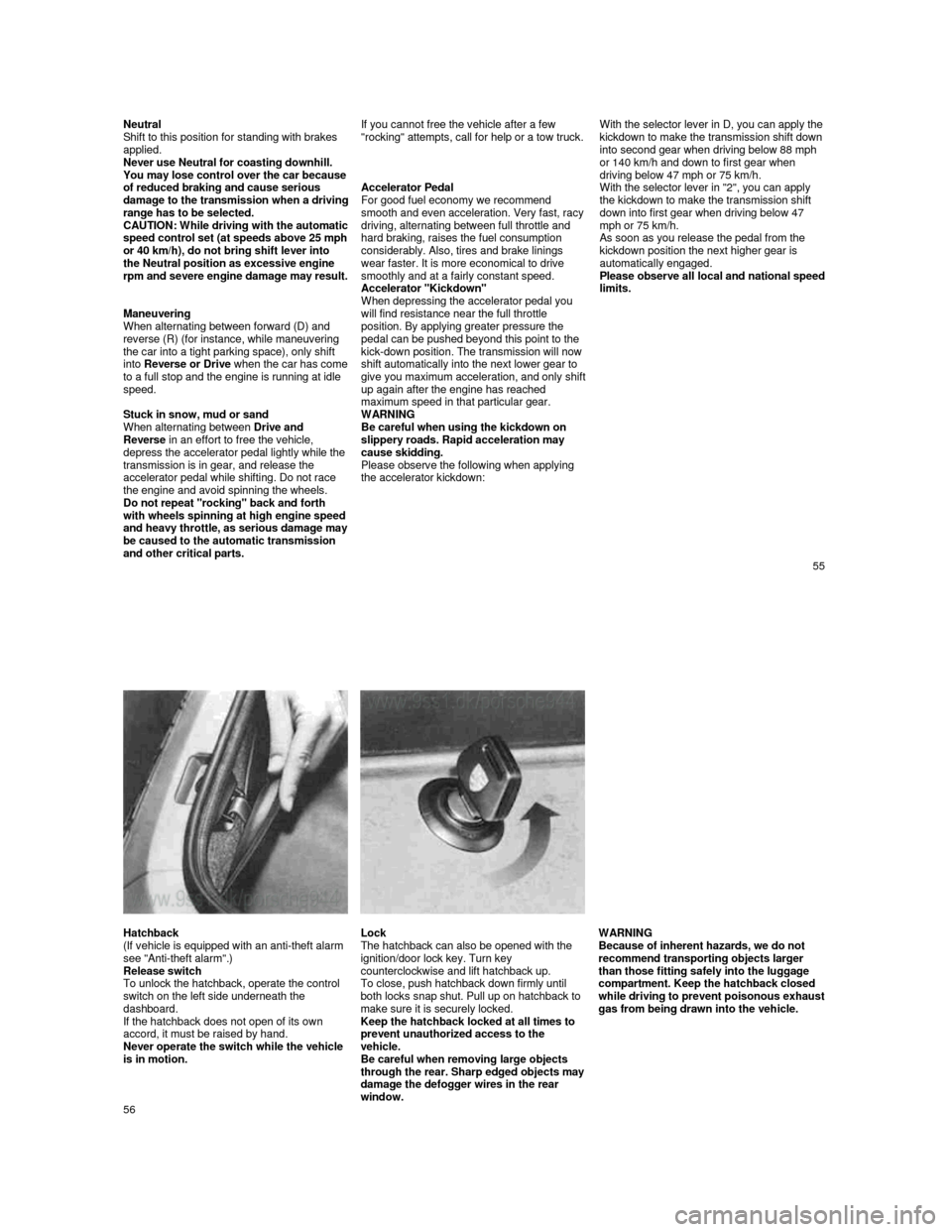
Hatchback
(If vehicle is equipped with an anti-theft alarm
see "Anti-theft alarm".)
Release switch
To unlock the hatchback, operate the control
switch on the left side underneath the
dashboard.
If the hatchback does not open of its own
accord, it must be raised by hand.
Never operate the switch while the vehicle
is in motion. Lock
The hatchback can also be opened with the
ignition/door lock key. Turn key
counterclockwise and lift hatchback up.
To close, push hatchback down firmly until
both locks snap shut. Pull up on hatchback to
make sure it is securely locked.
Keep the hatchback locked at all times to
prevent unauthorized access to the
vehicle.
Be careful when removing large objects
through th
e rear. Sharp edged objects may damage the defogger wires in the rear
window.
WARNING
Because of inherent hazards, we do not
recommend transporting objects larger
than those fitting safely into the luggage
compartment. Keep the hatchback closed
while dr
iving to prevent poisonous exhaust gas from being drawn into the vehicle.
56
Page 36 of 66
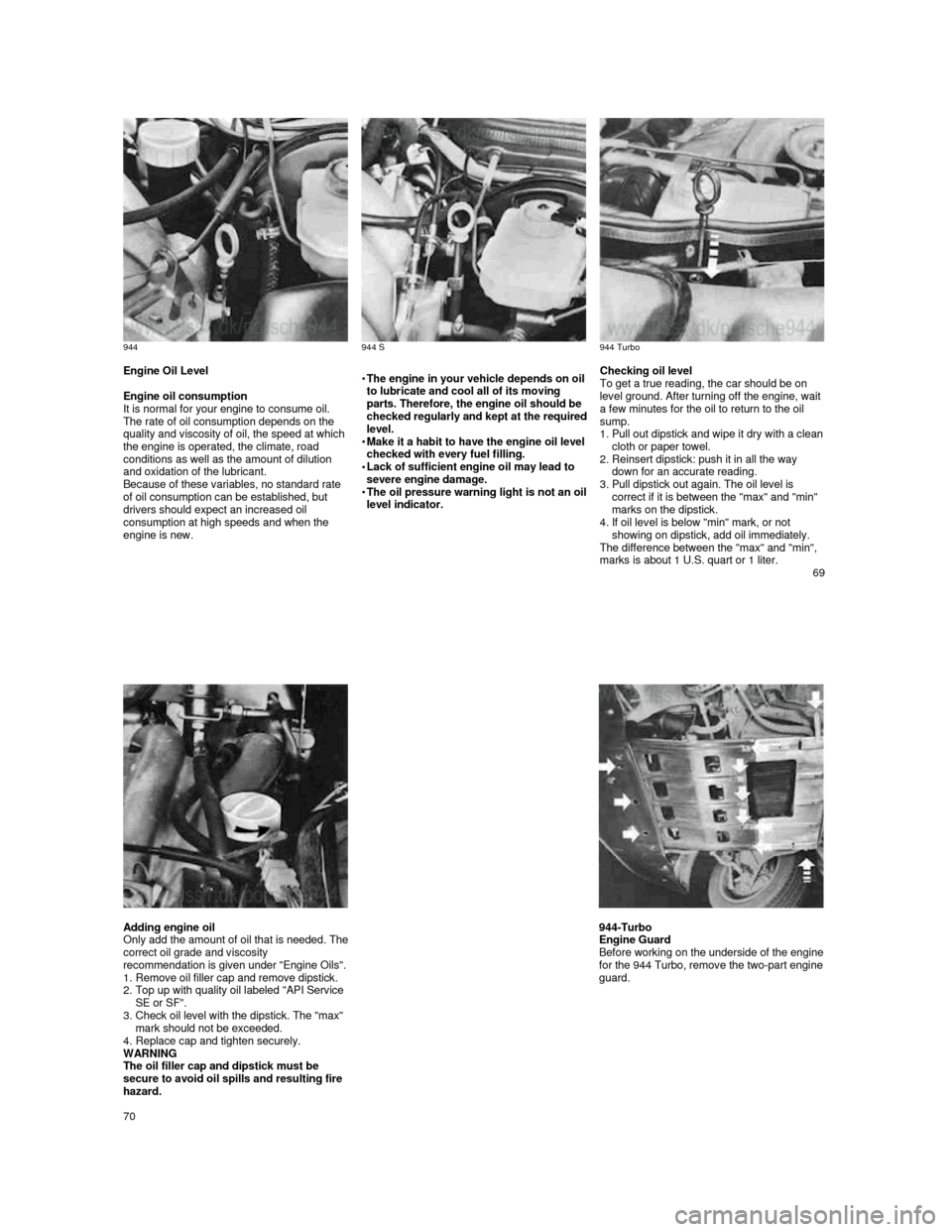
944
944 S
944 Turbo Engine Oil Level
Engine oil consumption
It is normal for your engine to consume oil.
The rate of oil consumption depends on the
quality and viscosity of oil, the speed at which
the engine is operated, the climate, road
conditions as well as the amount of dilution
and oxidation of the lubricant.
Because of these variables, no standard rate
of oil consumption can be established, but
drivers should expect an increased oil
consumption at high speeds and when the
engine is new.
The engine in your vehicle depends on oil to lubricate and cool all of its moving
parts. Therefore, the engine oil should be
checked regularly and kept at the required level.
Make it a habit to have the engine oil level checked with every fuel filling. Lack of sufficient engine oil may lead to severe engine damage. The oil pressure warning light is not an oil level indicator.
Checking oil level
To get a true reading, the car should be on
level ground. After turning off the engine, wait
a few minutes for the oil to return to the oil
sump.
1. Pull out dipstick and wip
e it dry with a clean cloth or paper towel.
2. Reinsert dipstick: push it in all the way
down for an accurate reading.
3.
Pull dipstick out again. The oil level is
correct if it is between the "max" and "min"
marks on the dipstick.
4.
If oil level is below "min" mark, or not
showing on dipstick, add oil immediately.
The difference between the "max" and "min",
marks is about 1 U.S. quart or 1 liter. 69
Adding engine oil Only add the amount of oil that is needed. The correct oil grade and viscosity
recommendation is given under "Engine Oils". 1. Remove oil filler cap and remove dipstick.
2. Top up with quality oil labeled "API Service
SE or SF".
3.
Check oil level with the dipstick. The "max"
mark should not be exceeded.
4.
Replace cap and tighten securely.
WARNING
The oil filler cap and dipstick must be
secure to avoid oil spills and resulting fire
hazard.
944-Turbo
Engine Guard
Before working on the underside of the engine for the 944 Turbo, remove the two-part engine guard.
70
Page 43 of 66
may not always be due to improper wheel
alignment. It can be the result of individual
driving habits such as cornering at high
speeds. If the tire pressure is not checked and adjusted regularly, abnormal tire wear can
also occur.
Tire care
WARNING
Avoid damaging tires and wheel rims. If you must drive over a curb or other obstacle,
drive slowly and at an obtuse angle.
Frequently check tires for uneven wear and
damage.
Remove imbedded material. Replace worn or damaged tires immediately. Replace missing valve dust caps. Keep oil, fuel, brake fluid, etc. away from
tires.
Keep tires inflated correctly.
Tire replacement
In the interest of maximum safety and best
all-around car handling, always buy
replacement tires that have the same
specifications with regard to tire size,
design, load carrying capacity, tread
pattern, tread depth etc. This also applies
to Porsche recommended alternate
replacement tires. If you do not use a
Porsche recommended replacement tire,
make sure that you purchase your new
tires from a reputable
tire specially dealer and that the dealer complies with all manufacturers warnings
for those tires.
In case of tire damage where it is uncertain
whether there is a break in the ply with all its consequences or, tire damage caused by
thermal or mechanical overloading due to a
loss of pressure or any other prior damage,
we recommend that the tire be replaced for safety reasons.
If one faulty tire on an axle is replaced it
should be noted that the difference in tread
depth on one axle must not be more than
30%.
Tire specifications are imprinted on the
sidewall of the tires. If in doubt, check with
your Porsche dealer.
When replacing tubeless tires, always install
new valve stems. When replacing tires
requiring an inner tube, always install new
tubes.
New tires do not possess maximum
traction. They tend to be slippery. Break
new tires in by driving at moderate speed
for the first 60-120 miles or 100-200
kilometers.
Wheel balancing
A wheel should always be balanced after a tire repair. Even with regular use a wheel can
get out of balance, and should therefore be
balanced from time to time. Unbalanced
wheels may affect car handling and tire life.
When balancing light alloy wheels, use only
adhesive balancing weights supplied through
the Porsche parts service.
Wheels
If you intend to use other than original
equipment wheels, be sure that they conform
to Porsche specifications for your model.
Check with your Porsche dealer regarding the
correct wheel specifications for type and
model year.
Removing and storing tires
The driving direction should be clearly marked on all tires before removing them for storage,
to make sure they are mounted and run in the
same direction as before. Store tires in a cool
and dry place. Tires without rims upright!
Avoid contact with oil, grease or gasoline. When remounting, put tires with the most
tread depth at the front.
Snow tires
For a better grip on snow and ice use radial M + S tires or snow tires with studs. Check with
your local Motor Vehicle Bureau for possible
restrictions.
Radial ply M+S tires should be inflated with
the same cold tire inflation pressures required
for the regular radial ply tires. However, do not exceed the maximum tire inflation pressure
listed on the tire sidewall.
Snow tires should have the same load
capacity as original equipment tires and
should be mounted on all four wheels. Snow
tires with studs should be run at moderate
speeds when new in order to give the studs
time to settle.
83
WARNING
Tires with badly worn treads and studs are
very dangerous. Make sure they are replaced
immediately.
Do not drive a vehicle equipped with snow
tires at prolonged high speed. Snow tires do
not have the same degree of traction on dry,
wet or snow free roads as a normal tire. Furthermore, snow tires wear rapidly under
these conditions.
Snow tires do not fulfill their purpose if the
tread depth is less than 5/32 in. / 4 mm.
Comply with all state and local laws
governing snow tire and tread depth
requirements.
Snow chains Should snow chains be necessary, they
must be mounted on the drive wheels
only.
Check with local authorities for possible
restrictions.
Use only Porsche-approved snow chains with
fine pitch links, so that enough
space remains between the chains and the inside of the wheel arches.
Drive wheels must rotate freely with chains
mounted to prevent damage to body, axle or
brake components. Follow instructions issued
by the supplier of the chains. Remove chains
as soon as roads are free of ice and snow.
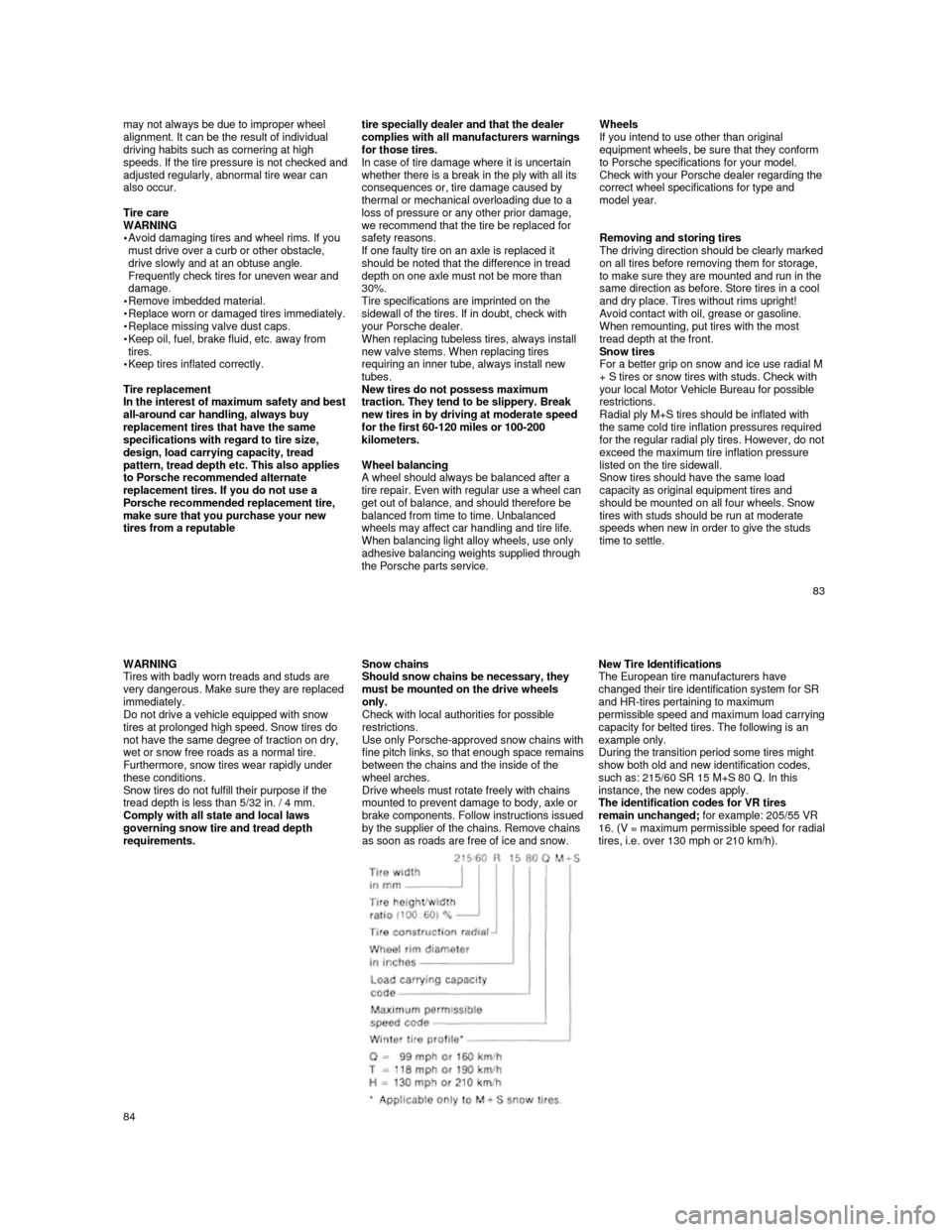
New Tire Identifications
The European tire manufacturers have
changed their tire identification system for SR
and HR-tires pertaining to maximum
permissible speed and maximum load carrying capacity for belted tires. The following is an
example only.
During the transition period some tires might
show both old and new identification codes,
such as: 215/60 SR 15 M+S 80 Q. In this
instance, the new codes apply.
The identification codes for VR tires
remain unchanged; for example: 205/55 VR
16. (V = maximum permissible speed for radial tires, i.e. over 130 mph or 210 km/h).
84
Page 45 of 66
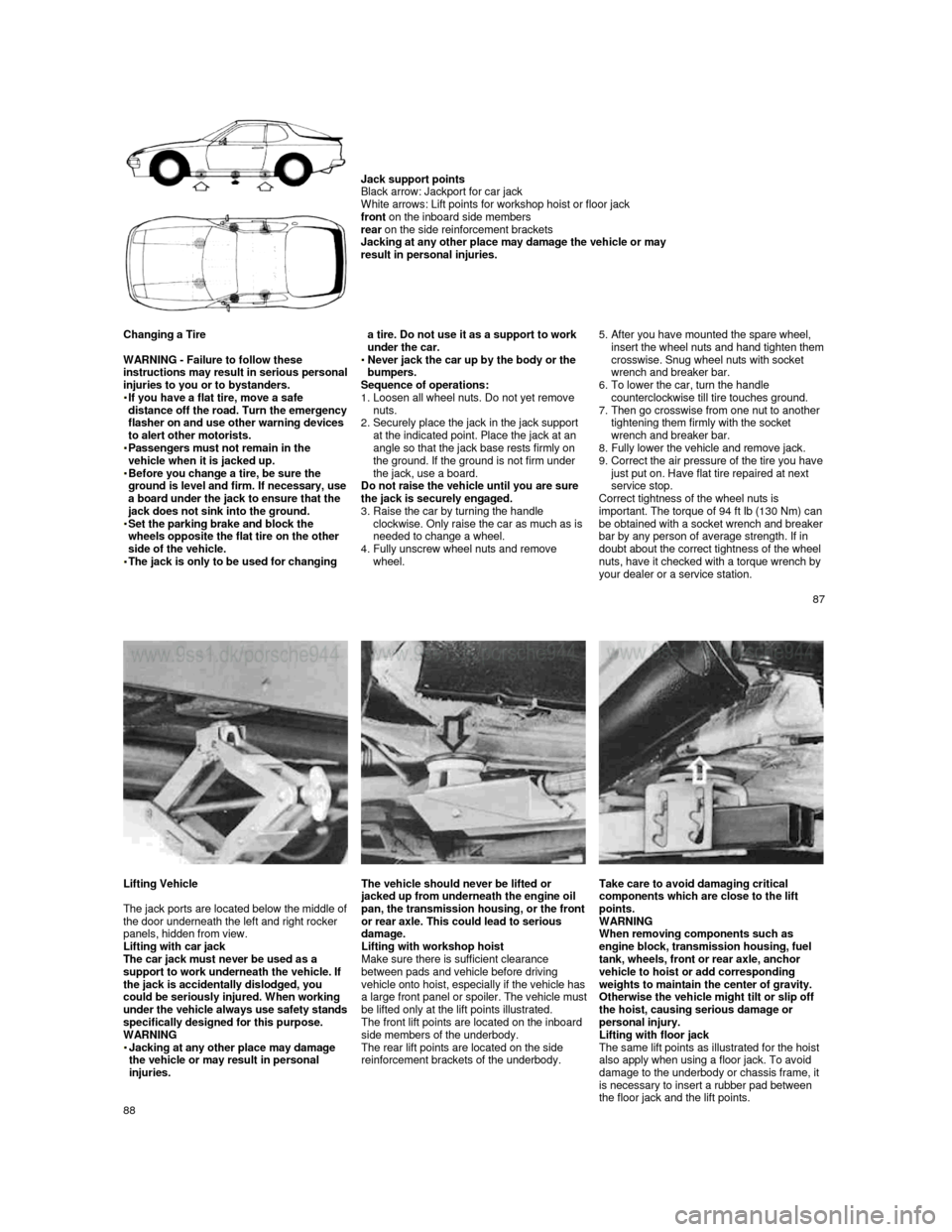
Jack support points
Black arrow: Jackport for car jack
White arrows: Lift points for workshop hoist or flo or jack
front on the inboard side members
rear on the side reinforcement brackets
Jacking at any other place may damage the vehicle o r may
result in personal injuries.
Changing a Tire
WARNING - Failure to follow these
instructions may result in serious personal injuries to you or to bystanders.
If you have a flat tire, move a safe distance off the road. Turn the emergency flasher on and use other warning devices
to alert other motorists.
Passengers must not remain in the vehicle when it is jacked up. Before you change a tire, be sure the ground is level and firm. If necessary, use a board under the jack to ensure that the jack does not sink into the ground. Set the parking brake and block the wheels opposite the flat tire on the other
side of the vehicle.
The jack is only to be used for changing
a tire. Do not use it as a support to work
under the car.
Never jack the car up by the body or the bumpers.
Sequence of operations:
1.
Loosen all wheel nuts. Do not yet remove
nuts.
2.
Securely place the jack in the jack support
at the indicated point. Place the jack at an
angle so that the jack base rests firmly on
the ground. If the ground is not firm under
the jack, use a board.
Do not raise the vehicle until you are sure
the jack is securely engaged.
3.
Raise the car by turning the handle
clockwise. Only raise the car as much as is
needed to change a wheel.
4.
Fully unscrew wheel nuts and remove wheel.
5. After you have mounted the spare wheel, insert the wheel nuts and hand tighten them crosswise. Snug wheel nuts with socket wrench and breaker bar.
6. To lower the car, turn the handle
counterclockwise till tire touches ground.
7.
Then go crosswise from one nut to another
tightening them firmly with the socket
wrench and breaker bar.
8. Fully lower the vehicle and remove jack.
9. Correct the air pressure of the tire you have just put on. Have flat tire repaired at next service stop.
Correct tightness of the wheel nuts is
important. The torque of 94 ft Ib (130 Nm) can
be obtained with a socket wrenc
h and breaker bar by any person of average strength. If in
doubt about the correct tightness of the wheel
nuts, have it checked with a torque wrench by
your dealer or a service station.
87
Lifting Vehicle
The jack ports are located below the middle of the door underneath the left and right rocker
panels, hidden from view.
Lifting with car jack
The car jack must never be used as a
support to work underneath the vehicle. If
the jack is accidentally dislodged, you
could be seriously injured. When working
under the vehicle always use safety stands specifically designed for this purpose.
WARNING
Jacking at any other place may damage the vehicle or may result in personal injuries.
The vehicle should never be lifted or jacked up from underneath the engine oil pan, the transmission housing, or the front or rear axle. This could lead to serious
damage.
Lifting with workshop hoist
Make sure there is sufficient clearance
between pads and vehicle before driving
vehicle onto hoist, especially if the vehicle
has a large front panel or spoiler. The vehicle must be lifted only at the lift points illustrated.
The front lift points are located on the inboard
side members of the underbody.
The rear lift points are located on the side
reinforcement brackets of the underbody.
Take care to avoid damaging critical
components which are close to the lift
points.
WARNING
When removing components such as
engine block, transmission housing, fuel
tank, wheels, front or rear axle, anchor
vehicle to hoist or add corresponding
weights to maintain the center of gravity.
Otherwise the vehicle might tilt or slip off
the hoist, causing serious damage or
personal injury.
Lifting with floor jack
The same lift points as illustrated for the hoist
also apply when using a floor jack. To avoid
damage to the underbody or chassis frame, it
is necessary to insert a rubber pad between
the floor jack and the lift points.
88
Page 49 of 66
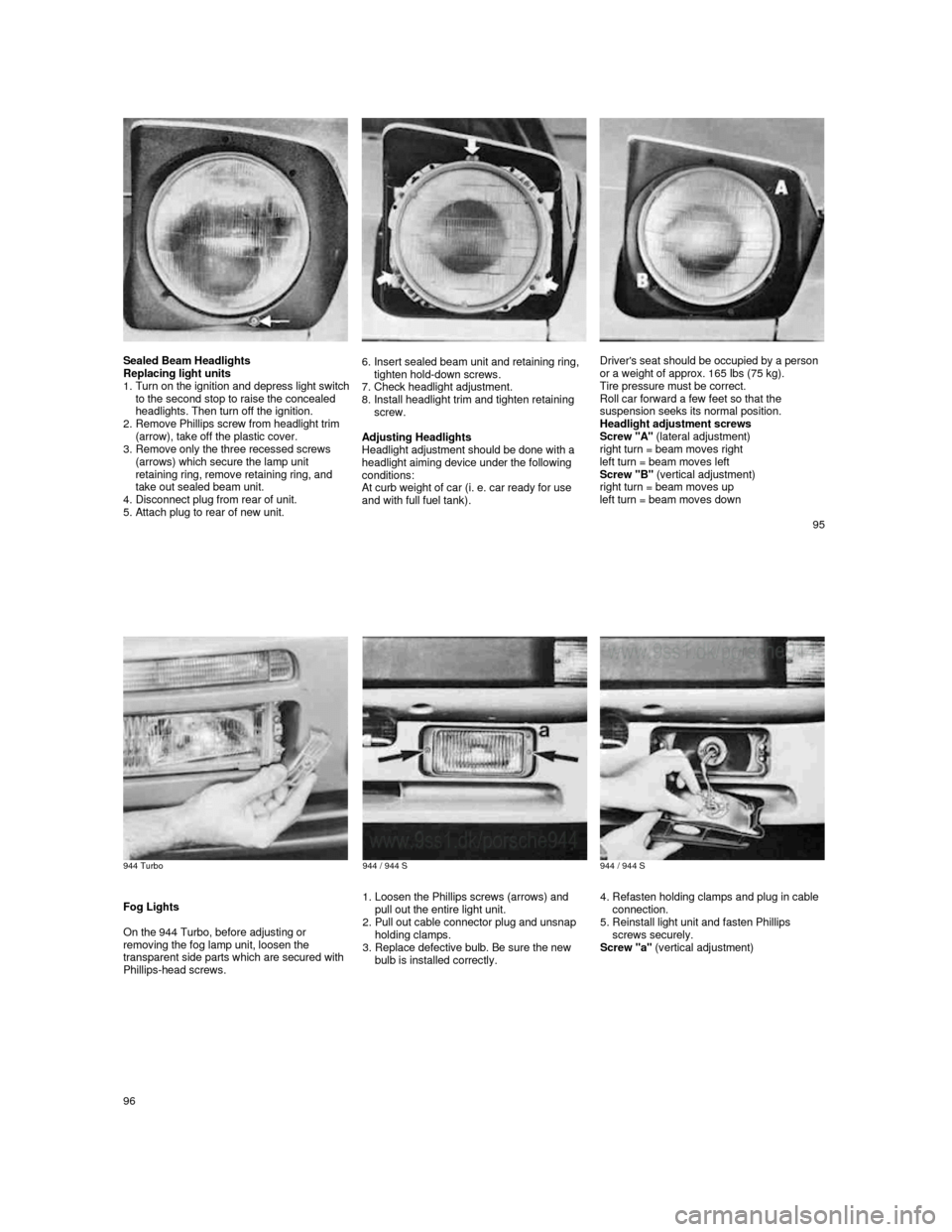
Sealed Beam Headlights
Replacing light units
1.
Turn on the ignition and depress light switch to the second stop to raise the concealed
headlights. Then turn off the ignition.
2.
Remove Phillips screw from headlight trim
(arrow), take off the plastic cover.
3.
Remove only the three recessed screws
(arrows) which secure the lamp unit
retaining ring, remove retaining ring, and
take out sealed beam unit.
4.
Disconnect plug from rear of unit.
5. Attach plug to rear of new unit.
6. Insert sealed beam unit and retaining ring,
tighten hold-down screws.
7.
Check headlight adjustment.
8. Install headlight trim and tighten retaining
screw.
Adjusting Headlights
Headlight adjustment should be done with a
headlight aiming device under the following
conditions:
At curb weight of car (i. e. car ready for use
and with full fuel tank).
Driver's seat should be occupied by a person
or a weight of approx. 165 Ibs (75 kg).
Tire pressure must be correct.
Roll car forward a few feet so that the
suspension seeks its normal position.
Headlight adjustment screws
Screw "A" (lateral adjustment)
right turn = beam moves right
left turn = beam moves left
Screw "B" (vertical adjustment)
right turn = beam moves up
left turn = beam moves down
95
944 Turbo
944 / 944 S
944 / 944 S
Fog Lights
On the 944 Turbo, before adjusting or
removing the fog lamp unit, loosen the
transparent side parts which are secured with
Phillips-head screws.
1. Loosen the Phillips screws (arrows) and
pull out the entire light unit.
2.
Pull out cable connector plug and unsnap
holding clamps.
3.
Replace defective bulb. Be sure the new
bulb is installed correctly.
4. Refasten holding clamps and plug in cable
connection.
5.
Reinstall light unit and fasten Phillips
screws securely.
Screw "a" (vertical adjustment)
96