1987 PORSCHE 944 air condition
[x] Cancel search: air conditionPage 23 of 66
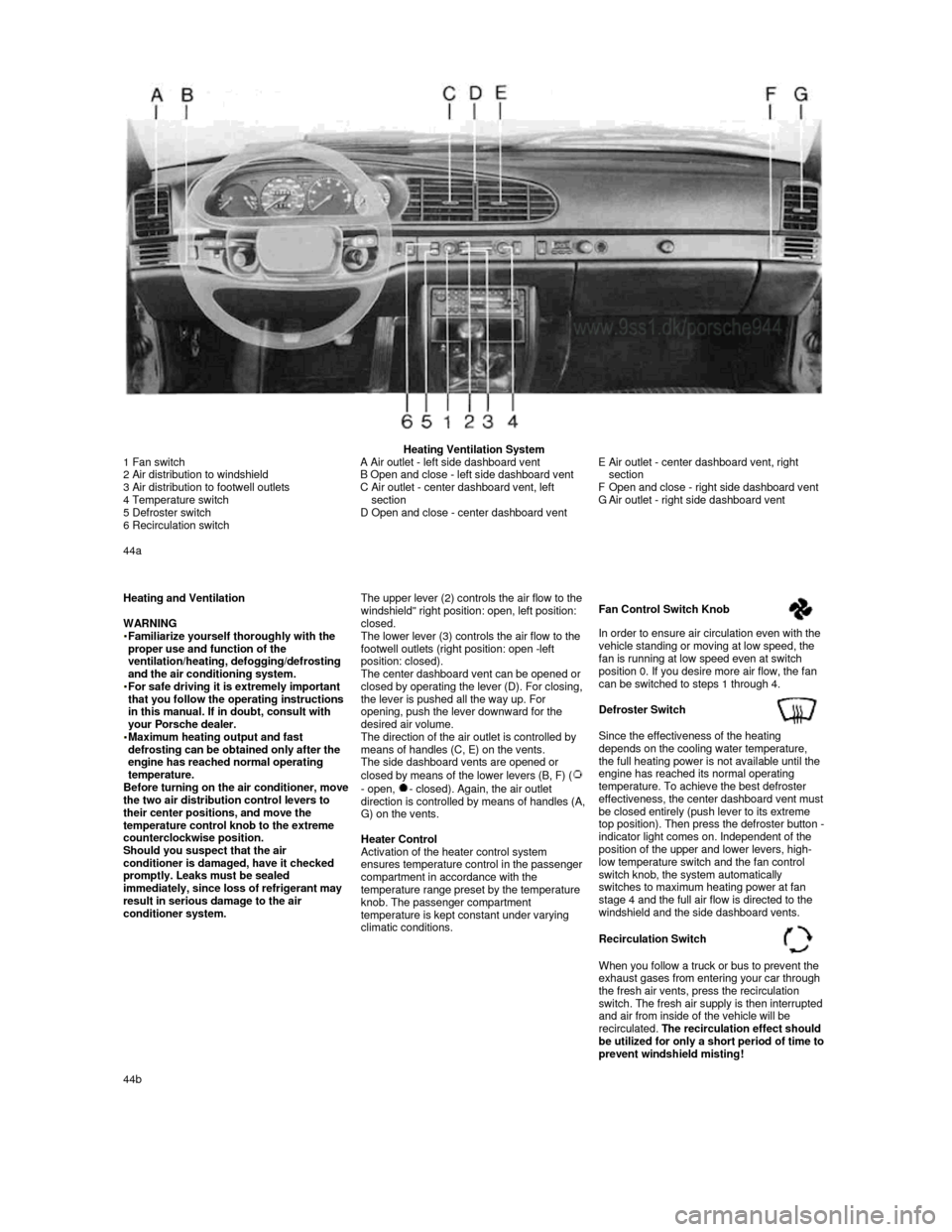
Heating Ventilation System
1 Fan switch
2 Air distribution to windshield
3 Air distribution to footwell outlets
4 Temperature switch
5 Defroster switch
6 Recirculation switch
A Air outlet - left side dashboard vent
B Open and close - left side dashboard vent
C
Air outlet - center dashboard vent, left
section
D Open and close - center dashboard vent
E Air outlet - center dashboard vent, right
section
F
Open and close - right side dashboard vent
G Air outlet - right side dashboard vent
44a
Heating and Ventilation
WARNING
Familiarize yourself thoroughly with the proper use and function of the
ventilation/heating, defogging/defrosting
and the air conditioning system.
For safe driving it is extremely important that you follow the operating instructions
in this manual. If in doubt, consult with
your Porsche dealer.
Maximum heating output and fast defrosting can be obtained only after the
engine has reached normal operating
temperature.
Before turning on the air conditioner, move the two air distribution control levers to
their center positions, and move the
temperature control knob to the extreme
counterclockwise position.
Should you suspect that the air
conditioner is damaged, have it checked
promptly. Leaks must be sealed
immediately, since loss of refrigerant may
result in serious damage to the air
conditioner system.
The upper lever (2) controls the air flow to the windshield" right position: open, left position: closed.
The lower lever (3) controls the air flow to the
footwell outlets (right position: open -left
position: closed).
The center dashboard vent can be opened or
closed by operating the lever (D). For closing,
the lever is pushed all the way up. For
opening, push the lever downward for the
desired air volume.
The direction of the air outlet is controlled by
means of handles (C, E) on the vents.
The side dashboard vents are opened or
closed by means of the lower levers (B, F) (
- open, - closed). Again, the air outlet direction is controlled by means of handles (A, G) on the vents.
Heater Control
Activation of the heater control system ensures temperature control in the passenger
compartment in accordance with the
temperature range preset by the temperature
knob. The passenger compartment
temperature is kept constant under varying
climatic conditions.
Fan Control Switch Knob
In order to ensure air circulation even with the
vehicle standing or moving at low speed, the
fan is running at low speed even at switch
position 0. If you desire more air flow, the fan
can be switched to steps 1 through 4.
Defroster Switch
Since the effectiveness of the heating
depends on the cooling water temperature,
the full heating power is not available until the
engine has reached its normal operating
temperature. To achieve the best defroster
effectiveness, the center dashboard vent must be closed entirely (push lever to its extreme
top position). Then press the defroster button - indicator light comes on. Independent of the
position of the upper and lower levers, high-
low temperature switch and the fan control
switch knob, the system automatically
switches to maximum heating power at fan
stage 4 and the full air flow is directed to the
windshield and the side dashboard vents.
Recirculation Switch
When you follow a truck or bus to prevent the
exhaust gases from entering your car through
the fresh air vents, press the recirculation
switch. The fresh air supply is then interrupted and air from inside of the vehicle will be
recirculated. The recirculation effect should
be utilized for only a short period of time to prevent windshield misting! 44b
Page 24 of 66
Automatically Controlled
Air Conditioner
The air conditioning system works only when
the engine is running. Its refrigerating capacity depends on engine speed. If a high
refrigerating capacity is desired, it is
necessary to rev up the engine -
particularly in city or bumper-to-bumper traffic.
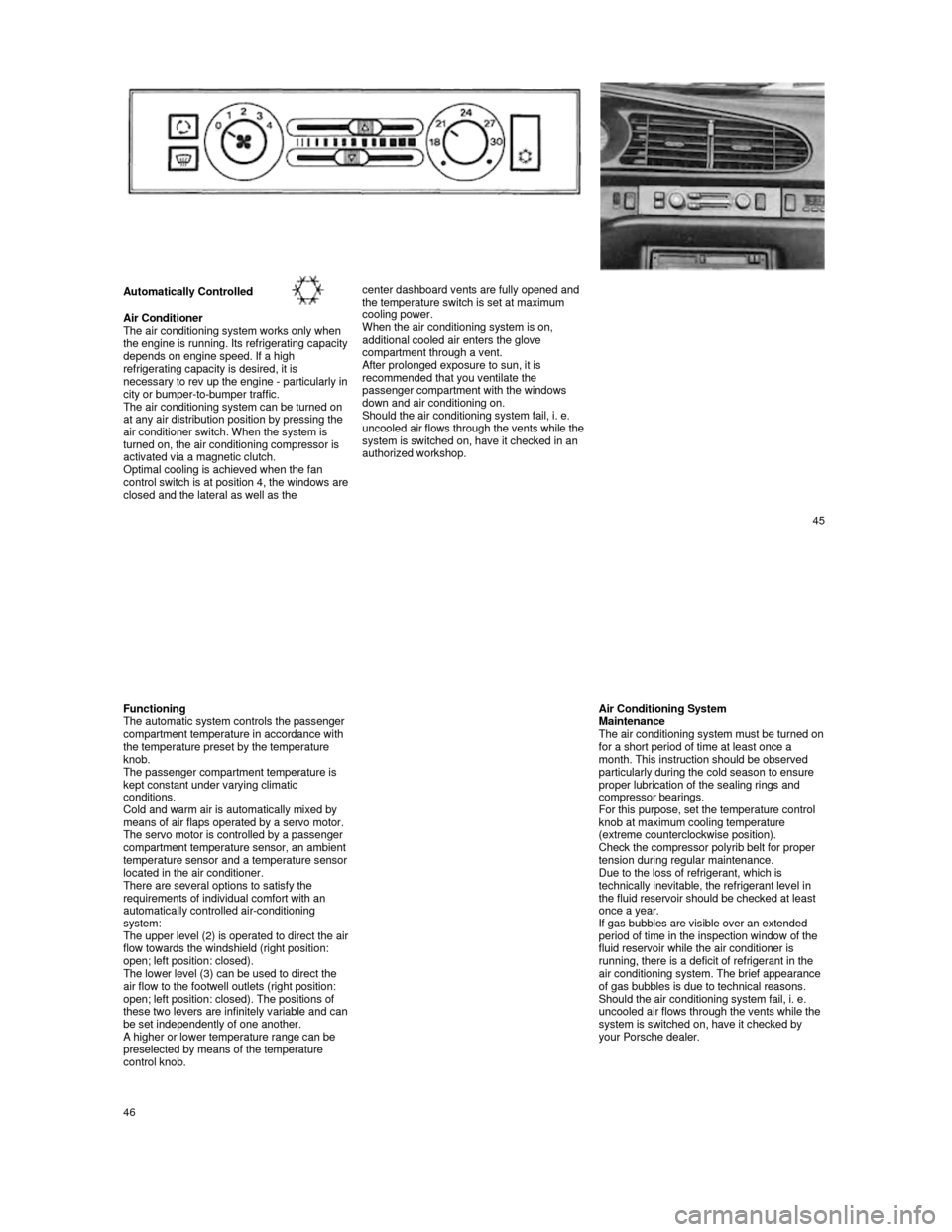
The air conditioning system can be turned on
at any air distribution position by pressing the
air conditioner switch. When the system is
turned on, the air conditioning compressor is
activated via a magnetic clutch.
Optimal cooling is achieved when the fan
control switch is at position 4, the windows are closed and the lateral as well as the
center dashboard vents are fully opened and
the temperature switch is set at maximum
cooling power.
When the air conditioning system is on,
additional cooled air enters the glove
compartment through a vent.
After prolonged exposure to sun, it is recommended that you ventilate the
passenger compartment with the windows
down and air conditioning on.
Should the air conditioning system fail, i. e.
uncooled air flows through the vents while the
system is switched on, have it checked in an
authorized workshop.
45
Functioning
The automatic system controls the passenger
compartment temperature in accordance with
the temperature preset by the temperature
knob.
The passenger compartment temperature is
kept constant under varying climatic
conditions.
Cold and warm air is automatically mixed by
means of air flaps operated by a servo motor.
The servo motor is controlled by a passenger
compartment temperature sensor, an ambient
temperature sensor and a temperature sensor located in the air conditioner.
There are several options to satisfy the
requirements of individual comfort with an
automatically controlled air-conditioning
system:
The upper level (2) is operated to direct the air flow towards the windshield (right position:
open; left position: closed).
The lower level (3) can be used to direct the
air flow to the footwell outlets (right position:
open; left position: closed). The positions of
these two levers are infinitely variable and can be set independently of one another. A higher or lower temperature range can be preselected by means of the temperature
control knob.
Air Conditioning System Maintenance The air conditioning system must be turned on for a short period of time at least once a
month. This instruction should be observed
particularly during the cold season to ensure
proper lubrication of the sealing rings and
compressor bearings.
For this purpose, set the temperature control
knob at maximum cooling temperature
(extreme counterclockwise position).
Check the compressor polyrib belt for proper
tension during regular maintenance.
Due to the loss of refrigerant, which is
technically inevitable, the refrigerant level in
the fluid reservoir should be checked at least
once a year.
If gas bubbles are visible over an extended
period of time in the inspection window of the
fluid reservoir while the air conditioner is
running, there is a deficit of refrigerant in the
air conditioning system. The brief appearance
of gas bubbles is due to technical reasons.
Should the air conditioning system fail, i. e.
uncooled air flows through the vents while the
system is switched on, have it checked by
your Porsche dealer.
46
Page 26 of 66
Fuel Economy
Fuel economy will vary depending on where,
when and how you drive, optional equipment installed, and the general condition of your
car. A car tuned to specifications and correctly maintained, will help you get maximum fuel
economy.
Have your vehicle tuned to specifications.
Fuel injection should be adjusted to
specifications.
Spark plugs should be clean, properly
gapped and fire efficiently.
Air cleaner should be dirt free to allow proper engine "breathing". Battery should be fully charged. Wheels should be properly aligned. Tires should be inflated at correct pressures. Keep a light foot on the accelerator pedal. Drive smoothly, avoid abrupt changes in
speed as much as possible.
Avoid jack rabbit starts and sudden stops. Do not drive longer than necessary in the
lower gears. Shifting up early helps to save
fuel.
Avoid unnecessary idling. Turn the engine
off.
Prolonged "warm up" idling wastes gas. Start the vehicle just before you are ready to drive. Accelerate slowly and smoothly.
Any additional weight carried in the vehicle reduces fuel economy. Always keep cargo to
a minimum and remove all unnecessary
items.
Organize your trips to take in several
errands.
Use air conditioner only when needed. All electrical equipment contribute to increased fuel consumption.
The EPA estimated m.p.g. is to be used for
comparison purposes, actual mileage may be
different from the estimated m.p.g., depending on your driving speed, weather conditions and trip length. Your actual highway mileage will
probably be less than the estimated m.p.g.
Please observe all local and national speed
limits.
49
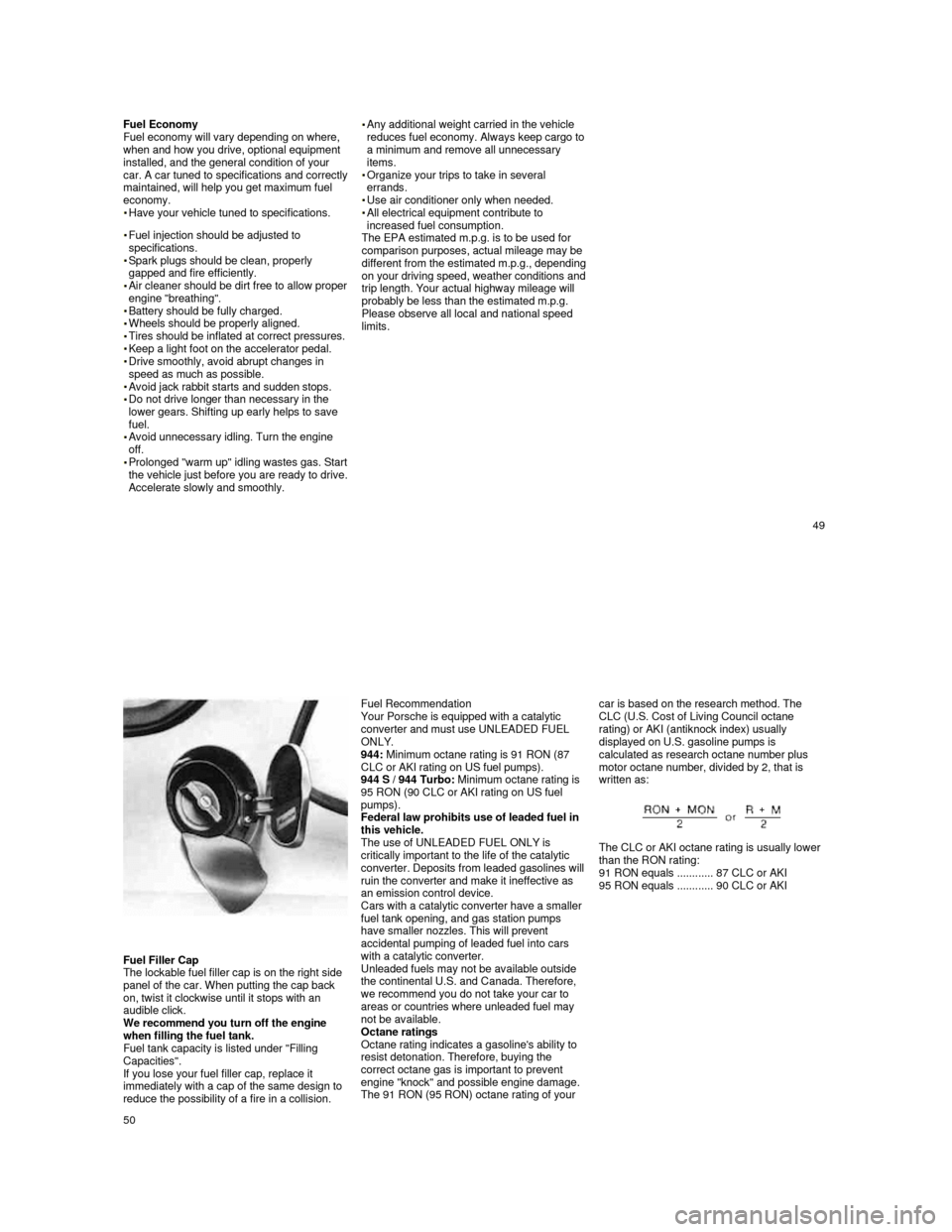
Fuel Filler Cap
The lockable fuel filler cap is on the right side
panel of the car. When putting the cap back
on, twist it clockwise until it stops with an
audible click.
We recommend you turn off the engine
when filling the fuel tank.
Fuel tank capacity is listed under "Filling
Capacities".
If you lose your fuel filler cap, replace it
immediately with a cap of the same design to
reduce the possibility of a fire in a collision.
Fuel Recommendation
Your Porsche is equipped with a catalytic
converter and must use UNLEADED FUEL
ONLY.
944:
Minimum octane rating is 91 RON (87
CLC or AKI rating on US fuel pumps).
944 S / 944 Turbo: Minimum octane rating is
95 RON (90 CLC or AKI rating on US fuel
pumps).
Federal law prohibits use of leaded fuel in
this vehicle.
The use of UNLEADED FUEL ONLY is
critically important to the life of the catalytic
converter. Deposits from leaded gasolines will ruin the converter and make it ineffective as
an emission control device.
Cars with a catalytic converter have a smaller
fuel tank opening, and gas station pumps
have smaller nozzles. This will prevent
accidental pumping of leaded fuel into cars
with a catalytic converter.
Unleaded fuels may not be available outside
the continental U.S. and Canada. Therefore,
we recommend you do not take your car to areas or countries where unleaded fuel may
not be available.
Octane ratings
Octane rating indicates a gasoline's ability to
resist detonation. Therefore, buying the
correct octane gas is important to prevent
engine "knock" and possible engine damage.
The 91 RON (95 RON) octane rating of your
car is based on the research method. The CLC (U.S. Cost of Living Council octane
rating) or AKI (antiknock index) usually
displayed on U.S. gasoline pumps is
calculated as research octane number plus
motor octane number, divided by 2, that is
written as:
The CLC or AKI octane rating is usually lower
than the RON rating:
91 RON equals ............ 87 CLC or AKI
95 RON equals ............ 90 CLC or AKI
50
Page 32 of 66

Car Care Instructions
Regular and correct care helps to maintain the value of your car and is also a
precondition for the long-life guarantee.
The Porsche paint finish is of a high quality
baked synthetic enamel. The color and
enamel type designation are indicated on the
"paint number sticker". When buying touch-up
paint, always give the paint and the car's
identification numbers to your dealer.
A well-cared for Porsche can look like new 10
years later. It all depends on the amount of
care the owner is willing to give the car.
Your Porsche dealer has a number of car-
care products and can advise you which ones to
use for cleaning the interior and exterior of
your car. Whether you use Porsche
recommended products or other commercially available cleaning agents first make sure of
their correct application.
WARNING
Cleaning agents may be poisonous. Keep
them out of the reach of children.
Observe all caution labels. Always read directions on the container before using any product. Most chemical cleaners are concentrates which require dilution. Do not use gasoline, kerosene, naphtha, nail
polish remover or other volatile cleaning
fluids. They may be toxic, flammable or
hazardous in other ways. Only use spot
removing fluids in well ventilated areas.
Do not wash, wax or dry the vehicle with the
engine running.
Do not clean the underside of chassis,
fenders, wheel covers, etc., without
protecting your hands and arms you may cut
yourself on sharp-edged metal parts.
Moisture and road salt on brakes may affect braking efficiency. Test the brakes after each vehicle washing.
Washing and waxing
The paint on your Porsche is very durable but
must be protected from losing its luster due to
outside influences. Therefore, wash and wax
your Porsche often. The longer the dirt is left
on the paint, the greater the risk of damaging
the glossy finish, either by scratching if the dirt is rubbed into the paint, or simply by the
chemical effect dirt particles have on the paint
surface. Do not wash or wax in direct
sunlight. Do not use hot water. Lukewarm
to cool water is kinder to the paint.
Pamper your Porsche! Wash it by hand! The
mechanical brushes in an Automatic Car
Wash may not reach every angle of the
vehicle, and some tracks may cause
damage to the underbody.
Use plenty of water, a car-wash and wax
solution and a soft sponge or hose brush.
Begin by spaying water over the dry surface to remove all loose dirt before applying the car-wash and wax solution. Use plenty of water to
rinse the vehicle off. Wipe everything dry with
a chamois to avoid water spots.
61
To guard against corrosion from the inside
out, clean drain holes on the bottom of doors,
tail gates, hatches etc., after each washing.
Then wipe dry thoroughly. Also inspect all
weatherstrips to make sure they do not allow water to enter the body panels. Do not aim the water jet directly at door, hatch or rear lid locks. Tape the key holes to prevent water from seeping into the lock cylinders.
Water in lock cylinders should be removed
with compressed air. To prevent locks from freezing in the winter, squirt glycerin or lock
deicer into the lock cylinders.
Do not use any solution that can damage
the body paint.
The underside of the vehicle picks up dirt and
road salts used to keep streets and highways
free of snow and ice. To guard against
corrosion, it is important to remove mud,
debris and road salt from the underside with a
powerful jet of water. Be sure to include the
wheel housings, bumpers, muffler, tailpipe
and brackets. This should be done twice a
year and is best accomplished after the
vehicle has been driven through a heavy rain.
Let engine and exhaust system cool down
before washing.
Waxing is not really needed when you have
used a car-wash and wax solution. If you do
not use a car-wash liquid with wax, apply wax
to preserve the natural shine of the body
paint. To obtain a long lasting finish, apply
hard wax. Wax again if water remains on the
surface in large patches instead of forming
beads and rolling off.
Exterior
Care of the finish
Oils contained in the paint are the most
important ingredients contributing to the
elasticity of the finish. Because these oils
diminish gradually due to weather and similar
causes, they must be replenished through
regular and proper care of the finish. Given
proper care, the original finish will retain its
luster for many years. Ask your dealer for
approved cleaning agents and preservatives.
The use of polishes is recommended only
after it becomes evident that the normal
preservatives no longer accomplish the job.
Dull finishes and plastics
Plastic parts, such as light bulb lenses,
decorative strips, panels, etc., will come clean
during car washing. Should additional
cleaning or spot removal be necessary, use a
soft brush or cloth soaked with a mild
detergent solution. Then rinse thoroughly and
immediately with clear water. Do not use
anything which could mar the plastic or dull
finished surface, such as wax or polish,
abrasive detergents or chemical cleaning
solvents.
Metal trim
Bright or black anodized trim will come clean
when you wash the vehicle. To protect the trim, use car wax.
Touch-up paint
Your dealer has touch-up paint for minor
scratches and stone chips. Scratches should
be touched up soon after they occur, to
prevent corrosion. If corrosion formation
becomes visible, however, a simple touch-up
job will not suffice. The affected surface must
be smoothed with sand paper and covered
with an anti-rust primer, before restoring the
painted finish.
62
Page 41 of 66
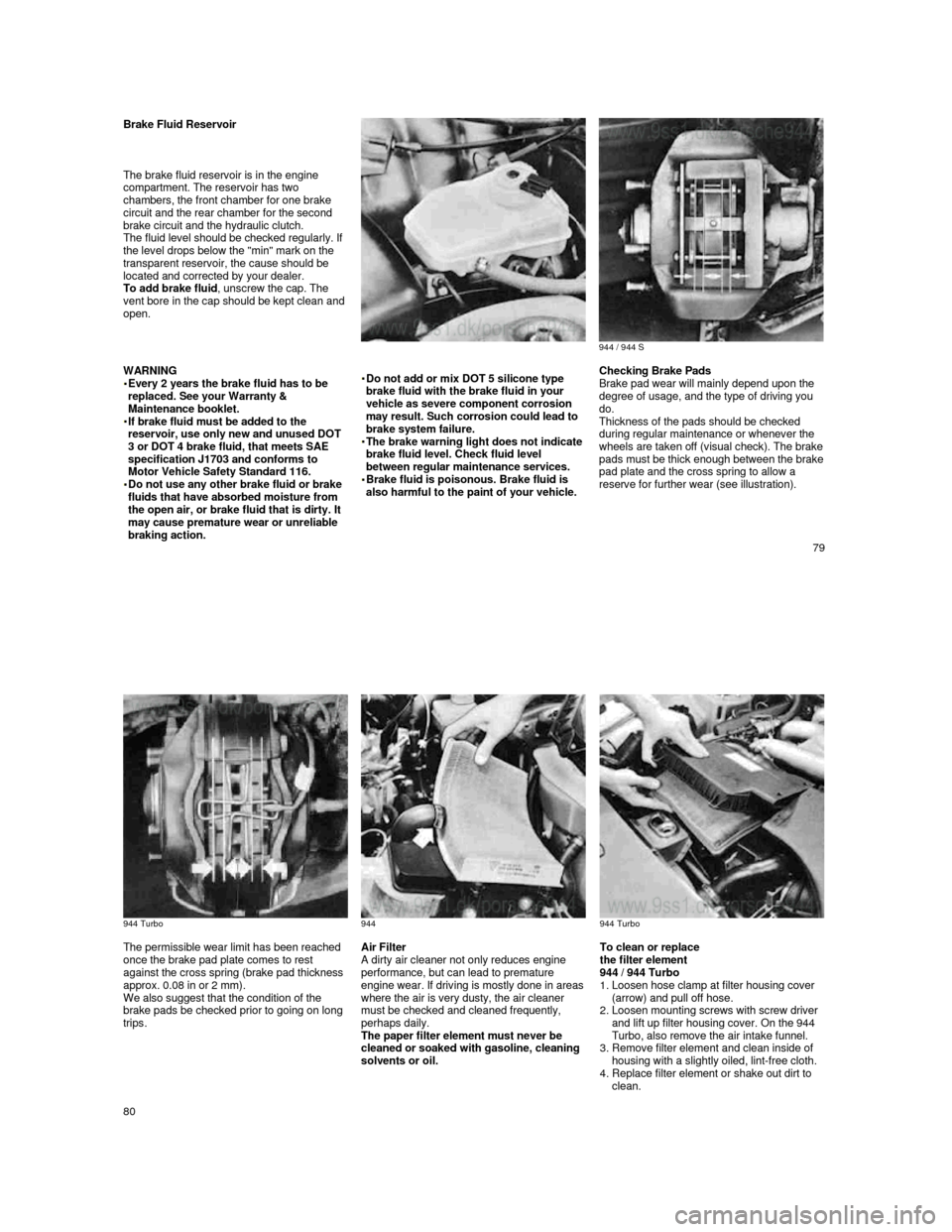
Brake Fluid Reservoir
The brake fluid reservoir is in the engine
compartment. The reservoir has two
chambers, the front chamber for one brake
circuit and the rear chamber for the second
brake circuit and the hydraulic clutch.
The fluid level should be checked regularly. If
the level drops below the "min" mark on the
transparent reservoir, the cause should be
located and corrected by your dealer.
To add brake fluid , unscrew the cap. The
vent bore in the cap should be kept clean and
open.
944 / 944 S WARNING
Every 2 years the brake fluid has to be replaced. See your Warranty &
Maintenance booklet.
If brake fluid must be added to the reservoir, use only new and unused DOT
3 or DOT 4 brake fluid, that meets SAE
specification J1703 and conforms to
Motor Vehicle Safety Standard 116.
Do not use any other brake fluid or brake fluids that have absorbed moisture from
the open air, or brake fluid that is dirty. It
may cause premature wear or unreliable
braking action.
Do not add or mix DOT 5 silicone type brake fluid with the brake fluid in your
vehicle as severe component corrosion
may result. Such corrosion could lead to
brake system failure.
The brake warning light does not indicate brake fluid level. Check fluid level
between regular maintenance services.
Brake fluid is poisonous. Brake fluid is also harmful to the paint of your vehicle.
Checking Brake Pads
Brake pad wear will mainly depend upon the
degree of usage, and the type of driving you
do.
Thickness of the pads should be checked
during regular maintenance or whenever the
wheels are taken off (visual check). The brake pads must be thick enough between the brake pad plate and the cross spring to allow a
reserve for further wear (see illustration).
79
944 Turbo
944
944 Turbo
The permissible wear limit has been reached
once the brake pad plate comes to rest
against the cross spring (brake pad thickness
approx. 0.08 in or 2 mm).
We also suggest that the condition of the
brake pads be checked prior to going on long
trips. Air Filter
A dirty air cleaner not only reduces engine performance, but can lead to premature
engine wear. If driving is mostly done in areas
where the air is very dusty, the air cleaner must be checked and cleaned frequently,
perhaps daily.
The paper filter element must never be
cleaned or soaked with gasoline, cleaning
solvents or oil.
To clean or replace
the filter element
944 / 944 Turbo
1. Loosen hose clamp at filter housing cover (arrow) and pull off hose.
2.
Loosen mounting screws with screw driver
and lift up filter housing cover. On the 944
Turbo, also remove the air intake funnel.
3.
Remove filter element and clean inside of
housing with a slightly oiled, lint-free cloth.
4.
Replace filter element or shake out dirt to
clean.
80
Page 42 of 66
944
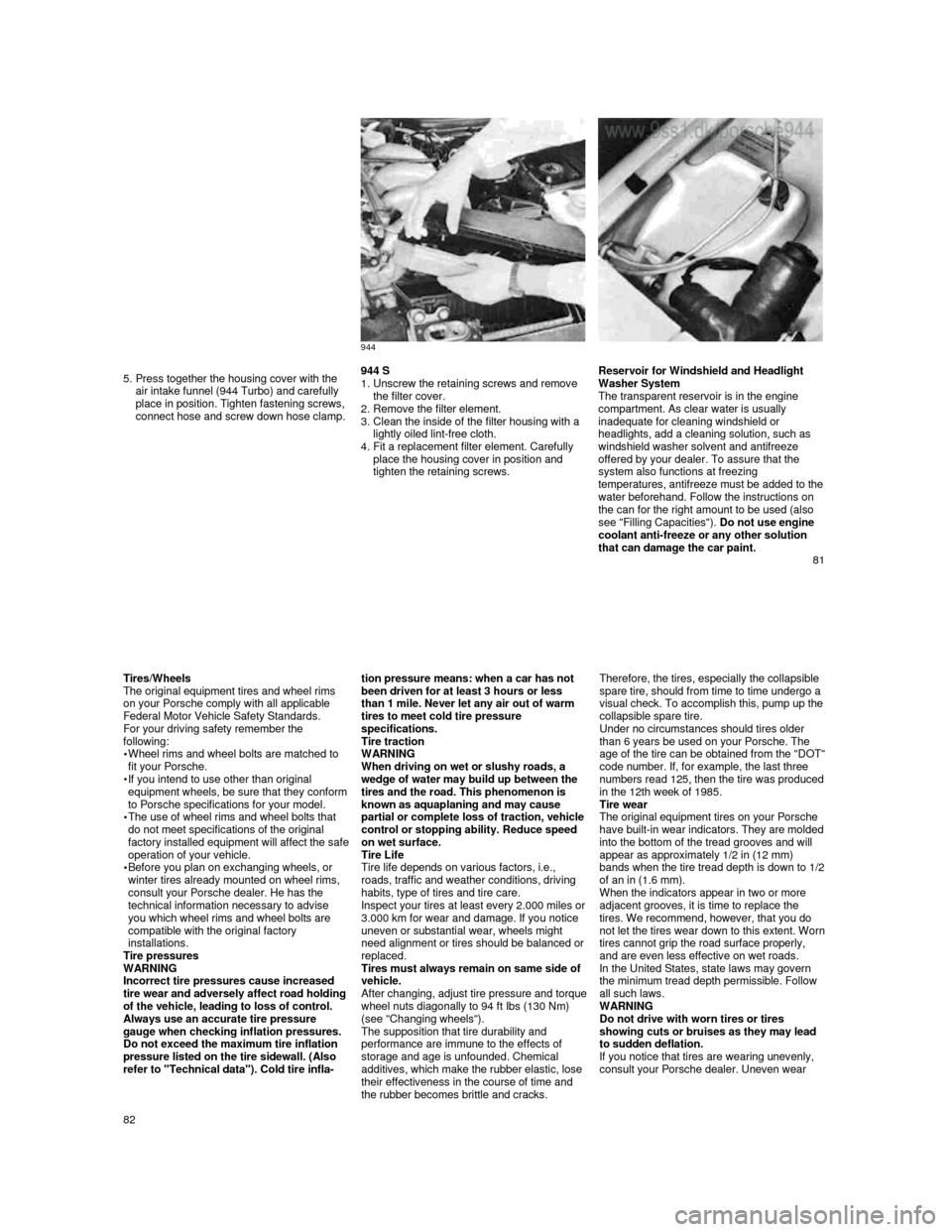
5. Press together the housing cover with the air intake funnel (944 Turbo) and carefully
place in position. Tighten fastening screws,
connect hose and screw down hose clamp.
944 S
1. Unscrew the retaining screws and remove
the filter cover.
2.
Remove the filter element.
3. Clean the inside of the filter housing with a
lightly oiled lint-free cloth.
4.
Fit a replacement filter element. Carefully
place the housing cover in position and
tighten the retaining screws.
Reservoir for Windshield and Headlight
Washer System
The transparent reservoir is in the engine
compartment. As clear water is usually
inadequate for cleaning windshield or
headlights, add a cleaning solution, such as
windshield washer solvent and antifreeze offered by your dealer. To assure that the
system also functions at freezing
temperatures, antifreeze must be added to the water beforehand. Follow the instructions on the can for the right amount to be used (also
see "Filling Capacities"). Do not use engine
coolant anti-freeze or any other solution
that can damage the car paint.
81
Tires/Wheels
The original equipment tires and wheel rims
on your Porsche comply with all applicable
Federal Motor Vehicle Safety Standards.
For your driving safety remember the
following:
Wheel rims and wheel bolts are matched to
fit your Porsche.
If you intend to use other than original equipment wheels, be sure that they conform to Porsche specifications for your model. The use of wheel rims and wheel bolts that
do not meet specifications of the original
factory installed equipment will affect the safe operation of your vehicle. Before you plan on exchanging wheels, or winter tires already mounted on wheel rims, consult your Porsche dealer. He has the
technical information necessary to advise
you which wheel rims and wheel bolts are
compatible with the original factory
installations.
Tire pressures
WARNING
Incorrect tire pressures cause increased
tire wear and adversely affect road holding of the vehicle, leading to loss of control.
Always use an accurate tire pressure
gauge when checking inflation pressures.
Do not exceed the maximum tire inflation
pressure listed on the tire sidewall. (Also
refer to "Technical data"). Cold tire infla-
tion pressure means: when a car has not been driven for at least 3 hours or less
than 1 mile. Never let any air out of warm
tires to meet cold tire pressure
specifications.
Tire traction
WARNING
When driving on wet or slushy roads, a
wedge of water may build up between the
tires and the road. This phenomenon is
known as aquaplaning and may cause
partial or com
plete loss of traction, vehicle control or stopping ability. Reduce speed
on wet surface.
Tire Life
Tire life depends on various factors, i.e.,
roads, traffic and weather conditions, driving
habits, type of tires and tire care.
Inspect your tires at least
every 2.000 miles or 3.000 km for wear and damage. If you notice
uneven or substantial wear, wheels might
need alignment or tires should be balanced or
replaced.
Tires must always remain on same side of
vehicle.
After changing, adjust tire pressure and torque wheel nuts diagonally to 94 ft Ibs (130 Nm) (see "Changing wheels").
The supposition that tire durability and
performance are immune to the effects of
storage and age is unfounded. Chemical
additives, which make the rubber elastic, lose
their effectiveness in the course of time and
the rubber becomes brittle and cracks.
Therefore, the tires, especially the collapsible
spare tire, should from time to time undergo a
visual check. To accomplish this,
pump up the collapsible spare tire.
Under no circumstances should tires older
than 6 years be used on your Porsche. The
age of the tire can be obtained from the "DOT" code number. If, for example, the last three
numbers read 125, then the tire was produced in the 12th week of 1985.
Tire wear
The original equipment tires on your Porsche
have built-
in wear indicators. They are molded into the bottom of the tread grooves and will
appear as approximately 1/2 in (12 mm)
bands when the tire tread depth is down to
1/2 of an in (1.6 mm).
When the indicators appear in two or more
adjacent grooves, it is time to replace the
tires. We recommend, however, that you do
not let the tires wear down to this extent. Worn tires cannot grip the road surface properly,
and are even less effective on wet roads.
In the United States, state laws may govern
the minimum tread depth permissible. Follow
all such laws.
WARNING
Do not drive with worn tires or tires
showing cuts or bruises as they may lead
to sudden deflation.
If you notice that tires are wearing unevenly,
consult your Porsche dealer. Uneven wear
82
Page 43 of 66
may not always be due to improper wheel
alignment. It can be the result of individual
driving habits such as cornering at high
speeds. If the tire pressure is not checked and adjusted regularly, abnormal tire wear can
also occur.
Tire care
WARNING
Avoid damaging tires and wheel rims. If you must drive over a curb or other obstacle,
drive slowly and at an obtuse angle.
Frequently check tires for uneven wear and
damage.
Remove imbedded material. Replace worn or damaged tires immediately. Replace missing valve dust caps. Keep oil, fuel, brake fluid, etc. away from
tires.
Keep tires inflated correctly.
Tire replacement
In the interest of maximum safety and best
all-around car handling, always buy
replacement tires that have the same
specifications with regard to tire size,
design, load carrying capacity, tread
pattern, tread depth etc. This also applies
to Porsche recommended alternate
replacement tires. If you do not use a
Porsche recommended replacement tire,
make sure that you purchase your new
tires from a reputable
tire specially dealer and that the dealer complies with all manufacturers warnings
for those tires.
In case of tire damage where it is uncertain
whether there is a break in the ply with all its consequences or, tire damage caused by
thermal or mechanical overloading due to a
loss of pressure or any other prior damage,
we recommend that the tire be replaced for safety reasons.
If one faulty tire on an axle is replaced it
should be noted that the difference in tread
depth on one axle must not be more than
30%.
Tire specifications are imprinted on the
sidewall of the tires. If in doubt, check with
your Porsche dealer.
When replacing tubeless tires, always install
new valve stems. When replacing tires
requiring an inner tube, always install new
tubes.
New tires do not possess maximum
traction. They tend to be slippery. Break
new tires in by driving at moderate speed
for the first 60-120 miles or 100-200
kilometers.
Wheel balancing
A wheel should always be balanced after a tire repair. Even with regular use a wheel can
get out of balance, and should therefore be
balanced from time to time. Unbalanced
wheels may affect car handling and tire life.
When balancing light alloy wheels, use only
adhesive balancing weights supplied through
the Porsche parts service.
Wheels
If you intend to use other than original
equipment wheels, be sure that they conform
to Porsche specifications for your model.
Check with your Porsche dealer regarding the
correct wheel specifications for type and
model year.
Removing and storing tires
The driving direction should be clearly marked on all tires before removing them for storage,
to make sure they are mounted and run in the
same direction as before. Store tires in a cool
and dry place. Tires without rims upright!
Avoid contact with oil, grease or gasoline. When remounting, put tires with the most
tread depth at the front.
Snow tires
For a better grip on snow and ice use radial M + S tires or snow tires with studs. Check with
your local Motor Vehicle Bureau for possible
restrictions.
Radial ply M+S tires should be inflated with
the same cold tire inflation pressures required
for the regular radial ply tires. However, do not exceed the maximum tire inflation pressure
listed on the tire sidewall.
Snow tires should have the same load
capacity as original equipment tires and
should be mounted on all four wheels. Snow
tires with studs should be run at moderate
speeds when new in order to give the studs
time to settle.
83
WARNING
Tires with badly worn treads and studs are
very dangerous. Make sure they are replaced
immediately.
Do not drive a vehicle equipped with snow
tires at prolonged high speed. Snow tires do
not have the same degree of traction on dry,
wet or snow free roads as a normal tire. Furthermore, snow tires wear rapidly under
these conditions.
Snow tires do not fulfill their purpose if the
tread depth is less than 5/32 in. / 4 mm.
Comply with all state and local laws
governing snow tire and tread depth
requirements.
Snow chains Should snow chains be necessary, they
must be mounted on the drive wheels
only.
Check with local authorities for possible
restrictions.
Use only Porsche-approved snow chains with
fine pitch links, so that enough
space remains between the chains and the inside of the wheel arches.
Drive wheels must rotate freely with chains
mounted to prevent damage to body, axle or
brake components. Follow instructions issued
by the supplier of the chains. Remove chains
as soon as roads are free of ice and snow.
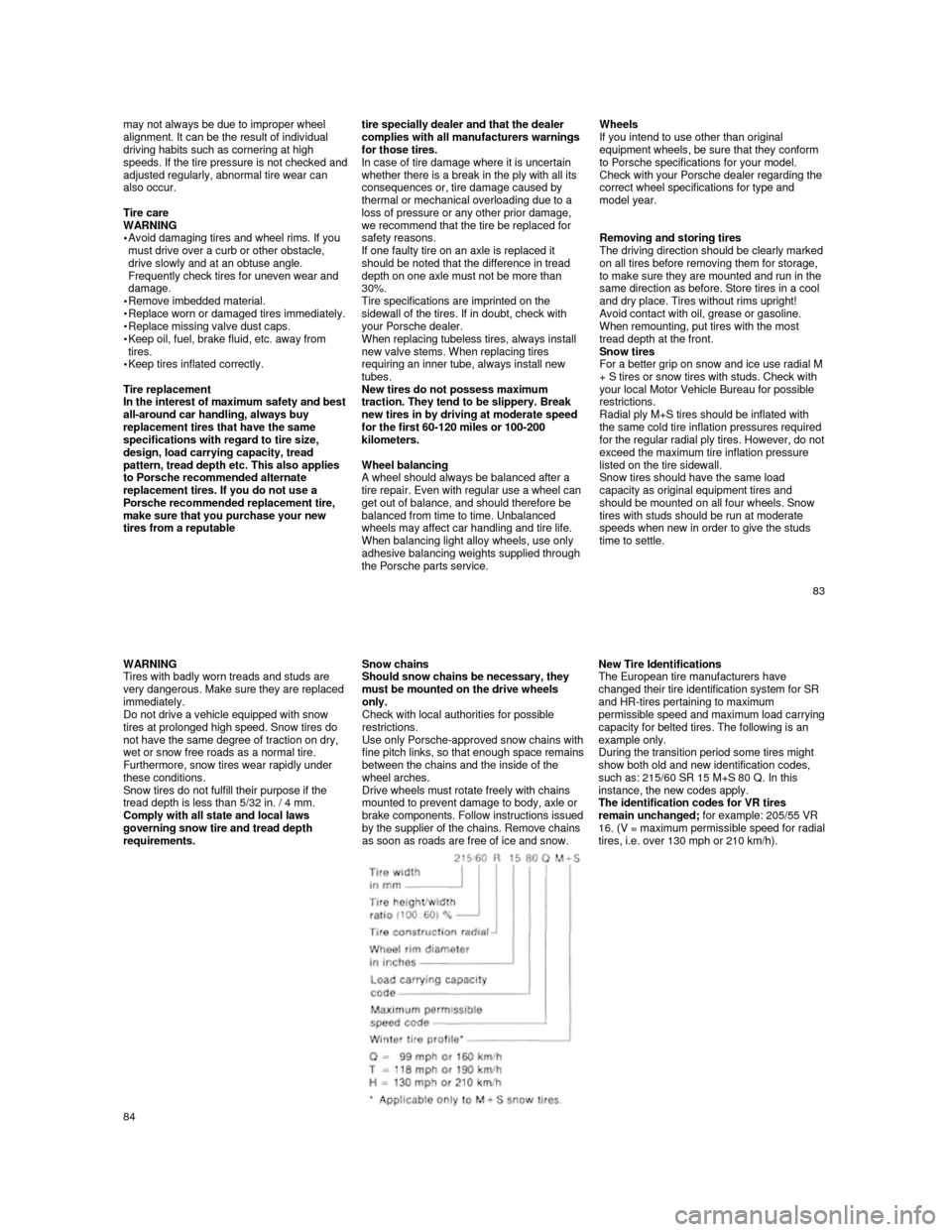
New Tire Identifications
The European tire manufacturers have
changed their tire identification system for SR
and HR-tires pertaining to maximum
permissible speed and maximum load carrying capacity for belted tires. The following is an
example only.
During the transition period some tires might
show both old and new identification codes,
such as: 215/60 SR 15 M+S 80 Q. In this
instance, the new codes apply.
The identification codes for VR tires
remain unchanged; for example: 205/55 VR
16. (V = maximum permissible speed for radial tires, i.e. over 130 mph or 210 km/h).
84
Page 51 of 66
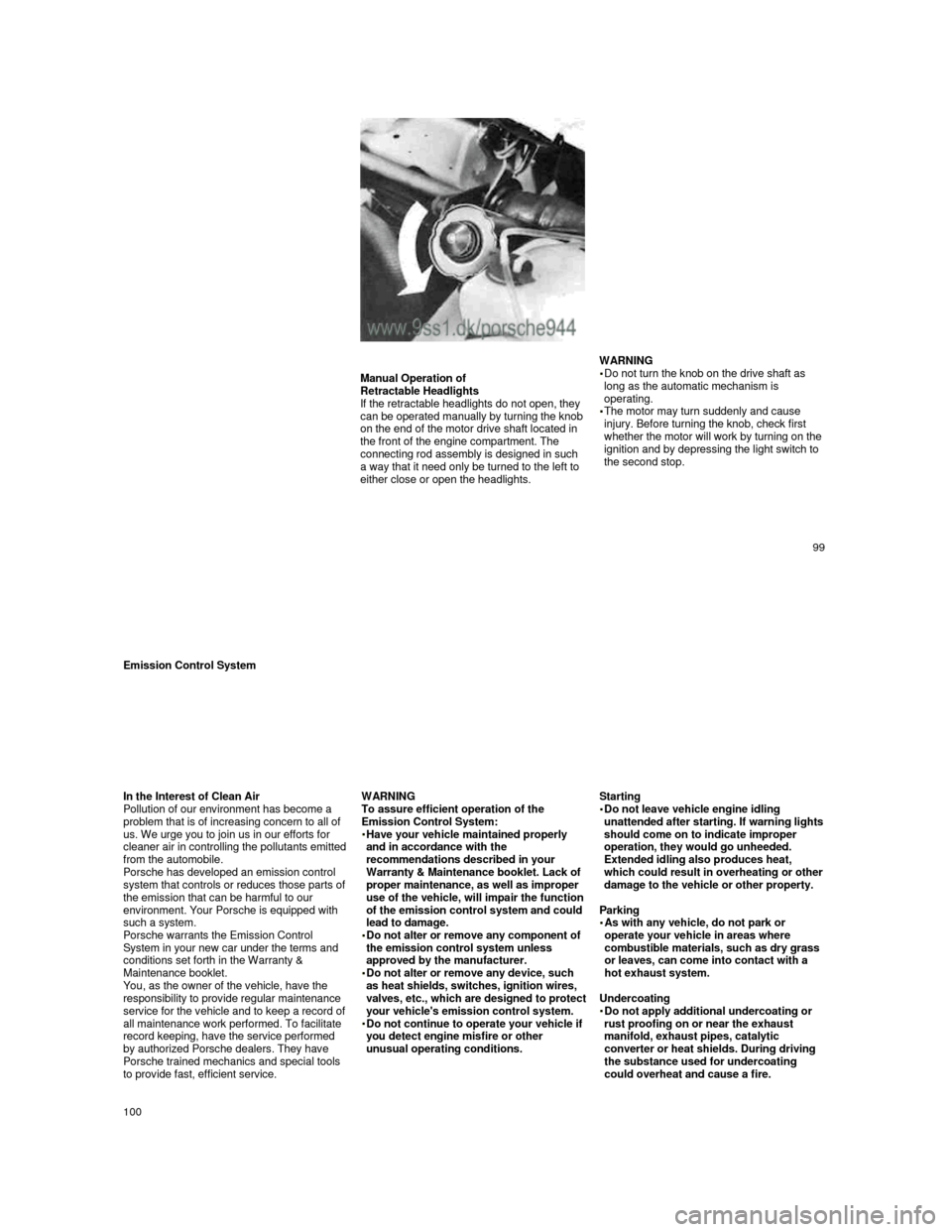
Manual Operation of
Retractable Headlights
If the retractable headlights do not open, they
can be operated manually by turning the knob
on the end of the motor drive shaft located in
the front of the engine compartment. The
connecting rod assembly is designed in such
a way that it need only be turned to the left to
either close or open the headlights.
WARNING
Do not turn the knob on the drive shaft as
long as the automatic mechanism is
operating.
The motor may turn suddenly and cause
injury. Before turning the knob, check first
whether the motor will work by turning on the ignition and by depressing the light switch to
the second stop.
99
Emission Control System
In the Interest of Clean Air
Pollution of our environment has become a
problem that is of increasing concern to all of
us. We urge you to join us in our efforts for
cleaner air in controlling the pollutants emitted from the automobile.
Porsche has developed an emission control
system that controls or reduces those parts of
the emission that can be harmful to our
environment. Your Porsche is equipped with
such a system.
Porsche warrants the Emission Control
System in your new car under the terms and
conditions set forth in the Warranty &
Maintenance booklet.
You, as the owner of the vehicle, have the
responsibility to provide regular maintenance
service for the vehicle and to keep a record of
all maintenance work performed. To facilitate
record keeping, have the service performed
by authorized Porsche dealers. They have
Porsche trained mechanics and special tools
to provide fast, efficient service.
WARNING To assure efficient operation of the
Emission Control System:
Have your vehicle maintained properly and in accordance with the
recommendations described in your
Warranty & Maintenance booklet. Lack of
proper maintenance, as well as improper
use of the vehicle, will impair the function
of the emission control system and could
lead to damage.
Do not alter or remove any component of the emission control system unless
approved by the manufacturer.
Do not alter or remove any device, such as heat shields, switches, ignition wires, valves, etc., which are designed to protect your vehicle's emission control system. Do not continue to operate your vehicle if you detect engine misfire or other
unusual operating conditions.
Starting
Do not leave vehicle engine idling unattended after starting. If warning lights should come on to indicate improper
operation, they would go unheeded.
Extended idling also produces heat,
which could result in overheating or other damage to the vehicle or other property.
Parking
As with any vehicle, do not park or operate your vehicle in areas where
combustible materials, such as dry grass
or leaves, can come into contact with a
hot exhaust system.
Undercoating
Do not apply additional undercoating or rust proofing on or near the exhaust
manifold, exhaust pipes, catalytic
converter or heat shields. During driving
the substance used for undercoating
could overheat and cause a fire.
100