1987 PORSCHE 944 Fan
[x] Cancel search: FanPage 35 of 66
Exercise Extreme Caution when Working under the
Engine Hood
The engine compartment of any motor vehicle is a potentially hazardous area. If you are not
fully familiar with proper repair procedures, do
not attempt the adjustments described on the
following pages. This caution applies to the
entire vehicle.
Only work on your vehicle outdoors or in a well ventilated area. Ensure that there are no open flames in the
area of your vehicles at any time when
gasoline fumes might be present. Be
especially cautious of such devices such as
hot water heaters which ignite a flame
intermittently.
Before working on any part in the engine
compartment, turn the engine off and let it
cool down sufficiently. Hot engine
compartment components can burn skin on
contact.
Even after the engine has stopped the
radiator fan may continue running until the
temperature of the coolant has dropped to a
certain level. Therefore, never touch the fan
blades as they will rotate spontaneously
when the thermostat turns the fan on, even with ignition off. Be alert and cautious around engine at all
times while the engine is running.
If work has to be done with the engine
running, always set the parking brake, and
make sure the shift lever is in either Neutral
or Park.
Exercise extreme caution to prevent
neckties, jewelry or long hair from getting
caught in the fan blades, the drive belts, or
any other moving engine parts.
Your Porsche is equipped with a
transistorized ignition system with
breakerless distributor. When the ignition is
on, high voltage is present in all wires
connected with the ignition system; therefore
exercise extreme caution when working on
any part of the engine while the ignition is on
or the engine is running.
Always support your car with safety stands if it is necessary to work underneath the car.
The jack supplied with the car is not
adequate for this purpose.
When working underneath the car without
safety stands but with the wheels on the
ground, make sure the car is on level ground, that the wheels are blocked, and that the
engine cannot be started. REMOVE THE
IGNITION KEY.
Do not smoke or allow an open flame around the battery or gasoline. Keep a fire extinguisher in close reach.
Incomplete or improper servicing may cause
problems in the operation of the car. If in
doubt about any servicing, have it done by
your authorized Porsche dealer or any other
properly equipped and qualified workshop.
Improper maintenance during the warranty
period may affect your warranty coverage.
67
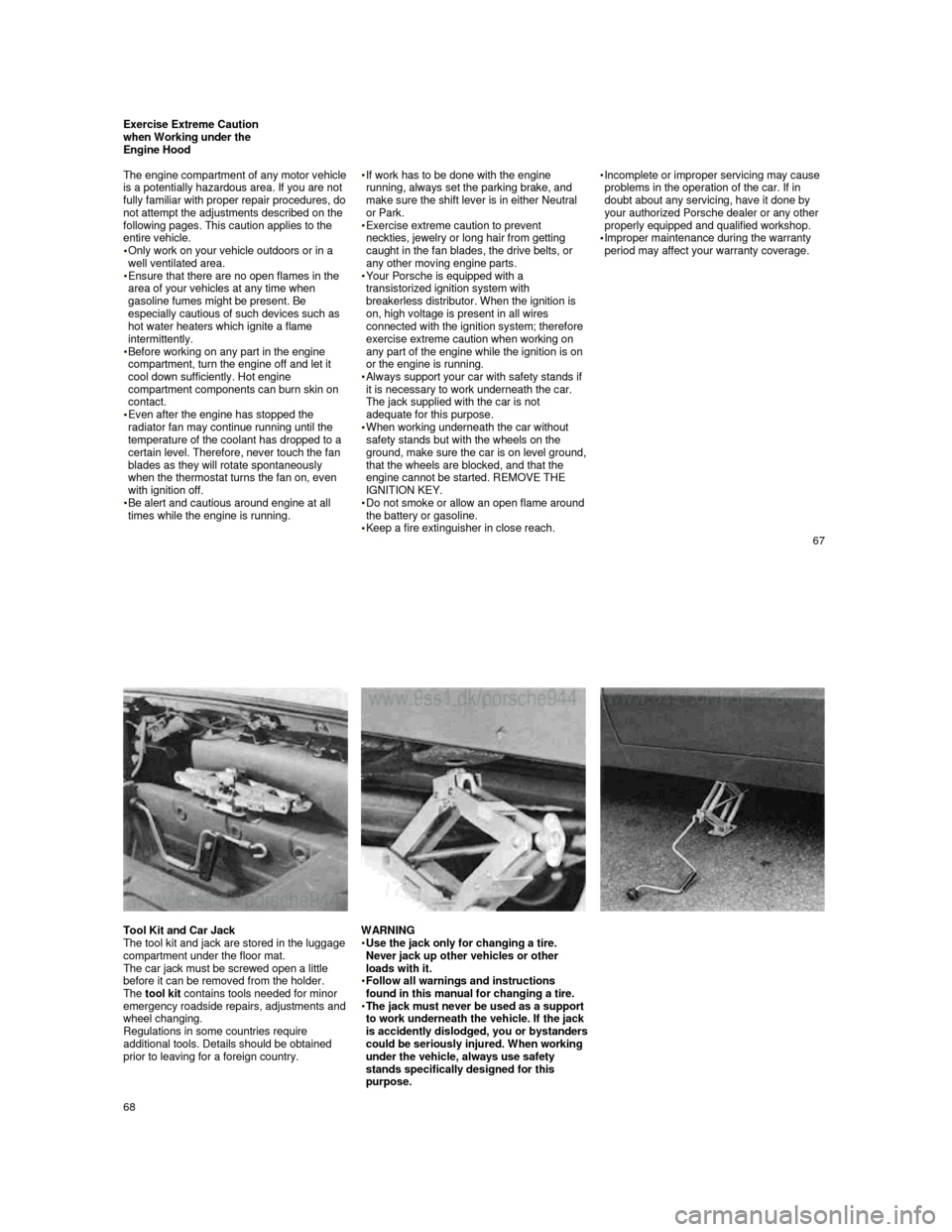
Tool Kit and Car Jack
The tool kit and jack are stored in the luggage
compartment under the floor mat.
The car jack must be screwed open a little
before it can be removed from the holder.
The tool kit contains tools needed for minor
emergency roadside repairs, adjustments and
wheel changing.
Regulations in some countries require
additional tools. Details should be obtained
prior to leaving for a foreign country.
WARNING
Use the jack only for changing a tire. Never jack up other vehicles or other loads with it. Follow all warnings and instructions found in this manual for changing a tire. The jack must never be used as a support to work underneath the vehicle. If the jack is accidently dislodged, you or bystanders could be seriously injured. When working
under the vehicle, always use safety
stands specifically designed for this
purpose.
68
Page 38 of 66
Power Assisted Steering
The hydraulic assistance system allows
effortless steering under all driving conditions.
Slight hissing or squeaking sounds during
sharp turns (turning steering wheel from lock
to lock) are normal and do not indicate a
defective steering mechanism.
If the engine is not running, po
wer assisted steering is no longer effective. You can
continue to steer the car but more effort
will be required to turn the steering wheel.
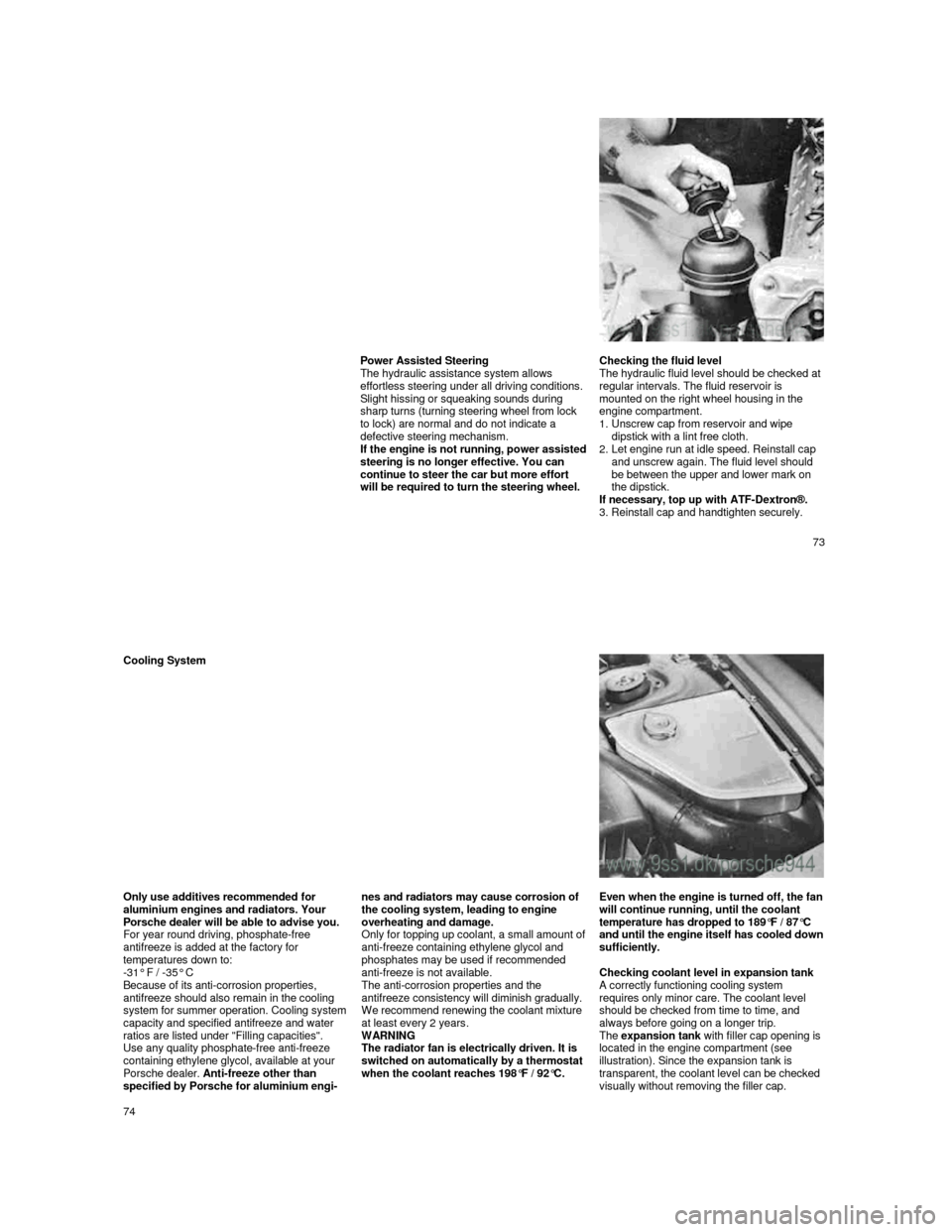
Checking the fluid level
The hydraulic fluid level should be checked at
regular intervals. The fluid reservoir is
mounted on the right wheel housing in the
engine compartment.
1.
Unscrew cap from reservoir and wipe
dipstick with a lint free cloth.
2.
Let engine run at idle speed. Reinstall cap
and unscrew again. The fluid level should
be between the upper and lower mark on
the dipstick.
If necessary, top up with ATF-Dextron®.
3. Reinstall cap and handtighten securely.
73
Cooling System
Only use additives recommended for
aluminium engines and radiators. Your
Porsche dealer will be able to advise you.
For year round driving, phosphate-free
antifreeze is added at the factory for
temperatures down to:
-31° F / -35° C
Because of its anti-corrosion properties,
antifreeze should also remain in the cooling
system for summer operation. Cooling system capacity and specified antifreeze and water
ratios are listed under "Filling capacities".
Use any quality phosphate-free anti-freeze
containing ethylene glycol, available at your
Porsche dealer. Anti-freeze other than
specified by Porsche for aluminium engi-
nes and radiators may cause corrosion of
the cooling system, leading to engine
overheating and damage.
Only
for topping up coolant, a small amount of anti-freeze containing ethylene glycol and
phosphates may be used if recommended
anti-freeze is not available.
The anti-corrosion properties and the
antifreeze consistency will diminish gradually.
We recommend renewing the coolant mixture
at least every 2 years.
WARNING
The radiator fan is electrically driven. It is
switched on automatically by a thermostat
when the coolant reaches 198°F / 92°C.
Even when the engine is turned off, the fan will continue running, until the coolant
temperature has dropped to 189°F / 87°C
and until the engine itself has cooled down sufficiently.
Checking coolant level in expansion tank
A correctly functioning cooling system requires only minor care. The coolant level
should be checked from time to time, and
always before going on a longer trip.
The
expansion tank with filler cap opening is
located in the engine compartment (see
illustration). Since the expansion tank is
transparent, the coolant level can be checked
visually without removing the filler cap.
74
Page 39 of 66
When the engine is cold, the coolant level
should reach the minimum mark on the
expansion tank. When the engine is warm, the coolant level will be above the minimum mark. Since the closed cooling system loses almost
no coolant, topping up is normally not
required. An obvious loss of coolant indicates
leakage. In this case contact your dealer.
WARNING
Do not open the filler cap when the engine is hot because of the danger of
scalding. Allow the engine to cool down.
Protect your hands, arms and face.
Using a thick rag, open the cap carefully and only enough to allow excess
pressure to escape before removing the
cap.
To avoid damage to the engine, only add
cold antifreeze and cold water
to the cooling system when the engine is also cold. A warm engine should only be topped up if the coolant level has dropped appreciably below
the minimum mark. Too much added coolant
will escape through the pressure cap when coolant warms up.
If more than about 1.06 U.S qt or 1 liter must
be added, the cooling system should be bled.
Winter operation At the beginning of the winter season, have the coolant checked for anti-freeze
concentration.
The ratio between water and anti-freeze
necessary to prevent freezing depends on the
anticipated outside temperatures. The ratios
can be taken from the mixing chart listed
under "Filling Capacities" or from the container of the antifreeze manufacturer.
Increasing the anti-freeze in the coolant
further than shown on the container is not
only uneconomical, it is also detrimental to engine cooling.
75
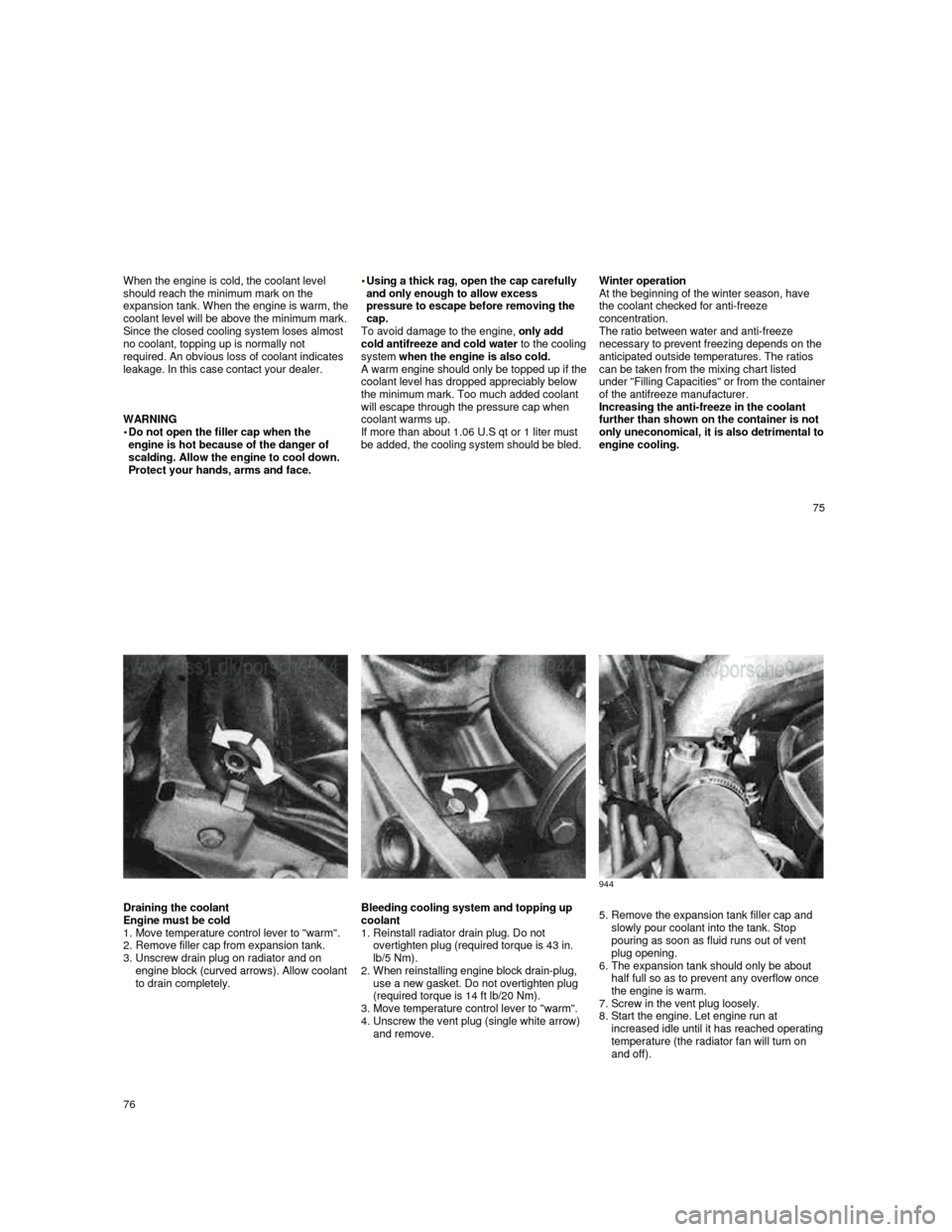
944 Draining the coolant
Engine must be cold
1. Move temperature control lever to "warm".
2.
Remove filler cap from expansion tank.
3. Unscrew drain plug on radiator and on engine block (curved arrows). Allow coolant to drain completely.
Bleeding cooling system and topping up
coolant
1. Reinstall radiator drain plug. Do not overtighten plug (required torque is 43 in.
lb/5 Nm).
2.
When reinstalling engine block drain-plug,
use a new gasket. Do not overtighten plug
(required torque is 14 ft lb/20 Nm).
3.
Move temperature control lever to "warm".
4. Unscrew the vent plug (single white arrow)
and remove.
5. Remove the expansion tank filler cap and
slowly pour coolant into the tank. Stop
pouring as soon as fluid runs out of vent
plug opening.
6.
The expansion tank should only be about
half full so as to prevent any overflow once
the engine is warm.
7.
Screw in the vent plug loosely.
8. Start the engine. Let engine run at increased idle until it has reached operating temperature (the radiator fan will turn on
and off).
76
Page 65 of 66
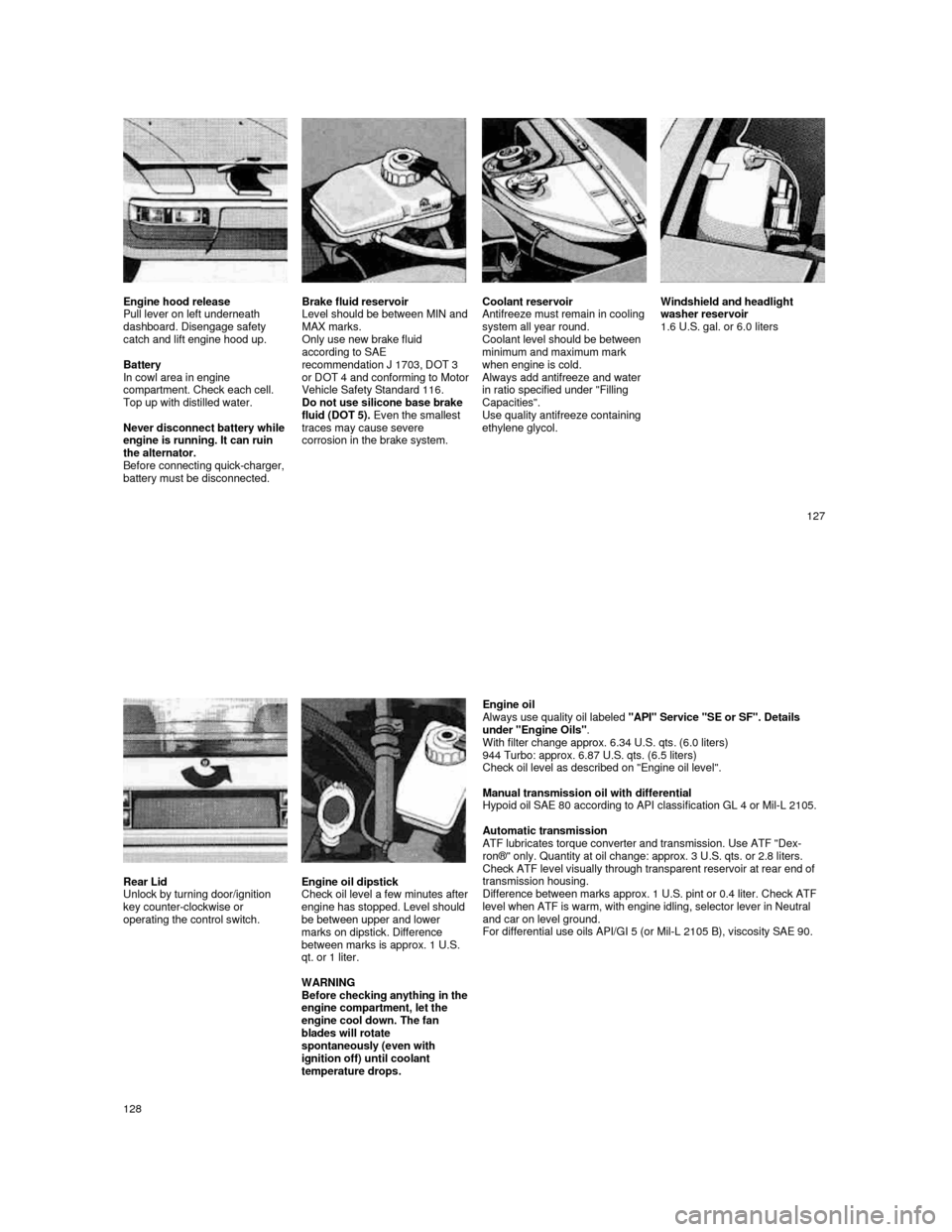
Engine hood release
Pull lever on left underneath
dashboard. Disengage safety
catch and lift engine hood up.
Battery
In cowl area in engine
compartment. Check each cell.
Top up with distilled water.
Never disconnect battery while
engine is running. It can ruin
the alternator.
Before connecting quick-charger,
battery must be disconnected. Brake fluid reservoir
Level should be between MIN and MAX marks.
Only use new brake fluid
according to SAE
recommendation J 1703, DOT 3
or DOT 4 and conforming to Motor Vehicle Safety Standard 116.
Do not use silicone base brake
fluid (DOT 5). Even the smallest
traces may cause severe
corrosion in the brake system.
Coolant reservoir
Antifreeze must remain in cooling
system all year round.
Coolant level should be between
minimum and maximum mark
when engine is cold. Always add antifreeze and water in ratio specified under "Filling
Capacities".
Use quality antifreeze containing
ethylene glycol.
Windshield and headlight
washer reservoir
1.6 U.S. gal. or 6.0 liters
127
Rear Lid
Unlock by turning door/ignition
key counter-clockwise or
operating the control switch.
Engine oil dipstick
Check oil level a few minutes after engine has stopped. Level should
be between upper and lower
marks on dipstick. Difference
between marks is approx. 1 U.S.
qt. or 1 liter.
WARNING
Before checking anything in
the engine compartment, let the
engine cool down. The fan
blades will rotate
spontaneously (even with
ignition off) until coolant
temperature drops.
Engine oil Always use quality oil labeled "API" Service "SE or SF". Details
under "Engine Oils" .
With filter change approx. 6.34 U.S. qts. (6.0 lite rs)
944 Turbo: approx. 6.87 U.S. qts. (6.5 liters)
Check oil level as described on "Engine oil level".
Manual transmission oil with differential
Hypoid oil SAE 80 according to API classification G L 4 or Mil-L 2105.
Automatic transmission
ATF lubricates torque converter and transmission. U se ATF "Dex-
ron®" only. Quantity at oil change: approx. 3 U.S. qts. or 2.8 liters.
Check ATF level visually through transparent reserv oir at rear end of
transmission housing.
Difference between marks approx. 1 U.S. pint or 0.4 liter. Check ATF
level when ATF is warm, with engine idling, selecto r lever in Neutral
and car on level ground.
For differential use oils API/GI 5 (or Mil-L 2105 B ), viscosity SAE 90.
128