1987 NISSAN PULSAR wheel bolt torque
[x] Cancel search: wheel bolt torquePage 168 of 238

168 Rear Suspension
NOTE: If a coil spring is defective it is
advisable to renew both coil springs as a
matched set.
(13) Check the spring seat for cracks, deforma-
tion or wear and renew as necessary.
(14) Check the upper mounting and the insulator
for wear, damage, signs of melting rubber or deterio-
ration. (15) Check that the piston rod is not cracked,
bent or damaged.
Dismantled view of the suspension unit.
(16 ) Check the hydraulic operation of the suspen-
sion unit. With the suspension unit vertical, move the
piston rod up and down severa l times. A firm pressure
with no slack spots should be evident in both direc-
tions. Also check the suspen sion unit for fluid leakage.
If fluid leakage is present, renew the suspension unit,
preferably in pairs.
TO ASSEMBLE AND INSTAL
Assembly is a reversal of the dismantling proce-
dure with attention to the following points:
(1) Install the coil spring and lower insulator to
the suspension unit ensuring th at the flat end of the
spring is positioned at the top and the lower end of the
spring is located correctly in the suspension unit.
(2) Install the remaining co mponents to the sus-
pension unit, ensuring that the arrow on the spring
seat will be facing the stub axle when installed.
(3) Install a new upper mounting retaining nut,
tighten to the specified tor que and remove the spring
compressor. (4) Position the suspension unit inside the rear
wheel housing and maneuver the mounting studs
into position. With the aid of an assistant, install the
suspension unit retaining nuts and tighten to the
specified torque.
View of the suspension unit removed from the vehicle.
(5) Install the bolts securin g the suspension unit
to the knuckle assembly and tighten the nuts to the
specified torque.
(6) Install the brake hose to the suspension unit
and secure with the retaining clip. (7) Install the rear wheel and lower the vehicle to
the ground. (8) On hatchback models, install the parcel shelf
side panel and the parcel shelf. (9) On sedan models, install the parcel shelf and
insert the retaining buttons firmly. If removed, install
the radio speaker grilles.
Page 169 of 238

Rear Suspension 169
5. CONTROL ARM
Special Equipment Required:
To Renew Control Arm Bush — Press and suitable
removal tool
TO REMOVE AND INSTAL
(1) Raise the rear of the vehicle and support it
on chassis stands as describe d in the Wheels and Tires
section.
(2) Suitably mark the front and rear control
arms to ensure installation to the original locations.
NOTE: The front and rear control arms are
identical in appearance, however, on models
manufactured prior to March 1988 the
compound of the rubber bushes differ.
(3) Remove the nut and bolt securing the control
arms to the knuckle assembly.
(4) Suitably mark the rear inner pivot bolt cams
in relation to the crossmember to ensure correct
installation.
(5) Remove the rear control arm inner pivot
bolt, adjusting cam, nut and control arm from the
vehicle. (6) Remove the front control arm inner pivot
bolt, washer, nut and control arm from the vehicle.
(7) Inspect the control arm bushes for wear,
cracks and deterioration and renew as necessary. (8) Inspect the control arms for cracks, damage
and distortion and renew as necessary.
(9) Inspect the pivot bolts for damage and renew
as necessary. Installation is a reversal of the removal procedure
with attention to the following points:
(1) Install the control arms to the original
loca-
tions, ensuring that the inner pivot bolts are installed
from the front of the crossmember.
(2) Align the marks on the rear inner pivot bolt
Dismantled view of the control arms and associated
components. Disc brake model.
cams and the crossmember that were made prior to
removal. Install the inner pivot bolt nuts but do not
tighten.
(3) Install the bolt that secures the control arms
to the knuckle assembly and tighten the nut finger
tight. (4) Lower the vehicle to the ground. With the
weight of the vehicle on th e rear wheels, ensure that
the marks on the inner pivot bolt cams and the
crossmember are aligned. (5) Tighten the inner and outer control arm
bolts and nuts to the specified torque. (6) Check and if necessary adjust the rear wheel
alignment. Refer to the Re ar Wheel Alignment head-
ing in this section.
TO RENEW CONTROL ARM BUSH
(1) Remove the control arm as previously de-
scribed. (2) Using a press and press plates or a bush
removal tool, remove the bush from the control arm.
NOTE: If a press or bush removal tool is not
available, a simple alternative can be made
using a long bolt, large and small washers, a
nut and a tubular spacer. This method is
illustrated in the General Information sec-
tion under the General Repair Procedures
heading.
(3) Install a new bush to the control arm
ensuring
that it is pressed squarely into the control arm. When
installed, the bush should be equidistant from either
end of the control arm bore. (4) Install the control arm as previously de-
scribed.
Ensure that the cam and the crossmember are suitably
marked prior to loosening the nut.
Page 170 of 238

170 Rear Suspension
6. KNUCKLE ASSEMBLY
TO REMOVE AND INSTAL
(1) Remove the rear hub as previously de-
scribed.
(2) On drum brake models, disconnect the brake
pipe from the wheel cylinder and plug the cylinder
and brake pipe apertures to prevent the loss of brake
fluid and the entry of dirt. (3) Remove the backing plate retaining bolts and
remove the backing plate from the knuckle assembly. (4) Remove the nut and bolt securing the control
arms to the knuckle assembly. (5) Remove the bolts and nuts securing the
suspension unit to the knuckle assembly. (6) Remove the nut, washers and bush securing
the stabilizer bar to the knuckle assembly, rotate the
knuckle assembly and remove it from the stabilizer
bar. (7) Carefully clean the knuckle assembly. Do not
immerse the rubber bush in solvent as damage will
occur.
(8) Check the knuckle assembly for wear, cracks
and damage. Installation is a reversal of the removal procedure
with attention to the following points:
(1) Install the knuckle assembly onto the stabi-
liser bar, maneuver it into position with the suspen-
sion unit and install the retaining bolts and nuts.
Tighten the bolts and nuts to the specified torque.
(2) Install the control arms to the knuckle
assem-
bly and install the retaining bolt and nut. Do
not
tighten the retaining bolt and nut at this stage. (3) Install the bush, washers and retaining nut to
the stabilizer bar. Do not tighten the retaining nut at
this stage. (4) Install the backing plate to the knuckle as-
sembly and tighten the retaining bolts to the specified
torque.
(5) On drum brake models, connect the brake
pipe to the wheel cylinder and tighten the flare nut
securely.
(6) Install the rear hub as previously described.
(7) On drum brake models, bleed the brake
hydraulic system as described in the Brakes section.
(8) With the weight of the vehicle on the road
wheels, tighten the control arms retaining bolt and nut
and the stabilizer bar retaining nut to the specified
torque. (9) Check and if necessary adjust the rear wheel
alignment. Refer to the Re ar Wheel Alignment head-
ing in this section.
7. STABILISER BAR
TO REMOVE AND INSTAL
(1) Raise the rear of the vehicle and support it
on chassis stands as describe d in the Wheels and Tires
section. Remove the rear wheels.
(2) Remove the nut. washer and bush retaining
the stabilizer bar to each knuckle assembly. (3) Remove the bolts retain ing the intermediate
exhaust pipe to the rear of the catalytic converter,
remove the bolt securing the exhaust mounting to the
underbody and slightly lower the intermediate exhaust
pipe. Support the intermediate pipe to prevent the
tailpipe contacting the lower bumper panel. (4) Remove the bolts retaining the stabilizer bar
mounting brackets to the underbody and withdraw
the stabilizer ba r from each knuckle assembly. Ma-
noeuvre the stabilizer bar from the vehicle.
(5) Remove the mounting rubbers from the
stabilizer bar and the rubber bush and spacer from
each knuckle assembly. (6) Inspect the stabilizer bar for cracks and
damage and renew as necessary. (7) Inspect the stabilizer bar mounting brackets
for wear and damage and renew as necessary. (8) Inspect the mounting rubbers, the rubber
bushes and spacers for wear and deterioration and
renew as necessary.
View of the knuckle assembly removed from the
vehicle. Disc brake model. View of the stabilizer bar mounting bracket and rubber
removed from the stabilizer bar.
Page 171 of 238

Rear Suspension 171
Installation is a reversal of the removal procedure
with attention to the following points:
(1) When installing the stabilizer bar to the
knuckle assembly bushes, ensu re that the thicker bush
is installed to the front of the knuckle assembly. Install
the rear bush, washers and nut but do not tighten at
this stage. (2) Install the stabil izer bar mounting
brackets,
ensuring that the end with the large bevel is facing the
front of the vehicle. Tighte n the retaining bolts to the
specified torque. (3) Using a new gasket, install the intermediate
exhaust pipe to the catalytic converter, ensuring that
the earth wire terminal is installed, and tighten the
bolts securely. Install the exhaust mounting
retaining
bolt. (4) Install the rear wheels and lower the
vehicle
to the ground. With the wei ght of the vehicle on the
road wheels, tighten the stabilizer bar retaining nuts to
the specified torque.
8. REAR WHEEL ALIGNMENT
Specialized equipment is required to measure the
rear wheel alignment. It is therefore recommended
that the vehicle be referred to a specialist suspension
workshop or an authorized dealer for measurement
and adjustment. The suspension components should
be inspected and renewed as necessary prior to having
the wheel alignment checked. If any suspension com-
ponents are renewed, the re ar wheel toe out may be
temporarily adjusted as described below.
TO INSPECT
Examine the tread of the tires. Excessive or
uneven wear will indicate misalignment or damaged
or worn components. Refer to the Tire Wear Trouble
Shooting Chart in the Wheels and Tires section for
possible causes and renew the faulty components.
Badly worn tires should be renewed prior to
having the wheel alignment checked.
TO CHECK AND ADJUST TOE OUT
NOTE: The following procedures are only a
temporary measure. Th e vehicle should be
referred to a specialis t suspension work-
shop or authorized dealer for accurate
measurement and adjustment.
(1) Position the vehicle on a level floor and
bounce the vehicle several tim es to settle the suspen-
sion. (2) Move the vehicle forward approximately 5
meters, with the front wheels straight ahead, to settle
the tires and suspension to the normal running
position.
(3) Place a chalk line across both tire treads at a
point equivalent to the stub axle height and to the rear
of the suspension. Place a vertical mark at the chalk line in the
centre of each tire.
(4) Using a telescopic gauge or tape measure,
measure the distance between both vertical marks and
record the measurement. (5) Move the vehicle forward until the marks are
to the front of the suspen sion, with the horizontal
marks at the same height as in operation (3). (6) Measure the distance between both vertical
marks. (7) The difference between the two measure-
ments will be the amount of toe out of the rear wheels. (8) If the toe out is not as specified, adjust the
rear control arm cams as follows: (9) Measure the distance between the inner
wheel rim and the adjusting flange on the rear
crossmember. Measure the distance on the other side
of the vehicle in the corresponding positions. (10) If the measurements are equal, loosen the
cam nut and turn the cam bolt to move the rear
control arm half the distance required to bring the
rear wheel toe out to specifications. Repeat this
operation on the other side of the vehicle.
(11) If the measurements obtained in operation
(9) are not equal, proceed as follows:
(a) If the toe out is less than specifications,
decrease the length of the shorter arm.
(b) If the toe out is greater than specifications,
increase the length of the longer arm.
NOTE: The toe out will alter approximately
2 mm with each graduation of the adjusting
cam.
Diagram indicating rear wheel toe out. B should be less than A. Refer to Specifications.
Page 172 of 238

172
BRAKES
SPECIFICATIONS
Type:
Except Pulsar/Vector GL from
July 1989 and Astra models ... Four wheel disc
Pulsar/Vector GL from
July 1989 and Astra models —
Front...............................................................Disc
Rear..............................................................Drum
Operation:
Footbrake ............... Vacuum assisted diagonally
split dual hydraulic
Handbrake................ Mechanical on rear wheels
Fluid type ...........................................................Dot 4
Master cylinder:
Make ........................................................ Girlock
Bore diameter —
Large .................................................... 25.40 mm
Small .................................................... 20.64 mm
Front disc brakes:
Caliper bore diameter ........................... 48.1 mm
Disc diameter ........................................ 240 mm
Disc thickness, minimum ......................... 16 mm
Disc runout, maximum ......................... 0.07 mm
Disc pad thickness, minimum ....................2 mm
Rear disc pads:
Caliper bore diameter ......................... 30.16 mm
Disc diameter ........................................ 234 mm
Disc thickness, minimum ...........................9 mm
Disc runout, maximum .......................... 0.07 mm
Disc pad thickness, minimum ....................2 mm
Rear drum brakes:
Wheel cylinder bore diameter ............ 15.87 mm
Drum diameter, maximum ............... 204.50 mm
Drum out of round, maximum.............. 0.03 mm
Drum runout, maximum ........................ 0.05 mm
Brake lining wear limit ........................... 1.5 mm
TORQUE WRENCH SETTINGS
Brake pedal bracket to body........................... 11 Nm
Brake pedal pivot bolt ..................................... 11 Nm
Brake servo unit to body................................. I I N m
Brake servo unit to master cylinder ............... 11 Nm
Pressure differential piston plug ...................... 12 Nm
Proportioning valve plug................................. 27 Nm
Caliper anchor plate bolts ............................... 52 Nm
Caliper guide bolts .......................................... 31 Nm
Brake hose to caliper....................................... 34 Nm
Handbrake cable bracket bolt ......................... 49 Nm
Handbrake lever to body ................................ 11 Nm
Cable clamp to body....................................... 11 Nm
Cam lever nut.................................................. 49 Nm
1. BRAKES TROUBLE SHOOTING
BRAKE PEDAL HARD
(1) Seized caliper piston or wheel cylinder: Over-
haul the caliper or wheel cylinder.
(2) Seized master cylinder piston: Overhaul the
master cylinder. (3) Seized pedal pivot: Rectify or renew the
pedal pivot shaft and bushes. (4) Restricted brake line: Remove the restriction
or renew the brake line.
(5) Vacuum servo system inoperative: Check
and repair the servo system.
NOTE: The vacuum servo system can be
checked as follows: With the engine
switched off, pump the brake pedal several
times to deplete any vacuum in the system.
With the engine still switched off, press
down firmly on the brake pedal and hold it
there noting the position and pressure re-
quired. Start the engine. If the servo unit is
operating correctly, the brake pedal will sink
slightly and the pressure required to hold it
may reduce. If the pedal does not sink
slightly when the engine is started, check the
vacuum supply to the servo unit. If vacuum
is reaching the brake servo unit, the unit can
be considered inoperative.
BRAKE DRAG
(1) Clogged master cylinder ports: Clean the
master cylinder and the fluid reservoir. Renew the
brake fluid. (2) Seized caliper piston or wheel cylinder: Over-
haul the caliper or wheel cylinder.
(3) Seized handbrake linkage: Free up or renew
the linkage.
Page 179 of 238
Brakes 179
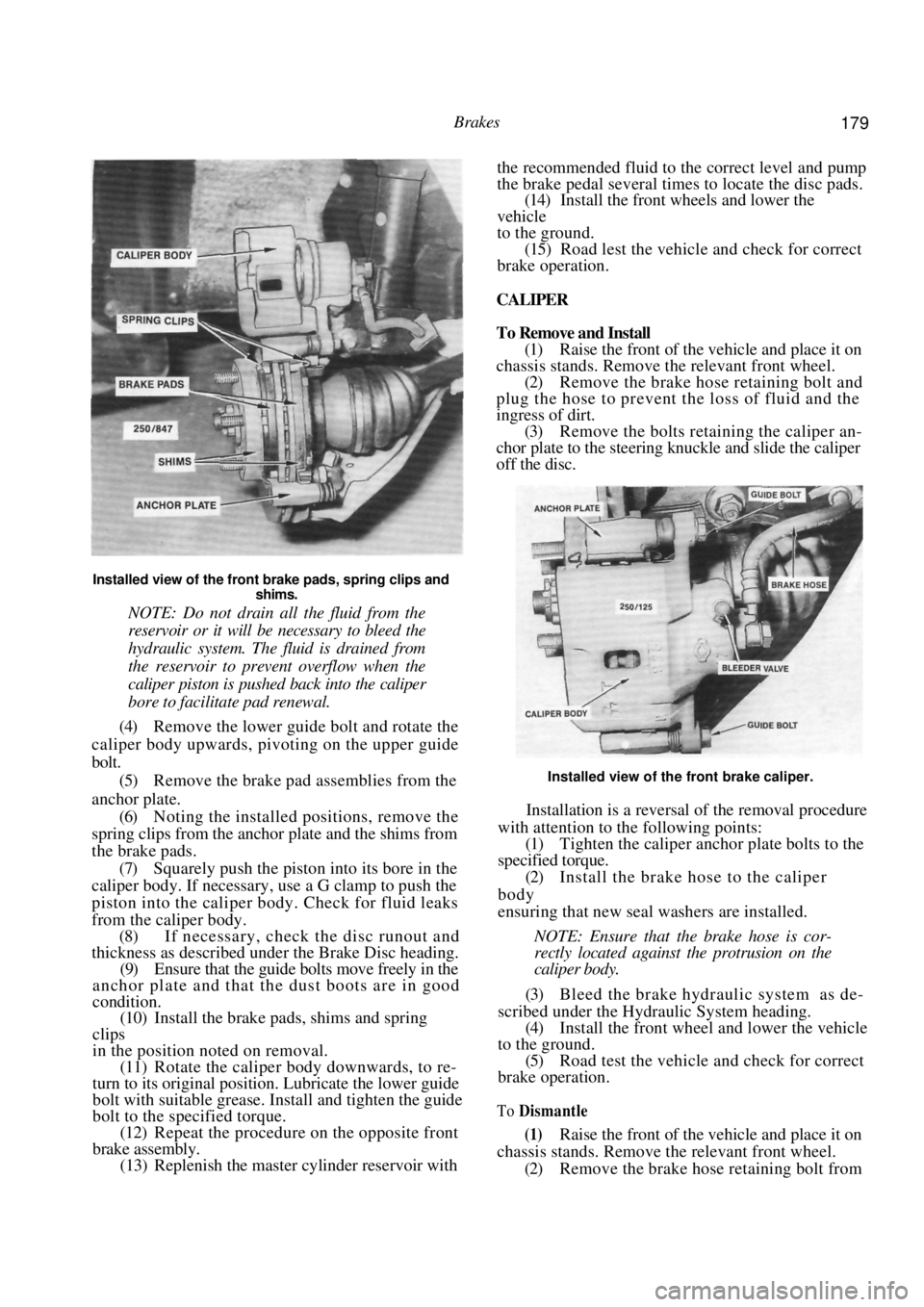
Installed view of the front brake pads, spring clips and shims.
NOTE: Do not drain all the fluid from the
reservoir or it will be necessary to bleed the
hydraulic system. The fluid is drained from
the reservoir to prevent overflow when the
caliper piston is pushed back into the caliper
bore to facilitate pad renewal.
(4) Remove the lower guide bolt and rotate the
caliper body upwards, pivoting on the upper guide
bolt.
(5) Remove the brake pad assemblies from the
anchor plate. (6) Noting the installed positions, remove the
spring clips from the anchor plate and the shims from
the brake pads.
(7) Squarely push the piston into its bore in the
caliper body. If necessary, us e a G clamp to push the
piston into the caliper b ody. Check for fluid leaks
from the calip er body.
(8) If necessary, check the disc runout and
thickness as described under the Brake Disc heading.
(9) Ensure that the guide bolts move freely in the
anchor plate and that the dust boots are in good
condition. (10) Install the brake pads, shims and spring
clips
in the position noted on removal. (11) Rotate the caliper body downwards, to re-
turn to its original position. Lubricate the lower guide
bolt with suitable grease. In stall and tighten the guide
bolt to the specified torque. (12) Repeat the procedure on the opposite front
brake assembly. (13) Replenish the master cylinder reservoir with the recommended fluid to the correct level and pump
the brake pedal several times to locate the disc pads.
(14)
Install the front wheels and lower the
vehicle
to the ground. (15) Road lest the vehicle and check for correct
brake operation.
CALIPER
To Remove and Install
(1) Raise the front of the vehicle and place it on
chassis stands. Remove the relevant front wheel. (2) Remove the brake hose retaining bolt and
plug the hose to prevent the loss of fluid and the
ingress of dirt. (3) Remove the bolts retaining the caliper an-
chor plate to the steering knuckle and slide the caliper
off the disc.
Installed view of the front brake caliper.
Installation is a reversal of the removal procedure
with attention to the following points:
(1) Tighten the caliper anch or plate bolts to the
specified torque.
(2) Install the brake hose to the caliper
body
ensuring that new seal washers are installed.
NOTE: Ensure that the brake hose is cor-
rectly located against the protrusion on the
caliper body.
(3) Bleed the brake hydraulic system as de-
scribed under the Hydraulic System heading. (4) Install the fron t wheel and lower the vehicle
to the ground. (5) Road test the vehicle and check for correct
brake operation.
To Dismantle
(1) Raise the front of the vehicle and place it on
chassis stands. Remove the relevant front wheel.
(2) Remove the brake hose retaining bolt from
Page 180 of 238

180 Brakes
the caliper body. Plug the brake hose to prevent the
loss of fluid and the ingress of dirt. Remove and
discard the sealing washers.
(3) Remove the guide bolts and slide the caliper
body from the anchor plate and pad assembly. (4) Remove the piston dust cover retaining clip.
Remove and discard the dust cover.
BRAKEPAD BRAKE PAD
Dismantled view of the front brake caliper.
(5) Place a piece of wood in front of the piston
and using low air pressure applied to the brake hose
aperture, gently force the piston from the caliper bore.
(6) Using a thin blunt probe, preferably made
from wood or plastic, remove and discard the piston
seal from the groove in the caliper bore. (7) Clean all the caliper components in methyl-
ated spirits and arrange the components in order, on
a clean, dry surface to aid in assembly.
To Inspect
(1) Inspect the caliper bore and piston for pit-
ting, wear or damage. Renew the caliper assembly or
piston if damage is evident.
NOTE: Slight rust spots in the caliper bore
may he removed with fine emery paper. The
piston must not be polished as the plated
surface wilt be damaged.
(2) Inspect the guide bolts for wear or damage.
Renew as necessary.
To Assemble
(1) Dip a new piston seal in clean hydraulic
brake fluid. Insert the seal into the groove in the
caliper bore ensuring that the seal is correctly seated
and not twisted.
(2) Install a new dust cover to the piston prior to
installing the piston to the caliper bore. (3) Coat the piston and caliper bore with clean
hydraulic brake fluid and insert the piston squarely
into the caliper bore.
(4) Locate the dust seal in the groove of the
caliper body and install the retaining clip.
(5) Lubricate the guide bolts using a suitable
grease. Install the caliper body to the anchor plate and
install and tighten the guide bolts to the
specified
torque. (6) Replenish the master cylinder reservoir with
the recommended fluid and bleed the brakes as
described under the Hydr aulic System heading.
(7) Install the front wheels and lower the vehicle
to the ground. (8) Road test the vehicle and check for correct
brake operation.
BRAKE DISC
To Check Runout
(1) Raise the front of the vehicle and support it
on chassis stands. Remove the relevant front wheel. (2) Install the wheel nuts with the flat side of
the
wheel nut towards the disc. Lightly tighten the nuts to
secure the disc against the hub.
Rotate the hub and check for disc runout.
(3) Mount a dial gauge stand to a suspension
component and position the dial gauge plunger
against the wheel hub. Check that the end float is less
than 0.05 mm. Excessive e nd float will necessitate
renewal of the hub bearing. (4) Position the dial gauge plunger against the
centre of the brake disc. Ro tate the hub and measure
the runout. Maximum allowable runout is 0.07 mm. (5) If the runout exceeds Specifications, machine
or renew the brake disc. (6) Install the fron t wheel and lower the vehicle
to the ground.
To Remove and Install
(1) Raise the front of the vehicle and support it
on chassis stands. Remove the relevant wheel. (2) Remove the bolts retaining the caliper an-
Page 182 of 238

182 Brakes
Illustration of the rear disc caliper showing the correct
piston alignment.
(9) Install the brake pads, shims and spring
clips
in the position noted on removal. (10) Install the caliper body to its original posi-
tion. Lubricate the guide bolts with suitable grease.
Install and tighten the guide bolts to the specified
torque. (11) Repeat the procedure on the opposite rear
brake assembly.
(12) Replenish the master cylinder reservoir with
the recommended fluid to the correct level and pump
the brake pedal several times to locate the disc pads. (13) Install the rear wheels and lower the vehicle
to the ground. (14) Road test the vehicle and check for correct
brake operation.
CALIPER
To Remove and Install
(1) Raise the rear of the vehicle and place it on
chassis stands. Remove the relevant rear wheel. (2) Remove the brake hose retaining bolt from
the caliper body and plug the hose to prevent the
loss of fluid and the ingress of dirt.
Installed view of the rear brake caliper.
(3) Remove the handbrake cable bracket retain-
ing bolts and disconnect the handbrake cable from the
cam lever. (4) Remove the bolts retaining the caliper an-
chor plate. Remove the caliper from the disc. Installation is a reversal of the removal procedure
with attention to the following points:
(1) Tighten the caliper anch or plate bolts to the
specified torque. (2) Install the brake hose to the caliper body
ensuring that new seal washers are installed.
NOTE: Ensure that the brake hose locating
pin is correctly installed in the caliper body.
de-
(3) Bleed the brake hydraulic system as
scribed under the Hydraulic System heading. (4) Install the rear wheel and lower the vehicle to
the ground. (5) Road test the vehicle and check for correct
brake operation.
Dismantled view of the rear brake caliper