1987 MAZDA 626 steering wheel
[x] Cancel search: steering wheelPage 1401 of 1865
BRAKE HYDRAULIC LINE 1 1
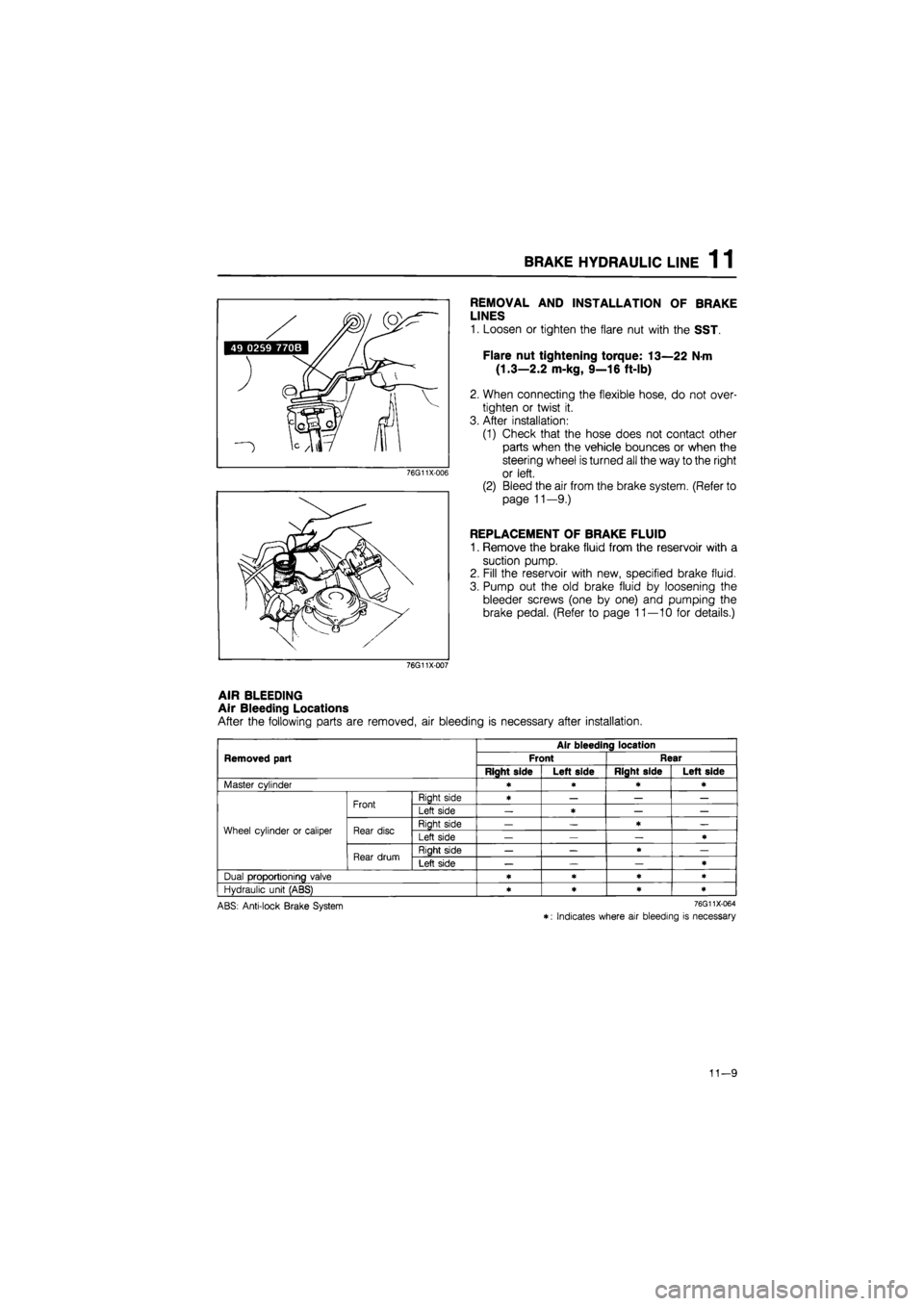
REMOVAL AND INSTALLATION OF BRAKE
LINES
1. Loosen or tighten the flare nut with the SST.
Flare nut tightening torque: 13—22 N-m
(1.3—2.2 m-kg, 9—16 ft-lb)
2. When connecting the flexible hose, do not over-
tighten or twist it.
3. After installation:
(1) Check that the hose does not contact other
parts when the vehicle bounces or when the
steering wheel is turned all the way to the right
or left.
(2) Bleed the air from the brake system. (Refer to
page 11—9.)
REPLACEMENT OF BRAKE FLUID
1. Remove the brake fluid from the reservoir with a
suction pump.
2. Fill the reservoir with new, specified brake fluid.
3. Pump out the old brake fluid by loosening the
bleeder screws (one by one) and pumping the
brake pedal. (Refer to page 11—10 for details.)
AIR BLEEDING
Air Bleeding Locations
After the following parts are removed, air bleeding is necessary after installation.
Removed part
Air bleeding location
Removed part Front Rear Removed part
Right side Left side Right side Left side
Master cylinder * * * *
Wheel cylinder or caliper
Front Right side * — — —
Wheel cylinder or caliper
Front Left side — * — —
Wheel cylinder or caliper Rear disc Right side — — * — Wheel cylinder or caliper Rear disc Left side — — — * Wheel cylinder or caliper
Rear drum Right side — — * —
Wheel cylinder or caliper
Rear drum Left side — — — *
Dual proportioning valve * * * *
Hydraulic unit (ABS) * * * *
ABS: Anti-lock Brake System 76GHX-064 *: Indicates where air bleeding is necessary
11—9
Page 1465 of 1865
ANTI-LOCK BRAKE SYSTEM (ABS) 1 1
TROUBLESHOOTING
Precaution
Conditions that are not malfunctions
1. It may happen that vibration is felt in the steering wheel, body, and/or brake pedal when the ABS
is functioning; such vibration is simply an indication that the system is functioning.
2. Sound of the pump motor operating, accumulator pressure being released, or the relay operating
may be heard from the engine compartment when the engine is started as the system is being auto-
matically checked.
3. The ABS pump motor may be automatically activated even though the ABS is not operating.
4. The ABS warning light may illuminate under any of the following conditions:
• When the vehicle is traveling on snow or ice with the parking brake activated or a brake dragging
at one wheel.
• When different-sized tires are used.
• When tires of different gripping performance are used.
• When (while the vehicle is jacked up or stuck) only the front wheels are spun for 20 seconds or more.
• When there is insufficient battery voltage.
Note
Under the above conditions, the warning light will not illuminate a second time when the
ignition is switched OFF then back ON, and there will be no memory entry to the control
unit of a problem.
Troubleshooting notes
The ABS is composed of electrical components, mechanical components (hydraulic unit), and the com-
ponents of the standard brake system.
Fundamentally, malfunction of the ABS electrical or mechanical components is judged by the self-
diagnosis function within the ABS control unit. And malfunctions are indicated by the warning light
in the instrument panel.
The location
of
a malfunction is indicated by the technician switching the system to the diagnosis-indication
mode.
The self-diagnosis and indication functions must be used when malfunctions of the ABS are being
diagnosed.
76G11X-091
11—73
Page 1479 of 1865
ANTI-LOCK BRAKE SYSTEM (ABS) 1 1
86U11X-1C
Q-08
Q-08
Fail-safe relay
B B BG
(Q-08)(Q-09)
V
BL BR
Motor relay
B BR (Q-09)
LO RY
View from male-pin side
86U11X-167
76G11X-096
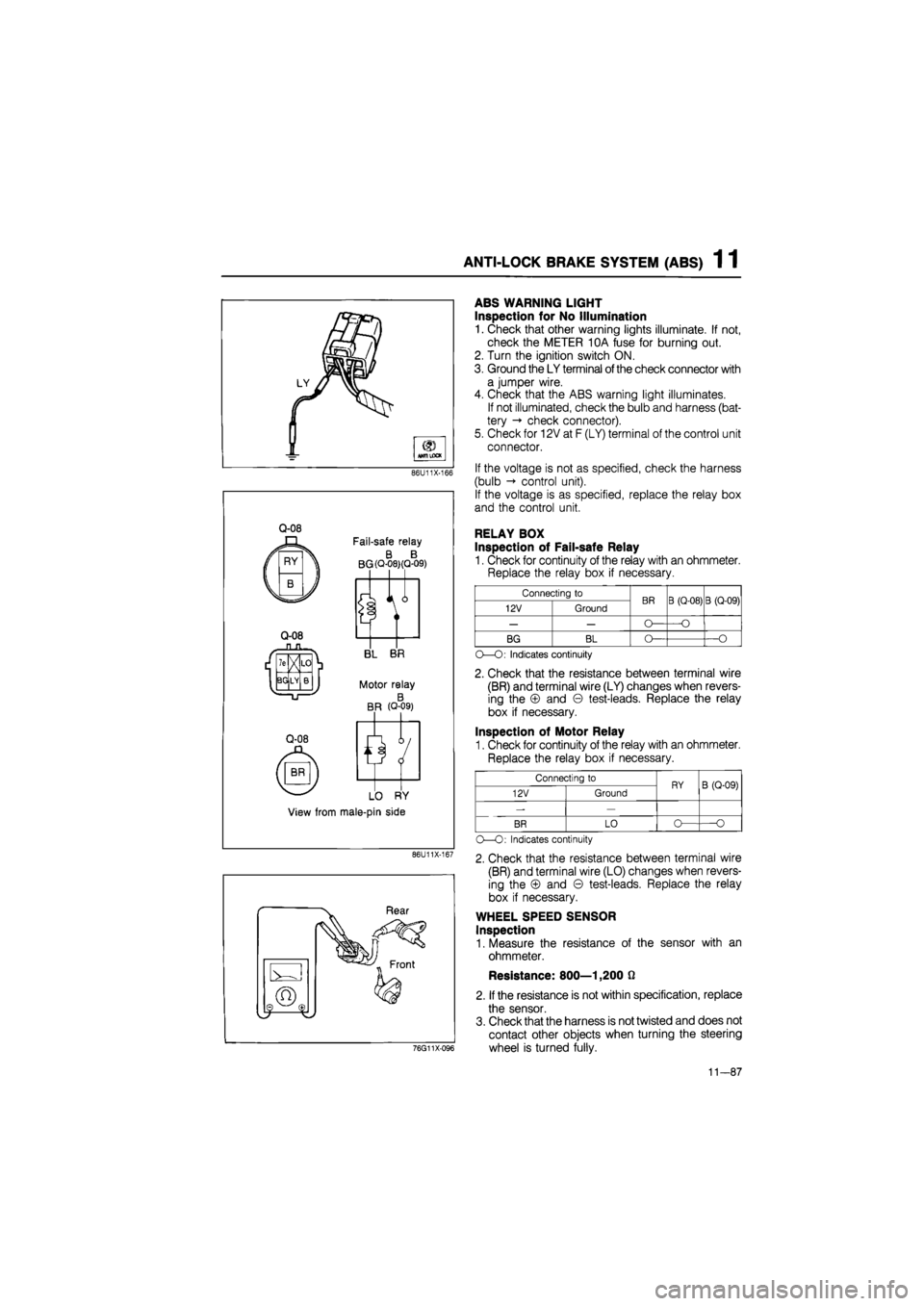
ABS WARNING LIGHT
Inspection for No Illumination
1. Check that other warning lights illuminate. If not,
check the METER 10A fuse for burning out.
2. Turn the ignition switch ON.
3. Ground the LY terminal
of
the check connector with
a jumper wire.
4. Check that the ABS warning light illuminates.
If not illuminated, check the bulb and harness (bat-
tery -» check connector).
5. Check for 12V at F (LY) terminal of the control unit
connector.
If the voltage is not as specified, check the harness
(bulb control unit).
If the voltage is as specified, replace the relay box
and the control unit.
RELAY BOX
Inspection of Fail-safe Relay
1. Check for continuity of the relay with an ohmmeter.
Replace the relay box if necessary.
Connecting to BR B (Q-08) B (Q-09) 12V Ground BR B (Q-08) B (Q-09)
— — O— —O
BG BL O— —O
O—O: Indicates continuity
2. Check that the resistance between terminal wire
(BR) and terminal wire (LY) changes when revers-
ing the © and © test-leads. Replace the relay
box if necessary.
Inspection of Motor Relay
1. Check for continuity of the relay with an ohmmeter.
Replace the relay box if necessary.
Connecting to RY B (Q-09) 12V Ground RY B (Q-09)
-—
BR LO o— O
O—O: Indicates continuity
2. Check that the resistance between terminal wire
(BR) and terminal wire (LO) changes when revers-
ing the © and © test-leads. Replace the relay
box if necessary.
WHEEL SPEED SENSOR
Inspection
1. Measure the resistance of the sensor with an
ohmmeter.
Resistance: 800—1,200 0
2. If the resistance is not within specification, replace
the sensor.
3. Check that the harness is not twisted and does not
contact other objects when turning the steering
wheel is turned fully.
11-87
Page 1480 of 1865
1 1 ANTI-LOCK BRAKE SYSTEM (ABS)
86U11X-170
86U11X-171
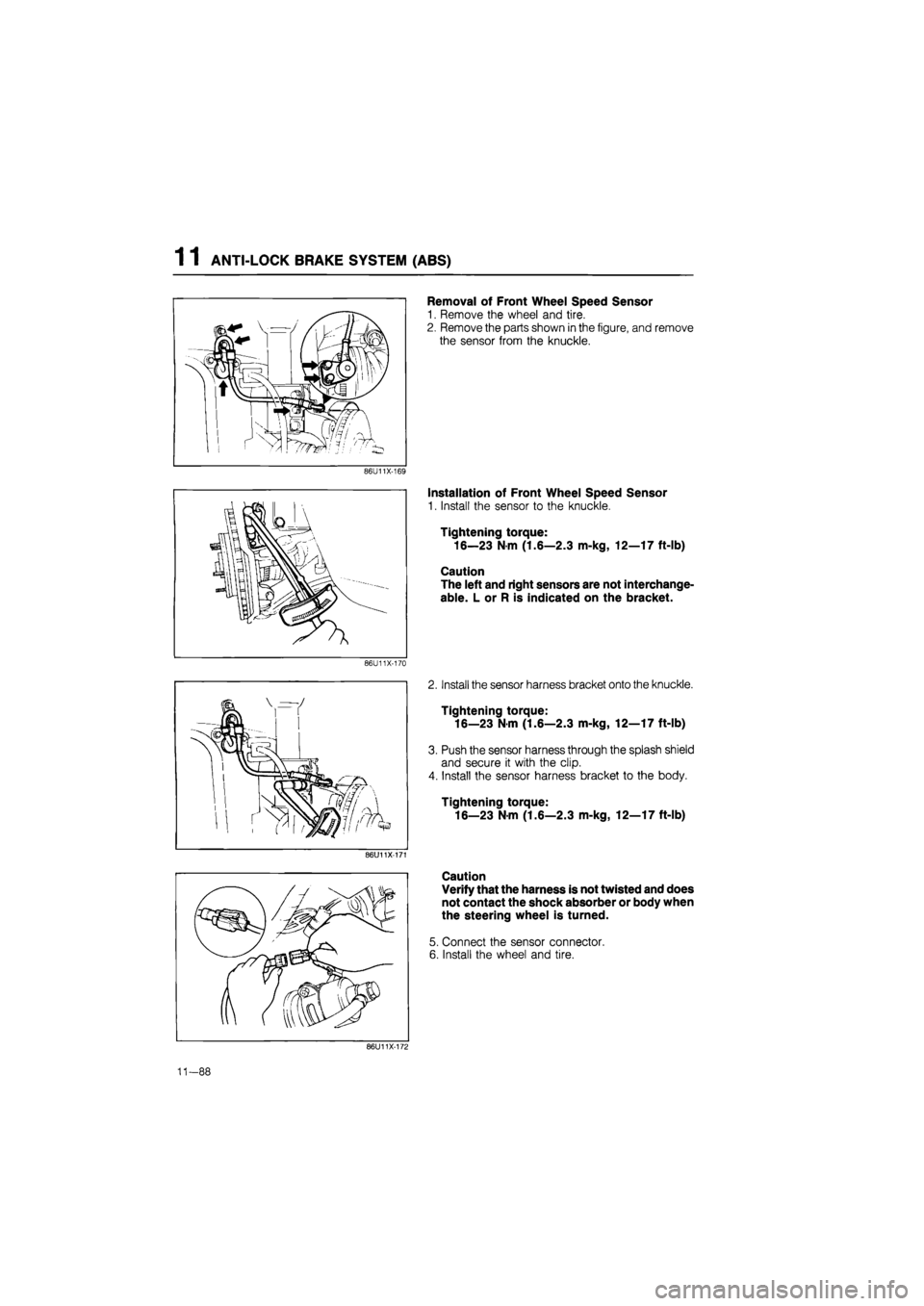
Removal of Front Wheel Speed Sensor
1. Remove the wheel and tire.
2. Remove the parts shown in the figure, and remove
the sensor from the knuckle.
Installation of Front Wheel Speed Sensor
1. Install the sensor to the knuckle.
Tightening torque:
16—23 N m (1.6—2.3 m-kg, 12—17 ft-lb)
Caution
The left and right sensors are not interchange-
able. L or R is indicated on the bracket.
2. Install the sensor harness bracket onto the knuckle.
Tightening torque:
16—23 Nm (1.6—2.3 m-kg, 12—17 ft-lb)
3. Push the sensor harness through the splash shield
and secure it with the clip.
4. Install the sensor harness bracket to the body.
Tightening torque:
16—23 Nm (1.6—2.3 m-kg, 12—17 ft-lb)
Caution
Verify that the harness is not twisted and does
not contact the shock absorber or body when
the steering wheel is turned.
5. Connect the sensor connector.
6. Install the wheel and tire.
86U11X-172
11-88
Page 1481 of 1865
ANTI-LOCK BRAKE SYSTEM (ABS) 1 1
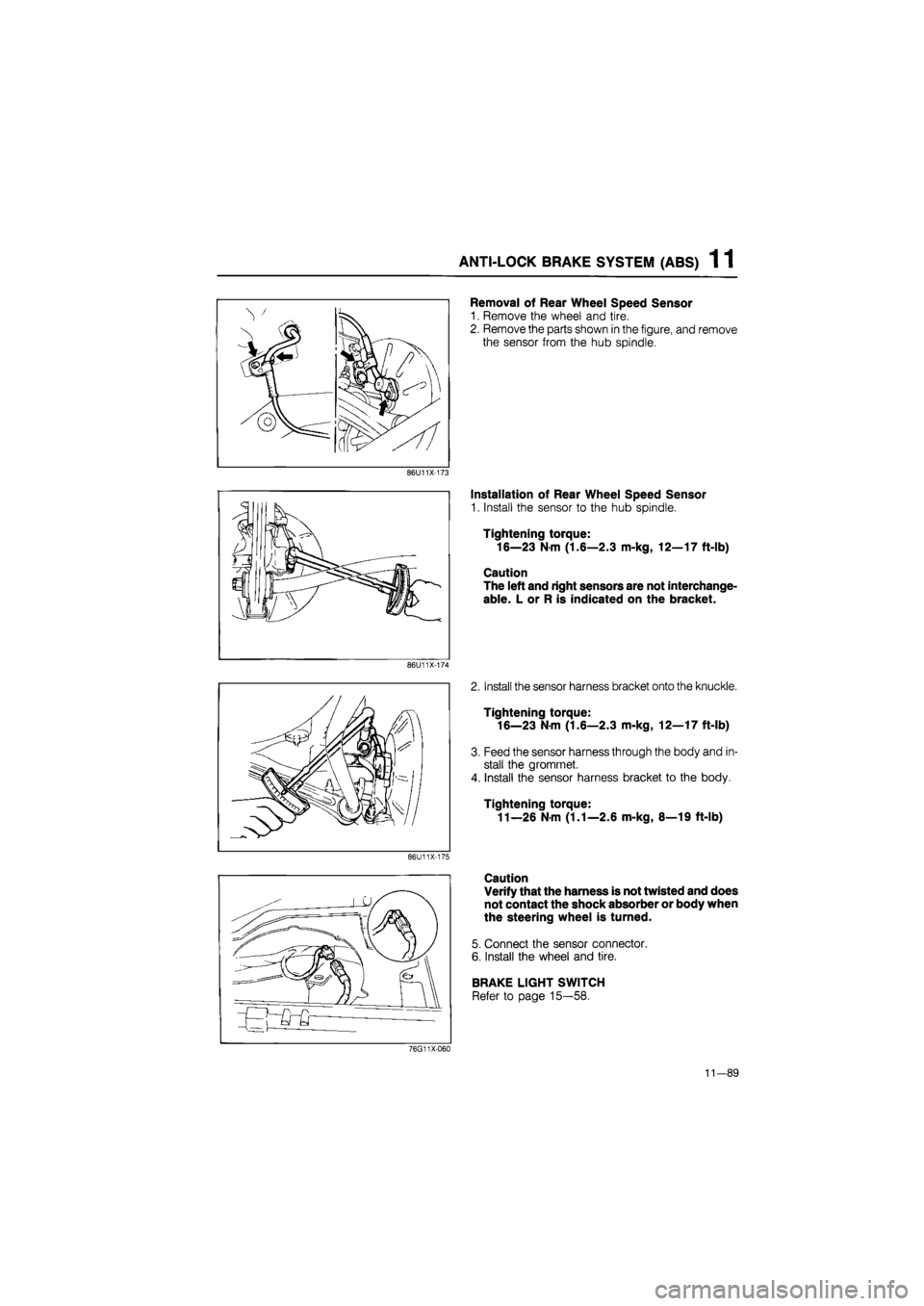
Removal of Rear Wheel Speed Sensor
1. Remove the wheel and tire.
2. Remove the parts shown in the figure, and remove
the sensor from the hub spindle.
86U11X-173
86U11X-174
86U11X-175
Installation of Rear Wheel Speed Sensor
1. Install the sensor to the hub spindle.
Tightening torque:
16—23 N m (1.6—2.3 m-kg, 12—17 ft-lb)
Caution
The left and right sensors are not interchange-
able. L or R is indicated on the bracket.
2. Install the sensor harness bracket onto the knuckle.
Tightening torque:
16—23 Nm (1.6—2.3 m-kg, 12—17 ft-lb)
3. Feed the sensor harness through the body and in-
stall the gromrnet.
4. Install the sensor harness bracket to the body.
Tightening torque:
11—26 N m (1.1—2.6 m-kg, 8—19 ft-lb)
Caution
Verify that the harness is not twisted and does
not contact the shock absorber or body when
the steering wheel is turned.
5. Connect the sensor connector.
6. Install the wheel and tire.
BRAKE LIGHT SWITCH
Refer to page 15—58.
76G11X-060
11-89
Page 1493 of 1865
1 2 OUTLINE, TROUBLESHOOTING GUIDE
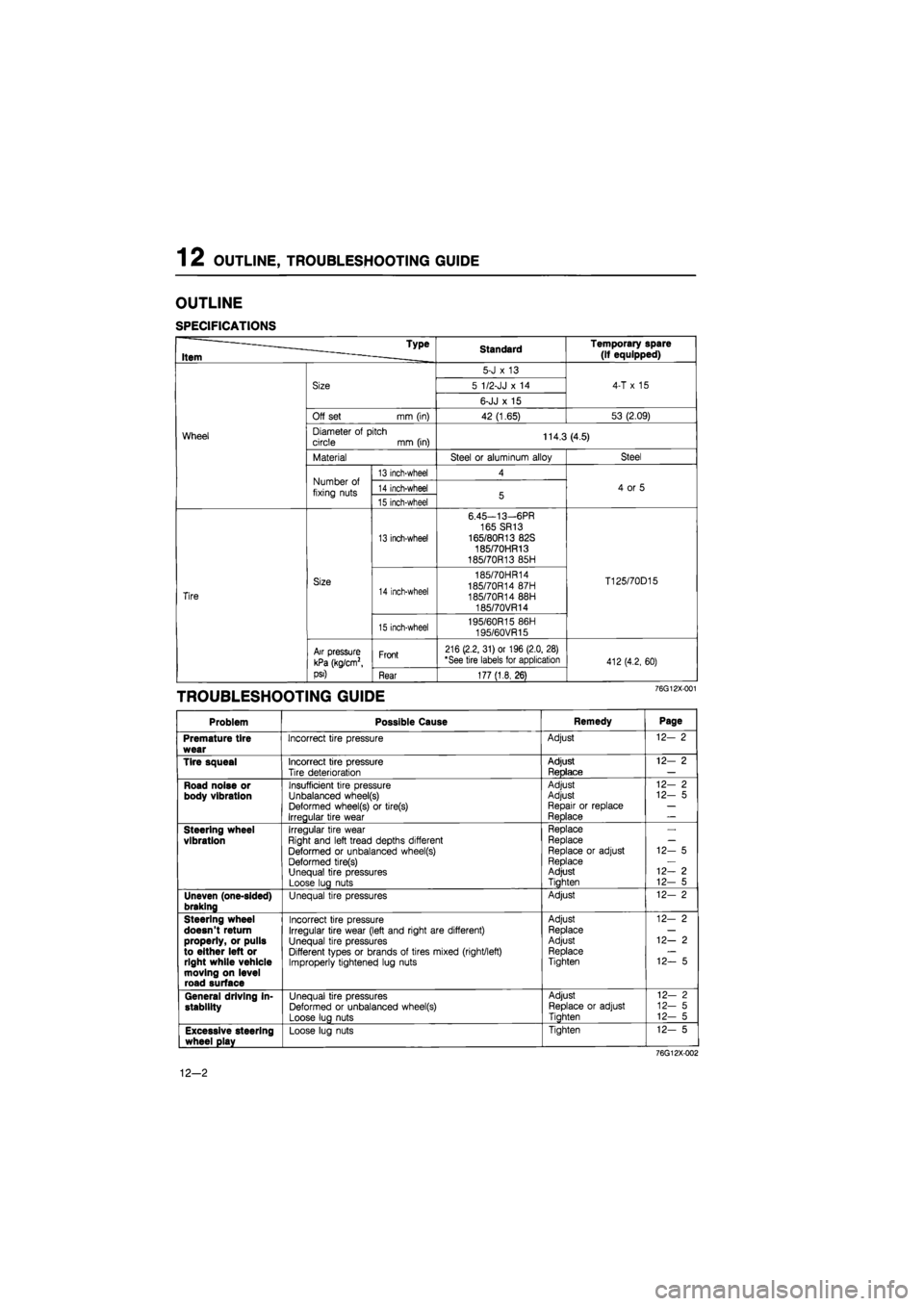
OUTLINE
SPECIFICATIONS
Type
Item Standard Temporary spare (if equipped)
Wheel
Size
5-J
x 13
4-T
x 15
Wheel
Size 5 1/2-JJ
x 14
4-T
x 15
Wheel
Size
6-JJ
x 15
4-T
x 15
Wheel
Off set mm (in) 42 (1.65) 53 (2.09)
Wheel Diameter
of
pitch circle
mm
(in) 114.3 (4.5) Wheel
Material Steel
or
aluminum alloy Steel
Wheel
Number
of
fixing nuts
13 inch-wheel 4
4
or 5
Wheel
Number
of
fixing nuts 14 inch-wheel 5 4
or 5
Wheel
Number
of
fixing nuts 15 inch-wheel 5 4
or 5
Tire
Size
13 inch-wheel
6.45—13—6PR
165 SR13 165/80R13 82S 185/70HR13 185/70R13 85H
T125/70D15
Tire
Size 14 inch-wheel
185/70HR14 185/70R14 87H 185/70R14 88H 185/70VR14
T125/70D15
Tire
Size
15 inch-wheel 195/60R15 86H
195/60VR15
T125/70D15
Tire
Air pressure
kPa (kg/cm2,
psi)
Front 216 (2.2, 31) or 196 (2.0, 28) "See tire labels for application 412(4.2, 60)
Tire
Air pressure
kPa (kg/cm2,
psi) Rear 177 (1.8, 26)
412(4.2, 60)
TROUBLESHOOTING GUIDE 76G12X-001
Problem Possible Cause Remedy Page
Premature tire wear
Incorrect tire pressure Adjust 12-
2
Tire squeal
Incorrect tire pressure Tire deterioration
Adjust ReDlace
12-
2
Road noise or body vibration
Insufficient tire pressure Unbalanced wheel(s) Deformed wheel(s)
or
tire(s) Irregular tire wear
Adjust Adjust Repair
or
replace Reolace
-1
12-
2
12-
5
Steering wheel vibration
Irregular tire wear Right and left tread depths different Deformed
or
unbalanced wheel(s) Deformed tire(s) Unequal tire pressures Loose lug nuts
Replace Replace
Replace
or
adjust Replace Adjust Tiahten
12-
5
12—
2
12-
5
Uneven (one-sided) braking
Unequal tire pressures Adjust 12-
2
Steering wheel doesn't return properly, or pulls to either left or right while vehicle moving on level road surface
Incorrect tire pressure Irregular tire wear (left and right are different) Unequal tire pressures Different types
or
brands
of
tires mixed (right/left) Improperly tightened lug nuts
Adjust Replace Adjust Replace Tighten
12-
2
12—
2
12-
5
General driving in-stability
Unequal tire pressures Deformed
or
unbalanced wheel(s) Loose lug nuts
Adjust Replace
or
adjust Tiahten
12-
2
12-
5
12-
5
Excessive steering wheel play
Loose lug nuts Tighten 12-
5
76G12X-002
12-2
Page 1500 of 1865
OUTLINE 13
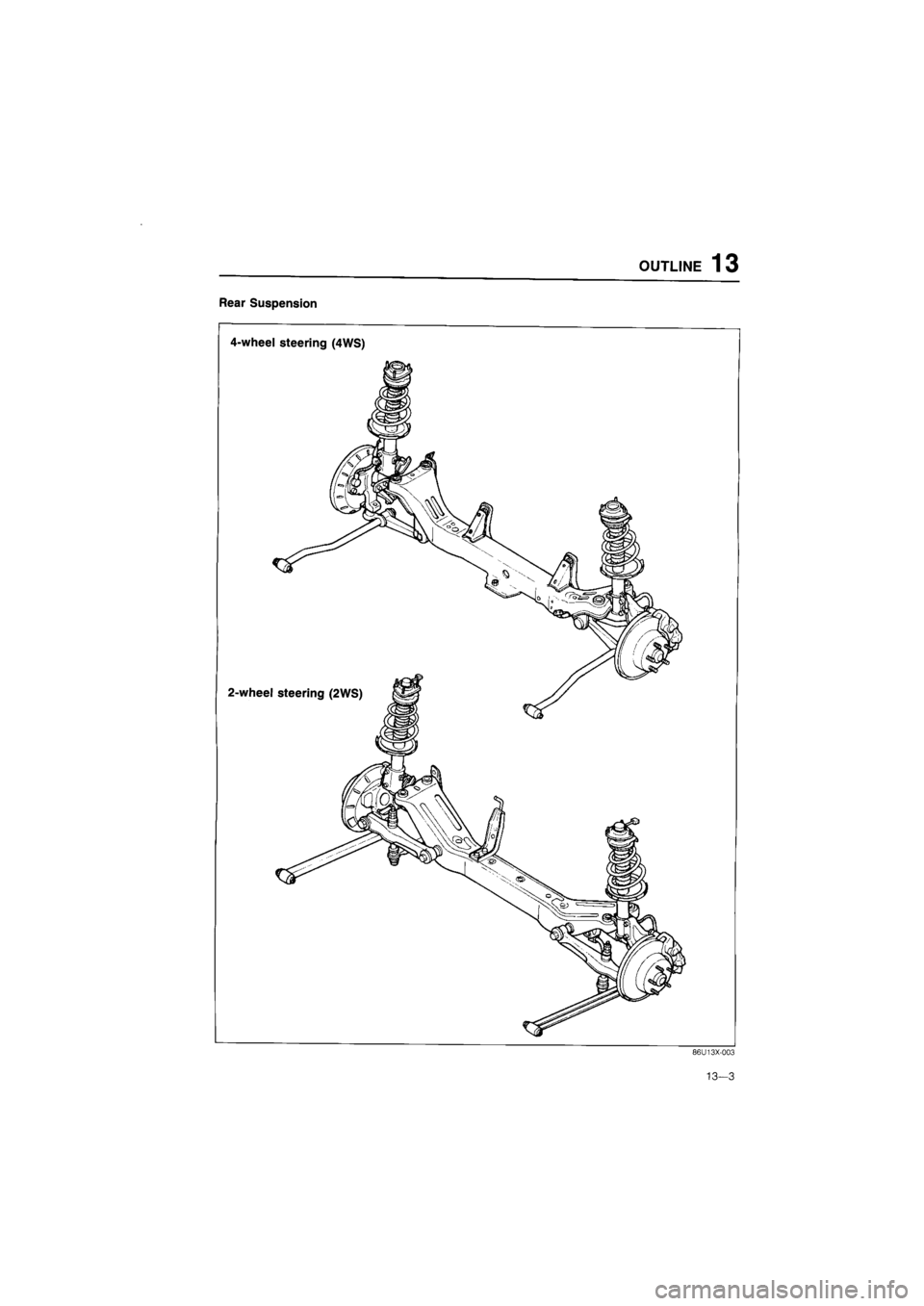
Rear Suspension
4-wheel steering (4WS)
86U13X-003
13—3
Page 1501 of 1865
13 OUTLINE
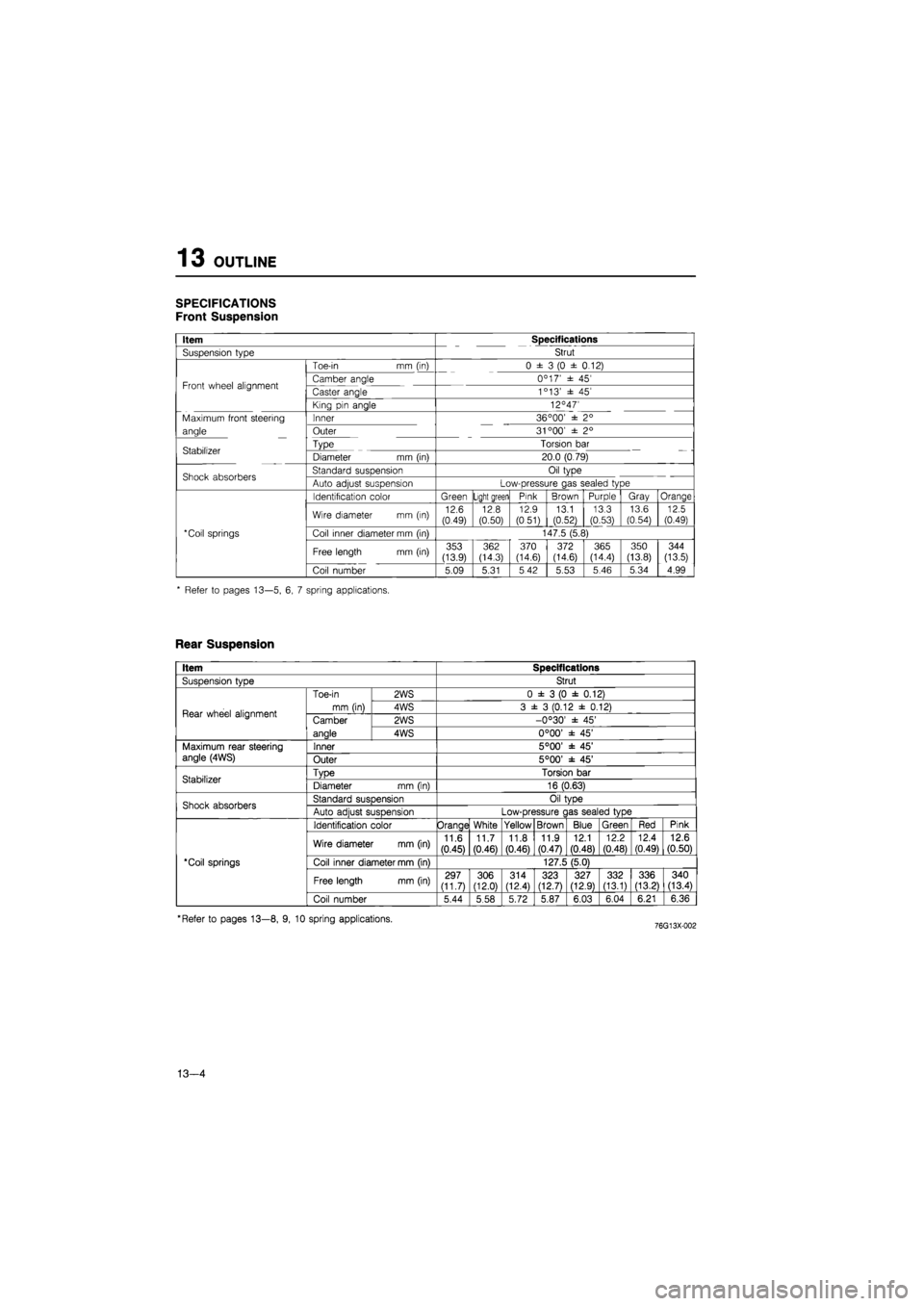
SPECIFICATIONS
Front Suspension
Item Specifications
Suspension type Strut
Toe-in mm (in) 0 ± 3 (0 ± 0.12)
Front wheel alignment Camber angle 0C 17' ± 45' Front wheel alignment Caster angle 1c 13' ± 45'
King pin angle 12°47'
Maximum front steering Inner 36 °00' ± 2°
angle Outer 31 °00' ± 2°
Stabilizer Type Torsion bar Stabilizer Diameter mm (in) 20.0 (0.79)
Shock absorbers Standard suspension Oil type Shock absorbers Auto adjust suspension Low-pressure gas sealed type
Identification color Green Light green Pink Brown Purple Gray Orange
Wire diameter mm (in) 12.6 (0.49) 12.8 (0.50)
12.9
(0.51) 13.1 (0.52)
13.3 (0.53)
13.6
(0.54) 12.5 (0.49)
*Coil springs Coil inner diameter mm (in) 147.5 (5.8)
Free length mm (in) 353 (13.9)
362 (14.3) 370 (14.6) 372 (14.6) 365 (14.4)
350
(13.8)
344
(13.5)
Coil number 5.09 5.31 5 42 5.53 5.46 5.34 4.99
* Refer to pages 13—5, 6, 7 spring applications.
Rear Suspension
Item Specifications
SusDension tvDe Strut
Rear wheel alignment
Toe-in
mm (in)
2WS 0 ± 3 (0 ± 0.12)
Rear wheel alignment
Toe-in
mm (in) 4WS 3 ± 3 (0.12 ± 0.12) Rear wheel alignment Camber
anale
2WS -0°30' ± 45' Rear wheel alignment Camber
anale 4WS 0°00' ± 45'
Maximum rear steering angle (4WS) Inner 5°00' ± 45' Maximum rear steering angle (4WS) Outer 5°00' ± 45'
Stabilizer TvDe Torsion bar Stabilizer Diameter mm (in) 16 (0.63)
Shock absorbers Standard susDension Oil tvDe Shock absorbers Auto adiust suspension Low-pressure c las sealed type
'Coil springs
Identification color Orange White Yellow Brown Blue Green Red Pink
'Coil springs
Wire diameter mm (in) 11.6
(0.45)
11.7 (0.46) 11.8
(0.46)
11.9 (0.47)
12.1
(0.48)
12.2
(0.48)
12.4 (0.49) 12.6 (0.50)
'Coil springs Coil inner diameter mm (in) 127.5 (5.0) 'Coil springs
Free length mm (in) 297 (11.7) 306 (12.0)
314 (12.4) 323 (12.7) 327 (12.9) 332 (13.1) 336 (13.21 340 (13.4)
'Coil springs
Coil number 5.44 5.58 5.72 5.87 6.03 6.04 6.21 6.36
'Refer to pages 13—8, 9, 10 spring applications.
13—4