1986 CHEVROLET CORVAIR service
[x] Cancel search: servicePage 7 of 56
Downloaded from www.Manualslib.com manuals search engine A WORD ABOUT ... VEHICLE SAFETY AND THE INI
TIAL FEDERA~ MOTOR VEHICLE SAFETY STANDARDS
Chevrolet has for many years been a leader in the field
of automotive safety. Almost every advance in design and engineering since the jnception of the industry has contributed
to the safety, reliability and durability of our cars. Continua
tion of this important and vital trend is exemplified in your
1968 Chevrolet. Important safety advances are designed to
aid in avoiding accidents, and in reducing injuries during the accident and as a result of the accident.
But remember-it takes more than a safe car to avoid
accidents. Observe all traffic laws, make safe driving a habit and maintain your car in top condition.
Your
n!,)w 1968 Chevrolet conformed to all federal motor
vehicle safety standards applicable at time of manufacture.
Effectiveness of these safety features ~an best be continued
through periodic vehicle inspection and regular maintenance .
Th~ initial Federal Motor Vehicle Safety Standards encompass a number of systems on all passenger cars. To promote better understanding of these standards, listed are those
standards applicable to passenger cars, and the purpose and
scope of each.
Initial
Federal Motor Vehicle Safety Standards (Effective January 1, 1968*)
Amendment to certain of these
Standards and additional Standards that would apply to 1968 Model passenger cars
manufactured after January 1, 1968 , were under cons ideration by the National Highway Safety Bureau at the time this Owner's Manual was prepared. '
STANDARD NO. 101
Control Location and Identification
Purpose and Scope. This standard specifies the requirements
for location and identification of certain controls to facilitate
their selection and ensure their accessibility.
4
STANDARD NO. 102 Transmission Shift Lever Sequence, Starter Interlock, and Transmission Braking Effect Purpose and Scope. This standard specifies the requirements
for the transmission shift lever sequence, a starter interlock, and for a braking effect of automatic transmissions, to requce the likelihood of shifting errors, starter engagement with vehicle in drive position, and to provide supplemental braking at speeds below 25 miles per hour.
STANDARD NO. 103 Windshield Defrosting and Defogging Purpose lind Scope. This standard specifies requirements
for providing vision through the windshield during frosting and fogging conditions.
STANDARD NO. 104 Windshield Wiping and Washing Systems
Purpose and Scope. This standard specifies requirements
for windshi eld wiping and washing systems.
ST ANDARD NO. 105 Hydraulic Service Brake, Emergency Brake, and Parking Brake Systems
Purpose and Scope. This standard specifies requirements
for hydraulic service brake, emergency brake, and parking
brake systems intended to ensure adequate braking performance under normal and emergency conditions.
STANDARD NO. 106 Hydraulic Brake Hoses Purpose and Scope. This standard specifies requirements
for hydraulic brake hoses that will reduce brake failures due to fluid leakage.
STANDARD NO. 107 Reflecting Surfaces
Purpose and Scope. This standard specifies reflecting surface requir ements for certain vehicle components in the driver's field of view.
..
Page 9 of 56
Downloaded from www.Manualslib.com manuals search engine A WORD FROM CHEVROLET ...
This Owner's Manual contains important information regarding the operation
and maintenance of your Corvair.
In order to obtain maximum enjoyment and usage from your car, we sug
gest that you familiarize yourself with the contents of this booklet and follow
the recommendations outlined.
Your Chevrolet dealer has the trained personnel and specialized equipment
to properly service your Corvair. Have
him inspect your car and perform any
maintenance or adjustments required.
We would like to take this opportunity to thank you for choosing a Chevrolet
product-and assure you of our continuing interest in your motoring pleasure and
satisfaction.
6
Page 10 of 56
Downloaded from www.Manualslib.com manuals search engine OPERATING INSTRUCTIONS
I
YOUR CORVAIR'S FIRST FEW HUNDRED MILES OF DRIVING
Sound design and precision manufacturing methods
will permit you to operate your new Corvair without
adhering to a formal "break-in" schedule. However,
during the first few hundred miles of driving you can,
by observing a few simple precautions, odd to the future
performance and economy of your cor.
It is recommended that your speed during the first
500 miles be confined to a maximum of 60 MPH, but
do not drive for extended periods at anyone constant
speed,
either fast or slow. During this period, ovoid full
throttle starts and unnecessary, quick abrupt stops .
Gentle braking during the first few hundred miles of
operation will result in longer broke life and better
future performance. Avoid unnecessary, hard stops espe
cially during the first 200 miles of operation since broke
misuse during this period will destroy much future broke
efficiency.
Always drive at a moderate speed until the engine
has completely warmed up.
DRIVING FOR ECONOMY
Proper maintenance and wise operation will com
bine to help you achieve maximum fuel economy with
your Corvair. Your Authorized Chevrolet Dealer can
properly tune and maintain your car but wise operation
is your responsibility. Give the cor sufficient warm-up
time, do not make "Full Throttle" storts or unnecessary
severe stops,
and drive at reasonable speeds and as
steady as traffic permits to gain the benefits of all the
economy built into your Corvair.
CAUTION: Avoid inhaling exhaust gases especially in an enclosed area such as a garage. Exhaust gases
contain
a percentage of carbon monoxide which is a potentially lethal gas that, by itself, is tasteless, color
less, and odorless. The exhaust system should be inspected for proper mounting, leaks and missing or damaged
parts each time the vehicle is raised for lubrication or oil change service.
7
Page 17 of 56
Downloaded from www.Manualslib.com manuals search engine operating, except the GEN-FAN indicator rna)' flicker
when
engine is idling.
CAUTION: If either of these indicators light
while .
car is being. -driYen, immediately follow the
procedure outlined .vnder "EMERGENCY OPER
ATING INSTRUCTIONS," so car may be driyen
to the nearest service facility.
BRAKE SYSTEM WARNING LIGHT
This dual purpose indicator light operates as
follows:
With parking brake applied the red light will light
when
the ignition switch is turned on.
As a dual service brake system warning, the red
light will come on when the brake pedal is depressed
if low pressure has developed in either the front or
rear brake system. Have your authorized Chevrolet
dealer locate and correct the trouble immediately.
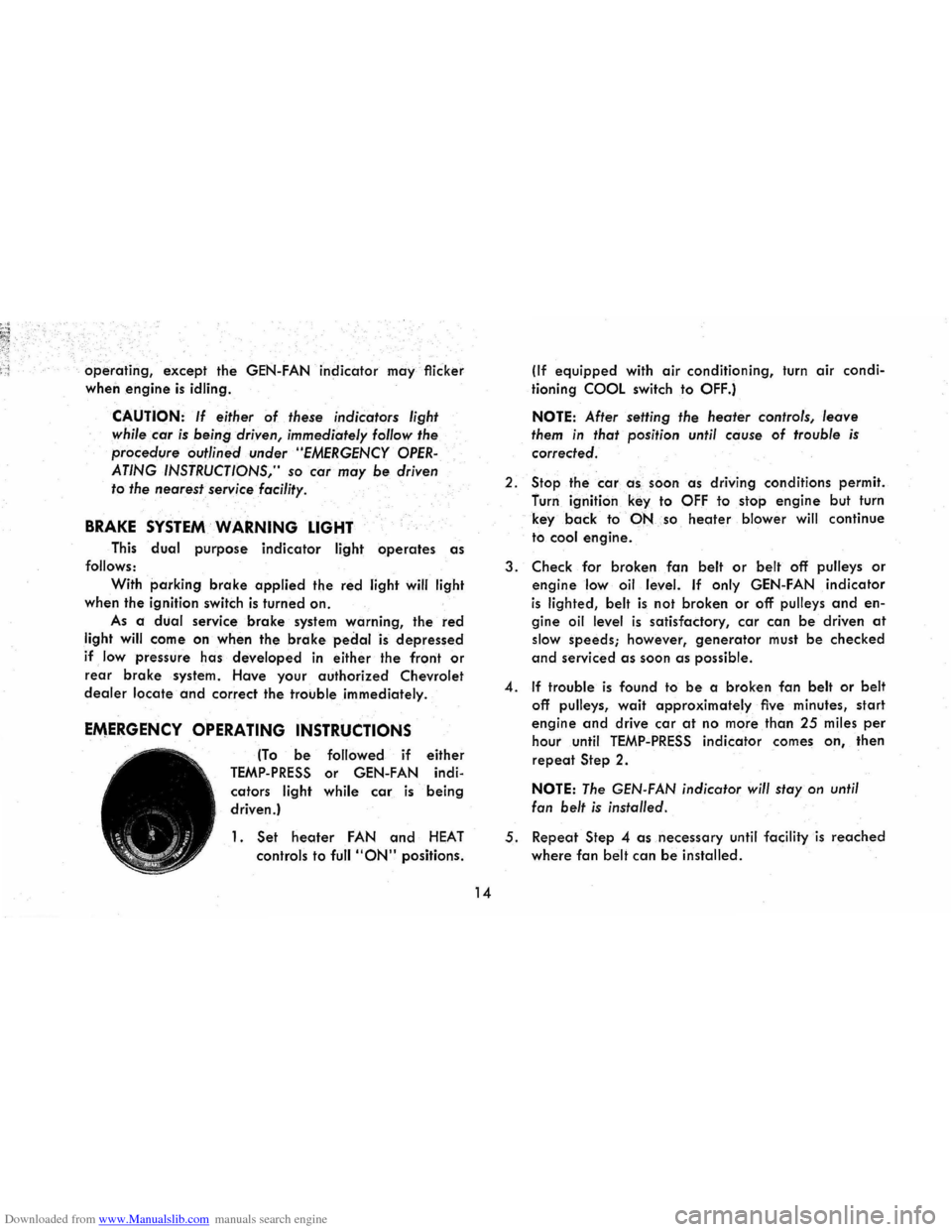
EMERGENCY OPERATING INSTRUCTIONS
(To be followed if either
TEMP-PRESS or GEN-FAN indi
cators
light while car is being
driven.)
1. Set heoter FAN and HEAT
controls to full "ON" positions.
14
(If equipped with air conditioning, turn air condi
tioning
COOL switch to OFF.)
NOTE: After setting the heater controls, leave
them in that position until cause of trouble is
corrected.
2.
Stop the car a -s , soon as driving conditions permit.
furn ignition
key to OFF to stop engine but turn
key
back to·-PNso heoter blower will continue
to
cool engine.
3. Check for broken fan belt or belt off pulleys or
engine low oil level. If only GEN-FAN indicator
is lighted, belt is not broken or off pulleys and en
gine oil level is satisfactory, car can be driven at
slow speeds; however, generator must be checked
and serviced as soon as possible.
4. If trouble is found to be a broken fan belt or belt
off pulleys, wait approximately five minutes, start
engine and drive car at no more than 25 miles per
hour until TEMP-PRESS indicator comes on, then
repeat Step 2.
NOTE: The GEN-FAN indicator will stay on until
fan
belt is installed.
5. Repeat Step 4 as necessary until facility is reached
where fan belt can be installed.
Page 20 of 56
Downloaded from www.Manualslib.com manuals search engine If the system is not functioning properly, a legal hand
signal should be given, since failure to indicate a turn
is considered a moving traffic violation in many states.
Always signal for a turn
at a reasonable distance before actu 'ally making it.
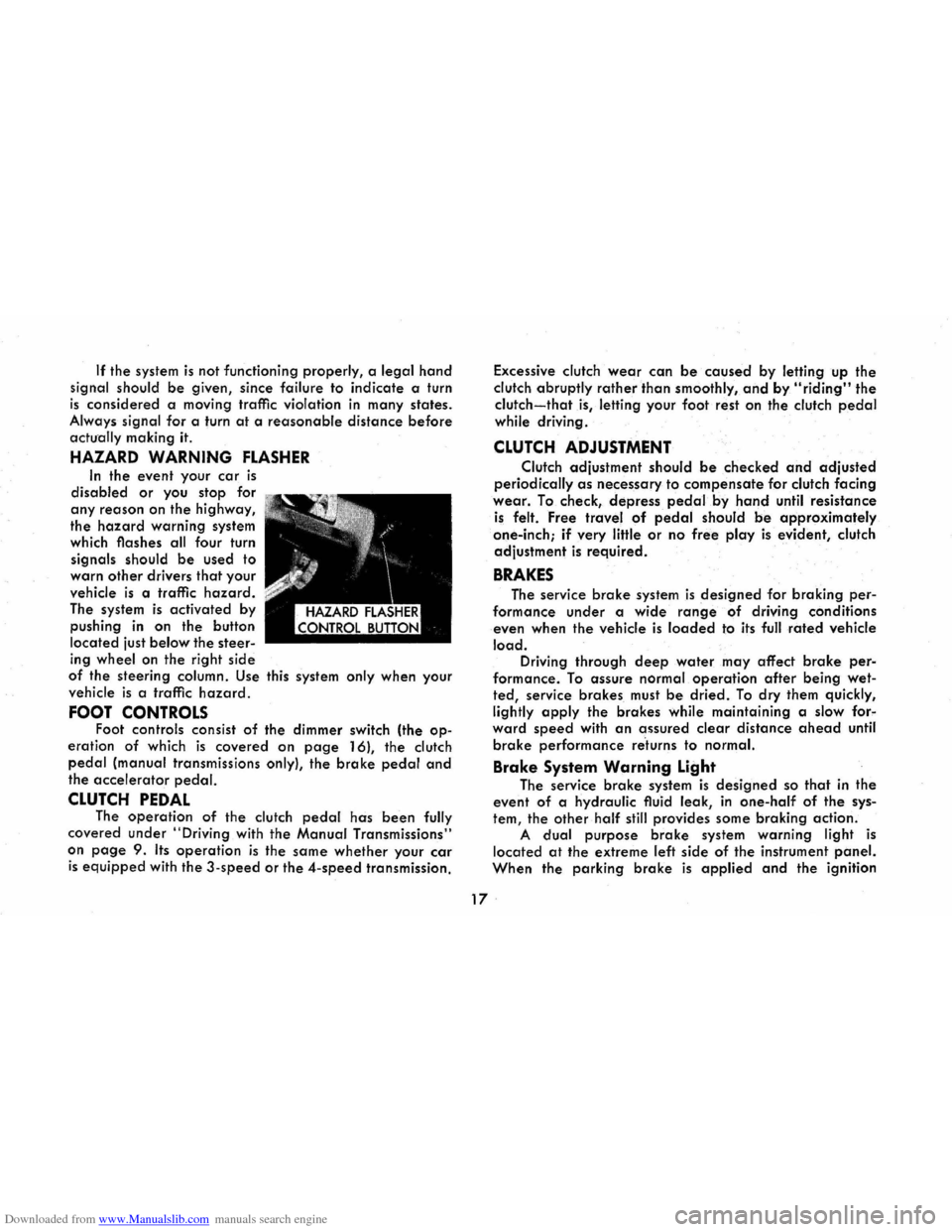
HAZARD WARNING FLASHER
In the event your car is
disabled or you stop for
any reason on the highway,
the
hazard warning system
which flashes all four turn
signals should
be used to
warn
other drivers that your
vehicle
is a traffic hazard.
The system is activated by
pushing
in on the button
located just
below the steer
ing wheel on the right side
of the steering column. Use this system only when your
vehicle
is a traffic hazard.
FOOT CONTROLS Foot controls consist of the dimmer switch (the op
eration of which is covered on page 16), the clutch
pedal (manual transmissions only), the brake pedal and
the accelerator pedal.
CLUTCH PEDAL The operation of the clutch pedal has been fully
covered under
"Driving with the Manual Transmissions"
on
page 9. Its operation is the same whether your car
is equipped with the 3-speed or the 4-speed transmission. Excessive
clutch
wear can be caused by letting up the
clutch abruptly
rather than smoothly, and by "riding" the
clutch-that is, letting your foot rest on the clutch pedal
while driving .
CLUTCH ADJUSTMENT
Clutch adjustment should be checked and adjusted
periodically as necessary to compensate for clutch facing
wear. To check, depress pedal.by hand until resistance
is felt. Free travel of pedal should be approximately
one-inch;
if very little or no free play is evident, clutch
adjustment
is required.
BRAKES
The service brake system is designed for braking per
formance under a wide range of driving conditions
even when the vehicle
is loaded to its full rated vehicle
load. Driving through deep water may affect brake per
formance. To assure normal operation after being wet
ted, service brakes must be dried. To dry them quickly,
lightly
apply the brakes while maintaining a slow for"
ward speed with an assured clear distance ahead until
brake performance re'turns to normal.
Brake System Warning Light
The service brake system is designed so that in the
event of a hydraulic fluid leak,
in one-half of the sys
tem, the other half still provides some braking action.
A dual purpose brake system warning light is
located at the extreme left side of the instrument panel.
When the parking brake is applied and the ignition
17 .
Page 36 of 56
Downloaded from www.Manualslib.com manuals search engine ENGINE OIL REQUIREMENTS
Engine Oil Recommendations
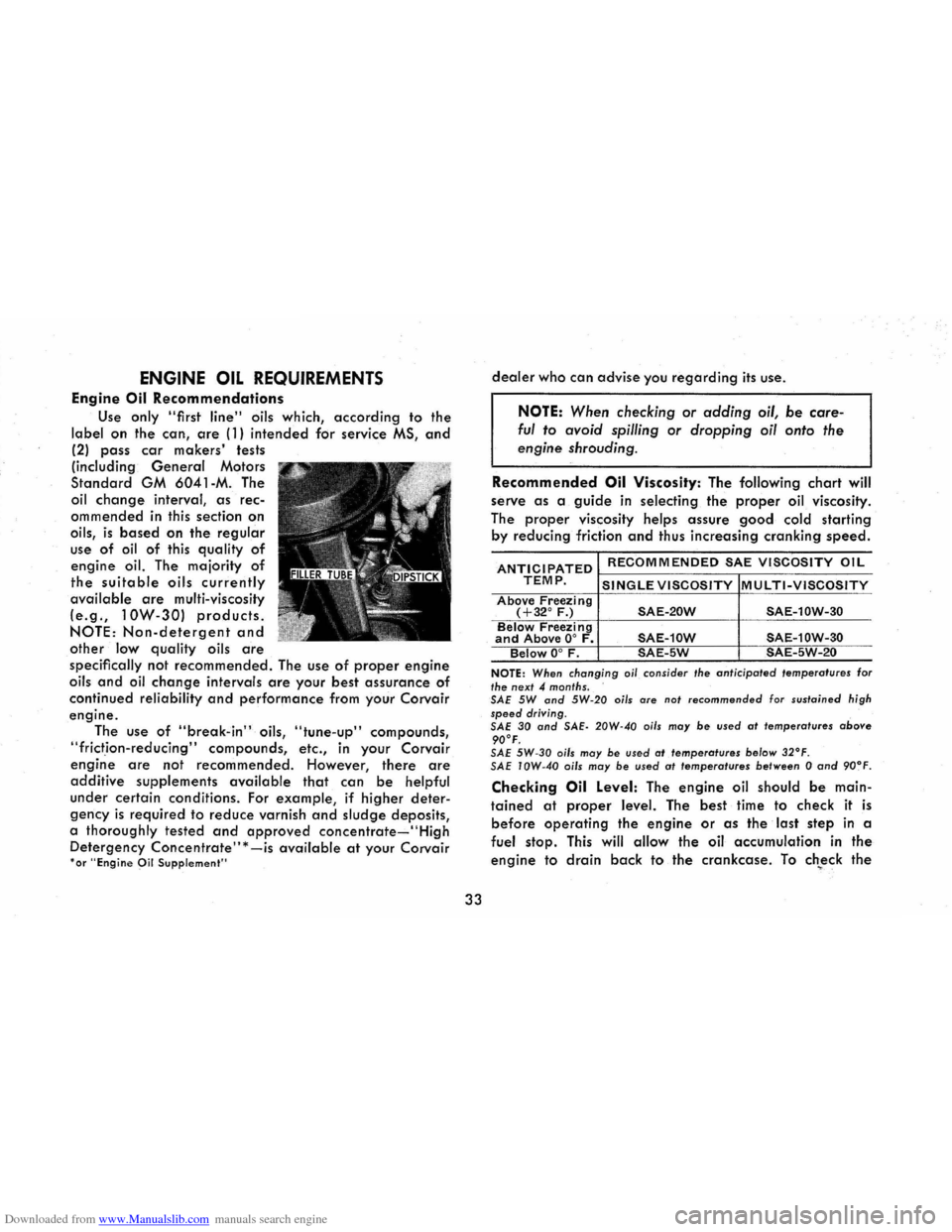
Use only "first line" oils which, according to the
label on the can, are (1) intended for service MS, and
(2) pass car makers' tests
(including
General Motors
Standard GM 6041-M. The
oil
change interval, as rec
ommended in this section on
oils,
is based on the regular
use of oil of this quality of
engine oil. The majority of
the suitable oils currently
available are multi-viscosity
(e.g., 10W-30) products.
NOTE: Non-detergent and
other low quality oils are
specifically not recommended. The use of proper engine
oils and oil change intervals are your best assurance of
continued reliability and performance from your Corvair
engine.
The use of "break-in" oils, "tune-up" compounds,
"frictIon-reducing" compounds, etc., in your Corvair
engine are not recommended. However, there are
additive supplements available that can be helpful
under certain conditIons. For example, if higher deter
gency is required to reduce varnish and sludge deposits,
a thoroughly tested
and approved concentrate-"High
Detergency Concentrate" * -is available at your Corvair 'or "Engine Oil Supplement"'
33
dealer who can advise you regarding its use.
NOTE: When checking or adding oil, be care
ful to avoid spilling or dropping oil onto the
engine shrouding .
Recommended Oil Viscosity: The following chart will
serve
as a guide in selecting the proper oil viscosity.
The
proper viscosity helps assure good cold starting
by reducing friction and thus increasing cranking speed.
ANTICIPATED RECOMMENDED SAE VISCOSITY OIL
TEMP. SINGLE VISCOSITY MULTI-VISCOSITY Above Freezing (+32° F.) SAE-20W SAE-10W-30 Below Freezing and Above 0° F. SAE-10W SAE-10W-30 Below 0° F. SAE-5W SAE-5W-20
NOTE: When changing oi/ consider the anticipoted temperatures for the next 4 months.
SAE 5W and 5W·20 oils are not recommended for sustained high speed driving.
SAE 30 and SAE· 20W-40 oils may be used at temperatures above 90°F. SAE 5W-30 oils may be used at temperatures be/ow 32°F . SAE IOW-40 oils may be used at temperatures between 0 and 90~F.
Checking Oil Level: The engine oil should be main
tained at proper level. The best time to check it is
before operating the engine or as the last step in a
fuel stop.
This will allow the oil accumulation in the
engine to drain back to the crankcase. To ch~eck the
Page 40 of 56
Downloaded from www.Manualslib.com manuals search engine PERIODIC MAINTENANCE AND LUBRICATION
The time or mileage intervals on the following pages
are intended as a general guide for establishing regular
maintenance and lubrication periods for your Corvair.
Sustained heavy duty or high speed operations or oper-
A WORD ABOUT VEHICLE EMISSIONS
All new 1968 Corvairs are certified by the United States Department of Health, Education and Welfare as
conforming to the requirements of the regulations for
the Control of Air Pollution from New Motor Vehicles
and New Motor Vehicle Engines.
General Motors has developed control systems which
are highly effective in reducing undesirable crankcase
and exhaust emissions. It is very important that the owner make certain that the engine is serviced regularly
in order to maintain its efficiency and to keep emissions
below maximum allowable limits.
The emission control system on
your 1968 Corvair is
relatively easy to maintain, requiring only specific serv
ices as recommended by Chevrolet. To function properly,
this system must be inspected periodically and engine
tune-up performed at specified intervals by qualified
repairmen. For ready reference, pertinent information regarding ignition timing and idle speed and fuel mix
ture specifications is shown on a sticker affixed under
the hood of your vehicle. Following the prescribed main-
37
ation under adverse conditions may necessitate more
frequent servicing. For specific recommendations for con
ditions under which you use your vehicle, consult your
authorized Chevrolet Dealer.
tenance services
will help assure cleaner air and will
provide better running, longer lasting engines for greater
all-around satisfaction, economy and performance.
POSITIVE CRANKCASE VENTILATION (P.C.V')
The Positive Crankcase Ventilation system, which is
standard equipment on your vehicle, prevents emission
of gases from the crankcase. The P .C.V. system connects
the crankcase and intake manifold of the engine and
crankcase gases are returned through this system to the
combustion
chamber where they are burned. Periodic
inspection
and required servicing of your P.C.V. system
assures a cleaner, better-performing, longer-lasting
engine. A plugged P.C.V. system results in a loss of
crankcase ventilation which can cause condensation of
blow-by gases in the crankcase, resulting in the forma
tion of acids, sludge build-up and oil dilution. This also
results in
an increase in exhaust emissions due to car
buretor enrichment. Every 12,000 miles or 12 months,
whichever occurs first, the PCV valve should be replaced.
Page 41 of 56
Downloaded from www.Manualslib.com manuals search engine Also, all hoses, fittings and the inlet air filter should be
inspected, cleaned and replciced if necessary.
NOTE: If the positive crankcase ventilator valve should
become
dogged, the engine idle will be adversely
affect~d. Therefore, if the engine idle becomes too slow
or rough, the ventilator valve should be checked before
any carburetor ad;ustments are made to compensate for
the trouble.
AIR INJECTION REACTOR (A.I.R.l
The Air
Injection Reactor system is designed to re
duce .air pollution caused by exhaust emissions. It is entirely separate from the Positive Crankcase Ventilating
system. The Air
Injection Reactor system operates by
oxidizing (or burning) the
hydrocarbons and carbon
monoxide as they are expelled from the combustion
chamber into the exhaust. A positive displacement air
pump, driven by the engine, compresses clean frltered
air, which
is distributed and injected at the exhaust part
of each cylinder. This fresh air mixes with the hot exhaust
gases and promotes further oxidation (or burning) of
both hydrocarbons and carbon monoxide by converting
some
of them to carbon dioxide and water. This does not
reduce the danger of inhaling carbon monoxide in con
frned areas. See page 7 for carbon monoxide warning.
Supplementing
the air pump a special carburetor and
distributor plus related components are required.
The Air
Injection Reactor system should have the A.I.R. pump filter serviced and the drive belt inspected
for
wear and tension every 12 months or 12,000 miles,
38
whichever occurs frrst. In addition, complete effectiveness
of the system, as well as full power and performance,
depends upon idle speed, ignition timing, and idle fuel
mixture being
set according to specifrcation. A quality
tune-up which includes
these adjustments should be per
formed periodically to assure normal engine efficiency,
operation and performance.
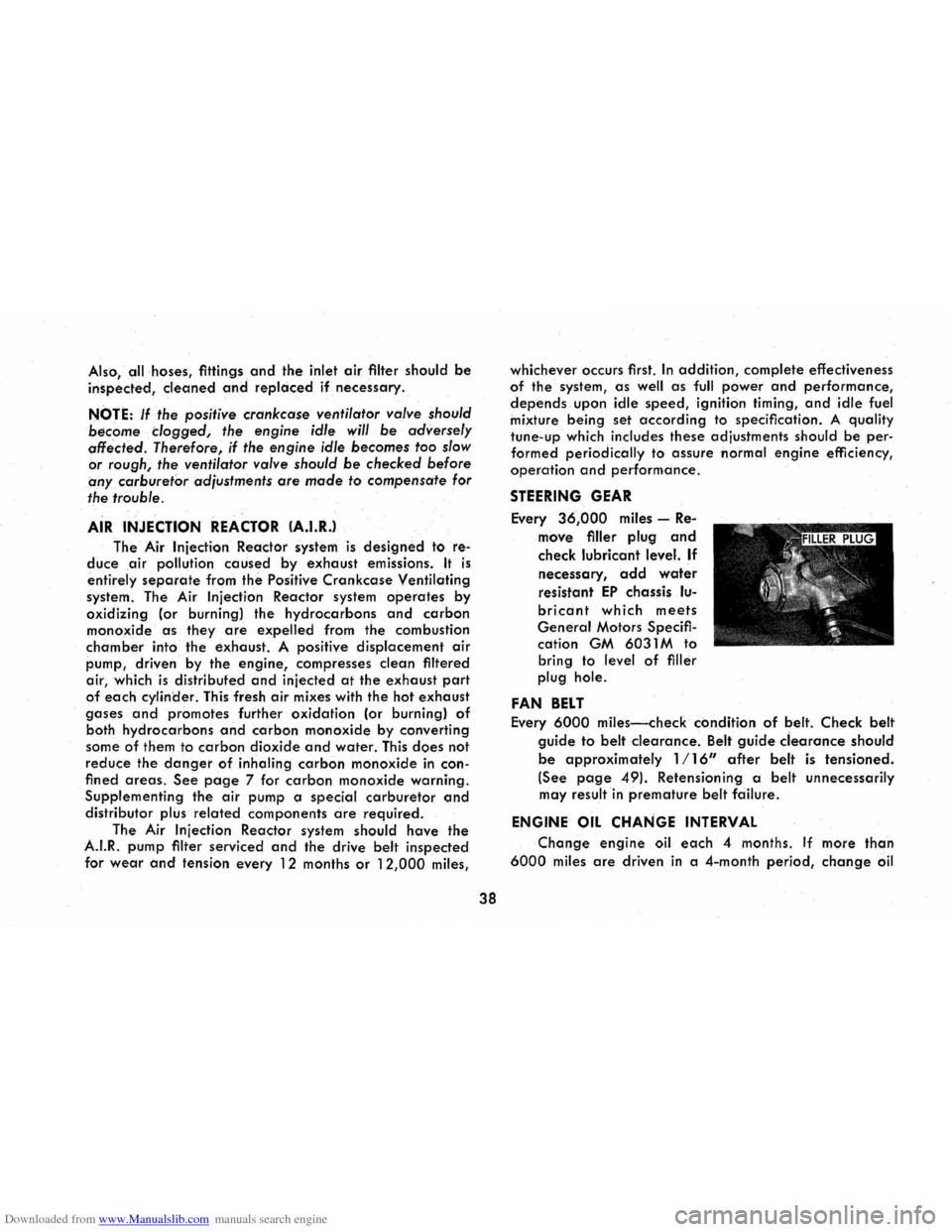
STEERING GEAR
Every 36,000 miles -Re
move frller plug and
check lubricant level. If
necessary, add water
resistant EP chassis lu
bricant which meets
General Motors Specifr
cation GM 6031 M to
bring to level
of frller
plug hole.
FAN BELT
Every 6000 miles-check condition of belt. Check belt
guide to belt clearance. Belt guide ciearance should
be approximately 1/16" after belt is tensioned.
(See page 49). Retensioning a belt unnecessarily
may result
in premature belt fciilure.
ENGINE OIL CHANGE INTERVAL
Change engine oil each 4 months. If more than
6000 miles are driven in a 4-month period, change oil