1986 CHEVROLET CORVAIR oil change
[x] Cancel search: oil changePage 10 of 56
Downloaded from www.Manualslib.com manuals search engine OPERATING INSTRUCTIONS
I
YOUR CORVAIR'S FIRST FEW HUNDRED MILES OF DRIVING
Sound design and precision manufacturing methods
will permit you to operate your new Corvair without
adhering to a formal "break-in" schedule. However,
during the first few hundred miles of driving you can,
by observing a few simple precautions, odd to the future
performance and economy of your cor.
It is recommended that your speed during the first
500 miles be confined to a maximum of 60 MPH, but
do not drive for extended periods at anyone constant
speed,
either fast or slow. During this period, ovoid full
throttle starts and unnecessary, quick abrupt stops .
Gentle braking during the first few hundred miles of
operation will result in longer broke life and better
future performance. Avoid unnecessary, hard stops espe
cially during the first 200 miles of operation since broke
misuse during this period will destroy much future broke
efficiency.
Always drive at a moderate speed until the engine
has completely warmed up.
DRIVING FOR ECONOMY
Proper maintenance and wise operation will com
bine to help you achieve maximum fuel economy with
your Corvair. Your Authorized Chevrolet Dealer can
properly tune and maintain your car but wise operation
is your responsibility. Give the cor sufficient warm-up
time, do not make "Full Throttle" storts or unnecessary
severe stops,
and drive at reasonable speeds and as
steady as traffic permits to gain the benefits of all the
economy built into your Corvair.
CAUTION: Avoid inhaling exhaust gases especially in an enclosed area such as a garage. Exhaust gases
contain
a percentage of carbon monoxide which is a potentially lethal gas that, by itself, is tasteless, color
less, and odorless. The exhaust system should be inspected for proper mounting, leaks and missing or damaged
parts each time the vehicle is raised for lubrication or oil change service.
7
Page 36 of 56
Downloaded from www.Manualslib.com manuals search engine ENGINE OIL REQUIREMENTS
Engine Oil Recommendations
Use only "first line" oils which, according to the
label on the can, are (1) intended for service MS, and
(2) pass car makers' tests
(including
General Motors
Standard GM 6041-M. The
oil
change interval, as rec
ommended in this section on
oils,
is based on the regular
use of oil of this quality of
engine oil. The majority of
the suitable oils currently
available are multi-viscosity
(e.g., 10W-30) products.
NOTE: Non-detergent and
other low quality oils are
specifically not recommended. The use of proper engine
oils and oil change intervals are your best assurance of
continued reliability and performance from your Corvair
engine.
The use of "break-in" oils, "tune-up" compounds,
"frictIon-reducing" compounds, etc., in your Corvair
engine are not recommended. However, there are
additive supplements available that can be helpful
under certain conditIons. For example, if higher deter
gency is required to reduce varnish and sludge deposits,
a thoroughly tested
and approved concentrate-"High
Detergency Concentrate" * -is available at your Corvair 'or "Engine Oil Supplement"'
33
dealer who can advise you regarding its use.
NOTE: When checking or adding oil, be care
ful to avoid spilling or dropping oil onto the
engine shrouding .
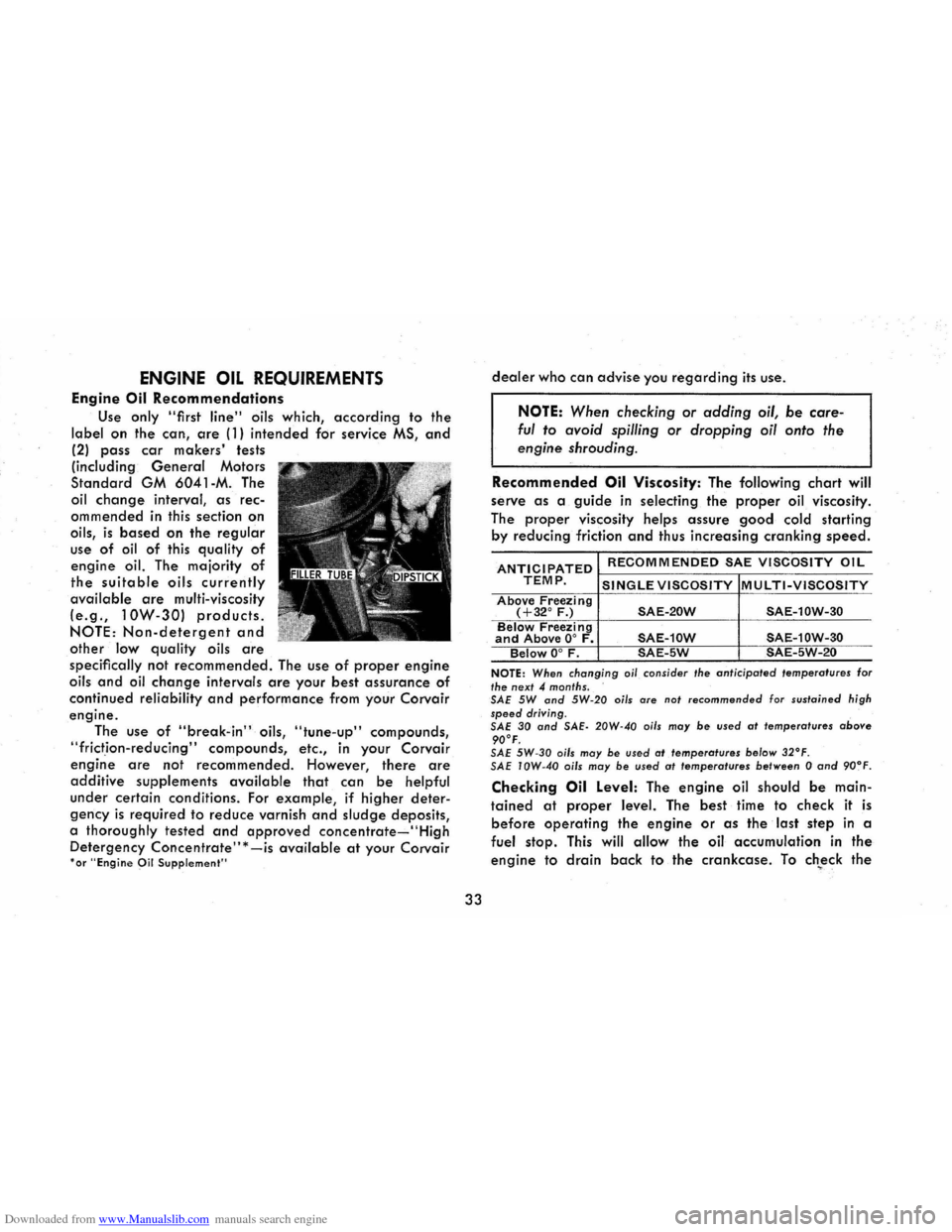
Recommended Oil Viscosity: The following chart will
serve
as a guide in selecting the proper oil viscosity.
The
proper viscosity helps assure good cold starting
by reducing friction and thus increasing cranking speed.
ANTICIPATED RECOMMENDED SAE VISCOSITY OIL
TEMP. SINGLE VISCOSITY MULTI-VISCOSITY Above Freezing (+32° F.) SAE-20W SAE-10W-30 Below Freezing and Above 0° F. SAE-10W SAE-10W-30 Below 0° F. SAE-5W SAE-5W-20
NOTE: When changing oi/ consider the anticipoted temperatures for the next 4 months.
SAE 5W and 5W·20 oils are not recommended for sustained high speed driving.
SAE 30 and SAE· 20W-40 oils may be used at temperatures above 90°F. SAE 5W-30 oils may be used at temperatures be/ow 32°F . SAE IOW-40 oils may be used at temperatures between 0 and 90~F.
Checking Oil Level: The engine oil should be main
tained at proper level. The best time to check it is
before operating the engine or as the last step in a
fuel stop.
This will allow the oil accumulation in the
engine to drain back to the crankcase. To ch~eck the
Page 41 of 56
Downloaded from www.Manualslib.com manuals search engine Also, all hoses, fittings and the inlet air filter should be
inspected, cleaned and replciced if necessary.
NOTE: If the positive crankcase ventilator valve should
become
dogged, the engine idle will be adversely
affect~d. Therefore, if the engine idle becomes too slow
or rough, the ventilator valve should be checked before
any carburetor ad;ustments are made to compensate for
the trouble.
AIR INJECTION REACTOR (A.I.R.l
The Air
Injection Reactor system is designed to re
duce .air pollution caused by exhaust emissions. It is entirely separate from the Positive Crankcase Ventilating
system. The Air
Injection Reactor system operates by
oxidizing (or burning) the
hydrocarbons and carbon
monoxide as they are expelled from the combustion
chamber into the exhaust. A positive displacement air
pump, driven by the engine, compresses clean frltered
air, which
is distributed and injected at the exhaust part
of each cylinder. This fresh air mixes with the hot exhaust
gases and promotes further oxidation (or burning) of
both hydrocarbons and carbon monoxide by converting
some
of them to carbon dioxide and water. This does not
reduce the danger of inhaling carbon monoxide in con
frned areas. See page 7 for carbon monoxide warning.
Supplementing
the air pump a special carburetor and
distributor plus related components are required.
The Air
Injection Reactor system should have the A.I.R. pump filter serviced and the drive belt inspected
for
wear and tension every 12 months or 12,000 miles,
38
whichever occurs frrst. In addition, complete effectiveness
of the system, as well as full power and performance,
depends upon idle speed, ignition timing, and idle fuel
mixture being
set according to specifrcation. A quality
tune-up which includes
these adjustments should be per
formed periodically to assure normal engine efficiency,
operation and performance.
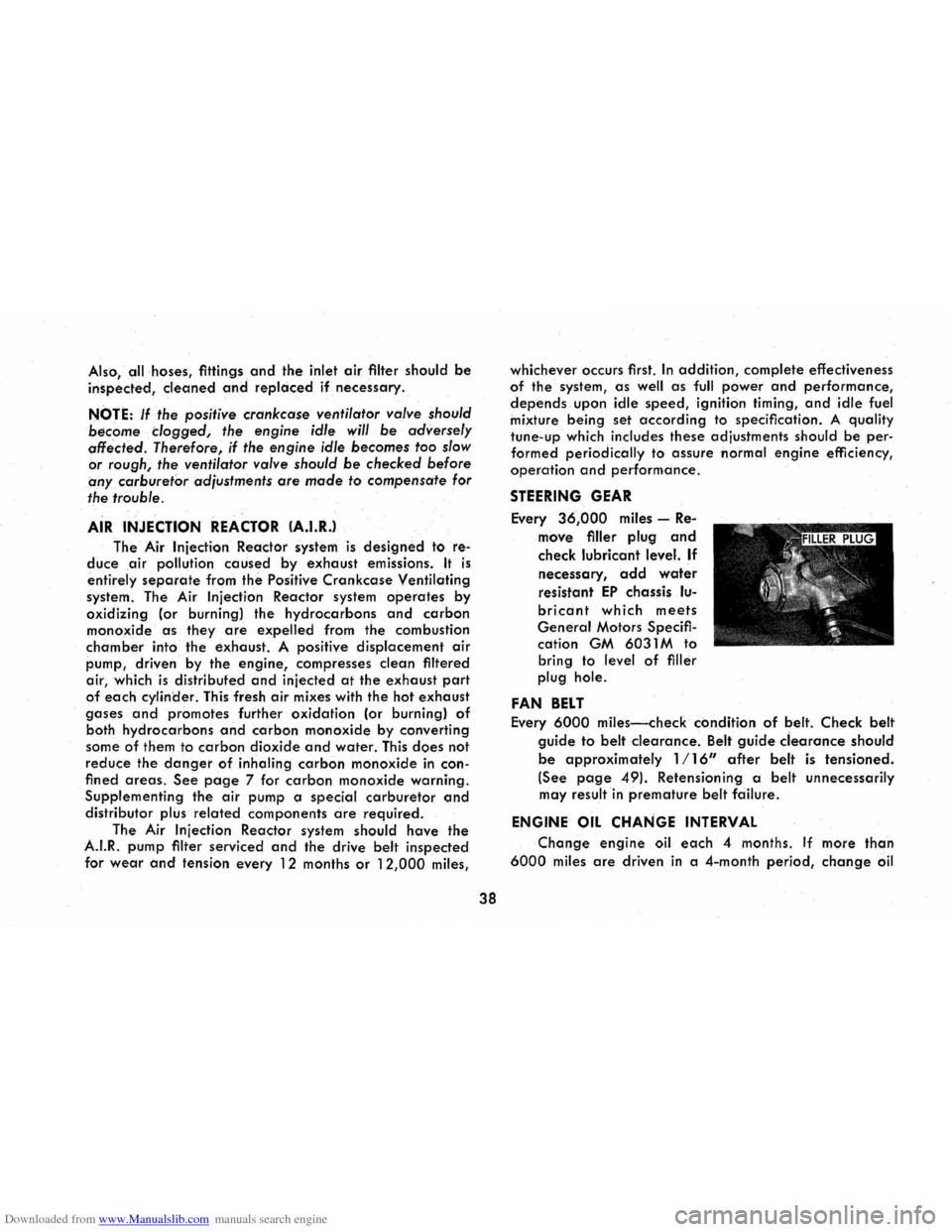
STEERING GEAR
Every 36,000 miles -Re
move frller plug and
check lubricant level. If
necessary, add water
resistant EP chassis lu
bricant which meets
General Motors Specifr
cation GM 6031 M to
bring to level
of frller
plug hole.
FAN BELT
Every 6000 miles-check condition of belt. Check belt
guide to belt clearance. Belt guide ciearance should
be approximately 1/16" after belt is tensioned.
(See page 49). Retensioning a belt unnecessarily
may result
in premature belt fciilure.
ENGINE OIL CHANGE INTERVAL
Change engine oil each 4 months. If more than
6000 miles are driven in a 4-month period, change oil
Page 42 of 56
Downloaded from www.Manualslib.com manuals search engine every 6000 miles. This interval applies to the initial
change as well as subsequent oil changes. The oil
change interval for your Corvair engine is based on the
use
of oils that meet the requirements indicated in the
section on
"Engine Oil Recommendations". Oil change
intervals longer than 4 months or 6,000 miles will result
in serious reductions in engine life and may effect Chev
rolet's
obligation under the provisions of the New Vehicle Warranty.
Certain atmospheric and/or driving conditions includ
ing
prolonged operations at sub-zero temperatures or
under extremely dusty conditions, frequent trailer haul
ing, and extensive idling necessitate more frequent oil
and filter changes. * Operation in dust storms may require
an immediate change of both oil and filter. See your
Chevrolet dealer for advice on frequency of oil and
filter changes because of unusual driving conditions.
A high
quality MS oil meeting General Motors
Standard GM 6041-M was installed in your engine at
the factory. It is not necessary to change this factory
installed oil
prior to the recommended normal change
period. However, the oil level should be checked more
frequently during
the break-in period since somewhat
higher oil consumption is normal until the piston rings
become seated.
*In many such situations, oil change intervals should not exceed 2
months, or 3000 miles, whichever occurs first, and similarly, filter changes should not exceed 4 months or 6000 miles, whichever comes
first.
39
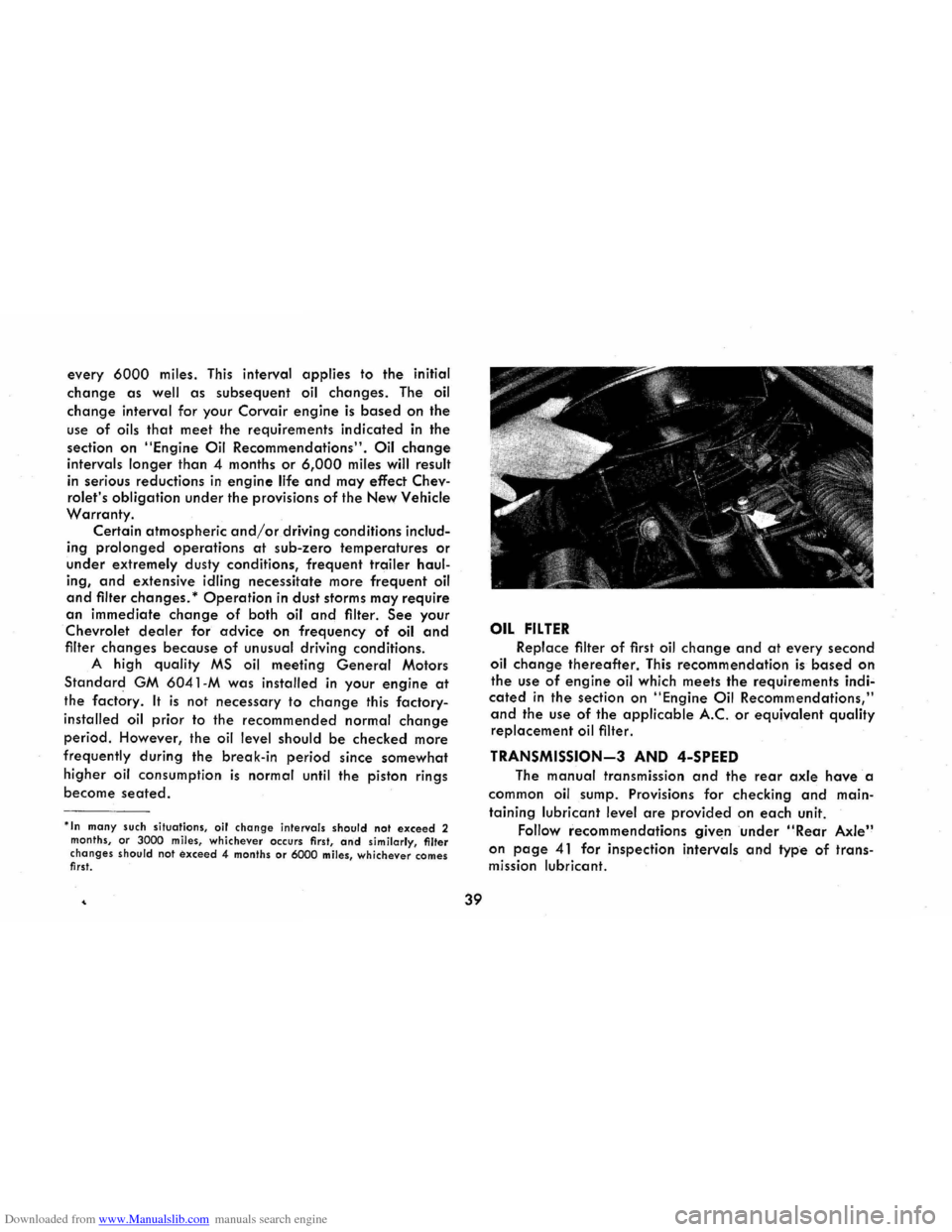
OIL FILTER
Replace filter of first oil change and at every second
oil change thereafter. This recommendation is based on
the use of engine oil which meets the requirements indi
cated in the section on "Engine Oil Recommendations,"
and the use of the applicable AC. or equivalent quality replacement oil filter.
TRANSMISSION-3 AND 4-SPEED
The manual transmission and the rear axle have' a
common
oil sump. Provisions for checking and main
taining lubricant level are provided on each unit.
Follow recommendations given
under "Rear Axle"
on page 41 for inspection intervals and type of trans
mission lubricant.
Page 47 of 56
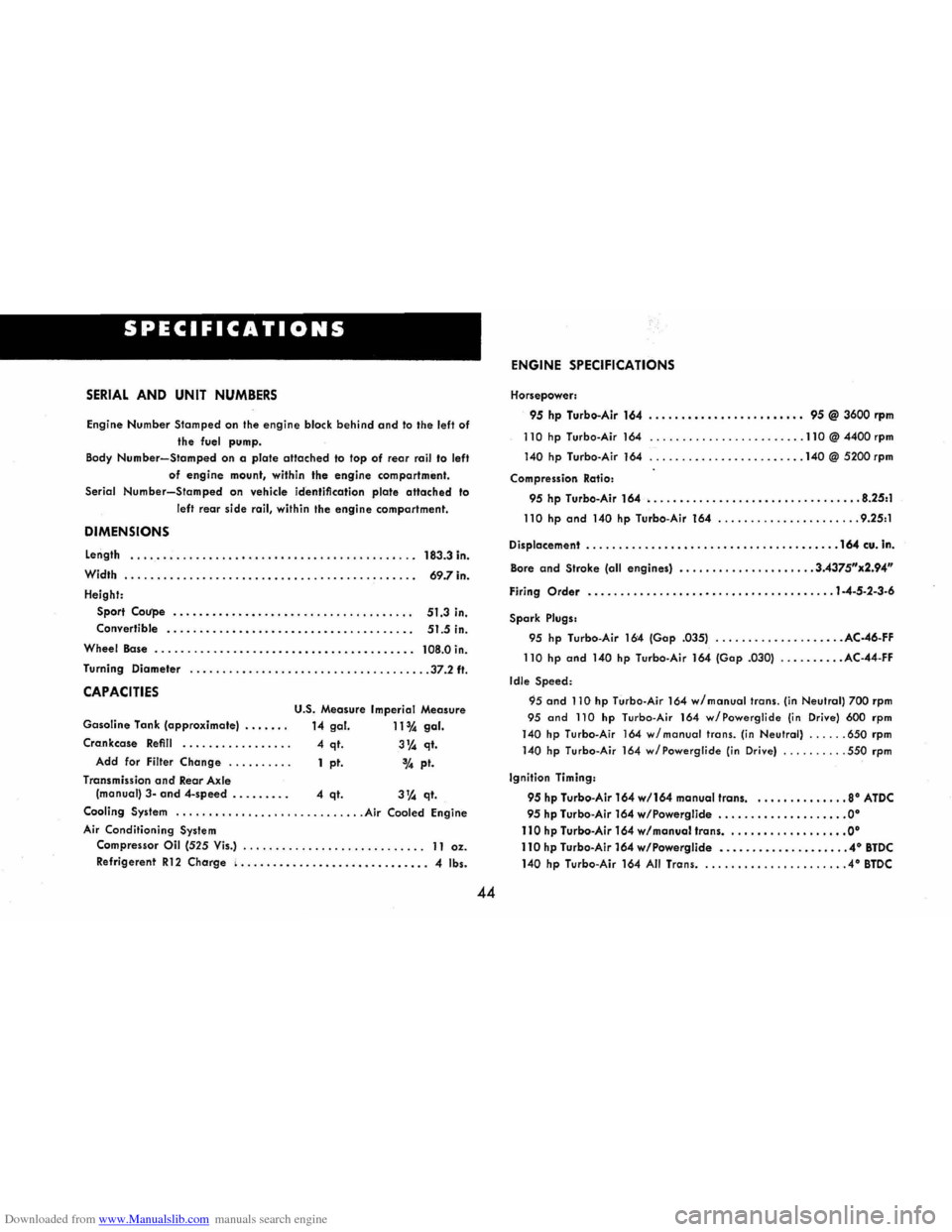
Downloaded from www.Manualslib.com manuals search engine SPECIFICATIONS
SERIAL AND UNIT NUMBERS
Engine Number Stamped on the engine block behind and to the left of
the fuel pump.
Body
Number-Stamped on a plate attached to top of rear rail to left
of engine mount, within the engine compartment .
Serial
Number-Stamped on vehicle identification plate attached to
left
rear side rail, within the engine compartment.
DIMENSIONS
Length .•...............•.•.•..................•... 183.3 in.
Width
.......•....•. . ....•..••......•.............• 69.7 in.
Height: Sport
Coupe ......•...••• ..•..••............•..•• 51.3 in.
Convertible
..........•.....••..•...•............. 51.5 in.
Wheel Base
...................•..•...•.... , ........ 108.0 in.
Turning Diameter .
.•..........•............... ........ 37.2 ft.
CAPACITIES
U.S. Measure Imperial Measure
Gasoline Tank (approximate) ...... .
14 gal. 11 % gal.
Crankcase Refill •....•..... ...... 4 qt. 3~ qt.
Add for Filter Change ......... . 1 pt. 3,4 pt.
Transmission
and Rear Axle
(manual) 3-and 4-speed ........ . 4 qt. 3~ qt.
Cooling System .....••...................... Air Cooled Engine
Air Conditioning System
Compressor Oil (525 Vis.) ...•............. ......... " 11 oz.
Refrigerent
R12 Charge ( •......•................•.... 4 Ibs.
44
ENGINE SPECIFICATIONS
Horsepower:
95 hp Turbo-Air 164 ......••.•.•........•.•• 95 @ 3600 rpm
110 hp Turbo-Air 164 ........................ 110 @ 4400 rpm
140 hp Turbo -Air 164 ........................ 140 @ 5200 rpm
Compression Ratio:
95 hp Turbo-Air 164 •...•........•.•.••••.•...••.•••. 8.25:1
110 hp and 140 hp Turbo-Air 164 ...................... 9.25:1
Displacement
......•....••••••..••••••...•..•.••\
•.•• 164 cu. In.
Bore and Stroke (all engines) ................. .... 3.4375"x2.94"
Firing Order •.........•..•••••••..•.•.••.•\
..••..•. 1-4-5-2-3·6
Spark Plugs.
95 hp Turbo-Air 164 (Gop .035)
.................... AC-46-FF
110
hp and 140 hp Turbo-Air 164 (Gop .030) .......... AC- 44-FF
Idle
Speed:
95 and 110 hp Turbo-Air 164 wi manual trans. (in Neutral) 700 rpm
95
and 110 hp Turbo-Air 164 w/Powerglide (in Drive) 600 rpm
140 hp Turbo-Air 164 wi manual trans. (in Neutral) ...... 650 rpm
140 hp Turbo-Air 164 w/Powerglide (in Drive) .......... 550 rpm
Ignition Timing:
95 hp Turbo-Air 164 wl164 manual trans •..•...•.•••.•. 8· ATDC
95 hp Turbo-Air 164 w/Powerglide ••.•..•••.••••..•••• 0·
110 hp Turbo-Air 164 wi manual Irons •....•..•..••....•. 0·
110 hp Turbo-Air 164 w/Powerglide •.••..•••.•..•••••.. 4· BTDC
140 hp Turbo-Air 164 All Trans ....................... 4° BTDC
Page 55 of 56
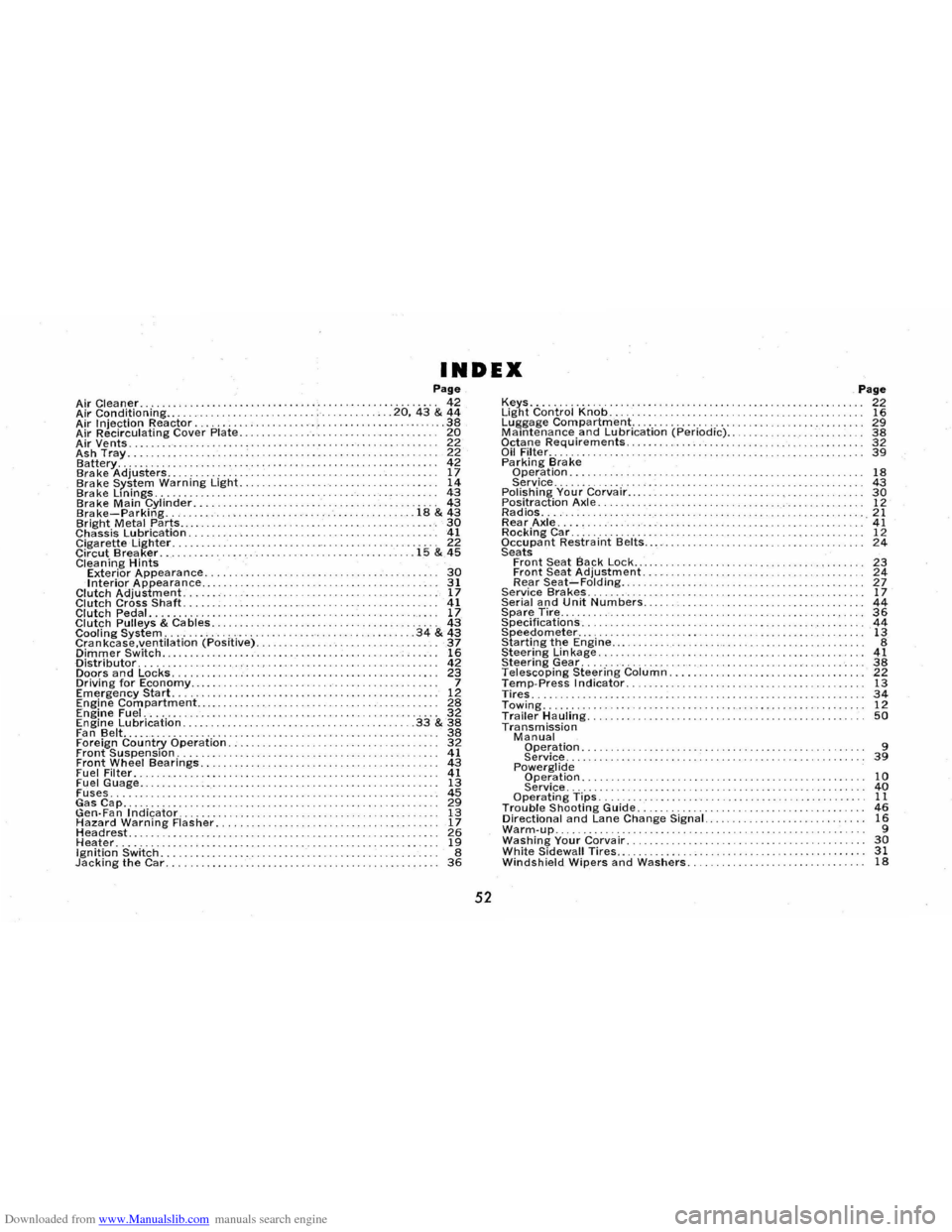
Downloaded from www.Manualslib.com manuals search engine INDEX Page Air Cleaner. . . . . . . . . .. , .. . . . . . . .. . . . . . . . . . . .......... 42 Air Conditioning.. ............ ... .... .• . . .20,43 & 44 Air Injection Reactor......... ........... . ... ... 38 Air Recirculating Cover Plate. . . . . . . . . . . .• . . . . .. . . . .. . . 20 Air Vents. . . . . . . . . . . . . . . . . . . . . . . 22 Ash Tray. ........ .. ... 22 Battery........... ............ ....•...•................. 42 Brake Adjusters...................... .. .. ... ............. 17 Brake System Warning Light. . ................. 14 Brake Lmings. . ....... ....... ........ ............... 43 Brake Main Cylinder.. ........... . ...... 43 Brake-Parking. . ............ .......... . .. 18 & 43 Bright Metal Parts..... .. ..................... '. 30 Chassis Lubrication. . . . . . . . . . . . . . 41 Cigarette Lighter. . . .. .... ... .. . . . .. .. " 22 Circut Brea ker. . . . . . ................. .. .............. 15 & 45 Cleaning Hints Exterior Appearance........ .... .... . ............ . 30 Interior Appearance.. ............... . ............. ........ 31 Clutch Adjustment......... 17 Clutch Cross Shaft. . . .. . . . . . . . ... .. . . 41 Clutch Pedal.. .. . .. .. .. .. . . .. .. . .. .. . 17 Clutch Pulleys & Cables..................... . 43 Cooling System. . . . . . . . . . . . . . . . . . ........ ....... 34 & 43 Crankcase.ventilation (Positive). 37 Dimmer Switch... .......... ..... 16 Distributor. . . . . . . 42 Doors and Locks. .. ..... .................. .• ................. 23 Driving for Economy..... ...... ...... 7 Emergency Start. . . . . . . . . . . . . . . . . . 12 Engine Compartment.... . . . . . . . . . . . . . . . . . . . .. .. . . 28 Engine Fuel. . . . . . . . . . . . . . . . . . . . . . . . . . . . . . . . . . . . . . . . . .. 32 Engine Lubrication. . . . . . . . . .. . . . .• . . . . . . . • . . . . . . .33& 38 Fan Belt........ .... ..................... ..... 38 Foreign Country Operation. .................. 32 Front Suspension. . . . . . . . . . . . . . ... . . . . . . . . . . . . . . . . . . . . . 41 Front Wheel Bearings.. . ............. .......... . 43 Fuel Filter. . . . . . . . . . . . . . . •. . . . . . . . . .. . . . . 41 Fuel Guage.. ............ 13 Fuses.. .. .. ... ...................... ..... 45 ~s~p.......... ~ Gen·Fan .Indicator........ 13 Hazard Warning Flasher. . 17 Headrest...... . . ....... ... .. ........ 26 Heater............................... ..... .. .......... 19 Ignition Switch. . . . . . . . . . . . . . . . . .. . . . . . . . . . . . . 8 Jacking the Car. . . . .. . . . . . . . . . . .. . . . . . . . . . . . . . . . . . . . . . . . . . . . . . .. 36
52
Keys............... . ......... .............. . Light Control Knob ...................... . . Luggage Compartment ................... . Maintenance and Lubrication (Periodic) .. Octane Requirements. . . . . ......... . Oil Filter .... ............ . Pa rking Bra ke Operation . ..................... . Service .......... ...... . Polishing Your Corvair... . . ... . . . . . .. . .........•. .... ........ Positraction Axle. . . ... ............... .. ...... .. .. .... . Radios. . . . .... . ........... . Rear Axle.... . . ...................................... . . Rocking Car .............. . Occupant Restraint Belts .. . . Seats Front Seat Back Lock ....... .•...... Front Seat Adjustment. Rear Seat-Folding ... Service Bra kes. . . . . . . . . .. . ......................... ... . Serial and Unit Numbers .......... .. . Spare Tire..... . .• ......... .................•.•. Specifications. . . . ................... ... .. .• ........ Speedometer ... .. ............... . Starting the Engine .... . Steering Lin kage ...... . Steering Gear ............... . Telescoping Steering Column. Temp·Press Indicator. Tires. Towing ..... Trailer Hauling. Transmission Manual Operation. ................ . ....... .. .... . Service ................... .. .. ...... .. . Powerglide Operation. Service ...... . Operating Tips ....... . Trouble Shooting Guide.......... . .............. ... . Directional and Lane Change Signal. . ....• ...•.... Warm·up... ............ . ....... .. ........... ... . Washing Your Corvair. . . ........ . White Sidewall Tires.. . . . . . . . . . . . . . . ......... .. . Windshield Wipers and Washers. . . .. .. .. .. .
Page 22 16 29 38 32 39
18 43 30 12 21 41 12 24
23 24 27 17 44 36 44 13 8 41 38 22 13 34 12 50
9 39
10 40 11 46 16 9 30 31 18